Japan Telemedicine and Surgical Simulation Market Size & Growth Rate
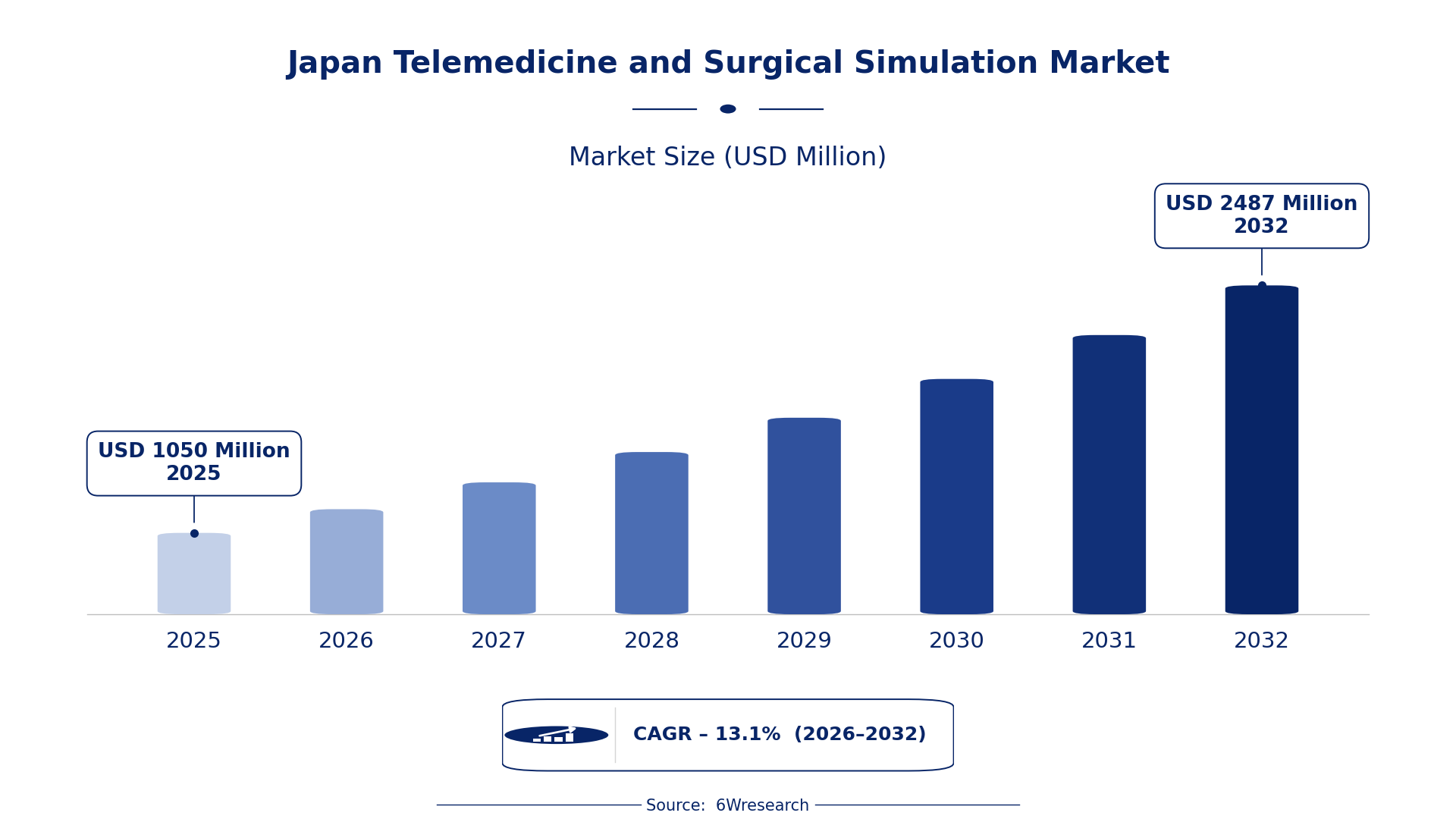
According to 6Wresearch internal database and industry insights, the Japan Telemedicine and Surgical Simulation Market was valued at USD 1,050 Million in 2025 and is projected to reach USD 2,487 Million by 2032, growing at a CAGR of approximately 13.1% during 2026–2032.
Japan Telemedicine and Surgical Simulation Market Highlights
| Report Metric | Details |
| Report Name | Japan Telemedicine and Surgical Simulation Market (2026-2032) |
| Market Size 2025 | USD 1,050 Million |
| Market Size 2032 | USD 2,487 Million |
| Absolute Growth 2025–2032 | USD 1,437 Million |
| CAGR 2026–2032 | 13.1% |
| Peak Annual Growth | 14.5% in 2032 |
| Forecast Period | 2026–2032 |
| Historical Data | 2022–2025 |
| Base Year | 2025 |
| Leading Application Type, 2025 | Remote Surgery Guidance (43% share) |
| Leading Simulation Mode, 2025 | VR-Based Training (47% share) |
| Leading Platform Type, 2025 | Desktop/AR Headset (41% share) |
| Leading End User, 2025 | Surgical Institutions (34% share) |
| Fastest-Growing Application Type | Preoperative Planning (17.5% CAGR) |
| Fastest-Growing Simulation Mode | Haptic Feedback (18.2% CAGR) |
| Fastest-Growing Platform Type | Simulated Models (19.3% CAGR) |
| Fastest-Growing End User | Medical Schools (16.9% CAGR) |
| Growing Sector | Healthcare Services |
| Key End Users | Surgical Institutions, Medical Schools, Tertiary Hospitals, Research Centers |
Japan Telemedicine and Surgical Simulation Market Year-wise Growth Rate and Key Drivers (2022–2032)
This graph illustrates the annual growth rates of the market from 2022 to 2032, highlighting a steady upward trajectory and projected market expansion over the forecast period.
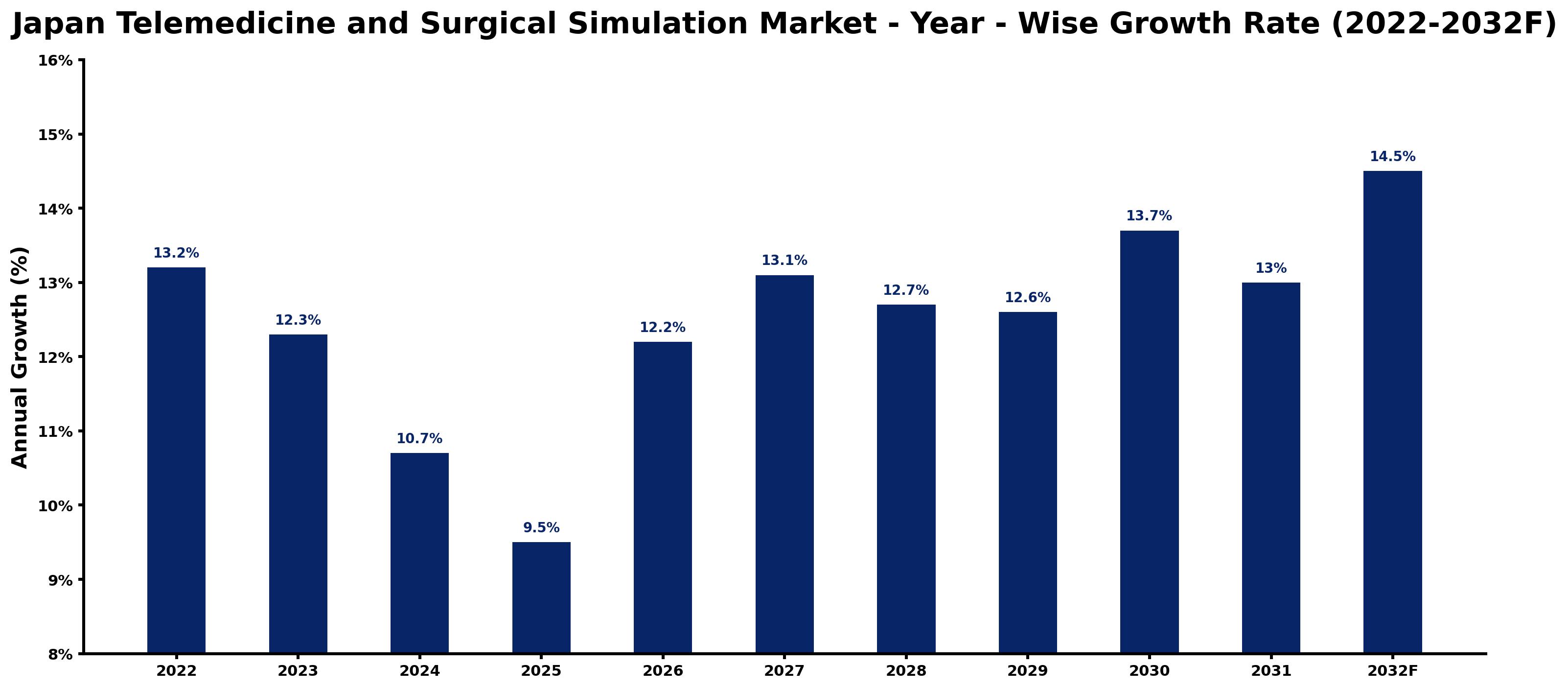
Below, each year's estimated growth is shown next to the factor that most influenced it.
| Year | Estimated Annual Growth (%) | Market Rationale |
| 2022 | 13.2 | The market experienced strong growth due to increased telemedicine adoption among healthcare providers. |
| 2023 | 12.3 | Growth slowed as institutions addressed initial telemedicine integration challenges. |
| 2024 | 10.7 | Market expansion continued, driven by the rising elderly population seeking remote consultations. |
| 2025 | 9.5 | Growth slowed further as the market stabilised after rapid initial adoption phases. |
| 2026 | 12.2 | Demand is expected to increase as healthcare facilities invest in advanced telemedicine technologies. |
| 2027 | 13.1 | The market will accelerate due to improved training programs in medical schools incorporating telemedicine. |
| 2028 | 12.7 | Growth is projected to slow slightly as the market adjusts to new technology implementations. |
| 2029 | 12.6 | Demand will remain steady, supported by ongoing investments in telemedicine infrastructure. |
| 2030 | 13.7 | The market is expected to grow faster as hospitals expand their telemedicine services for patient care. |
| 2031 | 13.0 | Growth will slow as the market matures and competition intensifies among providers. |
| 2032 | 14.5 | The market is projected to peak due to advancements in telemedicine technology and training. |
Note: Market size estimations and growth projections presented in this report are based on 6Wresearch's proprietary forecasting methodology, utilizing the latest available industry data, government publications, and primary research inputs.
Japan Telemedicine and Surgical Simulation Market Synopsis
Telemedicine and Surgical Simulation in Japan utilises advanced technology to enable remote medical consultations and surgical training, improving surgical precision and medical education. The market is expanding due to a growing elderly population, with 29.3% aged 65 or older, and strong backing from healthcare providers and educational institutions. Investment in telemedicine infrastructure is rising, driven by government initiatives like the Clinical Trials Act and the Next-Generation Medical Infrastructure Act, which promote innovation in healthcare practices.
Market Dynamics Impact Analysis (2026–2032)
| Factor | Type | Impact | Primary Segment Affected |
| Increasing elderly population drives demand for remote consultations. | Driver | High | Clinical Teleconsultation |
| Growing adoption of VR-based training enhances surgical education. | Driver | High | VR-Based Training |
| Expansion of telemedicine services in rural areas presents new opportunities. | Opportunity | High | Remote Surgery Guidance |
| Investment in telemedicine technology development is accelerating growth. | Opportunity | High | Preoperative Planning |
| High costs of implementing telemedicine solutions can limit adoption. | Restraint | Medium | Surgical Institutions |
| Compliance with regulatory standards can slow down technology integration. | Restraint | Medium | Medical Schools |
| Limited infrastructure in some regions poses challenges for telemedicine expansion. | Challenge | High | Tertiary Hospitals |
| Resistance to change among healthcare professionals can hinder adoption. | Challenge | Medium | Research Centers |
Evaluation of Drivers in Japan Telemedicine and Surgical Simulation Market (2026–2032)
Key forces behind demand, with the segment each one moves most, are listed below.
| Drivers | Primary Segment Affected | Why It Matters (Evidence) |
| Increased healthcare spending supports telemedicine adoption. | Clinical Teleconsultation | Japan's national medical care expenditure was about JPY 46.7 trillion in fiscal 2022, prompting healthcare providers to invest in telemedicine. |
| Growing elderly demographic boosts demand for remote consultations. | Remote Surgery Guidance | With 29.3% of the population aged 65 or older, healthcare providers are increasingly offering telemedicine services. |
| Integration of telemedicine in medical education improves training. | VR-Based Training | Over 70% of medical schools in Japan have integrated telemedicine into their curricula, enhancing training outcomes. |
| Technological advancements in simulation improve surgical training. | Haptic Feedback | VR-based training programs implemented in over 50 medical institutions improve the quality of surgical education. |
| Government support for telemedicine initiatives drives market growth. | Preoperative Planning | The Clinical Trials Act encourages healthcare facilities to adopt telemedicine solutions. |
Spending rises because Japan's national medical care expenditure reached about JPY 46.7 trillion in fiscal 2022, prompting healthcare providers to invest in telemedicine solutions. The elderly population, projected to reach 36 million by 2040, increases demand for remote consultations, leading hospitals to expand telemedicine services. More than 70% of medical schools have integrated telemedicine into their curricula, enhancing training for future healthcare professionals.
Evaluation of Restraints in Japan Telemedicine and Surgical Simulation Market
The main factors holding the market back are set out below.
| Market Restraint | Primary Segment Affected | Why It Matters (Evidence) |
| High implementation costs limit telemedicine adoption among smaller facilities. | Surgical Institutions | Many surgical institutions face budget constraints, making it difficult to invest in telemedicine infrastructure. |
| Compliance with regulatory standards can delay technology integration. | Medical Schools | Medical schools must adhere to strict regulations, slowing down the adoption of new telemedicine technologies. |
| Limited internet access in rural areas restricts telemedicine usage. | Tertiary Hospitals | Tertiary hospitals in remote regions struggle with connectivity issues, hindering telemedicine implementation. |
| Resistance to adopting new technologies among healthcare professionals can impede progress. | Research Centers | Some research centers face pushback from staff reluctant to change established practices. |
| Concerns over data privacy and security can deter telemedicine adoption. | Clinical Teleconsultation | Healthcare providers worry about safeguarding patient information, slowing the uptake of telemedicine solutions. |
Japan Telemedicine and Surgical Simulation Market Challenges
Strict regulations slow telemedicine growth, as compliance with standards like ISO 13485 can take over a year, delaying service availability for hospitals. Many healthcare providers struggle with technology integration, resulting in a 30% underutilisation of existing telemedicine solutions. High costs hinder widespread adoption; telemedicine technology development requires substantial investment, with ¥5 billion allocated in 2023, straining budgets for clinics. Supply chain issues arise from reliance on imported advanced technologies, causing implementation delays that can extend project timelines by up to six months for producers.
Trends in the Japan Telemedicine and Surgical Simulation Market
These developments are changing demand patterns in the Japan Telemedicine and Surgical Simulation Market.
- Growing Adoption of Remote Patient Monitoring: Healthcare providers are increasingly adopting remote patient monitoring solutions, particularly in urban areas like Tokyo, where telemedicine adoption is high. In 2023, Japan had over 8,100 hospitals, many of which are integrating these solutions.
- Shift Towards VR-Based Training: Since 2022, medical schools have shifted from traditional training methods to VR-based training programs. This change is reflected in over 50 institutions implementing immersive training environments for surgical education.
- Rise of AI-Enabled Surgical Simulations: AI-enabled modules are becoming prevalent in surgical simulations across Japan, with a notable increase in usage in 2023. This trend is improving training outcomes and decision-making processes for medical professionals.
- Integration of Telemedicine in Medical Curricula: In 2023, more than 70% of medical schools integrated telemedicine into their curricula, reflecting a shift towards modern training methods that prepare future healthcare professionals for remote consultations.
Investment Opportunities in the Japan Telemedicine and Surgical Simulation Market
The openings below show where demand in the Japan Telemedicine and Surgical Simulation Market is visible and how suppliers can enter.
- Increasing Demand for Remote Consultations: With 29.3% of Japan's population aged 65 or older, there is a pressing need for remote consultations. Healthcare providers can invest in telemedicine solutions to meet this demand, particularly in urban areas like Tokyo.
- Government Investment in Telemedicine Technology Development: The Japanese government allocated ¥5 billion for telemedicine technology development in 2023. This funding presents opportunities for healthcare providers to improve their telemedicine capabilities and patient care.
- Expansion of Telemedicine Services in Rural Areas: As telemedicine adoption increases, rural healthcare facilities can benefit from improved access to care. Investing in telemedicine solutions can help meet the needs of underserved populations in these regions.
- Advancing Surgical Training with VR Technology: The implementation of VR-based training programs in over 50 medical institutions highlights the opportunity for suppliers to provide advanced training solutions to surgical institutions looking to improve education.
Government Initiatives in the Japan Telemedicine and Surgical Simulation Market
The Medical Care Act, established in 1948, sets the foundational standards for hospitals and clinics in Japan, including staffing and facilities. This law has been pivotal in shaping the healthcare environment, ensuring that medical institutions adhere to necessary guidelines. More recently, the Clinical Trials Act, enacted in 2017, introduced rules for conducting and disclosing clinical research, enhancing transparency and safety in telemedicine practices. The Next-Generation Medical Infrastructure Act, also from 2017, allows certified bodies to anonymise medical data, promoting innovation and development in telemedicine technologies.
Healthcare providers benefit from the funding initiatives of the Japan Agency for Medical Research and Development (AMED), which supports telemedicine technology development with allocations such as the ¥5 billion designated in 2023. The Pharmaceuticals and Medical Devices Agency (PMDA) plays a crucial role in reviewing telemedicine products, ensuring compliance with safety standards. These measures facilitate the integration of advanced telemedicine solutions in over 1,200 tertiary hospitals, improving service delivery and patient access across the country.
Future Insight of the Japan Telemedicine and Surgical Simulation Market
Investment in telemedicine infrastructure will increase significantly by 2025, driven by the 'Health and Medical Strategy', creating demand for advanced surgical simulation technologies. By 2032, over 1,200 hospitals are expected to adopt telemedicine solutions, improving access to healthcare services. The integration of new training programmes will refine surgical education, benefiting both trainees and patients. AI-driven innovations in simulations will further improve training outcomes, ensuring better preparedness for healthcare providers.
Market Segmentation Analysis
Japan Telemedicine and Surgical Simulation Market report covers a detailed analysis of the following market segments:
By Application Type – Remote Surgery Guidance Leads, Preoperative Planning Expected to Grow Fastest
According to Saurav Kr Singh, Senior Research Analyst at 6Wresearch, Remote Surgery Guidance accounted for 43% of the market by application type in 2025. Remote Surgery Guidance holds the largest share as it allows surgeons to operate from different locations using real-time data, catering to healthcare facilities with limited specialist access. The numerous pilot programs in the Tokyo region exemplify its effectiveness in enhancing surgical outcomes. The quickest growth will come from Preoperative Planning, forecast to expand at a CAGR of 17.5% between 2026 and 2032. Preoperative Planning is witnessing rapid growth due to the increasing complexity of surgical procedures, with simulations aiding surgeons in their preparations. The integration of advanced simulation technologies in over 1,200 tertiary hospitals significantly contributes to this expansion. Suppliers should prioritise developing solutions that improve remote surgery capabilities to meet the rising demand.
By Simulation Mode – VR-Based Training Leads, Haptic Feedback Expected to Grow Fastest
With 47% of simulation mode revenue in 2025, VR-Based Training was the largest category. VR-Based Training leads the market as it offers an immersive environment for medical professionals, greatly enhancing their surgical skills and readiness. This mode is widely utilised across various medical institutions, making it vital for effective training. Over 2026–2032, Haptic Feedback is expected to post the fastest growth, at a CAGR of 18.2%. Haptic Feedback is experiencing swift growth as it provides realistic simulations of surgical instrument handling, crucial for developing fine motor skills. The adoption of this technology in over 50 medical institutions highlights its increasing importance in training. Buyers should invest in advanced simulation technologies to ensure their training programmes remain competitive and effective.
By Platform Type – Desktop/AR Headset Leads, Simulated Models Expected to Grow Fastest
In 2025, Desktop/AR Headset led the platform type split with a 41% share. Desktop/AR Headset platforms are commonly used due to their accessibility and integration into training programmes, making them the preferred choice for many institutions. Their extensive use in medical schools facilitates a seamless learning experience for students. Simulated Models are projected to grow fastest, at a CAGR of 19.3% during 2026–2032. Simulated Models are gaining popularity as they offer tangible practice opportunities, essential for hands-on training. The growing emphasis on practical skills in medical education is driving this segment's rapid growth. Suppliers must consider developing more simulated models to address the increasing demand for practical training solutions.
By End User – Surgical Institutions Lead, Medical Schools Expected to Grow Fastest
The largest end user category in 2025 was Surgical Institutions, at 34% of revenue. Surgical Institutions account for the largest share as they are the primary users of telemedicine for enhancing surgical training and procedures. Their dependence on advanced training methods highlights the significance of telemedicine in improving surgical outcomes. Medical Schools are set to record the highest CAGR in this split, 16.9% over 2026–2032. Medical Schools are the fastest-growing segment, propelled by the integration of telemedicine into curricula, which enriches the training of future healthcare professionals. The backing from the Ministry of Health, Labour and Welfare further accelerates this growth. Providers should tailor their offerings to meet the specific needs of medical schools to capitalise on this growth opportunity.
Key Attractiveness of the Report
- 10 Years of Market Numbers
- Historical Data Starting from 2022 to 2025
- Base Year 2025
- Forecast Data until 2032
- Key Performance Indicators Impacting the Market
- Major Upcoming Developments and Projects
Key Highlights of the Report:
- Japan Telemedicine and Surgical Simulation Market Outlook
- Market Size of Japan Telemedicine and Surgical Simulation Market, 2025
- Forecast of Japan Telemedicine and Surgical Simulation Market, 2032
- Historical Data and Forecast of Japan Telemedicine and Surgical Simulation Revenues & Volume for the Period 2022-2032F
- Japan Telemedicine and Surgical Simulation Market Trend Evolution
- Japan Telemedicine and Surgical Simulation Market Drivers and Challenges
- Japan Telemedicine and Surgical Simulation Price Trends
- Japan Telemedicine and Surgical Simulation Porter's Five Forces
- Japan Telemedicine and Surgical Simulation Industry Life Cycle
- Historical Data and Forecast of Japan Telemedicine and Surgical Simulation Market Revenues & Volume By Application Type for the Period 2022-2032F
- Historical Data and Forecast of Japan Telemedicine and Surgical Simulation Market Revenues & Volume By Remote Surgery Guidance for the Period 2022-2032F
- Historical Data and Forecast of Japan Telemedicine and Surgical Simulation Market Revenues & Volume By Preoperative Planning for the Period 2022-2032F
- Historical Data and Forecast of Japan Telemedicine and Surgical Simulation Market Revenues & Volume By Clinical Teleconsultation for the Period 2022-2032F
- Historical Data and Forecast of Japan Telemedicine and Surgical Simulation Market Revenues & Volume By Real-Time Simulation for the Period 2022-2032F
- Historical Data and Forecast of Japan Telemedicine and Surgical Simulation Market Revenues & Volume By Simulation Mode for the Period 2022-2032F
- Historical Data and Forecast of Japan Telemedicine and Surgical Simulation Market Revenues & Volume By VR-Based Training for the Period 2022-2032F
- Historical Data and Forecast of Japan Telemedicine and Surgical Simulation Market Revenues & Volume By Haptic Feedback for the Period 2022-2032F
- Historical Data and Forecast of Japan Telemedicine and Surgical Simulation Market Revenues & Volume By Video/Voice for the Period 2022-2032F
- Historical Data and Forecast of Japan Telemedicine and Surgical Simulation Market Revenues & Volume By AI-Enabled Modules for the Period 2022-2032F
- Historical Data and Forecast of Japan Telemedicine and Surgical Simulation Market Revenues & Volume By Platform Type for the Period 2022-2032F
- Historical Data and Forecast of Japan Telemedicine and Surgical Simulation Market Revenues & Volume By Desktop/AR Headset for the Period 2022-2032F
- Historical Data and Forecast of Japan Telemedicine and Surgical Simulation Market Revenues & Volume By Simulated Models for the Period 2022-2032F
- Historical Data and Forecast of Japan Telemedicine and Surgical Simulation Market Revenues & Volume By SaaS-Based Platforms for the Period 2022-2032F
- Historical Data and Forecast of Japan Telemedicine and Surgical Simulation Market Revenues & Volume By Integrated Imaging Systems for the Period 2022-2032F
- Historical Data and Forecast of Japan Telemedicine and Surgical Simulation Market Revenues & Volume By End User for the Period 2022-2032F
- Historical Data and Forecast of Japan Telemedicine and Surgical Simulation Market Revenues & Volume By Surgical Institutions for the Period 2022-2032F
- Historical Data and Forecast of Japan Telemedicine and Surgical Simulation Market Revenues & Volume By Medical Schools for the Period 2022-2032F
- Historical Data and Forecast of Japan Telemedicine and Surgical Simulation Market Revenues & Volume By Tertiary Hospitals for the Period 2022-2032F
- Historical Data and Forecast of Japan Telemedicine and Surgical Simulation Market Revenues & Volume By Research Centers for the Period 2022-2032F
- Japan Telemedicine and Surgical Simulation Import Export Trade Statistics
- Market Opportunity Assessment By Application Type
- Market Opportunity Assessment By Simulation Mode
- Market Opportunity Assessment By Platform Type
- Market Opportunity Assessment By End User
- Japan Telemedicine and Surgical Simulation Top Companies Market Share
- Japan Telemedicine and Surgical Simulation Competitive Benchmarking By Technical and Operational Parameters
- Japan Telemedicine and Surgical Simulation Company Profiles
- Japan Telemedicine and Surgical Simulation Key Strategic Recommendations
Market Covered
The following segment groups are covered in the report.
By Application Type
- Remote Surgery Guidance
- Preoperative Planning
- Clinical Teleconsultation
- Real-Time Simulation
By Simulation Mode
- VR-Based Training
- Haptic Feedback
- Video/Voice
- AI-Enabled Modules
By Platform Type
- Desktop/AR Headset
- Simulated Models
- SaaS-Based Platforms
- Integrated Imaging Systems
By End User
- Surgical Institutions
- Medical Schools
- Tertiary Hospitals
- Research Centers































