Japan Telemedicine Integration Market Size & Growth Rate
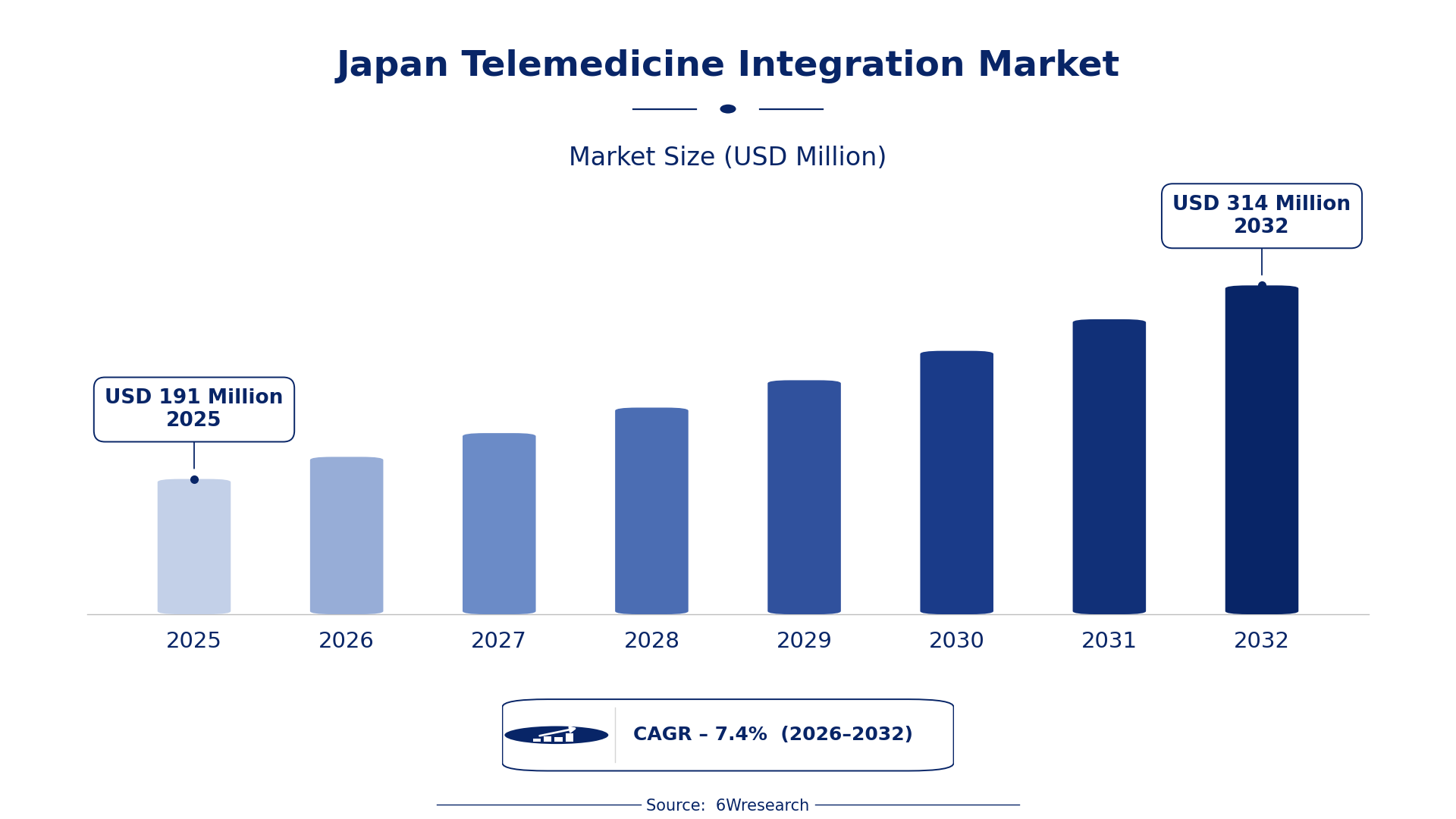
According to 6Wresearch internal database and industry insights, the Japan Telemedicine Integration Market was valued at USD 191 Million in 2025 and is projected to reach USD 314 Million by 2032, growing at a CAGR of approximately 7.4% during 2026–2032.
Japan Telemedicine Integration Market Highlights
| Report Metric | Details |
| Report Name | Japan Telemedicine Integration Market (2026-2032) |
| Market Size 2025 | USD 191 Million |
| Market Size 2032 | USD 314 Million |
| Absolute Growth 2025–2032 | USD 123 Million |
| CAGR 2026–2032 | 7.4% |
| Peak Annual Growth | 8.0% in 2032 |
| Forecast Period | 2026–2032 |
| Historical Data | 2022–2025 |
| Base Year | 2025 |
| Leading Integration Type, 2025 | EHR/EMR Integration (47% share) |
| Leading System Interface, 2025 | API-Based (41% share) |
| Leading Workflow Automation, 2025 | Patient History Access (45% share) |
| Leading End User, 2025 | Hospitals (49% share) |
| Fastest-Growing Integration Type | Lab System Integration (10.3% CAGR) |
| Fastest-Growing Workflow Automation | Diagnostic Coordination (9.4% CAGR) |
| Fastest-Growing End User | Specialty Clinics (9.7% CAGR) |
| Growing Sector | Healthcare Services |
| Key End Users | Hospitals, Diagnostic Labs, Specialty Clinics, Retail Pharmacies |
Japan Telemedicine Integration Market Year-wise Growth Rate and Key Drivers (2022–2032)
This graph illustrates the annual growth rates of the market from 2022 to 2032, highlighting a steady upward trajectory and projected market expansion over the forecast period.
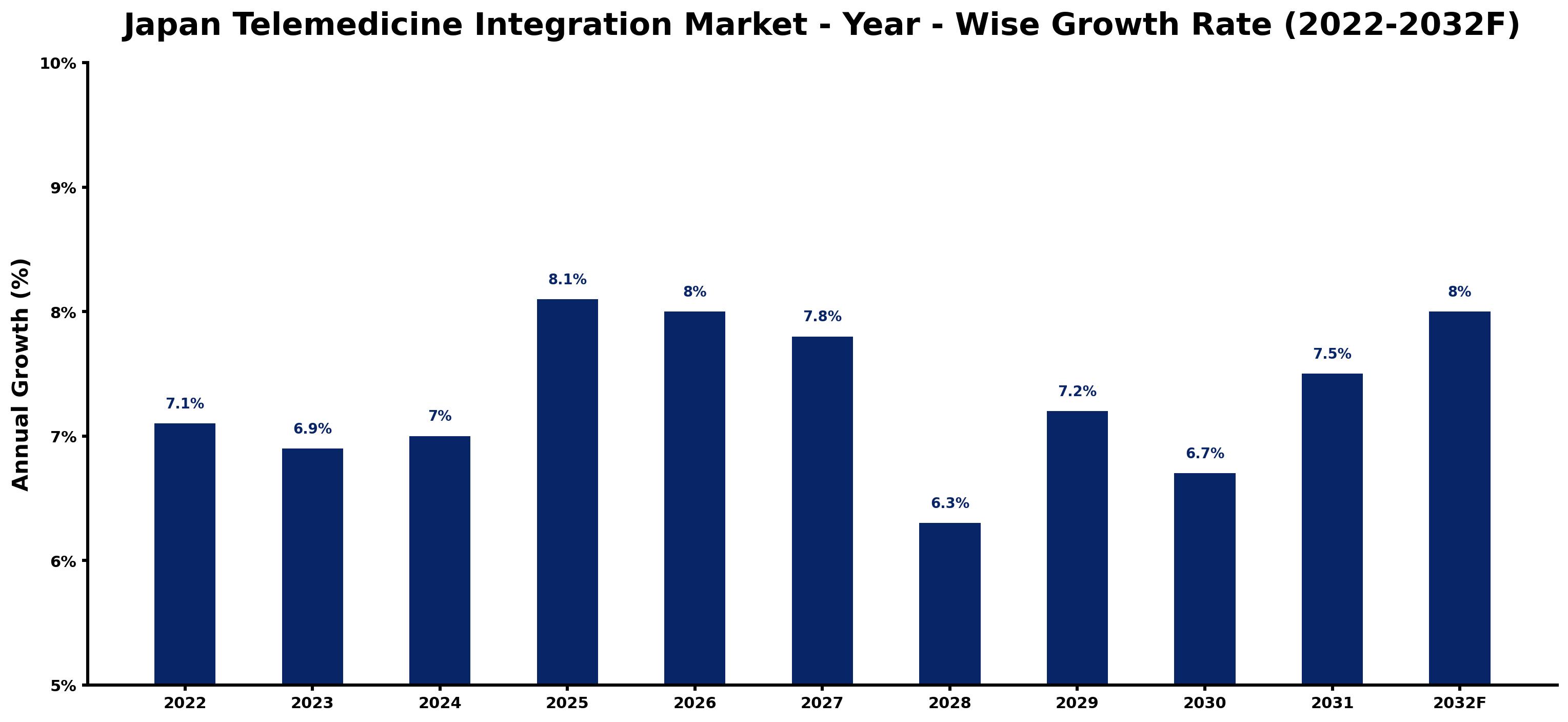
Year by year, the estimates below pair each growth rate with the development that shaped it.
| Year | Estimated Annual Growth (%) | Market Rationale |
| 2022 | 7.1 | The market experienced steady growth as healthcare providers began adopting telemedicine solutions. |
| 2023 | 6.9 | Growth slowed slightly as the market adjusted to new telemedicine regulations and standards. |
| 2024 | 7.0 | Increased investments in digital health technologies led to a rebound in growth rates. |
| 2025 | 8.1 | The market peaked as hospitals expanded their telemedicine offerings to meet rising patient demand. |
| 2026 | 8.0 | Growth is expected to slow due to market saturation and the need for further technological advancements. |
| 2027 | 7.8 | Growth is projected to slow as hospitals focus on optimising existing telemedicine systems. |
| 2028 | 6.3 | The market will see reduced growth as competition intensifies among telemedicine providers. |
| 2029 | 7.2 | Growth is expected to pick up again as new healthcare initiatives encourage telemedicine adoption. |
| 2030 | 6.7 | A slowdown in growth will be noted as the market stabilises with established players. |
| 2031 | 7.5 | The market is projected to rebound with increased investments in telemedicine infrastructure and services. |
| 2032 | 8.0 | Growth is expected to accelerate again as new healthcare policies promote telemedicine integration. |
Note: Market size estimations and growth projections presented in this report are based on 6Wresearch's proprietary forecasting methodology, utilizing the latest available industry data, government publications, and primary research inputs.
Japan Telemedicine Integration Market Synopsis
Telemedicine integration utilises technology to connect healthcare systems, enabling remote patient monitoring, consultations, and data sharing. This integration improves patient access to services and streamlines workflows. The Japan Telemedicine Integration Market is expanding due to a growing elderly population, with 29.3% aged 65 or older, alongside government initiatives targeting a 30% increase in telemedicine adoption by 2025 through various strategies. In 2023, over 8,000 hospitals are utilising telemedicine solutions, reflecting the rising demand for efficient healthcare delivery.
Market Dynamics Impact Analysis (2026–2032)
| Factor | Type | Impact | Primary Segment Affected |
| Growing elderly population driving demand for accessible healthcare services | Driver | High | EHR/EMR Integration |
| Increased funding for telemedicine infrastructure improvements | Driver | High | Lab System Integration |
| Rising demand for remote consultations among specialty clinics | Opportunity | Medium | Specialty Clinics |
| Need for efficient prescription management in retail pharmacies | Opportunity | Medium | Retail Pharmacies |
| High initial investment costs for telemedicine technologies | Restraint | High | Imaging System Linkage |
| Limited interoperability between existing healthcare systems | Restraint | Medium | Pharmacy Integration |
| Regulatory compliance costs affecting small providers | Challenge | High | Diagnostic Labs |
| Competition from emerging telemedicine solutions providers | Challenge | Medium | Hospitals |
Evaluation of Drivers in Japan Telemedicine Integration Market (2026–2032)
These are the developments adding the most demand over the forecast period.
| Drivers | Primary Segment Affected | Why It Matters (Evidence) |
| Increasing healthcare expenditure | EHR/EMR Integration | Japan's national medical care expenditure was about JPY 46.7 trillion in fiscal 2022, leading to more investments in telemedicine. |
| Growing adoption of digital health technologies | Lab System Integration | The 'Digital Health Strategy' initiated in 2020 promotes telemedicine, encouraging diagnostic labs to invest in integration. |
| Rising patient demand for remote healthcare services | Specialty Clinics | With an average patient age of 65, specialty clinics are expanding telemedicine services to cater to older patients. |
| Government initiatives supporting telemedicine | Pharmacy Integration | The Japanese government aims to increase telemedicine adoption by 30% by 2025, prompting pharmacies to integrate solutions. |
| Technological advancements in telemedicine software | Imaging System Linkage | ISO 13485 standards for telemedicine software development are driving innovation in imaging system integration. |
Much of the new demand traces back to increasing healthcare expenditure, which reached JPY 46.7 trillion in fiscal 2022, prompting hospitals to invest in telemedicine solutions. With the average age of patients at 65, specialty clinics are expanding their telemedicine offerings to meet the needs of older patients. Technological advancements are driving innovation in imaging system integration, unlocking new demand. As a result, hospitals are purchasing more telemedicine systems to improve patient care and operational efficiency.
Evaluation of Restraints in Japan Telemedicine Integration Market
These are the pressures that could keep growth below its potential.
| Market Restraint | Primary Segment Affected | Why It Matters (Evidence) |
| High initial investment costs for telemedicine technologies | Imaging System Linkage | The average cost of implementing telemedicine systems can be prohibitive for smaller healthcare providers, limiting their participation. |
| Limited interoperability between existing healthcare systems | Pharmacy Integration | Many pharmacies face challenges in integrating telemedicine solutions with legacy systems, hindering efficiency. |
| Regulatory compliance costs affecting small providers | Diagnostic Labs | Smaller diagnostic labs struggle with the costs associated with meeting regulatory requirements for telemedicine. |
| Competition from emerging telemedicine solutions providers | Hospitals | Established hospitals face pressure from new entrants offering telemedicine solutions at lower costs. |
| Slow adoption of telemedicine by some patient demographics | Specialty Clinics | Certain patient groups remain hesitant to use telemedicine, affecting demand in specialty clinics. |
Japan Telemedicine Integration Market Challenges
In 2023, over 8,000 hospitals in Japan utilised telemedicine solutions, yet many buyers face challenges with inconsistent technology integration, leading to fragmented patient data and delayed care coordination. Suppliers encounter fierce competition, as numerous firms vie for market share, resulting in price reductions that can erode profitability. Regulatory hurdles, particularly with standards like ISO 13485, complicate compliance for suppliers, causing delays in product launches. High operational costs, reflected in Japan's national medical care expenditure of JPY 46.7 trillion, burden hospitals, limiting their ability to invest in advanced telemedicine technologies.
Trends in the Japan Telemedicine Integration Market
Below are the shifts with the largest effect on the Japan Telemedicine Integration Market.
- Shift towards Integrated Telemedicine Solutions: The 'Healthcare and Medical Strategy' initiated in 2021 is driving a shift towards integrated telemedicine solutions across Japan's healthcare system, with over 8,000 hospitals adopting these technologies.
- Transition from In-Person to Virtual Consultations: In 2023, telemedicine consultations increased by 25%, reflecting a shift from traditional in-person visits to virtual consultations, particularly among elderly patients.
- Emergence of Remote Patient Monitoring: Remote patient monitoring technologies are gaining traction, with over 1,500 diagnostic labs integrating telemedicine solutions to improve patient care and streamline workflows.
- Prioritisation of Telemedicine in Healthcare Strategies: The 'eHealth Initiative' prioritises telemedicine integration, with a budget of ¥5 billion allocated for 2024 to enhance infrastructure.
Investment Opportunities in the Japan Telemedicine Integration Market
The following areas offer the clearest openings for investors and suppliers in the Japan Telemedicine Integration Market.
- Telemedicine Integration Solutions: With the growing elderly population, there is an opportunity to supply telemedicine integration solutions, especially for hospitals, which represent 49% of the market share in 2025.
- Remote Monitoring Technologies: The demand for remote monitoring technologies is increasing, particularly among specialty clinics, which are projected to grow at a rate of 9.7% by 2032, indicating a gap for suppliers.
- EHR/EMR Integration Services: The EHR/EMR integration segment is expanding, with hospitals needing efficient data management solutions, creating opportunities for service providers to enter the market.
- Pharmacy Integration Solutions: Retail pharmacies are increasingly seeking telemedicine integration solutions to streamline prescription processes, presenting an opportunity for suppliers to partner with local pharmacies.
Government Initiatives in the Japan Telemedicine Integration Market
The Clinical Trials Act, enacted in 2017, sets important rules for conducting clinical research, impacting telemedicine providers by ensuring compliance with ethical standards. The Medical Care Act of 1948 outlines standards for hospitals and clinics, including staffing and facilities, which telemedicine integration providers must adhere to.
The PMDA oversees the approval of telemedicine technologies, ensuring they meet safety and efficacy standards. The AMED funds medical research and development, supporting projects that improve telemedicine infrastructure and services.
Future Insight of the Japan Telemedicine Integration Market
The 'eHealth Initiative' will upgrade telemedicine infrastructure, enhancing connectivity among healthcare providers by 2024. By 2032, the Japanese government aims to increase telemedicine adoption significantly, driven by initiatives that streamline workflows and improve patient access. The integration of advanced software solutions will facilitate better data sharing between pharmacies and hospitals, optimising healthcare delivery. With over 30,000 retail pharmacies benefiting from telemedicine integration, the demand for remote monitoring and consultations will continue to grow, reshaping healthcare services.
Market Segmentation Analysis
Japan Telemedicine Integration Market report covers a detailed analysis of the following market segments:
By Integration Type – EHR/EMR Integration Leads, Lab System Integration Expected to Grow Fastest
According to Saurav Kr Singh, Senior Research Analyst at 6Wresearch, EHR/EMR Integration took 47% of integration type revenue in 2025, more than any other category. EHR/EMR integration commands the largest share as it is essential for patient data management and access, with over 8,000 hospitals in Japan utilising telemedicine solutions. This integration is crucial for healthcare providers to efficiently serve the growing elderly demographic, which is vital for patient care. Over 2026–2032, Lab System Integration is expected to post the fastest growth, at a CAGR of 10.3%. Lab system integration is rapidly expanding due to the increasing need for seamless lab result sharing with healthcare providers, demonstrated by over 1,500 diagnostic labs integrating telemedicine solutions. As hospitals continue to adopt these systems, EHR/EMR integration's lead will widen further. Suppliers should focus on enhancing EHR/EMR solutions to meet the increasing demand from hospitals.
By System Interface – API-Based Leads and Records the Fastest Growth
API-Based held 41% of the Japan Telemedicine Integration Market by system interface in 2025. API-based systems lead the market as they facilitate real-time data exchange between healthcare systems, ensuring timely and accurate information flow. This capability is vital for the efficient functioning of telemedicine services across various platforms. API-Based is also forecast to expand faster than any other category, at a CAGR of 10.8% over 2026–2032. The API-based interface is also the fastest-growing segment, as its ability to integrate diverse systems quickly is increasingly recognised by healthcare providers. This growth reinforces its leadership position, ensuring that real-time data exchange remains a priority. Buyers will benefit from prioritising API-based solutions to improve interoperability and streamline operations.
By Workflow Automation – Patient History Access Leads, Diagnostic Coordination Expected to Grow Fastest
Patient History Access accounted for 45% of the market by workflow automation in 2025. Patient history access is the leading segment as it is crucial for informed clinical decision-making, enabling healthcare providers to deliver tailored care. This functionality is particularly important in a market with a high percentage of elderly patients requiring comprehensive medical histories. Diagnostic Coordination is projected to grow fastest, at a CAGR of 9.4% during 2026–2032. Diagnostic coordination is experiencing rapid growth as it supports collaboration among healthcare providers, which is essential for improving patient outcomes. While patient history access remains vital, the increasing complexity of cases will drive further demand for diagnostic coordination solutions. Suppliers must enhance diagnostic coordination tools to support evolving healthcare collaboration needs.
By End User – Hospitals Lead, Specialty Clinics Expected to Grow Fastest
With 49% of end user revenue in 2025, Hospitals was the largest category. Hospitals are the primary users of telemedicine integration solutions, accounting for the largest share due to their extensive patient base and need for efficient healthcare delivery. With approximately 8,100 hospitals in Japan, their adoption of telemedicine is crucial for improving patient access to services. The quickest growth will come from Specialty Clinics, forecast to expand at a CAGR of 9.7% between 2026 and 2032. Specialty clinics are witnessing the fastest growth as they benefit from enhanced patient management capabilities, allowing them to cater to specific healthcare needs effectively. This trend indicates a shift towards more specialised care, which will complement hospital services. Suppliers should tailor their offerings to meet the unique demands of specialty clinics.
Key Attractiveness of the Report
- 10 Years of Market Numbers
- Historical Data Starting from 2022 to 2025
- Base Year 2025
- Forecast Data until 2032
- Key Performance Indicators Impacting the Market
- Major Upcoming Developments and Projects
Key Highlights of the Report:
- Japan Telemedicine Integration Market Outlook
- Market Size of Japan Telemedicine Integration Market, 2025
- Forecast of Japan Telemedicine Integration Market, 2032
- Historical Data and Forecast of Japan Telemedicine Integration Revenues & Volume for the Period 2022-2032F
- Japan Telemedicine Integration Market Trend Evolution
- Japan Telemedicine Integration Market Drivers and Challenges
- Japan Telemedicine Integration Price Trends
- Japan Telemedicine Integration Porter's Five Forces
- Japan Telemedicine Integration Industry Life Cycle
- Historical Data and Forecast of Japan Telemedicine Integration Market Revenues & Volume By Integration Type for the Period 2022-2032F
- Historical Data and Forecast of Japan Telemedicine Integration Market Revenues & Volume By EHR/EMR Integration for the Period 2022-2032F
- Historical Data and Forecast of Japan Telemedicine Integration Market Revenues & Volume By Lab System Integration for the Period 2022-2032F
- Historical Data and Forecast of Japan Telemedicine Integration Market Revenues & Volume By Imaging System Linkage for the Period 2022-2032F
- Historical Data and Forecast of Japan Telemedicine Integration Market Revenues & Volume By Pharmacy Integration for the Period 2022-2032F
- Historical Data and Forecast of Japan Telemedicine Integration Market Revenues & Volume By System Interface for the Period 2022-2032F
- Historical Data and Forecast of Japan Telemedicine Integration Market Revenues & Volume By API-Based for the Period 2022-2032F
- Historical Data and Forecast of Japan Telemedicine Integration Market Revenues & Volume By HL7 Interface for the Period 2022-2032F
- Historical Data and Forecast of Japan Telemedicine Integration Market Revenues & Volume By DICOM/PACS for the Period 2022-2032F
- Historical Data and Forecast of Japan Telemedicine Integration Market Revenues & Volume By eRx Modules for the Period 2022-2032F
- Historical Data and Forecast of Japan Telemedicine Integration Market Revenues & Volume By Workflow Automation for the Period 2022-2032F
- Historical Data and Forecast of Japan Telemedicine Integration Market Revenues & Volume By Patient History Access for the Period 2022-2032F
- Historical Data and Forecast of Japan Telemedicine Integration Market Revenues & Volume By Diagnostic Coordination for the Period 2022-2032F
- Historical Data and Forecast of Japan Telemedicine Integration Market Revenues & Volume By Radiology Consults for the Period 2022-2032F
- Historical Data and Forecast of Japan Telemedicine Integration Market Revenues & Volume By ePrescription Fulfillment for the Period 2022-2032F
- Historical Data and Forecast of Japan Telemedicine Integration Market Revenues & Volume By End User for the Period 2022-2032F
- Historical Data and Forecast of Japan Telemedicine Integration Market Revenues & Volume By Hospitals for the Period 2022-2032F
- Historical Data and Forecast of Japan Telemedicine Integration Market Revenues & Volume By Diagnostic Labs for the Period 2022-2032F
- Historical Data and Forecast of Japan Telemedicine Integration Market Revenues & Volume By Specialty Clinics for the Period 2022-2032F
- Historical Data and Forecast of Japan Telemedicine Integration Market Revenues & Volume By Retail Pharmacies for the Period 2022-2032F
- Japan Telemedicine Integration Import Export Trade Statistics
- Market Opportunity Assessment By Integration Type
- Market Opportunity Assessment By System Interface
- Market Opportunity Assessment By Workflow Automation
- Market Opportunity Assessment By End User
- Japan Telemedicine Integration Top Companies Market Share
- Japan Telemedicine Integration Competitive Benchmarking By Technical and Operational Parameters
- Japan Telemedicine Integration Company Profiles
- Japan Telemedicine Integration Key Strategic Recommendations
Market Covered
The report covers the following segments.
By Integration Type
- EHR/EMR Integration
- Lab System Integration
- Imaging System Linkage
- Pharmacy Integration
By System Interface
- API-Based
- HL7 Interface
- DICOM/PACS
- eRx Modules
By Workflow Automation
- Patient History Access
- Diagnostic Coordination
- Radiology Consults
- ePrescription Fulfillment
By End User
- Hospitals
- Diagnostic Labs
- Specialty Clinics
- Retail Pharmacies































