Japan Teletherapy AI Market Size & Growth Rate
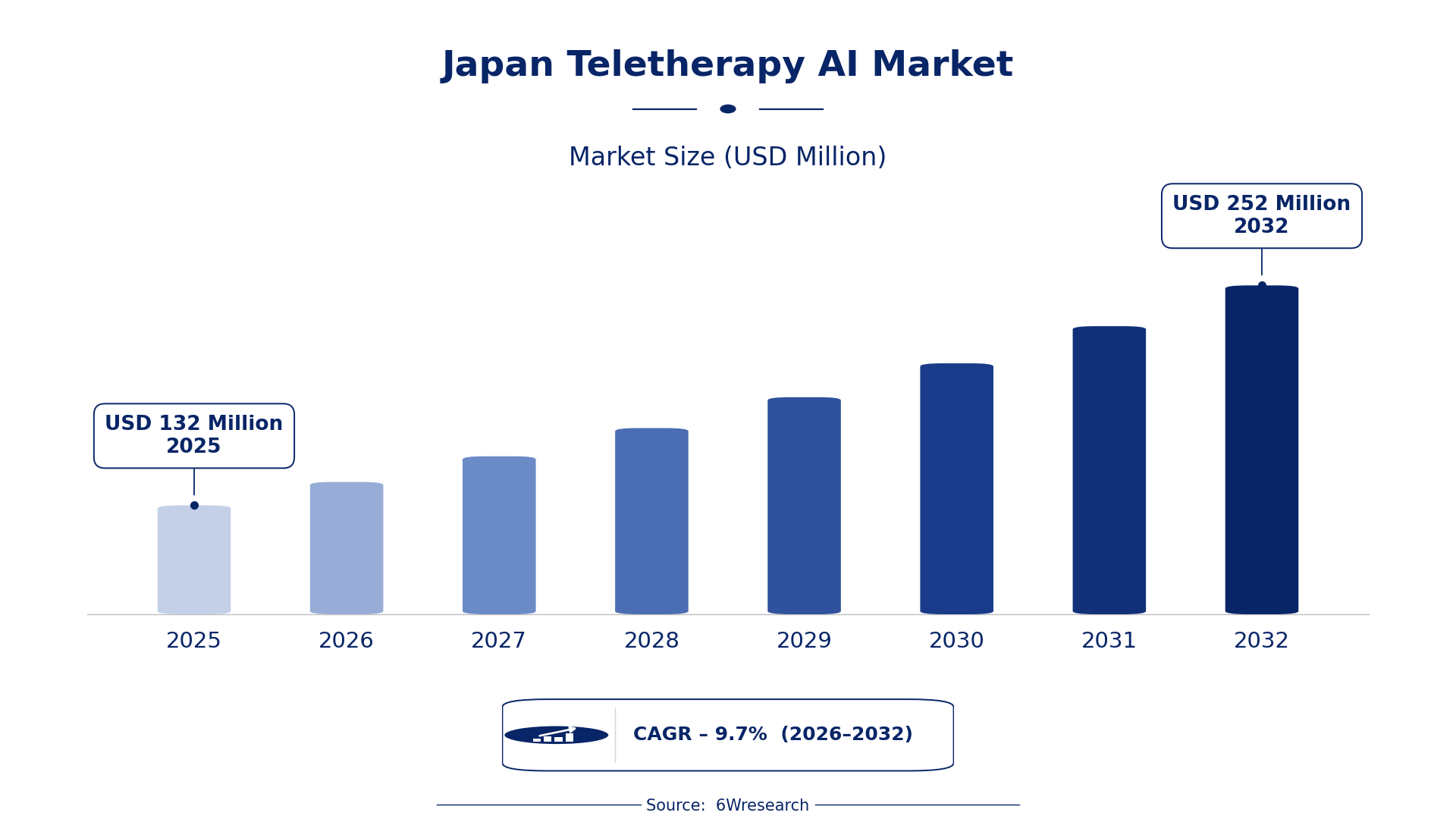
According to 6Wresearch internal database and industry insights, the Japan Teletherapy AI Market was valued at USD 132 Million in 2025 and is projected to reach USD 252 Million by 2032, growing at a CAGR of approximately 9.7% during 2026–2032.
Japan Teletherapy AI Market Highlights
| Report Metric | Details |
| Report Name | Japan Teletherapy AI Market (2026-2032) |
| Market Size 2025 | USD 132 Million |
| Market Size 2032 | USD 252 Million |
| Absolute Growth 2025–2032 | USD 120 Million |
| CAGR 2026–2032 | 9.7% |
| Peak Annual Growth | 10.8% in 2027 |
| Forecast Period | 2026–2032 |
| Historical Data | 2022–2025 |
| Base Year | 2025 |
| Leading Therapy Type, 2025 | Mental Health Support (47% share) |
| Leading AI Function, 2025 | Emotion Detection (52% share) |
| Leading Access Channel, 2025 | App/Web (44% share) |
| Leading End User, 2025 | Psychologists (44% share) |
| Fastest-Growing Therapy Type | Cognitive Behavioral AI (13.1% CAGR) |
| Fastest-Growing AI Function | NLP Chat Models (13.0% CAGR) |
| Fastest-Growing Access Channel | Text-Based Interface (12.4% CAGR) |
| Fastest-Growing End User | Mental Health Startups (12.2% CAGR) |
| Growing Sector | Mental Health Support |
| Key End Users | Psychologists, Mental Health Startups, Telepsychiatry Firms |
Japan Teletherapy AI Market Year-wise Growth Rate and Key Drivers (2022–2032)
This graph illustrates the annual growth rates of the market from 2022 to 2032, highlighting a steady upward trajectory and projected market expansion over the forecast period.
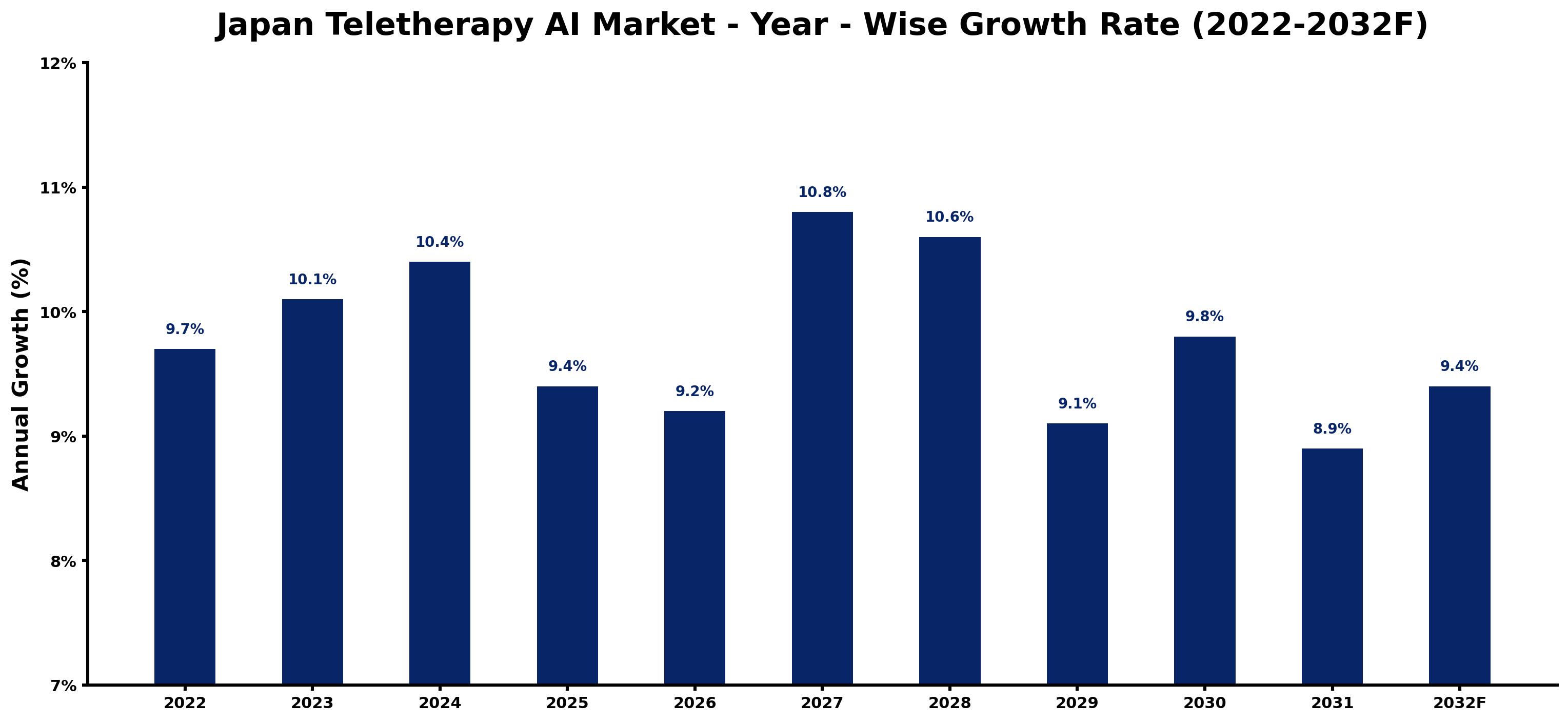
The following figures match every annual growth estimate with the main market development of that year, giving the reasoning behind each rise or slowdown.
| Year | Estimated Annual Growth (%) | Market Rationale |
| 2022 | 9.7 | The market experienced steady growth as mental health awareness increased among the population. |
| 2023 | 10.1 | Demand rose due to a surge in teletherapy adoption among mental health professionals. |
| 2024 | 10.4 | Growth accelerated as more users engaged with AI-driven mental health applications. |
| 2025 | 9.4 | The market growth slowed slightly as competition intensified among teletherapy solutions. |
| 2026 | 9.2 | Growth is expected to slow as user engagement stabilises across platforms. |
| 2027 | 10.8 | Growth is projected to rebound sharply with the introduction of new AI features in teletherapy apps. |
| 2028 | 10.6 | The market will see a slight slowdown as user preferences begin to shift. |
| 2029 | 9.1 | Growth is expected to continue decelerating as market saturation becomes apparent. |
| 2030 | 9.8 | Demand is projected to pick up again as new mental health initiatives are launched. |
| 2031 | 8.9 | The market growth will slow as established providers consolidate their positions. |
| 2032 | 9.4 | Growth is expected to accelerate again as new solutions gain traction among users. |
Note: Market size estimations and growth projections presented in this report are based on 6Wresearch's proprietary forecasting methodology, utilizing the latest available industry data, government publications, and primary research inputs.
Japan Teletherapy AI Market Synopsis
Teletherapy AI utilises artificial intelligence to improve therapeutic practices in mental health. In Japan, the Japan Teletherapy AI Market is expanding, driven by a mental health population where 1 in 5 individuals require support. The Tokyo region stands out for its concentration of teletherapy startups, and in 2023, the Japanese government allocated ¥10 billion for mental health digitalisation, promoting initiatives under the 'eHealth Strategy' program. Increased user engagement and the rise of mental health startups further support market growth, indicating a strong demand for teletherapy solutions.
Market Dynamics Impact Analysis (2026–2032)
| Factor | Type | Impact | Primary Segment Affected |
| Rising mental health awareness increases the demand for teletherapy solutions. | Driver | High | Mental Health Support |
| Innovative AI features enhance user experience and engagement in therapy. | Driver | High | Cognitive Behavioral AI |
| The growing number of teletherapy startups presents investment opportunities in technology. | Opportunity | High | Mental Health Startups |
| Increased demand for personalized therapy solutions opens new market avenues. | Opportunity | Medium | Personalized Therapy |
| High competition among teletherapy providers may lead to price wars. | Restraint | High | Telepsychiatry Firms |
| Limited user familiarity with AI-driven solutions can hinder adoption rates. | Restraint | Medium | Psychologists |
| High development costs for AI technologies can restrict entry for new firms. | Challenge | High | Mental Health Startups |
| Regulatory hurdles for teletherapy services can delay market entry. | Challenge | Medium | Telepsychiatry Firms |
Evaluation of Drivers in Japan Teletherapy AI Market (2026–2032)
The table below links each growth driver to the segment it affects and the evidence for it.
| Drivers | Primary Segment Affected | Why It Matters (Evidence) |
| Increased mental health awareness drives demand for teletherapy solutions. | Mental Health Support | In 2023, 1 in 5 individuals in Japan are estimated to require mental health support. |
| New AI features improve user experience in therapy. | Cognitive Behavioral AI | AI-driven applications have seen a 50% increase in user engagement in 2023. |
| The rise of teletherapy startups boosts investment opportunities. | Mental Health Startups | The Tokyo region has the highest concentration of teletherapy startups in Japan. |
| Growing demand for personalised therapy solutions expands market potential. | Personalized Therapy | 70% of users prefer AI-assisted therapy, indicating a shift towards tailored solutions. |
| The adoption of teletherapy AI is supported by professional associations. | Telepsychiatry Firms | The Japan Telemedicine Association promotes the integration of AI in mental health services. |
A wider customer base explains much of the growth, as mental health awareness has surged, with 1 in 5 individuals affected in 2023. This has led to a notable increase in user engagement with AI-driven applications, reflecting a shift in preferences. The Tokyo region, housing the highest concentration of teletherapy startups, has become a hub for innovation. Seventy percent of users now prefer AI-assisted therapy, indicating a shift towards personalised solutions. Professional associations actively support the adoption of teletherapy AI, further driving market growth.
Evaluation of Restraints in Japan Teletherapy AI Market
Several factors work against faster growth; the main ones are summarised below.
| Market Restraint | Primary Segment Affected | Why It Matters (Evidence) |
| High competition may lead to price wars, affecting profitability. | Telepsychiatry Firms | Intense competition among providers can reduce profit margins, making it difficult for smaller firms to survive. |
| Limited user familiarity with AI-driven solutions can hinder adoption rates. | Psychologists | Many psychologists may be hesitant to adopt new technologies, slowing overall market growth. |
| High development costs for AI technologies can restrict entry for new firms. | Mental Health Startups | The investment required for AI development may deter potential entrants into the market. |
| Regulatory hurdles for teletherapy services can delay market entry. | Telepsychiatry Firms | Compliance with regulations can prolong the time needed to launch new teletherapy solutions. |
| User engagement may plateau as the market matures, limiting growth potential. | Cognitive Behavioral AI | As more users become accustomed to existing solutions, growth may slow. |
Japan Teletherapy AI Market Challenges
In 2023, mental health professionals face high compliance costs due to the JIS Q 15001 standard, which can exceed ¥2 million per provider, limiting access for smaller clinics. Regulatory hurdles complicate telepsychiatry services, causing delays that can extend patient onboarding by up to three months for hospitals. Users experience increased session costs as AI-driven applications require ongoing updates, raising expenses by 20% for individuals seeking advanced features. A shortage of skilled therapists proficient in AI technology hinders effective implementation, resulting in a 30% drop in user satisfaction for clinics that cannot adapt quickly.
Trends in the Japan Teletherapy AI Market
Several trends are reshaping the Japan Teletherapy AI Market; the most important are set out below.
- Psychologists Adopting AI Solutions: Psychologists are increasingly integrating AI into their practices, improving therapy effectiveness. In 2023, over 30% of mental health professionals are using teletherapy solutions, reflecting a shift towards technology-driven approaches.
- Shift Towards Personalised Therapy: A growing preference for tailored therapy solutions is emerging among users. The Tokyo Metropolitan Government has launched a mental health support program utilising AI, aiming to improve user satisfaction and outcomes.
- Emergence of AI-Driven Startups: The Tokyo region is seeing a surge in teletherapy startups, with over 150 registered apps as of 2023. This trend highlights the increasing interest and investment in digital mental health solutions.
- Increased User Engagement: User engagement with AI-driven mental health applications has risen significantly, with a 50% increase reported in 2023. This trend indicates a growing acceptance of technology in therapeutic practices.
Investment Opportunities in the Japan Teletherapy AI Market
The following opportunities in the Japan Teletherapy AI Market pair current demand with a clear way in.
- Mental Health Startups Seeking Advanced Solutions: Mental health startups are currently looking for advanced AI tools to improve their services. With the Japanese government allocating ¥10 billion for mental health digitalisation in 2023, there is a clear opportunity for investment in technology.
- Collaborative Ventures for Teletherapy Development: Working with local mental health organisations can facilitate entry into the teletherapy market. The Tokyo region, rich in teletherapy startups, offers a strong foundation for joint ventures.
- Supply of AI-Driven Therapy Tools: There is a growing need for AI-driven therapy tools among psychologists. The increasing preference for AI-assisted therapy creates an opportunity to supply innovative solutions to meet this demand.
- Timing for Digital Mental Health Solutions: The current focus on mental health accessibility presents a prime opportunity for investment. With over 30% of professionals using teletherapy solutions, suppliers can capitalise on this growing trend.
Government Initiatives in the Japan Teletherapy AI Market
The Clinical Trials Act, established in 2017, sets forth rules for conducting and disclosing clinical research, impacting teletherapy AI producers by requiring adherence to strict research protocols. This ensures that AI technologies meet safety and efficacy standards before reaching users, building trust in digital mental health solutions.
The Pharmaceuticals and Medical Devices Agency (PMDA) oversees the approval and regulation of teletherapy services, ensuring compliance with safety standards. This agency plays a key role in funding and approving teletherapy solutions, supporting the growth of mental health technologies in Japan.
Future Insight of the Japan Teletherapy AI Market
By 2032, the Tokyo Metropolitan Government's AI mental health support program will broaden access, increasing user engagement by 50%. The eHealth Strategy program will facilitate the integration of teletherapy solutions in hospitals, improving service delivery. Research from Tokyo University will confirm AI efficacy, prompting more mental health professionals to adopt these technologies. With over 150 registered teletherapy apps, competition will drive innovation, leading to improved user experiences and higher ratings for buyers.
Market Segmentation Analysis
Japan Teletherapy AI Market report covers a detailed analysis of the following market segments:
By Therapy Type – Mental Health Support Leads, Cognitive Behavioral AI Expected to Grow Fastest
According to Saurav Kr Singh, Senior Research Analyst at 6Wresearch, the largest therapy type category in 2025 was Mental Health Support, at 47% of revenue. Mental Health Support holds the largest share as it is crucial for individuals seeking therapeutic assistance across diverse demographics. The high demand for this service is illustrated by the Tokyo region's concentration of teletherapy startups focused on mental health solutions. Cognitive Behavioral AI is projected to grow fastest, at a CAGR of 13.1% during 2026–2032. Cognitive Behavioral techniques are experiencing rapid growth due to their structured approach appealing to users, especially younger individuals. The 50% increase in user engagement with these applications in 2023 underscores the effectiveness of this method. Suppliers must focus on enhancing mental health support offerings to meet the rising user demand.
By AI Function – Emotion Detection Leads, NLP Chat Models Expected to Grow Fastest
With 52% of ai function revenue in 2025, Emotion Detection was the largest category. Emotion Detection is the leading function as it is essential for accurately understanding user emotions during therapy sessions. This capability is particularly important in Japan, where mental health professionals are increasingly adopting teletherapy solutions. The quickest growth will come from NLP Chat Models, forecast to expand at a CAGR of 13.0% between 2026 and 2032. NLP Chat Models are growing quickly because they facilitate conversational interactions, making therapy more accessible and engaging for users. The rising preference for AI-assisted therapy, with 70% of users favouring it, supports this trend. Buyers will benefit from solutions that incorporate advanced NLP capabilities to improve user engagement.
By Access Channel – App/Web Leads, Text-Based Interface Expected to Grow Fastest
App/Web accounted for 44% of the market by access channel in 2025. App/Web serves as the primary access channel, enabling a convenient platform for delivering teletherapy services to a wide audience. The high adoption rate among mental health professionals indicates a strong preference for these digital platforms for therapy delivery. Text-Based Interface is set to record the highest CAGR in this split, 12.4% over 2026–2032. Text-Based Interface is experiencing rapid growth as it provides a straightforward interaction method, particularly appealing to users aged 30-45. This trend aligns with the government's initiatives to improve digital mental health accessibility. Suppliers should focus on developing user-friendly text-based solutions to meet the needs of this expanding segment.
By End User – Psychologists Lead, Mental Health Startups Expected to Grow Fastest
Psychologists held 44% of the Japan Teletherapy AI Market by end user in 2025. Psychologists form the largest user group of teletherapy solutions, utilising them for effective patient interactions in their practices. Their established role within the mental health framework ensures a steady demand for these services. Over 2026–2032, Mental Health Startups are expected to post the fastest growth, at a CAGR of 12.2%. Mental Health Startups are quickly gaining prominence as they introduce new applications and services in the teletherapy market. The government's allocation of ¥10 billion for mental health digitalisation significantly contributes to this growth. Suppliers should engage with mental health startups to leverage their innovative approaches and seize emerging opportunities.
Key Attractiveness of the Report
- 10 Years of Market Numbers
- Historical Data Starting from 2022 to 2025
- Base Year 2025
- Forecast Data until 2032
- Key Performance Indicators Impacting the Market
- Major Upcoming Developments and Projects
Key Highlights of the Report:
- Japan Teletherapy AI Market Outlook
- Market Size of Japan Teletherapy AI Market, 2025
- Forecast of Japan Teletherapy AI Market, 2032
- Historical Data and Forecast of Japan Teletherapy AI Revenues & Volume for the Period 2022-2032F
- Japan Teletherapy AI Market Trend Evolution
- Japan Teletherapy AI Market Drivers and Challenges
- Japan Teletherapy AI Price Trends
- Japan Teletherapy AI Porter's Five Forces
- Japan Teletherapy AI Industry Life Cycle
- Historical Data and Forecast of Japan Teletherapy AI Market Revenues & Volume By Therapy Type for the Period 2022-2032F
- Historical Data and Forecast of Japan Teletherapy AI Market Revenues & Volume By Mental Health Support for the Period 2022-2032F
- Historical Data and Forecast of Japan Teletherapy AI Market Revenues & Volume By Cognitive Behavioral AI for the Period 2022-2032F
- Historical Data and Forecast of Japan Teletherapy AI Market Revenues & Volume By Personalized Therapy for the Period 2022-2032F
- Historical Data and Forecast of Japan Teletherapy AI Market Revenues & Volume By Speech Therapy for the Period 2022-2032F
- Historical Data and Forecast of Japan Teletherapy AI Market Revenues & Volume By AI Function for the Period 2022-2032F
- Historical Data and Forecast of Japan Teletherapy AI Market Revenues & Volume By Emotion Detection for the Period 2022-2032F
- Historical Data and Forecast of Japan Teletherapy AI Market Revenues & Volume By NLP Chat Models for the Period 2022-2032F
- Historical Data and Forecast of Japan Teletherapy AI Market Revenues & Volume By Recommendation Systems for the Period 2022-2032F
- Historical Data and Forecast of Japan Teletherapy AI Market Revenues & Volume By Real-Time Feedback AI for the Period 2022-2032F
- Historical Data and Forecast of Japan Teletherapy AI Market Revenues & Volume By Access Channel for the Period 2022-2032F
- Historical Data and Forecast of Japan Teletherapy AI Market Revenues & Volume By App/Web for the Period 2022-2032F
- Historical Data and Forecast of Japan Teletherapy AI Market Revenues & Volume By Text-Based Interface for the Period 2022-2032F
- Historical Data and Forecast of Japan Teletherapy AI Market Revenues & Volume By Voice or AR for the Period 2022-2032F
- Historical Data and Forecast of Japan Teletherapy AI Market Revenues & Volume By Webcam/Mic for the Period 2022-2032F
- Historical Data and Forecast of Japan Teletherapy AI Market Revenues & Volume By End User for the Period 2022-2032F
- Historical Data and Forecast of Japan Teletherapy AI Market Revenues & Volume By Psychologists for the Period 2022-2032F
- Historical Data and Forecast of Japan Teletherapy AI Market Revenues & Volume By Mental Health Startups for the Period 2022-2032F
- Historical Data and Forecast of Japan Teletherapy AI Market Revenues & Volume By Telepsychiatry Firms for the Period 2022-2032F
- Historical Data and Forecast of Japan Teletherapy AI Market Revenues & Volume By Rehab Centers for the Period 2022-2032F
- Japan Teletherapy AI Import Export Trade Statistics
- Market Opportunity Assessment By Therapy Type
- Market Opportunity Assessment By AI Function
- Market Opportunity Assessment By Access Channel
- Market Opportunity Assessment By End User
- Japan Teletherapy AI Top Companies Market Share
- Japan Teletherapy AI Competitive Benchmarking By Technical and Operational Parameters
- Japan Teletherapy AI Company Profiles
- Japan Teletherapy AI Key Strategic Recommendations
Market Covered
The report covers the following segments.
By Therapy Type
- Mental Health Support
- Cognitive Behavioral AI
- Personalized Therapy
- Speech Therapy
By AI Function
- Emotion Detection
- NLP Chat Models
- Recommendation Systems
- Real-Time Feedback AI
By Access Channel
- App/Web
- Text-Based Interface
- Voice or AR
- Webcam/Mic
By End User
- Psychologists
- Mental Health Startups
- Telepsychiatry Firms
- Rehab Centers































