Japan Teller Machine Operating Systems Market Size & Growth Rate
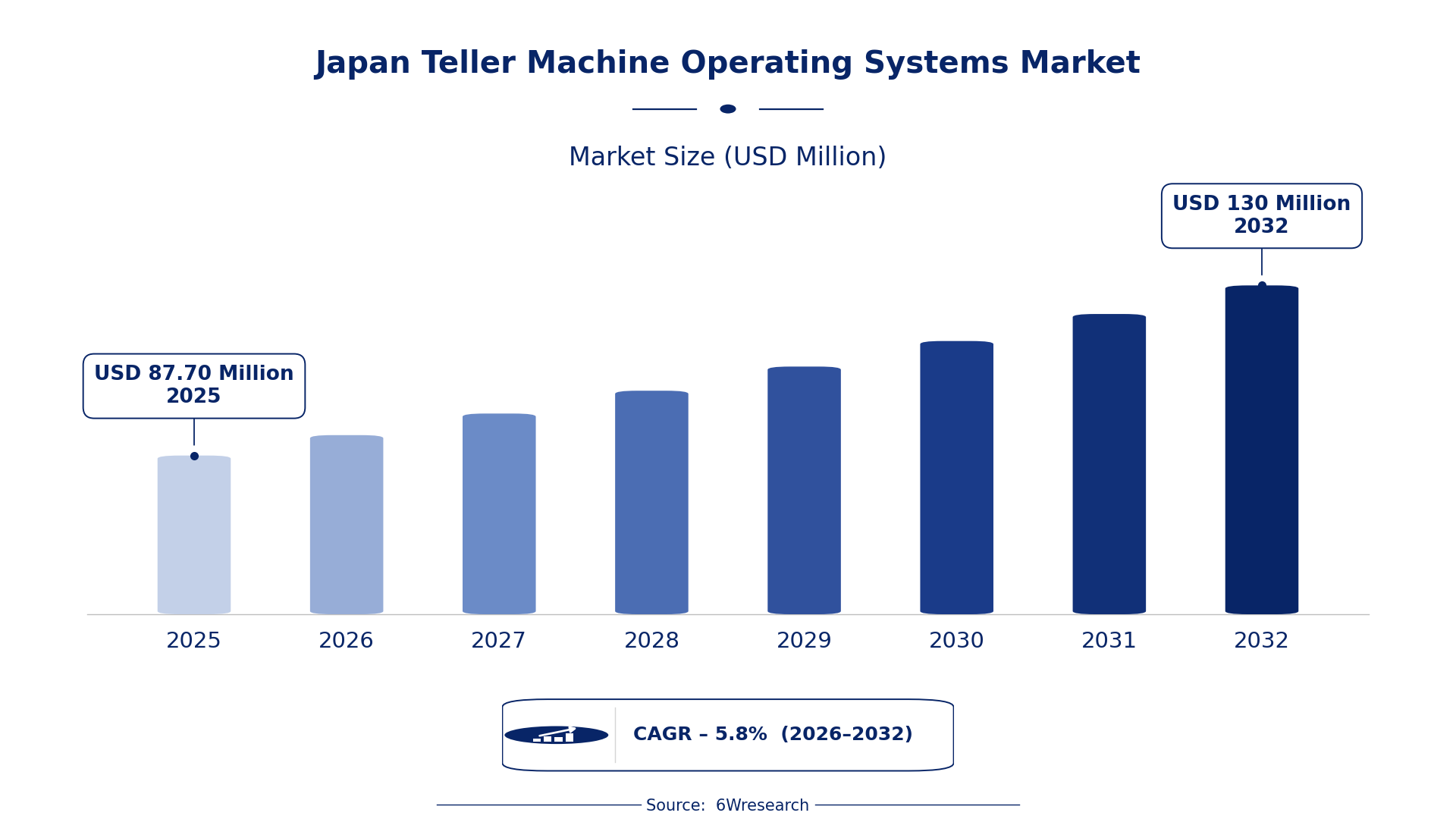
According to 6Wresearch internal database and industry insights, the Japan Teller Machine Operating Systems Market was valued at USD 87.70 Million in 2025 and is projected to reach USD 130 Million by 2032, growing at a CAGR of approximately 5.8% during 2026–2032.
Japan Teller Machine Operating Systems Market Highlights
| Report Metric | Details |
| Report Name | Japan Teller Machine Operating Systems Market (2026-2032) |
| Market Size 2025 | USD 87.70 Million |
| Market Size 2032 | USD 130 Million |
| Absolute Growth 2025–2032 | USD 42.30 Million |
| CAGR 2026–2032 | 5.8% |
| Peak Annual Growth | 6.8% in 2032 |
| Forecast Period | 2026–2032 |
| Historical Data | 2022–2025 |
| Base Year | 2025 |
| Leading OS Type, 2025 | Windows Embedded (42% share) |
| Leading Compatibility Level, 2025 | Multivendor ATM Support (40% share) |
| Leading Security Protocols, 2025 | End-to-End Encryption (50% share) |
| Leading End User, 2025 | Bank Chains (45% share) |
| Fastest-Growing OS Type | Cloud-Connected OS (8.8% CAGR) |
| Fastest-Growing Compatibility Level | API-Enabled (7.4% CAGR) |
| Fastest-Growing End User | Fintech Companies (7.3% CAGR) |
| Growing Sector | banking and financial services |
| Key End Users | banks, fintech companies, ATM manufacturers |
Japan Teller Machine Operating Systems Market Year-wise Growth Rate and Key Drivers (2022–2032)
This graph illustrates the annual growth rates of the market from 2022 to 2032, highlighting a steady upward trajectory and projected market expansion over the forecast period.
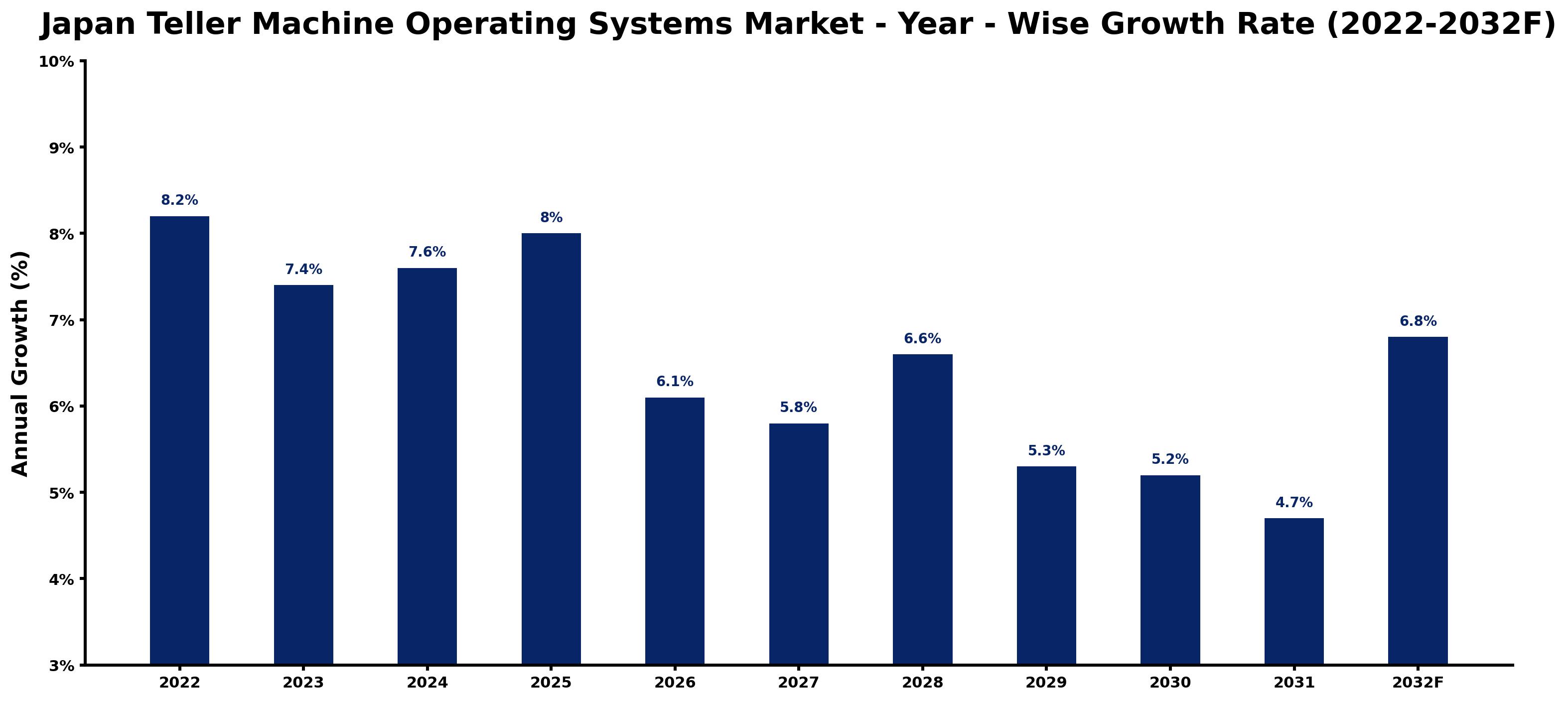
Year by year, the estimates below pair each growth rate with the development that shaped it.
| Year | Estimated Annual Growth (%) | Market Rationale |
| 2022 | 8.2 | The market experienced strong growth due to increased ATM installations and transaction volumes. |
| 2023 | 7.4 | Growth slowed as the market adjusted to previous high levels of activity and investment. |
| 2024 | 7.6 | Demand picked up again as banks continued to upgrade their ATM operating systems. |
| 2025 | 8.0 | The market saw faster growth driven by rising digital transaction volumes and improvements in security. |
| 2026 | 6.1 | Growth is expected to slow as the market faces saturation in certain urban areas. |
| 2027 | 5.8 | Continued demand for advanced features in ATMs is projected to contribute to slower growth rates. |
| 2028 | 6.6 | The market is expected to rebound with renewed interest in cloud-connected ATM solutions. |
| 2029 | 5.3 | Growth is projected to slow as competition intensifies among existing ATM operating systems. |
| 2030 | 5.2 | Market expansion is expected to continue slowing as buyers focus on cost-effective solutions. |
| 2031 | 4.7 | The market is projected to experience slower growth as technological advancements plateau. |
| 2032 | 6.8 | Growth is expected to accelerate again due to increased adoption of cloud-connected systems. |
Note: Market size estimations and growth projections presented in this report are based on 6Wresearch's proprietary forecasting methodology, utilizing the latest available industry data, government publications, and primary research inputs.
Japan Teller Machine Operating Systems Market Synopsis
Teller Machine Operating Systems are software platforms that manage automated teller machines, facilitating transactions and ensuring security protocols. The Japan Teller Machine Operating Systems Market is growing as banks and fintech companies invest in advanced technologies to improve user experience. Demand is driven by over 100,000 ATMs nationwide, a rising trend in digital transactions, and ongoing investments in security measures, particularly with the adoption of standards like ISO/IEC 27001.
Market Dynamics Impact Analysis (2026–2032)
| Factor | Type | Impact | Primary Segment Affected |
| Increased ATM installations driven by growing banking services | Driver | High | Windows Embedded |
| Rising digital transactions leading to demand for advanced systems | Driver | High | Linux-Based OS |
| Growing need for secure transactions creates opportunities for new technology | Opportunity | High | End-to-End Encryption |
| Emerging trend of cloud-connected ATMs presents market entry points | Opportunity | Medium | Cloud-Connected OS |
| Saturation in urban ATM markets limits growth potential for some segments | Restraint | High | Proprietary OS |
| High competition among operating systems can drive prices down | Restraint | Medium | Multivendor ATM Support |
| Technological advancements require constant investment from suppliers | Challenge | High | API-Enabled |
| Regulatory compliance can increase operational costs for producers | Challenge | Medium | BitLocker + Firewall |
Evaluation of Drivers in Japan Teller Machine Operating Systems Market (2026–2032)
The main growth drivers and the segments they affect most are set out below.
| Drivers | Primary Segment Affected | Why It Matters (Evidence) |
| Increased ATM installations | Windows Embedded | Japan has over 100,000 ATMs, driving demand for stable operating systems. |
| Rising digital transactions | Linux-Based OS | The Bank of Japan reports a steady increase in digital transactions, boosting system upgrades by banks. |
| Growing focus on security protocols | End-to-End Encryption | ISO/IEC 27001 compliance is becoming essential for secure ATM operations, influencing system choices. |
| Emerging cloud technology | Cloud-Connected OS | Cloud-connected ATMs are projected to grow by 15% by 2025, enhancing management capabilities for banks. |
| Demand for interoperability | Multivendor ATM Support | Banks require systems that work across various ATM brands for improved service delivery. |
Purchasing is picking up as banks upgrade their ATM systems to improve transaction efficiency. The banking sector employs around 300,000 personnel, driving demand for reliable Teller Machine Operating Systems. Digital transactions are steadily increasing, prompting banks to adopt advanced solutions that facilitate secure operations. The rise of cloud-connected ATMs, projected to grow by 15% by 2025, is pushing for new technologies that enhance management and security features for users.
Evaluation of Restraints in Japan Teller Machine Operating Systems Market
The table below lists the restraints and the evidence behind each.
| Market Restraint | Primary Segment Affected | Why It Matters (Evidence) |
| Market saturation in urban areas | Proprietary OS | With 1,200 active bank branches, competition limits growth for proprietary systems, affecting their market share. |
| Intense competition among operating systems | Multivendor ATM Support | As more vendors enter the market, pricing pressures can affect profitability for suppliers. |
| High compliance costs for security standards | BitLocker + Firewall | Meeting JIS Q 27001 standards increases operational expenses for ATM providers, impacting pricing. |
| Limited adoption of new technologies by some banks | API-Enabled | Not all banks are ready to invest in API-enabled systems, which slows market growth for these solutions. |
| Dependence on traditional ATM models | In-House ATM Models | Many banks still prefer established models, hindering innovation and the adoption of new technologies. |
Japan Teller Machine Operating Systems Market Challenges
Japan's ATM operating systems face notable technological challenges, as outdated platforms hinder compatibility with emerging digital payment systems, delaying upgrades for banks and fintech companies. Rising operational costs, driven by the national minimum wage increase to JPY 1,055 per hour, strain budgets for ATM management, potentially leading to reduced service availability for users. Intense competition among the extensive network of over 100,000 ATMs creates price pressures, limiting suppliers' ability to invest in system improvements. Supply chain disruptions further delay essential software updates, increasing transaction times for users, particularly in urban centres like Tokyo.
Trends in the Japan Teller Machine Operating Systems Market
The shifts below are changing how Japan Teller Machine Operating Systems Market products are bought and supplied.
- Shift from Traditional to Cloud-Connected ATMs: Cloud-connected ATMs are becoming more prevalent, with a projected 15% growth by 2025. This shift allows for remote management and updates, improving operational efficiency and security for banks.
- Increase in Security Protocol Adoption: The adoption of End-to-End Encryption has risen, achieving a 50% market share in 2025. This trend reflects the growing emphasis on secure transactions within the banking sector.
- Transition from Proprietary to Open Systems: More banks are moving towards Linux-Based OS for its flexibility and cost-effectiveness. This change is driven by the need for customization and adaptability in the ATM market.
- Emergence of API-Enabled Systems: API-Enabled operating systems are gaining traction as banks seek integration with other financial services. This trend is expected to grow due to increasing digital transaction volumes.
Investment Opportunities in the Japan Teller Machine Operating Systems Market
The openings below show where demand in the Japan Teller Machine Operating Systems Market is visible and how suppliers can enter.
- Cloud-Connected ATM Solutions: The shift towards cloud-connected ATMs presents an opportunity for suppliers to innovate. With a projected growth of 15% by 2025, banks are looking for remote management capabilities to enhance their operations.
- Advanced Security Features: Investing in advanced security protocols like End-to-End Encryption is essential. Banks are increasingly prioritising secure transactions, creating a demand for effective security solutions in the ATM market.
- Integration with Fintech Services: Fintech companies are expanding their ATM networks, creating a need for API-Enabled systems. This sector is projected to grow, indicating significant investment potential for suppliers.
- Multivendor Support Systems: As banks require interoperability among different ATM brands, there is a demand for Multivendor ATM Support. This need opens avenues for suppliers to provide compatible solutions to enhance service delivery.
Government Initiatives in the Japan Teller Machine Operating Systems Market
The New Robot Strategy (2015) aims to expand automation in various sectors, including banking. This strategy encourages the adoption of advanced technologies in Teller Machine Operating Systems, ensuring they meet modern operational demands and improve efficiency. The Industrial Safety and Health Act (1972) sets standards for safety in machinery, impacting how ATM systems are developed and maintained, ensuring compliance with safety regulations.
The Financial Services Agency oversees the implementation of security standards for ATMs. They ensure compliance with regulations like JIS Q 27001, which mandates rigorous security measures, benefiting both producers and users by building trust in ATM transactions and enhancing operational integrity.
Future Insight of the Japan Teller Machine Operating Systems Market
Cloud-connected ATMs will transform demand by 2032, with an anticipated increase in adoption driving software advancements. Enhanced security measures aligned with ISO/IEC 27001 standards will become vital, ensuring user confidence in digital transactions. The Ministry of Internal Affairs and Communications will champion fintech innovations, fostering market diversification. By 2032, the average transaction time at ATMs is expected to decrease to under 25 seconds, significantly enhancing user experience and operational efficiency for banks.
Market Segmentation Analysis
Japan Teller Machine Operating Systems Market report covers a detailed analysis of the following market segments:
By OS Type – Windows Embedded Leads, Cloud-Connected OS Expected to Grow Fastest
According to Saurav Kr Singh, Senior Research Analyst at 6Wresearch, Windows Embedded accounted for 42% of the market by os type in 2025. Windows Embedded holds the largest share in Japan because it is widely used in ATMs, providing stability and extensive support for various hardware components. This operating system is essential for financial institutions, ensuring reliable transactions across the country's extensive ATM network. Over 2026–2032, Cloud-Connected OS is expected to post the fastest growth, at a CAGR of 8.8%. The Cloud-Connected OS segment is experiencing rapid growth, propelled by its capability for remote management and updates, which are increasingly sought after for efficient ATM operations. With cloud-connected ATMs expected to grow by 15% by 2025, this trend indicates a shift towards modern technological solutions in the market. Suppliers should enhance cloud capabilities to align with the rising demand for advanced ATM management solutions.
By Compatibility Level – Multivendor ATM Support Leads, API-Enabled Expected to Grow Fastest
With 40% of compatibility level revenue in 2025, Multivendor ATM Support was the largest category. Multivendor ATM Support leads the market as it is crucial for ensuring interoperability among different ATM brands, essential for banks managing diverse fleets. This compatibility allows financial institutions to provide a consistent service experience across their ATM networks. API-Enabled is projected to grow fastest, at a CAGR of 7.4% during 2026–2032. The API-Enabled segment is rapidly gaining traction as it facilitates integration with other financial services, thereby enhancing ATM functionality. As the banking sector increasingly embraces digital transactions, the demand for seamless connectivity through APIs will drive this segment's growth. Buyers will benefit from solutions that improve integration capabilities, thereby enhancing operational efficiency.
By Security Protocols – End-to-End Encryption Leads and Records the Fastest Growth
End-to-End Encryption held 50% of the Japan Teller Machine Operating Systems Market by security protocols in 2025. End-to-End Encryption is the foremost security protocol as it is essential for secure data transmission between ATMs and banks, fostering customer trust and compliance with regulatory standards. This protocol is particularly critical in a market where security is paramount, especially with the increase in digital transactions. End-to-End Encryption is also forecast to expand faster than any other category, at a CAGR of 7.7% over 2026–2032. End-to-End Encryption also emerges as the fastest-growing segment, as its significance in protecting financial data continues to rise. The ongoing focus on security measures, including those governed by JIS Q 27001 standards, will further reinforce its market position. Suppliers must prioritise robust security features to meet increasing regulatory demands and customer expectations.
By End User – Bank Chains Lead, Fintech Companies Expected to Grow Fastest
In 2025, Bank Chains led the end user split with a 45% share. Bank Chains represent the primary users of ATM operating systems, extensively utilising these systems to efficiently manage their operations across networks. With approximately 300,000 personnel employed in the banking sector, their dependence on reliable ATM solutions is evident. Fintech Companies are set to record the highest CAGR in this split, 7.3% over 2026–2032. Fintech Companies are swiftly adopting ATM operating systems to offer innovative services, indicating a transformation in the execution of financial transactions. As digital transactions increase, the role of fintech in the ATM market will continue to expand, driving further growth. Suppliers should focus on fintech companies to seize emerging opportunities in the ATM operating systems market.
Key Attractiveness of the Report
- 10 Years of Market Numbers
- Historical Data Starting from 2022 to 2025
- Base Year 2025
- Forecast Data until 2032
- Key Performance Indicators Impacting the Market
- Major Upcoming Developments and Projects
Key Highlights of the Report:
- Japan Teller Machine Operating Systems Market Outlook
- Market Size of Japan Teller Machine Operating Systems Market, 2025
- Forecast of Japan Teller Machine Operating Systems Market, 2032
- Historical Data and Forecast of Japan Teller Machine Operating Systems Revenues & Volume for the Period 2022-2032F
- Japan Teller Machine Operating Systems Market Trend Evolution
- Japan Teller Machine Operating Systems Market Drivers and Challenges
- Japan Teller Machine Operating Systems Price Trends
- Japan Teller Machine Operating Systems Porter's Five Forces
- Japan Teller Machine Operating Systems Industry Life Cycle
- Historical Data and Forecast of Japan Teller Machine Operating Systems Market Revenues & Volume By OS Type for the Period 2022-2032F
- Historical Data and Forecast of Japan Teller Machine Operating Systems Market Revenues & Volume By Windows Embedded for the Period 2022-2032F
- Historical Data and Forecast of Japan Teller Machine Operating Systems Market Revenues & Volume By Linux-Based OS for the Period 2022-2032F
- Historical Data and Forecast of Japan Teller Machine Operating Systems Market Revenues & Volume By Proprietary OS for the Period 2022-2032F
- Historical Data and Forecast of Japan Teller Machine Operating Systems Market Revenues & Volume By Cloud-Connected OS for the Period 2022-2032F
- Historical Data and Forecast of Japan Teller Machine Operating Systems Market Revenues & Volume By Compatibility Level for the Period 2022-2032F
- Historical Data and Forecast of Japan Teller Machine Operating Systems Market Revenues & Volume By Multivendor ATM Support for the Period 2022-2032F
- Historical Data and Forecast of Japan Teller Machine Operating Systems Market Revenues & Volume By Open Source for the Period 2022-2032F
- Historical Data and Forecast of Japan Teller Machine Operating Systems Market Revenues & Volume By In-House ATM Models for the Period 2022-2032F
- Historical Data and Forecast of Japan Teller Machine Operating Systems Market Revenues & Volume By API-Enabled for the Period 2022-2032F
- Historical Data and Forecast of Japan Teller Machine Operating Systems Market Revenues & Volume By Security Protocols for the Period 2022-2032F
- Historical Data and Forecast of Japan Teller Machine Operating Systems Market Revenues & Volume By BitLocker + Firewall for the Period 2022-2032F
- Historical Data and Forecast of Japan Teller Machine Operating Systems Market Revenues & Volume By Custom Encryption for the Period 2022-2032F
- Historical Data and Forecast of Japan Teller Machine Operating Systems Market Revenues & Volume By Role-Based Access for the Period 2022-2032F
- Historical Data and Forecast of Japan Teller Machine Operating Systems Market Revenues & Volume By End-to-End Encryption for the Period 2022-2032F
- Historical Data and Forecast of Japan Teller Machine Operating Systems Market Revenues & Volume By End User for the Period 2022-2032F
- Historical Data and Forecast of Japan Teller Machine Operating Systems Market Revenues & Volume By Bank Chains for the Period 2022-2032F
- Historical Data and Forecast of Japan Teller Machine Operating Systems Market Revenues & Volume By ATM OEMs for the Period 2022-2032F
- Historical Data and Forecast of Japan Teller Machine Operating Systems Market Revenues & Volume By Private Banks for the Period 2022-2032F
- Historical Data and Forecast of Japan Teller Machine Operating Systems Market Revenues & Volume By Fintech Companies for the Period 2022-2032F
- Japan Teller Machine Operating Systems Import Export Trade Statistics
- Market Opportunity Assessment By OS Type
- Market Opportunity Assessment By Compatibility Level
- Market Opportunity Assessment By Security Protocols
- Market Opportunity Assessment By End User
- Japan Teller Machine Operating Systems Top Companies Market Share
- Japan Teller Machine Operating Systems Competitive Benchmarking By Technical and Operational Parameters
- Japan Teller Machine Operating Systems Company Profiles
- Japan Teller Machine Operating Systems Key Strategic Recommendations
Market Covered
Coverage by segment is as follows.
By OS Type
- Windows Embedded
- Linux-Based OS
- Proprietary OS
- Cloud-Connected OS
By Compatibility Level
- Multivendor ATM Support
- Open Source
- In-House ATM Models
- API-Enabled
By Security Protocols
- BitLocker + Firewall
- Custom Encryption
- Role-Based Access
- End-to-End Encryption
By End User
- Bank Chains
- ATM OEMs
- Private Banks
- Fintech Companies































