Japan Temperature Management Systems Market Size & Growth Rate
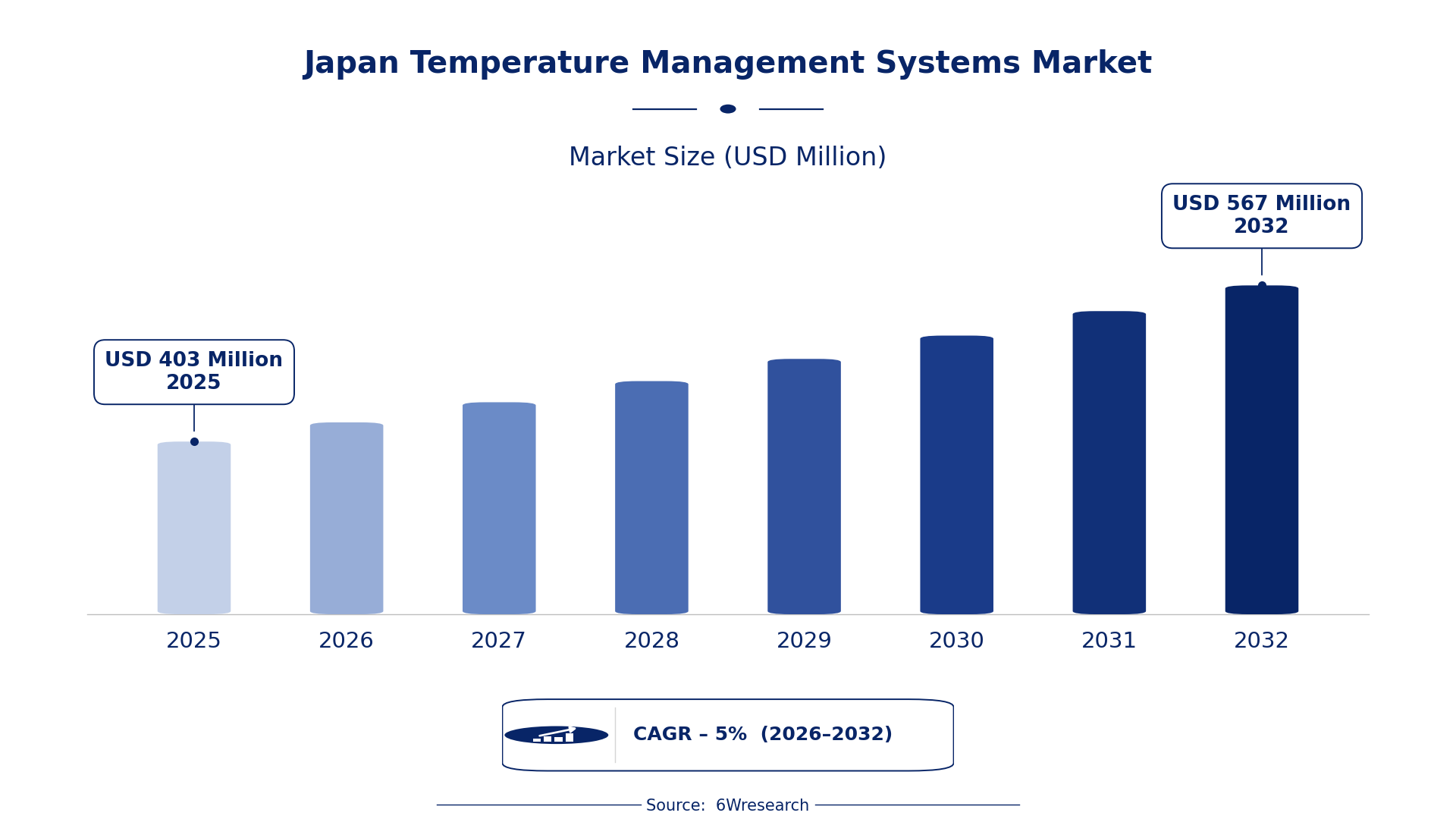
According to 6Wresearch internal database and industry insights, the Japan Temperature Management Systems Market was valued at USD 403 Million in 2025 and is projected to reach USD 567 Million by 2032, growing at a CAGR of approximately 5% during 2026–2032.
Japan Temperature Management Systems Market Highlights
| Report Metric | Details |
| Report Name | Japan Temperature Management Systems Market (2026-2032) |
| Market Size 2025 | USD 403 Million |
| Market Size 2032 | USD 567 Million |
| Absolute Growth 2025–2032 | USD 164 Million |
| CAGR 2026–2032 | 5% |
| Peak Annual Growth | 5.6% in 2030 |
| Forecast Period | 2026–2032 |
| Historical Data | 2022–2025 |
| Base Year | 2025 |
| Leading Management Type, 2025 | Patient Warming Systems (49% share) |
| Leading Modality Used, 2025 | Forced Air/Warm Blankets (34% share) |
| Leading Patient Use Case, 2025 | Surgery/Post-Op (35% share) |
| Leading End User, 2025 | ICUs (44% share) |
| Fastest-Growing Management Type | Patient Cooling Systems (7.2% CAGR) |
| Fastest-Growing Modality Used | Surface/Endovascular (6.6% CAGR) |
| Fastest-Growing Patient Use Case | Cardiac Arrest (6.9% CAGR) |
| Fastest-Growing End User | Emergency Rooms (6.3% CAGR) |
| Growing Sector | Critical Care |
| Key End Users | Hospitals, Emergency Rooms, ICUs, Trauma Centers |
Japan Temperature Management Systems Market Year-wise Growth Rate and Key Drivers (2022–2032)
This graph illustrates the annual growth rates of the market from 2022 to 2032, highlighting a steady upward trajectory and projected market expansion over the forecast period.
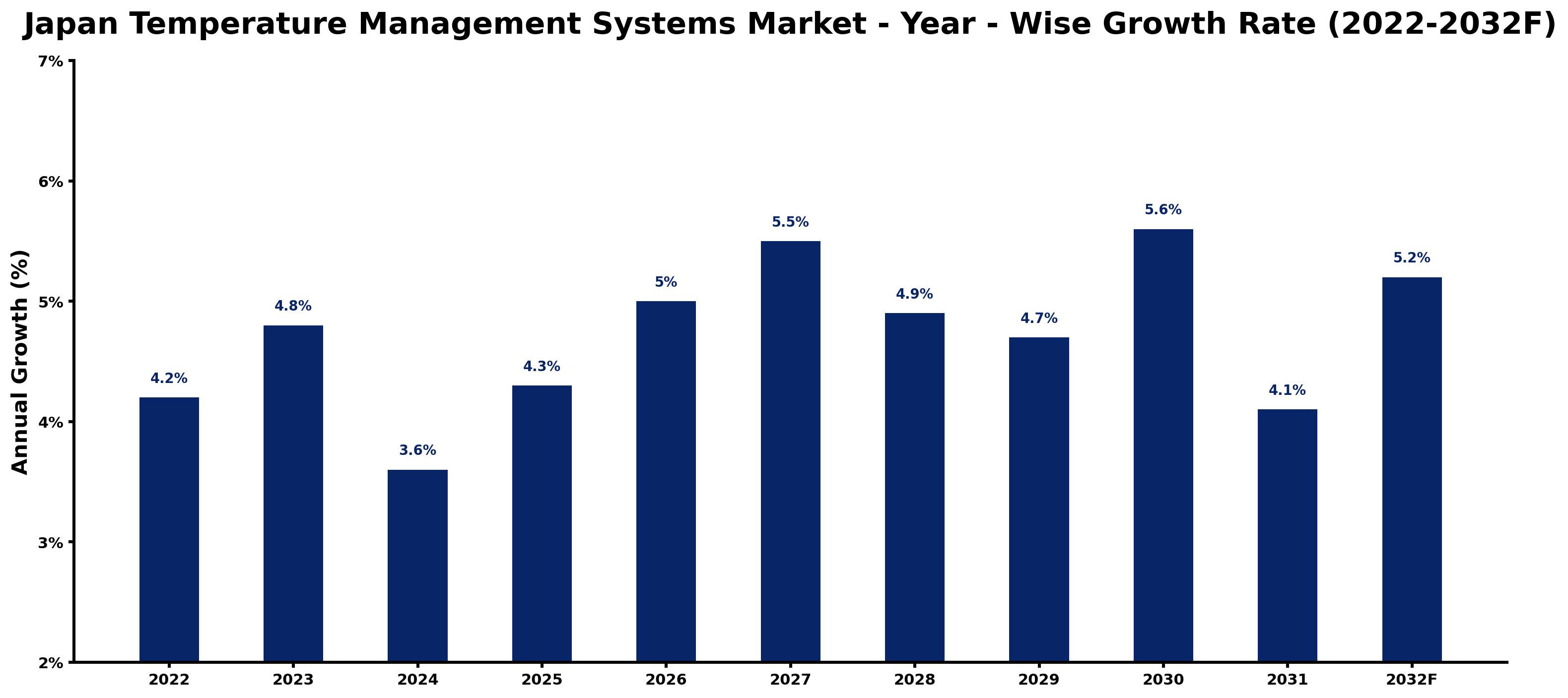
The following figures match every annual growth estimate with the main market development of that year, giving the reasoning behind each rise or slowdown.
| Year | Estimated Annual Growth (%) | Market Rationale |
| 2022 | 4.2 | The market experienced steady growth due to increasing hospital investments in medical technologies. |
| 2023 | 4.8 | Demand rose as hospitals upgraded their equipment and improved patient care standards. |
| 2024 | 3.6 | Growth slowed as hospitals adjusted to new technologies and patient management protocols. |
| 2025 | 4.3 | Renewed interest emerged as surgical procedures increased, boosting system demand. |
| 2026 | 5.0 | Demand is expected to rise with advancements in temperature management technologies. |
| 2027 | 5.5 | Growth is projected to continue as hospitals expand critical care capabilities. |
| 2028 | 4.9 | A slight slowdown is anticipated as market saturation begins in some regions. |
| 2029 | 4.7 | Growth is expected to moderate as hospitals optimize existing systems. |
| 2030 | 5.6 | The market will peak as new guidelines improve temperature management practices. |
| 2031 | 4.1 | Demand will stabilize as hospitals adapt to evolving patient care standards. |
| 2032 | 5.2 | Growth is projected to continue with ongoing healthcare technology advancements. |
Note: Market size estimations and growth projections presented in this report are based on 6Wresearch's proprietary forecasting methodology, utilizing the latest available industry data, government publications, and primary research inputs.
Japan Temperature Management Systems Market Synopsis
Temperature Management Systems are vital medical devices that maintain body temperature during surgical procedures and critical care. These systems, utilising advanced technologies like forced air and conductive heating, are increasingly adopted by hospitals. The Japan Temperature Management Systems Market is expanding due to rising surgical procedures and hospital investments in medical technology. In 2023, government funding for healthcare technology advancements further stimulates demand, while a focus on improving patient outcomes across the healthcare sector is expected to sustain growth in this market.
Market Dynamics Impact Analysis (2026–2032)
| Factor | Type | Impact | Primary Segment Affected |
| Increasing surgical procedures drive demand for patient warming systems. | Driver | High | Patient Warming Systems |
| Growing emphasis on neurocritical care enhances the need for targeted temperature management. | Driver | High | Targeted Temperature Management |
| Emerging technologies in temperature management create opportunities for innovation. | Opportunity | Medium | Hybrid Systems |
| The rise in trauma cases necessitates advanced temperature management solutions. | Opportunity | High | Patient Cooling Systems |
| High costs of advanced systems may limit adoption in smaller facilities. | Restraint | High | Patient Cooling Systems |
| Regulatory compliance can delay product approvals and market entry. | Restraint | Medium | Targeted Temperature Management |
| Limited training for emergency personnel affects system effectiveness in critical situations. | Challenge | High | Emergency Rooms |
| Inconsistent adoption of best practices across hospitals can hinder overall market growth. | Challenge | Medium | ICUs |
Evaluation of Drivers in Japan Temperature Management Systems Market (2026–2032)
The table below links each growth driver to the segment it affects and the evidence for it.
| Drivers | Primary Segment Affected | Why It Matters (Evidence) |
| Rising number of surgical procedures increases demand for patient warming systems. | Patient Warming Systems | In Japan, patient warming systems are critical in over 70% of surgical procedures. |
| Growing focus on neurocritical care increases the need for targeted temperature management. | Targeted Temperature Management | Standardized protocols across major hospitals in Japan ensure effective temperature management. |
| Increased investments in healthcare technology drive demand for advanced temperature management solutions. | Hybrid Systems | The Japanese government allocated ¥500 million for healthcare technology advancements in 2023. |
| Emerging technologies improve patient outcomes and efficiency in critical care settings. | Patient Cooling Systems | Emergency rooms report a significant use of cooling systems for cardiac arrest cases. |
| Higher patient volumes in critical care units necessitate effective temperature management. | ICUs | The average population served by a critical care unit is approximately 200,000. |
Most of the extra volume comes from rising surgical procedures, which have increased demand for patient warming systems critical in over 70% of operations. The focus on neurocritical care is driving the need for targeted temperature management, with standardized protocols ensuring effectiveness. New technologies improve patient outcomes, particularly in emergency rooms where cooling systems are vital for cardiac arrest cases. With critical care units serving an average population of 200,000, the demand for effective temperature management continues to rise.
Evaluation of Restraints in Japan Temperature Management Systems Market
The main factors holding the market back are set out below.
| Market Restraint | Primary Segment Affected | Why It Matters (Evidence) |
| High costs of advanced systems limit adoption in smaller hospitals. | Patient Cooling Systems | Many smaller facilities struggle to afford the latest temperature management technologies. |
| Regulatory compliance can delay product approvals and market entry. | Targeted Temperature Management | Manufacturers must navigate complex regulations set by the Ministry of Health, Labour and Welfare. |
| Insufficient training for emergency personnel affects system effectiveness in critical situations. | Emergency Rooms | Limited training can lead to improper use of temperature management systems. |
| Inconsistent adoption of best practices across hospitals can hinder overall market growth. | ICUs | Variability in protocols affects the quality of patient care and system utilization. |
| Market saturation in urban areas slows growth potential. | Patient Warming Systems | Many hospitals in metropolitan regions have already implemented advanced systems. |
Japan Temperature Management Systems Market Challenges
Japan's healthcare system, serving over 200,000 people per critical care unit, faces challenges with outdated technology, as many temperature management devices do not meet ISO 13485 standards, posing risks during surgeries. Intense competition among suppliers leads to price wars that can compromise device quality and hinder hospitals' ability to provide safe treatments. Buyers, especially hospitals, encounter high maintenance costs for these systems, which can reach ¥500 million, straining their budgets. Increased demand for advanced systems lengthens procurement timelines, delaying critical care and negatively impacting patient outcomes.
Trends in the Japan Temperature Management Systems Market
Buyers and suppliers in the Japan Temperature Management Systems Market are adjusting to the following trends.
- Launch of New Guidelines for Neurocritical Care: In 2023, a new guideline was introduced for temperature management in neurocritical care, enhancing treatment protocols across major hospitals. This standardisation is set to improve patient outcomes significantly.
- Increase in Use of Forced Air Warming Blankets: The use of forced air warming blankets has risen by 30% in surgical settings over the past year, reflecting a growing preference for effective patient warming solutions in hospitals.
- Expansion of Surface and Endovascular Modalities: Surface and endovascular modalities are gaining traction in cardiac care units across Japan, driven by the need for precise temperature control during critical procedures.
- Rise in Thermoregulation Pad Usage: Thermoregulation pads are increasingly utilised in outpatient settings for post-operative care, indicating a shift towards more versatile temperature management solutions.
Investment Opportunities in the Japan Temperature Management Systems Market
The following areas offer the clearest openings for investors and suppliers in the Japan Temperature Management Systems Market.
- Growth in Trauma Centers: The Tokyo region, with the highest concentration of trauma centers, presents an opportunity for temperature management systems, as the demand for advanced solutions rises with an increasing number of trauma cases.
- Investment in Patient Cooling Systems: With a growing number of cardiac arrest cases, there is an opportunity to invest in patient cooling systems, particularly in emergency rooms that require effective temperature management solutions.
- Development of Hybrid Systems: The current gap in versatile temperature management solutions opens opportunities for hybrid systems that combine warming and cooling features, appealing to diverse medical facilities.
- Expansion of Training Programs for Emergency Personnel: The recent national campaign launched in 2023 to improve training for emergency medical personnel creates an opportunity to increase the effectiveness of temperature management systems in critical situations.
Government Initiatives in the Japan Temperature Management Systems Market
The Medical Care Act of 1948 establishes essential standards for hospitals and clinics, including staffing and facilities for temperature management systems. The Long-Term Care Insurance Act, effective from 2000, funds nursing care and support services, ensuring older patients receive adequate temperature management during their care.
The Ministry of Health, Labour and Welfare oversees regulations for medical devices, approving new technologies and funding healthcare advancements. In 2023, the agency allocated ¥500 million to support healthcare technology improvements, increasing the availability of temperature management systems.
Future Insight of the Japan Temperature Management Systems Market
Technological advancements in thermoregulation will reshape demand for temperature management systems by 2032, particularly with the rise of efficient forced air warming blankets and new cooling methods. Government initiatives will promote standardised protocols across hospitals, ensuring uniform patient care. Enhanced training programmes for emergency medical personnel will improve response times in critical situations. The average number of patients treated for stroke annually, approximately 150,000, will drive the need for more effective temperature management solutions, prompting suppliers to develop new products.
Market Segmentation Analysis
Japan Temperature Management Systems Market report covers a detailed analysis of the following market segments:
By Management Type – Patient Warming Systems Lead, Patient Cooling Systems Expected to Grow Fastest
According to Saurav Kr Singh, Senior Research Analyst at 6Wresearch, Patient Warming Systems held 49% of the Japan Temperature Management Systems Market by management type in 2025. Patient warming systems hold the largest share as they are critical in over 70% of surgical procedures in Japan, ensuring patient safety and comfort during operations. Their widespread use across hospitals, particularly in regions with high surgical volumes, reinforces their dominant position. Patient Cooling Systems are set to record the highest CAGR in this split, 7.2% over 2026–2032. The growth of patient cooling systems is accelerated by their essential role in managing hyperthermia during emergencies, particularly in cardiac arrest situations. The increasing adoption of these systems in emergency rooms highlights their growing importance in critical care. Suppliers must focus on expanding the availability and capabilities of cooling systems to address the increasing demand in emergency medical settings.
By Modality Used – Forced Air/Warm Blankets Lead, Surface/Endovascular Expected to Grow Fastest
The largest modality used category in 2025 was Forced Air/Warm Blankets, at 34% of revenue. Forced air and warm blankets dominate the market due to their widespread application in hospitals for patient comfort and warmth during procedures. Their established presence in operating rooms contributes to their leading share. The quickest growth will come from Surface/Endovascular, forecast to expand at a CAGR of 6.6% between 2026 and 2032. Surface and endovascular modalities are experiencing rapid growth as they are increasingly applied in invasive procedures for precise temperature control. This trend is likely to continue as hospitals adopt more advanced techniques. Buyers may benefit from exploring the latest surface and endovascular technologies to improve patient outcomes.
By Patient Use Case – Surgery/Post-Op Leads, Cardiac Arrest Expected to Grow Fastest
In 2025, Surgery/Post-Op led the patient use case split with a 35% share. Surgery and post-operative care are the primary use cases as temperature management is crucial for patient recovery and safety during these stages. The substantial number of surgical procedures performed annually in Japan solidifies this segment's leading position. Over 2026–2032, Cardiac Arrest is expected to post the fastest growth, at a CAGR of 6.9%. The rapid growth in the cardiac arrest use case is driven by the urgent need to preserve brain function following an arrest, which has become a key focus in emergency care. The rising occurrence of cardiac events further intensifies this demand. Healthcare providers should concentrate on investing in solutions specifically designed for cardiac arrest scenarios to improve patient outcomes.
By End User – ICUs Leads, Emergency Rooms Expected to Grow Fastest
ICUs accounted for 44% of the market by end user in 2025. ICUs are the primary users of temperature management systems, as they require consistent and effective temperature regulation for critically ill patients. The high volume of patients treated in these units reinforces their leading position in the market. Emergency Rooms are projected to grow fastest, at a CAGR of 6.3% during 2026–2032. Emergency rooms are experiencing the fastest growth due to the frequent need for immediate temperature management in acute medical situations. The increasing number of emergency cases necessitates effective solutions in these settings. Suppliers should tailor their offerings to meet the specific needs of emergency rooms to capture this growing segment.
Key Attractiveness of the Report
- 10 Years of Market Numbers
- Historical Data Starting from 2022 to 2025
- Base Year 2025
- Forecast Data until 2032
- Key Performance Indicators Impacting the Market
- Major Upcoming Developments and Projects
Key Highlights of the Report:
- Japan Temperature Management Systems Market Outlook
- Market Size of Japan Temperature Management Systems Market, 2025
- Forecast of Japan Temperature Management Systems Market, 2032
- Historical Data and Forecast of Japan Temperature Management Systems Revenues & Volume for the Period 2022-2032F
- Japan Temperature Management Systems Market Trend Evolution
- Japan Temperature Management Systems Market Drivers and Challenges
- Japan Temperature Management Systems Price Trends
- Japan Temperature Management Systems Porter's Five Forces
- Japan Temperature Management Systems Industry Life Cycle
- Historical Data and Forecast of Japan Temperature Management Systems Market Revenues & Volume By Management Type for the Period 2022-2032F
- Historical Data and Forecast of Japan Temperature Management Systems Market Revenues & Volume By Patient Warming Systems for the Period 2022-2032F
- Historical Data and Forecast of Japan Temperature Management Systems Market Revenues & Volume By Patient Cooling Systems for the Period 2022-2032F
- Historical Data and Forecast of Japan Temperature Management Systems Market Revenues & Volume By Targeted Temperature Management for the Period 2022-2032F
- Historical Data and Forecast of Japan Temperature Management Systems Market Revenues & Volume By Hybrid Systems for the Period 2022-2032F
- Historical Data and Forecast of Japan Temperature Management Systems Market Revenues & Volume By Modality Used for the Period 2022-2032F
- Historical Data and Forecast of Japan Temperature Management Systems Market Revenues & Volume By Forced Air/Warm Blankets for the Period 2022-2032F
- Historical Data and Forecast of Japan Temperature Management Systems Market Revenues & Volume By Surface/Endovascular for the Period 2022-2032F
- Historical Data and Forecast of Japan Temperature Management Systems Market Revenues & Volume By Thermoregulation Pads for the Period 2022-2032F
- Historical Data and Forecast of Japan Temperature Management Systems Market Revenues & Volume By Cooling + Heating Units for the Period 2022-2032F
- Historical Data and Forecast of Japan Temperature Management Systems Market Revenues & Volume By Patient Use Case for the Period 2022-2032F
- Historical Data and Forecast of Japan Temperature Management Systems Market Revenues & Volume By Surgery/Post-Op for the Period 2022-2032F
- Historical Data and Forecast of Japan Temperature Management Systems Market Revenues & Volume By Cardiac Arrest, Stroke for the Period 2022-2032F
- Historical Data and Forecast of Japan Temperature Management Systems Market Revenues & Volume By Neurocritical Care for the Period 2022-2032F
- Historical Data and Forecast of Japan Temperature Management Systems Market Revenues & Volume By Trauma/Sepsis for the Period 2022-2032F
- Historical Data and Forecast of Japan Temperature Management Systems Market Revenues & Volume By End User for the Period 2022-2032F
- Historical Data and Forecast of Japan Temperature Management Systems Market Revenues & Volume By ICUs for the Period 2022-2032F
- Historical Data and Forecast of Japan Temperature Management Systems Market Revenues & Volume By Emergency Rooms for the Period 2022-2032F
- Historical Data and Forecast of Japan Temperature Management Systems Market Revenues & Volume By Critical Care Units for the Period 2022-2032F
- Historical Data and Forecast of Japan Temperature Management Systems Market Revenues & Volume By Trauma Centers for the Period 2022-2032F
- Japan Temperature Management Systems Import Export Trade Statistics
- Market Opportunity Assessment By Management Type
- Market Opportunity Assessment By Modality Used
- Market Opportunity Assessment By Patient Use Case
- Market Opportunity Assessment By End User
- Japan Temperature Management Systems Top Companies Market Share
- Japan Temperature Management Systems Competitive Benchmarking By Technical and Operational Parameters
- Japan Temperature Management Systems Company Profiles
- Japan Temperature Management Systems Key Strategic Recommendations
Market Covered
This report examines the market across the segments below.
By Management Type
- Patient Warming Systems
- Patient Cooling Systems
- Targeted Temperature Management
- Hybrid Systems
By Modality Used
- Forced Air/Warm Blankets
- Surface/Endovascular
- Thermoregulation Pads
- Cooling + Heating Units
By Patient Use Case
- Surgery/Post-Op
- Cardiac Arrest
- Stroke
- Neurocritical Care
- Trauma/Sepsis
By End User
- ICUs
- Emergency Rooms
- Critical Care Units
- Trauma Centers































