Japan Temperature regulation technologies Market Size & Growth Rate
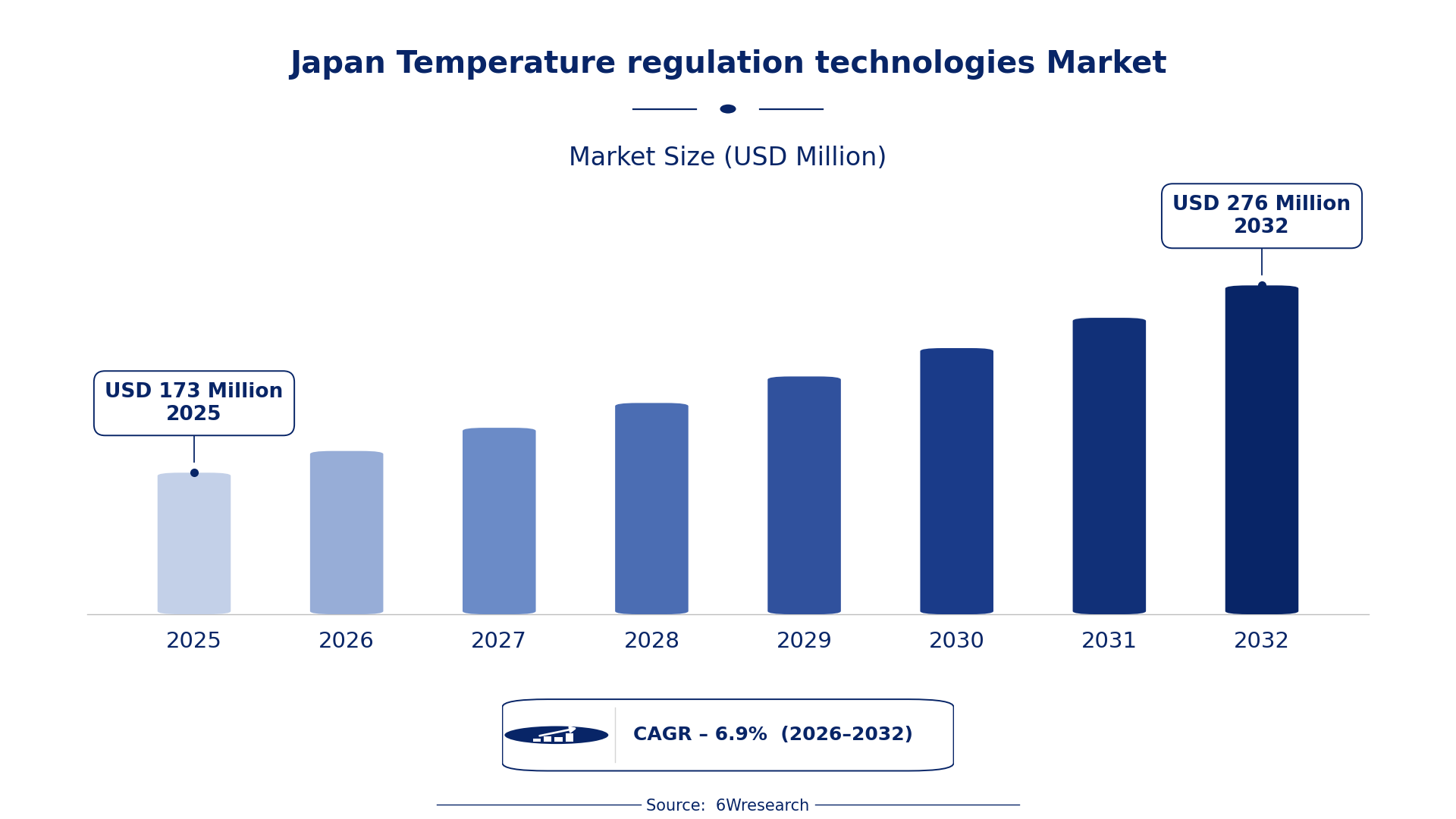
According to 6Wresearch internal database and industry insights, the Japan Temperature regulation technologies Market was valued at USD 173 Million in 2025 and is projected to reach USD 276 Million by 2032, growing at a CAGR of approximately 6.9% during 2026–2032.
Japan Temperature regulation technologies Market Highlights
| Report Metric | Details |
| Report Name | Japan Temperature regulation technologies Market (2026-2032) |
| Market Size 2025 | USD 173 Million |
| Market Size 2032 | USD 276 Million |
| Absolute Growth 2025–2032 | USD 103 Million |
| CAGR 2026–2032 | 6.9% |
| Peak Annual Growth | 7.6% in 2032 |
| Forecast Period | 2026–2032 |
| Historical Data | 2022–2025 |
| Base Year | 2025 |
| Leading Technology Type, 2025 | Thermoelectric Systems (43% share) |
| Leading Use Area, 2025 | Medical & Home Use (34% share) |
| Leading Automation Level, 2025 | Auto-Regulated (40% share) |
| Leading End User, 2025 | Hospital Tech Providers (43% share) |
| Fastest-Growing Technology Type | Phase Change Materials (10.7% CAGR) |
| Fastest-Growing Use Area | Drug Transport (8.8% CAGR) |
| Fastest-Growing Automation Level | Real-Time Feedback (9.1% CAGR) |
| Fastest-Growing End User | Pharmaceutical Firms (9.0% CAGR) |
| Growing Sector | Healthcare |
| Key End Users | Pharmaceutical Firms, Hospital Tech Providers, Wellness Brands |
Japan Temperature regulation technologies Market Year-wise Growth Rate and Key Drivers (2022–2032)
This graph illustrates the annual growth rates of the market from 2022 to 2032, highlighting a steady upward trajectory and projected market expansion over the forecast period.
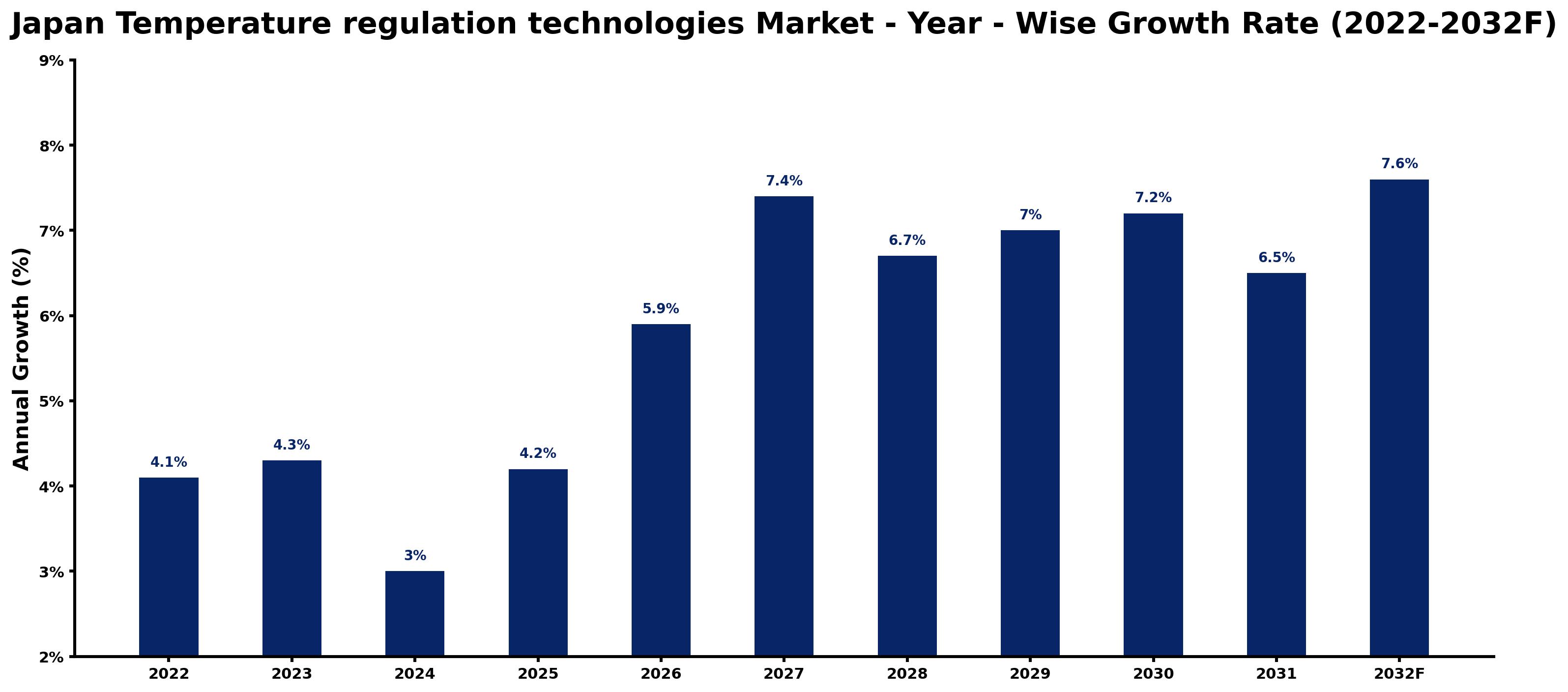
The yearly estimates that follow link every growth rate to its principal driver, so readers can see why the pace changed in each period.
| Year | Estimated Annual Growth (%) | Market Rationale |
| 2022 | 4.1 | The market showed steady growth, reflecting ongoing investments in healthcare technologies. |
| 2023 | 4.3 | Demand increased due to the aging population and heightened focus on healthcare innovations. |
| 2024 | 3.0 | Growth slowed as market adjustments took place after a peak in previous years. |
| 2025 | 4.2 | The market rebounded with renewed investments in advanced medical technologies. |
| 2026 | 5.9 | Demand is expected to surge as healthcare facilities adopt more smart sensor technologies. |
| 2027 | 7.4 | The market will continue to rise, driven by increased adoption of temperature regulation systems. |
| 2028 | 6.7 | Growth is projected to moderate as market saturation begins to affect demand rates. |
| 2029 | 7.0 | Demand will accelerate again with new innovations in temperature regulation technologies. |
| 2030 | 7.2 | The market is expected to maintain momentum as healthcare providers expand their technology portfolios. |
| 2031 | 6.5 | Growth will decelerate slightly as the market reaches a more stable phase. |
| 2032 | 7.6 | The market is projected to peak with advancements in temperature regulation technologies. |
Note: Market size estimations and growth projections presented in this report are based on 6Wresearch's proprietary forecasting methodology, utilizing the latest available industry data, government publications, and primary research inputs.
Japan Temperature regulation technologies Market Synopsis
Temperature regulation technologies involve systems and materials that maintain or alter temperature for various applications, particularly in healthcare. The Japan Temperature regulation technologies Market is expanding due to Japan's aging population, which increases the need for advanced medical technologies. In 2023, the healthcare sector invested over ¥1 trillion in these technologies, underscoring the importance of effective temperature control in drug transport and patient care.
Market Dynamics Impact Analysis (2026–2032)
| Factor | Type | Impact | Primary Segment Affected |
| Aging population driving healthcare demand | Driver | High | Medical & Home Use |
| Investment in smart sensors for hospitals | Driver | High | Smart Sensors |
| Growing need for drug transport solutions | Opportunity | High | Drug Transport |
| Rising demand for wearable health devices | Opportunity | Medium | Wearables & Devices |
| High costs of advanced technologies | Restraint | High | Thermoelectric Systems |
| Regulatory compliance requirements | Restraint | Medium | Phase Change Materials |
| Limited awareness of benefits among smaller providers | Challenge | Medium | Hospital Tech Providers |
| Competition from alternative temperature solutions | Challenge | High | Conductive Heating Mats |
Evaluation of Drivers in Japan Temperature regulation technologies Market (2026–2032)
The factors lifting demand, and the evidence behind each, are summarised below.
| Drivers | Primary Segment Affected | Why It Matters (Evidence) |
| Increased healthcare spending | Medical & Home Use | Japan's healthcare sector invested over ¥1 trillion in advanced medical technologies in 2023. |
| Adoption of smart sensors | Smart Sensors | The adoption rate of smart sensors in medical devices is estimated at over 30% as of 2023. |
| Demand for temperature-sensitive pharmaceuticals | Drug Transport | Japan's pharmaceutical market is valued at approximately ¥10 trillion, necessitating effective temperature control. |
| Growth in wellness brands | Wearables & Devices | Phase change materials are becoming popular in wearable devices for health monitoring applications. |
| Technological advancements in medical devices | Thermoelectric Systems | The Tokyo metropolitan area is a hub for medical technology innovation, driving demand. |
Buyers are adding capacity as Japan's healthcare sector invested over ¥1 trillion in advanced medical technologies in 2023. The adoption rate of smart sensors in medical devices is estimated at over 30%, prompting hospitals to purchase more advanced equipment. Demand for temperature-sensitive pharmaceuticals, valued at approximately ¥10 trillion, requires effective temperature control solutions. Wellness brands increasingly use phase change materials in health monitoring wearables, leading to higher purchases.
Evaluation of Restraints in Japan Temperature regulation technologies Market
The key brakes on demand, and where they bite hardest, are shown below.
| Market Restraint | Primary Segment Affected | Why It Matters (Evidence) |
| High costs of implementing advanced technologies | Thermoelectric Systems | The initial investment for advanced temperature regulation systems can exceed ¥100 million. |
| Regulatory compliance requirements for medical devices | Phase Change Materials | Manufacturers must adhere to ISO 13485 standards for quality management in medical devices. |
| Limited awareness of benefits among smaller providers | Hospital Tech Providers | Many smaller hospitals lack knowledge about the advantages of temperature regulation technologies. |
| Competition from alternative temperature solutions | Conductive Heating Mats | Conductive heating mats face competition from other heating solutions in home care settings. |
| Supply chain disruptions affecting material availability | Smart Sensors | Recent global supply chain issues have delayed the availability of critical components. |
Japan Temperature regulation technologies Market Challenges
In 2023, health equipment manufacturers in the Tokyo metropolitan area face intense competition, compelling suppliers to reduce prices and eroding profit margins. Increased costs of raw materials, especially advanced materials for temperature regulation systems, impose financial burdens on producers, resulting in higher expenses for buyers in the healthcare sector. Strict regulations from the Ministry of Health, Labour and Welfare complicate compliance, causing delays for hospitals aiming to implement new systems. A shortage of skilled technicians in Japan's healthcare sector hampers the installation and maintenance of temperature regulation solutions, creating operational inefficiencies for clinics and hospitals.
Trends in the Japan Temperature regulation technologies Market
The following changes are redrawing the Japan Temperature regulation technologies Market.
- Shift Towards Smart Sensors in Healthcare: The 2023 health technology initiative promotes the use of smart sensors in hospitals, increasing the adoption rate of these technologies to over 40% by 2025.
- Growth of Phase Change Materials in Wearables: Since 2022, phase change materials have gained traction in wearable health devices, improving temperature regulation. The market for these materials in wearables is projected to grow significantly.
- Increased Focus on Drug Transport Solutions: The Japan Pharmaceutical Manufacturers Association has advocated for improved temperature control in drug transport since 2023, resulting in a notable increase in demand for related technologies.
- Expansion of Telemedicine Requirements: The Japanese government's target to enhance telemedicine by 2025 necessitates effective temperature regulation technologies, driving investments in this area.
Investment Opportunities in the Japan Temperature regulation technologies Market
The following opportunities in the Japan Temperature regulation technologies Market pair current demand with a clear way in.
- Growing Demand for Drug Transport Solutions: With Japan's pharmaceutical market valued at approximately ¥10 trillion, there is an opportunity for temperature regulation technologies in drug transport, especially in urban areas like Tokyo.
- Investment in Smart Healthcare Technologies: The 2023 subsidy program for hospitals adopting smart healthcare technologies presents a chance for suppliers to enter the market through partnerships with healthcare providers.
- Rising Adoption of Wearable Health Devices: As phase change materials become popular in wearables, suppliers can target wellness brands looking to improve their product offerings, especially in regions with high health awareness.
- Expansion of Healthcare Facilities: The increasing number of healthcare facilities in urban areas creates a demand for advanced temperature regulation systems, particularly in hospitals and clinics.
Government Initiatives in the Japan Temperature regulation technologies Market
Temperature regulation technologies are influenced by various laws, including the Economic Security Promotion Act of 2022, which supports supply-chain resilience for critical products. The Chemical Substances Control Law of 1973 mandates the evaluation of chemical substances used in manufacturing, ensuring safety in temperature regulation technologies.
The Ministry of Health, Labour and Welfare oversees regulations affecting temperature-sensitive pharmaceuticals. This agency funds initiatives that promote the integration of advanced temperature regulation technologies in healthcare settings, improving patient care and safety.
Future Insight of the Japan Temperature regulation technologies Market
Investment in temperature regulation solutions will exceed ¥1 trillion by 2032, driven by an aging population and increased demand for effective medical applications. The adoption of advanced monitoring systems will improve patient care and streamline operations. Research initiatives from academic institutions will generate new temperature regulation applications for critical care settings. Government support for hospitals adopting these solutions will accelerate integration, creating opportunities for both suppliers and healthcare providers.
Market Segmentation Analysis
Japan Temperature regulation technologies Market report covers a detailed analysis of the following market segments:
By Technology Type – Thermoelectric Systems Lead, Phase Change Materials Expected to Grow Fastest
According to Saurav Kr Singh, Senior Research Analyst at 6Wresearch, Thermoelectric Systems held 43% of the Japan Temperature regulation technologies Market by technology type in 2025. Thermoelectric systems lead the market due to their essential role in precise temperature control for medical devices. Their application is critical in maintaining the necessary conditions for temperature-sensitive pharmaceuticals during transport, ensuring both efficacy and safety. Phase Change Materials are set to record the highest CAGR in this split, 10.7% over 2026–2032. Phase change materials are rapidly gaining traction as they are increasingly utilised in drug transport to maintain stable temperatures for sensitive medications. The Japanese pharmaceutical market, valued at ¥10 trillion, underscores the growing importance of these materials in ensuring drug integrity. Suppliers should prioritise the development of advanced thermoelectric systems to cater to the rising demand in the healthcare sector.
By Use Area – Medical & Home Use Leads, Drug Transport Expected to Grow Fastest
In 2025, Medical & Home Use led the use area split with a 34% share. The medical and home use segment is the largest due to its broad range of applications in healthcare and home care settings. This segment addresses the crucial need for temperature regulation in various medical devices and patient comfort solutions, especially with an aging population. Over 2026–2032, Drug Transport is expected to post the fastest growth, at a CAGR of 8.8%. Drug transport is the fastest-growing area as it is vital for maintaining temperature-sensitive pharmaceuticals, with substantial investments being made in this field. The increasing emphasis on drug safety significantly drives the demand for effective temperature regulation solutions in logistics and storage. Buyers must focus on reliable temperature regulation technologies to ensure compliance and safety in drug transport.
By Automation Level – Auto-Regulated Leads, Real-Time Feedback Expected to Grow Fastest
Auto-Regulated accounted for 40% of the market by automation level in 2025. Auto-regulated systems dominate the market as they are commonly found in advanced medical equipment for precise temperature control. Their reliability in maintaining optimal conditions is particularly crucial in healthcare settings, especially for critical care applications. The quickest growth will come from Real-Time Feedback, forecast to expand at a CAGR of 9.1% between 2026 and 2032. Real-time feedback systems are experiencing rapid growth because they are essential for monitoring patient conditions, thereby enhancing care delivery in hospitals. The rising investment in smart healthcare technologies aligns with the need for timely interventions in patient care. Suppliers should invest in real-time feedback technologies to capture the expanding market of automated healthcare solutions.
By End User – Hospital Tech Providers Lead, Pharmaceutical Firms Expected to Grow Fastest
The largest end user category in 2025 was Hospital Tech Providers, at 43% of revenue. Hospital tech providers hold the largest share as they supply critical temperature regulation solutions to healthcare facilities, ensuring patient safety and comfort. Their established relationships with hospitals facilitate the widespread adoption of these technologies, particularly in critical care environments. Pharmaceutical Firms are projected to grow fastest, at a CAGR of 9.0% during 2026–2032. Pharmaceutical firms represent the fastest-growing end user segment as they require effective solutions for drug transport and storage. The focus on maintaining drug efficacy drives the demand for advanced temperature regulation technologies in this sector, especially with increased regulatory scrutiny. Buyers in the pharmaceutical sector should seek partnerships with technology providers to enhance their temperature control capabilities.
Key Attractiveness of the Report
- 10 Years of Market Numbers
- Historical Data Starting from 2022 to 2025
- Base Year 2025
- Forecast Data until 2032
- Key Performance Indicators Impacting the Market
- Major Upcoming Developments and Projects
Key Highlights of the Report:
- Japan Temperature regulation technologies Market Outlook
- Market Size of Japan Temperature regulation technologies Market, 2025
- Forecast of Japan Temperature regulation technologies Market, 2032
- Historical Data and Forecast of Japan Temperature regulation technologies Revenues & Volume for the Period 2022-2032F
- Japan Temperature regulation technologies Market Trend Evolution
- Japan Temperature regulation technologies Market Drivers and Challenges
- Japan Temperature regulation technologies Price Trends
- Japan Temperature regulation technologies Porter's Five Forces
- Japan Temperature regulation technologies Industry Life Cycle
- Historical Data and Forecast of Japan Temperature regulation technologies Market Revenues & Volume By Technology Type for the Period 2022-2032F
- Historical Data and Forecast of Japan Temperature regulation technologies Market Revenues & Volume By Thermoelectric Systems for the Period 2022-2032F
- Historical Data and Forecast of Japan Temperature regulation technologies Market Revenues & Volume By Phase Change Materials for the Period 2022-2032F
- Historical Data and Forecast of Japan Temperature regulation technologies Market Revenues & Volume By Conductive Heating Mats for the Period 2022-2032F
- Historical Data and Forecast of Japan Temperature regulation technologies Market Revenues & Volume By Smart Sensors for the Period 2022-2032F
- Historical Data and Forecast of Japan Temperature regulation technologies Market Revenues & Volume By Use Area for the Period 2022-2032F
- Historical Data and Forecast of Japan Temperature regulation technologies Market Revenues & Volume By Wearables & Devices for the Period 2022-2032F
- Historical Data and Forecast of Japan Temperature regulation technologies Market Revenues & Volume By Drug Transport for the Period 2022-2032F
- Historical Data and Forecast of Japan Temperature regulation technologies Market Revenues & Volume By Medical & Home Use for the Period 2022-2032F
- Historical Data and Forecast of Japan Temperature regulation technologies Market Revenues & Volume By ICU Beds/Chairs for the Period 2022-2032F
- Historical Data and Forecast of Japan Temperature regulation technologies Market Revenues & Volume By Automation Level for the Period 2022-2032F
- Historical Data and Forecast of Japan Temperature regulation technologies Market Revenues & Volume By Auto-Regulated for the Period 2022-2032F
- Historical Data and Forecast of Japan Temperature regulation technologies Market Revenues & Volume By Passive Cooling for the Period 2022-2032F
- Historical Data and Forecast of Japan Temperature regulation technologies Market Revenues & Volume By Adjustable Settings for the Period 2022-2032F
- Historical Data and Forecast of Japan Temperature regulation technologies Market Revenues & Volume By Real-Time Feedback for the Period 2022-2032F
- Historical Data and Forecast of Japan Temperature regulation technologies Market Revenues & Volume By End User for the Period 2022-2032F
- Historical Data and Forecast of Japan Temperature regulation technologies Market Revenues & Volume By Wellness Brands for the Period 2022-2032F
- Historical Data and Forecast of Japan Temperature regulation technologies Market Revenues & Volume By Pharmaceutical Firms for the Period 2022-2032F
- Historical Data and Forecast of Japan Temperature regulation technologies Market Revenues & Volume By Health Equipment OEMs for the Period 2022-2032F
- Historical Data and Forecast of Japan Temperature regulation technologies Market Revenues & Volume By Hospital Tech Providers for the Period 2022-2032F
- Japan Temperature regulation technologies Import Export Trade Statistics
- Market Opportunity Assessment By Technology Type
- Market Opportunity Assessment By Use Area
- Market Opportunity Assessment By Automation Level
- Market Opportunity Assessment By End User
- Japan Temperature regulation technologies Top Companies Market Share
- Japan Temperature regulation technologies Competitive Benchmarking By Technical and Operational Parameters
- Japan Temperature regulation technologies Company Profiles
- Japan Temperature regulation technologies Key Strategic Recommendations
Market Covered
The following segment groups are covered in the report.
By Technology Type
- Thermoelectric Systems
- Phase Change Materials
- Conductive Heating Mats
- Smart Sensors
By Use Area
- Wearables & Devices
- Drug Transport
- Medical & Home Use
- ICU Beds/Chairs
By Automation Level
- Auto-Regulated
- Passive Cooling
- Adjustable Settings
- Real-Time Feedback
By End User
- Wellness Brands
- Pharmaceutical Firms
- Health Equipment OEMs
- Hospital Tech Providers































