Japan Terminal Automation Systems Market Size & Growth Rate
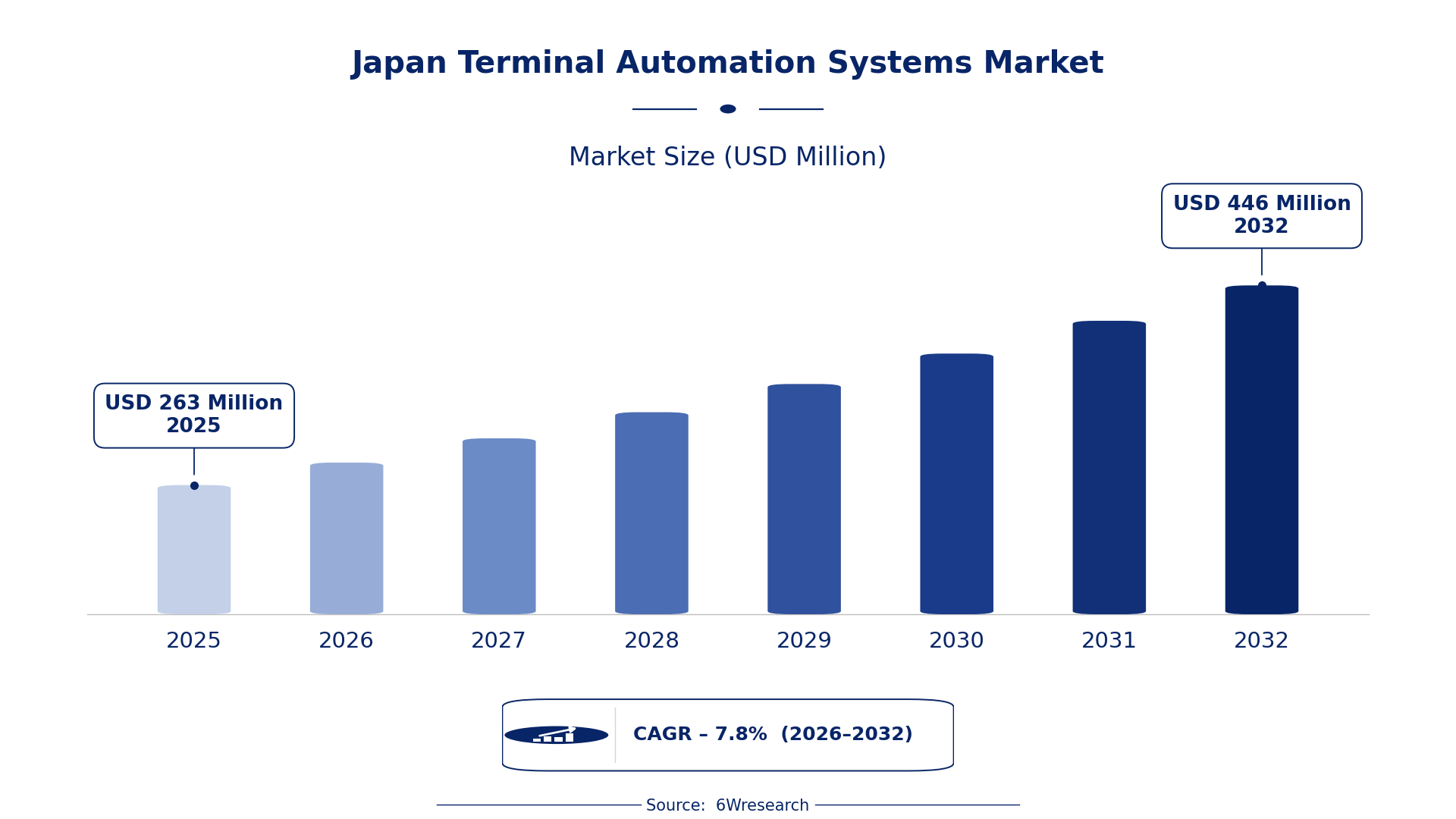
According to 6Wresearch internal database and industry insights, the Japan Terminal Automation Systems Market was valued at USD 263 Million in 2025 and is projected to reach USD 446 Million by 2032, growing at a CAGR of approximately 7.8% during 2026–2032.
Japan Terminal Automation Systems Market Highlights
| Report Metric | Details |
| Report Name | Japan Terminal Automation Systems Market (2026-2032) |
| Market Size 2025 | USD 263 Million |
| Market Size 2032 | USD 446 Million |
| Absolute Growth 2025–2032 | USD 183 Million |
| CAGR 2026–2032 | 7.8% |
| Peak Annual Growth | 8.6% in 2032 |
| Forecast Period | 2026–2032 |
| Historical Data | 2022–2025 |
| Base Year | 2025 |
| Leading Automation Level, 2025 | Fully Automated Terminals (42% share) |
| Leading Component Type, 2025 | SCADA/PLC (35% share) |
| Leading Fuel Type, 2025 | Oil/Gas/LNG (50% share) |
| Leading End User, 2025 | Energy Distributors (39% share) |
| Fastest-Growing Automation Level | IoT-Connected Solutions (11.2% CAGR) |
| Fastest-Growing Component Type | Real-Time Monitoring (11.8% CAGR) |
| Fastest-Growing Fuel Type | Petrochemicals (11.3% CAGR) |
| Fastest-Growing End User | Port Authorities (10.0% CAGR) |
| Growing Sector | Energy Distribution |
| Key End Users | Energy Distributors, Refining Plants, Port Authorities, Storage Operators |
Japan Terminal Automation Systems Market Year-wise Growth Rate and Key Drivers (2022–2032)
This graph illustrates the annual growth rates of the market from 2022 to 2032, highlighting a steady upward trajectory and projected market expansion over the forecast period.
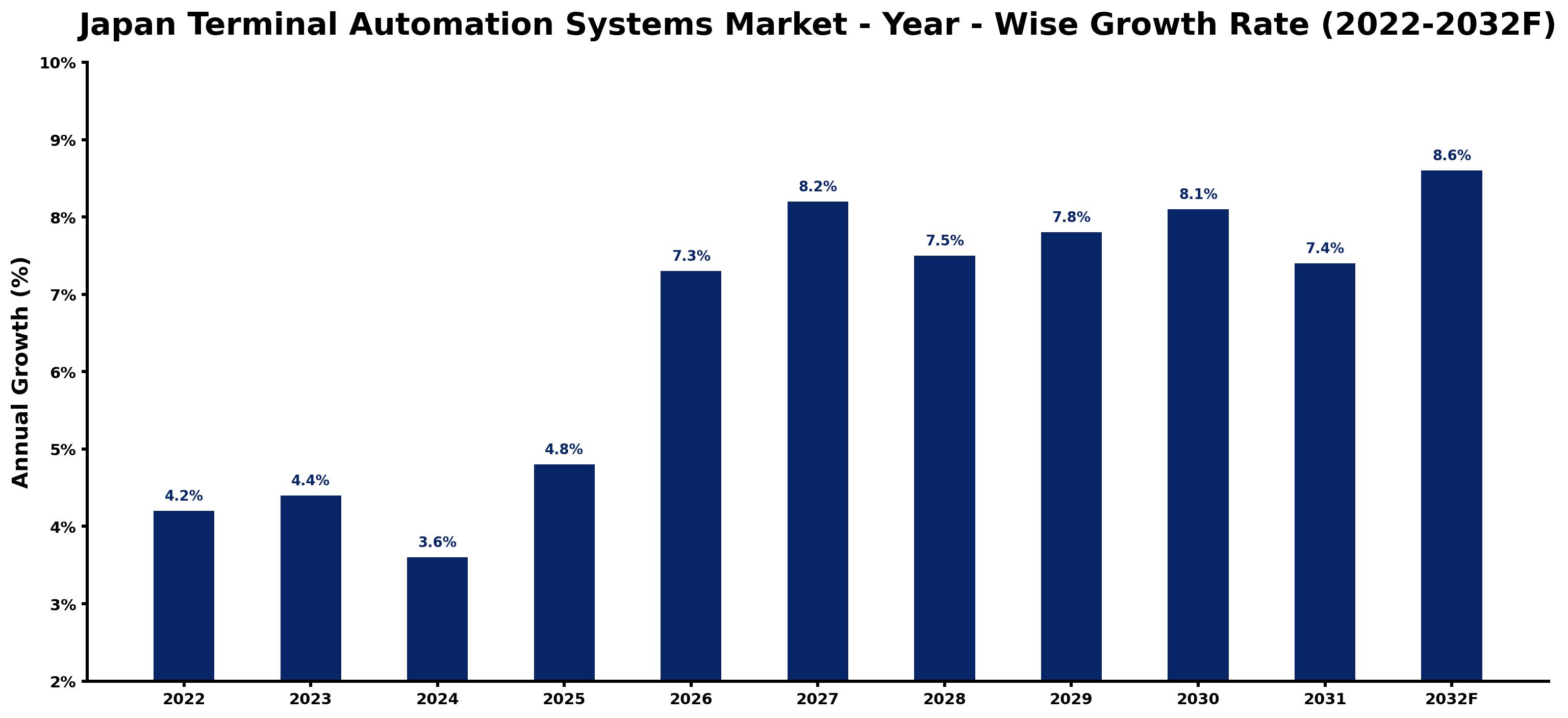
Each row of the following table gives one year's estimated growth and the event or demand shift that explains it.
| Year | Estimated Annual Growth (%) | Market Rationale |
| 2022 | 4.2 | The market exhibited steady growth due to ongoing investments in terminal infrastructure. |
| 2023 | 4.4 | Demand increased as energy distributors expanded their operations and upgraded systems. |
| 2024 | 3.6 | Growth slowed as some projects faced delays in implementation and funding. |
| 2025 | 4.8 | The market saw a resurgence as refining plants accelerated automation initiatives. |
| 2026 | 7.3 | Investment in IoT-connected solutions drove faster growth in terminal operations. |
| 2027 | 8.2 | Demand surged as energy distributors adopted advanced automation technologies. |
| 2028 | 7.5 | Growth moderated as market saturation began to impact new installations. |
| 2029 | 7.8 | Increased focus on sustainability led to higher demand for automation in terminals. |
| 2030 | 8.1 | The market expanded as refining plants upgraded to meet regulatory standards. |
| 2031 | 7.4 | Growth slowed as competition intensified among automation providers. |
| 2032 | 8.6 | Demand peaked as energy distributors fully integrated automation into operations. |
Note: Market size estimations and growth projections presented in this report are based on 6Wresearch's proprietary forecasting methodology, utilizing the latest available industry data, government publications, and primary research inputs.
Japan Terminal Automation Systems Market Synopsis
Terminal Automation Systems streamline and automate operations for handling liquids and gases, integrating software and hardware components like SCADA systems and flow meters. This market is expanding in Japan, propelled by over 100 major energy distributors and ongoing infrastructure investments. The government aims for substantial decarbonisation investments, while the uptake of IoT-connected solutions improves operational efficiency, safety, and compliance in energy distribution and refining processes.
Market Dynamics Impact Analysis (2026–2032)
| Factor | Type | Impact | Primary Segment Affected |
| Growing investments in infrastructure modernization | Driver | High | Fully Automated Terminals |
| Increased focus on sustainability and compliance | Driver | High | IoT-Connected Solutions |
| Rising demand for automation in refining plants | Opportunity | High | Refining Plants |
| Expansion of port authorities adopting automation | Opportunity | Medium | Port Authorities |
| High initial investment costs for automation systems | Restraint | High | Semi-Automated Systems |
| Limited skilled workforce for advanced automation technologies | Restraint | Medium | Integrated ERP Terminals |
| Competition among automation providers intensifying | Challenge | High | SCADA/PLC |
| Technological advancements outpacing market adaptation | Challenge | Medium | Flow Meters/Valves |
Evaluation of Drivers in Japan Terminal Automation Systems Market (2026–2032)
Below are the drivers that matter most for revenue growth, with supporting evidence.
| Drivers | Primary Segment Affected | Why It Matters (Evidence) |
| Investment in infrastructure modernization | Fully Automated Terminals | Japan's government allocated ¥5 billion for infrastructure improvements, prompting energy distributors to upgrade their systems. |
| Adoption of IoT technologies | IoT-Connected Solutions | Real-time monitoring systems are now included in 80% of new terminal projects, enhancing operational efficiency. |
| Demand for compliance with environmental regulations | Refining Plants | Japan targets a 46% cut in greenhouse-gas emissions by 2030, driving automation in refining processes. |
| Expansion of energy distribution networks | Energy Distributors | Over 100 major energy distributors are investing in terminal automation to improve distribution efficiency. |
| Increased focus on safety and operational efficiency | SCADA/PLC | The installed base of SCADA systems in Japan's terminals exceeds 500 units, reflecting heightened safety measures. |
The adoption of IoT technologies is transforming terminal operations, as seen in 80% of new projects implementing real-time monitoring systems. Major energy distributors are increasingly automating their networks to improve distribution efficiency. The installed base of SCADA systems, exceeding 500 units, reflects the focus on safety and operational efficiency in terminal automation.
Evaluation of Restraints in Japan Terminal Automation Systems Market
The key brakes on demand, and where they bite hardest, are shown below.
| Market Restraint | Primary Segment Affected | Why It Matters (Evidence) |
| High initial investment costs for automation systems | Semi-Automated Systems | High investment costs deter smaller operators from adopting advanced automation, limiting market growth. |
| Limited skilled workforce for advanced automation technologies | Integrated ERP Terminals | A shortage of skilled technicians hampers the implementation of sophisticated automation solutions, affecting productivity. |
| Regulatory compliance challenges | Fully Automated Terminals | Complex regulations increase operational costs for terminal operators, impacting their automation investments. |
| Market saturation in certain regions | IoT-Connected Solutions | As major players adopt IoT technologies, opportunities for new entrants diminish in saturated markets. |
| Technological advancements outpacing market adaptation | Flow Meters/Valves | Rapid technological changes can leave some operators behind, affecting their competitiveness in the market. |
Japan Terminal Automation Systems Market Challenges
Stringent regulations in Japan elevate operational costs for producers, resulting in project delays averaging 20% for energy distributors. Intense competition among over 100 major energy distributors drives prices down, compelling suppliers to cut margins and limiting their capacity to invest in new technologies. Rising material costs, worsened by a national minimum wage increase to JPY 1,055 per hour, strain budgets for producers, leading to higher prices for buyers. Rapid technological advancements necessitate frequent upgrades, which can postpone implementation for clinics and plants, risking operational inefficiencies.
Trends in the Japan Terminal Automation Systems Market
Buyers and suppliers in the Japan Terminal Automation Systems Market are adjusting to the following trends.
- Green Growth Strategy Promoting Automation: Japan's commitment to carbon neutrality by 2050 is driving automation in energy sectors. The government plans for ¥150 trillion in decarbonisation investments over ten years, boosting demand for advanced terminal automation systems.
- Shift Towards IoT-Connected Solutions: A shift towards IoT-connected solutions is apparent in terminal operations, enhancing real-time data collection. Approximately 80% of new terminal projects now integrate these technologies, improving operational efficiency and safety.
- Increased Automation in Refining Plants: Refining plants are embracing greater automation to meet stricter environmental regulations. This trend aligns with Japan's goal to cut greenhouse gas emissions by 46% by 2030, enhancing operational efficiency.
- Expansion of Port Authorities' Automation Initiatives: Port authorities throughout Japan are broadening their automation initiatives, particularly in Tokyo Bay. This area accounts for 30% of terminal automation demand, reflecting the rising need for efficient cargo management.
Investment Opportunities in the Japan Terminal Automation Systems Market
Where to invest in the Japan Terminal Automation Systems Market: the main openings are set out below.
- Timing for Investment in Automation: With Japan aiming for a 46% reduction in greenhouse gas emissions by 2030, there is an urgent need for automation. Suppliers can invest in advanced terminal automation systems to fulfil this demand.
- Focus on Port Authorities' Automation Needs: Tokyo Bay, representing 30% of terminal automation demand, offers a substantial opportunity for suppliers. Investing in automation solutions tailored for port operations can yield significant returns.
- Supply of IoT-Connected Solutions: The growing adoption of IoT technologies in terminals presents an opportunity for suppliers. Focusing on real-time monitoring systems can attract energy distributors seeking to improve efficiency.
- Investment in Refining Automation: The refining sector's drive for automation due to regulatory compliance presents a promising opportunity. Suppliers should partner with refining plants to deliver customised automation solutions.
Government Initiatives in the Japan Terminal Automation Systems Market
The Green Growth Strategy Through Achieving Carbon Neutrality in 2050, updated in 2021, encourages investments in terminal automation. This strategy complements existing laws by setting ambitious targets for decarbonisation, driving demand for advanced automation technologies in the energy sector.
The Ministry of Economy, Trade and Industry supports automation initiatives through funding and resources. With a budget of ¥5 billion allocated for infrastructure modernization, energy distributors can access resources to improve terminal operations.
Future Insight of the Japan Terminal Automation Systems Market
The JPY 150 trillion investment in decarbonisation will drive demand for terminal automation systems, particularly in energy distribution and refining. By 2032, the installed base of SCADA systems is projected to exceed 1,000 units, improving operational efficiency for buyers. The implementation of JIS B 8001 standards will ensure quality and reliability, benefiting suppliers by standardising processes. Increased government funding for infrastructure modernization will spur innovation and create growth opportunities within the sector.
Market Segmentation Analysis
Japan Terminal Automation Systems Market report covers a detailed analysis of the following market segments:
By Automation Level – Fully Automated Terminals Lead, IoT-Connected Solutions Expected to Grow Fastest
According to Saurav Kr Singh, Senior Research Analyst at 6Wresearch, Fully Automated Terminals held 42% of the Japan Terminal Automation Systems Market by automation level in 2025. Fully automated terminals dominate the market due to their essential role in maximising efficiency for energy distributors. With over 100 major energy distributors in Japan, these systems are crucial for optimising terminal operations and meeting demand. The quickest growth will come from IoT-Connected Solutions, forecast to expand at a CAGR of 11.2% between 2026 and 2032. IoT-connected solutions are experiencing rapid growth because they significantly enhance real-time data collection, which is vital for operational efficiency. The adoption of these solutions in 80% of new terminal projects underscores their strong growth potential. Suppliers should focus on developing IoT-connected solutions to meet the rising demand for improved operational efficiency.
By Component Type – SCADA/PLC Leads, Real-Time Monitoring Expected to Grow Fastest
In 2025, SCADA/PLC led the component type split with a 35% share. SCADA/PLC systems lead the market as they are vital for effectively monitoring and controlling terminal operations. The installed base of over 500 SCADA systems in Japan's terminals highlights their critical role in the industry. Real-Time Monitoring is projected to grow fastest, at a CAGR of 11.8% during 2026–2032. Real-time monitoring is the fastest-growing component type, providing immediate insights that greatly enhance safety and operational efficiency. The increasing reliance on these systems in new terminal projects is a key factor driving their rapid growth. Buyers should prioritise the integration of real-time monitoring systems to enhance operational insights and safety in terminal operations.
By Fuel Type – Oil/Gas/LNG Leads, Petrochemicals Expected to Grow Fastest
The largest fuel type category in 2025 was Oil/Gas/LNG, at 50% of revenue. Oil, gas, and LNG are the primary focus of terminal automation systems in Japan, effectively addressing the country's energy distribution needs. Their extensive use in terminal operations solidifies their leading position in the market. Over 2026–2032, Petrochemicals are expected to post the fastest growth, at a CAGR of 11.3%. Petrochemicals are witnessing rapid growth as automated systems become more widely used for handling and processing in this sector. The rising demand for petrochemical products is a significant factor driving this segment's expansion. Suppliers must adapt to the growing demand for automation in petrochemical handling to capitalise on emerging market opportunities.
By End User – Energy Distributors Lead, Port Authorities Expected to Grow Fastest
With 39% of end user revenue in 2025, Energy Distributors was the largest category. Energy distributors are the largest user group of terminal automation systems, requiring efficient distribution methods to meet national energy targets. Their substantial investments in automation technologies drive the market's leadership position. Port Authorities are set to record the highest CAGR in this split, 10.0% over 2026–2032. Port authorities are the fastest-growing end users, leveraging automation to manage cargo and streamline operations at ports. The increasing number of port authorities adopting these systems is a crucial factor for growth in this segment. Suppliers should target port authorities to capitalise on the rapid adoption of automation technologies in cargo management.
Key Attractiveness of the Report
- 10 Years of Market Numbers
- Historical Data Starting from 2022 to 2025
- Base Year 2025
- Forecast Data until 2032
- Key Performance Indicators Impacting the Market
- Major Upcoming Developments and Projects
Key Highlights of the Report:
- Japan Terminal Automation Systems Market Outlook
- Market Size of Japan Terminal Automation Systems Market, 2025
- Forecast of Japan Terminal Automation Systems Market, 2032
- Historical Data and Forecast of Japan Terminal Automation Systems Revenues & Volume for the Period 2022-2032F
- Japan Terminal Automation Systems Market Trend Evolution
- Japan Terminal Automation Systems Market Drivers and Challenges
- Japan Terminal Automation Systems Price Trends
- Japan Terminal Automation Systems Porter's Five Forces
- Japan Terminal Automation Systems Industry Life Cycle
- Historical Data and Forecast of Japan Terminal Automation Systems Market Revenues & Volume By Automation Level for the Period 2022-2032F
- Historical Data and Forecast of Japan Terminal Automation Systems Market Revenues & Volume By Fully Automated Terminals for the Period 2022-2032F
- Historical Data and Forecast of Japan Terminal Automation Systems Market Revenues & Volume By Semi-Automated Systems for the Period 2022-2032F
- Historical Data and Forecast of Japan Terminal Automation Systems Market Revenues & Volume By Integrated ERP Terminals for the Period 2022-2032F
- Historical Data and Forecast of Japan Terminal Automation Systems Market Revenues & Volume By IoT-Connected Solutions for the Period 2022-2032F
- Historical Data and Forecast of Japan Terminal Automation Systems Market Revenues & Volume By Component Type for the Period 2022-2032F
- Historical Data and Forecast of Japan Terminal Automation Systems Market Revenues & Volume By SCADA/PLC for the Period 2022-2032F
- Historical Data and Forecast of Japan Terminal Automation Systems Market Revenues & Volume By Flow Meters/Valves for the Period 2022-2032F
- Historical Data and Forecast of Japan Terminal Automation Systems Market Revenues & Volume By Loading/Dispatch Software for the Period 2022-2032F
- Historical Data and Forecast of Japan Terminal Automation Systems Market Revenues & Volume By Real-Time Monitoring for the Period 2022-2032F
- Historical Data and Forecast of Japan Terminal Automation Systems Market Revenues & Volume By Fuel Type for the Period 2022-2032F
- Historical Data and Forecast of Japan Terminal Automation Systems Market Revenues & Volume By Oil/Gas/LNG for the Period 2022-2032F
- Historical Data and Forecast of Japan Terminal Automation Systems Market Revenues & Volume By Petrochemicals for the Period 2022-2032F
- Historical Data and Forecast of Japan Terminal Automation Systems Market Revenues & Volume By Multiple for the Period 2022-2032F
- Historical Data and Forecast of Japan Terminal Automation Systems Market Revenues & Volume By Crude + Refined for the Period 2022-2032F
- Historical Data and Forecast of Japan Terminal Automation Systems Market Revenues & Volume By End User for the Period 2022-2032F
- Historical Data and Forecast of Japan Terminal Automation Systems Market Revenues & Volume By Energy Distributors for the Period 2022-2032F
- Historical Data and Forecast of Japan Terminal Automation Systems Market Revenues & Volume By Refining Plants for the Period 2022-2032F
- Historical Data and Forecast of Japan Terminal Automation Systems Market Revenues & Volume By Port Authorities for the Period 2022-2032F
- Historical Data and Forecast of Japan Terminal Automation Systems Market Revenues & Volume By Storage Operators for the Period 2022-2032F
- Japan Terminal Automation Systems Import Export Trade Statistics
- Market Opportunity Assessment By Automation Level
- Market Opportunity Assessment By Component Type
- Market Opportunity Assessment By Fuel Type
- Market Opportunity Assessment By End User
- Japan Terminal Automation Systems Top Companies Market Share
- Japan Terminal Automation Systems Competitive Benchmarking By Technical and Operational Parameters
- Japan Terminal Automation Systems Company Profiles
- Japan Terminal Automation Systems Key Strategic Recommendations
Market Covered
Coverage by segment is as follows.
By Automation Level
- Fully Automated Terminals
- Semi-Automated Systems
- Integrated ERP Terminals
- IoT-Connected Solutions
By Component Type
- SCADA/PLC
- Flow Meters/Valves
- Loading/Dispatch Software
- Real-Time Monitoring
By Fuel Type
- Oil/Gas/LNG
- Petrochemicals
- Multiple
- Crude + Refined
By End User
- Energy Distributors
- Refining Plants
- Port Authorities
- Storage Operators































