Japan Terminal Lighting Market Size & Growth Rate
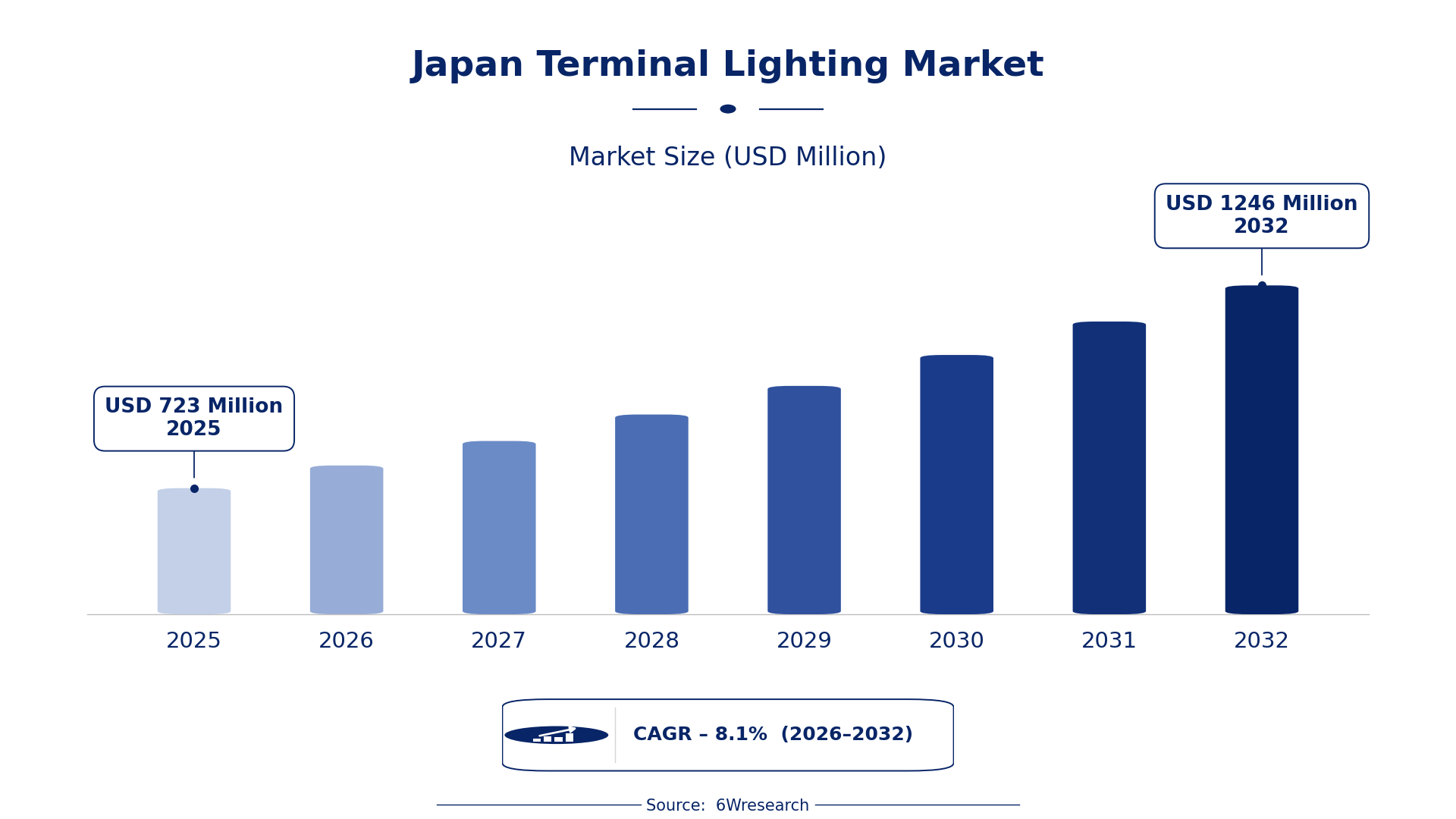
According to 6Wresearch internal database and industry insights, the Japan Terminal Lighting Market was valued at USD 723 Million in 2025 and is projected to reach USD 1,246 Million by 2032, growing at a CAGR of approximately 8.1% during 2026–2032.
Japan Terminal Lighting Market Highlights
| Report Metric | Details |
| Report Name | Japan Terminal Lighting Market (2026-2032) |
| Market Size 2025 | USD 723 Million |
| Market Size 2032 | USD 1,246 Million |
| Absolute Growth 2025–2032 | USD 523 Million |
| CAGR 2026–2032 | 8.1% |
| Peak Annual Growth | 8.9% in 2032 |
| Forecast Period | 2026–2032 |
| Historical Data | 2022–2025 |
| Base Year | 2025 |
| Leading Lighting Type, 2025 | Apron Lighting Systems (44% share) |
| Leading Technology Type, 2025 | LED Floodlights (51% share) |
| Leading Usage Zone, 2025 | Airside Terminals (45% share) |
| Leading End User, 2025 | Airports (41% share) |
| Fastest-Growing Lighting Type | Runway Edge Lighting (11.3% CAGR) |
| Fastest-Growing Technology Type | High-Intensity Discharge (11.5% CAGR) |
| Fastest-Growing Usage Zone | Airfield Perimeters (9.7% CAGR) |
| Fastest-Growing End User | Aviation Authorities (10.5% CAGR) |
| Growing Sector | aviation |
| Key End Users | airports, military bases, aviation authorities, airport operators |
Japan Terminal Lighting Market Year-wise Growth Rate and Key Drivers (2022–2032)
This graph illustrates the annual growth rates of the market from 2022 to 2032, highlighting a steady upward trajectory and projected market expansion over the forecast period.
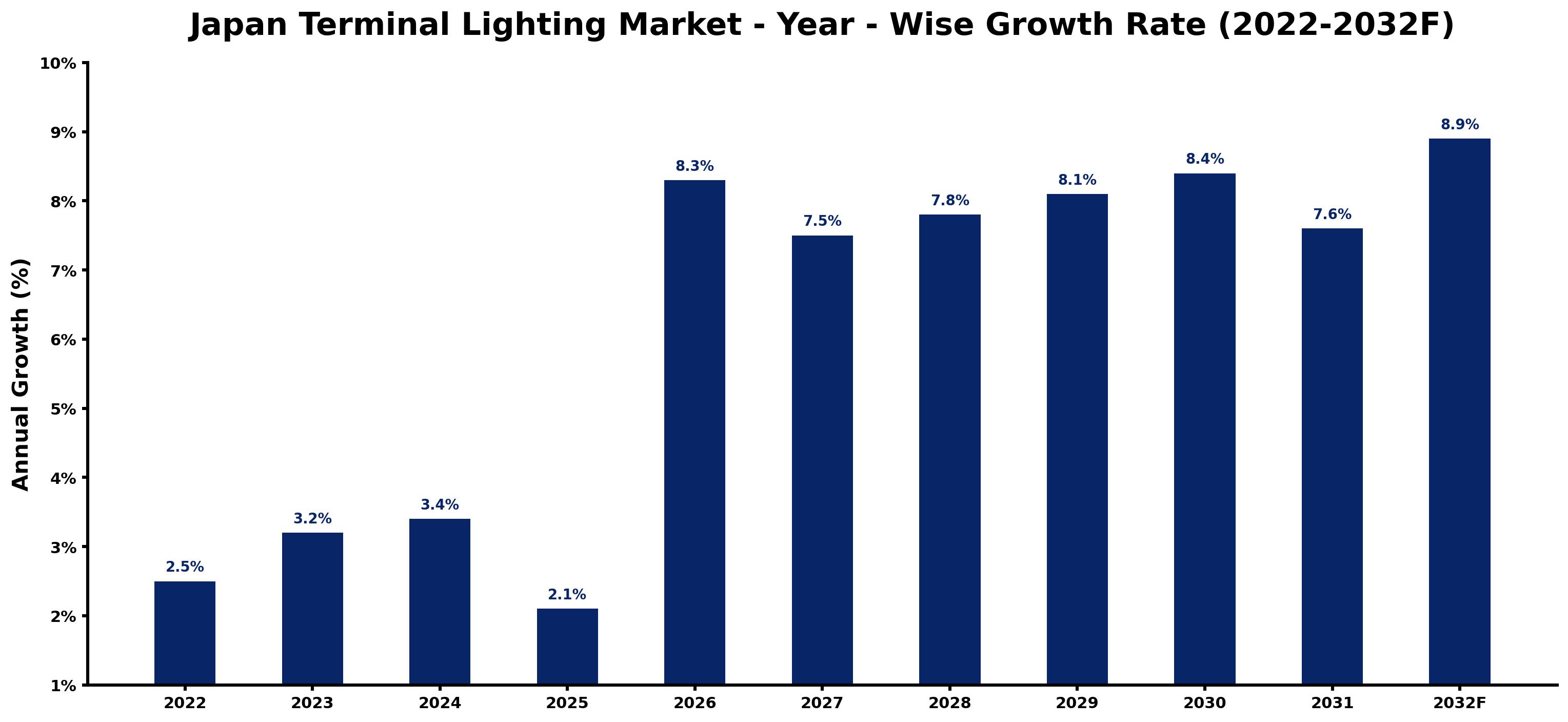
For each year, the table pairs the estimated growth rate with the leading influence on demand, showing how the drivers changed across the period.
| Year | Estimated Annual Growth (%) | Market Rationale |
| 2022 | 2.5 | The market displayed steady growth, reflecting ongoing investments in airport infrastructure. |
| 2023 | 3.2 | Demand accelerated due to increased passenger traffic at major airports across the country. |
| 2024 | 3.4 | Growth continued as airports upgraded lighting systems to meet safety standards. |
| 2025 | 2.1 | The growth rate slowed as some airports completed major renovation projects. |
| 2026 | 8.3 | A surge in investment for energy-efficient lighting systems drove significant growth. |
| 2027 | 7.5 | The market experienced a slight slowdown as competition intensified among suppliers. |
| 2028 | 7.8 | Growth rebounded as airports adopted smart lighting technologies for efficiency. |
| 2029 | 8.1 | Increased passenger numbers and operational demands spurred further market expansion. |
| 2030 | 8.4 | Continued upgrades to lighting systems supported a steady growth rate. |
| 2031 | 7.6 | The market growth rate slowed as saturation in some segments began to appear. |
| 2032 | 8.9 | A peak in growth was reached due to extensive infrastructure investments and upgrades. |
Note: Market size estimations and growth projections presented in this report are based on 6Wresearch's proprietary forecasting methodology, utilizing the latest available industry data, government publications, and primary research inputs.
Japan Terminal Lighting Market Synopsis
Terminal lighting encompasses various systems used in airports to ensure safety and visibility for aircraft and passengers. This market is driven primarily by domestic airports and military bases, with substantial investments in airport infrastructure projected to exceed ¥1 trillion by 2025. The adoption of LED technology, accounting for approximately 70% of new installations, improves energy efficiency and lowers operational costs. As passenger traffic surpasses 80 million annually at major airports, the demand for advanced lighting solutions continues to grow, creating a vibrant market environment.
Market Dynamics Impact Analysis (2026–2032)
| Factor | Type | Impact | Primary Segment Affected |
| Growing investment in airport infrastructure | Driver | High | Terminal Building Lights |
| Increased passenger traffic at airports | Driver | High | Airside Terminals |
| Emerging demand for energy-efficient lighting solutions | Opportunity | High | LED Floodlights |
| Adoption of smart lighting technologies | Opportunity | Medium | Taxiway Centerline Lights |
| Regulatory compliance costs for lighting systems | Restraint | High | Runway Edge Lighting |
| Limited supplier competition in certain segments | Restraint | Medium | Apron Lighting Systems |
| High costs associated with upgrading outdated systems | Challenge | High | High-Intensity Discharge |
| Technological integration challenges with new systems | Challenge | Medium | In-Pavement Fixtures |
Evaluation of Drivers in Japan Terminal Lighting Market (2026–2032)
Key forces behind demand, with the segment each one moves most, are listed below.
| Drivers | Primary Segment Affected | Why It Matters (Evidence) |
| Increased passenger traffic | Airside Terminals | The average passenger traffic at major airports exceeds 80 million annually, driving demand for lighting systems. |
| Investment in airport infrastructure | Terminal Building Lights | Projected investments exceeding ¥1 trillion by 2025 lead to upgrades in lighting systems for safety and efficiency. |
| Adoption of LED technology | LED Floodlights | Around 70% of new installations are LED, promoting energy efficiency and reducing operational costs. |
| Regulatory compliance requirements | Runway Edge Lighting | Aviation authorities mandate regular inspections, ensuring safety and performance standards are met. |
| Technological advancements in smart lighting | Taxiway Centerline Lights | Airports are adopting smart technologies for improved efficiency and operational effectiveness. |
Orders keep climbing as passenger traffic at major airports exceeds 80 million annually, necessitating effective lighting systems for safety. Investment in airport infrastructure is projected to exceed ¥1 trillion by 2025, propelling upgrades in terminal lighting. Approximately 70% of new installations are LED, promoting energy efficiency and lowering operational costs. Aviation authorities mandate regular inspections of lighting systems, ensuring compliance with safety standards. Airports are embracing smart lighting technologies to boost efficiency and operational effectiveness, further increasing demand.
Evaluation of Restraints in Japan Terminal Lighting Market
The table below lists the restraints and the evidence behind each.
| Market Restraint | Primary Segment Affected | Why It Matters (Evidence) |
| High costs associated with upgrading systems | High-Intensity Discharge | Upgrading outdated lighting systems incurs expenses that impact budget allocations for airport operators. |
| Regulatory compliance costs | Runway Edge Lighting | Compliance with safety standards requires ongoing investments in inspections and system upgrades. |
| Limited competition in certain segments | Apron Lighting Systems | A few suppliers dominate the market, limiting options for airport operators and increasing costs. |
| Technological integration challenges | In-Pavement Fixtures | Integrating new technologies with existing systems can lead to delays and increased costs for airport operators. |
| Dependence on government regulations | LED Floodlights | Changes in regulations can impact the adoption rate of new technologies, affecting market conditions. |
Japan Terminal Lighting Market Challenges
Tokyo Haneda Airport faces project delays due to a shortage of skilled technicians, extending timelines by up to six months for airport operators. Strict regulations enforced by the Ministry of Land, Infrastructure, Transport and Tourism raise compliance costs by approximately ¥500 million annually for airports. Supply chain disruptions delay the delivery of LED components, potentially postponing projects by three months for lighting suppliers. Intense competition among airports for advanced technologies escalates installation costs, forcing operators to allocate additional budgets that can exceed ¥200 million for major upgrades.
Trends in the Japan Terminal Lighting Market
The shifts below are changing how Japan Terminal Lighting Market products are bought and supplied.
- Shift towards LED Technology: Approximately 70% of new lighting installations at airports are now LED, driven by energy efficiency mandates. This shift reduces operational costs and supports sustainability efforts in the aviation sector.
- Adoption of Smart Lighting Solutions: Airports are increasingly implementing smart lighting technologies, particularly in the Tokyo region, to improve operational efficiency. This trend is expected to expand as airports aim to enhance passenger experience.
- Focus on Energy Efficiency: The Building Energy Efficiency Act promotes energy-efficient lighting systems, with investments projected to exceed ¥1 trillion by 2025. This initiative encourages airports to upgrade to modern, efficient solutions.
- Increased Regulatory Oversight: The Ministry of Land, Infrastructure, Transport and Tourism has strengthened regulations on lighting systems, ensuring compliance with safety standards. This oversight affects the procurement and maintenance of airport lighting.
Investment Opportunities in the Japan Terminal Lighting Market
The following areas offer the clearest openings for investors and suppliers in the Japan Terminal Lighting Market.
- Supply of LED Lighting Systems: The growing demand for energy-efficient lighting presents opportunities for suppliers of LED systems, particularly in airports. With around 70% of new installations being LED, suppliers can focus on this segment.
- Investment in Smart Lighting Technologies: Airports in the Tokyo region are seeking to adopt smart lighting solutions, creating opportunities for technology providers. Collaborating with local partners can facilitate market entry.
- Upgrading Outdated Systems: Airport operators are looking to replace outdated lighting systems, with investments projected to exceed ¥1 trillion by 2025. Suppliers can target this need by offering modern solutions.
- Compliance with International Standards: The need for airports to comply with international lighting standards creates opportunities for certification and consulting services. Engaging with aviation authorities can streamline the approval process.
Government Initiatives in the Japan Terminal Lighting Market
The Building Energy Efficiency Act, amended in 2022, mandates that all new buildings, including airports, meet energy standards effective from April 2025. This law compels airport operators to invest in energy-efficient lighting systems that comply with the latest regulations. The Act on the Rational Use of Energy obliges large energy users, such as airports, to improve energy efficiency and report their energy use, further driving the adoption of modern lighting technologies.
The Japan Civil Aviation Bureau oversees the assessment and approval of lighting systems at airports, ensuring compliance with safety standards. This agency funds initiatives aimed at upgrading airport lighting infrastructure, supporting investments in advanced technologies. With the Airports Council International providing guidelines, airports can align their lighting systems with international standards, improving safety and operational efficiency.
Future Insight of the Japan Terminal Lighting Market
By 2032, buyers will increasingly adopt smart lighting technologies to enhance energy efficiency and reduce operational costs. Investment in airport infrastructure will exceed ¥1 trillion, driving demand for modern lighting solutions. The government's initiative to replace outdated systems will enable suppliers to offer tailored products that meet contemporary requirements. Compliance with international lighting standards will ensure safety and efficiency remain priorities, benefiting both buyers and suppliers.
Market Segmentation Analysis
Japan Terminal Lighting Market report covers a detailed analysis of the following market segments:
By Lighting Type – Apron Lighting Systems Lead, Runway Edge Lighting Expected to Grow Fastest
According to Saurav Kr Singh, Senior Research Analyst at 6Wresearch, Apron Lighting Systems accounted for 44% of the market by lighting type in 2025. Apron lighting systems are essential for safe aircraft operations at terminals, particularly in busy airports like Tokyo Haneda, which sees high traffic. Their critical function in ensuring visibility and safety across Japan's airports secures their leading market position. Over 2026–2032, Runway Edge Lighting is expected to post the fastest growth, at a CAGR of 11.3%. Runway edge lighting is crucial for maintaining visibility during operations, especially considering the average passenger traffic exceeding 80 million annually at major airports. This necessity for compliance with safety regulations will continue to drive the segment's rapid growth. Suppliers should focus on developing advanced runway edge lighting solutions to meet the increasing safety demands.
By Technology Type – LED Floodlights Lead, High-Intensity Discharge Expected to Grow Fastest
The largest technology type category in 2025 was LED Floodlights, at 51% of revenue. LED floodlights are widely used for their energy efficiency and brightness, making them the preferred choice for new installations in airports. Approximately 70% of new lighting installations utilise LED technology, highlighting its dominance in the market. High-Intensity Discharge is projected to grow fastest, at a CAGR of 11.5% during 2026–2032. High-intensity discharge lighting is commonly used for high-output lighting needs, particularly in busy airports like Tokyo Haneda. The ongoing investment in airport infrastructure further fuels the demand for this technology. Buyers should prioritise energy-efficient lighting options to align with sustainability initiatives and reduce operational costs.
By Usage Zone – Airside Terminals Lead, Airfield Perimeters Expected to Grow Fastest
With 45% of usage zone revenue in 2025, Airside Terminals was the largest category. Airside terminals are vital for ensuring passenger safety and processing, necessitating effective lighting solutions for smooth operations. The high concentration of airports in the Tokyo region significantly boosts the demand for reliable lighting in these areas. The quickest growth will come from Airfield Perimeters, forecast to expand at a CAGR of 9.7% between 2026 and 2032. Airfield perimeters are important for security and safety, particularly as aviation authorities enforce regular inspections of lighting systems. This emphasis on compliance with safety standards accelerates the growth of lighting solutions in these zones. Suppliers must ensure their products comply with stringent safety standards to meet the growing demands for airfield perimeter lighting.
By End User – Airports Lead, Aviation Authorities Expected to Grow Fastest
Airports took 41% of end user revenue in 2025, more than any other category. Airports are the primary users of terminal lighting, relying on effective systems to maintain safety and enhance passenger experiences. With substantial investments in airport infrastructure projected, the demand for reliable lighting solutions remains strong. Aviation Authorities are set to record the highest CAGR in this split, 10.5% over 2026–2032. Aviation authorities play a crucial role in regulating lighting standards, driving the adoption of advanced technologies in the market. Their ongoing assessments of lighting systems ensure compliance and stimulate growth in this sector. Suppliers should collaborate with aviation authorities to align their products with regulatory standards and market expectations.
Key Attractiveness of the Report
- 10 Years of Market Numbers
- Historical Data Starting from 2022 to 2025
- Base Year 2025
- Forecast Data until 2032
- Key Performance Indicators Impacting the Market
- Major Upcoming Developments and Projects
Key Highlights of the Report:
- Japan Terminal Lighting Market Outlook
- Market Size of Japan Terminal Lighting Market, 2025
- Forecast of Japan Terminal Lighting Market, 2032
- Historical Data and Forecast of Japan Terminal Lighting Revenues & Volume for the Period 2022-2032F
- Japan Terminal Lighting Market Trend Evolution
- Japan Terminal Lighting Market Drivers and Challenges
- Japan Terminal Lighting Price Trends
- Japan Terminal Lighting Porter's Five Forces
- Japan Terminal Lighting Industry Life Cycle
- Historical Data and Forecast of Japan Terminal Lighting Market Revenues & Volume By Lighting Type for the Period 2022-2032F
- Historical Data and Forecast of Japan Terminal Lighting Market Revenues & Volume By Apron Lighting Systems for the Period 2022-2032F
- Historical Data and Forecast of Japan Terminal Lighting Market Revenues & Volume By Runway Edge Lighting for the Period 2022-2032F
- Historical Data and Forecast of Japan Terminal Lighting Market Revenues & Volume By Taxiway Centerline Lights for the Period 2022-2032F
- Historical Data and Forecast of Japan Terminal Lighting Market Revenues & Volume By Terminal Building Lights for the Period 2022-2032F
- Historical Data and Forecast of Japan Terminal Lighting Market Revenues & Volume By Technology Type for the Period 2022-2032F
- Historical Data and Forecast of Japan Terminal Lighting Market Revenues & Volume By LED Floodlights for the Period 2022-2032F
- Historical Data and Forecast of Japan Terminal Lighting Market Revenues & Volume By High-Intensity Discharge for the Period 2022-2032F
- Historical Data and Forecast of Japan Terminal Lighting Market Revenues & Volume By In-Pavement Fixtures for the Period 2022-2032F
- Historical Data and Forecast of Japan Terminal Lighting Market Revenues & Volume By Motion-Sensitive LEDs for the Period 2022-2032F
- Historical Data and Forecast of Japan Terminal Lighting Market Revenues & Volume By Usage Zone for the Period 2022-2032F
- Historical Data and Forecast of Japan Terminal Lighting Market Revenues & Volume By Airside Terminals for the Period 2022-2032F
- Historical Data and Forecast of Japan Terminal Lighting Market Revenues & Volume By Airfield Perimeters for the Period 2022-2032F
- Historical Data and Forecast of Japan Terminal Lighting Market Revenues & Volume By Aircraft Movement Areas for the Period 2022-2032F
- Historical Data and Forecast of Japan Terminal Lighting Market Revenues & Volume By Passenger Waiting Lounges for the Period 2022-2032F
- Historical Data and Forecast of Japan Terminal Lighting Market Revenues & Volume By End User for the Period 2022-2032F
- Historical Data and Forecast of Japan Terminal Lighting Market Revenues & Volume By Airports for the Period 2022-2032F
- Historical Data and Forecast of Japan Terminal Lighting Market Revenues & Volume By Aviation Authorities for the Period 2022-2032F
- Historical Data and Forecast of Japan Terminal Lighting Market Revenues & Volume By Military Bases for the Period 2022-2032F
- Historical Data and Forecast of Japan Terminal Lighting Market Revenues & Volume By Airport Operators for the Period 2022-2032F
- Japan Terminal Lighting Import Export Trade Statistics
- Market Opportunity Assessment By Lighting Type
- Market Opportunity Assessment By Technology Type
- Market Opportunity Assessment By Usage Zone
- Market Opportunity Assessment By End User
- Japan Terminal Lighting Top Companies Market Share
- Japan Terminal Lighting Competitive Benchmarking By Technical and Operational Parameters
- Japan Terminal Lighting Company Profiles
- Japan Terminal Lighting Key Strategic Recommendations
Market Covered
The following segment groups are covered in the report.
By Lighting Type
- Apron Lighting Systems
- Runway Edge Lighting
- Taxiway Centerline Lights
- Terminal Building Lights
By Technology Type
- LED Floodlights
- High-Intensity Discharge
- In-Pavement Fixtures
- Motion-Sensitive LEDs
By Usage Zone
- Airside Terminals
- Airfield Perimeters
- Aircraft Movement Areas
- Passenger Waiting Lounges
By End User
- Airports
- Aviation Authorities
- Military Bases
- Airport Operators































