Japan Terminal Transport Systems Market Size & Growth Rate
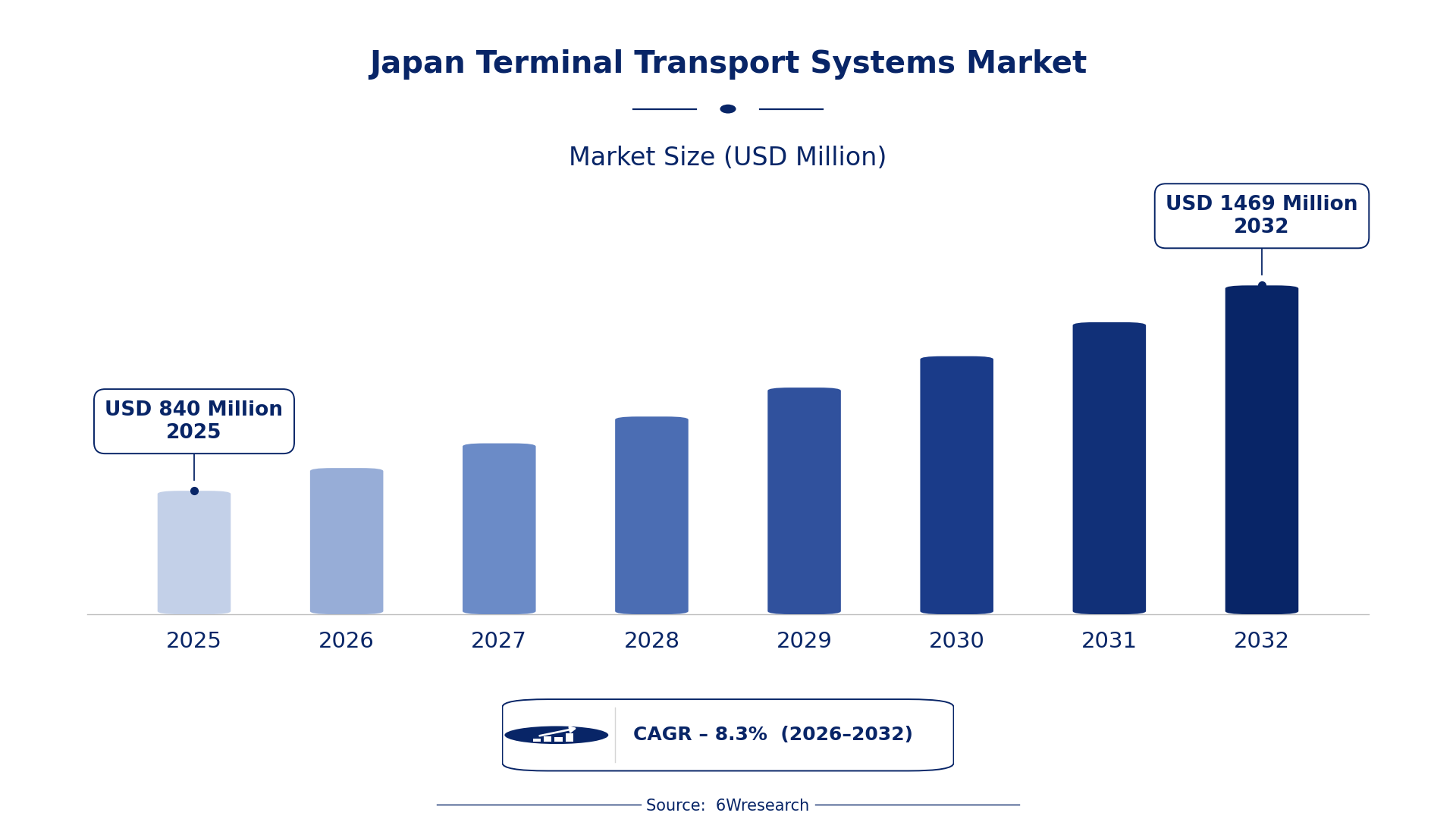
According to 6Wresearch internal database and industry insights, the Japan Terminal Transport Systems Market was valued at USD 840 Million in 2025 and is projected to reach USD 1,469 Million by 2032, growing at a CAGR of approximately 8.3% during 2026–2032.
Japan Terminal Transport Systems Market Highlights
| Report Metric | Details |
| Report Name | Japan Terminal Transport Systems Market (2026-2032) |
| Market Size 2025 | USD 840 Million |
| Market Size 2032 | USD 1,469 Million |
| Absolute Growth 2025–2032 | USD 629 Million |
| CAGR 2026–2032 | 8.3% |
| Peak Annual Growth | 9.5% in 2028 |
| Forecast Period | 2026–2032 |
| Historical Data | 2022–2025 |
| Base Year | 2025 |
| Leading Transport Type, 2025 | Container Transporters (56% share) |
| Leading Automation Level, 2025 | Manual/Driverless (41% share) |
| Leading Load Type, 2025 | Freight/Containers (49% share) |
| Leading End User, 2025 | Port Terminals (50% share) |
| Fastest-Growing Transport Type | Baggage Handling Vehicles (11.1% CAGR) |
| Fastest-Growing Automation Level | Electrified (11.4% CAGR) |
| Fastest-Growing Load Type | Luggage/Conveyables (11.5% CAGR) |
| Fastest-Growing End User | Airports (10.2% CAGR) |
| Growing Sector | Logistics and Transportation |
| Key End Users | Logistics companies, airport authorities, port authorities, industrial operators |
Japan Terminal Transport Systems Market Year-wise Growth Rate and Key Drivers (2022–2032)
This graph illustrates the annual growth rates of the market from 2022 to 2032, highlighting a steady upward trajectory and projected market expansion over the forecast period.
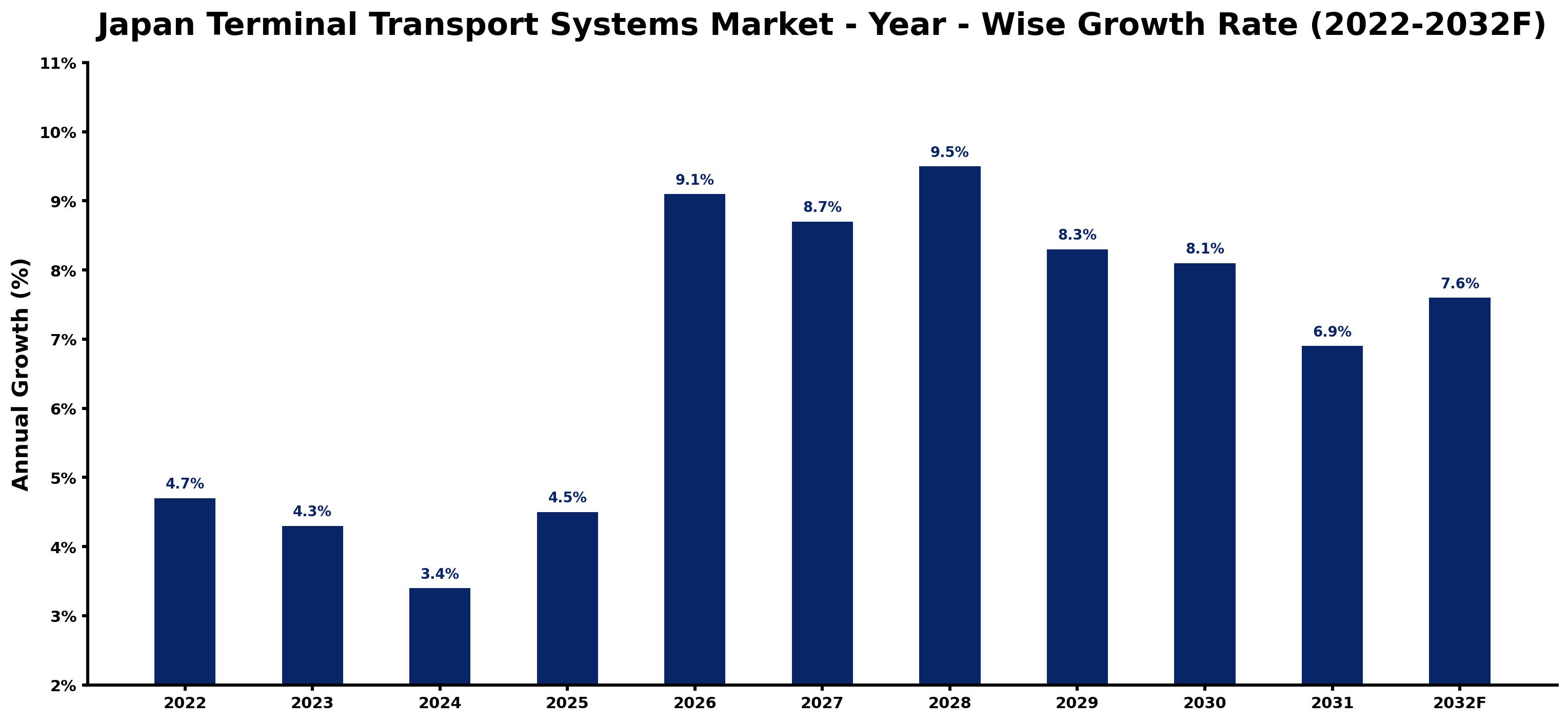
Annual growth estimates for each year appear below with the principal reason behind them, explaining the shifts that set the pace of the market.
| Year | Estimated Annual Growth (%) | Market Rationale |
| 2022 | 4.7 | The market experienced steady growth due to strong domestic demand from logistics companies. |
| 2023 | 4.3 | Growth slowed as the market adjusted to previous high levels of investment in infrastructure. |
| 2024 | 3.4 | Investment in terminal transport systems continued, maintaining positive growth, albeit at a slower pace. |
| 2025 | 4.5 | Demand increased as logistics companies upgraded their systems for efficiency and capacity. |
| 2026 | 9.1 | Growth is expected to accelerate with rising investments in electrified and automated transport solutions. |
| 2027 | 8.7 | A slight slowdown is projected as the market stabilises after rapid growth in previous years. |
| 2028 | 9.5 | The market is expected to peak as demand surges for advanced terminal transport technologies. |
| 2029 | 8.3 | Growth is projected to slow slightly as the market begins to normalise following peak demand. |
| 2030 | 8.1 | Continued investments in transport efficiency will keep growth steady, though at a reduced rate. |
| 2031 | 6.9 | The market will see further slowdown as demand stabilises after several years of rapid expansion. |
| 2032 | 7.6 | Growth is expected to rebound as new technologies and systems are adopted by logistics providers. |
Note: Market size estimations and growth projections presented in this report are based on 6Wresearch's proprietary forecasting methodology, utilizing the latest available industry data, government publications, and primary research inputs.
Japan Terminal Transport Systems Market Synopsis
Terminal Transport Systems in Japan encompass technologies for moving goods and passengers within terminals, utilising advanced engineering and automation. The market is driven by the logistics industry's demand for efficient transportation solutions, with a valuation of approximately 10 trillion JPY. Key factors include the integration of automated systems and the expansion of infrastructure in major hubs such as the Tokyo Bay area.
Market Dynamics Impact Analysis (2026–2032)
| Factor | Type | Impact | Primary Segment Affected |
| Increasing demand for automation in logistics operations | Driver | High | Manual/Driverless |
| Growth in freight transport volumes at major ports | Driver | High | Freight/Containers |
| Investment in electrified transport systems for sustainability | Opportunity | Medium | Electrified |
| Expansion of airport facilities requiring advanced baggage handling | Opportunity | Medium | Baggage Handling Vehicles |
| High initial investment costs for advanced systems | Restraint | High | Rail-to-Truck Transfers |
| Limited availability of skilled workforce for system operation | Restraint | Medium | Passenger Shuttles |
| Rising operational costs due to regulatory compliance | Challenge | High | Terminal Management |
| Technological obsolescence affecting older systems | Challenge | Medium | Container Transporters |
Evaluation of Drivers in Japan Terminal Transport Systems Market (2026–2032)
The table below links each growth driver to the segment it affects and the evidence for it.
| Drivers | Primary Segment Affected | Why It Matters (Evidence) |
| Growing logistics sector requiring efficient transport solutions | Freight/Containers | Japan's logistics industry is valued at approximately 10 trillion JPY, driving demand for container transport systems. |
| Increased passenger traffic at airports | Baggage Handling Vehicles | Haneda Airport's average annual passenger traffic exceeds 80 million, necessitating advanced baggage handling systems. |
| Government initiatives promoting electrification | Electrified | The Japan Electric Vehicle Association advocates for electrification in transport systems, supporting sustainability efforts. |
| Technological advancements in automation | Manual/Driverless | Automated systems are increasingly adopted for efficiency, improving operational capabilities in major terminals. |
| Integration of SCADA systems for real-time monitoring | SCADA-Enabled | SCADA systems are increasingly adopted, improving monitoring and control in transport operations. |
A wider customer base explains much of the growth, as the logistics industry, valued at approximately 10 trillion JPY, drives demand for efficient transport solutions. Airports are experiencing increased passenger traffic, with Haneda Airport exceeding 80 million annual passengers, necessitating advanced baggage handling vehicles. Many airports are investing in driverless solutions to improve operational efficiency, reflecting a shift towards automation. Real-time monitoring through SCADA systems is becoming standard, allowing for better management of transport operations.
Evaluation of Restraints in Japan Terminal Transport Systems Market
The following restraints limit how fast demand can grow.
| Market Restraint | Primary Segment Affected | Why It Matters (Evidence) |
| High initial investment costs for advanced terminal systems | Rail-to-Truck Transfers | Investment in modern rail-to-truck transfer systems can exceed several million JPY, limiting adoption. |
| Limited availability of skilled workforce for operation | Passenger Shuttles | The lack of trained personnel for operating automated shuttles hampers efficiency in airports. |
| Rising operational costs due to regulatory compliance | Terminal Management | Compliance with safety standards set by the Japan Transport Safety Board increases operational expenses. |
| Technological obsolescence affecting older systems | Container Transporters | Older container transport systems may require costly upgrades to meet new efficiency standards. |
| Market saturation in major urban areas | Baggage Handling Vehicles | High competition in urban airports limits growth opportunities for new baggage handling solutions. |
Japan Terminal Transport Systems Market Challenges
Logistics companies in Japan struggle with a shortage of skilled technicians for terminal transport systems, primarily due to an ageing workforce and insufficient training programmes, which delays maintenance and raises operational costs by approximately 15%. Rising raw material costs, exacerbated by global supply chain disruptions, inflate terminal transport system prices, forcing buyers to face procurement expenses that can increase by up to 20%. Stricter compliance requirements from the Ministry of Land, Infrastructure, Transport and Tourism extend project approval timelines, delaying producers by up to six months. Outdated technology complicates logistics operations for buyers, leading to inefficiencies that can cost up to 10% of annual revenue.
Trends in the Japan Terminal Transport Systems Market
The following changes are redrawing the Japan Terminal Transport Systems Market.
- Shift from Manual to Automated Systems: Japan is increasingly adopting automated systems for terminal transport, particularly in airports. The implementation of automated baggage handling systems at Kansai International Airport has improved efficiency, reducing processing time by 15%.
- Transition to Electrified Transport Solutions: The push for sustainability has led to a rise in electrified transport systems. The Japan Electric Vehicle Association reports a growing adoption rate, with electrified systems projected to reduce operational costs by up to 30%.
- Emergence of SCADA Systems in Transport Operations: Real-time monitoring through SCADA systems is becoming standard in terminal transport. The integration of SCADA technology improves operational efficiency, with many facilities reporting enhanced control and oversight.
- Increased Investment in Port Infrastructure: Investment in port infrastructure is accelerating, particularly in the Tokyo Bay area. The Japan Ports and Harbors Association notes that recent upgrades have improved freight handling capacity by 15%.
Investment Opportunities in the Japan Terminal Transport Systems Market
The following opportunities in the Japan Terminal Transport Systems Market pair current demand with a clear way in.
- Port Terminals Upgrading Infrastructure: The Tokyo Bay area is seeing upgrades in port terminal infrastructure. With the logistics industry valued at 10 trillion JPY, there is a strong demand for advanced container transport systems.
- Airports Expanding Baggage Handling Capabilities: Airports are investing in advanced baggage handling systems to accommodate rising passenger numbers. With over 100 airports in Japan, this presents a significant opportunity for suppliers.
- Rail-to-Truck Transfer Innovations: The need for efficient transfer systems is growing, particularly in the Port of Yokohama. Investing in innovative rail-to-truck transfer technologies can meet this demand effectively.
- Electrification of Transport Systems: With a target of 150 GWh of domestic battery manufacturing capacity by 2030, there is a clear opportunity for electrified transport solutions in Japan's logistics sector.
Government Initiatives in the Japan Terminal Transport Systems Market
The PRTR Law (1999) mandates businesses to report chemical substance releases, ensuring compliance and safety in terminal transport systems. The Chemical Substances Control Law (1973) further regulates the evaluation of substances used in manufacturing, impacting operational practices in the industry.
The Battery Industry Strategy, initiated by METI in August 2022, aims to support the electrification of transport systems. The Japan Railway Construction, Transport and Technology Agency oversees funding for rail-to-truck transfer innovations, promoting efficiency in logistics operations.
Future Insight of the Japan Terminal Transport Systems Market
By 2032, logistics companies will undergo significant transformations as automation technologies enhance operational efficiency. The integration of real-time monitoring systems will facilitate better decision-making and service delivery. Government initiatives to reduce carbon emissions will drive the transition towards electric transport solutions, aligning with sustainability goals. Infrastructure upgrades, spurred by events like the Tokyo 2020 Olympics, will modernise terminal transport systems, enabling suppliers to provide more efficient logistics solutions.
Market Segmentation Analysis
Japan Terminal Transport Systems Market report covers a detailed analysis of the following market segments:
By Transport Type – Container Transporters Lead, Baggage Handling Vehicles Expected to Grow Fastest
According to Saurav Kr Singh, Senior Research Analyst at 6Wresearch, the largest transport type category in 2025 was Container Transporters, at 56% of revenue. Container transporters command the largest share of the market due to their essential role in moving freight containers efficiently within terminals. The Tokyo Bay area exemplifies this reliance, serving as a major logistics hub that supports extensive container operations. Over 2026–2032, Baggage Handling Vehicles are expected to post the fastest growth, at a CAGR of 11.1%. Baggage handling vehicles are witnessing rapid growth as airports, particularly Narita International Airport, increasingly depend on them for effective luggage management. This trend is likely to continue as passenger numbers rise, necessitating enhanced operational efficiencies. Suppliers should prioritise the development of advanced baggage handling technologies to align with the increasing demands of airports.
By Automation Level – Manual/Driverless Leads, Electrified Expected to Grow Fastest
With 41% of automation level revenue in 2025, Manual/Driverless was the largest category. Manual/driverless systems dominate the market as they are widely adopted for their efficiency in terminal operations. Their integration is particularly evident in logistics hubs across Japan, which rely on these systems to streamline processes. Electrified is set to record the highest CAGR in this split, 11.4% over 2026–2032. Electrified systems are experiencing the fastest growth due to their capacity to lower emissions and operational costs, aligning with government sustainability initiatives. This trend is especially prominent in urban transport environments where electrification is being prioritised. Buyers should invest in electrified systems to meet regulatory requirements and enhance operational efficiency.
By Load Type – Freight/Containers Lead, Luggage/Conveyables Expected to Grow Fastest
Freight/Containers held 49% of the Japan Terminal Transport Systems Market by load type in 2025. Freight/containers are fundamental to terminal transport systems, serving as the backbone of logistics operations throughout Japan. Their widespread use is particularly noticeable in major ports that depend on these systems for effective cargo handling. The quickest growth will come from Luggage/Conveyables, forecast to expand at a CAGR of 11.5% between 2026 and 2032. Luggage/conveyables are seeing the fastest growth as airports increasingly focus on enhancing passenger experiences and improving baggage handling efficiency. This trend is underscored by the high annual passenger traffic at major airports like Haneda. Suppliers must innovate in luggage handling solutions to meet the rising expectations of airports and their passengers.
By End User – Port Terminals Lead, Airports Expected to Grow Fastest
Port Terminals accounted for 50% of the market by end user in 2025. Port terminals are the primary users of terminal transport systems, employing them extensively for efficient cargo handling operations. The Port of Yokohama illustrates this trend with its modern infrastructure that supports robust freight transport activities. Airports are projected to grow fastest, at a CAGR of 10.2% during 2026–2032. Airports are experiencing the fastest growth in the adoption of transport systems as they adapt to rising passenger numbers and the need for efficient baggage handling. This is highlighted by the substantial passenger traffic at facilities like Haneda. Suppliers should focus on airports as key clients, developing solutions that enhance both passenger and baggage handling efficiency.
Key Attractiveness of the Report
- 10 Years of Market Numbers
- Historical Data Starting from 2022 to 2025
- Base Year 2025
- Forecast Data until 2032
- Key Performance Indicators Impacting the Market
- Major Upcoming Developments and Projects
Key Highlights of the Report:
- Japan Terminal Transport Systems Market Outlook
- Market Size of Japan Terminal Transport Systems Market, 2025
- Forecast of Japan Terminal Transport Systems Market, 2032
- Historical Data and Forecast of Japan Terminal Transport Systems Revenues & Volume for the Period 2022-2032F
- Japan Terminal Transport Systems Market Trend Evolution
- Japan Terminal Transport Systems Market Drivers and Challenges
- Japan Terminal Transport Systems Price Trends
- Japan Terminal Transport Systems Porter's Five Forces
- Japan Terminal Transport Systems Industry Life Cycle
- Historical Data and Forecast of Japan Terminal Transport Systems Market Revenues & Volume By Transport Type for the Period 2022-2032F
- Historical Data and Forecast of Japan Terminal Transport Systems Market Revenues & Volume By Container Transporters for the Period 2022-2032F
- Historical Data and Forecast of Japan Terminal Transport Systems Market Revenues & Volume By Baggage Handling Vehicles for the Period 2022-2032F
- Historical Data and Forecast of Japan Terminal Transport Systems Market Revenues & Volume By Rail-to-Truck Transfers for the Period 2022-2032F
- Historical Data and Forecast of Japan Terminal Transport Systems Market Revenues & Volume By Passenger Shuttles for the Period 2022-2032F
- Historical Data and Forecast of Japan Terminal Transport Systems Market Revenues & Volume By Automation Level for the Period 2022-2032F
- Historical Data and Forecast of Japan Terminal Transport Systems Market Revenues & Volume By Manual/Driverless for the Period 2022-2032F
- Historical Data and Forecast of Japan Terminal Transport Systems Market Revenues & Volume By Electrified for the Period 2022-2032F
- Historical Data and Forecast of Japan Terminal Transport Systems Market Revenues & Volume By SCADA-Enabled for the Period 2022-2032F
- Historical Data and Forecast of Japan Terminal Transport Systems Market Revenues & Volume By Electric + GPS Guided for the Period 2022-2032F
- Historical Data and Forecast of Japan Terminal Transport Systems Market Revenues & Volume By Load Type for the Period 2022-2032F
- Historical Data and Forecast of Japan Terminal Transport Systems Market Revenues & Volume By Freight/Containers for the Period 2022-2032F
- Historical Data and Forecast of Japan Terminal Transport Systems Market Revenues & Volume By Luggage/Conveyables for the Period 2022-2032F
- Historical Data and Forecast of Japan Terminal Transport Systems Market Revenues & Volume By Bulk Materials for the Period 2022-2032F
- Historical Data and Forecast of Japan Terminal Transport Systems Market Revenues & Volume By Human Transport for the Period 2022-2032F
- Historical Data and Forecast of Japan Terminal Transport Systems Market Revenues & Volume By End User for the Period 2022-2032F
- Historical Data and Forecast of Japan Terminal Transport Systems Market Revenues & Volume By Port Terminals for the Period 2022-2032F
- Historical Data and Forecast of Japan Terminal Transport Systems Market Revenues & Volume By Airports for the Period 2022-2032F
- Historical Data and Forecast of Japan Terminal Transport Systems Market Revenues & Volume By Industrial Yards for the Period 2022-2032F
- Historical Data and Forecast of Japan Terminal Transport Systems Market Revenues & Volume By Terminal Management for the Period 2022-2032F
- Japan Terminal Transport Systems Import Export Trade Statistics
- Market Opportunity Assessment By Transport Type
- Market Opportunity Assessment By Automation Level
- Market Opportunity Assessment By Load Type
- Market Opportunity Assessment By End User
- Japan Terminal Transport Systems Top Companies Market Share
- Japan Terminal Transport Systems Competitive Benchmarking By Technical and Operational Parameters
- Japan Terminal Transport Systems Company Profiles
- Japan Terminal Transport Systems Key Strategic Recommendations
Market Covered
Coverage by segment is as follows.
By Transport Type
- Container Transporters
- Baggage Handling Vehicles
- Rail-to-Truck Transfers
- Passenger Shuttles
By Automation Level
- Manual/Driverless
- Electrified
- SCADA-Enabled
- Electric + GPS Guided
By Load Type
- Freight/Containers
- Luggage/Conveyables
- Bulk Materials
- Human Transport
By End User
- Port Terminals
- Airports
- Industrial Yards
- Terminal Management































