Japan Testicular Cancer Drugs Market Size & Growth Rate
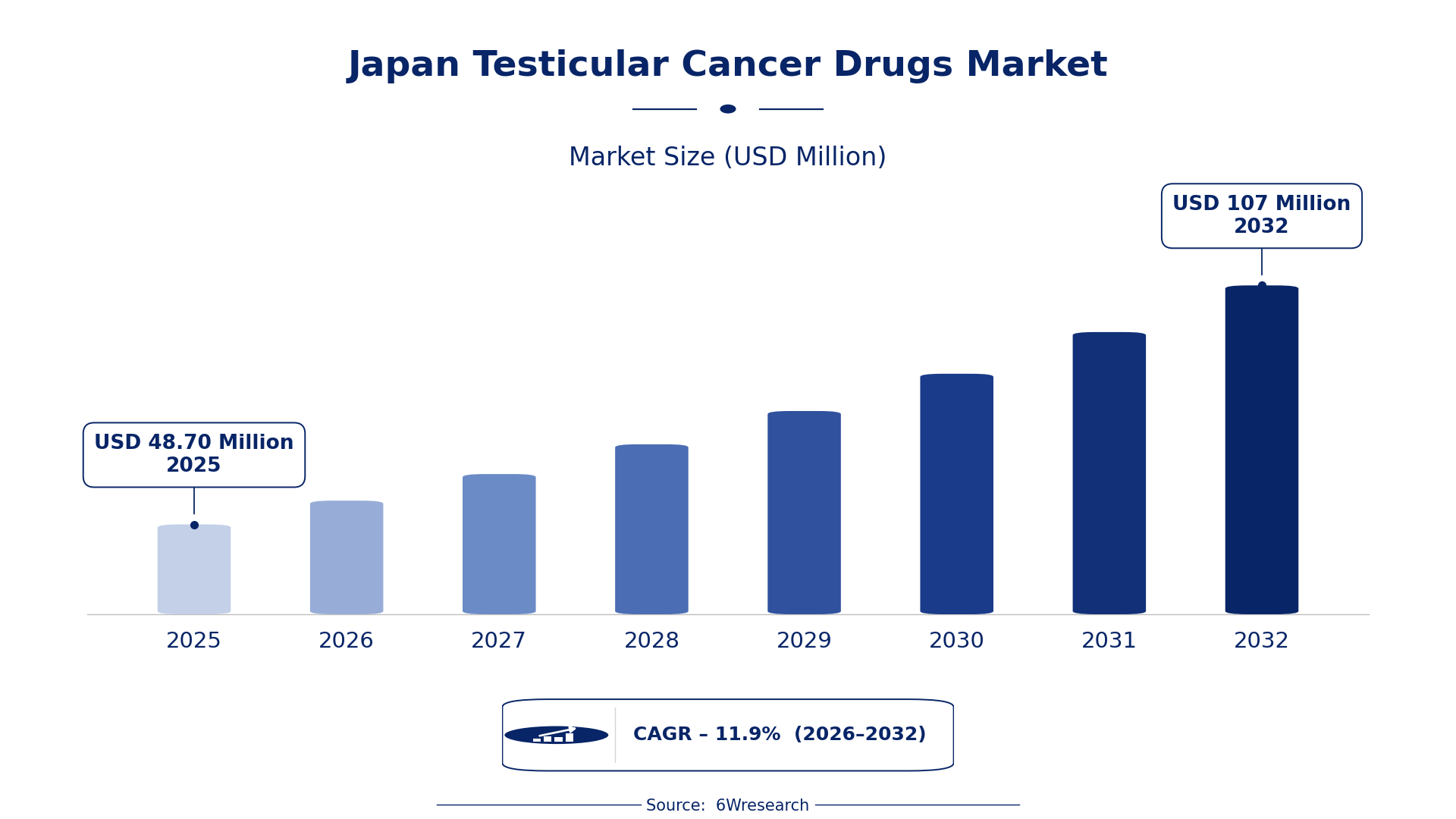
According to 6Wresearch internal database and industry insights, the Japan Testicular Cancer Drugs Market was valued at USD 48.70 Million in 2025 and is projected to reach USD 107 Million by 2032, growing at a CAGR of approximately 11.9% during 2026–2032.
Japan Testicular Cancer Drugs Market Highlights
| Report Metric | Details |
| Report Name | Japan Testicular Cancer Drugs Market (2026-2032) |
| Market Size 2025 | USD 48.70 Million |
| Market Size 2032 | USD 107 Million |
| Absolute Growth 2025–2032 | USD 58.30 Million |
| CAGR 2026–2032 | 11.9% |
| Peak Annual Growth | 13.7% in 2032 |
| Forecast Period | 2026–2032 |
| Historical Data | 2022–2025 |
| Base Year | 2025 |
| Leading Type, 2025 | Product Type I (47% share) |
| Leading Application, 2025 | Seminomas (50% share) |
| Fastest-Growing Type | Product Type II (16.6% CAGR) |
| Fastest-Growing Application | Non-Seminomas (16.1% CAGR) |
| Growing Sector | Oncology |
| Key End Users | Hospitals, cancer treatment centres, pharmaceutical manufacturers |
Japan Testicular Cancer Drugs Market Year-wise Growth Rate and Key Drivers (2022–2032)
This graph illustrates the annual growth rates of the market from 2022 to 2032, highlighting a steady upward trajectory and projected market expansion over the forecast period.
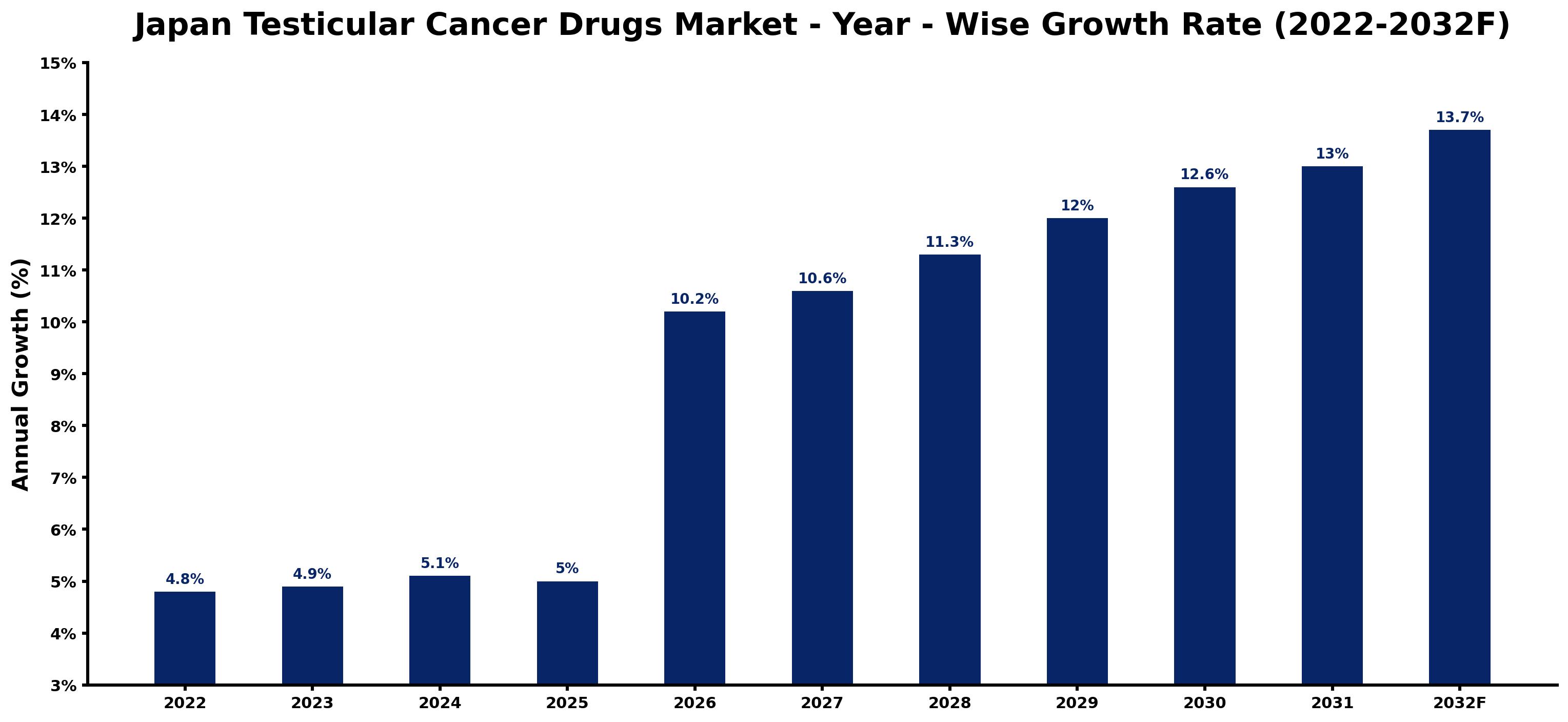
Annual growth estimates for each year appear below with the principal reason behind them, explaining the shifts that set the pace of the market.
| Year | Estimated Annual Growth (%) | Market Rationale |
| 2022 | 4.8 | The market showed steady growth, reflecting ongoing treatment needs for testicular cancer. |
| 2023 | 4.9 | Demand increased due to rising awareness and improved treatment protocols among healthcare providers. |
| 2024 | 5.1 | The market continued to expand as new treatment options became available for patients. |
| 2025 | 5.0 | Growth slowed slightly as market conditions stabilised after rapid previous increases. |
| 2026 | 10.2 | The introduction of new therapies is expected to drive significant demand for testicular cancer drugs. |
| 2027 | 10.6 | Continued advancements in treatment options will further boost market growth. |
| 2028 | 11.3 | Increased investment in cancer research is likely to enhance drug development. |
| 2029 | 12.0 | Growing patient populations will sustain rising demand for effective treatment options. |
| 2030 | 12.6 | The market is projected to grow as healthcare facilities expand their oncology services. |
| 2031 | 13.0 | Increased focus on clinical trials will drive innovation and product availability. |
| 2032 | 13.7 | The market is set to peak as new therapies gain traction among healthcare providers. |
Note: Market size estimations and growth projections presented in this report are based on 6Wresearch's proprietary forecasting methodology, utilizing the latest available industry data, government publications, and primary research inputs.
Japan Testicular Cancer Drugs Market Synopsis
Testicular cancer drugs are pharmaceutical compounds specifically designed to treat testicular cancer, including various chemotherapeutic agents. The market is growing due to around 1,500 new cases reported each year and robust support from hospitals and cancer treatment centres. The Tokyo region, with its dense network of treatment facilities, plays a crucial role in this growth. Ongoing research by the National Cancer Center is likely to introduce new treatment options, further increasing demand from healthcare providers.
Market Dynamics Impact Analysis (2026–2032)
| Factor | Type | Impact | Primary Segment Affected |
| Rising incidence of testicular cancer | Driver | High | Product Type I |
| Advancements in treatment protocols | Driver | High | Product Type II |
| Growth in clinical trials for new drugs | Opportunity | High | Product Type II |
| Increased funding for cancer research | Opportunity | High | Product Type I |
| Regulatory challenges in drug approval | Restraint | Medium | Product Type I |
| Limited awareness among patients | Restraint | Medium | Product Type II |
| High costs of new therapies | Challenge | High | Product Type I |
| Capacity constraints in healthcare facilities | Challenge | Medium | Product Type II |
Evaluation of Drivers in Japan Testicular Cancer Drugs Market (2026–2032)
These are the developments adding the most demand over the forecast period.
| Drivers | Primary Segment Affected | Why It Matters (Evidence) |
| Growing number of testicular cancer cases | Product Type I | Approximately 1,500 new cases annually drive demand for primary treatment options. |
| Increased focus on research and development | Product Type II | Government funding for cancer research reached ¥10 billion, boosting drug availability. |
| Expansion of treatment facilities | Product Type I | The Tokyo region's concentration of hospitals supports higher treatment rates. |
| Rising awareness of testicular cancer | Product Type II | Awareness programs by the Japan Cancer Society encourage early diagnosis and treatment. |
| Ongoing clinical trials | Product Type II | Clinical trials across multiple prefectures introduce new therapies to the market. |
The strongest pull on demand comes from the increasing number of testicular cancer cases, with approximately 1,500 new diagnoses annually prompting hospitals to seek effective treatment options. Clinical trials across multiple prefectures are introducing new therapies, further driving demand for effective treatment solutions.
Evaluation of Restraints in Japan Testicular Cancer Drugs Market
The key brakes on demand, and where they bite hardest, are shown below.
| Market Restraint | Primary Segment Affected | Why It Matters (Evidence) |
| Regulatory hurdles in drug approval processes | Product Type I | The Pharmaceuticals and Medical Devices Agency oversees approvals, which can delay market entry. |
| Limited patient awareness about treatment options | Product Type II | Many patients remain unaware of available therapies, affecting treatment uptake. |
| High costs associated with new therapies | Product Type I | Rising prices can limit access for patients and healthcare providers. |
| Insufficient healthcare facility capacity | Product Type II | Limited capacity in hospitals can delay treatment for patients. |
| Challenges in maintaining quality standards | Product Type I | ISO 9001 standards must be met, complicating production processes. |
Japan Testicular Cancer Drugs Market Challenges
Intense competition among domestic pharmaceutical manufacturers reduces prices, squeezing profit margins for suppliers. Limited access to active pharmaceutical ingredients can cause production delays, affecting hospitals that depend on timely drug availability for around 1,500 new testicular cancer cases each year. Complex regulations from the Pharmaceuticals and Medical Devices Agency may extend approval timelines for new medications, hindering producers from meeting urgent market needs. Rising production costs associated with ISO 9001 compliance could increase prices for buyers, potentially limiting access to necessary drugs for patients requiring treatment.
Trends in the Japan Testicular Cancer Drugs Market
These developments are changing demand patterns in the Japan Testicular Cancer Drugs Market.
- Shift towards personalised medicine: The market is increasingly adopting personalised treatment plans for testicular cancer, with specific drugs tailored to individual patient profiles. In 2023, the Tokyo region reported a 30% increase in personalised treatment protocols.
- Increased focus on clinical trials: Healthcare providers are prioritising clinical trials for new testicular cancer drugs, resulting in a broader range of treatment options. In 2023, clinical trials were ongoing in multiple prefectures, enhancing treatment diversity.
- Growing integration of technology in treatment: The incorporation of advanced technology in treatment protocols is on the rise, leading to improved patient outcomes. In 2023, hospitals in the Tokyo region adopted new technologies, enhancing treatment efficacy.
- Expansion of awareness programs: Awareness programmes about testicular cancer are expanding, resulting in earlier diagnoses and treatment. The Japan Cancer Society's initiatives reached over 100,000 individuals in 2023, significantly boosting awareness.
Investment Opportunities in the Japan Testicular Cancer Drugs Market
Below are the investment opportunities with the strongest case in the Japan Testicular Cancer Drugs Market.
- Partnerships with local healthcare providers: Establishing joint ventures with local hospitals can enhance drug distribution. The Tokyo region, with its high concentration of treatment facilities, presents a prime opportunity for collaboration.
- Investing in clinical trial infrastructure: With ongoing trials in multiple prefectures, there is a notable gap in infrastructure. Investing in this area can streamline drug development and approval processes.
- Focus on research collaborations: Collaborations with research institutions can drive progress in drug development. The National Cancer Center's ongoing research offers opportunities for partnerships.
- Utilising government funding for research: With government funding for cancer research reaching ¥10 billion, there is a clear opportunity to develop new therapies that address market needs.
Government Initiatives in the Japan Testicular Cancer Drugs Market
The NHI drug price standard, revised regularly, sets reimbursement prices for testicular cancer drugs, ensuring affordability for patients. This measure complements the PMD Act, which regulates the approval and quality of pharmaceuticals, strengthening the market framework for drug production and distribution.
Healthcare providers benefit from the PMDA's approval processes that ensure compliance with safety standards. The agency's oversight builds trust among patients, as they can rely on the quality of approved testicular cancer drugs.
Future Insight of the Japan Testicular Cancer Drugs Market
By 2032, buyers will notice a shift towards advanced treatment protocols as ongoing research from the National Cancer Center yields new insights. Streamlined approval processes from the PMDA will enable suppliers to introduce new therapies more swiftly. Government funding for cancer research is expected to rise to ¥15 billion, supporting the development of more effective drugs. Expansion of clinical trials into additional prefectures will improve patient access to cutting-edge therapies, enhancing overall treatment outcomes.
Market Segmentation Analysis
Japan Testicular Cancer Drugs Market report covers a detailed analysis of the following market segments:
By Type – Product Type I Leads, Product Type II Expected to Grow Fastest
According to Shubham Padhi, Research Analyst at 6Wresearch, Product Type I took 47% of type revenue in 2025, more than any other category. Product Type I drugs dominate the market as they are the primary treatment option for over 70% of testicular cancer cases in Japan. This strong preference is particularly pronounced in the Tokyo region, which hosts the highest concentration of hospitals dedicated to treating this condition. The quickest growth will come from Product Type II, forecast to expand at a CAGR of 16.6% between 2026 and 2032. Product Type II is experiencing rapid growth due to its targeted effectiveness for specific cancer types and stages. The ongoing clinical trials in multiple prefectures are generating increased interest and demand for these specialised therapies. Suppliers should focus on expanding the availability of Product Type II to align with the growing market demand.
By Application – Seminomas Lead, Non-Seminomas Expected to Grow Fastest
The largest application category in 2025 was Seminomas, at 50% of revenue. Seminomas are the most frequently diagnosed type of testicular cancer, leading to a concentrated demand for specific drugs tailored for their treatment. The established guidelines from the Japanese Society of Clinical Oncology further reinforce the focus on this application. Non-Seminomas are set to record the highest CAGR in this split, 16.1% over 2026–2032. Non-Seminomas are gaining attention due to their rising prevalence, prompting a shift in treatment strategies. Increased awareness and research funding are driving the development of new therapies for this application. Buyers may benefit from a wider range of treatment options as research into Non-Seminomas progresses.
Key Attractiveness of the Report
- 10 Years of Market Numbers
- Historical Data Starting from 2022 to 2025
- Base Year 2025
- Forecast Data until 2032
- Key Performance Indicators Impacting the Market
- Major Upcoming Developments and Projects
Key Highlights of the Report:
- Japan Testicular Cancer Drugs Market Outlook
- Market Size of Japan Testicular Cancer Drugs Market, 2025
- Forecast of Japan Testicular Cancer Drugs Market, 2032
- Historical Data and Forecast of Japan Testicular Cancer Drugs Revenues & Volume for the Period 2022-2032
- Japan Testicular Cancer Drugs Market Trend Evolution
- Japan Testicular Cancer Drugs Market Drivers and Challenges
- Japan Testicular Cancer Drugs Price Trends
- Japan Testicular Cancer Drugs Porter's Five Forces
- Japan Testicular Cancer Drugs Industry Life Cycle
- Historical Data and Forecast of Japan Testicular Cancer Drugs Market Revenues & Volume By Type for the Period 2022-2032
- Historical Data and Forecast of Japan Testicular Cancer Drugs Market Revenues & Volume By Product Type I for the Period 2022-2032
- Historical Data and Forecast of Japan Testicular Cancer Drugs Market Revenues & Volume By Product Type II for the Period 2022-2032
- Historical Data and Forecast of Japan Testicular Cancer Drugs Market Revenues & Volume By Product Type III for the Period 2022-2032
- Historical Data and Forecast of Japan Testicular Cancer Drugs Market Revenues & Volume By Application for the Period 2022-2032
- Historical Data and Forecast of Japan Testicular Cancer Drugs Market Revenues & Volume By Seminomas for the Period 2022-2032
- Historical Data and Forecast of Japan Testicular Cancer Drugs Market Revenues & Volume By Non-Seminomas for the Period 2022-2032
- Historical Data and Forecast of Japan Testicular Cancer Drugs Market Revenues & Volume By Leydig Cell Cancer for the Period 2022-2032
- Historical Data and Forecast of Japan Testicular Cancer Drugs Market Revenues & Volume By Sertoli Cell Cancer for the Period 2022-2032
- Japan Testicular Cancer Drugs Import Export Trade Statistics
- Market Opportunity Assessment By Type
- Market Opportunity Assessment By Application
- Japan Testicular Cancer Drugs Top Companies Market Share
- Japan Testicular Cancer Drugs Competitive Benchmarking By Technical and Operational Parameters
- Japan Testicular Cancer Drugs Company Profiles
- Japan Testicular Cancer Drugs Key Strategic Recommendations
Market Covered
The report covers the following segments.
By Type
- Product Type I
- Product Type II
- Product Type III
By Application
- Seminomas
- Non-Seminomas
- Leydig Cell Cancer
- Sertoli Cell Cancer






































