Japan Textile Care Market Size & Growth Rate
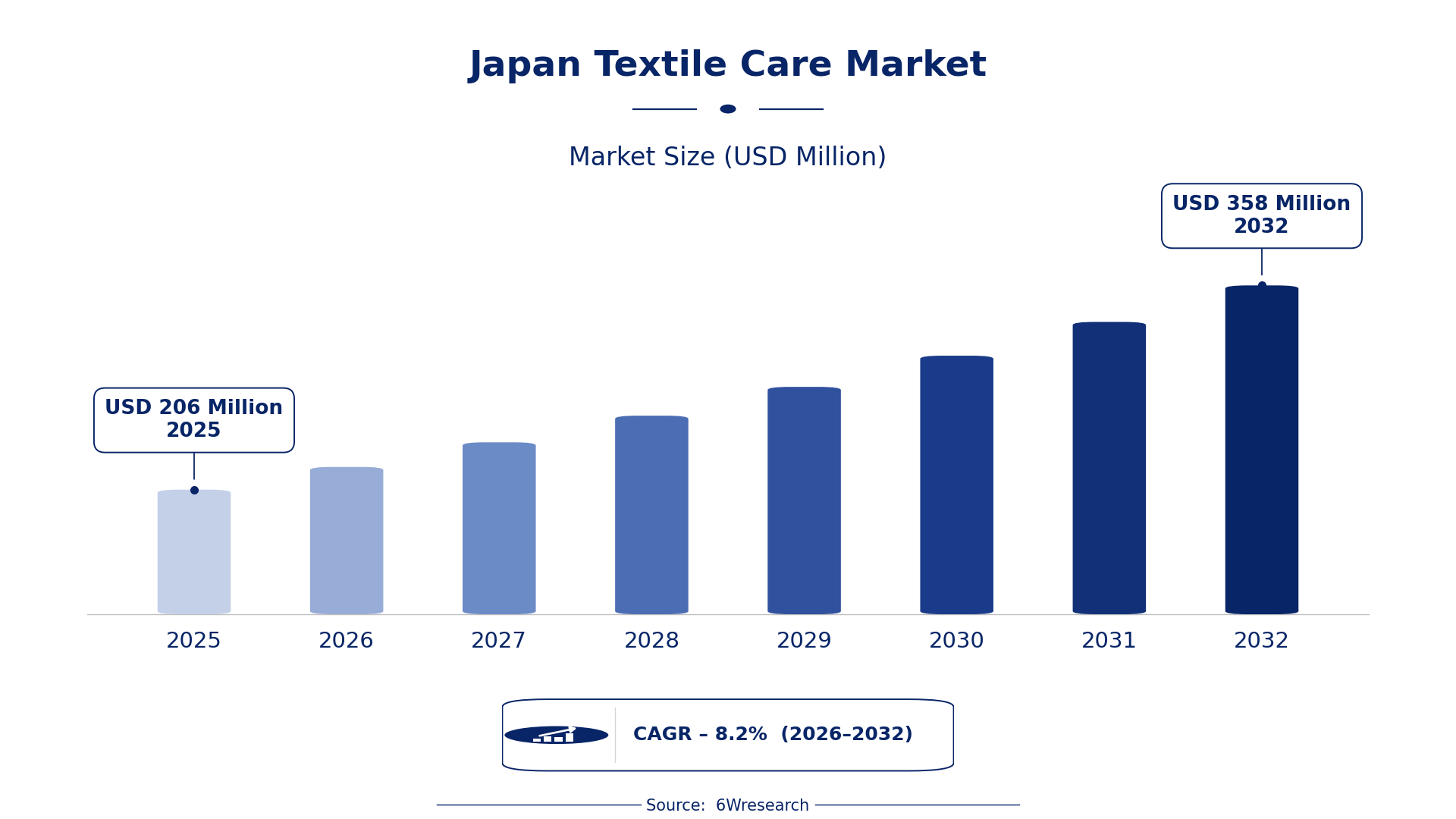
According to 6Wresearch internal database and industry insights, the Japan Textile Care Market was valued at USD 206 Million in 2025 and is projected to reach USD 358 Million by 2032, growing at a CAGR of approximately 8.2% during 2026–2032.
Japan Textile Care Market Highlights
| Report Metric | Details |
| Report Name | Japan Textile Care Market (2026-2032) |
| Market Size 2025 | USD 206 Million |
| Market Size 2032 | USD 358 Million |
| Absolute Growth 2025–2032 | USD 152 Million |
| CAGR 2026–2032 | 8.2% |
| Peak Annual Growth | 9.1% in 2026 |
| Forecast Period | 2026–2032 |
| Historical Data | 2022–2025 |
| Base Year | 2025 |
| Leading Care Service, 2025 | Dry Cleaning (40% share) |
| Leading Delivery Mode, 2025 | In-Store (41% share) |
| Leading Fiber Type, 2025 | Silk (37% share) |
| Leading End User, 2025 | Luxury Garments (36% share) |
| Fastest-Growing Care Service | Laundry Services (10.8% CAGR) |
| Fastest-Growing Delivery Mode | Pickup/Drop (11.3% CAGR) |
| Fastest-Growing Fiber Type | Wool (12.0% CAGR) |
| Fastest-Growing End User | Residential & Commercial (10.9% CAGR) |
| Growing Sector | Healthcare |
| Key End Users | Residential customers, hospitality sector, healthcare facilities, environmentally-conscious consumers |
Japan Textile Care Market Year-wise Growth Rate and Key Drivers (2022–2032)
This graph illustrates the annual growth rates of the market from 2022 to 2032, highlighting a steady upward trajectory and projected market expansion over the forecast period.
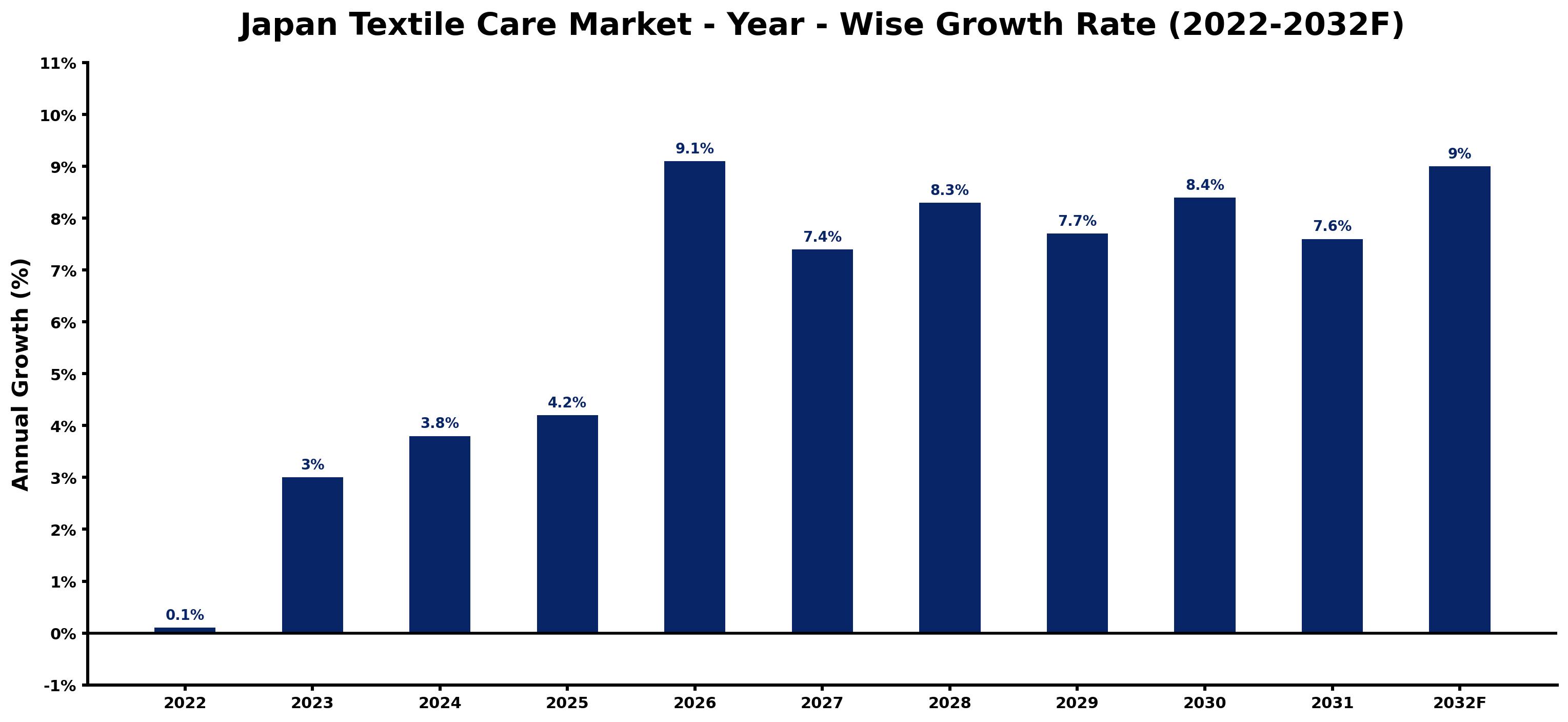
For each year, the table pairs the estimated growth rate with the leading influence on demand, showing how the drivers changed across the period.
| Year | Estimated Annual Growth (%) | Market Rationale |
| 2022 | 0.1 | The market experienced minimal growth due to limited consumer spending. |
| 2023 | 3.0 | Demand increased as urban populations sought convenient laundry services. |
| 2024 | 3.8 | Growth accelerated with rising awareness of eco-friendly cleaning options. |
| 2025 | 4.2 | The market expanded further as the hospitality sector increased textile care needs. |
| 2026 | 9.1 | Growth peaked due to heightened demand for luxury garment cleaning services. |
| 2027 | 7.4 | The growth rate slowed as market saturation began in urban areas. |
| 2028 | 8.3 | Demand rose again as more consumers opted for eco-friendly solutions. |
| 2029 | 7.7 | Growth decelerated slightly as competition intensified among service providers. |
| 2030 | 8.4 | The market experienced renewed growth driven by technological advancements. |
| 2031 | 7.6 | Growth moderated as consumers became more price-sensitive in spending. |
| 2032 | 9.0 | Demand surged again as the hospitality sector rebounded. |
Note: Market size estimations and growth projections presented in this report are based on 6Wresearch's proprietary forecasting methodology, utilizing the latest available industry data, government publications, and primary research inputs.
Japan Textile Care Market Synopsis
Textile care involves cleaning and maintaining fabrics through methods like dry cleaning and laundering, utilising detergents and specialized equipment. The Japan Textile Care Market is projected to expand, driven by a rising population aged 65 or older, which reached 29.3% in September 2024, and increasing demand from sectors such as hospitality and healthcare, which require high standards of textile cleaning. The market is also experiencing a shift towards eco-friendly cleaning methods, with urban areas reporting a 20% increase in such services in 2023, reflecting changing consumer preferences.
Market Dynamics Impact Analysis (2026–2032)
| Factor | Type | Impact | Primary Segment Affected |
| Rising population aged 65 or older increases demand for laundry services. | Driver | High | Laundry Services |
| Growing awareness of sustainable practices boosts eco-friendly cleaning options. | Driver | High | Eco-Friendly Cleaning |
| Increasing demand for luxury garment cleaning services presents growth opportunities. | Opportunity | High | Luxury Garments |
| Urban areas are experiencing a surge in eco-friendly cleaning service adoption. | Opportunity | High | Eco-Friendly Cleaning |
| Competition among service providers may lead to price wars. | Restraint | Medium | Dry Cleaning |
| High operational costs can limit service expansion for smaller businesses. | Restraint | Medium | Laundry Services |
| Technological advancements require significant investment from suppliers. | Challenge | High | Industrial Cleaning |
| Consumer preferences are shifting rapidly towards eco-friendly options. | Challenge | High | Eco-Friendly Cleaning |
Evaluation of Drivers in Japan Textile Care Market (2026–2032)
The factors lifting demand, and the evidence behind each, are summarised below.
| Drivers | Primary Segment Affected | Why It Matters (Evidence) |
| Increasing elderly population drives demand for laundry services. | Laundry Services | Approximately 29.3% of Japan's population was aged 65 or older in September 2024, leading to higher laundry service usage. |
| Rising awareness of eco-friendly practices boosts demand. | Eco-Friendly Cleaning | Urban areas reported a 20% increase in eco-friendly cleaning services in 2023, reflecting consumer preferences. |
| Luxury garment cleaning services are in high demand. | Luxury Garments | The hospitality sector employs over 1.5 million people, increasing the need for premium cleaning services. |
| Technological advancements in cleaning methods improve service efficiency. | Industrial Cleaning | The textile care industry is set to adopt more automation technologies by 2025, improving operational processes. |
| High standards in healthcare drive demand for textile cleaning. | Healthcare | The healthcare sector adheres to JIS standards, necessitating high-quality textile care services. |
Orders keep climbing as the elderly population in Japan increases demand for laundry services. Urban areas are experiencing a 20% rise in eco-friendly cleaning options, reflecting a shift towards sustainable practices. The hospitality sector drives the need for luxury garment cleaning, with over 1.5 million people employed in the industry. By 2025, the industry will adopt more automation technologies, improving operational processes. Facilities adhering to JIS standards also contribute to the growing demand for high-quality textile care services.
Evaluation of Restraints in Japan Textile Care Market
The table below lists the restraints and the evidence behind each.
| Market Restraint | Primary Segment Affected | Why It Matters (Evidence) |
| Intense competition may lead to price wars among service providers. | Dry Cleaning | Increased competition can force businesses to lower prices, impacting profitability. |
| High operational costs limit service expansion for smaller businesses. | Laundry Services | Small operators struggle with rising costs, hindering their ability to expand service offerings. |
| Technological advancements require considerable investment from suppliers. | Industrial Cleaning | Investments in new technologies can be prohibitively expensive for some operators. |
| Consumer preferences are shifting rapidly towards eco-friendly options. | Eco-Friendly Cleaning | Businesses that do not adapt may lose market share to more sustainable competitors. |
| Regulatory compliance can increase operational complexities. | Healthcare | Adhering to JIS standards requires additional investments in training and equipment. |
Japan Textile Care Market Challenges
Root causes of challenges in Japan's textile care market stem from supply chain constraints, as over 1,000 dry cleaning establishments compete for limited resources, raising operational costs for producers. Technology adoption lags, with only 30% of facilities using green solvents, which increases expenses and slows service delivery for buyers. Regulatory pressures mount, as compliance with JIS standards and a government initiative to cut chemical usage by 15% by 2025 adds costs that can delay services for consumers. Intense competition in urban areas like Tokyo and Osaka forces many producers to lower prices, squeezing margins and limiting investment in quality for buyers.
Trends in the Japan Textile Care Market
Several trends are reshaping the Japan Textile Care Market; the most important are set out below.
- Shift towards Eco-Friendly Cleaning Solutions: A government program launched in 2023 promotes eco-friendly cleaning methods, resulting in a 20% increase in urban areas. This trend is reshaping service offerings, as consumers increasingly prefer sustainable options.
- Transition from Traditional to Automated Cleaning Services: By 2025, the textile care industry will adopt more automation technologies, improving operational efficiency. This shift will attract tech-savvy consumers seeking modern solutions.
- Luxury Garments Prioritised over Everyday Textiles: The hospitality sector's demand for premium cleaning services drives a focus on luxury garments. This segment is expected to grow, reflecting changing consumer preferences.
- Emergence of Green Solvents in Cleaning Facilities: Green solvents are becoming standard in 30% of cleaning facilities in Japan. This trend aligns with the growing consumer demand for environmentally-friendly products.
Investment Opportunities in the Japan Textile Care Market
Investors looking at the Japan Textile Care Market should consider the following areas.
- Healthcare Sector Seeking High-Quality Textile Care: The healthcare sector, which demands high standards for textile cleaning, presents a significant opportunity. With Japan's national medical care expenditure at about JPY 46.7 trillion in fiscal 2022, suppliers can invest in advanced cleaning technologies.
- Urban Areas Embracing Eco-Friendly Cleaning Services: Urban areas are increasingly adopting eco-friendly cleaning services, with a reported 20% rise in 2023. Suppliers should focus on providing sustainable cleaning solutions to meet this demand.
- Growing Demand for Luxury Garment Cleaning: The luxury garment segment is expanding as consumer spending on premium services rises. With the hospitality industry employing over 1.5 million people, suppliers can target this lucrative market.
- Investment in Automation Technologies: The textile care industry is set to adopt more automation technologies by 2025. This presents an opportunity for suppliers to invest in innovative cleaning solutions that improve efficiency.
Government Initiatives in the Japan Textile Care Market
The GX Basic Policy adopted in 2023 aims for about JPY 150 trillion of public-private decarbonisation investment over 10 years, impacting textile care producers by promoting eco-friendly practices. This policy builds on earlier laws, such as the Long-Term Care Insurance Act, which supports services for the elderly, indirectly influencing the demand for textile care services.
The Japan Textile Care Association utilises the Long-Term Care Insurance Act to ensure that textile care services meet the needs of the elderly population. This association plays an important role in promoting high standards and sustainable practices within the industry, helping businesses align with government initiatives.
Future Insight of the Japan Textile Care Market
By 2032, policy-driven changes will reshape the textile care sector, as government initiatives promote sustainable practices and eco-friendly cleaning methods. The adoption of automation technologies will streamline operations, reducing costs and improving service efficiency. Buyers will benefit from enhanced service quality as competition encourages innovation in offerings. Suppliers will need to align with evolving environmental standards to remain competitive, particularly as the demand for eco-friendly services continues to grow in urban markets.
Market Segmentation Analysis
Japan Textile Care Market report covers a detailed analysis of the following market segments:
By Care Service – Dry Cleaning Leads, Laundry Services Expected to Grow Fastest
According to Prakhar Dixit, Senior Research Analyst at 6Wresearch, Dry Cleaning took 40% of care service revenue in 2025, more than any other category. Dry cleaning holds the largest share as it is essential for maintaining delicate fabrics, particularly in urban centres like Tokyo where demand is high. The presence of over 1,000 dry cleaning establishments across Japan solidifies this segment's dominance. Laundry Services are set to record the highest CAGR in this split, 10.8% over 2026–2032. Laundry services are experiencing rapid growth as households increasingly rely on these services, averaging three uses per month. This trend is particularly pronounced in densely populated areas, such as Tokyo, which drives further demand. Suppliers must adapt their strategies to align with the growing preference for laundry services.
By Delivery Mode – In-Store Leads, Pickup/Drop Expected to Grow Fastest
With 41% of delivery mode revenue in 2025, In-Store was the largest category. In-store service is the leading delivery mode, remaining the traditional choice for textile care. Customers value the direct interaction and assurance of quality that comes from visiting a physical location for their cleaning needs. Over 2026–2032, Pickup/Drop is expected to post the fastest growth, at a CAGR of 11.3%. Pickup/drop services are expanding quickly due to the convenience they offer, especially for busy urban customers. This growth reflects a shift towards more efficient service options that cater to modern lifestyles. Providers should focus on enhancing logistics and technology to optimise the efficiency of pickup/drop services.
By Fiber Type – Silk Leads, Wool Expected to Grow Fastest
The largest fiber type category in 2025 was Silk, at 37% of revenue. Silk is the leading fiber type in the market because it requires specialised care that is highly valued by consumers seeking premium textile services. The demand for silk cleaning is particularly strong among luxury garment owners who prioritise quality. The quickest growth will come from Wool, forecast to expand at a CAGR of 12.0% between 2026 and 2032. Wool is the fastest-growing fiber type as it necessitates specific cleaning processes that are increasingly recognised for their importance in maintaining garment quality. The rise in wool garment sales contributes to this segment's growth. Suppliers should develop tailored cleaning solutions for wool to capitalise on its growing popularity.
By End User – Luxury Garments Lead, Residential & Commercial Expected to Grow Fastest
Luxury Garments accounted for 36% of the market by end user in 2025. Luxury garments dominate the end user segment due to the high demand for premium cleaning services among affluent consumers. This segment benefits from a clientele that is willing to invest in maintaining the quality of their high-value items. Residential & Commercial is projected to grow fastest, at a CAGR of 10.9% during 2026–2032. The residential and commercial segment is growing rapidly as it encompasses a broad customer base, including households and businesses that require regular cleaning services. This expansion reflects the increasing reliance on professional textile care in everyday life. Market players should diversify their offerings to cater to both luxury and everyday cleaning needs.
Key Attractiveness of the Report
- 10 Years of Market Numbers
- Historical Data Starting from 2022 to 2025
- Base Year 2025
- Forecast Data until 2032
- Key Performance Indicators Impacting the Market
- Major Upcoming Developments and Projects
Key Highlights of the Report:
- Japan Textile Care Market Outlook
- Market Size of Japan Textile Care Market, 2025
- Forecast of Japan Textile Care Market, 2032
- Historical Data and Forecast of Japan Textile Care Revenues & Volume for the Period 2022-2032F
- Japan Textile Care Market Trend Evolution
- Japan Textile Care Market Drivers and Challenges
- Japan Textile Care Price Trends
- Japan Textile Care Porter's Five Forces
- Japan Textile Care Industry Life Cycle
- Historical Data and Forecast of Japan Textile Care Market Revenues & Volume By Care Service for the Period 2022-2032F
- Historical Data and Forecast of Japan Textile Care Market Revenues & Volume By Dry Cleaning for the Period 2022-2032F
- Historical Data and Forecast of Japan Textile Care Market Revenues & Volume By Laundry Services for the Period 2022-2032F
- Historical Data and Forecast of Japan Textile Care Market Revenues & Volume By Industrial Cleaning for the Period 2022-2032F
- Historical Data and Forecast of Japan Textile Care Market Revenues & Volume By Eco-Friendly Cleaning for the Period 2022-2032F
- Historical Data and Forecast of Japan Textile Care Market Revenues & Volume By Delivery Mode for the Period 2022-2032F
- Historical Data and Forecast of Japan Textile Care Market Revenues & Volume By In-Store for the Period 2022-2032F
- Historical Data and Forecast of Japan Textile Care Market Revenues & Volume By Pickup/Drop for the Period 2022-2032F
- Historical Data and Forecast of Japan Textile Care Market Revenues & Volume By Contractual for the Period 2022-2032F
- Historical Data and Forecast of Japan Textile Care Market Revenues & Volume By Green Solvents for the Period 2022-2032F
- Historical Data and Forecast of Japan Textile Care Market Revenues & Volume By Fiber Type for the Period 2022-2032F
- Historical Data and Forecast of Japan Textile Care Market Revenues & Volume By Silk, Wool for the Period 2022-2032F
- Historical Data and Forecast of Japan Textile Care Market Revenues & Volume By Cotton/Synthetics for the Period 2022-2032F
- Historical Data and Forecast of Japan Textile Care Market Revenues & Volume By Uniforms for the Period 2022-2032F
- Historical Data and Forecast of Japan Textile Care Market Revenues & Volume By Mixed Textiles for the Period 2022-2032F
- Historical Data and Forecast of Japan Textile Care Market Revenues & Volume By End User for the Period 2022-2032F
- Historical Data and Forecast of Japan Textile Care Market Revenues & Volume By Luxury Garments for the Period 2022-2032F
- Historical Data and Forecast of Japan Textile Care Market Revenues & Volume By Residential & Commercial for the Period 2022-2032F
- Historical Data and Forecast of Japan Textile Care Market Revenues & Volume By Hospitality, Healthcare for the Period 2022-2032F
- Historical Data and Forecast of Japan Textile Care Market Revenues & Volume By Environmentally-Conscious for the Period 2022-2032F
- Japan Textile Care Import Export Trade Statistics
- Market Opportunity Assessment By Care Service
- Market Opportunity Assessment By Delivery Mode
- Market Opportunity Assessment By Fiber Type
- Market Opportunity Assessment By End User
- Japan Textile Care Top Companies Market Share
- Japan Textile Care Competitive Benchmarking By Technical and Operational Parameters
- Japan Textile Care Company Profiles
- Japan Textile Care Key Strategic Recommendations
Market Covered
The report covers the following segments.
By Care Service
- Dry Cleaning
- Laundry Services
- Industrial Cleaning
- Eco-Friendly Cleaning
By Delivery Mode
- In-Store
- Pickup/Drop
- Contractual
- Green Solvents
By Fiber Type
- Silk
- Wool
- Cotton/Synthetics
- Uniforms
- Mixed Textiles
By End User
- Luxury Garments
- Residential & Commercial
- Hospitality
- Healthcare
- Environmentally-Conscious































