Japan Textile Furnishing Market Size & Growth Rate
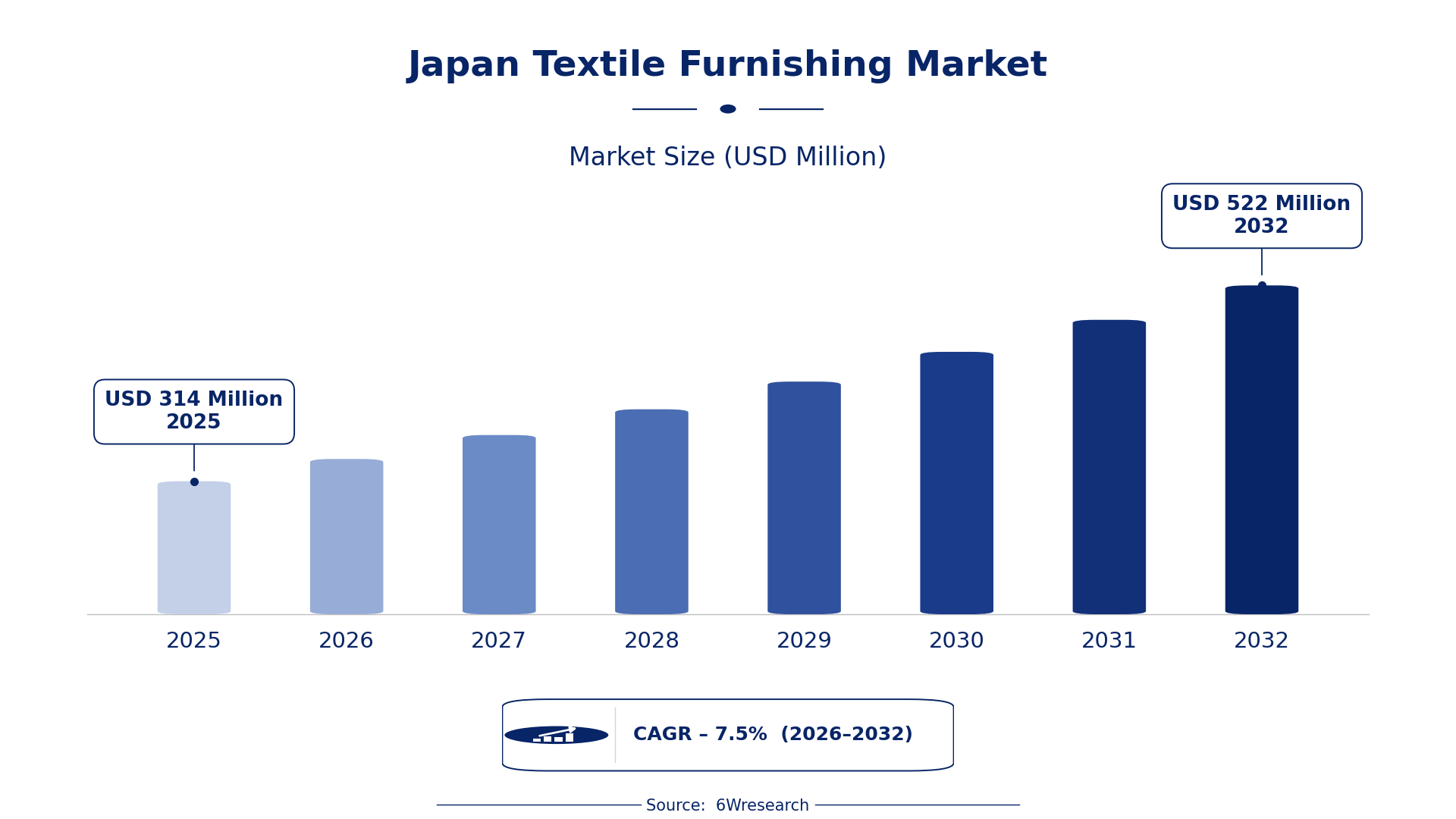
According to 6Wresearch internal database and industry insights, the Japan Textile Furnishing Market was valued at USD 314 Million in 2025 and is projected to reach USD 522 Million by 2032, growing at a CAGR of approximately 7.5% during 2026–2032.
Japan Textile Furnishing Market Highlights
| Report Metric | Details |
| Report Name | Japan Textile Furnishing Market (2026-2032) |
| Market Size 2025 | USD 314 Million |
| Market Size 2032 | USD 522 Million |
| Absolute Growth 2025–2032 | USD 208 Million |
| CAGR 2026–2032 | 7.5% |
| Peak Annual Growth | 8.5% in 2028 |
| Forecast Period | 2026–2032 |
| Historical Data | 2022–2025 |
| Base Year | 2025 |
| Leading Textile Furnishing, 2025 | Upholstery Fabrics (45% share) |
| Leading Product Type, 2025 | Heavy-Duty Wovens (39% share) |
| Leading Fabric Type, 2025 | Polyester (45% share) |
| Leading Distribution Channel, 2025 | Retail Home Decor (44% share) |
| Leading End User Industry, 2025 | Residential Furnishings (43% share) |
| Fastest-Growing Textile Furnishing | Curtain & Draperies (10.0% CAGR) |
| Fastest-Growing Product Type | Sheers/Blackout (10.6% CAGR) |
| Fastest-Growing Fabric Type | Cotton (11.5% CAGR) |
| Fastest-Growing Distribution Channel | Online Stores (9.6% CAGR) |
| Fastest-Growing End User Industry | Hospitality (9.8% CAGR) |
| Growing Sector | Residential Furnishings |
| Key End Users | Residential consumers, hospitality sector, retail home decor, online retailers |
Japan Textile Furnishing Market Year-wise Growth Rate and Key Drivers (2022–2032)
This graph illustrates the annual growth rates of the market from 2022 to 2032, highlighting a steady upward trajectory and projected market expansion over the forecast period.
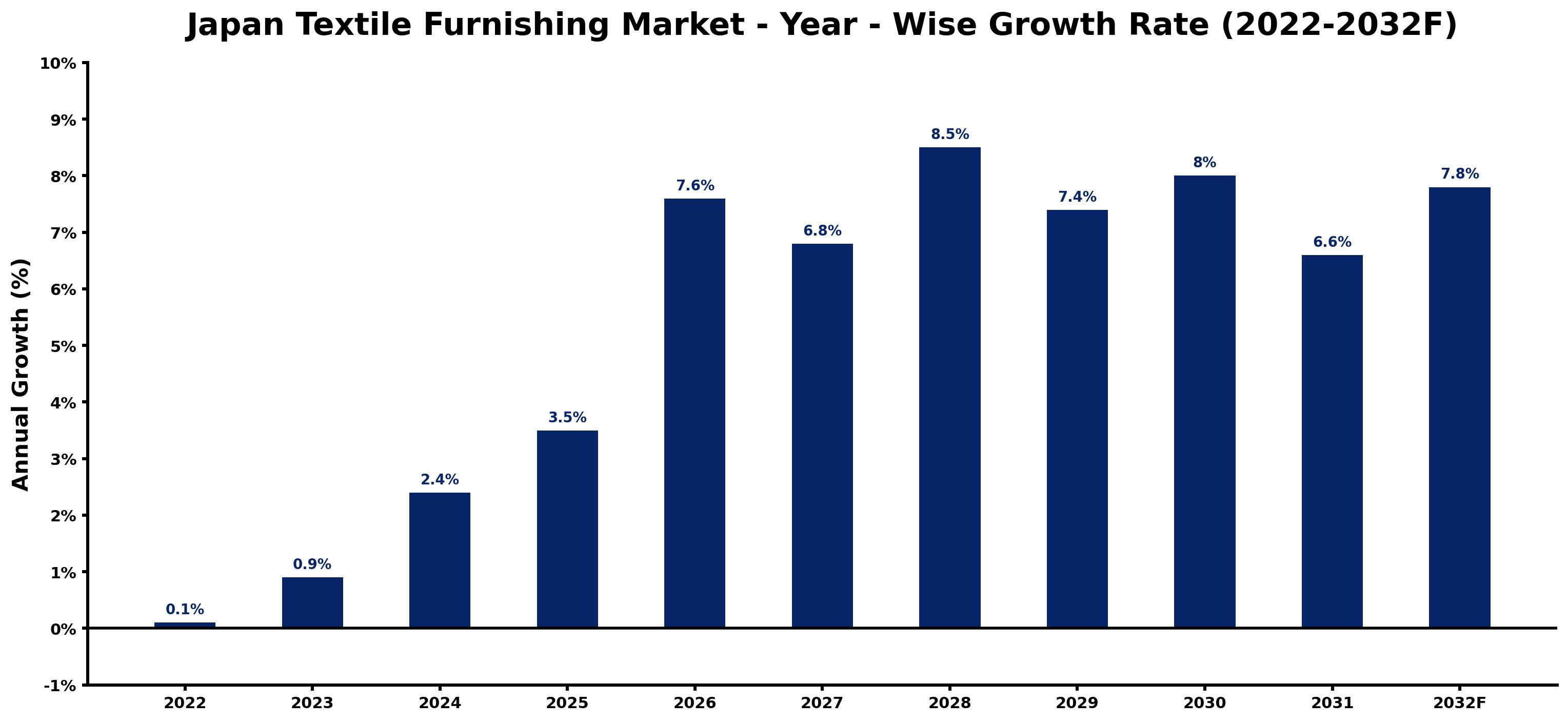
The yearly estimates that follow link every growth rate to its principal driver, so readers can see why the pace changed in each period.
| Year | Estimated Annual Growth (%) | Market Rationale |
| 2022 | 0.1 | The market showed minimal growth due to recovery from previous economic impacts. |
| 2023 | 0.9 | Demand increased as consumer spending on home furnishings began to rise. |
| 2024 | 2.4 | Growth accelerated with a resurgence in residential renovations and new builds. |
| 2025 | 3.5 | The hospitality sector expanded, driving demand for textile furnishings. |
| 2026 | 7.6 | Demand surged as the market embraces new sustainable textile practices. |
| 2027 | 6.8 | Growth slowed slightly as supply chain challenges began to surface. |
| 2028 | 8.5 | A peak in growth occurred as technology adoption in production increased. |
| 2029 | 7.4 | The market experienced a slowdown as competition intensified among suppliers. |
| 2030 | 8.0 | Demand rebounded with appealing designs attracting consumers. |
| 2031 | 6.6 | Growth moderated as market saturation began to affect purchasing decisions. |
| 2032 | 7.8 | The market is expected to grow steadily as sustainability becomes a priority. |
Note: Market size estimations and growth projections presented in this report are based on 6Wresearch's proprietary forecasting methodology, utilizing the latest available industry data, government publications, and primary research inputs.
Japan Textile Furnishing Market Synopsis
Textile furnishing encompasses fabric-based products such as upholstery, curtains, bed linens, and carpets, produced through weaving, dyeing, and finishing processes. The Japan Textile Furnishing Market is growing as consumer spending rises, particularly in the residential sector, where households allocate around 15% of their budgets to home furnishings. The hospitality sector, with over 30,000 establishments, is increasingly investing in textile furnishings, which drives demand for sustainable options and fresh designs.
Market Dynamics Impact Analysis (2026–2032)
| Factor | Type | Impact | Primary Segment Affected |
| Increasing demand from the hospitality sector drives textile furnishing purchases. | Driver | High | Residential Furnishings |
| Rising consumer interest in home decor trends boosts demand for textile furnishings. | Driver | High | Rugs & Carpets |
| Supply chain disruptions delay deliveries of textile products. | Restraint | Medium | Curtain & Draperies |
| Limited availability of premium materials affects product offerings. | Restraint | Medium | Rugs & Carpets |
| High competition among suppliers pressures pricing strategies. | Challenge | Medium | Bed & Table Linens |
| Rising consumer preferences for unique designs create challenges for inventory management. | Challenge | Medium | Upholstery Fabrics |
| Growing consumer focus on sustainable textiles opens new market opportunities. | Opportunity | High | Upholstery Fabrics |
| The shift towards online shopping increases access to textile products. | Opportunity | Medium | Online Stores |
Evaluation of Drivers in Japan Textile Furnishing Market (2026–2032)
Key forces behind demand, with the segment each one moves most, are listed below.
| Drivers | Primary Segment Affected | Why It Matters (Evidence) |
| Rising consumer spending on home furnishings increases demand for textiles. | Residential Furnishings | The average household spends around 15% of its budget on home furnishings, driving purchases. |
| Expansion of the hospitality sector boosts textile furnishing needs. | Hotels & Retail | With over 30,000 establishments, the hospitality sector requires extensive textile furnishings. |
| Growing emphasis on sustainable practices drives demand for eco-friendly textiles. | Upholstery Fabrics | Sustainability initiatives prompt consumers to seek environmentally friendly options. |
| Technological advancements in textile production improve product offerings. | Curtain & Draperies | Innovations in design and manufacturing attract consumers looking for modern solutions. |
| Increased online shopping accessibility expands market reach for textile products. | Online Stores | The rise of e-commerce platforms allows consumers to easily purchase textiles. |
Much of the new demand traces back to rising consumer spending, with households allocating approximately 15% of their budgets to home furnishings. The hospitality sector, comprising over 30,000 establishments, boosts textile furnishing needs, leading to increased purchases. Advancements in production improve offerings, attracting consumers seeking modern designs. The growing emphasis on sustainability prompts buyers to seek eco-friendly options, driving demand for upholstery fabrics. Increased accessibility to online shopping expands market reach, allowing consumers to easily purchase a variety of textile products.
Evaluation of Restraints in Japan Textile Furnishing Market
The key brakes on demand, and where they bite hardest, are shown below.
| Market Restraint | Primary Segment Affected | Why It Matters (Evidence) |
| Supply chain disruptions delay deliveries of textile products. | Curtain & Draperies | Increased global shipping times have affected the availability of essential materials. |
| Limited availability of premium materials affects product offerings. | Rugs & Carpets | The scarcity of high-quality fibers can restrict production capabilities. |
| Consumer preferences shift rapidly, creating inventory challenges. | Upholstery Fabrics | Manufacturers must adapt quickly to changing trends, risking excess stock. |
| Regulatory compliance costs can burden small manufacturers. | Heavy-Duty Wovens | Adhering to quality standards increases operational expenses for smaller firms. |
| High competition among suppliers pressures pricing strategies. | Bed & Table Linens | Price wars can lead to reduced profit margins for manufacturers. |
Japan Textile Furnishing Market Challenges
A shortage of skilled workers in the textile furnishing sector results in production delays, causing suppliers to struggle with timely deliveries. Complex regulations from the Japan Textile Federation raise compliance costs, forcing manufacturers to divert resources from innovation. Buyers are facing rising expenses, as the average household spends around 15% of its budget on home furnishings, prompting them to explore cheaper alternatives. Intense competition from both local and international producers pressures suppliers to reduce prices, which diminishes profit margins and limits investment in quality improvements.
Trends in the Japan Textile Furnishing Market
Several trends are reshaping the Japan Textile Furnishing Market; the most important are set out below.
- Shift towards Sustainable Textile Practices: The Ministry of Economy, Trade and Industry promotes sustainable textile practices, encouraging manufacturers to adopt greener methods. In 2023, initiatives aimed at improving textile recycling technologies are gaining traction, resulting in increased eco-friendly product offerings.
- Emergence of Online Shopping for Textile Furnishings: The rise of e-commerce platforms has transformed consumer purchasing habits, particularly in urban areas. Online Stores are projected to grow at a CAGR of 9.6% from 2026 to 2032, reflecting changing buyer preferences.
- Focus on Creative Design in Textile Furnishings: Tokyo Design Week showcases advancements in textile furnishing designs, highlighting the industry's commitment to creativity. This event attracts designers and consumers alike, influencing market trends and driving demand for unique products.
- Increased Demand for Eco-Friendly Upholstery Fabrics: Sustainability initiatives prompt consumers to seek environmentally friendly upholstery options. This trend is reflected in growing purchases of sustainable fabrics, which are becoming increasingly popular among residential buyers.
Investment Opportunities in the Japan Textile Furnishing Market
The opportunities below stand out in the Japan Textile Furnishing Market for new entrants and existing suppliers.
- Growing Demand for Eco-Friendly Products: As sustainability becomes a priority, there is a gap in eco-friendly textile furnishing options. Manufacturers can seize this opportunity by developing sustainable products that appeal to environmentally conscious consumers in urban areas.
- Expansion of Online Retail Channels: The rise of online shopping presents a timely opportunity for suppliers to reach a wider audience. Collaborating with e-commerce platforms can facilitate entry into the expanding market of online textile sales.
- Investment in New Textile Technologies: With technological advancements, there is a pressing need for investment in innovative textile production methods. Suppliers can gain from adopting new technologies to improve product quality and efficiency.
- Targeting the Hospitality Sector: As the hospitality industry expands, there is an increasing need for textile furnishings. Suppliers can focus on partnerships with hotels and retail establishments to satisfy their growing demands.
Government Initiatives in the Japan Textile Furnishing Market
The Japan Textile Federation oversees standards and regulations in the textile industry, ensuring quality and safety for textile furnishing products. The Medical Care Act of 1948 established essential guidelines for healthcare facilities, influencing textile requirements in hospitals. More recently, the Digital Agency, established in 2021, promotes digital transformation in various sectors, including textiles, improving operational efficiencies for manufacturers.
In 2023, a government initiative aimed to improve textile recycling technologies, with funding of approximately USD 5 million allocated for research and development. The Ministry of Economy, Trade and Industry administers this initiative, supporting manufacturers in adopting sustainable practices and improving product offerings.
Future Insight of the Japan Textile Furnishing Market
Advancements in textile recycling technologies will reshape demand for textile furnishings by 2032, prompting buyers to favour eco-friendly products. The integration of smart textiles will encourage suppliers to develop multifunctional offerings that meet evolving consumer preferences. Trade events will increasingly showcase innovative designs, pushing producers to improve their competitiveness. By 2032, the hospitality sector will require more customised textile solutions, as the number of establishments exceeds 30,000, compelling manufacturers to diversify their product lines.
Market Segmentation Analysis
Japan Textile Furnishing Market report covers a detailed analysis of the following market segments:
By Textile Furnishing – Upholstery Fabrics Lead, Curtain & Draperies Expected to Grow Fastest
According to Saurav Kr Singh, Senior Research Analyst at 6Wresearch, the largest textile furnishing category in 2025 was Upholstery Fabrics, at 45% of revenue. Upholstery fabrics command the largest share as they are essential for covering furniture and enhancing aesthetics in both residential and commercial settings. The substantial presence of over 30,000 hospitality establishments in Japan ensures a consistent demand for these products. Curtain & Draperies are projected to grow fastest, at a CAGR of 10.0% during 2026–2032. Curtains and draperies are experiencing rapid growth due to their critical role in window treatments and light control, particularly in urban centres like Tokyo. The increasing focus on modern interior design trends is propelling this segment's development further. Suppliers should prioritise innovative curtain designs to effectively address the rising market demand.
By Product Type – Heavy-Duty Wovens Lead, Sheers/Blackout Expected to Grow Fastest
With 39% of product type revenue in 2025, Heavy-Duty Wovens was the largest category. Heavy-duty wovens hold the largest share as they are specifically designed for high-traffic areas, ensuring durability and longevity. Their widespread use in both residential and commercial settings solidifies their market position. Sheers/Blackout is set to record the highest CAGR in this split, 10.6% over 2026–2032. Sheers and blackout fabrics are growing quickly, driven by consumer demand for privacy and light control solutions in modern homes. The trend towards multifunctional spaces is also contributing to their popularity. Manufacturers should consider expanding their offerings of sheers and blackout options to meet rising consumer expectations.
By Fabric Type – Polyester Leads, Cotton Expected to Grow Fastest
Polyester accounted for 45% of the market by fabric type in 2025. Polyester leads the market because of its durability and cost-effectiveness, making it the preferred choice for a wide range of textile furnishing applications. Its extensive use across various segments reinforces its dominant position in the industry. Over 2026–2032, Cotton is expected to post the fastest growth, at a CAGR of 11.5%. Cotton is growing rapidly as consumers are increasingly drawn to natural fibres for their comfort and breathability. The rising trend towards sustainable and eco-friendly products is enhancing cotton's appeal in the market. Suppliers ought to expand their range of cotton-based products to align with the consumer shift towards sustainability.
By Distribution Channel – Retail Home Decor Leads, Online Stores Expected to Grow Fastest
Retail Home Decor took 44% of distribution channel revenue in 2025, more than any other category. Retail home decor is the foremost distribution channel, providing a wide array of textile furnishing products that meet diverse consumer needs. The physical presence of these stores allows customers to engage with products directly, improving their purchasing experience. The quickest growth will come from Online Stores, forecast to expand at a CAGR of 9.6% between 2026 and 2032. Online stores are swiftly gaining traction, propelled by the convenience of home shopping and the expanding trend of e-commerce. The increase in digital engagement among consumers is further accelerating this transition to online purchasing. Retailers need to enhance their online presence to capture the growing consumer base that is shifting towards digital shopping.
By End User Industry – Residential Furnishings Lead, Hospitality Expected to Grow Fastest
In 2025, Residential Furnishings led the end user industry split with a 43% share. Residential furnishings account for the largest end-user segment, serving as the primary market for textile furnishing applications in homes. The significant expenditure on home textiles by the average household underscores the importance of this sector. Hospitality is projected to grow fastest, at a CAGR of 9.8% during 2026–2032. The hospitality sector is witnessing the fastest growth due to its extensive need for textile furnishings, especially in urban areas with high tourist traffic. The ongoing recovery of the tourism industry is also aiding this sector's expansion. Suppliers should create tailored solutions for the hospitality sector to take advantage of its increasing demands.
Key Attractiveness of the Report
- 10 Years of Market Numbers
- Historical Data Starting from 2022 to 2025
- Base Year 2025
- Forecast Data until 2032
- Key Performance Indicators Impacting the Market
- Major Upcoming Developments and Projects
Key Highlights of the Report:
- Japan Textile Furnishing Market Outlook
- Market Size of Japan Textile Furnishing Market, 2025
- Forecast of Japan Textile Furnishing Market, 2032
- Historical Data and Forecast of Japan Textile Furnishing Revenues & Volume for the Period 2022-2032F
- Japan Textile Furnishing Market Trend Evolution
- Japan Textile Furnishing Market Drivers and Challenges
- Japan Textile Furnishing Price Trends
- Japan Textile Furnishing Porter's Five Forces
- Japan Textile Furnishing Industry Life Cycle
- Historical Data and Forecast of Japan Textile Furnishing Market Revenues & Volume By Textile Furnishing for the Period 2022-2032F
- Historical Data and Forecast of Japan Textile Furnishing Market Revenues & Volume By Upholstery Fabrics for the Period 2022-2032F
- Historical Data and Forecast of Japan Textile Furnishing Market Revenues & Volume By Curtain & Draperies for the Period 2022-2032F
- Historical Data and Forecast of Japan Textile Furnishing Market Revenues & Volume By Bed & Table Linens for the Period 2022-2032F
- Historical Data and Forecast of Japan Textile Furnishing Market Revenues & Volume By Rugs & Carpets for the Period 2022-2032F
- Historical Data and Forecast of Japan Textile Furnishing Market Revenues & Volume By Product Type for the Period 2022-2032F
- Historical Data and Forecast of Japan Textile Furnishing Market Revenues & Volume By Heavy-Duty Wovens for the Period 2022-2032F
- Historical Data and Forecast of Japan Textile Furnishing Market Revenues & Volume By Sheers/Blackout for the Period 2022-2032F
- Historical Data and Forecast of Japan Textile Furnishing Market Revenues & Volume By Sheets, Tablecloths for the Period 2022-2032F
- Historical Data and Forecast of Japan Textile Furnishing Market Revenues & Volume By Area Rugs for the Period 2022-2032F
- Historical Data and Forecast of Japan Textile Furnishing Market Revenues & Volume By Fabric Type for the Period 2022-2032F
- Historical Data and Forecast of Japan Textile Furnishing Market Revenues & Volume By Poly/Cotton Blends for the Period 2022-2032F
- Historical Data and Forecast of Japan Textile Furnishing Market Revenues & Volume By Linen, Polyester for the Period 2022-2032F
- Historical Data and Forecast of Japan Textile Furnishing Market Revenues & Volume By Cotton, Percale for the Period 2022-2032F
- Historical Data and Forecast of Japan Textile Furnishing Market Revenues & Volume By Wool, Synthetic Blends for the Period 2022-2032F
- Historical Data and Forecast of Japan Textile Furnishing Market Revenues & Volume By Distribution Channel for the Period 2022-2032F
- Historical Data and Forecast of Japan Textile Furnishing Market Revenues & Volume By Furniture Makers for the Period 2022-2032F
- Historical Data and Forecast of Japan Textile Furnishing Market Revenues & Volume By Retail Home Decor for the Period 2022-2032F
- Historical Data and Forecast of Japan Textile Furnishing Market Revenues & Volume By Online Stores for the Period 2022-2032F
- Historical Data and Forecast of Japan Textile Furnishing Market Revenues & Volume By Carpet Retail Chains for the Period 2022-2032F
- Historical Data and Forecast of Japan Textile Furnishing Market Revenues & Volume By End User Industry for the Period 2022-2032F
- Historical Data and Forecast of Japan Textile Furnishing Market Revenues & Volume By Residential Furnishings for the Period 2022-2032F
- Historical Data and Forecast of Japan Textile Furnishing Market Revenues & Volume By Hotels & Retail for the Period 2022-2032F
- Historical Data and Forecast of Japan Textile Furnishing Market Revenues & Volume By Hospitality for the Period 2022-2032F
- Historical Data and Forecast of Japan Textile Furnishing Market Revenues & Volume By Office & Commercial for the Period 2022-2032F
- Japan Textile Furnishing Import Export Trade Statistics
- Market Opportunity Assessment By Textile Furnishing
- Market Opportunity Assessment By Product Type
- Market Opportunity Assessment By Fabric Type
- Market Opportunity Assessment By Distribution Channel
- Market Opportunity Assessment By End User Industry
- Japan Textile Furnishing Top Companies Market Share
- Japan Textile Furnishing Competitive Benchmarking By Technical and Operational Parameters
- Japan Textile Furnishing Company Profiles
- Japan Textile Furnishing Key Strategic Recommendations
Market Covered
The report covers the following segments.
By Textile Furnishing
- Upholstery Fabrics
- Curtain & Draperies
- Bed & Table Linens
- Rugs & Carpets
By Product Type
- Heavy-Duty Wovens
- Sheers/Blackout
- Sheets
- Tablecloths
- Area Rugs
By Fabric Type
- Poly/Cotton Blends
- Linen
- Polyester
- Cotton
- Percale
- Wool
- Synthetic Blends
By Distribution Channel
- Furniture Makers
- Retail Home Decor
- Online Stores
- Carpet Retail Chains
By End User Industry
- Residential Furnishings
- Hotels & Retail
- Hospitality
- Office & Commercial































