Japan Textile Grade Cellulose Market Size & Growth Rate
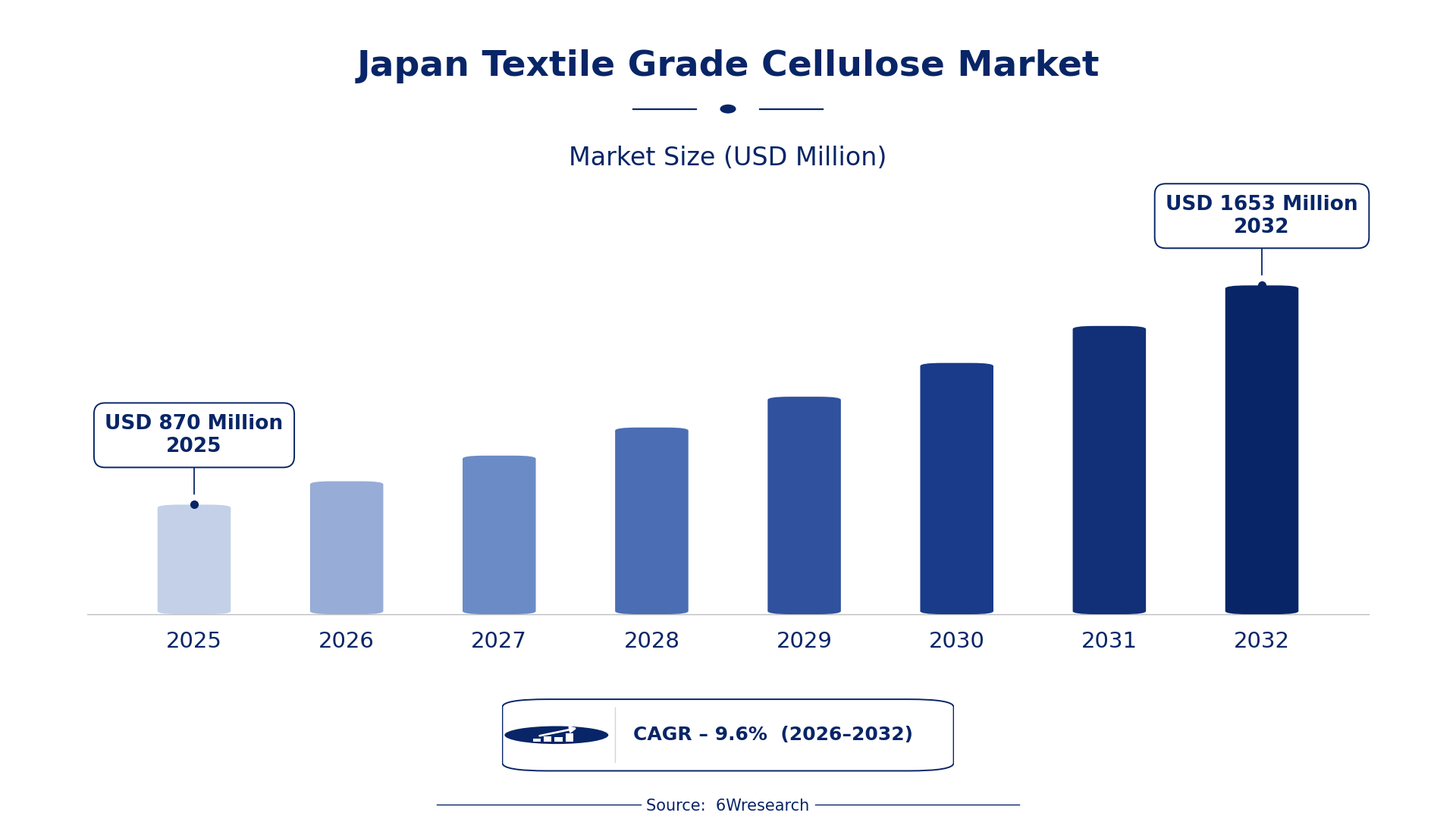
According to 6Wresearch internal database and industry insights, the Japan Textile Grade Cellulose Market was valued at USD 870 Million in 2025 and is projected to reach USD 1,653 Million by 2032, growing at a CAGR of approximately 9.6% during 2026–2032.
Japan Textile Grade Cellulose Market Highlights
| Report Metric | Details |
| Report Name | Japan Textile Grade Cellulose Market (2026-2032) |
| Market Size 2025 | USD 870 Million |
| Market Size 2032 | USD 1,653 Million |
| Absolute Growth 2025–2032 | USD 783 Million |
| CAGR 2026–2032 | 9.6% |
| Peak Annual Growth | 11.5% in 2030 |
| Forecast Period | 2026–2032 |
| Historical Data | 2022–2025 |
| Base Year | 2025 |
| Leading Textile Grade Cellulose, 2025 | Dissolving Pulp (46% share) |
| Leading Product Type, 2025 | Viscose (47% share) |
| Leading Cellulose Type, 2025 | Wood Pulp Derived (35% share) |
| Leading Distribution Channel, 2025 | Chemical Traders (49% share) |
| Leading End User Industry, 2025 | Fiber Spinning Mills (37% share) |
| Fastest-Growing Textile Grade Cellulose | Cotton Linters (14.9% CAGR) |
| Fastest-Growing Product Type | Lyocell (14.4% CAGR) |
| Fastest-Growing Cellulose Type | High-Purity Linter (14.2% CAGR) |
| Fastest-Growing Distribution Channel | Industrial Suppliers (12.9% CAGR) |
| Fastest-Growing End User Industry | High-End Apparel (12.8% CAGR) |
| Growing Sector | sustainable textiles |
| Key End Users | fiber spinning mills, high-end apparel manufacturers, technical textiles producers |
Japan Textile Grade Cellulose Market Year-wise Growth Rate and Key Drivers (2022–2032)
This graph illustrates the annual growth rates of the market from 2022 to 2032, highlighting a steady upward trajectory and projected market expansion over the forecast period.
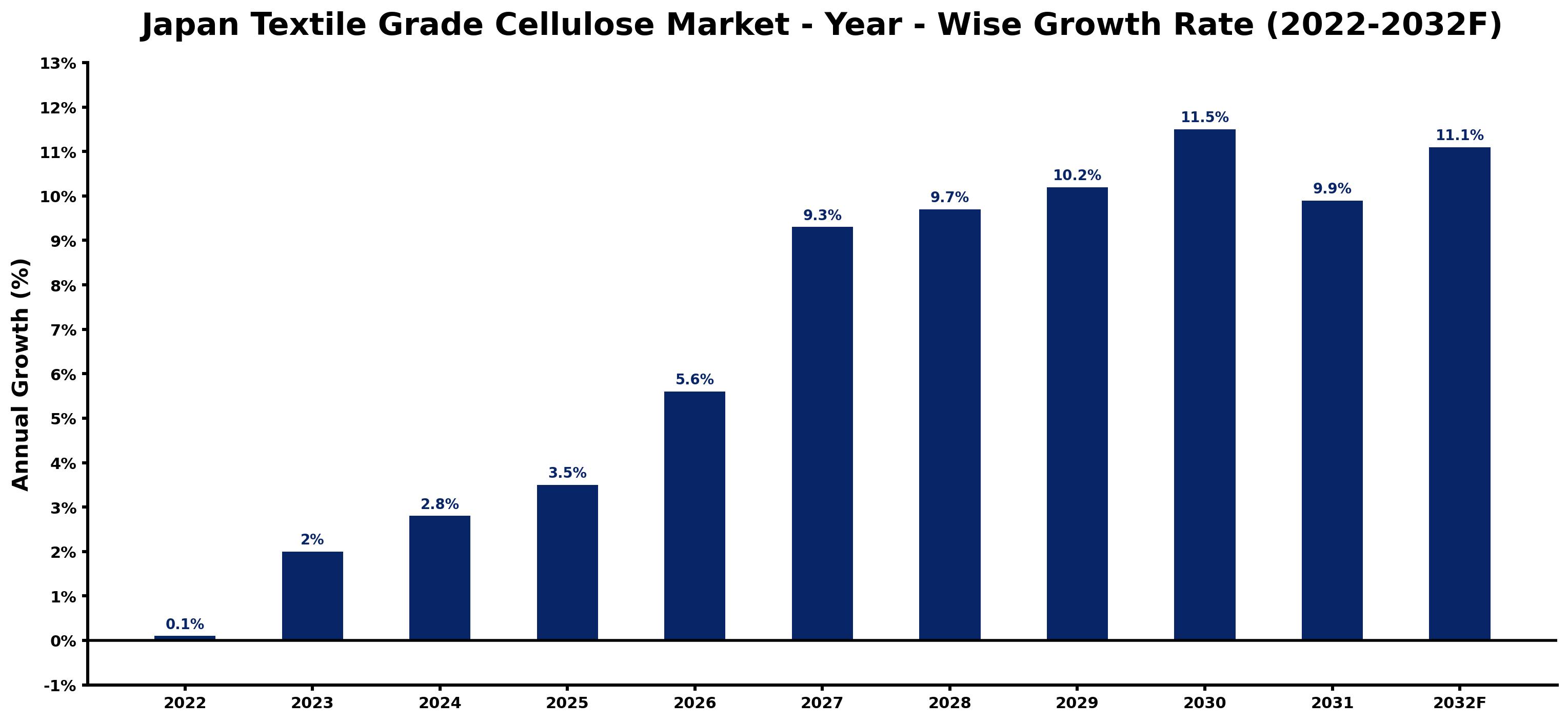
For each year, the table pairs the estimated growth rate with the leading influence on demand, showing how the drivers changed across the period.
| Year | Estimated Annual Growth (%) | Market Rationale |
| 2022 | 0.1 | Demand remained stable, with moderate activity in the textile sector. |
| 2023 | 2.0 | Growth accelerated as domestic textile production increased. |
| 2024 | 2.8 | The market expanded further due to rising demand for viscose fibers. |
| 2025 | 3.5 | Growth peaked as fiber spinning mills ramped up production capacity. |
| 2026 | 5.6 | The market is expected to gain momentum from increased lyocell adoption. |
| 2027 | 9.3 | Demand is projected to rise sharply as sustainability trends take hold. |
| 2028 | 9.7 | Growth continues with heightened interest in eco-friendly textile solutions. |
| 2029 | 10.2 | The market is set to grow as technological advancements enhance production. |
| 2030 | 11.5 | Demand will peak as major textile initiatives are implemented nationwide. |
| 2031 | 9.9 | Growth slows slightly as the market stabilises after previous peaks. |
| 2032 | 11.1 | Demand is expected to rise again with new innovations in cellulose. |
Note: Market size estimations and growth projections presented in this report are based on 6Wresearch's proprietary forecasting methodology, utilizing the latest available industry data, government publications, and primary research inputs.
Japan Textile Grade Cellulose Market Synopsis
Textile Grade Cellulose is a refined form of cellulose derived from wood pulp or cotton linters, primarily used in the textile industry for producing fibres like viscose and lyocell. The Japan Textile Grade Cellulose Market is expanding due to strong domestic demand, particularly from fibre spinning mills and high-end apparel manufacturers. Growth is driven by a shift towards sustainable textiles, with lyocell projected to grow by 15% annually through 2025, supported by advanced manufacturing capabilities and investment in eco-friendly practices.
Market Dynamics Impact Analysis (2026–2032)
| Factor | Type | Impact | Primary Segment Affected |
| Growing demand for sustainable textiles | Driver | High | Lyocell |
| Increased production of viscose fibers | Driver | High | Viscose |
| Rising interest in eco-friendly textile solutions | Opportunity | High | High-End Apparel |
| Expansion of fiber spinning mills in major regions | Opportunity | Medium | Fiber Spinning Mills |
| High production costs for sustainable materials | Restraint | High | Lyocell |
| Limited availability of high-purity cellulose | Restraint | Medium | Wood Pulp Derived |
| Challenges in meeting stringent environmental regulations | Challenge | High | Dissolving Pulp |
| Competition from synthetic fiber alternatives | Challenge | Medium | Viscose |
Evaluation of Drivers in Japan Textile Grade Cellulose Market (2026–2032)
The factors lifting demand, and the evidence behind each, are summarised below.
| Drivers | Primary Segment Affected | Why It Matters (Evidence) |
| Increased production capacity in fiber spinning mills | Fiber Spinning Mills | Japan's textile industry produced approximately 1.5 million tons of viscose in 2022, driving demand for cellulose. |
| Growing adoption of lyocell in textiles | Lyocell | The demand for lyocell is expected to grow significantly through 2025, prompting more purchases. |
| Sustainability initiatives in textile production | High-End Apparel | Government support for sustainable textile practices encourages eco-friendly material use. |
| Rising exports of textile products | Technical Textiles | Japan's textile exports reached $10 billion in 2023, boosting cellulose demand for production. |
| Research advancements in cellulose applications | Nanocellulose Fibers | Local universities are exploring new uses for cellulose, increasing market interest. |
Volumes grow on the back of increased production capacity in fibre spinning mills, which produced approximately 1.5 million tons of viscose in 2022. The growing adoption of lyocell, expected to rise significantly through 2025, drives demand for cellulose. Rising exports of textile products, valued at $10 billion in 2023, further boost cellulose demand. Research advancements in cellulose applications are generating interest and increasing market potential.
Evaluation of Restraints in Japan Textile Grade Cellulose Market
These are the pressures that could keep growth below its potential.
| Market Restraint | Primary Segment Affected | Why It Matters (Evidence) |
| High production costs for sustainable materials | Lyocell | The shift towards sustainable textiles incurs higher production costs, affecting profitability for manufacturers. |
| Limited availability of high-purity cellulose | Wood Pulp Derived | The scarcity of high-purity cellulose restricts production capabilities for manufacturers. |
| Challenges in meeting stringent environmental regulations | Dissolving Pulp | Compliance with environmental regulations adds complexity and costs for producers. |
| Dependence on fluctuating raw material prices | Dissolving Pulp | Volatility in raw material prices impacts the overall production costs for manufacturers. |
| Competition from synthetic fiber alternatives | Viscose | The rise of synthetic fibers presents a challenge to traditional cellulose-based products. |
Japan Textile Grade Cellulose Market Challenges
Japan's textile industry consumes around 800,000 tons of dissolving pulp annually, but buyers face rising input costs due to limited domestic sources, which increases production expenses. Local producers encounter intense competition from cheaper imports, forcing them to lower prices and reducing profit margins. Advanced textile manufacturing suffers from skills shortages, as over 200,000 employees are insufficient to meet industry demands, delaying innovation. Supply chain disruptions, influenced by stringent government regulations, extend production timelines, causing buyers to experience longer lead times for essential cellulose products.
Trends in the Japan Textile Grade Cellulose Market
The following changes are redrawing the Japan Textile Grade Cellulose Market.
- Shift towards Sustainable Textiles: The textile industry is increasingly prioritising sustainable materials, with high-end apparel brands adopting lyocell for eco-friendly clothing. In 2023, the demand for lyocell is projected to grow by 15% annually.
- Transition from Traditional to Technical Textiles: The Kanto region is experiencing a shift towards technical textiles, reflecting the growing demand for specialised textile applications. The market is projected to reach $5 billion by 2025.
- Emergence of Nanocellulose Fibers: Research into nanocellulose fibers is gaining traction, particularly in automotive textiles. Local universities are exploring new applications, indicating a potential market expansion.
- Increased Exports of Textile Products: Japan's textile exports reached $10 billion in 2023, highlighting a shift towards international markets. This growth is driving demand for cellulose in production processes.
Investment Opportunities in the Japan Textile Grade Cellulose Market
The following opportunities in the Japan Textile Grade Cellulose Market pair current demand with a clear way in.
- High-End Apparel Manufacturers: High-end apparel brands are increasingly seeking sustainable textile solutions, with a projected growth of lyocell by 15% annually. Collaborating with local suppliers can facilitate market entry.
- Kanto Region Fiber Spinning Mills: The Kanto region is a major hub for fibre spinning mills, which are expanding production. Investing in cellulose supply can meet rising demand in this area.
- Sustainable Textile Solutions: There is a growing need for eco-friendly cellulose products, particularly lyocell. Engaging in partnerships with local manufacturers can facilitate market access.
- Research and Development in Nanocellulose: Investment in nanocellulose research is on the rise, with local universities leading initiatives. Collaborating with these institutions can open new market opportunities.
Government Initiatives in the Japan Textile Grade Cellulose Market
The Plastic Resource Circulation Act, enacted in 2021, promotes the reduction, reuse, and recycling of plastics, impacting textile producers by encouraging sustainable practices in cellulose production. Compliance with this act requires manufacturers to adopt eco-friendly processes, leading to a shift towards sustainability in the textile industry.
The Ministry of the Environment and the Ministry of Economy, Trade and Industry oversee the implementation of various initiatives, including funding projects aimed at promoting sustainable textile production. This support helps manufacturers adopt environmentally friendly practices, enhancing their competitiveness in the market.
Future Insight of the Japan Textile Grade Cellulose Market
Nanocellulose technology will transform demand for textile applications by 2032, particularly in automotive textiles. Government initiatives will promote sustainable practices, encouraging suppliers to adopt greener methods. JIS Z 8815 standards will improve, ensuring higher quality and safety in textile grade cellulose. The annual consumption of dissolving pulp in Japan is projected to remain around 800,000 tons, as suppliers adapt to changing buyer preferences and seek advanced solutions.
Market Segmentation Analysis
Japan Textile Grade Cellulose Market report covers a detailed analysis of the following market segments:
By Textile Grade Cellulose – Dissolving Pulp Leads, Cotton Linters Expected to Grow Fastest
According to Saurav Kr Singh, Senior Research Analyst at 6Wresearch, the largest textile grade cellulose category in 2025 was Dissolving Pulp, at 46% of revenue. Dissolving pulp is essential for producing fibres like viscose and lyocell, which are widely used in the textile industry. The concentration of production facilities in regions such as Kanto drives a strong demand for this sub-segment. Cotton Linters are projected to grow fastest, at a CAGR of 14.9% during 2026–2032. The increasing focus on sustainable textiles is significantly elevating the demand for cotton linters, which are vital for eco-friendly cellulose production. With a projected annual growth rate of 15% for lyocell, cotton linters are well-positioned to benefit from this trend. Suppliers need to embrace sustainable practices to meet the evolving preferences of buyers and capitalise on the growing market.
By Product Type – Viscose Leads, Lyocell Expected to Grow Fastest
Viscose accounted for 47% of the market by product type in 2025. Viscose dominates the market due to its prevalent use in clothing production, representing a substantial share of Japan's textile output. The familiarity of consumers with viscose and established manufacturing processes reinforce its leading position. The quickest growth will come from Lyocell, forecast to expand at a CAGR of 14.4% between 2026 and 2032. Lyocell is rapidly gaining traction in sustainable textiles, driven by high-end apparel brands that seek eco-friendly alternatives. The anticipated 15% annual growth in lyocell demand underscores its rising significance in the textile industry. Buyers should consider integrating more sustainable materials like lyocell into their sourcing strategies to meet evolving consumer preferences.
By Cellulose Type – Wood Pulp Derived Leads, High-Purity Linter Expected to Grow Fastest
Wood Pulp Derived took 35% of cellulose type revenue in 2025, more than any other category. Wood pulp derived cellulose is the predominant source for cellulose production, making it the most widely utilised type in the industry. Its well-established supply chain and processing capabilities ensure consistent availability for manufacturers. High-Purity Linter is set to record the highest CAGR in this split, 14.2% over 2026–2032. High-purity linter cellulose is increasingly sought after for its critical role in producing high-quality textiles. As the demand for premium products rises, the focus on high-purity linter is likely to intensify. Suppliers should prioritise investments in high-purity linter production to meet the growing demand for quality textiles.
By Distribution Channel – Chemical Traders Lead, Industrial Suppliers Expected to Grow Fastest
Chemical Traders held 49% of the Japan Textile Grade Cellulose Market by distribution channel in 2025. Chemical traders are pivotal in supplying cellulose products to manufacturers, ensuring a steady flow of materials across the industry. Their extensive networks enable them to connect with a wide array of clients in the textile sector. Over 2026–2032, Industrial Suppliers are expected to post the fastest growth, at a CAGR of 12.9%. Industrial suppliers are increasingly important as they provide necessary raw materials for production, particularly with the rise of sustainable practices. Their role in the supply chain is expected to expand as demand for eco-friendly options increases. Suppliers should focus on building strong partnerships with industrial suppliers to improve market access and adaptability.
By End User Industry – Fiber Spinning Mills Lead, High-End Apparel Expected to Grow Fastest
In 2025, Fiber Spinning Mills led the end user industry split with a 37% share. Fiber spinning mills are the primary consumers of textile grade cellulose, extensively utilising it in the production of various fibers. Their established operations and substantial output position them as a key segment in the market. High-End Apparel is projected to grow fastest, at a CAGR of 12.8% during 2026–2032. High-end apparel is rapidly increasing its use of cellulose fibers for premium textiles, reflecting a notable shift towards sustainability in fashion. This segment's growth signals changing consumer preferences towards eco-friendly products. Buyers in the high-end apparel sector should prioritise sourcing from suppliers that offer sustainable cellulose options.
Key Attractiveness of the Report
- 10 Years of Market Numbers
- Historical Data Starting from 2022 to 2025
- Base Year 2025
- Forecast Data until 2032
- Key Performance Indicators Impacting the Market
- Major Upcoming Developments and Projects
Key Highlights of the Report:
- Japan Textile Grade Cellulose Market Outlook
- Market Size of Japan Textile Grade Cellulose Market, 2025
- Forecast of Japan Textile Grade Cellulose Market, 2032
- Historical Data and Forecast of Japan Textile Grade Cellulose Revenues & Volume for the Period 2022-2032F
- Japan Textile Grade Cellulose Market Trend Evolution
- Japan Textile Grade Cellulose Market Drivers and Challenges
- Japan Textile Grade Cellulose Price Trends
- Japan Textile Grade Cellulose Porter's Five Forces
- Japan Textile Grade Cellulose Industry Life Cycle
- Historical Data and Forecast of Japan Textile Grade Cellulose Market Revenues & Volume By Textile Grade Cellulose for the Period 2022-2032F
- Historical Data and Forecast of Japan Textile Grade Cellulose Market Revenues & Volume By Dissolving Pulp for the Period 2022-2032F
- Historical Data and Forecast of Japan Textile Grade Cellulose Market Revenues & Volume By Cotton Linters for the Period 2022-2032F
- Historical Data and Forecast of Japan Textile Grade Cellulose Market Revenues & Volume By Cellulose Acetate Dope for the Period 2022-2032F
- Historical Data and Forecast of Japan Textile Grade Cellulose Market Revenues & Volume By Nanocellulose Fibers for the Period 2022-2032F
- Historical Data and Forecast of Japan Textile Grade Cellulose Market Revenues & Volume By Product Type for the Period 2022-2032F
- Historical Data and Forecast of Japan Textile Grade Cellulose Market Revenues & Volume By Viscose, Lyocell for the Period 2022-2032F
- Historical Data and Forecast of Japan Textile Grade Cellulose Market Revenues & Volume By Short Staple Pulp for the Period 2022-2032F
- Historical Data and Forecast of Japan Textile Grade Cellulose Market Revenues & Volume By Dope Solutions for the Period 2022-2032F
- Historical Data and Forecast of Japan Textile Grade Cellulose Market Revenues & Volume By Specialty Additive for the Period 2022-2032F
- Historical Data and Forecast of Japan Textile Grade Cellulose Market Revenues & Volume By Cellulose Type for the Period 2022-2032F
- Historical Data and Forecast of Japan Textile Grade Cellulose Market Revenues & Volume By Wood Pulp Derived for the Period 2022-2032F
- Historical Data and Forecast of Japan Textile Grade Cellulose Market Revenues & Volume By High-Purity Linter for the Period 2022-2032F
- Historical Data and Forecast of Japan Textile Grade Cellulose Market Revenues & Volume By Acetate Chemistry for the Period 2022-2032F
- Historical Data and Forecast of Japan Textile Grade Cellulose Market Revenues & Volume By Nano-Fibrils for the Period 2022-2032F
- Historical Data and Forecast of Japan Textile Grade Cellulose Market Revenues & Volume By Distribution Channel for the Period 2022-2032F
- Historical Data and Forecast of Japan Textile Grade Cellulose Market Revenues & Volume By Chemical Traders for the Period 2022-2032F
- Historical Data and Forecast of Japan Textile Grade Cellulose Market Revenues & Volume By Industrial Suppliers for the Period 2022-2032F
- Historical Data and Forecast of Japan Textile Grade Cellulose Market Revenues & Volume By Direct Chemical Sales for the Period 2022-2032F
- Historical Data and Forecast of Japan Textile Grade Cellulose Market Revenues & Volume By Specialty Distributors for the Period 2022-2032F
- Historical Data and Forecast of Japan Textile Grade Cellulose Market Revenues & Volume By End User Industry for the Period 2022-2032F
- Historical Data and Forecast of Japan Textile Grade Cellulose Market Revenues & Volume By Fiber Spinning Mills for the Period 2022-2032F
- Historical Data and Forecast of Japan Textile Grade Cellulose Market Revenues & Volume By High-End Apparel for the Period 2022-2032F
- Historical Data and Forecast of Japan Textile Grade Cellulose Market Revenues & Volume By Photographic/Film for the Period 2022-2032F
- Historical Data and Forecast of Japan Textile Grade Cellulose Market Revenues & Volume By Technical Textiles for the Period 2022-2032F
- Japan Textile Grade Cellulose Import Export Trade Statistics
- Market Opportunity Assessment By Textile Grade Cellulose
- Market Opportunity Assessment By Product Type
- Market Opportunity Assessment By Cellulose Type
- Market Opportunity Assessment By Distribution Channel
- Market Opportunity Assessment By End User Industry
- Japan Textile Grade Cellulose Top Companies Market Share
- Japan Textile Grade Cellulose Competitive Benchmarking By Technical and Operational Parameters
- Japan Textile Grade Cellulose Company Profiles
- Japan Textile Grade Cellulose Key Strategic Recommendations
Market Covered
Coverage by segment is as follows.
By Textile Grade Cellulose
- Dissolving Pulp
- Cotton Linters
- Cellulose Acetate Dope
- Nanocellulose Fibers
By Product Type
- Viscose
- Lyocell
- Short Staple Pulp
- Dope Solutions
- Specialty Additive
By Cellulose Type
- Wood Pulp Derived
- High-Purity Linter
- Acetate Chemistry
- Nano-Fibrils
By Distribution Channel
- Chemical Traders
- Industrial Suppliers
- Direct Chemical Sales
- Specialty Distributors
By End User Industry
- Fiber Spinning Mills
- High-End Apparel
- Photographic/Film
- Technical Textiles































