Japan Textile Processing Chemicals Market Size & Growth Rate
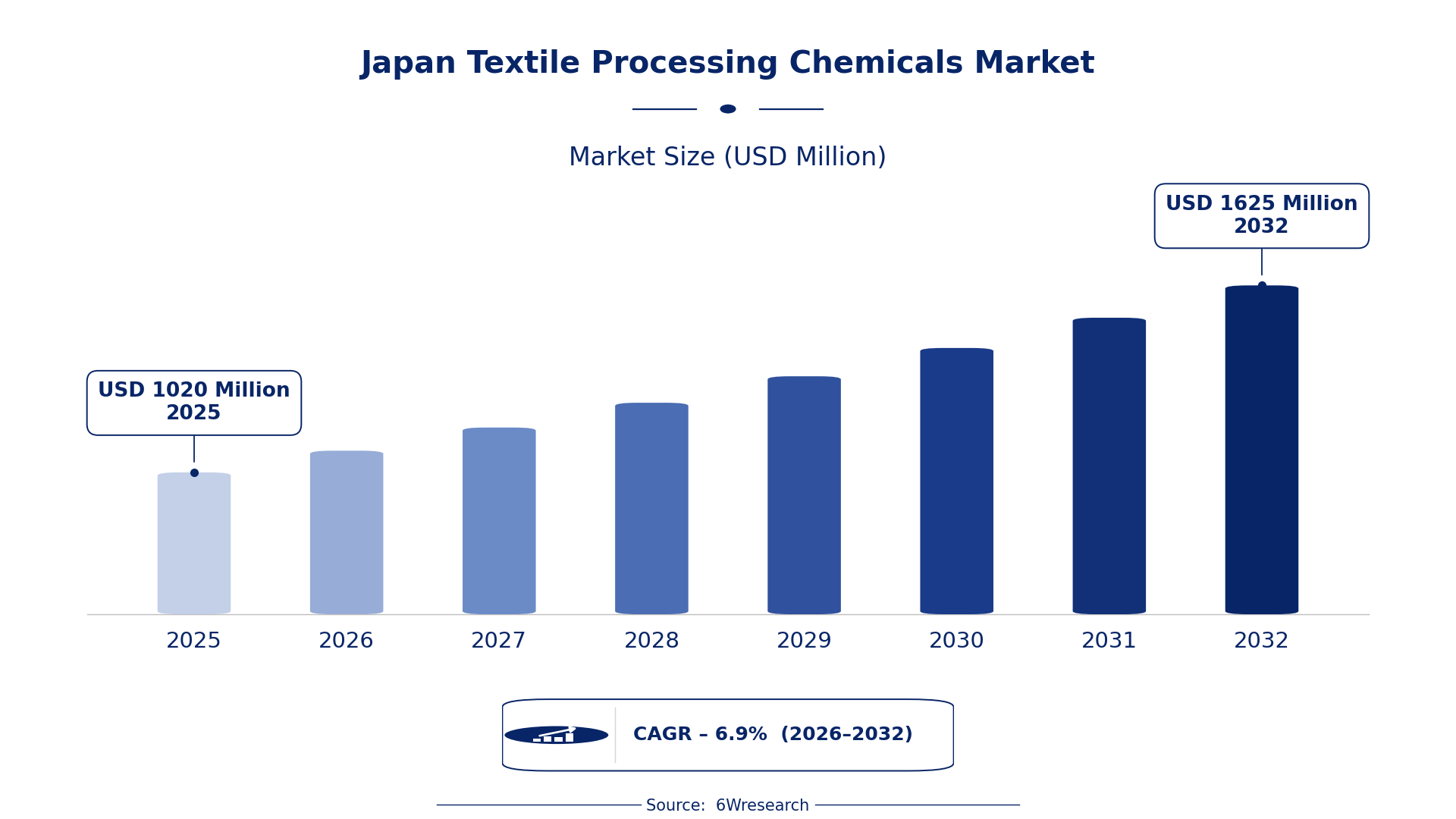
According to 6Wresearch internal database and industry insights, the Japan Textile Processing Chemicals Market was valued at USD 1,020 Million in 2025 and is projected to reach USD 1,625 Million by 2032, growing at a CAGR of approximately 6.9% during 2026–2032.
Japan Textile Processing Chemicals Market Highlights
| Report Metric | Details |
| Report Name | Japan Textile Processing Chemicals Market (2026-2032) |
| Market Size 2025 | USD 1,020 Million |
| Market Size 2032 | USD 1,625 Million |
| Absolute Growth 2025–2032 | USD 605 Million |
| CAGR 2026–2032 | 6.9% |
| Peak Annual Growth | 7.6% in 2030 |
| Forecast Period | 2026–2032 |
| Historical Data | 2022–2025 |
| Base Year | 2025 |
| Leading Textile Processing Chem., 2025 | Scouring & Degreasing Agents (42% share) |
| Leading Product Type, 2025 | Detergents (41% share) |
| Leading Chemical Function, 2025 | Oil & Wax Removal (51% share) |
| Leading Distribution Channel, 2025 | Chemical Distributors (41% share) |
| Leading End User Industry, 2025 | Textile Mills (46% share) |
| Fastest-Growing Textile Processing Chem. | Flame Retardants (9.1% CAGR) |
| Fastest-Growing Product Type | Fabric Finishes (9.5% CAGR) |
| Fastest-Growing Chemical Function | Safety Enhancement (9.0% CAGR) |
| Fastest-Growing Distribution Channel | Direct Sales (9.4% CAGR) |
| Fastest-Growing End User Industry | Technical Textile Mills (8.7% CAGR) |
| Growing Sector | Technical Textile Mills |
| Key End Users | Textile Mills, Apparel Factories, Technical Textile Mills, Home Textile Makers |
Japan Textile Processing Chemicals Market Year-wise Growth Rate and Key Drivers (2022–2032)
This graph illustrates the annual growth rates of the market from 2022 to 2032, highlighting a steady upward trajectory and projected market expansion over the forecast period.
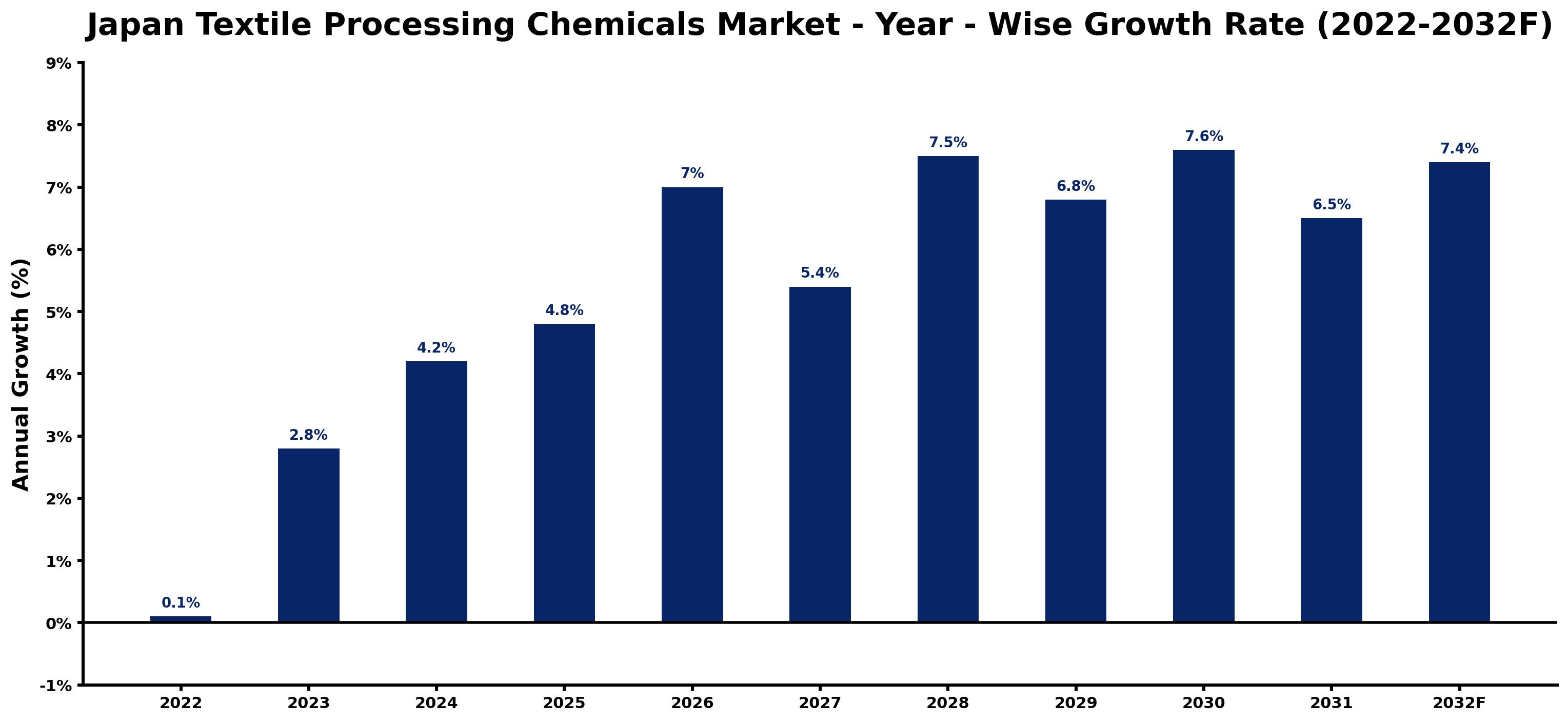
The table below sets out the estimated growth rate for each year and the main factor behind it.
| Year | Estimated Annual Growth (%) | Market Rationale |
| 2022 | 0.1 | The market exhibited minimal growth, reflecting stable demand from textile mills. |
| 2023 | 2.8 | Demand increased due to a recovery in apparel production after disruptions. |
| 2024 | 4.2 | Growth accelerated as manufacturers adopted more advanced textile processing methods. |
| 2025 | 4.8 | A peak in growth occurred as investments in sustainable practices gained momentum. |
| 2026 | 7.0 | The market is expected to benefit from rising investments in eco-friendly chemicals. |
| 2027 | 5.4 | Growth is expected to slow slightly as the market adjusts to new environmental regulations. |
| 2028 | 7.5 | Demand is projected to rise again as textile innovation continues to expand. |
| 2029 | 6.8 | Growth is expected to moderate as competition intensifies among chemical suppliers. |
| 2030 | 7.6 | The market is projected to reach its peak growth driven by technological advancements in processing. |
| 2031 | 6.5 | Growth is expected to slow as the market stabilises after reaching previous peaks. |
| 2032 | 7.4 | Demand is expected to remain strong due to ongoing investments in sustainability. |
Note: Market size estimations and growth projections presented in this report are based on 6Wresearch's proprietary forecasting methodology, utilizing the latest available industry data, government publications, and primary research inputs.
Japan Textile Processing Chemicals Market Synopsis
Textile processing chemicals are specialized formulations used in fabric treatment to improve performance, durability, and aesthetics. The Japan Textile Processing Chemicals Market is growing, supported by investments in sustainable practices, with the government targeting a 46% reduction in greenhouse-gas emissions by 2030. The textile industry employs approximately 600,000 people, and the Tokyo region serves as a hub for innovation and processing, further driving demand for eco-friendly solutions. With over 1,000 textile mills in operation, the market is set for continued expansion as manufacturers seek to adopt greener technologies.
Market Dynamics Impact Analysis (2026–2032)
| Factor | Type | Impact | Primary Segment Affected |
| Increased investment in sustainable textile processing technologies | Driver | High | Flame Retardants |
| Growing demand for eco-friendly textile chemicals | Driver | High | Detergents |
| Expansion of technical textile production | Opportunity | Medium | Technical Textile Mills |
| Rising consumer preference for sustainable fashion | Opportunity | Medium | Apparel Factories |
| Stringent environmental regulations affecting chemical formulations | Restraint | High | Oil & Wax Removal |
| Limited availability of certain raw materials for chemical production | Restraint | Medium | Chemical Distributors |
| High compliance costs for environmental regulations | Challenge | High | Textile Mills |
| Technological barriers in adopting new eco-friendly chemicals | Challenge | Medium | Fabric Finishes |
Evaluation of Drivers in Japan Textile Processing Chemicals Market (2026–2032)
The factors lifting demand, and the evidence behind each, are summarised below.
| Drivers | Primary Segment Affected | Why It Matters (Evidence) |
| Investment in sustainable textile processing technologies | Flame Retardants | This investment is expected to improve safety features in textiles, aligning with decarbonisation targets of JPY 150 trillion over 10 years. |
| Rising demand for eco-friendly textile chemicals | Detergents | Consumer preferences are shifting towards sustainability, prompting manufacturers to source sustainable detergents. |
| Growth in technical textiles production | Technical Textile Mills | The rise in technical textiles is driving demand for advanced processing chemicals to meet specific performance requirements. |
| Consumer preference for sustainable fashion | Apparel Factories | This trend is leading to increased purchases of eco-friendly processing chemicals to cater to environmentally conscious consumers. |
| Government support for textile innovation | Textile Mills | Programs promoting sustainable practices are encouraging mills to invest in advanced processing technologies. |
The strongest pull on demand comes from investment in sustainable textile processing technologies, aiming for a 46% reduction in greenhouse-gas emissions by 2030. This drives manufacturers to adopt eco-friendly solutions, raising the average annual consumption of textile chemicals to approximately 300,000 tons. The growth of technical textiles, which account for 20% of total production, is increasing demand for specialized processing chemicals. As consumer awareness of sustainable fashion rises, manufacturers are sourcing eco-friendly solutions to meet market expectations.
Evaluation of Restraints in Japan Textile Processing Chemicals Market
The following restraints limit how fast demand can grow.
| Market Restraint | Primary Segment Affected | Why It Matters (Evidence) |
| Rising costs for eco-friendly raw materials | Flame Retardants | Manufacturers face increased operational costs, affecting pricing strategies due to higher raw material prices. |
| Limited availability of sustainable options | Detergents | Approximately 75% of fabrics processed are synthetic, restricting choices and increasing costs for manufacturers. |
| Regulatory pressures to reduce textile waste | Textile Mills | Government targets a 30% reduction by 2030 complicate procurement strategies for buyers. |
| High compliance costs due to stringent environmental regulations | Apparel Factories | Manufacturers face increased operational costs, impacting their pricing and competitiveness. |
| Delays in production schedules due to sourcing challenges | Technical Textile Mills | Limited availability of eco-friendly materials can extend lead times by an average of three weeks. |
Japan Textile Processing Chemicals Market Challenges
Buyers face rising costs for textile processing chemicals due to stringent environmental regulations, inflating compliance expenses by approximately 10%. Suppliers encounter challenges with the limited availability of eco-friendly raw materials, causing production delays that can extend lead times by an average of four weeks. Producers struggle to find sustainable options, as about 75% of fabrics processed are synthetic, which restricts choices and may increase costs by 12%. Regulatory demands to cut textile waste by 30% by 2030 complicate sourcing strategies for buyers, resulting in higher operational expenses and potential supply chain disruptions.
Trends in the Japan Textile Processing Chemicals Market
Four trends stand out in the Japan Textile Processing Chemicals Market.
- Shift Towards Eco-Friendly Textile Processing: Japan's textile industry is increasingly adopting eco-friendly processing chemicals, as seen during Tokyo Fashion Week, where sustainable technologies were showcased. This shift reflects the growing market for green solutions, with eco-friendly chemicals projected to rise significantly.
- Transition from Traditional to Technical Textiles: The production of technical textiles is rising, accounting for 20% of total textile output. This shift reflects the industry's adaptation to new performance requirements, particularly in specialized applications, leading to increased demand for advanced processing chemicals.
- Emergence of Sustainable Fashion Initiatives: There is a growing focus on sustainable fashion practices among apparel manufacturers, with initiatives promoting eco-friendly textiles gaining traction. Investments in green processing solutions are expected to rise, reflecting changing consumer preferences.
- Prioritisation of Government Support for Innovation: The government is increasingly prioritising support for textile innovation programs, with funding for sustainable practices expected to reach JPY 150 trillion over the next decade. This initiative drives industry growth and encourages the adoption of eco-friendly technologies.
Investment Opportunities in the Japan Textile Processing Chemicals Market
The openings below show where demand in the Japan Textile Processing Chemicals Market is visible and how suppliers can enter.
- Textile Mills Seeking Sustainable Solutions: Textile mills are increasingly looking for eco-friendly processing chemicals, driven by regulatory pressures. Investing in sustainable chemical formulations can meet this demand and align with government targets, with the market for eco-friendly chemicals expected to grow significantly.
- Fabric Finishes for Improved Aesthetics: There is a rising demand for fabric finishes that improve the aesthetic appeal of textiles. Suppliers can focus on innovative formulations to cater to this growing market, which is projected to expand as consumer preferences evolve.
- Technical Textile Mills Adopting Advanced Chemicals: Technical textile mills are seeking advanced processing chemicals to meet specific performance requirements. Suppliers can enter this market through partnerships with local manufacturers, capitalising on the demand for specialized solutions.
- Direct Sales Channels for Eco-Friendly Chemicals: Direct sales channels are gaining traction as buyers prefer sourcing sustainable chemicals directly. Establishing partnerships with distributors can facilitate market entry and expand reach in the growing eco-friendly chemicals market.
Government Initiatives in the Japan Textile Processing Chemicals Market
The PRTR Law mandates businesses to report releases of designated chemical substances, impacting textile processing chemical producers. Compliance with this law is essential for manufacturers to maintain market access and ensure environmental responsibility, with over 1,000 textile mills affected by these regulations.
The Ministry of Economy, Trade and Industry supports various textile innovation programs, funding initiatives that promote sustainable practices. These programs aim to improve the competitiveness of Japan's textile industry and encourage the adoption of eco-friendly technologies, with a focus on reducing waste and emissions.
Future Insight of the Japan Textile Processing Chemicals Market
Emerging technologies in sustainable textile processing will reshape demand by 2032, with a focus on eco-friendly chemical formulations that improve fabric properties. The government's investment of JPY 150 trillion in decarbonisation initiatives will encourage suppliers to innovate and adapt their products. As the market shifts towards greener practices, buyers will benefit from enhanced options that meet environmental standards. This transition will stimulate growth in the sector, promoting a more sustainable textile industry.
Market Segmentation Analysis
Japan Textile Processing Chemicals Market report covers a detailed analysis of the following market segments:
By Textile Processing Chem. – Scouring & Degreasing Agents Lead, Flame Retardants Expected to Grow Fastest
According to Saurav Kr Singh, Senior Research Analyst at 6Wresearch, the largest textile processing chem. category in 2025 was Scouring & Degreasing Agents, at 42% of revenue. Scouring and degreasing agents dominate the market due to their essential role in cleaning fabrics before dyeing. Their widespread application in over 1,000 textile mills across Japan, particularly in Osaka and Kyoto, reinforces their critical importance in textile processing. Flame Retardants are projected to grow fastest, at a CAGR of 9.1% during 2026–2032. Flame retardants are experiencing rapid growth as safety regulations become stricter, particularly within the technical textiles sector. This trend is driven by Japan's increasing focus on safety and sustainability, ensuring a continued rise in demand for these chemicals. Suppliers should prioritise flame retardants to align with the growing emphasis on safety standards in the textile industry.
By Product Type – Detergents Lead, Fabric Finishes Expected to Grow Fastest
Detergents accounted for 41% of the market by product type in 2025. Detergents lead the market as they are crucial for washing and preparing fabrics for further processing. Their consistent usage across Japan's textile mills guarantees a steady demand for these products in the industry. The quickest growth will come from Fabric Finishes, forecast to expand at a CAGR of 9.5% between 2026 and 2032. Fabric finishes are witnessing swift growth as manufacturers seek to achieve specific textures and appearances in their textiles. This demand is largely influenced by consumer preferences for unique fabric qualities in the fashion sector. Suppliers need to focus on developing innovative fabric finishes to cater to the rising demand for diverse textile aesthetics.
By Chemical Function – Oil & Wax Removal Leads, Safety Enhancement Expected to Grow Fastest
With 51% of chemical function revenue in 2025, Oil & Wax Removal was the largest category. Oil and wax removal agents hold the largest share as they are vital for preparing fabrics for subsequent processing stages. Their necessity is underscored by the high volume of synthetic materials processed in Japan, which require thorough cleaning. Safety Enhancement is set to record the highest CAGR in this split, 9.0% over 2026–2032. Safety enhancement chemicals are rapidly gaining traction as manufacturers increasingly focus on safety features in their textiles. This shift aligns with the broader trend of adhering to stringent environmental regulations and consumer safety expectations. Suppliers must invest in safety enhancement chemicals to comply with regulatory requirements and meet consumer expectations.
By Distribution Channel – Chemical Distributors Lead, Direct Sales Expected to Grow Fastest
Chemical Distributors took 41% of distribution channel revenue in 2025, more than any other category. Chemical distributors are the primary channel for textile processing chemicals, effectively supplying various end users throughout the industry. Their established networks facilitate the distribution of essential chemicals to Japan's extensive base of textile mills. Over 2026–2032, Direct Sales is expected to post the fastest growth, at a CAGR of 9.4%. Direct sales are expanding quickly as suppliers aim to strengthen relationships with manufacturers. This approach allows for tailored solutions and quicker responses to changing market demands, improving overall service delivery. Suppliers should enhance direct sales strategies to improve customer relationships and streamline service provision.
By End User Industry – Textile Mills Lead, Technical Textile Mills Expected to Grow Fastest
In 2025, Textile Mills led the end user industry split with a 46% share. Textile mills represent the largest end user of processing chemicals, as they are the primary consumers in the fabric treatment process. With approximately 600,000 people employed in this sector, their demand for chemicals is substantial and consistent. Technical Textile Mills are projected to grow fastest, at a CAGR of 8.7% during 2026–2032. Technical textile mills are experiencing the fastest growth as they require advanced processing chemicals for specialised applications. This segment's expansion is driven by increasing innovation and demand for technical textiles in various industries. Suppliers should focus on developing advanced chemicals tailored for technical textile mills to capitalise on this growing market.
Key Attractiveness of the Report
- 10 Years of Market Numbers
- Historical Data Starting from 2022 to 2025
- Base Year 2025
- Forecast Data until 2032
- Key Performance Indicators Impacting the Market
- Major Upcoming Developments and Projects
Key Highlights of the Report:
- Japan Textile Processing Chemicals Market Outlook
- Market Size of Japan Textile Processing Chemicals Market, 2025
- Forecast of Japan Textile Processing Chemicals Market, 2032
- Historical Data and Forecast of Japan Textile Processing Chemicals Revenues & Volume for the Period 2022-2032F
- Japan Textile Processing Chemicals Market Trend Evolution
- Japan Textile Processing Chemicals Market Drivers and Challenges
- Japan Textile Processing Chemicals Price Trends
- Japan Textile Processing Chemicals Porter's Five Forces
- Japan Textile Processing Chemicals Industry Life Cycle
- Historical Data and Forecast of Japan Textile Processing Chemicals Market Revenues & Volume By Textile Processing Chem. for the Period 2022-2032F
- Historical Data and Forecast of Japan Textile Processing Chemicals Market Revenues & Volume By Scouring & Degreasing Agents for the Period 2022-2032F
- Historical Data and Forecast of Japan Textile Processing Chemicals Market Revenues & Volume By Anti-Static Finishes for the Period 2022-2032F
- Historical Data and Forecast of Japan Textile Processing Chemicals Market Revenues & Volume By Softening Agents for the Period 2022-2032F
- Historical Data and Forecast of Japan Textile Processing Chemicals Market Revenues & Volume By Flame Retardants for the Period 2022-2032F
- Historical Data and Forecast of Japan Textile Processing Chemicals Market Revenues & Volume By Product Type for the Period 2022-2032F
- Historical Data and Forecast of Japan Textile Processing Chemicals Market Revenues & Volume By Detergents for the Period 2022-2032F
- Historical Data and Forecast of Japan Textile Processing Chemicals Market Revenues & Volume By Fabric Finishes for the Period 2022-2032F
- Historical Data and Forecast of Japan Textile Processing Chemicals Market Revenues & Volume By Fabric Softeners for the Period 2022-2032F
- Historical Data and Forecast of Japan Textile Processing Chemicals Market Revenues & Volume By FR Finishes for the Period 2022-2032F
- Historical Data and Forecast of Japan Textile Processing Chemicals Market Revenues & Volume By Chemical Function for the Period 2022-2032F
- Historical Data and Forecast of Japan Textile Processing Chemicals Market Revenues & Volume By Oil & Wax Removal for the Period 2022-2032F
- Historical Data and Forecast of Japan Textile Processing Chemicals Market Revenues & Volume By Charge Control for the Period 2022-2032F
- Historical Data and Forecast of Japan Textile Processing Chemicals Market Revenues & Volume By Hand Feel Enhancers for the Period 2022-2032F
- Historical Data and Forecast of Japan Textile Processing Chemicals Market Revenues & Volume By Safety Enhancement for the Period 2022-2032F
- Historical Data and Forecast of Japan Textile Processing Chemicals Market Revenues & Volume By Distribution Channel for the Period 2022-2032F
- Historical Data and Forecast of Japan Textile Processing Chemicals Market Revenues & Volume By Chemical Distributors for the Period 2022-2032F
- Historical Data and Forecast of Japan Textile Processing Chemicals Market Revenues & Volume By Direct Sales for the Period 2022-2032F
- Historical Data and Forecast of Japan Textile Processing Chemicals Market Revenues & Volume By Industrial Retailers for the Period 2022-2032F
- Historical Data and Forecast of Japan Textile Processing Chemicals Market Revenues & Volume By Specialty Suppliers for the Period 2022-2032F
- Historical Data and Forecast of Japan Textile Processing Chemicals Market Revenues & Volume By End User Industry for the Period 2022-2032F
- Historical Data and Forecast of Japan Textile Processing Chemicals Market Revenues & Volume By Textile Mills for the Period 2022-2032F
- Historical Data and Forecast of Japan Textile Processing Chemicals Market Revenues & Volume By Apparel Factories for the Period 2022-2032F
- Historical Data and Forecast of Japan Textile Processing Chemicals Market Revenues & Volume By Home Textile Makers for the Period 2022-2032F
- Historical Data and Forecast of Japan Textile Processing Chemicals Market Revenues & Volume By Technical Textile Mills for the Period 2022-2032F
- Japan Textile Processing Chemicals Import Export Trade Statistics
- Market Opportunity Assessment By Textile Processing Chem.
- Market Opportunity Assessment By Product Type
- Market Opportunity Assessment By Chemical Function
- Market Opportunity Assessment By Distribution Channel
- Market Opportunity Assessment By End User Industry
- Japan Textile Processing Chemicals Top Companies Market Share
- Japan Textile Processing Chemicals Competitive Benchmarking By Technical and Operational Parameters
- Japan Textile Processing Chemicals Company Profiles
- Japan Textile Processing Chemicals Key Strategic Recommendations
Market Covered
The following segment groups are covered in the report.
By Textile Processing Chem.
- Scouring & Degreasing Agents
- Anti-Static Finishes
- Softening Agents
- Flame Retardants
By Product Type
- Detergents
- Fabric Finishes
- Fabric Softeners
- FR Finishes
By Chemical Function
- Oil & Wax Removal
- Charge Control
- Hand Feel Enhancers
- Safety Enhancement
By Distribution Channel
- Chemical Distributors
- Direct Sales
- Industrial Retailers
- Specialty Suppliers
By End User Industry
- Textile Mills
- Apparel Factories
- Home Textile Makers
- Technical Textile Mills































