Japan Textile Supply Chain Market Size & Growth Rate
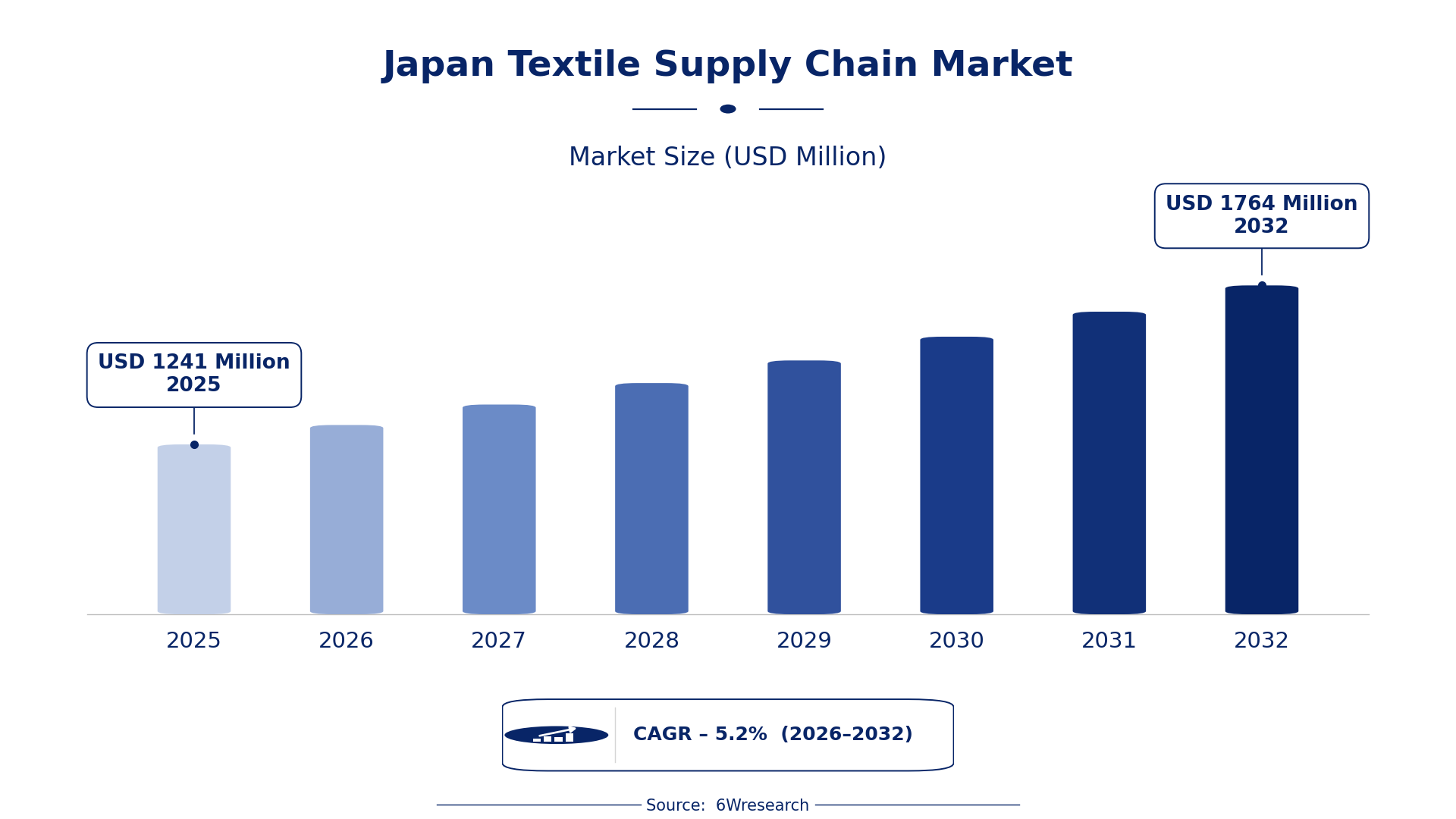
According to 6Wresearch internal database and industry insights, the Japan Textile Supply Chain Market was valued at USD 1,241 Million in 2025 and is projected to reach USD 1,764 Million by 2032, growing at a CAGR of approximately 5.2% during 2026–2032.
Japan Textile Supply Chain Market Highlights
| Report Metric | Details |
| Report Name | Japan Textile Supply Chain Market (2026-2032) |
| Market Size 2025 | USD 1,241 Million |
| Market Size 2032 | USD 1,764 Million |
| Absolute Growth 2025–2032 | USD 523 Million |
| CAGR 2026–2032 | 5.2% |
| Peak Annual Growth | 6.0% in 2029 |
| Forecast Period | 2026–2032 |
| Historical Data | 2022–2025 |
| Base Year | 2025 |
| Leading Textile Supply Chain, 2025 | Fabric & Garment Manufacturing (46% share) |
| Leading Segment, 2025 | Yarn Production (38% share) |
| Leading Service Type, 2025 | Sustainability Certification (44% share) |
| Leading Distribution Channel, 2025 | Direct Sourcing (37% share) |
| Leading End User Industry, 2025 | Apparel Brands (37% share) |
| Fastest-Growing Textile Supply Chain | Logistics & Distribution (7.0% CAGR) |
| Fastest-Growing Segment | Textile Logistics (6.8% CAGR) |
| Fastest-Growing Distribution Channel | Contract Production (6.5% CAGR) |
| Fastest-Growing End User Industry | Global Retail Platforms (6.7% CAGR) |
| Growing Sector | Apparel Brands |
| Key End Users | Apparel Brands, Global Retail Platforms, Fashion Industry |
Japan Textile Supply Chain Market Year-wise Growth Rate and Key Drivers (2022–2032)
This graph illustrates the annual growth rates of the market from 2022 to 2032, highlighting a steady upward trajectory and projected market expansion over the forecast period.
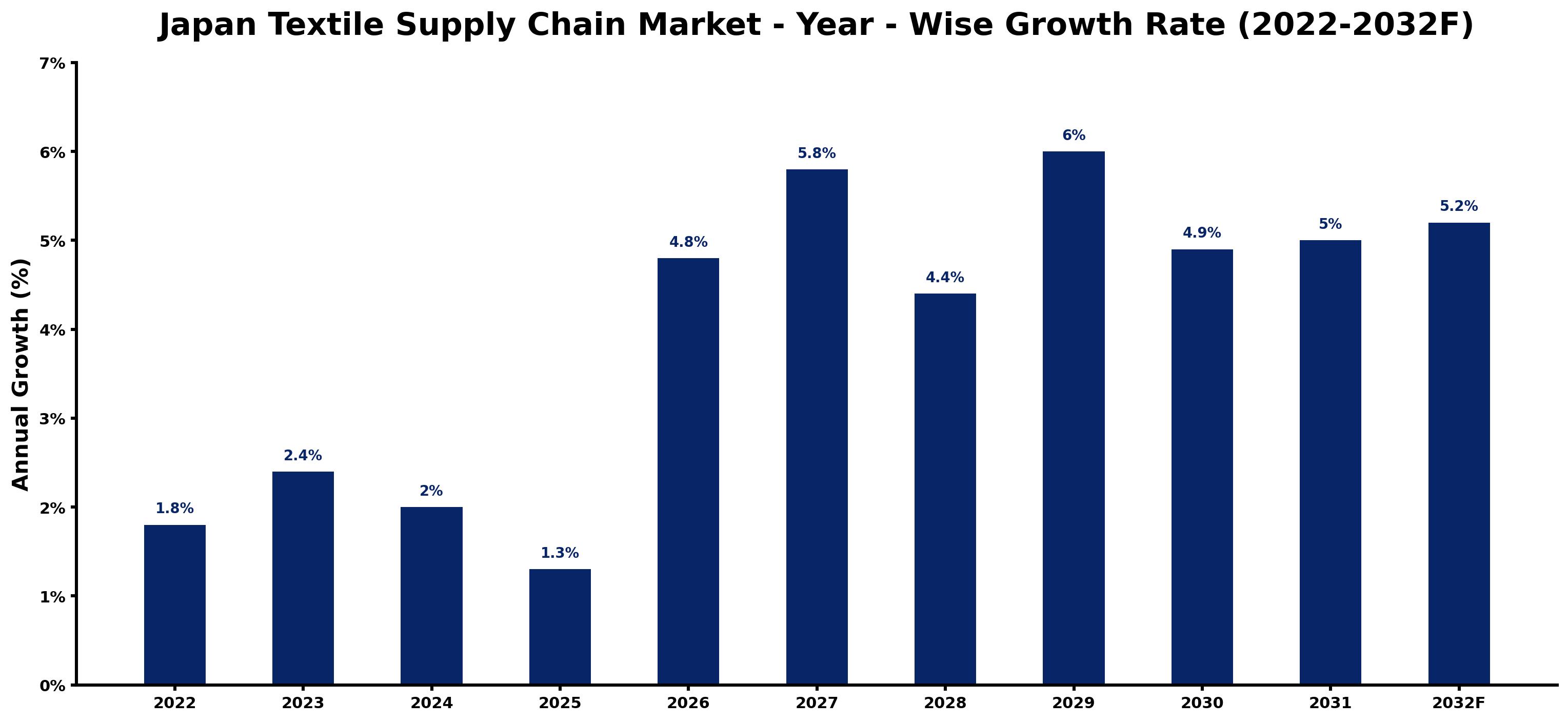
The yearly estimates that follow link every growth rate to its principal driver, so readers can see why the pace changed in each period.
| Year | Estimated Annual Growth (%) | Market Rationale |
| 2022 | 1.8 | The market experienced steady growth, reflecting ongoing demand from domestic apparel brands. |
| 2023 | 2.4 | Growth accelerated due to increased investments in textile innovations and sustainability practices. |
| 2024 | 2.0 | The market saw a slowdown as manufacturers adjusted to changing consumer preferences. |
| 2025 | 1.3 | Demand continued to grow, albeit at a slower pace, as brands focused on quality improvements. |
| 2026 | 4.8 | Growth is expected to rebound as logistics and distribution capabilities expand to meet rising demand. |
| 2027 | 5.8 | The market is projected to benefit from heightened interest in eco-friendly textiles and sustainable practices. |
| 2028 | 4.4 | A slight slowdown is anticipated as the market stabilises after rapid growth in previous years. |
| 2029 | 6.0 | Growth will peak as the demand for sustainable textile solutions surges among brands. |
| 2030 | 4.9 | The market is expected to experience a slowdown as competition intensifies among textile manufacturers. |
| 2031 | 5.0 | Growth will resume as brands increasingly adopt sustainable practices and technologies. |
| 2032 | 5.2 | The market is projected to grow steadily with rising demand for eco-friendly textiles. |
Note: Market size estimations and growth projections presented in this report are based on 6Wresearch's proprietary forecasting methodology, utilizing the latest available industry data, government publications, and primary research inputs.
Japan Textile Supply Chain Market Synopsis
Textile Supply Chain encompasses the entire process from raw material sourcing to garment distribution, serving domestic apparel brands and global retail platforms. The Japan Textile Supply Chain Market is expanding due to rising demand for sustainable practices, increased investments in logistics, and the growth of the Fast Fashion sector. In 2022, textile production was valued at approximately 1.5 trillion yen, indicating strong market activity and potential for future growth. The market is expected to benefit from government initiatives promoting eco-friendly innovations and improvements in supply chain efficiency.
Market Dynamics Impact Analysis (2026–2032)
| Factor | Type | Impact | Primary Segment Affected |
| Rising demand for sustainable textiles | Driver | High | Sustainability Certification |
| Increased investments in logistics and distribution | Driver | High | Logistics & Distribution |
| Expansion of eco-friendly textile innovations | Opportunity | High | Fabric & Garment Manufacturing |
| Growth in Fast Fashion sector driving production needs | Opportunity | High | Yarn Production |
| Stringent quality standards affecting production costs | Restraint | Medium | Manufacturing & Spinning |
| Limited availability of raw materials impacting supply | Restraint | Medium | Raw Material Sourcing |
| High costs associated with sustainability certifications | Challenge | High | Sustainability Certification |
| Intense competition among manufacturers leading to price wars | Challenge | Medium | Textile Logistics |
Evaluation of Drivers in Japan Textile Supply Chain Market (2026–2032)
Demand rests on the following drivers, each shown with the segment it touches most.
| Drivers | Primary Segment Affected | Why It Matters (Evidence) |
| Growing consumer preference for sustainable products | Sustainability Certification | This trend drives brands to invest in eco-friendly practices, with 44% of buyers prioritising sustainability in their sourcing decisions. |
| Expansion of logistics capabilities to meet demand | Logistics & Distribution | Tokyo serves as a major hub for textile logistics, supporting faster delivery times and efficient operations. |
| Investment in new textile production technologies | Fabric & Garment Manufacturing | Technological advancements enable manufacturers to improve production efficiency and product quality, meeting evolving consumer demands. |
| Rising popularity of Fast Fashion driving production | Yarn Production | The Fast Fashion sector's growth leads to increased demand for quick turnaround times, boosting yarn production volumes. |
| Increased collaboration between manufacturers and retailers | Contract Production | Partnerships are essential as brands seek to scale production efficiently to meet market demands. |
Buyers are adding capacity as Japan's textile production was valued at approximately 1.5 trillion yen in 2022. This value reflects the growing consumer preference for sustainable products, with 44% of buyers prioritising eco-friendly sourcing. Investments in logistics capabilities are essential, particularly in Tokyo, which serves as a major hub for textile logistics. The Fast Fashion sector is influencing production, driving demand for quicker turnaround times. Collaboration between manufacturers and retailers is increasing, enabling brands to scale production efficiently to meet rising market demands.
Evaluation of Restraints in Japan Textile Supply Chain Market
These restraints slow adoption and weigh on supplier margins.
| Market Restraint | Primary Segment Affected | Why It Matters (Evidence) |
| Stringent quality standards affecting production costs | Manufacturing & Spinning | Japan's strict quality standards, including JIS standards, require substantial investment in compliance, impacting overall production costs. |
| Limited availability of raw materials impacting supply | Raw Material Sourcing | The reliance on specific raw materials creates supply chain vulnerabilities, affecting manufacturers' ability to meet demand. |
| High costs associated with sustainability certifications | Sustainability Certification | The increasing demand for certifications, such as ISO 14001, adds financial burdens on producers aiming for eco-friendly practices. |
| Competition leading to price pressures among manufacturers | Textile Logistics | Intense competition in the logistics sector results in price wars, impacting profitability for logistics providers. |
| Challenges in adapting to rapid market changes | Fabric & Garment Manufacturing | Manufacturers face difficulties in quickly adjusting production processes to align with fast-changing consumer preferences. |
Japan Textile Supply Chain Market Challenges
High compliance costs from Japan's stringent quality standards for textiles can inflate prices for domestic brands, forcing them to absorb up to 15% in additional expenses. Intense competition from lower-cost producers in Asia pressures local textile manufacturers to reduce prices, risking profit margins by approximately 20%. Rapid technological advancements require continuous investment, which strains budgets for smaller firms and limits their ability to innovate effectively. A shortage of skilled workers in advanced textile techniques hampers production efficiency, causing lead times to extend by as much as 30% for garment manufacturers.
Trends in the Japan Textile Supply Chain Market
The following changes are redrawing the Japan Textile Supply Chain Market.
- Launch of Eco-Friendly Textile Innovations: In 2023, the government initiated a program to support eco-friendly textile innovations, promoting sustainable practices among manufacturers. This initiative is projected to drive demand for new materials and processes, increasing the overall sustainability of the textile supply chain.
- Shift Towards Sustainability Certification: The textile industry is increasingly prioritising sustainability certification, with 44% of buyers demanding eco-friendly practices. This shift is reshaping production methods, as manufacturers strive to meet consumer expectations for environmentally responsible textiles.
- Growth of Fast Fashion Influencing Production Methods: The Fast Fashion sector is rapidly expanding, impacting textile production methods. In 2022, the textile export value from Japan reached 300 billion yen, highlighting the demand for quick turnaround times in production.
- Expansion of Logistics Capabilities: Tokyo is enhancing its logistics capabilities to support the textile supply chain. With over 1,000 textile manufacturers concentrated in the Kansai region, improved logistics are essential for efficient distribution to retailers.
Investment Opportunities in the Japan Textile Supply Chain Market
Several openings in the Japan Textile Supply Chain Market merit attention from investors.
- Investment in Eco-Friendly Textile Facilities: With government support for eco-friendly innovations, there is an opportunity to invest in sustainable textile facilities. The textile logistics sector is set for growth, especially in regions like Kansai, where demand for sustainable practices is increasing.
- Partnerships for Sustainable Production: Now is an ideal time for manufacturers to enter partnerships focused on sustainability. Collaborations with apparel brands in Tokyo can improve production efficiency while meeting rising consumer demand for eco-friendly textiles.
- Expansion of Contract Production Services: The demand for contract production services is increasing, driven by brands seeking to scale production efficiently. This sector offers promising investment opportunities for manufacturers.
- Development of Innovative Textile Solutions: Investing in new textile solutions is essential as the market evolves. The growing Fast Fashion sector presents opportunities for manufacturers to supply quick-turnaround products that meet changing consumer preferences.
Government Initiatives in the Japan Textile Supply Chain Market
The Economic Security Promotion Act, enacted in 2022, supports supply-chain resilience for critical products, including textiles. This law complements existing regulations by ensuring that manufacturers adhere to stringent quality standards while promoting sustainability in production processes. The act aims to improve the overall efficiency of the textile supply chain and encourage innovation in eco-friendly practices.
Buyers in the textile sector benefit from the PRTR Law, which mandates reporting on chemical substances. This requirement ensures transparency in the supply chain, allowing brands to verify compliance with environmental standards and strengthen their sustainability credentials. Additionally, the Digital Agency leads initiatives to streamline digital transformation within the industry, improving operational efficiency.
Future Insight of the Japan Textile Supply Chain Market
Investment in eco-friendly textile innovations will exceed 500 billion yen by 2032, creating substantial demand for sustainable materials. Government initiatives will improve distribution efficiency, benefiting producers by streamlining logistics. The widespread adoption of ISO 14001 will standardise environmental management practices across the supply chain, ensuring compliance and sustainability. As consumer preferences shift towards sustainability, suppliers will need to adapt their product offerings to align with these new market expectations.
Market Segmentation Analysis
Japan Textile Supply Chain Market report covers a detailed analysis of the following market segments:
By Textile Supply Chain – Fabric & Garment Manufacturing Leads, Logistics & Distribution Expected to Grow Fastest
According to Saurav Kr Singh, Senior Research Analyst at 6Wresearch, in 2025, Fabric & Garment Manufacturing led the textile supply chain split with a 46% share. Fabric and garment manufacturing holds the largest share because it is crucial for producing final textile products that cater to both domestic and international markets. The concentration of over 1,000 textile manufacturers in the Kansai region supports this segment's dominance. Logistics & Distribution is set to record the highest CAGR in this split, 7.0% over 2026–2032. Logistics and distribution is expanding rapidly due to the growing necessity for efficient transportation solutions to retailers. Government initiatives focused on enhancing logistics efficiency are likely to further accelerate this segment's growth. Suppliers must improve their logistics capabilities to meet the rising demand for efficient distribution.
By Segment – Yarn Production Leads, Textile Logistics Expected to Grow Fastest
Yarn Production held 38% of the Japan Textile Supply Chain Market by segment in 2025. Yarn production is the leading sub-segment as it is a key step in the textile manufacturing process, essential for creating various fabric types. The established infrastructure for yarn production in Japan supports a diverse range of textile applications. The quickest growth will come from Textile Logistics, forecast to expand at a CAGR of 6.8% between 2026 and 2032. Textile logistics is growing quickly due to the need for efficient supply chain management, particularly as the fast fashion sector expands. The increasing complexity of logistics requirements in the textile industry fuels this growth. Buyers must prioritise partnerships with efficient logistics providers to ensure timely delivery.
By Service Type – Sustainability Certification Leads and Records the Fastest Growth
With 44% of service type revenue in 2025, Sustainability Certification was the largest category. Sustainability certification leads the service type segment as it aligns with brands' goals for eco-friendly practices, which are increasingly sought after by consumers. The growing emphasis on sustainability in the textile industry makes this certification essential for compliance and marketability. The same category is also set to grow fastest, at a CAGR of 7.1% during 2026–2032. Sustainability certification is also the fastest-growing service type, fuelled by rising consumer awareness and the demand for environmentally responsible products. As brands work to meet these consumer expectations, the need for certification services will continue to expand. Suppliers should prioritise investments in sustainability certification to stay relevant in the market.
By Distribution Channel – Direct Sourcing Leads, Contract Production Expected to Grow Fastest
The largest distribution channel category in 2025 was Direct Sourcing, at 37% of revenue. Direct sourcing is the predominant distribution channel as it enables manufacturers to ensure product quality and maintain oversight of their supply chain. This approach is widely adopted by textile manufacturers aiming to uphold high standards. Over 2026–2032, Contract Production is expected to post the fastest growth, at a CAGR of 6.5%. Contract production is the fastest-growing channel, as brands increasingly pursue efficient scaling of production while ensuring quality. This trend reflects a growing demand for flexibility and responsiveness in manufacturing capabilities. Suppliers should consider contract production arrangements to better meet the demands of brands.
By End User Industry – Apparel Brands Lead, Global Retail Platforms Expected to Grow Fastest
Apparel Brands took 37% of end user industry revenue in 2025, more than any other category. Apparel brands represent the largest end-user group within the textile supply chain, driving substantial demand for a wide range of textile products. Their strong purchasing power and influence within the market solidify their leading position in the industry. Global Retail Platforms are set to record the highest CAGR in this split, 6.7% over 2026–2032. Global retail platforms are witnessing the fastest growth as they increasingly demand textile products to cater to varied consumer preferences. The rise of e-commerce and online shopping is a significant factor contributing to this segment's rapid development. Suppliers should customise their offerings to meet the distinct needs of global retail platforms.
Key Attractiveness of the Report
- 10 Years of Market Numbers
- Historical Data Starting from 2022 to 2025
- Base Year 2025
- Forecast Data until 2032
- Key Performance Indicators Impacting the Market
- Major Upcoming Developments and Projects
Key Highlights of the Report:
- Japan Textile Supply Chain Market Outlook
- Market Size of Japan Textile Supply Chain Market, 2025
- Forecast of Japan Textile Supply Chain Market, 2032
- Historical Data and Forecast of Japan Textile Supply Chain Revenues & Volume for the Period 2022-2032F
- Japan Textile Supply Chain Market Trend Evolution
- Japan Textile Supply Chain Market Drivers and Challenges
- Japan Textile Supply Chain Price Trends
- Japan Textile Supply Chain Porter's Five Forces
- Japan Textile Supply Chain Industry Life Cycle
- Historical Data and Forecast of Japan Textile Supply Chain Market Revenues & Volume By Textile Supply Chain for the Period 2022-2032F
- Historical Data and Forecast of Japan Textile Supply Chain Market Revenues & Volume By Raw Material Sourcing for the Period 2022-2032F
- Historical Data and Forecast of Japan Textile Supply Chain Market Revenues & Volume By Manufacturing & Spinning for the Period 2022-2032F
- Historical Data and Forecast of Japan Textile Supply Chain Market Revenues & Volume By Fabric & Garment Manufacturing for the Period 2022-2032F
- Historical Data and Forecast of Japan Textile Supply Chain Market Revenues & Volume By Logistics & Distribution for the Period 2022-2032F
- Historical Data and Forecast of Japan Textile Supply Chain Market Revenues & Volume By Segment for the Period 2022-2032F
- Historical Data and Forecast of Japan Textile Supply Chain Market Revenues & Volume By Fiber Procurement for the Period 2022-2032F
- Historical Data and Forecast of Japan Textile Supply Chain Market Revenues & Volume By Yarn Production for the Period 2022-2032F
- Historical Data and Forecast of Japan Textile Supply Chain Market Revenues & Volume By Cut & Sew for the Period 2022-2032F
- Historical Data and Forecast of Japan Textile Supply Chain Market Revenues & Volume By Textile Logistics for the Period 2022-2032F
- Historical Data and Forecast of Japan Textile Supply Chain Market Revenues & Volume By Service Type for the Period 2022-2032F
- Historical Data and Forecast of Japan Textile Supply Chain Market Revenues & Volume By Sustainability Certification for the Period 2022-2032F
- Historical Data and Forecast of Japan Textile Supply Chain Market Revenues & Volume By Vertical Integration for the Period 2022-2032F
- Historical Data and Forecast of Japan Textile Supply Chain Market Revenues & Volume By Fast DV to Retail for the Period 2022-2032F
- Historical Data and Forecast of Japan Textile Supply Chain Market Revenues & Volume By Cold Chain/Textile Handling for the Period 2022-2032F
- Historical Data and Forecast of Japan Textile Supply Chain Market Revenues & Volume By Distribution Channel for the Period 2022-2032F
- Historical Data and Forecast of Japan Textile Supply Chain Market Revenues & Volume By Direct Sourcing for the Period 2022-2032F
- Historical Data and Forecast of Japan Textile Supply Chain Market Revenues & Volume By Contract Production for the Period 2022-2032F
- Historical Data and Forecast of Japan Textile Supply Chain Market Revenues & Volume By OEM Partnerships for the Period 2022-2032F
- Historical Data and Forecast of Japan Textile Supply Chain Market Revenues & Volume By Freight Forwarders for the Period 2022-2032F
- Historical Data and Forecast of Japan Textile Supply Chain Market Revenues & Volume By End User Industry for the Period 2022-2032F
- Historical Data and Forecast of Japan Textile Supply Chain Market Revenues & Volume By Apparel Brands for the Period 2022-2032F
- Historical Data and Forecast of Japan Textile Supply Chain Market Revenues & Volume By Retail & Fashion for the Period 2022-2032F
- Historical Data and Forecast of Japan Textile Supply Chain Market Revenues & Volume By Fashion Industry for the Period 2022-2032F
- Historical Data and Forecast of Japan Textile Supply Chain Market Revenues & Volume By Global Retail Platforms for the Period 2022-2032F
- Japan Textile Supply Chain Import Export Trade Statistics
- Market Opportunity Assessment By Textile Supply Chain
- Market Opportunity Assessment By Segment
- Market Opportunity Assessment By Service Type
- Market Opportunity Assessment By Distribution Channel
- Market Opportunity Assessment By End User Industry
- Japan Textile Supply Chain Top Companies Market Share
- Japan Textile Supply Chain Competitive Benchmarking By Technical and Operational Parameters
- Japan Textile Supply Chain Company Profiles
- Japan Textile Supply Chain Key Strategic Recommendations
Market Covered
Coverage by segment is as follows.
By Textile Supply Chain
- Raw Material Sourcing
- Manufacturing & Spinning
- Fabric & Garment Manufacturing
- Logistics & Distribution
By Segment
- Fiber Procurement
- Yarn Production
- Cut & Sew
- Textile Logistics
By Service Type
- Sustainability Certification
- Vertical Integration
- Fast DV to Retail
- Cold Chain/Textile Handling
By Distribution Channel
- Direct Sourcing
- Contract Production
- OEM Partnerships
- Freight Forwarders
By End User Industry
- Apparel Brands
- Retail & Fashion
- Fashion Industry
- Global Retail Platforms































