Japan Textile Waste Market Size & Growth Rate
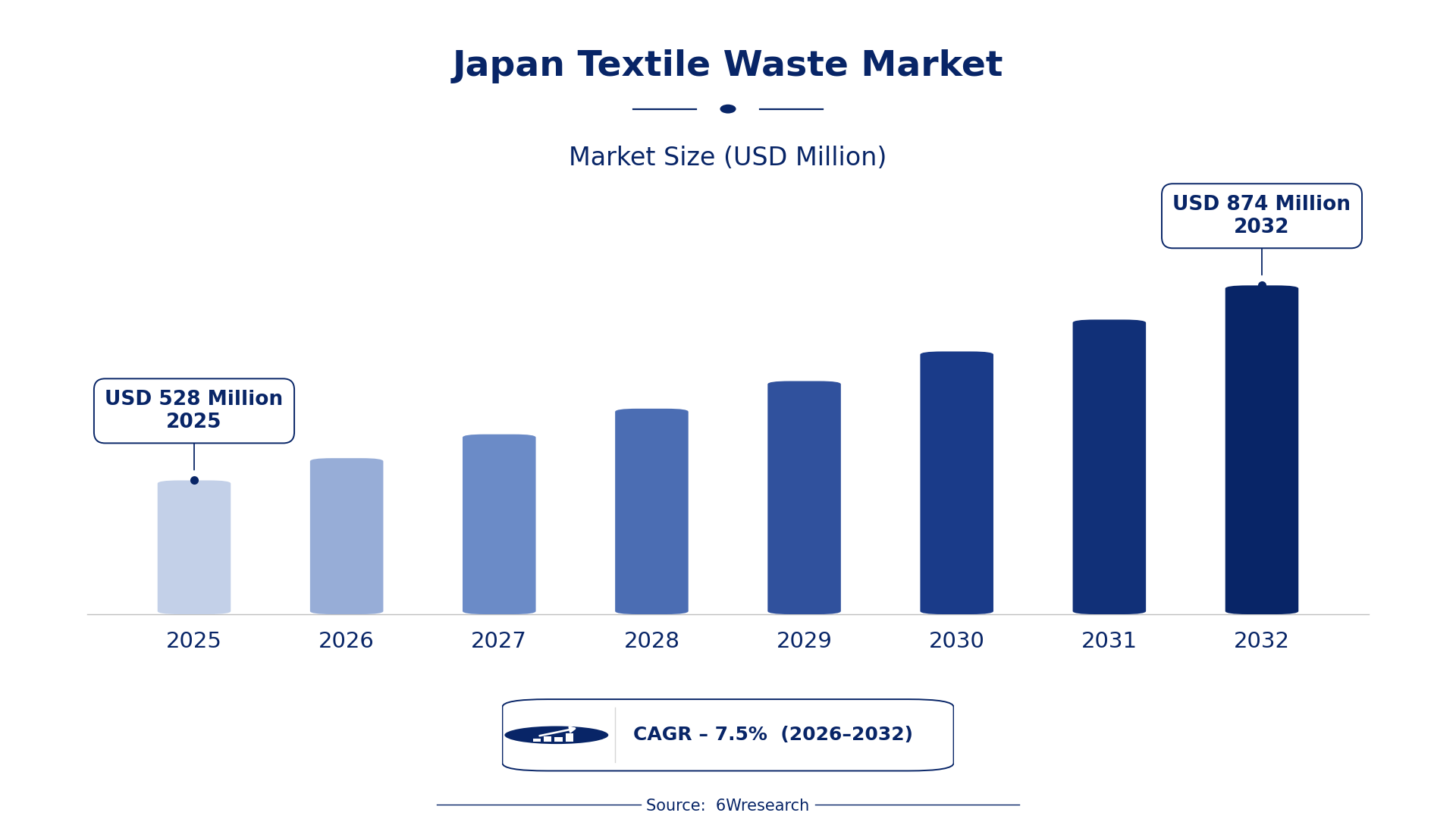
According to 6Wresearch internal database and industry insights, the Japan Textile Waste Market was valued at USD 528 Million in 2025 and is projected to reach USD 874 Million by 2032, growing at a CAGR of approximately 7.5% during 2026–2032.
Japan Textile Waste Market Highlights
| Report Metric | Details |
| Report Name | Japan Textile Waste Market (2026-2032) |
| Market Size 2025 | USD 528 Million |
| Market Size 2032 | USD 874 Million |
| Absolute Growth 2025–2032 | USD 346 Million |
| CAGR 2026–2032 | 7.5% |
| Peak Annual Growth | 8.3% in 2028 |
| Forecast Period | 2026–2032 |
| Historical Data | 2022–2025 |
| Base Year | 2025 |
| Leading Solution Types, 2025 | Recycling Solutions (41% share) |
| Leading Product Types, 2025 | Clothing waste (49% share) |
| Fastest-Growing Solution Types | Source Reduction Solutions (10.7% CAGR) |
| Fastest-Growing Product Types | Dyeing waste (10.9% CAGR) |
| Growing Sector | Dyeing waste |
| Key End Users | Clothing waste, Consumer waste, Dyeing waste, Spinning waste |
Japan Textile Waste Market Year-wise Growth Rate and Key Drivers (2022–2032)
This graph illustrates the annual growth rates of the market from 2022 to 2032, highlighting a steady upward trajectory and projected market expansion over the forecast period.
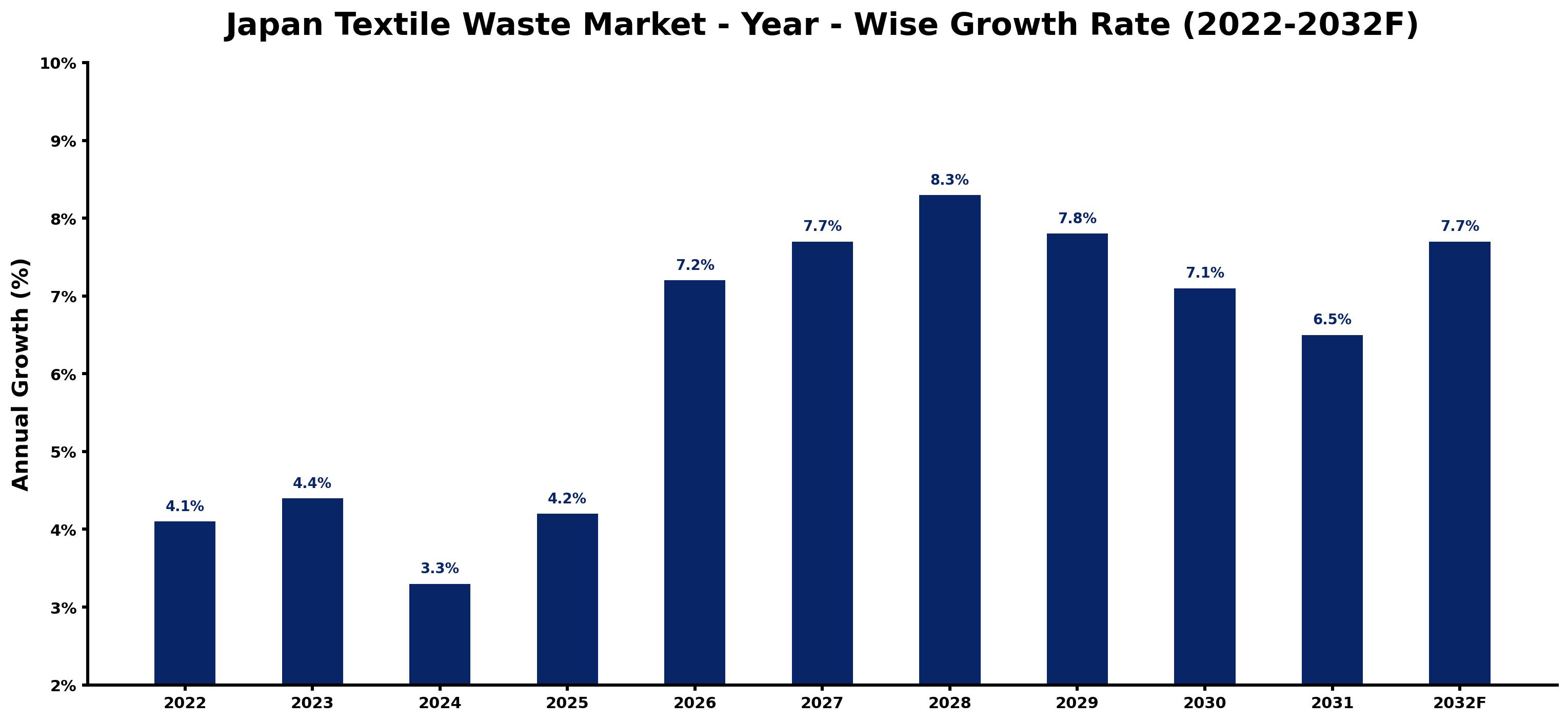
Each row of the following table gives one year's estimated growth and the event or demand shift that explains it.
| Year | Estimated Annual Growth (%) | Market Rationale |
| 2022 | 4.1 | The market experienced steady growth, reflecting ongoing recycling efforts and consumer awareness. |
| 2023 | 4.4 | Growth was supported by increased textile waste generation and heightened recycling initiatives. |
| 2024 | 3.3 | A slowdown occurred as recycling infrastructure faced capacity constraints despite ongoing demand. |
| 2025 | 4.2 | Growth accelerated again due to new recycling programs and consumer engagement in waste management. |
| 2026 | 7.2 | The market is expected to see growth as investments in recycling technologies begin to yield results. |
| 2027 | 7.7 | Demand will continue to rise with new initiatives promoting sustainable textile practices across regions. |
| 2028 | 8.3 | The peak growth year will reflect heightened awareness and government support for recycling solutions. |
| 2029 | 7.8 | A slight slowdown is expected as the market adjusts to new recycling capacities and technologies. |
| 2030 | 7.1 | Growth will slow further as the industry faces challenges in scaling up recycling operations effectively. |
| 2031 | 6.5 | The market will continue to grow, driven by persistent consumer demand for sustainable practices. |
| 2032 | 7.7 | Demand is projected to rise again as new recycling technologies are adopted widely. |
Note: Market size estimations and growth projections presented in this report are based on 6Wresearch's proprietary forecasting methodology, utilizing the latest available industry data, government publications, and primary research inputs.
Japan Textile Waste Market Synopsis
Textile waste consists of discarded materials from textile production and consumption, including spinning, weaving, and consumer waste. Japan generates approximately 1.3 million tons of textile waste annually, with a recycling rate around 30%. The Japan Textile Waste Market is expanding due to increasing consumer awareness and government initiatives, such as a ¥1 billion allocation for textile waste reduction in 2023. The Tokyo region, a major textile hub, drives demand for recycling solutions, further stimulating market growth alongside sustainable practices in the industry.
Market Dynamics Impact Analysis (2026–2032)
| Factor | Type | Impact | Primary Segment Affected |
| Growing consumer awareness of sustainability | Driver | High | Recycling Solutions |
| Government initiatives promoting recycling | Driver | High | Source Reduction Solutions |
| Investment in recycling technologies | Opportunity | High | Recycling Solutions |
| Expansion of textile recycling facilities | Opportunity | High | Source Reduction Solutions |
| Limited recycling infrastructure capacity | Restraint | High | Recycling Solutions |
| High costs associated with recycling processes | Restraint | Medium | Source Reduction Solutions |
| Supply chain disruptions affecting waste management | Challenge | High | Recycling Solutions |
| Competition from alternative waste disposal methods | Challenge | Medium | Source Reduction Solutions |
Evaluation of Drivers in Japan Textile Waste Market (2026–2032)
Key forces behind demand, with the segment each one moves most, are listed below.
| Drivers | Primary Segment Affected | Why It Matters (Evidence) |
| Increased consumer demand for sustainable products | Recycling Solutions | The average Japanese citizen discards about 5 kg of clothing per year, driving demand for recycling. |
| Government funding for textile waste initiatives | Source Reduction Solutions | In 2023, the government allocated ¥1 billion for textile waste reduction initiatives, supporting recycling efforts. |
| Growing textile production in urban areas | Recycling Solutions | The Tokyo region generates approximately 1.3 million tons of textile waste annually, necessitating effective management solutions. |
| Adoption of environmental management standards by manufacturers | Source Reduction Solutions | Many textile manufacturers in Japan adopt ISO 14001 standards that promote waste reduction and sustainability. |
| Rising awareness of environmental impact | Recycling Solutions | Increased advocacy for sustainable practices is driving demand for effective recycling solutions. |
Volumes grow on the back of heightened consumer awareness regarding sustainability, as the average Japanese citizen discards about 5 kg of clothing annually, increasing the need for recycling solutions. The Tokyo region generates approximately 1.3 million tons of textile waste each year, necessitating effective management approaches. The push for sustainable practices among manufacturers is also contributing to rising demand for recycling solutions. As awareness of environmental impacts increases, more consumers and businesses are engaging in recycling efforts.
Evaluation of Restraints in Japan Textile Waste Market
The table below lists the restraints and the evidence behind each.
| Market Restraint | Primary Segment Affected | Why It Matters (Evidence) |
| Limited capacity of recycling facilities | Recycling Solutions | The recycling rate for textile waste in Japan is around 30%, indicating infrastructure challenges. |
| High operational costs of recycling processes | Source Reduction Solutions | Recycling processes require considerable investment, which can deter some manufacturers from participating. |
| Supply chain disruptions affecting waste management | Recycling Solutions | Recent global supply chain issues have impacted the availability of materials for recycling, hindering operations. |
| Competition from alternative waste disposal methods | Source Reduction Solutions | Landfilling remains a cheaper option for some waste producers, limiting recycling adoption. |
| Consumer reluctance to change disposal habits | Recycling Solutions | The average consumer's disposal habits can hinder the growth of recycling initiatives. |
Japan Textile Waste Market Challenges
High disposal costs burden buyers in Japan's textile waste market, as only 30% of textile waste is recycled due to a lack of processing facilities. Intense competition among waste management companies leads to price wars, which can compromise service quality for producers needing reliable waste disposal. Suppliers encounter delays in implementing advanced recycling technologies, causing inefficiencies that inflate operational costs. Regulatory pressures are mounting, with the Tokyo Metropolitan Government aiming for a 50% reduction in textile waste by 2030, which could strain compliance budgets for manufacturers.
Trends in the Japan Textile Waste Market
Buyers and suppliers in the Japan Textile Waste Market are adjusting to the following trends.
- Shift Towards Sustainable Disposal Practices: Consumers are increasingly opting for sustainable disposal methods, such as recycling, influenced by awareness campaigns. In 2023, the government allocated ¥1 billion for textile waste reduction initiatives, promoting eco-friendly practices.
- Transition from Landfilling to Recycling: Since 2022, there has been a notable shift from landfilling to recycling textile waste, driven by government policies. The Tokyo Metropolitan Government aims to reduce textile waste by 50% by 2030.
- Emergence of Environmental Management Standards: The adoption of environmental management standards has gained traction since 2021, with many manufacturers aligning with existing regulations. This shift is expected to improve recycling efforts across the industry.
- Increased Investment in Advanced Recycling Technologies: Investment in advanced recycling technologies has surged, particularly in urban areas like Tokyo. In 2023, the government allocated ¥1 billion to support these initiatives, encouraging innovation.
Investment Opportunities in the Japan Textile Waste Market
The openings below show where demand in the Japan Textile Waste Market is visible and how suppliers can enter.
- Expansion of Recycling Facilities in Urban Areas: The Tokyo region presents opportunities for new recycling facilities, supported by a growing textile waste stream. With a projected annual waste of 1.3 million tons, there is a clear need for expanded infrastructure.
- Supply of Sustainable Recycling Solutions: There is a rising demand for eco-friendly recycling solutions, particularly among urban consumers. Collaborating with local governments can facilitate market entry and improve service offerings.
- Partnerships with Local Manufacturers: Forming partnerships with local textile manufacturers can help in promoting sustainable practices. This approach aligns with the growing consumer trend towards eco-friendly products.
- Investment in Innovative Recycling Technologies: Investing in advanced recycling technologies is essential now, as the market is evolving rapidly. The government's allocation of ¥1 billion for waste reduction initiatives highlights the urgency for innovation.
Government Initiatives in the Japan Textile Waste Market
The Waste Management and Public Cleansing Act (1970) sets the framework for managing textile waste, ensuring that proper recycling practices are followed. This law mandates that manufacturers implement sustainable waste management solutions, contributing to Japan's overall recycling rate of around 30%.
The Ministry of the Environment oversees various initiatives, including the allocation of ¥1 billion in 2023 for textile waste reduction. This funding supports research and development of recycling technologies, helping manufacturers comply with environmental standards and improve their waste management practices.
Future Insight of the Japan Textile Waste Market
Investment in textile recycling technologies will rise by 2032, driven by government initiatives that support waste reduction. This shift will create demand for advanced recycling facilities and eco-friendly production standards, such as ISO 14001, which many manufacturers adopt for environmental management. Manufacturers will need to adjust their processes to comply with evolving regulations, boosting their competitiveness. Buyers will benefit from enhanced recycling solutions, while suppliers must innovate to meet increased sustainability expectations.
Market Segmentation Analysis
Japan Textile Waste Market report covers a detailed analysis of the following market segments:
By Solution Types – Recycling Solutions Lead, Source Reduction Solutions Expected to Grow Fastest
According to Ravi Bhandari, Research Head at 6Wresearch, Recycling Solutions held 41% of the Japan Textile Waste Market by solution types in 2025. Recycling Solutions hold the largest share due to the established infrastructure and processes in place for textile waste management, particularly in the Tokyo region, which is a hub for textile production. The government's commitment to promoting recycling through initiatives like the ¥1 billion allocation further supports this segment's dominance. Over 2026–2032, Source Reduction Solutions are expected to post the fastest growth, at a CAGR of 10.7%. Source Reduction Solutions are experiencing rapid growth as the government aims to reduce textile waste by 50% by 2030, highlighting a shift towards minimising waste generation. This focus on prevention, alongside the promotion of sustainable practices by the Japan Textile Federation, is driving this segment's expansion. Suppliers should prioritise developing source reduction strategies to align with government targets and consumer expectations.
By Product Types – Clothing waste Leads, Dyeing waste Expected to Grow Fastest
Clothing waste accounted for 49% of the market by product types in 2025. Clothing waste holds the largest share due to the high volume of discarded garments by consumers, with the average Japanese citizen disposing of about 5 kg of clothing annually. This waste is primarily collected and processed in urban areas like Tokyo, which is a central hub for textile production and waste management. Dyeing waste is set to record the highest CAGR in this split, 10.9% over 2026–2032. Dyeing waste is experiencing rapid growth because of increased focus on sustainable practices within the textile industry, as highlighted by the Ministry of the Environment's support for recycling technologies. This segment is likely to expand as manufacturers seek to comply with environmental standards like ISO 14001. Suppliers should prioritise solutions for dyeing waste management to capitalise on this growth trend, while buyers may benefit from improved recycling technologies.
Key Attractiveness of the Report
- 10 Years of Market Numbers
- Historical Data Starting from 2022 to 2025
- Base Year 2025
- Forecast Data until 2032
- Key Performance Indicators Impacting the Market
- Major Upcoming Developments and Projects
Key Highlights of the Report:
- Japan Textile Waste Market Outlook
- Market Size of Japan Textile Waste Market, 2025
- Forecast of Japan Textile Waste Market, 2032
- Historical Data and Forecast of Japan Textile Waste Revenues & Volume for the Period 2022-2032
- Japan Textile Waste Market Trend Evolution
- Japan Textile Waste Market Drivers and Challenges
- Japan Textile Waste Price Trends
- Japan Textile Waste Porter's Five Forces
- Japan Textile Waste Industry Life Cycle
- Historical Data and Forecast of Japan Textile Waste Market Revenues & Volume By Solution Types for the Period 2022-2032
- Historical Data and Forecast of Japan Textile Waste Market Revenues & Volume By Source Reduction Solutions for the Period 2022-2032
- Historical Data and Forecast of Japan Textile Waste Market Revenues & Volume By Landfills Solutions for the Period 2022-2032
- Historical Data and Forecast of Japan Textile Waste Market Revenues & Volume By Recycling Solutions for the Period 2022-2032
- Historical Data and Forecast of Japan Textile Waste Market Revenues & Volume By Incineration Solutions for the Period 2022-2032
- Historical Data and Forecast of Japan Textile Waste Market Revenues & Volume By Product Types for the Period 2022-2032
- Historical Data and Forecast of Japan Textile Waste Market Revenues & Volume By Spinning waste for the Period 2022-2032
- Historical Data and Forecast of Japan Textile Waste Market Revenues & Volume By Weaving waste for the Period 2022-2032
- Historical Data and Forecast of Japan Textile Waste Market Revenues & Volume By Knitting waste for the Period 2022-2032
- Historical Data and Forecast of Japan Textile Waste Market Revenues & Volume By Dyeing waste for the Period 2022-2032
- Historical Data and Forecast of Japan Textile Waste Market Revenues & Volume By Clothing waste for the Period 2022-2032
- Historical Data and Forecast of Japan Textile Waste Market Revenues & Volume By Consumer waste for the Period 2022-2032
- Japan Textile Waste Import Export Trade Statistics
- Market Opportunity Assessment By Solution Types
- Market Opportunity Assessment By Product Types
- Japan Textile Waste Top Companies Market Share
- Japan Textile Waste Competitive Benchmarking By Technical and Operational Parameters
- Japan Textile Waste Company Profiles
- Japan Textile Waste Key Strategic Recommendations
Market Covered
The report covers the following segments.
By Solution Types
- Source Reduction Solutions
- Landfills Solutions
- Recycling Solutions
- Incineration Solutions
By Product Types
- Spinning waste
- Weaving waste
- Knitting waste
- Dyeing waste
- Clothing waste
- Consumer waste































