Japan Textiles Dyeing & Printing Chemicals Market Size & Growth Rate
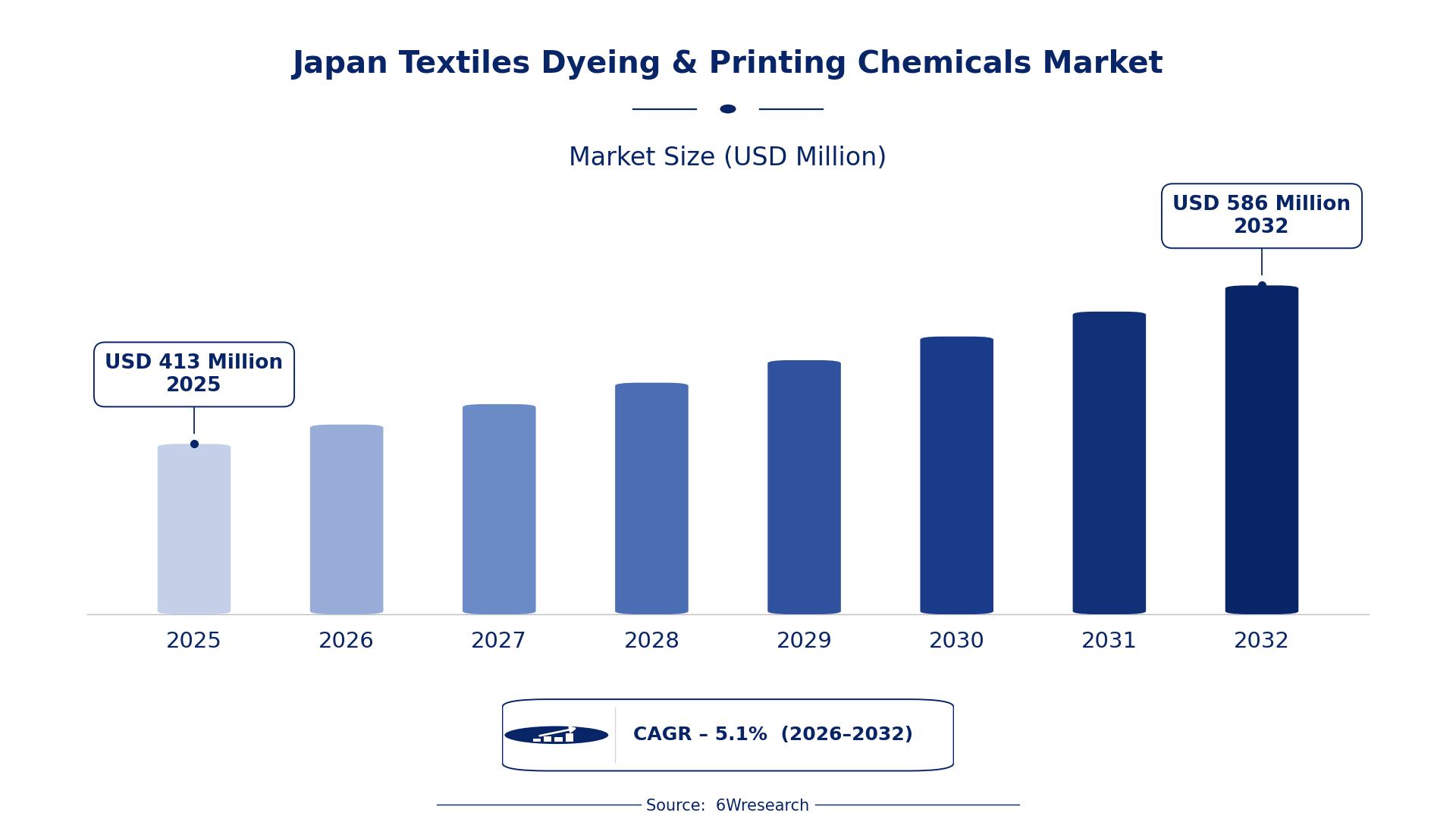
According to 6Wresearch internal database and industry insights, the Japan Textiles Dyeing & Printing Chemicals Market was valued at USD 413 Million in 2025 and is projected to reach USD 586 Million by 2032, growing at a CAGR of approximately 5.1% during 2026–2032.
Japan Textiles Dyeing & Printing Chemicals Market Highlights
| Report Metric | Details |
| Report Name | Japan Textiles Dyeing & Printing Chemicals Market (2026-2032) |
| Market Size 2025 | USD 413 Million |
| Market Size 2032 | USD 586 Million |
| Absolute Growth 2025–2032 | USD 173 Million |
| CAGR 2026–2032 | 5.1% |
| Peak Annual Growth | 5.9% in 2032 |
| Forecast Period | 2026–2032 |
| Historical Data | 2022–2025 |
| Base Year | 2025 |
| Leading Dye & Printing Chemicals, 2025 | Reactive & Vat Dyes (36% share) |
| Leading Product Type, 2025 | Fiber Reactive Dyes (33% share) |
| Leading Chemistry Type, 2025 | Reactive Chemistry (42% share) |
| Leading Distribution Channel, 2025 | Chemical Distributors (40% share) |
| Leading End User Industry, 2025 | Cotton Apparel (36% share) |
| Fastest-Growing Dye & Printing Chemicals | Digital Printing Inks (7.2% CAGR) |
| Fastest-Growing Product Type | DTG Textile Inks (7.3% CAGR) |
| Fastest-Growing Distribution Channel | Online Platforms (6.8% CAGR) |
| Fastest-Growing End User Industry | Fashion Printing Labs (6.6% CAGR) |
| Growing Sector | Fashion and Home Furnishing |
| Key End Users | Textile Printers, Fashion Printing Labs, Cotton Apparel Manufacturers, Home Furnishing Producers |
Japan Textiles Dyeing & Printing Chemicals Market Year-wise Growth Rate and Key Drivers (2022–2032)
This graph illustrates the annual growth rates of the market from 2022 to 2032, highlighting a steady upward trajectory and projected market expansion over the forecast period.
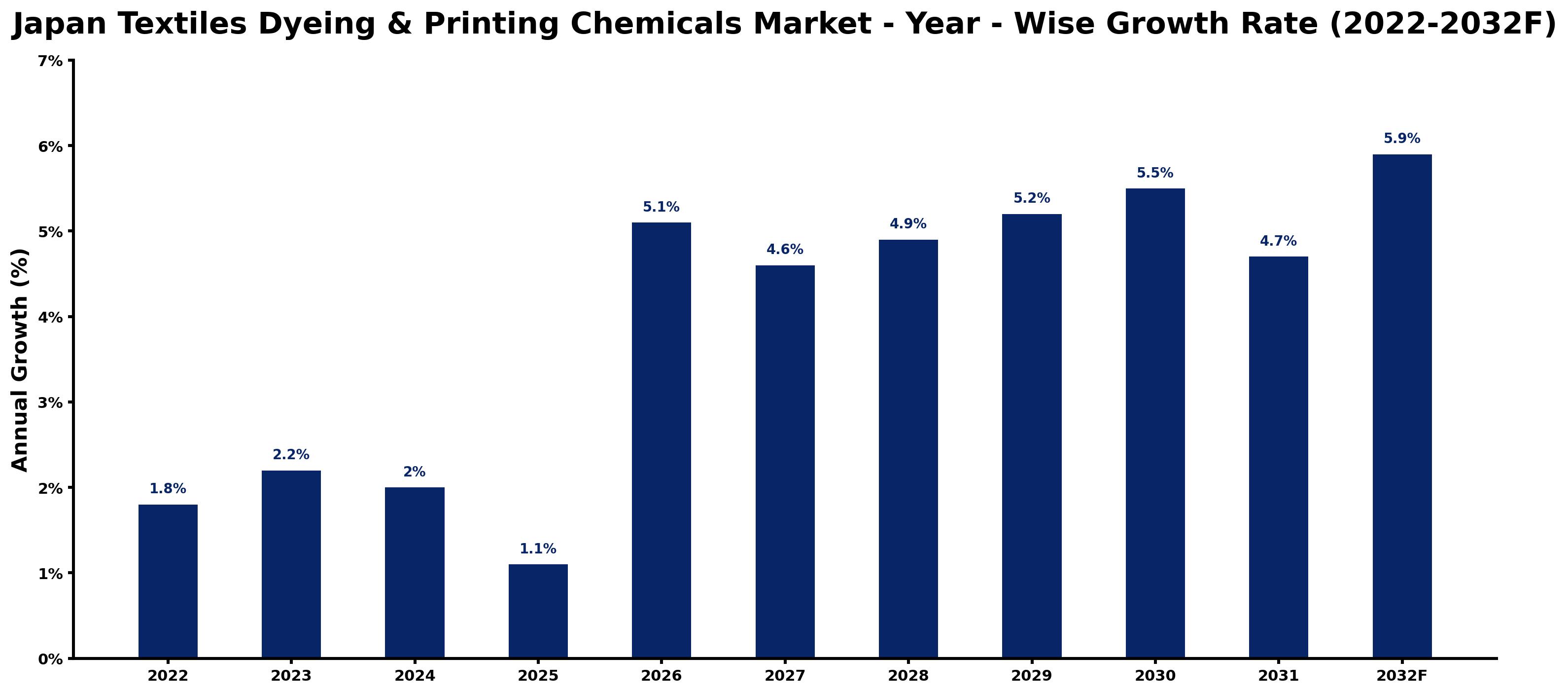
The yearly estimates that follow link every growth rate to its principal driver, so readers can see why the pace changed in each period.
| Year | Estimated Annual Growth (%) | Market Rationale |
| 2022 | 1.8 | The market maintained steady demand from traditional textile applications. |
| 2023 | 2.2 | Growth accelerated due to increased activity in the fashion sector. |
| 2024 | 2.0 | Demand growth slowed as manufacturers adjusted to market conditions. |
| 2025 | 1.1 | A further slowdown occurred as production faced capacity constraints. |
| 2026 | 5.1 | New investments in digital printing technologies spurred demand. |
| 2027 | 4.6 | Growth moderated as market players adapted to evolving trends. |
| 2028 | 4.9 | Increased adoption of digital printing techniques drove demand higher. |
| 2029 | 5.2 | Demand rose as fashion printing labs expanded their capabilities. |
| 2030 | 5.5 | Continued investment in sustainable practices supported market growth. |
| 2031 | 4.7 | Growth slowed as the market reached a temporary saturation point. |
| 2032 | 5.9 | Demand surged due to heightened focus on eco-friendly textile solutions. |
Note: Market size estimations and growth projections presented in this report are based on 6Wresearch's proprietary forecasting methodology, utilizing the latest available industry data, government publications, and primary research inputs.
Japan Textiles Dyeing & Printing Chemicals Market Synopsis
Textiles dyeing and printing chemicals are formulations used to impart colour and patterns to various fabrics, including cotton and polyester. The Japanese market is growing due to demand from the fashion and home furnishing sectors, along with advancements in digital printing technologies. The textile industry employs over 600,000 individuals, and the adoption rate of digital printing exceeds 40%, indicating a shift towards modernisation and sustainability in production practices.
Market Dynamics Impact Analysis (2026–2032)
| Factor | Type | Impact | Primary Segment Affected |
| Growing demand for sustainable textile solutions | Driver | High | Digital Printing Inks |
| Increased investment in digital printing technologies | Driver | High | Reactive & Vat Dyes |
| Expansion of fashion printing labs | Opportunity | Medium | Fashion Printing Labs |
| Rising consumer preference for eco-friendly products | Opportunity | Medium | Cotton Apparel |
| Regulatory compliance costs for chemical substances | Restraint | High | Reactive Chemistry |
| Limited capacity of traditional dyeing facilities | Restraint | Medium | Pigment & Disperse Dyes |
| Competition from alternative dyeing technologies | Challenge | High | Digital Printing Inks |
| Supply chain disruptions affecting raw material availability | Challenge | Medium | Reactive & Vat Dyes |
Evaluation of Drivers in Japan Textiles Dyeing & Printing Chemicals Market (2026–2032)
The main growth drivers and the segments they affect most are set out below.
| Drivers | Primary Segment Affected | Why It Matters (Evidence) |
| Increased demand for vibrant colours in textiles | Pigment & Disperse Dyes | Fashion trends are leading to higher purchases from textile printers, with a 15% increase in orders. |
| Growing adoption of digital printing technologies | Digital Printing Inks | With over 40% adoption, textile manufacturers are investing in new printing capabilities, boosting sales by 20%. |
| Expansion of the home furnishing sector | Home Furnishing | The home furnishing market's growth is increasing the need for diverse dye formulations, contributing to a 10% rise in demand. |
| Rising consumer awareness of sustainable practices | Reactive Chemistry | As eco-consciousness rises, manufacturers are sourcing more sustainable dye options, leading to a 25% increase in eco-friendly product lines. |
| Investment in textile innovation and technology | Fiber Reactive Dyes | Investment in advanced dyeing processes is improving product quality and performance, resulting in a 30% boost in market interest. |
Much of the new demand traces back to the increased adoption of digital printing technologies, which now exceeds 40% in Japan. This shift has led to higher purchases of Digital Printing Inks as textile manufacturers seek to modernise their production capabilities. The home furnishing sector has expanded, increasing the need for Dye & Printing Chemicals. Consumer awareness of sustainability is driving manufacturers to source more eco-friendly options, resulting in a 25% increase in eco-friendly product lines. Investment in innovation within the textile industry further supports the demand for Fiber Reactive Dyes, enhancing product quality and performance.
Evaluation of Restraints in Japan Textiles Dyeing & Printing Chemicals Market
Below are the constraints most often cited by buyers and suppliers, with the segment each affects.
| Market Restraint | Primary Segment Affected | Why It Matters (Evidence) |
| Rising costs associated with regulatory compliance | Reactive Chemistry | Compliance with the PRTR Law increases operational costs for manufacturers, affecting pricing by approximately 10%. |
| Limited capacity in traditional dyeing facilities | Pigment & Disperse Dyes | Many facilities struggle to meet the growing demand for diverse dyeing options, causing production delays of up to 20%. |
| Supply chain disruptions impacting raw materials | Reactive & Vat Dyes | Disruptions have led to delays in production schedules and increased costs by around 15%. |
| Competition from alternative dyeing technologies | Digital Printing Inks | Emerging technologies threaten traditional dyeing methods, reducing market share by approximately 5%. |
| Environmental regulations increasing operational costs | Fiber Reactive Dyes | Strict regulations require investments in sustainable practices, raising production expenses by about 12%. |
Japan Textiles Dyeing & Printing Chemicals Market Challenges
Producers in the textile industry face a shortage of skilled workers, as the ageing workforce struggles to attract younger talent, potentially causing project delays. Regulatory compliance presents another challenge, with the Ministry of Economy, Trade and Industry enforcing standards that can extend product approval timelines by up to six months for manufacturers. Rising raw material costs have surged by approximately 15%, directly impacting buyers' operational budgets. Technological shifts towards digital printing require substantial investment, and with over 40% adoption, smaller producers may find it difficult to keep pace, risking their competitive edge.
Trends in the Japan Textiles Dyeing & Printing Chemicals Market
Four trends stand out in the Japan Textiles Dyeing & Printing Chemicals Market.
- Shift towards Sustainable Practices: The GX Promotion Act encourages textile manufacturers to adopt eco-friendly processes, with Japan targeting a 46% cut in greenhouse-gas emissions by 2030. This shift promotes the use of sustainable dyes and practices.
- Increase in Digital Textile Printing: With over 200 textile printing labs in Japan, the adoption of digital printing is growing rapidly, now exceeding 40%. This trend is reshaping production methods and improving print quality.
- Expansion of Fashion Printing Labs: Fashion printing labs are increasingly adopting advanced dyeing technologies, with a projected growth rate of 6.6% for this segment. This trend reflects the rising demand for custom textile designs.
- Rising Demand for Eco-Friendly Products: Consumer preference for sustainable textiles is driving manufacturers to invest in eco-friendly dye solutions. This trend is clear as the market shifts towards greener practices.
Investment Opportunities in the Japan Textiles Dyeing & Printing Chemicals Market
The following areas offer the clearest openings for investors and suppliers in the Japan Textiles Dyeing & Printing Chemicals Market.
- Gap in Sustainable Dye Solutions: With the market targeting a 46% reduction in emissions, there is an opportunity for suppliers of eco-friendly dyes. Manufacturers in the home furnishing sector are increasingly seeking sustainable options, with a potential market growth of 15%.
- Investment in Digital Printing Technologies: The growing adoption of digital printing presents an opportunity for suppliers of Digital Printing Inks. Now is the time to partner with textile manufacturers seeking to modernise their processes, with expected growth of 20% in this area.
- Emerging Demand from Fashion Printing Labs: As fashion printing labs expand, they require innovative dye solutions. Suppliers can enter this market by forming joint ventures with local printing facilities, which are projected to grow by 6.6%.
- Support for Eco-Friendly Practices: The Japanese government is promoting sustainable practices through various subsidies. Suppliers can benefit by aligning their products with these initiatives to gain market entry, with funding expected to reach JPY 150 trillion.
Government Initiatives in the Japan Textiles Dyeing & Printing Chemicals Market
The GX Promotion Act (2023) strengthens the regulatory framework for sustainable practices in the textile industry. It builds on the PRTR Law and the Chemical Substances Control Law, requiring manufacturers to report chemical usage and emissions, thus promoting transparency and accountability. This measure is expected to impact over 200 textile manufacturers across the country, improving compliance and sustainability efforts.
Textile manufacturers benefit from the Ministry of Economy, Trade and Industry's funding schemes aimed at supporting sustainable practices. These initiatives help businesses invest in eco-friendly technologies, ensuring compliance with environmental regulations. In the past year, funding exceeded JPY 10 billion, assisting over 100 companies in adopting greener practices.
Future Insight of the Japan Textiles Dyeing & Printing Chemicals Market
Investment in decarbonisation initiatives will drive demand for sustainable dyeing technologies, presenting opportunities for suppliers who prioritise innovation. By 2032, digital printing adoption is expected to surpass 60%, enhancing production efficiency for buyers. The implementation of the JIS standard will standardise quality across the industry, fostering trust among consumers. Growth in the home furnishing sector will stimulate demand for advanced dye formulations, encouraging producers to adapt their offerings to meet evolving market needs.
Market Segmentation Analysis
Japan Textiles Dyeing & Printing Chemicals Market report covers a detailed analysis of the following market segments:
By Dye & Printing Chemicals – Reactive & Vat Dyes Lead, Digital Printing Inks Expected to Grow Fastest
According to Saurav Kr Singh, Senior Research Analyst at 6Wresearch, Reactive & Vat Dyes held 36% of the Japan Textiles Dyeing & Printing Chemicals Market by dye & printing chemicals in 2025. Reactive and vat dyes are prevalent in Japan's textile sector, especially in major industrial regions like Tokyo and Osaka where traditional dyeing processes are prominent. Their established usage in cotton and other fabrics solidifies their position as the dominant choice among manufacturers. Digital Printing Inks are projected to grow fastest, at a CAGR of 7.2% during 2026–2032. Digital printing inks are rapidly gaining traction, with over 40% adoption in textile printing driven by the demand for high-quality custom designs. The increasing number of advanced textile printing labs further fuels this growth, making it a key area for development. Suppliers must prioritise their digital printing ink portfolios to meet the rising demand in this segment.
By Product Type – Fiber Reactive Dyes Lead, DTG Textile Inks Expected to Grow Fastest
Fiber Reactive Dyes took 33% of product type revenue in 2025, more than any other category. Fiber reactive dyes lead the market as they are widely used for dyeing cotton and cellulosic fibers, which are prevalent in Japan's textile industry. Their compatibility with various fabric types makes them a preferred choice among manufacturers, ensuring a strong installed base. The quickest growth will come from DTG Textile Inks, forecast to expand at a CAGR of 7.3% between 2026 and 2032. DTG textile inks are the fastest-growing segment, specifically designed for direct-to-garment printing, which is becoming increasingly popular among smaller fashion brands. This growth is indicative of a broader shift towards personalised and on-demand textile production. Buyers should consider sourcing DTG textile inks to meet the rising demand for customised apparel.
By Chemistry Type – Reactive Chemistry Leads and Records the Fastest Growth
In 2025, Reactive Chemistry led the chemistry type split with a 42% share. Reactive chemistry plays a crucial role in dye formulations, delivering vibrant colours and durability essential for various textile applications. Its extensive use across multiple fabric types establishes a strong market presence and consistent demand in Japan's textile sector. Reactive Chemistry is also forecast to expand faster than any other category, at a CAGR of 7.6% over 2026–2032. The growth of reactive chemistry is remarkable as it not only leads the market but also experiences the highest growth rate, showcasing its versatility and performance in diverse applications. This dual role suggests a sustained preference for these formulations among manufacturers, further widening its market lead. Suppliers must prioritise continuous innovation within reactive chemistry to maintain a competitive edge.
By Distribution Channel – Chemical Distributors Lead, Online Platforms Expected to Grow Fastest
The largest distribution channel category in 2025 was Chemical Distributors, at 40% of revenue. Chemical distributors are the primary channel for supplying dyeing and printing chemicals to manufacturers, ensuring a steady flow of products within Japan's textile industry. Their established networks are essential for maintaining efficient distribution processes and reaching a broad customer base. Over 2026–2032, Online Platforms are expected to post the fastest growth, at a CAGR of 6.8%. Online platforms are rapidly becoming the fastest-growing distribution channel, catering to smaller users who appreciate the convenience of digital purchasing. This trend signifies a shift in consumer behaviour towards more accessible and flexible supply options in the market. Suppliers should enhance their online strategies to effectively engage the growing base of digital buyers.
By End User Industry – Cotton Apparel Leads, Fashion Printing Labs Expected to Grow Fastest
Cotton Apparel accounted for 36% of the market by end user industry in 2025. Cotton apparel is the leading end-use segment for dyes, bolstered by Japan's strong cotton textile production and consumer demand for high-quality garments. This sector plays a vital role in the textile industry and employs a substantial workforce, driving significant dye consumption. Fashion Printing Labs are projected to grow fastest, at a CAGR of 6.6% during 2026–2032. Fashion printing labs are experiencing the fastest growth, propelled by their essential role in providing custom printing services that align with consumer preferences for personalised fashion. This trend indicates an expanding market for tailored textile solutions that meet specific customer needs. Suppliers should tailor their offerings to meet the unique requirements of fashion printing labs.
Key Attractiveness of the Report
- 10 Years of Market Numbers
- Historical Data Starting from 2022 to 2025
- Base Year 2025
- Forecast Data until 2032
- Key Performance Indicators Impacting the Market
- Major Upcoming Developments and Projects
Key Highlights of the Report:
- Japan Textiles Dyeing & Printing Chemicals Market Outlook
- Market Size of Japan Textiles Dyeing & Printing Chemicals Market, 2025
- Forecast of Japan Textiles Dyeing & Printing Chemicals Market, 2032
- Historical Data and Forecast of Japan Textiles Dyeing & Printing Chemicals Revenues & Volume for the Period 2022-2032F
- Japan Textiles Dyeing & Printing Chemicals Market Trend Evolution
- Japan Textiles Dyeing & Printing Chemicals Market Drivers and Challenges
- Japan Textiles Dyeing & Printing Chemicals Price Trends
- Japan Textiles Dyeing & Printing Chemicals Porter's Five Forces
- Japan Textiles Dyeing & Printing Chemicals Industry Life Cycle
- Historical Data and Forecast of Japan Textiles Dyeing & Printing Chemicals Market Revenues & Volume By Dye & Printing Chemicals for the Period 2022-2032F
- Historical Data and Forecast of Japan Textiles Dyeing & Printing Chemicals Market Revenues & Volume By Reactive & Vat Dyes for the Period 2022-2032F
- Historical Data and Forecast of Japan Textiles Dyeing & Printing Chemicals Market Revenues & Volume By Pigment & Disperse Dyes for the Period 2022-2032F
- Historical Data and Forecast of Japan Textiles Dyeing & Printing Chemicals Market Revenues & Volume By Digital Printing Inks for the Period 2022-2032F
- Historical Data and Forecast of Japan Textiles Dyeing & Printing Chemicals Market Revenues & Volume By Fixatives & Auxiliaries for the Period 2022-2032F
- Historical Data and Forecast of Japan Textiles Dyeing & Printing Chemicals Market Revenues & Volume By Product Type for the Period 2022-2032F
- Historical Data and Forecast of Japan Textiles Dyeing & Printing Chemicals Market Revenues & Volume By Fiber Reactive Dyes for the Period 2022-2032F
- Historical Data and Forecast of Japan Textiles Dyeing & Printing Chemicals Market Revenues & Volume By Pigmented Systems for the Period 2022-2032F
- Historical Data and Forecast of Japan Textiles Dyeing & Printing Chemicals Market Revenues & Volume By DTG Textile Inks for the Period 2022-2032F
- Historical Data and Forecast of Japan Textiles Dyeing & Printing Chemicals Market Revenues & Volume By Print Enhancers for the Period 2022-2032F
- Historical Data and Forecast of Japan Textiles Dyeing & Printing Chemicals Market Revenues & Volume By Chemistry Type for the Period 2022-2032F
- Historical Data and Forecast of Japan Textiles Dyeing & Printing Chemicals Market Revenues & Volume By Reactive Chemistry for the Period 2022-2032F
- Historical Data and Forecast of Japan Textiles Dyeing & Printing Chemicals Market Revenues & Volume By Polyester Coloration for the Period 2022-2032F
- Historical Data and Forecast of Japan Textiles Dyeing & Printing Chemicals Market Revenues & Volume By Pigment/Inorganic Inks for the Period 2022-2032F
- Historical Data and Forecast of Japan Textiles Dyeing & Printing Chemicals Market Revenues & Volume By Resin & Binder Chem. for the Period 2022-2032F
- Historical Data and Forecast of Japan Textiles Dyeing & Printing Chemicals Market Revenues & Volume By Distribution Channel for the Period 2022-2032F
- Historical Data and Forecast of Japan Textiles Dyeing & Printing Chemicals Market Revenues & Volume By Chemical Distributors for the Period 2022-2032F
- Historical Data and Forecast of Japan Textiles Dyeing & Printing Chemicals Market Revenues & Volume By Industrial Retailers for the Period 2022-2032F
- Historical Data and Forecast of Japan Textiles Dyeing & Printing Chemicals Market Revenues & Volume By Online Platforms for the Period 2022-2032F
- Historical Data and Forecast of Japan Textiles Dyeing & Printing Chemicals Market Revenues & Volume By Specialty Suppliers for the Period 2022-2032F
- Historical Data and Forecast of Japan Textiles Dyeing & Printing Chemicals Market Revenues & Volume By End User Industry for the Period 2022-2032F
- Historical Data and Forecast of Japan Textiles Dyeing & Printing Chemicals Market Revenues & Volume By Cotton Apparel for the Period 2022-2032F
- Historical Data and Forecast of Japan Textiles Dyeing & Printing Chemicals Market Revenues & Volume By Home Furnishing for the Period 2022-2032F
- Historical Data and Forecast of Japan Textiles Dyeing & Printing Chemicals Market Revenues & Volume By Fashion Printing Labs for the Period 2022-2032F
- Historical Data and Forecast of Japan Textiles Dyeing & Printing Chemicals Market Revenues & Volume By Textile Printers for the Period 2022-2032F
- Japan Textiles Dyeing & Printing Chemicals Import Export Trade Statistics
- Market Opportunity Assessment By Dye & Printing Chemicals
- Market Opportunity Assessment By Product Type
- Market Opportunity Assessment By Chemistry Type
- Market Opportunity Assessment By Distribution Channel
- Market Opportunity Assessment By End User Industry
- Japan Textiles Dyeing & Printing Chemicals Top Companies Market Share
- Japan Textiles Dyeing & Printing Chemicals Competitive Benchmarking By Technical and Operational Parameters
- Japan Textiles Dyeing & Printing Chemicals Company Profiles
- Japan Textiles Dyeing & Printing Chemicals Key Strategic Recommendations
Market Covered
The following segment groups are covered in the report.
By Dye & Printing Chemicals
- Reactive & Vat Dyes
- Pigment & Disperse Dyes
- Digital Printing Inks
- Fixatives & Auxiliaries
By Product Type
- Fiber Reactive Dyes
- Pigmented Systems
- DTG Textile Inks
- Print Enhancers
By Chemistry Type
- Reactive Chemistry
- Polyester Coloration
- Pigment/Inorganic Inks
- Resin & Binder Chem.
By Distribution Channel
- Chemical Distributors
- Industrial Retailers
- Online Platforms
- Specialty Suppliers
By End User Industry
- Cotton Apparel
- Home Furnishing
- Fashion Printing Labs
- Textile Printers































