Japan thermal acoustic insulation Market Size & Growth Rate
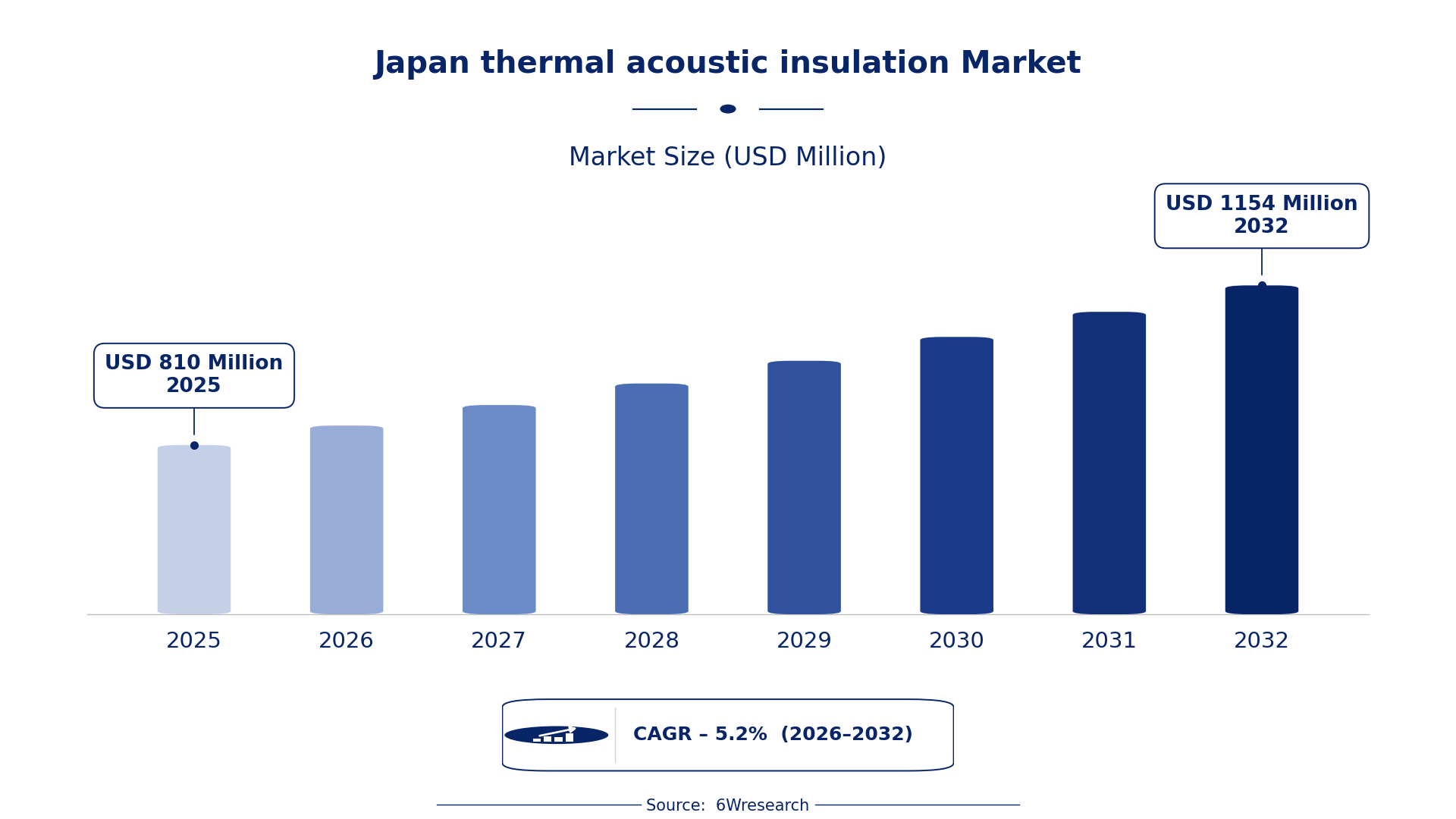
According to 6Wresearch internal database and industry insights, the Japan thermal acoustic insulation Market was valued at USD 810 Million in 2025 and is projected to reach USD 1,154 Million by 2032, growing at a CAGR of approximately 5.2% during 2026–2032.
Japan thermal acoustic insulation Market Highlights
| Report Metric | Details |
| Report Name | Japan thermal acoustic insulation Market (2026-2032) |
| Market Size 2025 | USD 810 Million |
| Market Size 2032 | USD 1,154 Million |
| Absolute Growth 2025–2032 | USD 344 Million |
| CAGR 2026–2032 | 5.2% |
| Peak Annual Growth | 5.9% in 2026 |
| Forecast Period | 2026–2032 |
| Historical Data | 2022–2025 |
| Base Year | 2025 |
| Leading Insulation Material, 2025 | Polyurethane Foams (42% share) |
| Leading Function Type, 2025 | Noise + Heat Barrier (50% share) |
| Leading Application Sector, 2025 | Passenger Vehicles (51% share) |
| Leading End User, 2025 | OEMs (41% share) |
| Fastest-Growing Insulation Material | Fiberglass Mats (7.5% CAGR) |
| Fastest-Growing Function Type | Sound Dampening (7.2% CAGR) |
| Fastest-Growing Application Sector | Commercial Vehicles (6.6% CAGR) |
| Fastest-Growing End User | Tier 1 Suppliers (6.7% CAGR) |
| Growing Sector | automotive |
| Key End Users | OEMs, Tier 1 Suppliers, Component Manufacturers, Auto Assemblers |
Japan thermal acoustic insulation Market Year-wise Growth Rate and Key Drivers (2022–2032)
This graph illustrates the annual growth rates of the market from 2022 to 2032, highlighting a steady upward trajectory and projected market expansion over the forecast period.
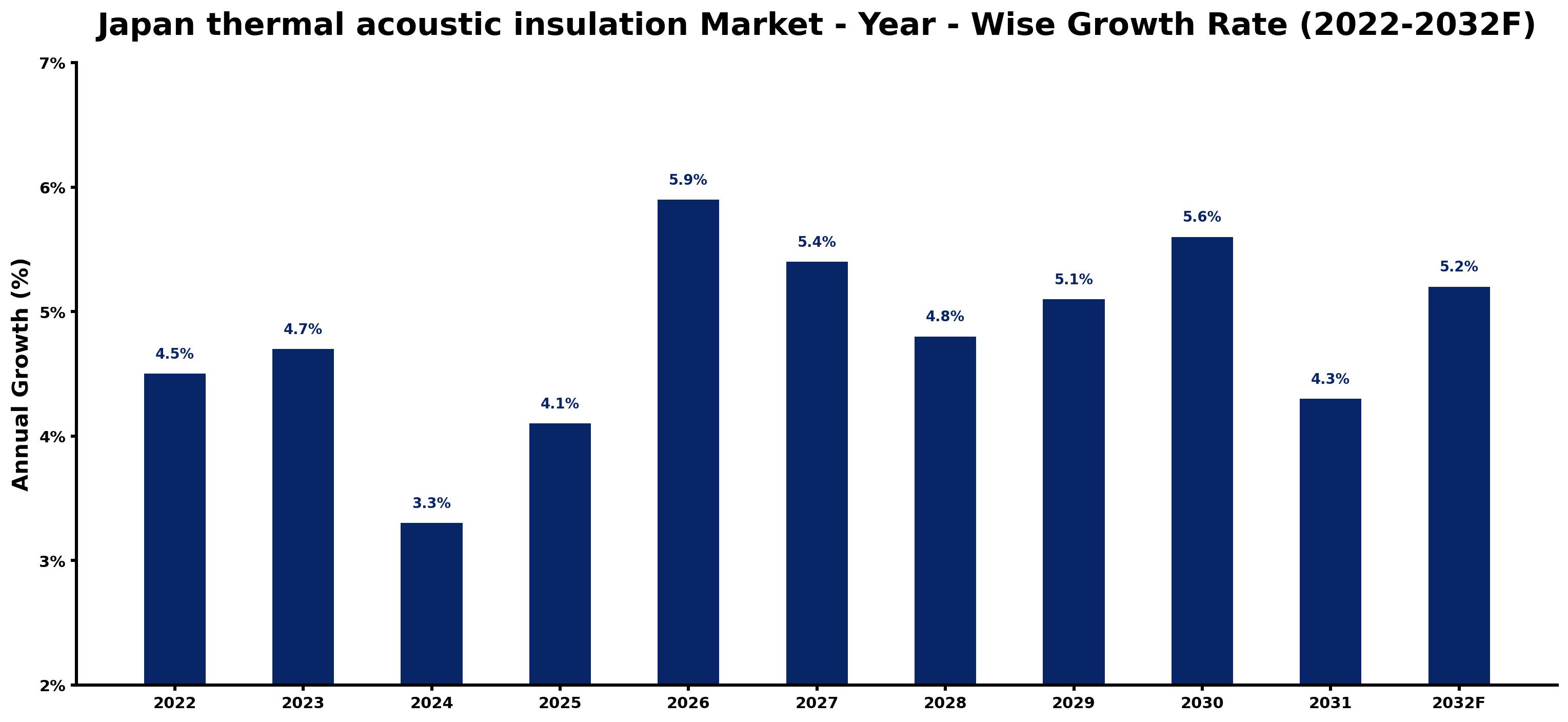
Each row of the following table gives one year's estimated growth and the event or demand shift that explains it.
| Year | Estimated Annual Growth (%) | Market Rationale |
| 2022 | 4.5 | The market experienced steady growth, reflecting ongoing demand from the automotive sector. |
| 2023 | 4.7 | Growth accelerated due to increased automotive production and efficiency standards. |
| 2024 | 3.3 | Growth slowed as manufacturers adjusted to changing material costs and supply chain conditions. |
| 2025 | 4.1 | Demand increased as automotive manufacturers focused on enhancing vehicle comfort and performance. |
| 2026 | 5.9 | The market is expected to peak as energy efficiency initiatives drive higher insulation requirements. |
| 2027 | 5.4 | Growth is projected to slow as the market stabilises after the peak demand year. |
| 2028 | 4.8 | Demand is expected to continue growing, driven by ongoing investments in vehicle innovation. |
| 2029 | 5.1 | The market is projected to rebound with increased orders from commercial vehicle manufacturers. |
| 2030 | 5.6 | Growth is expected to remain strong as new energy-efficient vehicle models are introduced. |
| 2031 | 4.3 | The market will see a slowdown as manufacturers face challenges in sourcing materials. |
| 2032 | 5.2 | Demand is expected to rise as eco-friendly materials gain traction in automotive applications. |
Note: Market size estimations and growth projections presented in this report are based on 6Wresearch's proprietary forecasting methodology, utilizing the latest available industry data, government publications, and primary research inputs.
Japan thermal acoustic insulation Market Synopsis
Thermal acoustic insulation is a composite material designed to reduce sound and heat transfer, primarily made from polyurethane foams and fiberglass. The Japan thermal acoustic insulation Market is expanding due to high automotive production levels, with 8.3 million units produced in 2022. The focus on energy efficiency, supported by government initiatives, is increasing demand for insulation materials, particularly in passenger and commercial vehicles, as manufacturers seek to improve vehicle performance and comfort.
Market Dynamics Impact Analysis (2026–2032)
| Factor | Type | Impact | Primary Segment Affected |
| High automotive production levels drive demand for insulation materials. | Driver | High | Passenger Vehicles |
| The push for energy-efficient vehicles creates new insulation requirements. | Driver | High | Commercial Vehicles |
| Growing consumer preference for quieter vehicles presents opportunities for insulation suppliers. | Opportunity | High | Noise + Heat Barrier |
| The rise in eco-friendly materials opens avenues for innovative insulation products. | Opportunity | Medium | Eco-Friendly Insulation |
| Fluctuating material costs can impact pricing strategies for insulation manufacturers. | Restraint | High | Fiberglass Mats |
| Supply chain disruptions may delay insulation product availability for manufacturers. | Restraint | Medium | Polyurethane Foams |
| Competition from alternative materials can limit market share for traditional insulation. | Challenge | High | Ceramic Insulation |
| Technological advancements in insulation materials require continuous investment. | Challenge | Medium | Recycled Textiles |
Evaluation of Drivers in Japan thermal acoustic insulation Market (2026–2032)
The following drivers explain most of the expected growth.
| Drivers | Primary Segment Affected | Why It Matters (Evidence) |
| Increased automotive production levels drive demand for insulation materials. | Passenger Vehicles | Japan's automotive production reached 8.3 million units in 2022, leading to higher insulation usage. |
| Government initiatives promote energy efficiency in vehicles, boosting insulation demand. | Commercial Vehicles | In 2023, a program aimed to increase vehicle energy efficiency by 20%, raising insulation requirements. |
| The need for quieter vehicles drives demand for sound dampening materials. | Noise + Heat Barrier | Sound dampening materials are essential in over 70% of new vehicle models, prompting manufacturers to invest in these products. |
| Growing focus on sustainability encourages the use of eco-friendly insulation. | Eco-Friendly Insulation | The Ministry of the Environment promotes eco-friendly materials, leading to increased demand for sustainable options. |
| Technological advancements in insulation materials improve performance and efficiency. | Fiberglass Mats | Fiberglass insulation is used in over 60% of passenger vehicles, improving thermal management. |
Most of the extra volume comes from the automotive sector, where production levels reached 8.3 million units in 2022, driving insulation demand. Sound dampening materials are essential in over 70% of new vehicle models, prompting manufacturers to invest in these products. The promotion of eco-friendly materials has led to increased adoption of sustainable insulation options. Technological advancements in insulation materials further improve performance, particularly in fiberglass, which is used in over 60% of passenger vehicles.
Evaluation of Restraints in Japan thermal acoustic insulation Market
These restraints slow adoption and weigh on supplier margins.
| Market Restraint | Primary Segment Affected | Why It Matters (Evidence) |
| Fluctuating material costs can impact pricing strategies for insulation manufacturers. | Fiberglass Mats | Material costs have risen, affecting profit margins for manufacturers in the insulation sector. |
| Supply chain disruptions may delay insulation product availability for manufacturers. | Polyurethane Foams | Recent global supply chain issues have led to delays in sourcing essential insulation materials. |
| Competition from alternative materials can limit market share for traditional insulation. | Ceramic Insulation | New materials are gaining traction, reducing demand for conventional insulation products. |
| Technological advancements require continuous investment in R&D for insulation manufacturers. | Recycled Textiles | Manufacturers must invest substantially to keep up with new insulation technologies. |
| Regulatory compliance can increase operational costs for insulation producers. | Noise + Heat Barrier | Compliance with standards like JIS A 9501 adds to production costs for manufacturers. |
Japan thermal acoustic insulation Market Challenges
High costs for automotive manufacturers stem from outdated technology in insulation production, which results in inefficiencies that inflate prices. Insufficient skilled workers hinder the adoption of advanced manufacturing techniques, delaying product development and affecting suppliers' ability to fulfil orders promptly. Adhering to the JIS A 9501 standard incurs extra costs for producers, which can increase prices for buyers by up to 15%. Intense competition among local manufacturers pressures profit margins, forcing producers to compromise on quality, ultimately diminishing buyer satisfaction and trust.
Trends in the Japan thermal acoustic insulation Market
These developments are changing demand patterns in the Japan thermal acoustic insulation Market.
- Shift Towards Eco-Friendly Insulation Materials: In 2023, the Ministry of the Environment's initiatives have spurred interest in eco-friendly insulation materials, increasing their adoption in the automotive sector. This trend is evidenced by a rise in sustainable product offerings, with over 30% of new vehicles incorporating such materials.
- Transition from Traditional to Advanced Insulation Technologies: The automotive industry is increasingly adopting advanced insulation technologies, with over 60% of passenger vehicles using fiberglass insulation. This shift began in 2022 as manufacturers sought to improve thermal management and reduce noise levels.
- Passenger Vehicles Prioritised Over Commercial Vehicles: The passenger vehicle segment has consistently led the insulation market, holding a 51% share in 2025. This trend reflects consumer demand for comfort and performance, particularly in urban areas like Tokyo.
- Commercial Vehicles Gaining Ground: Commercial vehicles are experiencing a notable increase in insulation demand, projected to grow at a CAGR of 6.6% from 2026 to 2032. This shift is driven by rising logistics and transportation needs in regions like Greater Nagoya.
Investment Opportunities in the Japan thermal acoustic insulation Market
Where to invest in the Japan thermal acoustic insulation Market: the main openings are set out below.
- Ideal Timing for Eco-Friendly Insulation: With the government's focus on sustainability, now is an ideal time to invest in eco-friendly insulation materials. The Ministry of the Environment's initiatives are promoting these products, with a budget of ¥10 billion allocated for automotive innovation.
- Greater Nagoya Area as a Hub for Insulation Supply: The Greater Nagoya area is a key location for automotive component manufacturing, presenting opportunities for insulation suppliers. Investing in local partnerships can facilitate market entry and expand reach.
- OEMs Seeking Advanced Insulation Solutions: OEMs are increasingly looking for advanced insulation solutions to improve vehicle performance. Suppliers can tap into this demand by developing products that meet evolving industry standards.
- Joint Ventures for New Insulation Products: Now is the time to explore joint ventures with local manufacturers to develop new insulation products. This approach can help navigate regulatory requirements and strengthen market presence.
Government Initiatives in the Japan thermal acoustic insulation Market
The Building Energy Efficiency Act (2015, amended 2022) mandates that all new buildings meet energy standards from April 2025, promoting the use of thermal insulation in construction. This law complements existing regulations like the Waste Management and Public Cleansing Act, which governs the treatment of industrial waste, ensuring a thorough approach to energy efficiency and material sustainability.
In 2023, the government allocated ¥10 billion for automotive innovation, administered by the Ministry of the Environment and the Ministry of Economy, Trade and Industry. This funding supports projects aimed at enhancing vehicle energy efficiency and promoting the use of eco-friendly materials in automotive applications.
Future Insight of the Japan thermal acoustic insulation Market
The introduction of energy efficiency programmes will reshape the thermal acoustic insulation market by 2032, as manufacturers seek to comply with new standards. The government’s ¥10 billion investment in automotive innovation will stimulate advancements in insulation technology. By 2032, Japan's automotive production is projected to grow to 9 million units, creating a heightened demand for effective thermal solutions. The Greater Nagoya area's automotive component manufacturing hub will facilitate collaboration, benefiting suppliers and enhancing product offerings.
Market Segmentation Analysis
Japan thermal acoustic insulation Market report covers a detailed analysis of the following market segments:
By Insulation Material – Polyurethane Foams Lead, Fiberglass Mats Expected to Grow Fastest
According to Saurav Kr Singh, Senior Research Analyst at 6Wresearch, in 2025, Polyurethane Foams led the insulation material split with a 42% share. Polyurethane foams dominate the market due to their extensive application in automotive insulation, particularly in passenger vehicles where comfort is paramount. Their properties are essential for meeting the ISO 9001 standards widely adopted in the automotive supply chain. Fiberglass Mats are set to record the highest CAGR in this split, 7.5% over 2026–2032. Fiberglass mats are experiencing rapid growth as they are increasingly recognised for their effective thermal insulation capabilities. The government's initiative to enhance vehicle energy efficiency by 20% in 2023 is a key driver of this trend. Suppliers should prioritise the development of advanced fiberglass mats to meet the rising demand in the automotive sector.
By Function Type – Noise + Heat Barrier Leads, Sound Dampening Expected to Grow Fastest
The largest function type category in 2025 was Noise + Heat Barrier, at 50% of revenue. The noise and heat barrier function type leads the market as it is vital for ensuring vehicle comfort and performance, making it a preferred choice for manufacturers. This dual functionality is essential in over 70% of new vehicle models, highlighting its importance. Sound Dampening is projected to grow fastest, at a CAGR of 7.2% during 2026–2032. Sound dampening is rapidly growing due to its critical role in reducing cabin noise levels, which is increasingly expected by consumers. The adoption of sound dampening materials in new vehicle models is a clear indicator of this trend. Buyers should invest in sound dampening technologies to satisfy the growing consumer demand for quieter vehicles.
By Application Sector – Passenger Vehicles Lead, Commercial Vehicles Expected to Grow Fastest
Passenger Vehicles took 51% of application sector revenue in 2025, more than any other category. Passenger vehicles are the largest application sector for insulation materials, driven by high production volumes and consumer preferences for comfort. With Japan's automotive production reaching 8.3 million units in 2022, this segment remains crucial. The quickest growth will come from Commercial Vehicles, forecast to expand at a CAGR of 6.6% between 2026 and 2032. Commercial vehicles are witnessing the fastest growth, primarily due to rising demand for insulation in larger vehicles. This trend is supported by the substantial employment of over 5 million people in Japan's automotive industry, indicating a strong market. Suppliers should tailor their products for commercial vehicles to capitalise on this expanding market segment.
By End User – OEMs Lead, Tier 1 Suppliers Expected to Grow Fastest
With 41% of end user revenue in 2025, OEMs was the largest category. OEMs are the primary users of insulation materials, integrating these products into their vehicles during manufacturing. Their purchasing power ensures they maintain a dominant position in the market. Over 2026–2032, Tier 1 Suppliers are expected to post the fastest growth, at a CAGR of 6.7%. Tier 1 suppliers are experiencing rapid growth as they provide essential components, including insulation, to OEMs. This shift towards outsourcing component manufacturing is significantly increasing the demand for high-quality insulation materials. Suppliers must strengthen relationships with Tier 1 suppliers to secure consistent demand for insulation products.
Key Attractiveness of the Report
- 10 Years of Market Numbers
- Historical Data Starting from 2022 to 2025
- Base Year 2025
- Forecast Data until 2032
- Key Performance Indicators Impacting the Market
- Major Upcoming Developments and Projects
Key Highlights of the Report:
- Japan thermal acoustic insulation Market Outlook
- Market Size of Japan thermal acoustic insulation Market, 2025
- Forecast of Japan thermal acoustic insulation Market, 2032
- Historical Data and Forecast of Japan thermal acoustic insulation Revenues & Volume for the Period 2022-2032F
- Japan thermal acoustic insulation Market Trend Evolution
- Japan thermal acoustic insulation Market Drivers and Challenges
- Japan thermal acoustic insulation Price Trends
- Japan thermal acoustic insulation Porter's Five Forces
- Japan thermal acoustic insulation Industry Life Cycle
- Historical Data and Forecast of Japan thermal acoustic insulation Market Revenues & Volume By Insulation Material for the Period 2022-2032F
- Historical Data and Forecast of Japan thermal acoustic insulation Market Revenues & Volume By Polyurethane Foams for the Period 2022-2032F
- Historical Data and Forecast of Japan thermal acoustic insulation Market Revenues & Volume By Fiberglass Mats for the Period 2022-2032F
- Historical Data and Forecast of Japan thermal acoustic insulation Market Revenues & Volume By Ceramic Insulation for the Period 2022-2032F
- Historical Data and Forecast of Japan thermal acoustic insulation Market Revenues & Volume By Recycled Textiles for the Period 2022-2032F
- Historical Data and Forecast of Japan thermal acoustic insulation Market Revenues & Volume By Function Type for the Period 2022-2032F
- Historical Data and Forecast of Japan thermal acoustic insulation Market Revenues & Volume By Noise + Heat Barrier for the Period 2022-2032F
- Historical Data and Forecast of Japan thermal acoustic insulation Market Revenues & Volume By Sound Dampening for the Period 2022-2032F
- Historical Data and Forecast of Japan thermal acoustic insulation Market Revenues & Volume By Heat Shielding for the Period 2022-2032F
- Historical Data and Forecast of Japan thermal acoustic insulation Market Revenues & Volume By Eco-Friendly Insulation for the Period 2022-2032F
- Historical Data and Forecast of Japan thermal acoustic insulation Market Revenues & Volume By Application Sector for the Period 2022-2032F
- Historical Data and Forecast of Japan thermal acoustic insulation Market Revenues & Volume By Passenger Vehicles for the Period 2022-2032F
- Historical Data and Forecast of Japan thermal acoustic insulation Market Revenues & Volume By Commercial Vehicles for the Period 2022-2032F
- Historical Data and Forecast of Japan thermal acoustic insulation Market Revenues & Volume By Engine Compartments for the Period 2022-2032F
- Historical Data and Forecast of Japan thermal acoustic insulation Market Revenues & Volume By Cabin Interiors for the Period 2022-2032F
- Historical Data and Forecast of Japan thermal acoustic insulation Market Revenues & Volume By End User for the Period 2022-2032F
- Historical Data and Forecast of Japan thermal acoustic insulation Market Revenues & Volume By OEMs for the Period 2022-2032F
- Historical Data and Forecast of Japan thermal acoustic insulation Market Revenues & Volume By Tier 1 Suppliers for the Period 2022-2032F
- Historical Data and Forecast of Japan thermal acoustic insulation Market Revenues & Volume By Component Manufacturers for the Period 2022-2032F
- Historical Data and Forecast of Japan thermal acoustic insulation Market Revenues & Volume By Auto Assemblers for the Period 2022-2032F
- Japan thermal acoustic insulation Import Export Trade Statistics
- Market Opportunity Assessment By Insulation Material
- Market Opportunity Assessment By Function Type
- Market Opportunity Assessment By Application Sector
- Market Opportunity Assessment By End User
- Japan thermal acoustic insulation Top Companies Market Share
- Japan thermal acoustic insulation Competitive Benchmarking By Technical and Operational Parameters
- Japan thermal acoustic insulation Company Profiles
- Japan thermal acoustic insulation Key Strategic Recommendations
Market Covered
The report covers the following segments.
By Insulation Material
- Polyurethane Foams
- Fiberglass Mats
- Ceramic Insulation
- Recycled Textiles
By Function Type
- Noise + Heat Barrier
- Sound Dampening
- Heat Shielding
- Eco-Friendly Insulation
By Application Sector
- Passenger Vehicles
- Commercial Vehicles
- Engine Compartments
- Cabin Interiors
By End User
- OEMs
- Tier 1 Suppliers
- Component Manufacturers
- Auto Assemblers































