Japan Thermal Control Components Market Size & Growth Rate
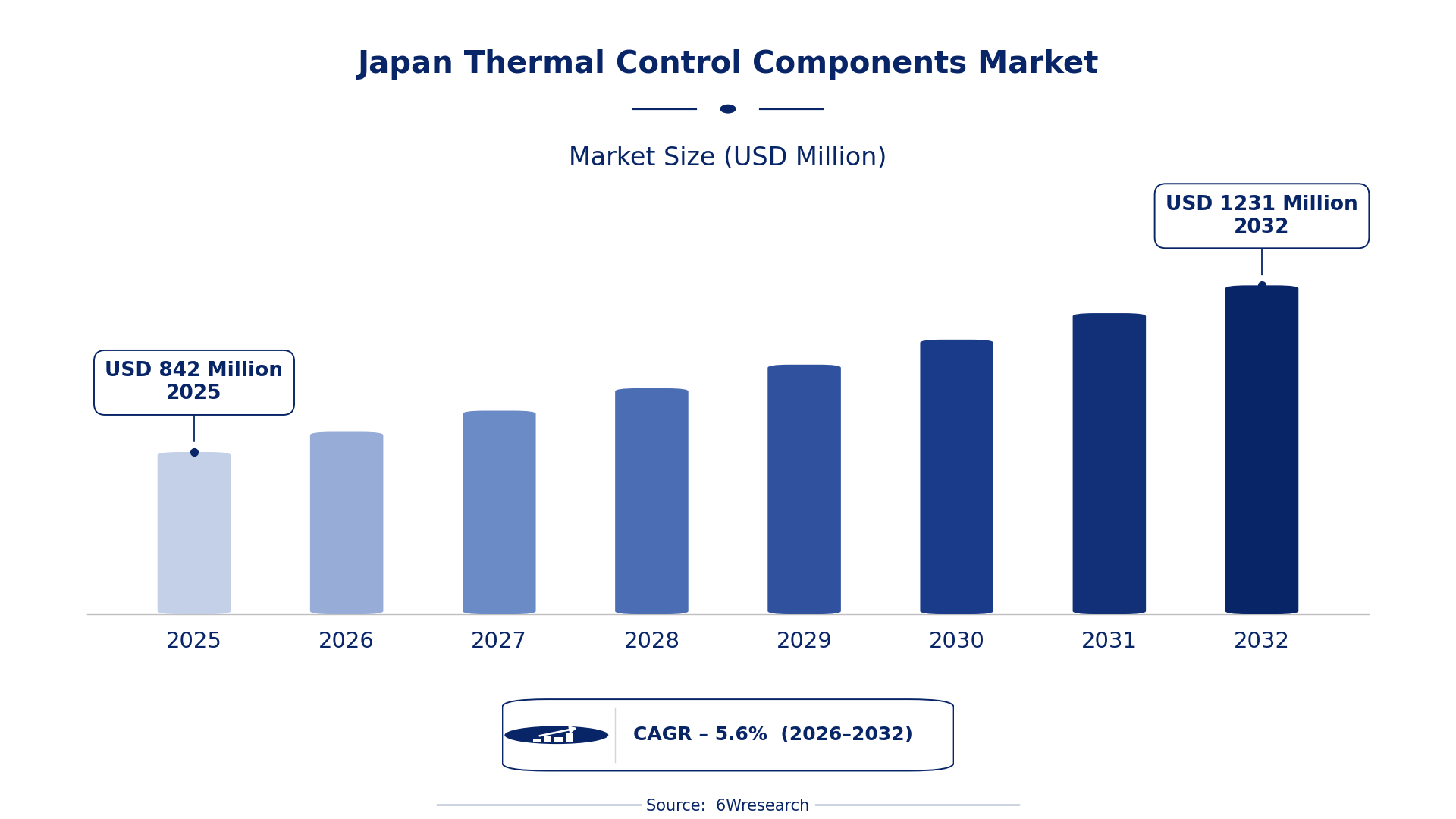
According to 6Wresearch internal database and industry insights, the Japan Thermal Control Components Market was valued at USD 842 Million in 2025 and is projected to reach USD 1,231 Million by 2032, growing at a CAGR of approximately 5.6% during 2026–2032.
Japan Thermal Control Components Market Highlights
| Report Metric | Details |
| Report Name | Japan Thermal Control Components Market (2026-2032) |
| Market Size 2025 | USD 842 Million |
| Market Size 2032 | USD 1,231 Million |
| Absolute Growth 2025–2032 | USD 389 Million |
| CAGR 2026–2032 | 5.6% |
| Peak Annual Growth | 6.7% in 2032 |
| Forecast Period | 2026–2032 |
| Historical Data | 2022–2025 |
| Base Year | 2025 |
| Leading Component Type, 2025 | Heat Pipes (49% share) |
| Leading Control Mechanism, 2025 | Passive Heat Transfer (35% share) |
| Leading Application Segment, 2025 | Satellites (46% share) |
| Leading End User, 2025 | Space Companies (42% share) |
| Fastest-Growing Component Type | Radiators (8.0% CAGR) |
| Fastest-Growing Control Mechanism | Active Dissipation (7.4% CAGR) |
| Fastest-Growing Application Segment | Spacecraft (7.6% CAGR) |
| Fastest-Growing End User | Aerospace OEMs (7.3% CAGR) |
| Growing Sector | Spacecraft |
| Key End Users | Satellites, Spacecraft, Avionics Systems, Planetary Missions |
Japan Thermal Control Components Market Year-wise Growth Rate and Key Drivers (2022–2032)
This graph illustrates the annual growth rates of the market from 2022 to 2032, highlighting a steady upward trajectory and projected market expansion over the forecast period.
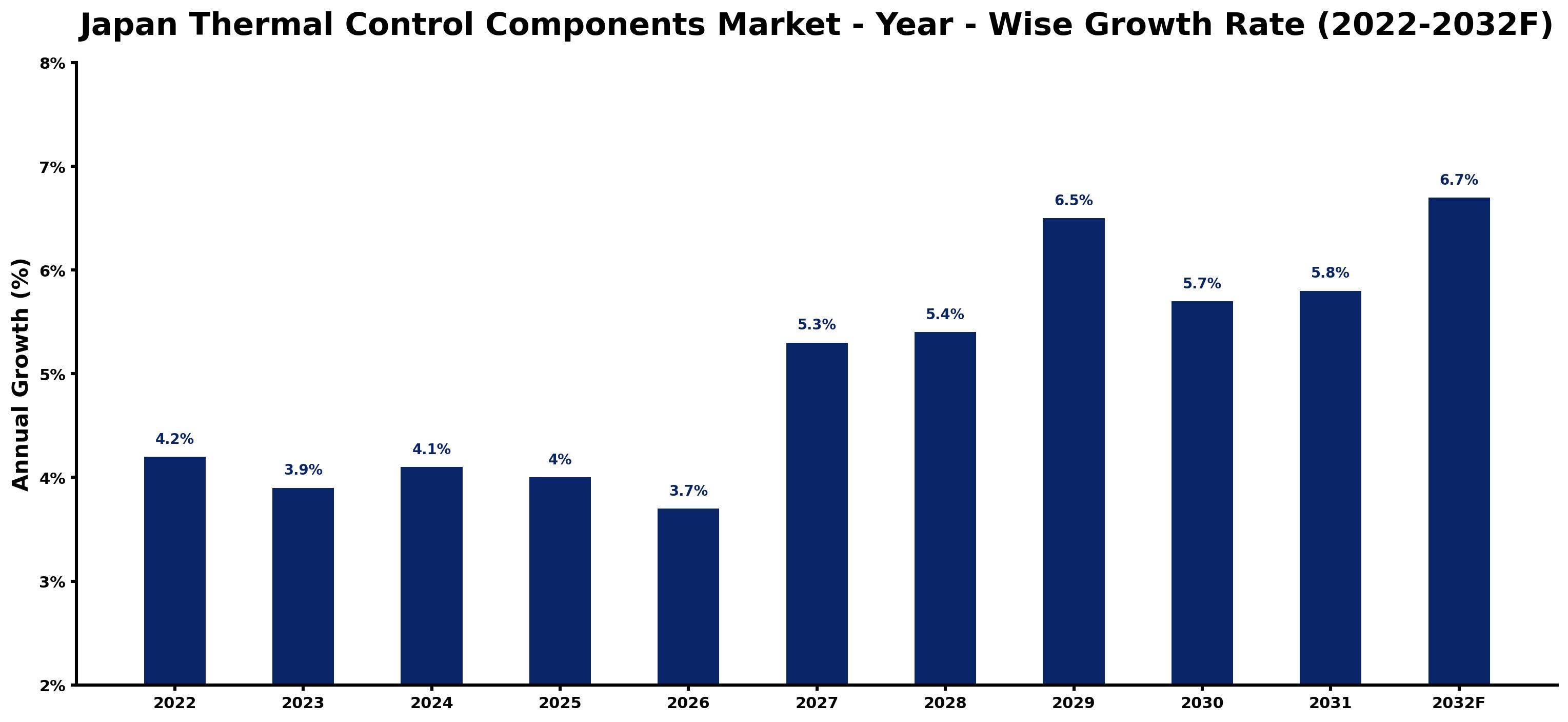
Below, each year's estimated growth is shown next to the factor that most influenced it.
| Year | Estimated Annual Growth (%) | Market Rationale |
| 2022 | 4.2 | The market experienced steady growth as demand from space agencies increased. |
| 2023 | 3.9 | Growth slowed as the number of satellite launches was slightly lower than anticipated. |
| 2024 | 4.1 | Demand rose as aerospace companies ramped up projects involving thermal control components. |
| 2025 | 4.0 | The market continued to grow, although at a slower pace due to saturation in certain aerospace applications. |
| 2026 | 3.7 | A slowdown occurred as the market is expected to adjust to recent technological advancements. |
| 2027 | 5.3 | Demand is projected to increase as new spacecraft projects are initiated by various agencies. |
| 2028 | 5.4 | Growth is expected to continue rising with the successful completion of several satellite missions. |
| 2029 | 6.5 | The market is projected to surge as advancements in thermal technology are widely adopted. |
| 2030 | 5.7 | Growth is expected to slow as competition intensifies among local aerospace manufacturers. |
| 2031 | 5.8 | Demand is projected to increase with new government funding for space exploration initiatives. |
| 2032 | 6.7 | The market is expected to peak as the number of planned satellite launches reaches record levels. |
Note: Market size estimations and growth projections presented in this report are based on 6Wresearch's proprietary forecasting methodology, utilizing the latest available industry data, government publications, and primary research inputs.
Japan Thermal Control Components Market Synopsis
Thermal control components are essential technologies for managing heat in aerospace applications, made from advanced materials that ensure efficient heat transfer. Their primary applications include satellites, spacecraft, and avionics systems. The Japan Thermal Control Components Market is expanding due to a surge in satellite launches, with over 20 planned for 2023, and ongoing projects by the Japan Aerospace Exploration Agency that drive demand for these critical technologies. The government allocated ¥100 billion for space exploration initiatives, supporting the market's growth potential.
Market Dynamics Impact Analysis (2026–2032)
| Factor | Type | Impact | Primary Segment Affected |
| Growing satellite launches in Japan | Driver | High | Satellites |
| Increased investment in space exploration | Driver | High | Space Companies |
| Rising demand for advanced thermal management solutions | Opportunity | Medium | Radiators |
| Expansion of aerospace manufacturing capabilities | Opportunity | Medium | Heat Pipes |
| High competition among local manufacturers | Restraint | High | Thermal Straps |
| Technological limitations in certain applications | Restraint | Medium | Active Dissipation |
| Supply chain disruptions affecting component availability | Challenge | High | Passive Heat Transfer |
| Skilled labor shortages in aerospace sectors | Challenge | Medium | Aerospace OEMs |
Evaluation of Drivers in Japan Thermal Control Components Market (2026–2032)
Key forces behind demand, with the segment each one moves most, are listed below.
| Drivers | Primary Segment Affected | Why It Matters (Evidence) |
| Increased satellite launches | Satellites | Japan's space industry is projected to grow with over 20 planned satellite launches in 2023. |
| Government funding for space initiatives | Space Companies | The Japanese government allocated ¥100 billion for space exploration initiatives in 2023. |
| Technological advancements in thermal management | Radiators | Ongoing projects are driving technology adoption in thermal control solutions. |
| Growing demand from aerospace OEMs | Heat Pipes | Aerospace companies employ over 50,000 skilled workers in thermal management roles. |
| Rising focus on planetary missions | Planetary Missions | Thermal control components are critical for the success of planetary missions. |
Much of the new demand traces back to the increasing number of satellite launches planned by Japan's space industry, with over 20 launches expected in 2023. Funding of ¥100 billion for space exploration projects boosts investments in thermal control technologies. As aerospace companies ramp up their projects, there is a heightened need for efficient heat transfer solutions. The focus on planetary missions highlights the critical role of thermal control components in maintaining operational stability during exploration.
Evaluation of Restraints in Japan Thermal Control Components Market
These restraints slow adoption and weigh on supplier margins.
| Market Restraint | Primary Segment Affected | Why It Matters (Evidence) |
| Rising production costs due to labour expenses | Heat Pipes | Japan's national minimum wage rose to JPY 1,055 per hour, increasing production expenses. |
| Supply chain disruptions in sourcing materials | Radiators | Delays in sourcing advanced materials affect production timelines for aerospace companies. |
| Stringent compliance with industry standards | Thermal Straps | Compliance with ISO 14644 standards raises operational costs for manufacturers. |
| Intense competition from international markets | Passive Heat Transfer | Local producers face pressure to lower prices, which can compromise quality. |
| Limited market for certain thermal technologies | Active Dissipation | The adoption of active dissipation technologies is slower due to high costs. |
Japan Thermal Control Components Market Challenges
High production costs in Japan, with the national minimum wage at JPY 1,055 per hour, burden thermal control component manufacturers, forcing buyers to face increased expenses. Local producers encounter fierce competition from global markets, compelling them to lower prices, which can compromise quality for aerospace companies. Supply chain issues in acquiring advanced materials lead to production delays, impacting timely deliveries for manufacturers. Compliance with ISO 14644 standards for cleanroom environments adds operational costs, pushing up prices for thermal control components and straining budgets for aerospace companies.
Trends in the Japan Thermal Control Components Market
Four trends stand out in the Japan Thermal Control Components Market.
- Shift in Focus to Planetary Missions: Space agencies are prioritising planetary missions, with Japan's focus on Mars exploration driving demand for advanced thermal control technologies. In 2023, the government allocated ¥100 billion for space projects, facilitating new developments.
- Transition from Passive to Active Thermal Management: Aerospace companies are moving towards active thermal management solutions, improving efficiency in heat regulation. Ongoing projects by the Japan Aerospace Exploration Agency are expected to accelerate this shift, reflecting a growing trend in the industry.
- Emerging Demand for Advanced Materials: The aerospace sector is seeing a rising demand for advanced materials in thermal control components. Ongoing projects and satellite launches are pushing manufacturers to innovate, ensuring optimal performance in extreme conditions.
- Increased Collaboration in R&D: Collaboration between academia and industry is becoming more prevalent, boosting research in thermal management technologies. This trend is supported by government funding, which reached ¥100 billion for space exploration initiatives in 2023.
Investment Opportunities in the Japan Thermal Control Components Market
The openings below show where demand in the Japan Thermal Control Components Market is visible and how suppliers can enter.
- Investment in Satellite Launch Technologies: With over 20 planned satellite launches in 2023, aerospace companies are seeking advanced thermal control components. Suppliers can enter this market through partnerships with local manufacturers to meet growing demand.
- Expansion of Space Exploration Initiatives: The Japanese government's allocation of ¥100 billion for space exploration initiatives creates opportunities for suppliers of thermal control components. Collaborating with space agencies can facilitate entry into this expanding market.
- Development of Advanced Thermal Management Solutions: The increasing focus on planetary missions presents a significant opportunity for investment in innovative thermal management technologies. Suppliers can engage with aerospace OEMs to develop tailored solutions.
- Growth in Aerospace Manufacturing Hubs: Tokyo is a major hub for aerospace manufacturing, housing numerous aerospace OEMs. Suppliers can establish joint ventures to tap into this growing market for thermal control components.
Government Initiatives in the Japan Thermal Control Components Market
The Water Supply Act (1957) sets standards for drinking-water quality and supply, which indirectly affects aerospace manufacturing by ensuring clean facilities. The Electrical Appliance and Material Safety Act (1961) regulates the safety of materials used in thermal control components, ensuring compliance with safety standards. The Food Sanitation Act amendment (2018) introduced a positive list system for synthetic resins used in food utensils, containers and packaging, in force from June 2020, which affects materials used in aerospace applications.
The Ministry of Education, Culture, Sports, Science and Technology funds various space technology projects, approving initiatives that support thermal management solutions. The Japan Aerospace Exploration Agency oversees projects that require compliance with established safety and quality standards, ensuring that thermal control components meet necessary regulations.
Future Insight of the Japan Thermal Control Components Market
A strategic shift towards increased space exploration will transform the demand for thermal control components by 2032, driven by substantial government funding in technology initiatives. Collaborative projects between educational institutions and industry will drive advancements in thermal management solutions. Ongoing efforts by the Japan Aerospace Exploration Agency will introduce innovations that improve temperature regulation in aerospace applications. With over 20 planned satellite launches in 2023, suppliers will need to enhance production capabilities to meet the growing requirements of aerospace companies.
Market Segmentation Analysis
Japan Thermal Control Components Market report covers a detailed analysis of the following market segments:
By Component Type – Heat Pipes Lead, Radiators Expected to Grow Fastest
According to Saurav Kr Singh, Senior Research Analyst at 6Wresearch, the largest component type category in 2025 was Heat Pipes, at 49% of revenue. Heat pipes dominate the market due to their critical role in efficient heat transfer for spacecraft and satellite applications. Their widespread adoption in various missions, particularly those led by domestic aerospace entities, solidifies their leading position. The quickest growth will come from Radiators, forecast to expand at a CAGR of 8.0% between 2026 and 2032. Radiators are witnessing rapid growth as they are essential for effective heat dissipation in advanced aerospace applications. The anticipated surge in demand is driven by over 20 planned satellite launches in 2023, highlighting the need for reliable thermal management solutions. Suppliers should prioritise the development of radiator technologies to meet the increasing demands of the aerospace sector.
By Control Mechanism – Passive Heat Transfer Leads, Active Dissipation Expected to Grow Fastest
In 2025, Passive Heat Transfer led the control mechanism split with a 35% share. Passive heat transfer is the preferred choice in many space applications due to its reliability and simplicity. Its established track record in various missions reinforces its strong market presence. Active Dissipation is projected to grow fastest, at a CAGR of 7.4% during 2026–2032. Active dissipation is gaining traction as advancements in thermal management systems enable more precise temperature control in complex aerospace environments. As technology progresses, the demand for these systems is expected to rise significantly. Buyers may find value in investing in active dissipation technologies to enhance the performance of their thermal management systems.
By Application Segment – Satellites Lead, Spacecraft Expected to Grow Fastest
Satellites held 46% of the Japan Thermal Control Components Market by application segment in 2025. Satellites represent the largest application for thermal control components, as they are essential for maintaining optimal temperatures in orbit. Ongoing projects by space companies highlight the critical need for these components in satellite design. Spacecraft is set to record the highest CAGR in this split, 7.6% over 2026–2032. Spacecraft are experiencing the fastest growth due to their crucial role in various missions, including planetary explorations. The increasing number of missions necessitates advanced thermal management solutions tailored specifically for spacecraft operations. Suppliers should focus on developing specialised thermal solutions for spacecraft to capitalise on this growing demand.
By End User – Space Companies Lead, Aerospace OEMs Expected to Grow Fastest
Space Companies accounted for 42% of the market by end user in 2025. Space companies are the primary users of thermal control technologies, relying on these components for mission success. The substantial government investment in space exploration initiatives further strengthens their leading market position. Over 2026–2032, Aerospace OEMs are expected to post the fastest growth, at a CAGR of 7.3%. Aerospace OEMs are rapidly integrating thermal components into their designs, driven by the need for enhanced performance in their products. The growing number of aerospace projects underscores the importance of effective thermal management solutions to meet industry standards. Suppliers should collaborate with aerospace OEMs to ensure their thermal control components align with evolving design requirements.
Key Attractiveness of the Report
- 10 Years of Market Numbers
- Historical Data Starting from 2022 to 2025
- Base Year 2025
- Forecast Data until 2032
- Key Performance Indicators Impacting the Market
- Major Upcoming Developments and Projects
Key Highlights of the Report:
- Japan Thermal Control Components Market Outlook
- Market Size of Japan Thermal Control Components Market, 2025
- Forecast of Japan Thermal Control Components Market, 2032
- Historical Data and Forecast of Japan Thermal Control Components Revenues & Volume for the Period 2022-2032F
- Japan Thermal Control Components Market Trend Evolution
- Japan Thermal Control Components Market Drivers and Challenges
- Japan Thermal Control Components Price Trends
- Japan Thermal Control Components Porter's Five Forces
- Japan Thermal Control Components Industry Life Cycle
- Historical Data and Forecast of Japan Thermal Control Components Market Revenues & Volume By Component Type for the Period 2022-2032F
- Historical Data and Forecast of Japan Thermal Control Components Market Revenues & Volume By Heat Pipes for the Period 2022-2032F
- Historical Data and Forecast of Japan Thermal Control Components Market Revenues & Volume By Radiators for the Period 2022-2032F
- Historical Data and Forecast of Japan Thermal Control Components Market Revenues & Volume By Thermal Straps for the Period 2022-2032F
- Historical Data and Forecast of Japan Thermal Control Components Market Revenues & Volume By Louvers and Coatings for the Period 2022-2032F
- Historical Data and Forecast of Japan Thermal Control Components Market Revenues & Volume By Control Mechanism for the Period 2022-2032F
- Historical Data and Forecast of Japan Thermal Control Components Market Revenues & Volume By Passive Heat Transfer for the Period 2022-2032F
- Historical Data and Forecast of Japan Thermal Control Components Market Revenues & Volume By Active Dissipation for the Period 2022-2032F
- Historical Data and Forecast of Japan Thermal Control Components Market Revenues & Volume By Flexible Conduction for the Period 2022-2032F
- Historical Data and Forecast of Japan Thermal Control Components Market Revenues & Volume By Radiation Control for the Period 2022-2032F
- Historical Data and Forecast of Japan Thermal Control Components Market Revenues & Volume By Application Segment for the Period 2022-2032F
- Historical Data and Forecast of Japan Thermal Control Components Market Revenues & Volume By Satellites for the Period 2022-2032F
- Historical Data and Forecast of Japan Thermal Control Components Market Revenues & Volume By Spacecraft for the Period 2022-2032F
- Historical Data and Forecast of Japan Thermal Control Components Market Revenues & Volume By Avionics Systems for the Period 2022-2032F
- Historical Data and Forecast of Japan Thermal Control Components Market Revenues & Volume By Planetary Missions for the Period 2022-2032F
- Historical Data and Forecast of Japan Thermal Control Components Market Revenues & Volume By End User for the Period 2022-2032F
- Historical Data and Forecast of Japan Thermal Control Components Market Revenues & Volume By Space Companies for the Period 2022-2032F
- Historical Data and Forecast of Japan Thermal Control Components Market Revenues & Volume By Aerospace OEMs for the Period 2022-2032F
- Historical Data and Forecast of Japan Thermal Control Components Market Revenues & Volume By Defense Integrators for the Period 2022-2032F
- Historical Data and Forecast of Japan Thermal Control Components Market Revenues & Volume By Space Agencies for the Period 2022-2032F
- Japan Thermal Control Components Import Export Trade Statistics
- Market Opportunity Assessment By Component Type
- Market Opportunity Assessment By Control Mechanism
- Market Opportunity Assessment By Application Segment
- Market Opportunity Assessment By End User
- Japan Thermal Control Components Top Companies Market Share
- Japan Thermal Control Components Competitive Benchmarking By Technical and Operational Parameters
- Japan Thermal Control Components Company Profiles
- Japan Thermal Control Components Key Strategic Recommendations
Market Covered
The following segment groups are covered in the report.
By Component Type
- Heat Pipes
- Radiators
- Thermal Straps
- Louvers and Coatings
By Control Mechanism
- Passive Heat Transfer
- Active Dissipation
- Flexible Conduction
- Radiation Control
By Application Segment
- Satellites
- Spacecraft
- Avionics Systems
- Planetary Missions
By End User
- Space Companies
- Aerospace OEMs
- Defense Integrators
- Space Agencies































