Japan Thermal Insulation Board Market Size & Growth Rate
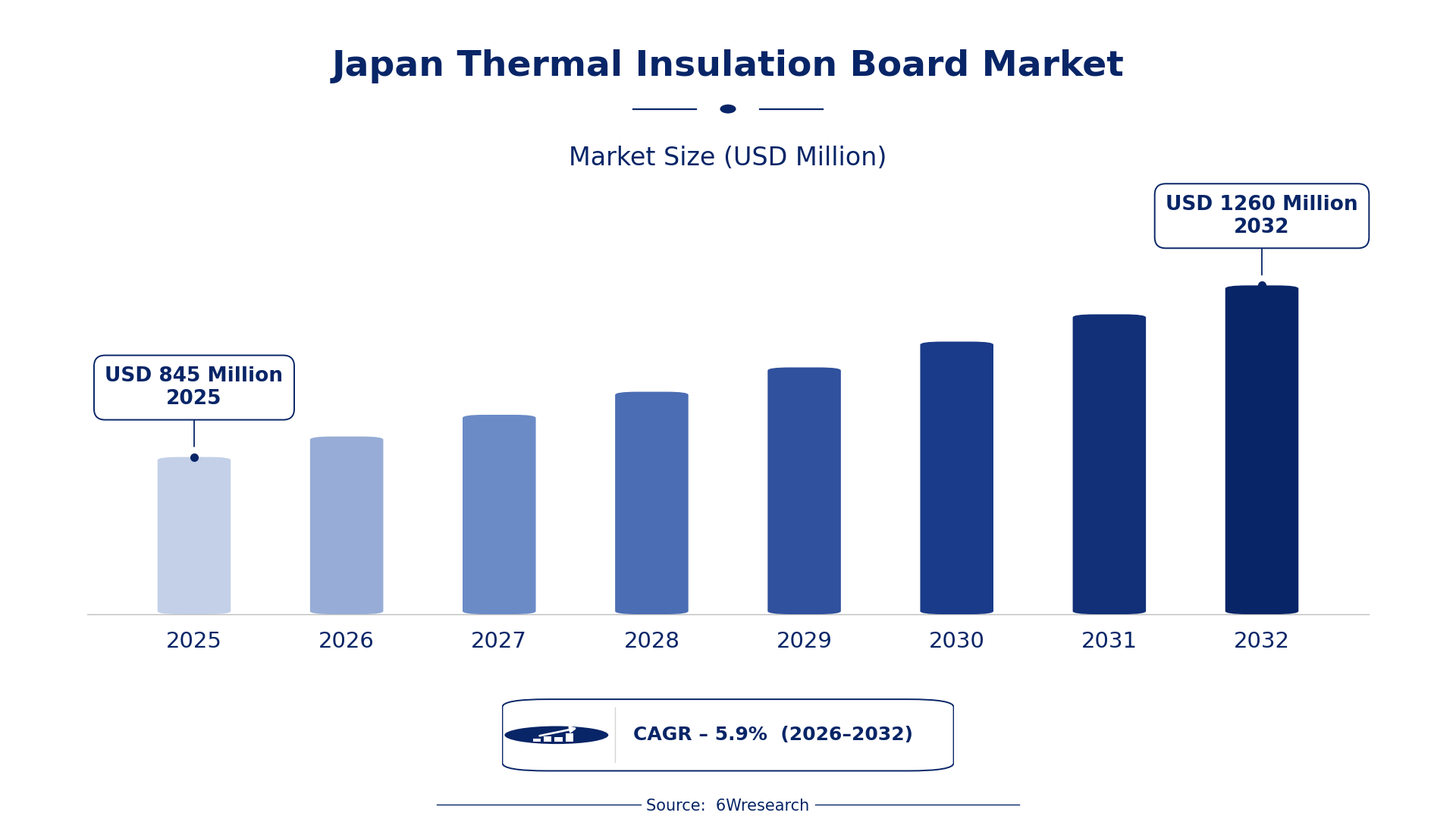
According to 6Wresearch internal database and industry insights, the Japan Thermal Insulation Board Market was valued at USD 845 Million in 2025 and is projected to reach USD 1,260 Million by 2032, growing at a CAGR of approximately 5.9% during 2026–2032.
Japan Thermal Insulation Board Market Highlights
| Report Metric | Details |
| Report Name | Japan Thermal Insulation Board Market (2026-2032) |
| Market Size 2025 | USD 845 Million |
| Market Size 2032 | USD 1,260 Million |
| Absolute Growth 2025–2032 | USD 415 Million |
| CAGR 2026–2032 | 5.9% |
| Peak Annual Growth | 6.7% in 2027 |
| Forecast Period | 2026–2032 |
| Historical Data | 2022–2025 |
| Base Year | 2025 |
| Leading Board Material Type, 2025 | Polyurethane Boards (45% share) |
| Leading Insulation Property, 2025 | High R-Value (39% share) |
| Leading Usage Zone, 2025 | Roofs/Walls (43% share) |
| Leading End User, 2025 | Builders (43% share) |
| Fastest-Growing Insulation Property | Fire Resistant (7.7% CAGR) |
| Fastest-Growing Usage Zone | Cold Storage (7.2% CAGR) |
| Fastest-Growing End User | Green Builders (8.0% CAGR) |
| Growing Sector | Green Builders |
| Key End Users | Builders, Commercial Installers, Infrastructure Firms, Green Builders |
Japan Thermal Insulation Board Market Year-wise Growth Rate and Key Drivers (2022–2032)
This graph illustrates the annual growth rates of the market from 2022 to 2032, highlighting a steady upward trajectory and projected market expansion over the forecast period.
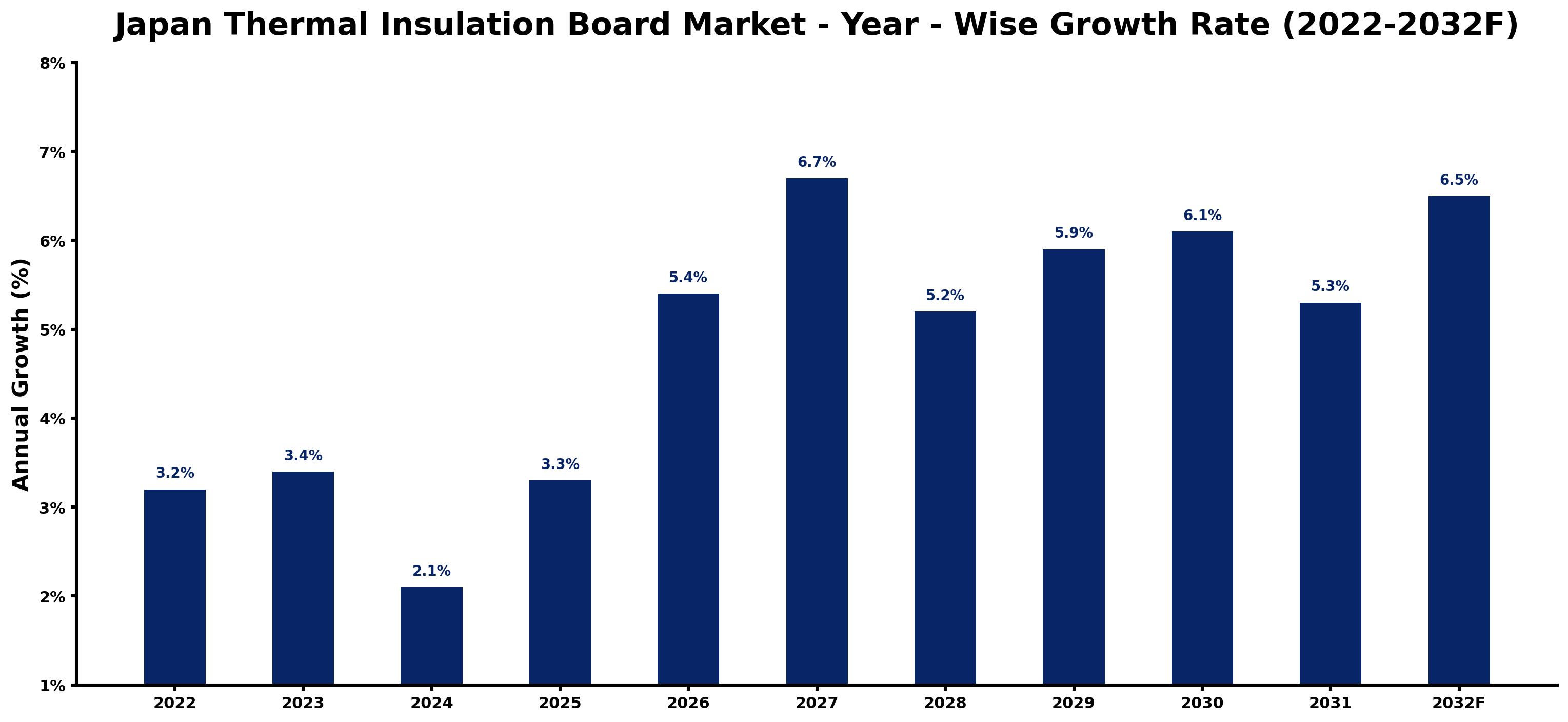
For each year, the table pairs the estimated growth rate with the leading influence on demand, showing how the drivers changed across the period.
| Year | Estimated Annual Growth (%) | Market Rationale |
| 2022 | 3.2 | The market experienced steady growth, driven by ongoing construction activities across Japan. |
| 2023 | 3.4 | Demand increased due to heightened investments in infrastructure following the Tokyo 2020 Olympics. |
| 2024 | 2.1 | A slowdown occurred as growth moderated after the previous year's surge in construction projects. |
| 2025 | 3.3 | Growth accelerated again as builders focused on energy-efficient solutions amid rising energy costs. |
| 2026 | 5.4 | The market expanded rapidly as the adoption of high-performance insulation materials gained momentum. |
| 2027 | 6.7 | Peak growth was achieved as demand surged for energy-efficient solutions in the construction sector. |
| 2028 | 5.2 | Growth slowed slightly as the market stabilised after reaching its peak in the previous year. |
| 2029 | 5.9 | Demand rose again as cold storage facilities increased their need for high-performance insulation. |
| 2030 | 6.1 | Growth continued with builders prioritising energy efficiency in response to regulatory changes. |
| 2031 | 5.3 | A slowdown was noted as the market adjusted to new compliance requirements and material standards. |
| 2032 | 6.5 | Demand is expected to rise as buyers seek insulation solutions that meet stricter energy efficiency standards. |
Note: Market size estimations and growth projections presented in this report are based on 6Wresearch's proprietary forecasting methodology, utilizing the latest available industry data, government publications, and primary research inputs.
Japan Thermal Insulation Board Market Synopsis
Thermal insulation boards are key materials designed to minimise heat transfer, primarily used in buildings, cold storage facilities, and industrial structures. The Japan Thermal Insulation Board Market is expanding due to substantial investments in the construction sector, valued at over 60 trillion yen, and rising demand for energy-efficient solutions. The Tokyo metropolitan area, accounting for 30% of construction activities, propels this growth, alongside government initiatives that promote energy efficiency in residential buildings. The average R-value of insulation boards used in Japan is around 5.0, reflecting the industry's commitment to high-performance materials.
Market Dynamics Impact Analysis (2026–2032)
| Factor | Type | Impact | Primary Segment Affected |
| Growing construction sector in Japan | Driver | High | Roofs/Walls |
| Rising demand for energy-efficient solutions | Driver | High | High R-Value |
| Increased focus on sustainable building practices | Opportunity | High | Green Builders |
| Expansion of cold storage facilities | Opportunity | Medium | Cold Storage |
| High installation costs of thermal insulation boards | Restraint | High | Polyurethane Boards |
| Stricter building codes demanding fire-resistant materials | Restraint | Medium | Fire Resistant |
| Supply chain disruptions affecting material availability | Challenge | High | Mineral Wool Boards |
| Increased competition among insulation material suppliers | Challenge | Medium | Fiberglass Boards |
Evaluation of Drivers in Japan Thermal Insulation Board Market (2026–2032)
The main growth drivers and the segments they affect most are set out below.
| Drivers | Primary Segment Affected | Why It Matters (Evidence) |
| Increased construction activities in urban areas | Roofs/Walls | The construction sector's value exceeds 60 trillion yen, prompting higher demand for insulation boards. |
| Government initiatives promoting energy efficiency | High R-Value | Support for energy-efficient building practices drives demand for high-performance insulation materials. |
| Growth in cold storage facilities | Cold Storage | The need for maintaining temperature in storage facilities boosts demand for high-performance insulation solutions. |
| Rising energy costs | Polyurethane Boards | Builders are increasingly opting for high R-value materials to reduce energy consumption in buildings. |
| Stricter regulations on building safety | Fire Resistant | The demand for fire-resistant insulation boards is increasing due to stricter building codes. |
Much of the new demand traces back to the construction sector, valued at over 60 trillion yen, which drives the need for thermal insulation boards. Increased investments in infrastructure following the Tokyo 2020 Olympics have resulted in heightened purchases of high R-value materials. Growth in cold storage facilities necessitates high-performance insulation solutions, further boosting demand. Rising energy costs compel builders to invest in polyurethane boards, improving energy efficiency in buildings.
Evaluation of Restraints in Japan Thermal Insulation Board Market
The key brakes on demand, and where they bite hardest, are shown below.
| Market Restraint | Primary Segment Affected | Why It Matters (Evidence) |
| High installation costs of thermal insulation boards | Polyurethane Boards | The average installation cost is around 1,200 yen per square meter, which can deter some buyers. |
| Stricter building codes requiring specific materials | Fire Resistant | Compliance with new regulations can increase project costs, affecting buyer decisions. |
| Supply chain disruptions impacting availability | Mineral Wool Boards | Material shortages can delay projects and increase costs for builders. |
| High competition among insulation suppliers | Fiberglass Boards | Intense competition can lead to price wars, affecting profit margins for suppliers. |
| Limited awareness of insulation benefits among some builders | Green Builders | This can slow the adoption of advanced insulation technologies. |
Japan Thermal Insulation Board Market Challenges
High installation costs for thermal insulation boards reach around 1,200 yen per square meter, which burdens producers and limits their competitiveness. Supply chain disruptions arise from reliance on specific materials, causing delays in project timelines for buyers in the construction sector. Technology adoption lags due to a lack of skilled workers, resulting in inefficient processes that can prolong production times for manufacturers. Regulatory changes, such as the JIS A 9501 standard, require constant updates to materials, creating compliance costs for suppliers and potentially delaying product availability for buyers.
Trends in the Japan Thermal Insulation Board Market
These developments are changing demand patterns in the Japan Thermal Insulation Board Market.
- Shift from Traditional to High R-Value Insulation: Since 2023, builders have increasingly favoured high R-value insulation boards to meet energy efficiency standards. The average R-value for insulation boards used in Japan is around 5.0, prompting suppliers to focus on these products.
- Growing Adoption of Fire-Resistant Materials: In 2023, stricter building codes have led to a rise in demand for fire-resistant insulation boards. This trend is clear in hospitals, where safety regulations necessitate such materials for compliance.
- Expansion of Cold Storage Facilities: The demand for cold storage solutions has surged since 2022, driven by the need for efficient temperature control. This has led to increased investments in high-performance insulation boards.
- Increased Focus on Sustainable Building Practices: The Green Building Council Japan has been promoting sustainable building practices, leading to a rise in demand for eco-friendly insulation materials. In 2023, 10 billion yen was allocated for energy efficiency initiatives.
Investment Opportunities in the Japan Thermal Insulation Board Market
The openings below show where demand in the Japan Thermal Insulation Board Market is visible and how suppliers can enter.
- Investment in Cold Storage Facilities: Cold storage facilities in Japan require high-performance insulation solutions, with demand increasing. Builders focusing on this sector can capitalise on the growing need for efficient insulation materials.
- Supply of High R-Value Insulation Boards: Builders are increasingly seeking high R-value insulation boards to comply with energy efficiency standards. Collaborating with construction firms in the Tokyo metropolitan area can provide access to this growing market.
- Expansion into Green Building Practices: With the Green Building Council Japan promoting sustainable practices, there is an opportunity to supply eco-friendly insulation materials. Engaging with green builders can facilitate entry into this segment.
- Partnerships for Compliance with Building Codes: Establishing partnerships with local firms can help navigate the regulatory environment for insulation materials. This is particularly relevant for fire-resistant boards, which are in high demand due to new regulations.
Government Initiatives in the Japan Thermal Insulation Board Market
The Building Energy Efficiency Act, amended in 2022, mandates that all new buildings meet energy standards from April 2025. This measure directly impacts buyers by requiring them to invest in high-performance insulation materials to comply with regulations, driving demand for thermal insulation boards.
In 2023, 10 billion yen was allocated for energy efficiency initiatives in buildings, administered by the Ministry of Land, Infrastructure, Transport and Tourism. This funding supports projects that improve insulation standards, benefiting both producers and buyers in the thermal insulation market.
Future Insight of the Japan Thermal Insulation Board Market
By 2032, buyers in the construction sector will increasingly demand high-performance insulation solutions to comply with stricter energy efficiency standards. Government energy efficiency initiatives will encourage suppliers to innovate and improve product offerings. Advanced manufacturing technologies will enhance production efficiency, reducing costs for suppliers and ensuring timely availability for buyers. The emphasis on sustainable building practices will drive the market towards insulation materials that align with environmental regulations and standards.
Market Segmentation Analysis
Japan Thermal Insulation Board Market report covers a detailed analysis of the following market segments:
By Board Material Type – Polyurethane Boards Lead and Record the Fastest Growth
According to Saurav Kr Singh, Senior Research Analyst at 6Wresearch, Polyurethane Boards accounted for 45% of the market by board material type in 2025. Polyurethane boards lead the market due to their high R-value, making them ideal for high-performance insulation applications in various construction projects. Their effectiveness in reducing heat transfer has established them as a preferred choice among builders in Japan. Its lead should widen, with a projected CAGR of 8.6% during 2026–2032, the highest in this split. The increasing emphasis on energy-efficient solutions, particularly in residential buildings, is driving the growth of polyurethane boards, especially following recent government initiatives. This trend will likely widen their lead as more projects seek to implement energy-saving measures. Suppliers should prioritise the production of polyurethane boards to capitalise on the growing demand for energy-efficient insulation solutions.
By Insulation Property – High R-Value Leads, Fire Resistant Expected to Grow Fastest
With 39% of insulation property revenue in 2025, High R-Value was the largest category. High R-value insulation boards are essential for energy-efficient building designs, making them a staple in the construction sector. Their effectiveness in reducing energy consumption has solidified their leading share in the market. Fire Resistant is set to record the highest CAGR in this split, 7.7% over 2026–2032. The fire-resistant insulation boards are gaining traction due to stricter building codes and safety regulations, which necessitate higher standards for construction materials. This trend indicates a growing market segment that suppliers should capitalise on. Buyers will increasingly prioritise fire-resistant options, prompting suppliers to adapt their offerings to meet these safety requirements.
By Usage Zone – Roofs/Walls Lead, Cold Storage Expected to Grow Fastest
The largest usage zone category in 2025 was Roofs/Walls, at 43% of revenue. Roofs and walls represent the primary application area for insulation boards, as they are critical for energy conservation in buildings. This widespread use in residential and commercial structures ensures a substantial market share for this segment. The quickest growth will come from Cold Storage, forecast to expand at a CAGR of 7.2% between 2026 and 2032. The cold storage segment is experiencing rapid growth, driven by the need for effective temperature control in storage facilities. As food safety and preservation become more critical, this segment's demand will likely continue to rise. Suppliers should consider expanding their product lines to cater to the growing needs of cold storage facilities.
By End User – Builders Lead, Green Builders Expected to Grow Fastest
Builders held 43% of the Japan Thermal Insulation Board Market by end user in 2025. Builders hold the largest share of the thermal insulation board market due to their essential role in various construction projects, including residential and commercial buildings. Their consistent demand for insulation solutions is evident, particularly in the Tokyo metropolitan area, which accounts for 30% of Japan's construction activities. Green Builders are projected to grow fastest, at a CAGR of 8.0% during 2026–2032. Green builders are experiencing rapid growth as they increasingly prioritise sustainable construction practices, spurred by government initiatives promoting energy efficiency in residential buildings. This shift is expected to further accelerate as more projects align with environmental standards. Suppliers must adapt their products to support the sustainability goals of green builders, ensuring they remain competitive in this growing segment.
Key Attractiveness of the Report
- 10 Years of Market Numbers
- Historical Data Starting from 2022 to 2025
- Base Year 2025
- Forecast Data until 2032
- Key Performance Indicators Impacting the Market
- Major Upcoming Developments and Projects
Key Highlights of the Report:
- Japan Thermal Insulation Board Market Outlook
- Market Size of Japan Thermal Insulation Board Market, 2025
- Forecast of Japan Thermal Insulation Board Market, 2032
- Historical Data and Forecast of Japan Thermal Insulation Board Revenues & Volume for the Period 2022-2032F
- Japan Thermal Insulation Board Market Trend Evolution
- Japan Thermal Insulation Board Market Drivers and Challenges
- Japan Thermal Insulation Board Price Trends
- Japan Thermal Insulation Board Porter's Five Forces
- Japan Thermal Insulation Board Industry Life Cycle
- Historical Data and Forecast of Japan Thermal Insulation Board Market Revenues & Volume By Board Material Type for the Period 2022-2032F
- Historical Data and Forecast of Japan Thermal Insulation Board Market Revenues & Volume By XPS (Extruded Polystyrene) for the Period 2022-2032F
- Historical Data and Forecast of Japan Thermal Insulation Board Market Revenues & Volume By Polyurethane Boards for the Period 2022-2032F
- Historical Data and Forecast of Japan Thermal Insulation Board Market Revenues & Volume By Fiberglass Boards for the Period 2022-2032F
- Historical Data and Forecast of Japan Thermal Insulation Board Market Revenues & Volume By Mineral Wool Boards for the Period 2022-2032F
- Historical Data and Forecast of Japan Thermal Insulation Board Market Revenues & Volume By Insulation Property for the Period 2022-2032F
- Historical Data and Forecast of Japan Thermal Insulation Board Market Revenues & Volume By High R-Value for the Period 2022-2032F
- Historical Data and Forecast of Japan Thermal Insulation Board Market Revenues & Volume By Moisture Resistant for the Period 2022-2032F
- Historical Data and Forecast of Japan Thermal Insulation Board Market Revenues & Volume By Fire Resistant for the Period 2022-2032F
- Historical Data and Forecast of Japan Thermal Insulation Board Market Revenues & Volume By Acoustic + Thermal for the Period 2022-2032F
- Historical Data and Forecast of Japan Thermal Insulation Board Market Revenues & Volume By Usage Zone for the Period 2022-2032F
- Historical Data and Forecast of Japan Thermal Insulation Board Market Revenues & Volume By Roofs/Walls for the Period 2022-2032F
- Historical Data and Forecast of Japan Thermal Insulation Board Market Revenues & Volume By Cold Storage for the Period 2022-2032F
- Historical Data and Forecast of Japan Thermal Insulation Board Market Revenues & Volume By Industrial Structures for the Period 2022-2032F
- Historical Data and Forecast of Japan Thermal Insulation Board Market Revenues & Volume By Apartment Walls for the Period 2022-2032F
- Historical Data and Forecast of Japan Thermal Insulation Board Market Revenues & Volume By End User for the Period 2022-2032F
- Historical Data and Forecast of Japan Thermal Insulation Board Market Revenues & Volume By Builders for the Period 2022-2032F
- Historical Data and Forecast of Japan Thermal Insulation Board Market Revenues & Volume By Commercial Installers for the Period 2022-2032F
- Historical Data and Forecast of Japan Thermal Insulation Board Market Revenues & Volume By Infrastructure Firms for the Period 2022-2032F
- Historical Data and Forecast of Japan Thermal Insulation Board Market Revenues & Volume By Green Builders for the Period 2022-2032F
- Japan Thermal Insulation Board Import Export Trade Statistics
- Market Opportunity Assessment By Board Material Type
- Market Opportunity Assessment By Insulation Property
- Market Opportunity Assessment By Usage Zone
- Market Opportunity Assessment By End User
- Japan Thermal Insulation Board Top Companies Market Share
- Japan Thermal Insulation Board Competitive Benchmarking By Technical and Operational Parameters
- Japan Thermal Insulation Board Company Profiles
- Japan Thermal Insulation Board Key Strategic Recommendations
Market Covered
Segments analysed in this report are listed below.
By Board Material Type
- XPS (Extruded Polystyrene)
- Polyurethane Boards
- Fiberglass Boards
- Mineral Wool Boards
By Insulation Property
- High R-Value
- Moisture Resistant
- Fire Resistant
- Acoustic + Thermal
By Usage Zone
- Roofs/Walls
- Cold Storage
- Industrial Structures
- Apartment Walls
By End User
- Builders
- Commercial Installers
- Infrastructure Firms
- Green Builders































