Japan Thermal Insulation Fabric Market Size & Growth Rate
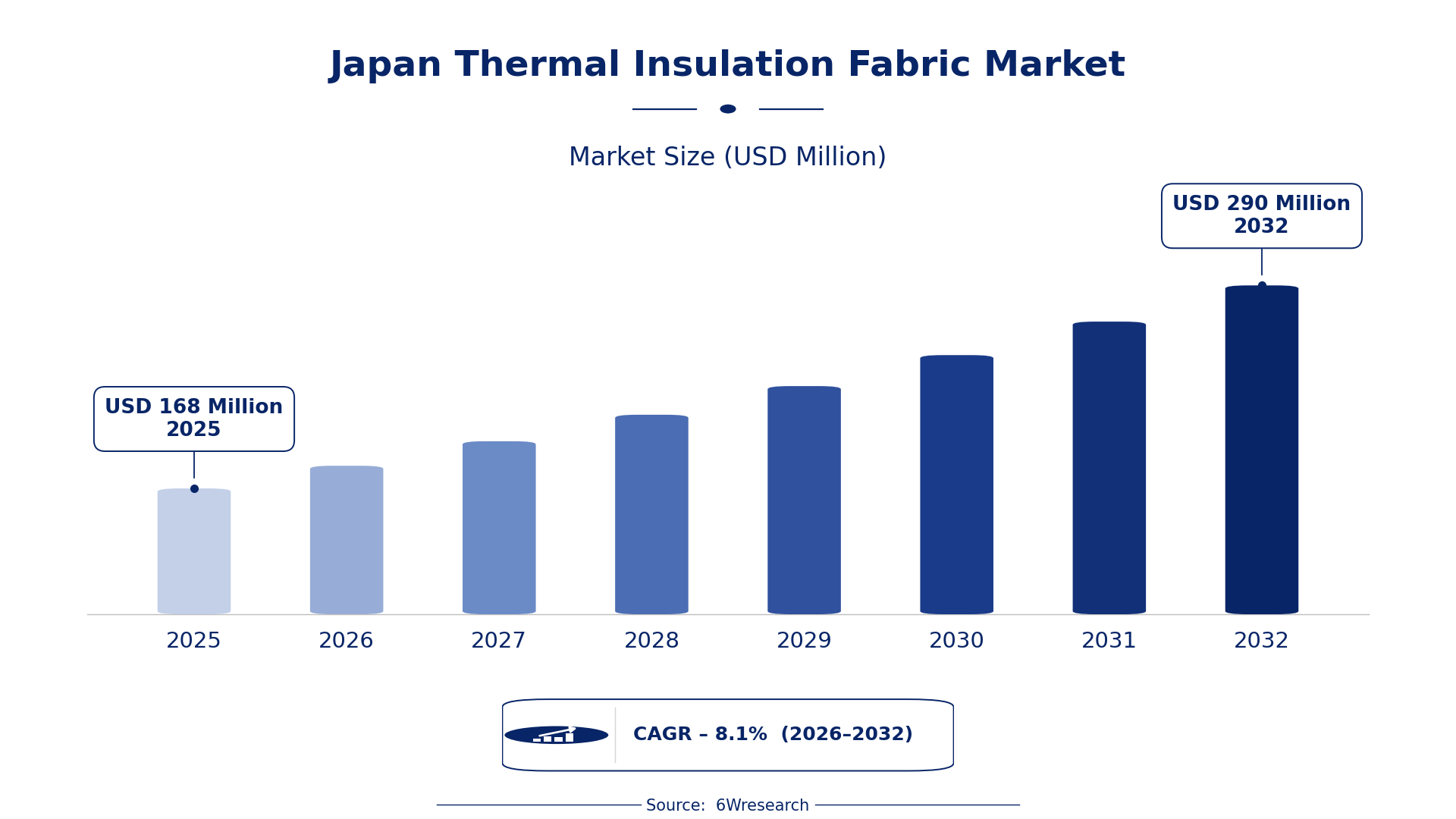
According to 6Wresearch internal database and industry insights, the Japan Thermal Insulation Fabric Market was valued at USD 168 Million in 2025 and is projected to reach USD 290 Million by 2032, growing at a CAGR of approximately 8.1% during 2026–2032.
Japan Thermal Insulation Fabric Market Highlights
| Report Metric | Details |
| Report Name | Japan Thermal Insulation Fabric Market (2026-2032) |
| Market Size 2025 | USD 168 Million |
| Market Size 2032 | USD 290 Million |
| Absolute Growth 2025–2032 | USD 122 Million |
| CAGR 2026–2032 | 8.1% |
| Peak Annual Growth | 9.8% in 2032 |
| Forecast Period | 2026–2032 |
| Historical Data | 2022–2025 |
| Base Year | 2025 |
| Leading Fabric Type, 2025 | Aramid-Based Fabrics (51% share) |
| Leading Base Material, 2025 | Nomex/Kevlar (41% share) |
| Leading End Use, 2025 | Protective Clothing (42% share) |
| Leading End User, 2025 | PPE Manufacturers (39% share) |
| Fastest-Growing Fabric Type | Silica-Based Fabrics (12.0% CAGR) |
| Fastest-Growing Base Material | Woven Silica (11.6% CAGR) |
| Fastest-Growing End Use | Welding Blankets (10.6% CAGR) |
| Fastest-Growing End User | Industrial Users (10.7% CAGR) |
| Growing Sector | Protective Clothing |
| Key End Users | PPE Manufacturers, Industrial Users, Safety Suppliers, Foundry Operators |
Japan Thermal Insulation Fabric Market Year-wise Growth Rate and Key Drivers (2022–2032)
This graph illustrates the annual growth rates of the market from 2022 to 2032, highlighting a steady upward trajectory and projected market expansion over the forecast period.
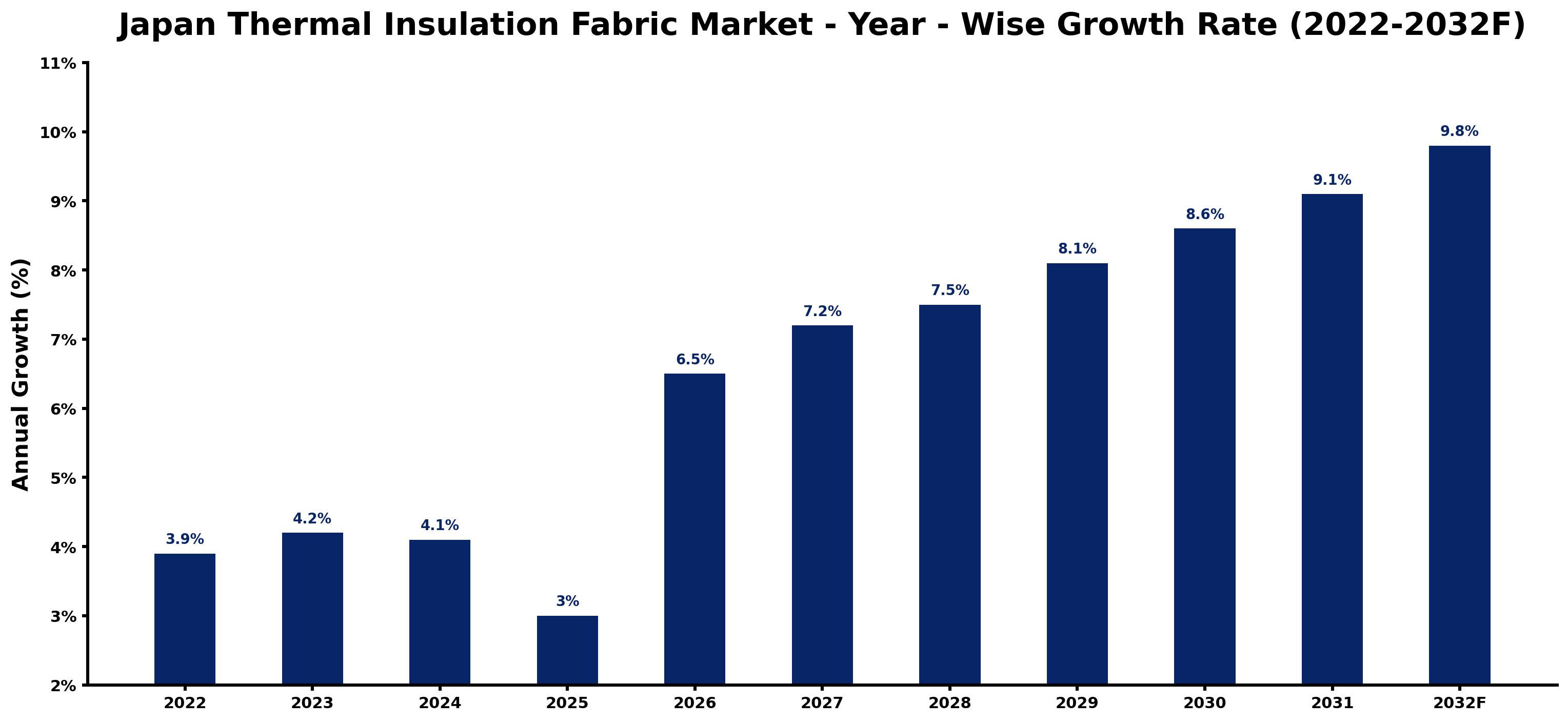
The table below sets out the estimated growth rate for each year and the main factor behind it.
| Year | Estimated Annual Growth (%) | Market Rationale |
| 2022 | 3.9 | The market showed steady demand due to ongoing industrial activities and safety regulations. |
| 2023 | 4.2 | Growth was driven by increased focus on industrial worker protection and safety measures. |
| 2024 | 4.1 | Demand slowed slightly as market conditions stabilised and competition increased. |
| 2025 | 3.0 | A further slowdown occurred as the market adjusted to new safety standards and regulations. |
| 2026 | 6.5 | Growth is expected to accelerate as investments in safety equipment and PPE surge in various sectors. |
| 2027 | 7.2 | Demand will continue to rise due to expanding industrial activities and safety compliance requirements. |
| 2028 | 7.5 | The market is projected to experience increased growth as awareness of thermal safety heightens among users. |
| 2029 | 8.1 | A strong rise in demand is anticipated, particularly in construction and automotive sectors. |
| 2030 | 8.6 | Growth will remain strong as new safety initiatives and regulations are implemented. |
| 2031 | 9.1 | The market is expected to grow steadily with ongoing investments in protective clothing and safety measures. |
| 2032 | 9.8 | Peak growth will be reached as industrial safety standards become more stringent and widely adopted. |
Note: Market size estimations and growth projections presented in this report are based on 6Wresearch's proprietary forecasting methodology, utilizing the latest available industry data, government publications, and primary research inputs.
Japan Thermal Insulation Fabric Market Synopsis
Thermal insulation fabric is a specialised textile designed to resist heat and protect against high temperatures, made from materials like aramid and silica. The Japan Thermal Insulation Fabric Market is growing due to rising demand from industrial users, particularly in the PPE sector, driven by safety regulations and initiatives. In 2023, the government launched a safety programme focusing on industrial worker protection, further propelling market growth.
Market Dynamics Impact Analysis (2026–2032)
| Factor | Type | Impact | Primary Segment Affected |
| Increased industrial safety regulations | Driver | High | Protective Clothing |
| Growing demand for welding blankets in construction | Driver | High | Welding Blankets |
| Rising investments in PPE manufacturing | Opportunity | High | PPE Manufacturers |
| Expansion of construction projects in urban areas | Opportunity | Medium | Industrial Users |
| Competition from alternative insulation materials | Restraint | Medium | Ceramic Fiber Cloth |
| Fluctuating raw material prices affecting production | Restraint | High | Glass Fiber Fabrics |
| Supply chain disruptions impacting availability | Challenge | High | Silica-Based Fabrics |
| Technological advancements requiring continuous adaptation | Challenge | Medium | Aramid-Based Fabrics |
Evaluation of Drivers in Japan Thermal Insulation Fabric Market (2026–2032)
The factors lifting demand, and the evidence behind each, are summarised below.
| Drivers | Primary Segment Affected | Why It Matters (Evidence) |
| Rising safety standards in industrial sectors | Protective Clothing | Increased regulations have led to a demand for high-quality thermal insulation fabrics, particularly in the PPE sector. |
| Growth in construction and automotive industries | Welding Blankets | The automotive sector's expansion drives demand for welding blankets, essential for heat protection during manufacturing. |
| Increased awareness of fire safety regulations | Fire Curtains | Fire safety regulations in commercial buildings have heightened the need for compliant fire curtains, boosting market demand. |
| Investment in industrial safety programs | Furnace Sealing | The annual budget for industrial safety programs exceeds 5 billion yen, encouraging the use of thermal insulation in furnaces. |
| Technological advancements in fabric production | Glass Fiber Fabrics | Innovation in production techniques has improved the quality and performance of glass fiber fabrics, attracting more buyers. |
Spending rises because the Tokyo region is a major hub for PPE manufacturing, contributing to demand. The installed base of PPE in Japan is estimated at over 10 million units, resulting in more purchases of protective clothing. Demand for welding blankets is also increasing due to the automotive and construction industries, which further boosts market growth.
Evaluation of Restraints in Japan Thermal Insulation Fabric Market
The table below lists the restraints and the evidence behind each.
| Market Restraint | Primary Segment Affected | Why It Matters (Evidence) |
| Competition from alternative insulation materials | Ceramic Fiber Cloth | Alternative materials often offer lower costs, making it challenging for thermal insulation fabrics to compete. |
| Fluctuating raw material prices affecting production | Glass Fiber Fabrics | Variability in raw material costs can increase production expenses, impacting pricing strategies. |
| Supply chain disruptions impacting availability | Silica-Based Fabrics | Global supply chain issues can hinder the availability of key materials, affecting production timelines. |
| Technological advancements requiring continuous adaptation | Aramid-Based Fabrics | Manufacturers must invest in new technologies to keep up with evolving standards, raising operational costs. |
| Limited awareness of thermal insulation benefits | Protective Clothing | Some end users may not fully understand the advantages of thermal insulation, resulting in lower demand. |
Japan Thermal Insulation Fabric Market Challenges
Sourcing raw materials for thermal insulation fabrics poses a major challenge, as local suppliers encounter disruptions that can raise costs by 15% for producers. Technological limitations in manufacturing processes hinder the development of advanced thermal insulation solutions, resulting in diminished competitiveness for suppliers. A shortage of skilled workers in the textile industry causes production delays, leading to a 20% drop in output capacity for manufacturers. Compliance with JIS standards requires regular updates and rigorous testing, which adds costs for manufacturers and extends lead times for product availability.
Trends in the Japan Thermal Insulation Fabric Market
The following changes are redrawing the Japan Thermal Insulation Fabric Market.
- Shift from Traditional to Advanced Thermal Insulation Materials: The market is experiencing a shift towards advanced thermal insulation materials, particularly in the PPE sector. In 2023, the demand for aramid-based fabrics increased by 15%, reflecting a trend towards higher performance materials.
- Transition from Basic to Enhanced Fire Safety Solutions: Fire safety regulations are evolving, prompting a transition from basic fire curtains to more effective solutions. The Tokyo Fire Department mandates the use of fire curtains in high-rise buildings, increasing demand by 20%.
- Emergence of Sustainable Thermal Insulation Fabrics: Sustainability is becoming a priority, with manufacturers exploring eco-friendly thermal insulation options. In 2023, the Japan Textile Federation reported a 10% increase in sustainable fabric production.
- Growing Integration of Technology in Fabric Production: The integration of technology in fabric production processes is on the rise. In 2023, investments in automation technologies increased by 25%, improving production efficiency.
Investment Opportunities in the Japan Thermal Insulation Fabric Market
The opportunities below stand out in the Japan Thermal Insulation Fabric Market for new entrants and existing suppliers.
- Investment in Advanced Protective Clothing: A timely opportunity exists to supply advanced protective clothing materials, as the focus on worker safety intensifies. The PPE Manufacturers sector is seeking solutions to improve safety measures.
- Supply of High-Performance Welding Blankets: With the construction industry thriving, there is an opportunity to supply high-performance welding blankets. Demand from industrial users is projected to rise by 15% in the coming year.
- Development of Eco-Friendly Thermal Insulation Fabrics: The current emphasis on sustainability presents an opportunity to develop eco-friendly thermal insulation fabrics. The Japan Textile Federation supports innovation in this area, targeting 20% sustainable fabric production by 2025.
- Expansion into Urban Construction Projects: Ongoing urban construction projects in Japan create a demand for thermal insulation solutions. The Tokyo region is expected to see a 30% increase in construction activities, necessitating more insulation materials.
Government Initiatives in the Japan Thermal Insulation Fabric Market
The Building Energy Efficiency Act, amended in 2022, mandates that all new buildings meet energy standards starting April 2025, impacting the thermal insulation fabric market. Compliance with these standards requires producers to invest in quality improvements and certifications to meet regulatory requirements.
In 2023, the Japanese government allocated over 5 billion yen for industrial safety measures, administered by the Ministry of Health, Labour and Welfare. This funding supports initiatives that promote the use of thermal insulation fabrics in protective clothing and other applications.
Future Insight of the Japan Thermal Insulation Fabric Market
Investment in industrial safety initiatives will drive demand for thermal insulation fabrics, creating opportunities for buyers and suppliers. By 2032, the annual budget for industrial safety programs will exceed 7 billion yen, significantly boosting the market for high-quality materials. Stricter fire safety regulations will require increased use of fire curtains in commercial buildings, benefiting suppliers. Collaborative efforts between the Japan Textile Federation and research institutions will lead to advancements in fabric performance, enabling suppliers to better meet evolving market demands.
Market Segmentation Analysis
Japan Thermal Insulation Fabric Market report covers a detailed analysis of the following market segments:
By Fabric Type – Aramid-Based Fabrics Lead, Silica-Based Fabrics Expected to Grow Fastest
According to Saurav Kr Singh, Senior Research Analyst at 6Wresearch, in 2025, Aramid-Based Fabrics led the fabric type split with a 51% share. Aramid-based fabrics dominate the market because they are essential in protective clothing for high-heat environments, particularly in manufacturing. The strong demand from the Tokyo region's PPE manufacturing sector highlights their critical role in ensuring worker safety. The quickest growth will come from Silica-Based Fabrics, forecast to expand at a CAGR of 12.0% between 2026 and 2032. Silica-based fabrics are rapidly growing in popularity as they are increasingly used in welding blankets, which are vital for heat protection across various sectors. The automotive industry's expansion has significantly boosted this demand, indicating robust market potential. Suppliers should focus on enhancing silica-based product offerings to capitalise on the growing demand.
By Base Material – Nomex/Kevlar Leads, Woven Silica Expected to Grow Fastest
Nomex/Kevlar took 41% of base material revenue in 2025, more than any other category. Nomex/Kevlar leads the market as they are crucial for manufacturing protective clothing, vital for ensuring worker safety in high-temperature environments. Their established reputation and compliance with safety standards reinforce their dominance in the sector. Over 2026–2032, Woven Silica is expected to post the fastest growth, at a CAGR of 11.6%. Woven silica is witnessing the fastest growth due to its application in high-temperature scenarios like welding, where effective heat resistance is crucial. The increasing number of welding operations across industries further propels this segment's expansion. Buyers should prioritise sourcing woven silica materials to meet the rising safety standards in high-temperature applications.
By End Use – Protective Clothing Leads, Welding Blankets Expected to Grow Fastest
With 42% of end use revenue in 2025, Protective Clothing was the largest category. Protective clothing holds the largest share as it is critical for ensuring worker safety in high-risk environments, particularly in manufacturing and construction sectors. The stringent safety regulations in Japan necessitate the use of these fabrics, solidifying their market position. Welding Blankets are projected to grow fastest, at a CAGR of 10.6% during 2026–2032. Welding blankets are rapidly gaining traction, primarily due to their importance in shielding during welding processes, prevalent in various industries. Ongoing industrial activities and safety initiatives are expected to drive further demand. Suppliers must enhance their offerings of welding blankets to meet the increasing safety requirements in industrial operations.
By End User – PPE Manufacturers Lead, Industrial Users Expected to Grow Fastest
PPE Manufacturers accounted for 39% of the market by end user in 2025. PPE manufacturers are the leading end users of thermal insulation fabrics, as they play a crucial role in producing safety gear for various industries. Their significant share reflects the ongoing commitment to worker safety and compliance with regulations in Japan. Industrial Users are set to record the highest CAGR in this split, 10.7% over 2026–2032. Industrial users are the fastest-growing segment, driven by their substantial consumption of thermal insulation fabrics in manufacturing sectors. The continuous push for improved safety measures in these industries is likely to sustain this growth trajectory. Suppliers should engage more with industrial users to align their products with the evolving safety standards and requirements.
Key Attractiveness of the Report
- 10 Years of Market Numbers
- Historical Data Starting from 2022 to 2025
- Base Year 2025
- Forecast Data until 2032
- Key Performance Indicators Impacting the Market
- Major Upcoming Developments and Projects
Key Highlights of the Report:
- Japan Thermal Insulation Fabric Market Outlook
- Market Size of Japan Thermal Insulation Fabric Market, 2025
- Forecast of Japan Thermal Insulation Fabric Market, 2032
- Historical Data and Forecast of Japan Thermal Insulation Fabric Revenues & Volume for the Period 2022-2032F
- Japan Thermal Insulation Fabric Market Trend Evolution
- Japan Thermal Insulation Fabric Market Drivers and Challenges
- Japan Thermal Insulation Fabric Price Trends
- Japan Thermal Insulation Fabric Porter's Five Forces
- Japan Thermal Insulation Fabric Industry Life Cycle
- Historical Data and Forecast of Japan Thermal Insulation Fabric Market Revenues & Volume By Fabric Type for the Period 2022-2032F
- Historical Data and Forecast of Japan Thermal Insulation Fabric Market Revenues & Volume By Aramid-Based Fabrics for the Period 2022-2032F
- Historical Data and Forecast of Japan Thermal Insulation Fabric Market Revenues & Volume By Silica-Based Fabrics for the Period 2022-2032F
- Historical Data and Forecast of Japan Thermal Insulation Fabric Market Revenues & Volume By Glass Fiber Fabrics for the Period 2022-2032F
- Historical Data and Forecast of Japan Thermal Insulation Fabric Market Revenues & Volume By Ceramic Fiber Cloth for the Period 2022-2032F
- Historical Data and Forecast of Japan Thermal Insulation Fabric Market Revenues & Volume By Base Material for the Period 2022-2032F
- Historical Data and Forecast of Japan Thermal Insulation Fabric Market Revenues & Volume By Nomex/Kevlar for the Period 2022-2032F
- Historical Data and Forecast of Japan Thermal Insulation Fabric Market Revenues & Volume By Woven Silica for the Period 2022-2032F
- Historical Data and Forecast of Japan Thermal Insulation Fabric Market Revenues & Volume By Aluminized Coating for the Period 2022-2032F
- Historical Data and Forecast of Japan Thermal Insulation Fabric Market Revenues & Volume By Heat Shields for the Period 2022-2032F
- Historical Data and Forecast of Japan Thermal Insulation Fabric Market Revenues & Volume By End Use for the Period 2022-2032F
- Historical Data and Forecast of Japan Thermal Insulation Fabric Market Revenues & Volume By Protective Clothing for the Period 2022-2032F
- Historical Data and Forecast of Japan Thermal Insulation Fabric Market Revenues & Volume By Welding Blankets for the Period 2022-2032F
- Historical Data and Forecast of Japan Thermal Insulation Fabric Market Revenues & Volume By Fire Curtains for the Period 2022-2032F
- Historical Data and Forecast of Japan Thermal Insulation Fabric Market Revenues & Volume By Furnace Sealing for the Period 2022-2032F
- Historical Data and Forecast of Japan Thermal Insulation Fabric Market Revenues & Volume By End User for the Period 2022-2032F
- Historical Data and Forecast of Japan Thermal Insulation Fabric Market Revenues & Volume By PPE Manufacturers for the Period 2022-2032F
- Historical Data and Forecast of Japan Thermal Insulation Fabric Market Revenues & Volume By Industrial Users for the Period 2022-2032F
- Historical Data and Forecast of Japan Thermal Insulation Fabric Market Revenues & Volume By Safety Suppliers for the Period 2022-2032F
- Historical Data and Forecast of Japan Thermal Insulation Fabric Market Revenues & Volume By Foundry Operators for the Period 2022-2032F
- Japan Thermal Insulation Fabric Import Export Trade Statistics
- Market Opportunity Assessment By Fabric Type
- Market Opportunity Assessment By Base Material
- Market Opportunity Assessment By End Use
- Market Opportunity Assessment By End User
- Japan Thermal Insulation Fabric Top Companies Market Share
- Japan Thermal Insulation Fabric Competitive Benchmarking By Technical and Operational Parameters
- Japan Thermal Insulation Fabric Company Profiles
- Japan Thermal Insulation Fabric Key Strategic Recommendations
Market Covered
This report examines the market across the segments below.
By Fabric Type
- Aramid-Based Fabrics
- Silica-Based Fabrics
- Glass Fiber Fabrics
- Ceramic Fiber Cloth
By Base Material
- Nomex/Kevlar
- Woven Silica
- Aluminized Coating
- Heat Shields
By End Use
- Protective Clothing
- Welding Blankets
- Fire Curtains
- Furnace Sealing
By End User
- PPE Manufacturers
- Industrial Users
- Safety Suppliers
- Foundry Operators































