Japan Thermal Management Control Unit Market Size & Growth Rate
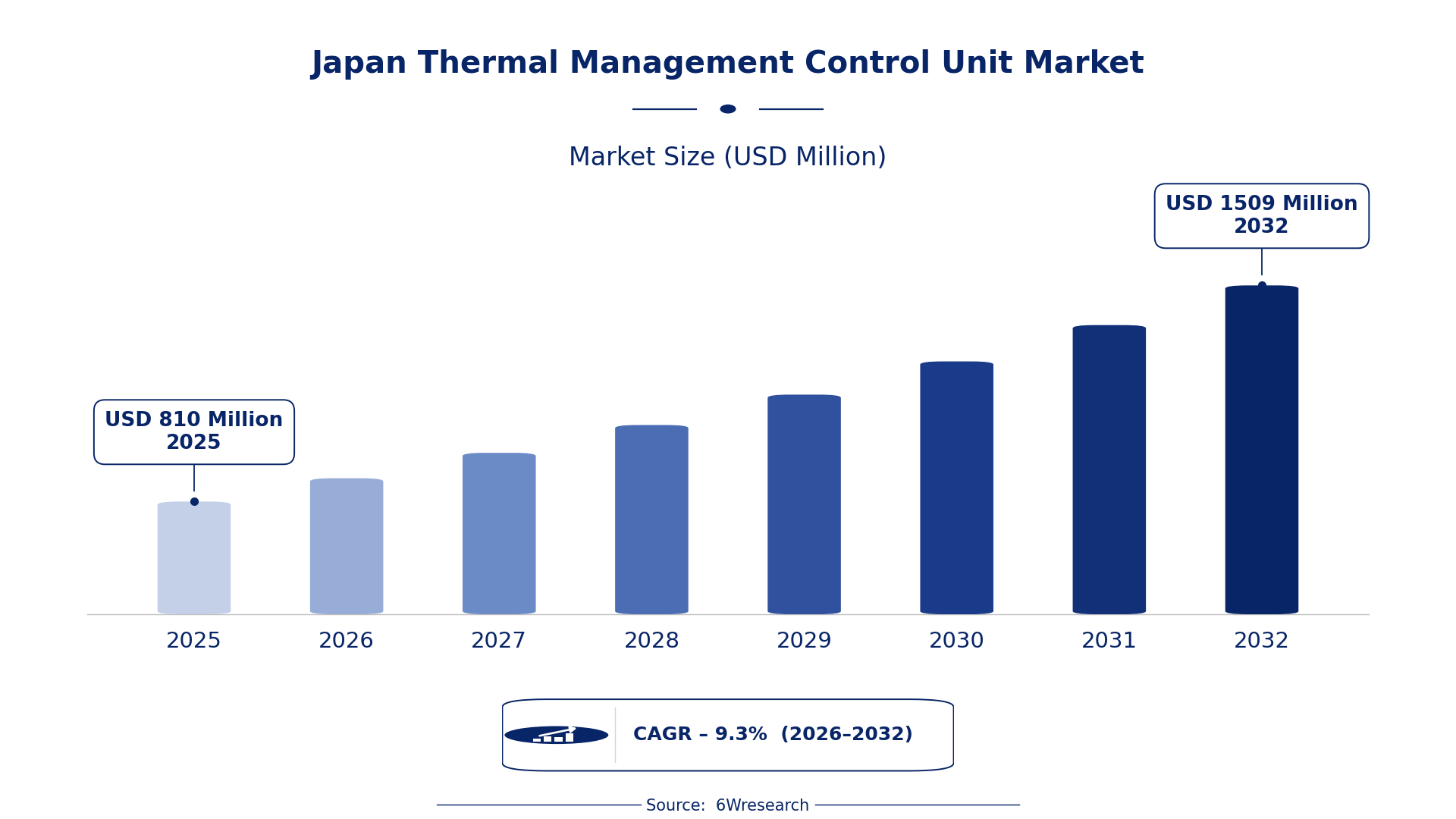
According to 6Wresearch internal database and industry insights, the Japan Thermal Management Control Unit Market was valued at USD 810 Million in 2025 and is projected to reach USD 1,509 Million by 2032, growing at a CAGR of approximately 9.3% during 2026–2032.
Japan Thermal Management Control Unit Market Highlights
| Report Metric | Details |
| Report Name | Japan Thermal Management Control Unit Market (2026-2032) |
| Market Size 2025 | USD 810 Million |
| Market Size 2032 | USD 1,509 Million |
| Absolute Growth 2025–2032 | USD 699 Million |
| CAGR 2026–2032 | 9.3% |
| Peak Annual Growth | 10.2% in 2032 |
| Forecast Period | 2026–2032 |
| Historical Data | 2022–2025 |
| Base Year | 2025 |
| Leading Thermal Management Control Unit, 2025 | Engine Heat Management (45% share) |
| Leading Product Type, 2025 | Thermostat Units (43% share) |
| Leading Control Method, 2025 | On-Board Control (46% share) |
| Leading Distribution Channel, 2025 | OEM Suppliers (43% share) |
| Leading End User Industry, 2025 | Passenger Vehicles (43% share) |
| Fastest-Growing Thermal Management Control Unit | HVAC Climate Control (12.8% CAGR) |
| Fastest-Growing Product Type | Climate Units (13.0% CAGR) |
| Fastest-Growing Control Method | Electro-Thermal (13.3% CAGR) |
| Fastest-Growing Distribution Channel | Aftermarket Dealers (11.7% CAGR) |
| Fastest-Growing End User Industry | Commercial Vehicles (12.9% CAGR) |
| Growing Sector | Commercial Vehicles |
| Key End Users | Passenger Vehicles, Commercial Vehicles, EV Manufacturers, Server/Data Centers |
Japan Thermal Management Control Unit Market Year-wise Growth Rate and Key Drivers (2022–2032)
This graph illustrates the annual growth rates of the market from 2022 to 2032, highlighting a steady upward trajectory and projected market expansion over the forecast period.
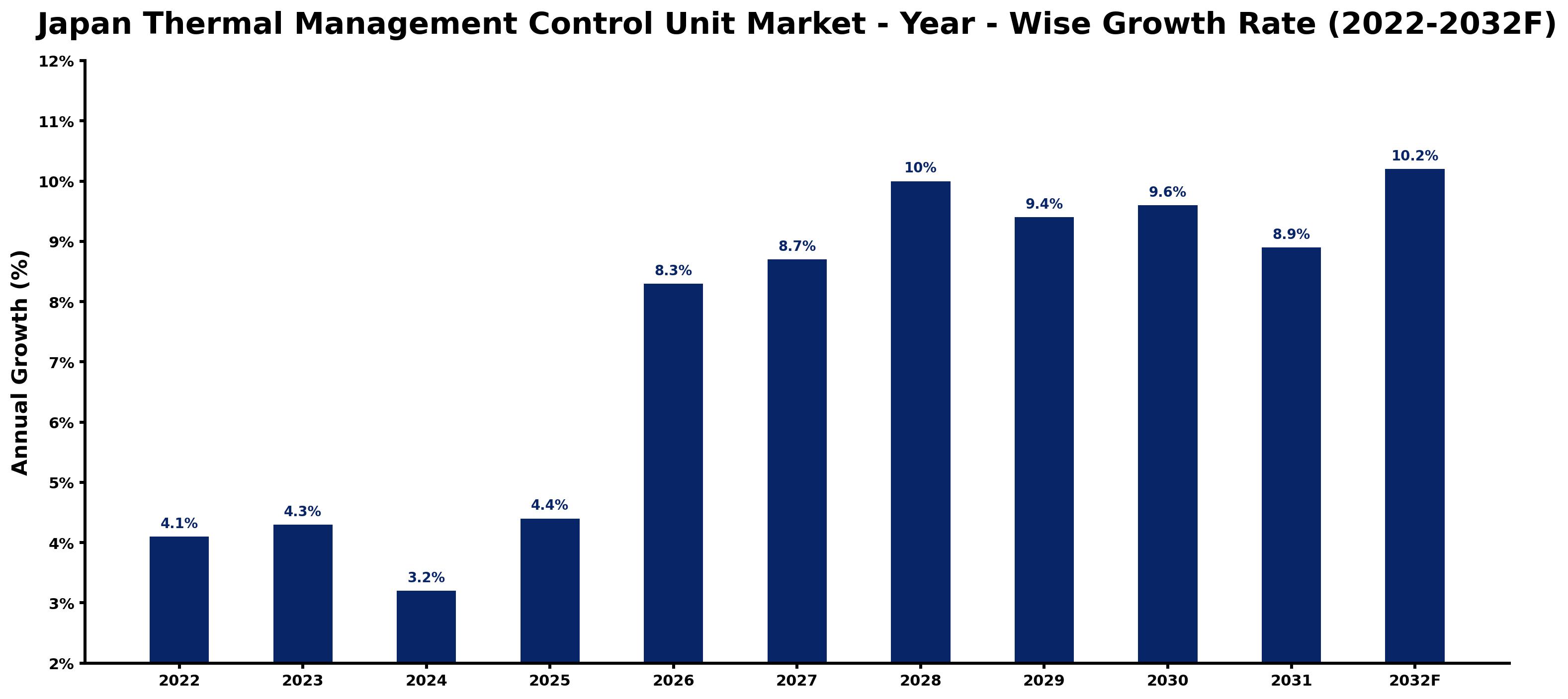
For each year, the table pairs the estimated growth rate with the leading influence on demand, showing how the drivers changed across the period.
| Year | Estimated Annual Growth (%) | Market Rationale |
| 2022 | 4.1 | The market showed steady growth with increasing demand from the automotive sector. |
| 2023 | 4.3 | Growth accelerated due to rising production in Japan's automotive industry. |
| 2024 | 3.2 | The market experienced a slowdown as demand stabilised after previous growth. |
| 2025 | 4.4 | Growth picked up again, driven by advancements in thermal management technologies. |
| 2026 | 8.3 | The market will grow faster as electric vehicle adoption increases. |
| 2027 | 8.7 | Demand is projected to rise further with improved thermal management solutions. |
| 2028 | 10.0 | Growth is anticipated to peak as infrastructure for EVs expands. |
| 2029 | 9.4 | A slowdown is expected as the market begins to stabilise after rapid growth. |
| 2030 | 9.6 | Growth is likely to rise again with new automotive technologies emerging. |
| 2031 | 8.9 | The market is projected to slow as it approaches maturity in certain segments. |
| 2032 | 10.2 | Growth is expected to peak, driven by innovations in thermal management. |
Note: Market size estimations and growth projections presented in this report are based on 6Wresearch's proprietary forecasting methodology, utilizing the latest available industry data, government publications, and primary research inputs.
Japan Thermal Management Control Unit Market Synopsis
Thermal Management Control Units regulate temperature in applications such as automotive and data centres, utilising advanced sensors and control algorithms. In Japan, the automotive sector produced 8 million vehicles in 2022, which has driven demand for these units. The Japan Thermal Management Control Unit Market is expanding due to increased production in the automotive industry, the growth of electric vehicles, and government initiatives promoting energy efficiency, leading to higher investments in thermal management solutions.
Market Dynamics Impact Analysis (2026–2032)
| Factor | Type | Impact | Primary Segment Affected |
| Growing automotive production and electric vehicle adoption | Driver | High | Engine Heat Management |
| Rising demand for energy-efficient HVAC systems | Driver | High | HVAC Climate Control |
| Increasing need for battery thermal management in EVs | Opportunity | High | Battery Thermal Control |
| Expansion of data centers requiring reliable cooling solutions | Opportunity | High | Data Center Cooling Units |
| High costs associated with advanced thermal management technologies | Restraint | Medium | Engine Heat Management |
| Limited awareness of thermal management benefits among smaller manufacturers | Restraint | Medium | Engine Heat Management |
| Supply chain disruptions affecting component availability | Challenge | High | Engine Heat Management |
| Intense competition among manufacturers leading to price pressures | Challenge | High | Engine Heat Management |
Evaluation of Drivers in Japan Thermal Management Control Unit Market (2026–2032)
Key forces behind demand, with the segment each one moves most, are listed below.
| Drivers | Primary Segment Affected | Why It Matters (Evidence) |
| Increased automotive production | Engine Heat Management | Japan's automotive sector produced 8 million vehicles in 2022, driving demand for thermal management units. |
| Growing electric vehicle market | Battery Thermal Control | The EV market is projected to reach 2 million units by 2025, increasing demand for battery thermal management solutions. |
| Rising energy efficiency standards | HVAC Climate Control | The Electrical Appliance and Material Safety Act regulates energy-efficient HVAC systems, boosting demand for thermal solutions. |
| Expansion of data centers | Data Center Cooling Units | Tokyo and Aichi are key regions for data center growth, necessitating advanced cooling solutions. |
| Technological advancements in thermal management | Engine Heat Management | Adoption of ISO 50001 by many companies improves energy management and thermal solutions. |
Several shifts outside the market lift sales. The automotive sector produced 8 million vehicles in 2022, increasing demand for Engine Heat Management solutions. In Tokyo, the expansion of data centers has led to a notable rise in demand for cooling units, necessitating improved thermal management technologies. The adoption of ISO 50001 enhances energy management practices, supporting overall growth in thermal management solutions.
Evaluation of Restraints in Japan Thermal Management Control Unit Market
Several factors work against faster growth; the main ones are summarised below.
| Market Restraint | Primary Segment Affected | Why It Matters (Evidence) |
| High costs of advanced thermal management systems | Engine Heat Management | Investments in new technologies can exceed budgets, limiting adoption among smaller manufacturers. |
| Limited awareness of thermal management benefits | Engine Heat Management | Many smaller manufacturers do not fully understand the advantages of thermal management solutions. |
| Supply chain disruptions | Engine Heat Management | Component shortages have delayed production timelines, impacting delivery schedules for manufacturers. |
| Intense competition leading to price pressures | Engine Heat Management | Increased competition among manufacturers has resulted in lower prices, affecting profit margins. |
| Regulatory compliance costs | Engine Heat Management | Meeting safety and efficiency standards incurs costs that deter potential buyers. |
Japan Thermal Management Control Unit Market Challenges
In 2022, Japan's automotive sector produced 8 million vehicles, which raised the demand for thermal management technologies. Many suppliers face challenges with outdated systems, causing delays in product delivery for manufacturers. A shortage of skilled technicians complicates the implementation of energy-efficient HVAC systems, costing automotive buyers both time and resources. Regulatory requirements from the Japan Refrigeration and Air Conditioning Industry Association can extend production timelines for suppliers, ultimately hindering buyers' ability to meet market demands promptly.
Trends in the Japan Thermal Management Control Unit Market
Buyers and suppliers in the Japan Thermal Management Control Unit Market are adjusting to the following trends.
- Shift Towards Energy-Efficient HVAC Systems: The HVAC industry is increasingly focusing on energy efficiency, driven by government initiatives. In 2023, Japan launched a program to improve EV infrastructure, including thermal management solutions, promoting sustainable practices.
- Emergence of Advanced Battery Thermal Management: The demand for sophisticated battery thermal management systems is rising. By 2025, the EV market is set to expand, necessitating improved thermal solutions.
- Growing Importance of Data Center Cooling: Data centres are placing greater emphasis on effective cooling solutions to ensure operational efficiency. In Tokyo, the expansion of data centres has led to a notable rise in demand for cooling units.
- Integration of Smart Technologies in Thermal Management: Smart technologies are being incorporated into thermal management systems for better control. The adoption of ISO 50001 in many facilities promotes energy-efficient practices.
Investment Opportunities in the Japan Thermal Management Control Unit Market
Below are the investment opportunities with the strongest case in the Japan Thermal Management Control Unit Market.
- Supply Advanced Thermal Management Solutions: With the EV market expanding, there is a growing demand for improved thermal management solutions. The market for battery thermal management is projected to reach 2 million units by 2025, requiring suppliers to invest in advanced technologies.
- Invest in Energy-Efficient HVAC Systems: The HVAC sector is prioritising energy efficiency, creating a demand for effective solutions. Suppliers can target commercial building owners in Tokyo, where energy efficiency initiatives are being implemented.
- Develop Data Center Cooling Technologies: As data centres expand, there is a need for effective cooling solutions. Suppliers can collaborate with IT equipment vendors to provide tailored thermal management systems.
- Enhance Electric Vehicle Thermal Management: The growing EV market presents opportunities for advanced thermal management technologies. By partnering with EV manufacturers, suppliers can meet the increasing demand for battery thermal solutions.
Government Initiatives in the Japan Thermal Management Control Unit Market
The Electrical Appliance and Material Safety Act regulates the safety of thermal management systems in Japan, ensuring compliance with safety standards. This law requires manufacturers to adhere to strict guidelines, impacting production costs and timelines for thermal management units. The Act on the Rational Use of Energy obliges large energy users to improve energy efficiency and report energy use, influencing the operational practices of buyers in the automotive and HVAC sectors.
The Economic Security Promotion Act supports supply-chain resilience for critical products, including thermal management technologies. This act encourages manufacturers to invest in local production capabilities, enhancing the availability of thermal management solutions in the market.
Future Insight of the Japan Thermal Management Control Unit Market
By 2032, automotive buyers will experience a transition towards advanced thermal management technologies driven by R&D initiatives from the Ministry of Economy, Trade and Industry. New EV infrastructure will improve thermal management solutions, benefiting both buyers and suppliers. Energy efficiency programmes will promote better operational practices, reducing costs for facilities. The adoption of updated standards will streamline processes, resulting in enhanced product performance and reliability across the market.
Market Segmentation Analysis
Japan Thermal Management Control Unit Market report covers a detailed analysis of the following market segments:
By Thermal Management Control Unit – Engine Heat Management Leads, HVAC Climate Control Expected to Grow Fastest
According to Saurav Kr Singh, Senior Research Analyst at 6Wresearch, Engine Heat Management took 45% of thermal management control unit revenue in 2025, more than any other category. Engine heat management holds the largest share as it is essential for regulating engine temperature in Japan's automotive sector, which produced 8 million vehicles in 2022. This high production volume necessitates effective thermal management solutions to ensure optimal vehicle performance. HVAC Climate Control is set to record the highest CAGR in this split, 12.8% over 2026–2032. HVAC climate control is growing rapidly, driven by the Ministry of the Environment's initiatives promoting energy-efficient systems under the Energy Conservation Act. The increasing focus on energy efficiency in commercial buildings significantly propels this segment's growth. Suppliers should focus on developing advanced HVAC solutions to meet the rising demand for energy efficiency.
By Product Type – Thermostat Units Lead, Climate Units Expected to Grow Fastest
Thermostat Units held 43% of the Japan Thermal Management Control Unit Market by product type in 2025. Thermostat units lead the market due to their critical role in HVAC systems, ensuring effective temperature regulation across various applications. Their widespread use in both residential and commercial settings solidifies their position as the dominant product type in thermal management. Over 2026–2032, Climate Units are expected to post the fastest growth, at a CAGR of 13.0%. Climate units are experiencing rapid growth, primarily because they are integral to comprehensive HVAC solutions that are increasingly valued for their efficiency. The heightened awareness of the importance of climate control in buildings significantly boosts this segment's expansion. Buyers should consider investing in climate units to improve overall HVAC efficiency and performance.
By Control Method – On-Board Control Leads, Electro-Thermal Expected to Grow Fastest
With 46% of control method revenue in 2025, On-Board Control was the largest category. On-board control is the leading method, crucial for vehicle thermal management as it allows real-time temperature regulation in automotive applications. Its direct application in vehicles makes it vital for manufacturers aiming to optimise performance. The quickest growth will come from Electro-Thermal, forecast to expand at a CAGR of 13.3% between 2026 and 2032. Electro-thermal control is growing swiftly due to its specific applications in advanced automotive technologies, which are becoming more prevalent. As these technologies gain popularity, the adoption of electro-thermal methods is expected to increase significantly. Suppliers must prioritise the development of electro-thermal technologies to meet the rising demand in specialised applications.
By Distribution Channel – OEM Suppliers Lead, Aftermarket Dealers Expected to Grow Fastest
In 2025, OEM Suppliers led the distribution channel split with a 43% share. OEM suppliers dominate the distribution channel as they are the primary source for manufacturers, ensuring the integration of thermal management units into new vehicles. Their established relationships with automotive producers create a consistent demand for these products. Aftermarket Dealers are projected to grow fastest, at a CAGR of 11.7% during 2026–2032. Aftermarket dealers are experiencing the fastest growth, as they provide essential support for existing thermal management systems, which is crucial for vehicle owners seeking replacements or upgrades. This trend underscores the growing importance of maintaining vehicle efficiency over time. Suppliers should strengthen partnerships with aftermarket dealers to enhance market reach and customer service.
By End User Industry – Passenger Vehicles Lead, Commercial Vehicles Expected to Grow Fastest
Passenger Vehicles accounted for 43% of the market by end user industry in 2025. Passenger vehicles represent the largest end user industry for thermal management, driven by the strong demand for efficient thermal solutions in personal transportation. Japan's population of 125 million significantly contributes to the robust market for passenger vehicles. Commercial Vehicles are set to record the highest CAGR in this split, 12.9% over 2026–2032. Commercial vehicles are the fastest-growing segment, increasingly adopting advanced thermal management solutions to improve operational efficiency. The rising demand for logistics and transportation services is a key factor in this segment's rapid growth. Suppliers should tailor their offerings to meet the specific thermal management needs of the commercial vehicle sector.
Key Attractiveness of the Report
- 10 Years of Market Numbers
- Historical Data Starting from 2022 to 2025
- Base Year 2025
- Forecast Data until 2032
- Key Performance Indicators Impacting the Market
- Major Upcoming Developments and Projects
Key Highlights of the Report:
- Japan Thermal Management Control Unit Market Outlook
- Market Size of Japan Thermal Management Control Unit Market, 2025
- Forecast of Japan Thermal Management Control Unit Market, 2032
- Historical Data and Forecast of Japan Thermal Management Control Unit Revenues & Volume for the Period 2022-2032F
- Japan Thermal Management Control Unit Market Trend Evolution
- Japan Thermal Management Control Unit Market Drivers and Challenges
- Japan Thermal Management Control Unit Price Trends
- Japan Thermal Management Control Unit Porter's Five Forces
- Japan Thermal Management Control Unit Industry Life Cycle
- Historical Data and Forecast of Japan Thermal Management Control Unit Market Revenues & Volume By Thermal Management Control Unit for the Period 2022-2032F
- Historical Data and Forecast of Japan Thermal Management Control Unit Market Revenues & Volume By Engine Heat Management for the Period 2022-2032F
- Historical Data and Forecast of Japan Thermal Management Control Unit Market Revenues & Volume By HVAC Climate Control for the Period 2022-2032F
- Historical Data and Forecast of Japan Thermal Management Control Unit Market Revenues & Volume By Battery Thermal Control for the Period 2022-2032F
- Historical Data and Forecast of Japan Thermal Management Control Unit Market Revenues & Volume By Data Center Cooling Units for the Period 2022-2032F
- Historical Data and Forecast of Japan Thermal Management Control Unit Market Revenues & Volume By Product Type for the Period 2022-2032F
- Historical Data and Forecast of Japan Thermal Management Control Unit Market Revenues & Volume By Thermostat Units for the Period 2022-2032F
- Historical Data and Forecast of Japan Thermal Management Control Unit Market Revenues & Volume By Climate Units for the Period 2022-2032F
- Historical Data and Forecast of Japan Thermal Management Control Unit Market Revenues & Volume By BMS Heat Controllers for the Period 2022-2032F
- Historical Data and Forecast of Japan Thermal Management Control Unit Market Revenues & Volume By Rack-Based Cooling for the Period 2022-2032F
- Historical Data and Forecast of Japan Thermal Management Control Unit Market Revenues & Volume By Control Method for the Period 2022-2032F
- Historical Data and Forecast of Japan Thermal Management Control Unit Market Revenues & Volume By On-Board Control for the Period 2022-2032F
- Historical Data and Forecast of Japan Thermal Management Control Unit Market Revenues & Volume By Electro-Thermal for the Period 2022-2032F
- Historical Data and Forecast of Japan Thermal Management Control Unit Market Revenues & Volume By Coolant Recirculation for the Period 2022-2032F
- Historical Data and Forecast of Japan Thermal Management Control Unit Market Revenues & Volume By Active Module Cooling for the Period 2022-2032F
- Historical Data and Forecast of Japan Thermal Management Control Unit Market Revenues & Volume By Distribution Channel for the Period 2022-2032F
- Historical Data and Forecast of Japan Thermal Management Control Unit Market Revenues & Volume By OEM Suppliers for the Period 2022-2032F
- Historical Data and Forecast of Japan Thermal Management Control Unit Market Revenues & Volume By Aftermarket Dealers for the Period 2022-2032F
- Historical Data and Forecast of Japan Thermal Management Control Unit Market Revenues & Volume By Direct Integration for the Period 2022-2032F
- Historical Data and Forecast of Japan Thermal Management Control Unit Market Revenues & Volume By IT Equipment Vendors for the Period 2022-2032F
- Historical Data and Forecast of Japan Thermal Management Control Unit Market Revenues & Volume By End User Industry for the Period 2022-2032F
- Historical Data and Forecast of Japan Thermal Management Control Unit Market Revenues & Volume By Passenger Vehicles for the Period 2022-2032F
- Historical Data and Forecast of Japan Thermal Management Control Unit Market Revenues & Volume By Commercial Vehicles for the Period 2022-2032F
- Historical Data and Forecast of Japan Thermal Management Control Unit Market Revenues & Volume By EV Manufacturers for the Period 2022-2032F
- Historical Data and Forecast of Japan Thermal Management Control Unit Market Revenues & Volume By Server/Data Centers for the Period 2022-2032F
- Japan Thermal Management Control Unit Import Export Trade Statistics
- Market Opportunity Assessment By Thermal Management Control Unit
- Market Opportunity Assessment By Product Type
- Market Opportunity Assessment By Control Method
- Market Opportunity Assessment By Distribution Channel
- Market Opportunity Assessment By End User Industry
- Japan Thermal Management Control Unit Top Companies Market Share
- Japan Thermal Management Control Unit Competitive Benchmarking By Technical and Operational Parameters
- Japan Thermal Management Control Unit Company Profiles
- Japan Thermal Management Control Unit Key Strategic Recommendations
Market Covered
Segments analysed in this report are listed below.
By Thermal Management Control Unit
- Engine Heat Management
- HVAC Climate Control
- Battery Thermal Control
- Data Center Cooling Units
By Product Type
- Thermostat Units
- Climate Units
- BMS Heat Controllers
- Rack-Based Cooling
By Control Method
- On-Board Control
- Electro-Thermal
- Coolant Recirculation
- Active Module Cooling
By Distribution Channel
- OEM Suppliers
- Aftermarket Dealers
- Direct Integration
- IT Equipment Vendors
By End User Industry
- Passenger Vehicles
- Commercial Vehicles
- EV Manufacturers
- Server/Data Centers































