Japan Thermal Processing Market Size & Growth Rate
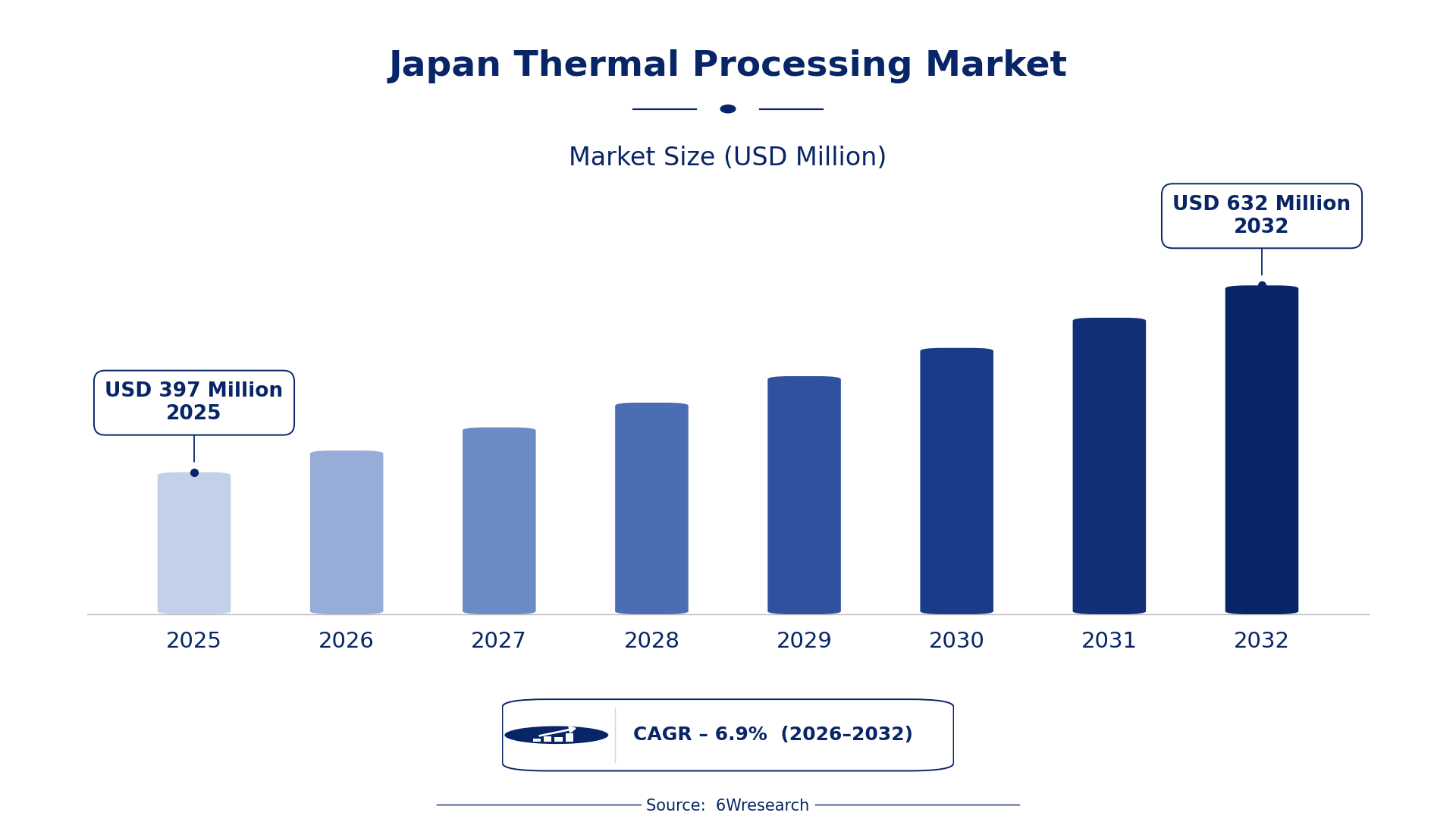
According to 6Wresearch internal database and industry insights, the Japan Thermal Processing Market was valued at USD 397 Million in 2025 and is projected to reach USD 632 Million by 2032, growing at a CAGR of approximately 6.9% during 2026–2032.
Japan Thermal Processing Market Highlights
| Report Metric | Details |
| Report Name | Japan Thermal Processing Market (2026-2032) |
| Market Size 2025 | USD 397 Million |
| Market Size 2032 | USD 632 Million |
| Absolute Growth 2025–2032 | USD 235 Million |
| CAGR 2026–2032 | 6.9% |
| Peak Annual Growth | 7.5% in 2029 |
| Forecast Period | 2026–2032 |
| Historical Data | 2022–2025 |
| Base Year | 2025 |
| Leading Thermal Processing, 2025 | Food Thermal Processing (42% share) |
| Leading Product Type, 2025 | Batch/Furnaces (37% share) |
| Leading Processing Method, 2025 | Sterilization (44% share) |
| Leading Distribution Channel, 2025 | Food Equipment Suppliers (38% share) |
| Leading End User Industry, 2025 | Food Manufacturing (37% share) |
| Fastest-Growing Thermal Processing | Semiconductor Thermal (9.9% CAGR) |
| Fastest-Growing Product Type | Retort Systems (10.1% CAGR) |
| Fastest-Growing Processing Method | Wafer Processing (9.7% CAGR) |
| Fastest-Growing End User Industry | Electronics Manufacturing (8.8% CAGR) |
| Growing Sector | Food Manufacturing |
| Key End Users | Food manufacturers, Electronics manufacturers, Automotive component suppliers |
Japan Thermal Processing Market Year-wise Growth Rate and Key Drivers (2022–2032)
This graph illustrates the annual growth rates of the market from 2022 to 2032, highlighting a steady upward trajectory and projected market expansion over the forecast period.
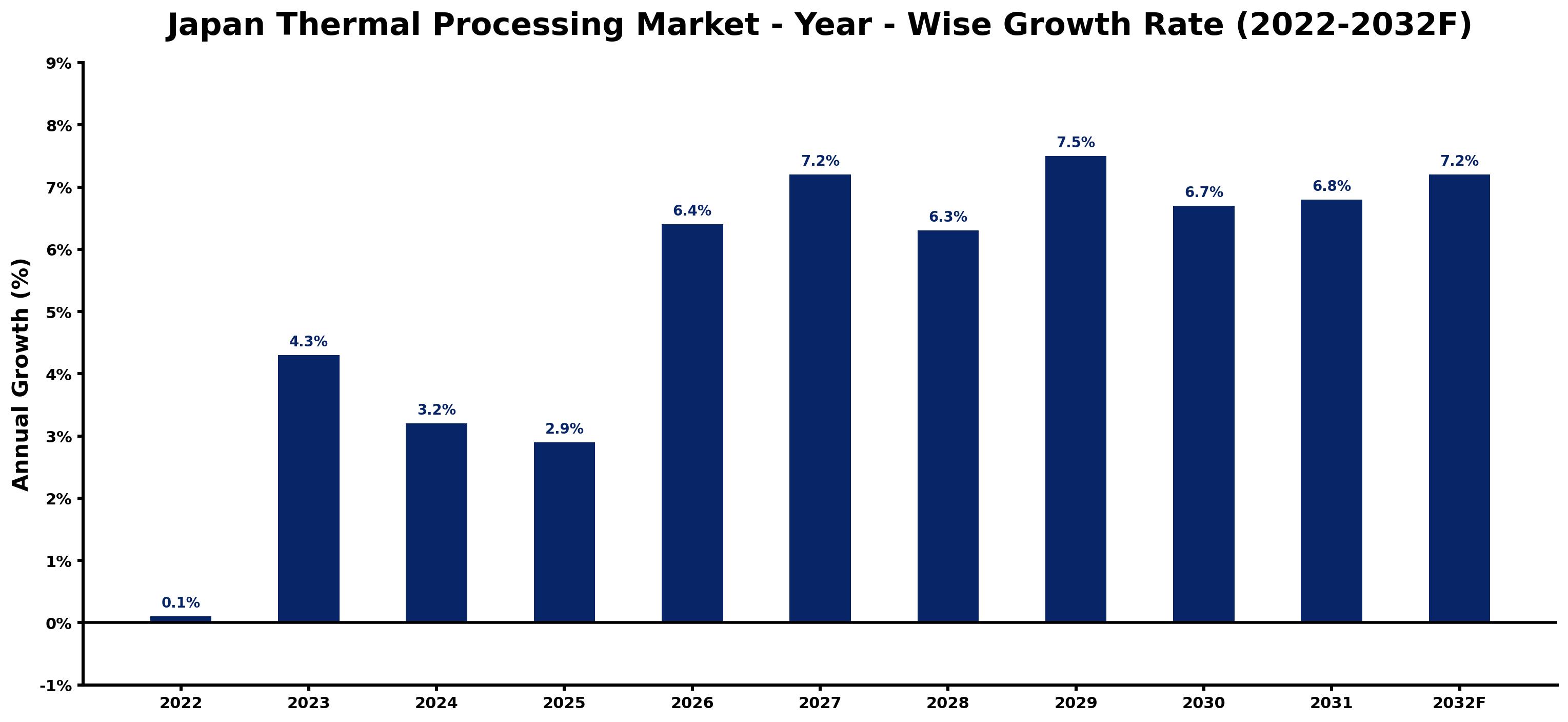
Annual growth estimates for each year appear below with the principal reason behind them, explaining the shifts that set the pace of the market.
| Year | Estimated Annual Growth (%) | Market Rationale |
| 2022 | 0.1 | The market exhibited minimal growth due to stabilisation after previous fluctuations. |
| 2023 | 4.3 | Demand surged as the automotive sector produced over 8 million vehicles, increasing thermal processing needs. |
| 2024 | 3.2 | Growth slowed as the market adjusted to previous high levels of activity in manufacturing. |
| 2025 | 2.9 | A further slowdown occurred as industries stabilised after the previous year's surge in demand. |
| 2026 | 6.4 | Demand is expected to rise as investments in advanced thermal processing equipment increase. |
| 2027 | 7.2 | The market will continue to grow as semiconductor production ramps up with new technologies. |
| 2028 | 6.3 | Growth is projected to slow slightly as the market reaches a more stable phase. |
| 2029 | 7.5 | A peak in growth is anticipated as the electronics sector expands its thermal processing capabilities. |
| 2030 | 6.7 | Growth will moderate as the market adjusts to the peak levels of the previous year. |
| 2031 | 6.8 | Demand is expected to rise again as food safety standards drive thermal processing investments. |
| 2032 | 7.2 | The market will stabilise at a high level as ongoing investments in food and semiconductor sectors continue. |
Note: Market size estimations and growth projections presented in this report are based on 6Wresearch's proprietary forecasting methodology, utilizing the latest available industry data, government publications, and primary research inputs.
Japan Thermal Processing Market Synopsis
Thermal processing involves applying heat to materials to alter physical properties and ensure safety, particularly in sectors like food and electronics. The Japan Thermal Processing Market is growing, driven by the automotive sector's production of over 8 million vehicles in 2022 and investments in advanced thermal processing technologies, especially in the food industry valued at approximately $200 billion. Ongoing demand from food manufacturers and electronics producers is expected to sustain this growth.
Market Dynamics Impact Analysis (2026–2032)
| Factor | Type | Impact | Primary Segment Affected |
| Increasing production in the automotive sector drives demand for heat treatment ovens. | Driver | High | Heat Treatment Ovens |
| Rising investments in food safety enhance the need for food thermal processing. | Driver | High | Food Thermal Processing |
| The growing electronics sector presents opportunities for semiconductor thermal processing. | Opportunity | High | Semiconductor Thermal |
| Investment in advanced thermal processing equipment is increasing among food manufacturers. | Opportunity | High | Food Thermal Processing |
| High costs associated with upgrading thermal processing equipment can limit market access. | Restraint | Medium | Batch/Furnaces |
| Regulatory compliance for food safety can slow down the adoption of new technologies. | Restraint | Medium | Food Thermal Processing |
| High initial investment costs deter smaller manufacturers from upgrading facilities. | Challenge | High | Semiconductor Thermal |
| Technological advancements require continuous training, impacting operational efficiency. | Challenge | Medium | Heat Treatment Ovens |
Evaluation of Drivers in Japan Thermal Processing Market (2026–2032)
The main growth drivers and the segments they affect most are set out below.
| Drivers | Primary Segment Affected | Why It Matters (Evidence) |
| Increased vehicle production requires extensive heat treatment processes. | Heat Treatment Ovens | Japan's automotive sector produced over 8 million vehicles in 2022, leading to higher demand for heat treatment ovens. |
| The food industry's focus on safety drives the need for thermal processing. | Food Thermal Processing | The food industry in Japan is valued at approximately $200 billion, necessitating advanced thermal processing technologies. |
| Growing semiconductor production boosts demand for wafer processing technologies. | Semiconductor Thermal | The electronics sector requires thermal processing for semiconductor fabrication, driving demand in major hubs like Tokyo and Osaka. |
| Investments in food processing equipment improve operational capabilities. | Retort Systems | In 2023, Japan's food processing industry invested ¥30 billion in advanced thermal processing equipment. |
| Adoption of ISO 22000 standards increases demand for food safety management. | Food Thermal Processing | The application of ISO 22000 standards ensures compliance, driving demand for effective thermal processing solutions. |
What keeps demand rising is the automotive sector's production of over 8 million vehicles in 2022, which necessitates extensive thermal processing for heat treatment. The food industry increasingly prioritises safety, prompting investments in thermal processing technologies. The expanding semiconductor industry requires efficient thermal processing technologies, contributing to rising demand. The adoption of ISO 22000 standards for food safety management further propels the need for effective thermal processing solutions.
Evaluation of Restraints in Japan Thermal Processing Market
These restraints slow adoption and weigh on supplier margins.
| Market Restraint | Primary Segment Affected | Why It Matters (Evidence) |
| High costs of upgrading thermal processing equipment limit market access for smaller players. | Batch/Furnaces | The investment required for advanced equipment can deter smaller manufacturers from entering the market. |
| Regulatory compliance for food safety can slow down the adoption of new technologies. | Food Thermal Processing | Adherence to food safety standards may delay the implementation of new thermal processing solutions. |
| Limited availability of skilled labour affects operational efficiency in thermal processing. | Semiconductor Thermal | The need for specialised training in advanced thermal processing techniques can hinder productivity. |
| Market fluctuations in raw material prices impact thermal processing costs. | Heat Treatment Ovens | Volatility in material costs can lead to unpredictable expenses for manufacturers in the thermal processing sector. |
| Environmental regulations impose additional costs on thermal processing operations. | Food Thermal Processing | Compliance with environmental standards can increase operational costs for food manufacturers. |
Japan Thermal Processing Market Challenges
Disruptions in thermal processing equipment can delay production timelines for automotive manufacturers, impacting over 8 million vehicle outputs in 2022. Competition intensifies among food manufacturers, as over 1,000 registered entities strive to meet stringent standards while managing rising costs associated with advanced technologies. A lack of skilled workers in specialised thermal processing techniques hampers operational efficiency, leading to increased training expenditures for producers. The ¥30 billion investment in advanced equipment by the food industry in 2023 creates financial strain, particularly for smaller manufacturers who find it challenging to compete with larger firms.
Trends in the Japan Thermal Processing Market
The trends below show where the Japan Thermal Processing Market is heading.
- Shift from Conventional to Advanced Thermal Processing: Since 2023, food manufacturers have increasingly adopted advanced thermal processing technologies to improve food safety. This shift is evidenced by the ¥30 billion investment in new equipment, allowing producers to meet stringent safety standards.
- Emergence of Semiconductor Thermal Processing: The semiconductor sector has rapidly expanded since 2026, particularly in Tokyo and Osaka. This growth is reflected in the 9.9% CAGR for semiconductor thermal processing, driven by demand for advanced electronics.
- Transition to Sustainable Thermal Processing Solutions: In 2022, the Green Growth Strategy identified thermal processing as a key sector for sustainability. This has prompted investments in eco-friendly technologies, aligning with Japan's carbon neutrality goals by 2050.
- Increased Focus on Food Safety Standards: The implementation of ISO 22000 standards has gained momentum since 2022, leading to a greater emphasis on thermal processing in food manufacturing. This trend is important for maintaining high safety levels across the industry.
Investment Opportunities in the Japan Thermal Processing Market
The opportunities below stand out in the Japan Thermal Processing Market for new entrants and existing suppliers.
- Investment Gap in Advanced Thermal Processing: With a projected ¥30 billion investment in 2023, there is an opportunity for suppliers of advanced thermal processing equipment to meet demand from food manufacturers.
- Growing Demand for Semiconductor Thermal Solutions: The electronics manufacturing sector, particularly in Tokyo, requires advanced thermal processing solutions, creating opportunities for suppliers to invest in wafer processing technologies.
- Expansion of Food Equipment Suppliers: Food Equipment Suppliers can capitalise on the increasing demand for thermal processing technologies, especially as the food industry invests heavily in safety measures.
- Growth in Automotive Thermal Processing Needs: The automotive sector's production of over 8 million vehicles in 2022 presents an opportunity for suppliers to provide heat treatment ovens and related technologies.
Government Initiatives in the Japan Thermal Processing Market
The Economic Security Promotion Act, enacted in 2022, supports supply-chain resilience for critical products, including thermal processing equipment. This law encourages manufacturers to invest in advanced technologies to improve production efficiency and safety standards. Additionally, the PRTR Law mandates reporting on chemical substances, ensuring that thermal processing operations comply with environmental regulations, which is essential for maintaining market access.
In 2023, the Ministry of Agriculture, Forestry and Fisheries allocated ¥10 billion to support initiatives that improve food safety through thermal processing technologies. The agency oversees the implementation of these funds to ensure compliance with safety standards and promote the adoption of effective thermal processing solutions.
Future Insight of the Japan Thermal Processing Market
The pipeline for investment in advanced thermal processing technology will expand, driving demand in both food and automotive sectors. By 2032, the food industry is expected to implement new ISO 22000 standards, enhancing food safety management systems. The Ministry of Agriculture, Forestry and Fisheries will likely introduce additional initiatives to promote safe processing methods. As Japan's population of approximately 125 million continues to depend on processed food, advancements in thermal processing will ensure higher quality and safety standards for consumers.
Market Segmentation Analysis
Japan Thermal Processing Market report covers a detailed analysis of the following market segments:
By Thermal Processing – Food Thermal Processing Leads, Semiconductor Thermal Expected to Grow Fastest
According to Saurav Kr Singh, Senior Research Analyst at 6Wresearch, Food Thermal Processing held 42% of the Japan Thermal Processing Market by thermal processing in 2025. Food thermal processing commands the largest share due to its critical function in sterilising and preserving food products. With over 1,000 registered food manufacturers in Japan, the demand for effective thermal processing is substantial and ongoing. The quickest growth will come from Semiconductor Thermal, forecast to expand at a CAGR of 9.9% between 2026 and 2032. The semiconductor thermal processing segment is witnessing rapid growth, driven by the increasing need for advanced wafer fabrication in the electronics sector. The significant investments in thermal processing technologies within the electronics industry further fuel this expansion. Suppliers should focus on developing solutions tailored for the food and semiconductor industries.
By Product Type – Batch/Furnaces Lead, Retort Systems Expected to Grow Fastest
Batch/Furnaces took 37% of product type revenue in 2025, more than any other category. Batch/furnaces lead the market as they are extensively utilised in metal fabrication for heat treatment processes. Their reliability and versatility make them essential in various manufacturing applications, particularly in the automotive sector. Retort Systems are set to record the highest CAGR in this split, 10.1% over 2026–2032. Retort systems are experiencing rapid growth, primarily due to their widespread application in food processing for sterilisation. The food industry's substantial investments in advanced thermal processing equipment are a key factor driving this trend. Suppliers should prioritise innovation in retort systems to meet the rising demand in the food sector.
By Processing Method – Sterilization Leads, Wafer Processing Expected to Grow Fastest
Sterilization accounted for 44% of the market by processing method in 2025. Sterilisation is the leading method, crucial for ensuring safety in food and medical applications. This method is integral to the operations of numerous food manufacturers across Japan, reinforcing its dominant market position. Wafer Processing is projected to grow fastest, at a CAGR of 9.7% during 2026–2032. Wafer processing is the fastest-growing method, vital for device fabrication in the semiconductor industry. The increasing production of electronic devices is fuelling the demand for efficient wafer processing techniques. This suggests that suppliers must invest in developing advanced wafer processing technologies to capture market opportunities.
By Distribution Channel – Food Equipment Suppliers Lead and Record the Fastest Growth
With 38% of distribution channel revenue in 2025, Food Equipment Suppliers was the largest category. Food equipment suppliers dominate the distribution channel as they provide essential equipment for food thermal processing, serving a large market of food manufacturers. Their established networks ensure timely delivery and comprehensive support for clients in the food sector. The same category are also set to grow fastest, at a CAGR of 8.6% during 2026–2032. Food equipment suppliers are also the fastest-growing channel, benefiting from the rising demand for food processing technologies. Their ability to adapt to changing market needs enhances their growth prospects significantly. This means suppliers should strengthen partnerships with food equipment suppliers to maximise market reach.
By End User Industry – Food Manufacturing Leads, Electronics Manufacturing Expected to Grow Fastest
The largest end user industry category in 2025 was Food Manufacturing, at 37% of revenue. Food manufacturing is the largest end user of thermal processing, heavily relying on these technologies to ensure product safety and quality. The sector's substantial size drives consistent demand for thermal processing solutions, solidifying its market dominance. The quickest growth will come from Electronics Manufacturing, forecast to expand at a CAGR of 8.8% between 2026 and 2032. Electronics manufacturing is the fastest-growing end user, utilising thermal processing extensively in semiconductor production. The rapid advancements in electronics technology are propelling this growth, creating new opportunities for suppliers. This highlights the need for suppliers to tailor their offerings to meet the specific requirements of the electronics sector.
Key Attractiveness of the Report
- 10 Years of Market Numbers
- Historical Data Starting from 2022 to 2025
- Base Year 2025
- Forecast Data until 2032
- Key Performance Indicators Impacting the Market
- Major Upcoming Developments and Projects
Key Highlights of the Report:
- Japan Thermal Processing Market Outlook
- Market Size of Japan Thermal Processing Market, 2025
- Forecast of Japan Thermal Processing Market, 2032
- Historical Data and Forecast of Japan Thermal Processing Revenues & Volume for the Period 2022-2032F
- Japan Thermal Processing Market Trend Evolution
- Japan Thermal Processing Market Drivers and Challenges
- Japan Thermal Processing Price Trends
- Japan Thermal Processing Porter's Five Forces
- Japan Thermal Processing Industry Life Cycle
- Historical Data and Forecast of Japan Thermal Processing Market Revenues & Volume By Thermal Processing for the Period 2022-2032F
- Historical Data and Forecast of Japan Thermal Processing Market Revenues & Volume By Heat Treatment Ovens for the Period 2022-2032F
- Historical Data and Forecast of Japan Thermal Processing Market Revenues & Volume By Food Thermal Processing for the Period 2022-2032F
- Historical Data and Forecast of Japan Thermal Processing Market Revenues & Volume By Semiconductor Thermal for the Period 2022-2032F
- Historical Data and Forecast of Japan Thermal Processing Market Revenues & Volume By Coating Thermal Baths for the Period 2022-2032F
- Historical Data and Forecast of Japan Thermal Processing Market Revenues & Volume By Product Type for the Period 2022-2032F
- Historical Data and Forecast of Japan Thermal Processing Market Revenues & Volume By Batch/Furnaces for the Period 2022-2032F
- Historical Data and Forecast of Japan Thermal Processing Market Revenues & Volume By Retort Systems for the Period 2022-2032F
- Historical Data and Forecast of Japan Thermal Processing Market Revenues & Volume By Bake/Anneal Systems for the Period 2022-2032F
- Historical Data and Forecast of Japan Thermal Processing Market Revenues & Volume By Curing Ovens for the Period 2022-2032F
- Historical Data and Forecast of Japan Thermal Processing Market Revenues & Volume By Processing Method for the Period 2022-2032F
- Historical Data and Forecast of Japan Thermal Processing Market Revenues & Volume By Annealing/Quenching for the Period 2022-2032F
- Historical Data and Forecast of Japan Thermal Processing Market Revenues & Volume By Sterilization for the Period 2022-2032F
- Historical Data and Forecast of Japan Thermal Processing Market Revenues & Volume By Wafer Processing for the Period 2022-2032F
- Historical Data and Forecast of Japan Thermal Processing Market Revenues & Volume By Powder Coating for the Period 2022-2032F
- Historical Data and Forecast of Japan Thermal Processing Market Revenues & Volume By Distribution Channel for the Period 2022-2032F
- Historical Data and Forecast of Japan Thermal Processing Market Revenues & Volume By Equipment Vendors for the Period 2022-2032F
- Historical Data and Forecast of Japan Thermal Processing Market Revenues & Volume By Food Equipment Suppliers for the Period 2022-2032F
- Historical Data and Forecast of Japan Thermal Processing Market Revenues & Volume By Cleanroom Equipment for the Period 2022-2032F
- Historical Data and Forecast of Japan Thermal Processing Market Revenues & Volume By Industrial Integrators for the Period 2022-2032F
- Historical Data and Forecast of Japan Thermal Processing Market Revenues & Volume By End User Industry for the Period 2022-2032F
- Historical Data and Forecast of Japan Thermal Processing Market Revenues & Volume By Automotive Components for the Period 2022-2032F
- Historical Data and Forecast of Japan Thermal Processing Market Revenues & Volume By Food Manufacturing for the Period 2022-2032F
- Historical Data and Forecast of Japan Thermal Processing Market Revenues & Volume By Electronics Manufacturing for the Period 2022-2032F
- Historical Data and Forecast of Japan Thermal Processing Market Revenues & Volume By Metal Fabrication for the Period 2022-2032F
- Japan Thermal Processing Import Export Trade Statistics
- Market Opportunity Assessment By Thermal Processing
- Market Opportunity Assessment By Product Type
- Market Opportunity Assessment By Processing Method
- Market Opportunity Assessment By Distribution Channel
- Market Opportunity Assessment By End User Industry
- Japan Thermal Processing Top Companies Market Share
- Japan Thermal Processing Competitive Benchmarking By Technical and Operational Parameters
- Japan Thermal Processing Company Profiles
- Japan Thermal Processing Key Strategic Recommendations
Market Covered
This report examines the market across the segments below.
By Thermal Processing
- Heat Treatment Ovens
- Food Thermal Processing
- Semiconductor Thermal
- Coating Thermal Baths
By Product Type
- Batch/Furnaces
- Retort Systems
- Bake/Anneal Systems
- Curing Ovens
By Processing Method
- Annealing/Quenching
- Sterilization
- Wafer Processing
- Powder Coating
By Distribution Channel
- Equipment Vendors
- Food Equipment Suppliers
- Cleanroom Equipment
- Industrial Integrators
By End User Industry
- Automotive Components
- Food Manufacturing
- Electronics Manufacturing
- Metal Fabrication































