Japan Thermoplastic 3D Printing Market Size & Growth Rate
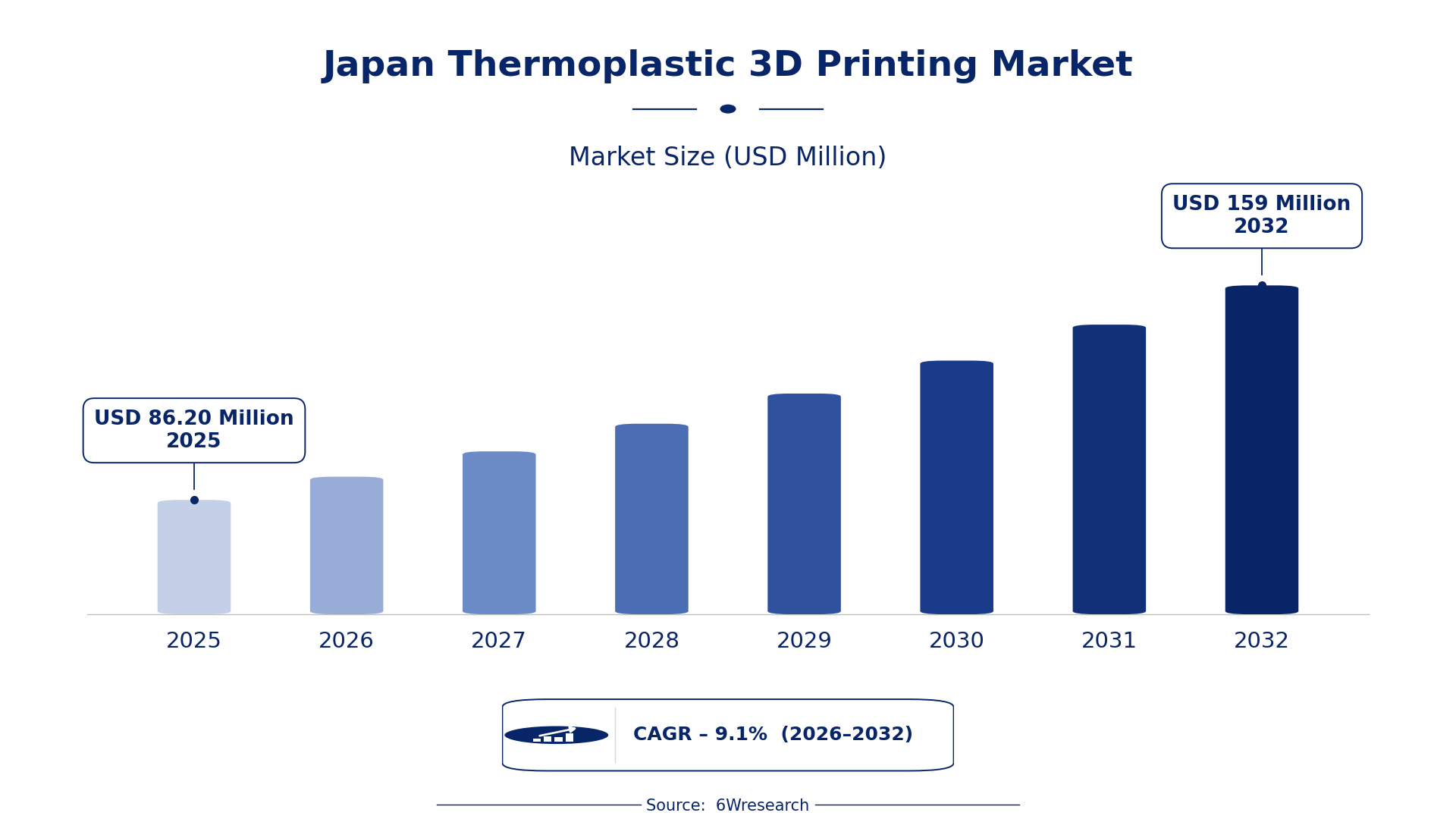
According to 6Wresearch internal database and industry insights, the Japan Thermoplastic 3D Printing Market was valued at USD 86.20 Million in 2025 and is projected to reach USD 159 Million by 2032, growing at a CAGR of approximately 9.1% during 2026–2032.
Japan Thermoplastic 3D Printing Market Highlights
| Report Metric | Details |
| Report Name | Japan Thermoplastic 3D Printing Market (2026-2032) |
| Market Size 2025 | USD 86.20 Million |
| Market Size 2032 | USD 159 Million |
| Absolute Growth 2025–2032 | USD 72.80 Million |
| CAGR 2026–2032 | 9.1% |
| Peak Annual Growth | 10.8% in 2028 |
| Forecast Period | 2026–2032 |
| Historical Data | 2022–2025 |
| Base Year | 2025 |
| Leading Thermoplastic 3D Printing, 2025 | Industrial 3D Printers (43% share) |
| Leading Product Type, 2025 | Professional Printers (51% share) |
| Leading Filament Type, 2025 | PLA/ABS Filaments (41% share) |
| Leading Distribution Channel, 2025 | Online Retailers (38% share) |
| Leading End User Industry, 2025 | Healthcare (49% share) |
| Fastest-Growing Thermoplastic 3D Printing | Large-Scale Printers (12.3% CAGR) |
| Fastest-Growing Product Type | Medical/Dental Printers (12.8% CAGR) |
| Fastest-Growing Filament Type | Medical-grade PLA (12.9% CAGR) |
| Fastest-Growing Distribution Channel | Medical Equipment Vendors (11.5% CAGR) |
| Growing Sector | Healthcare |
| Key End Users | Healthcare, Aerospace, Automotive, Education |
Japan Thermoplastic 3D Printing Market Year-wise Growth Rate and Key Drivers (2022–2032)
This graph illustrates the annual growth rates of the market from 2022 to 2032, highlighting a steady upward trajectory and projected market expansion over the forecast period.
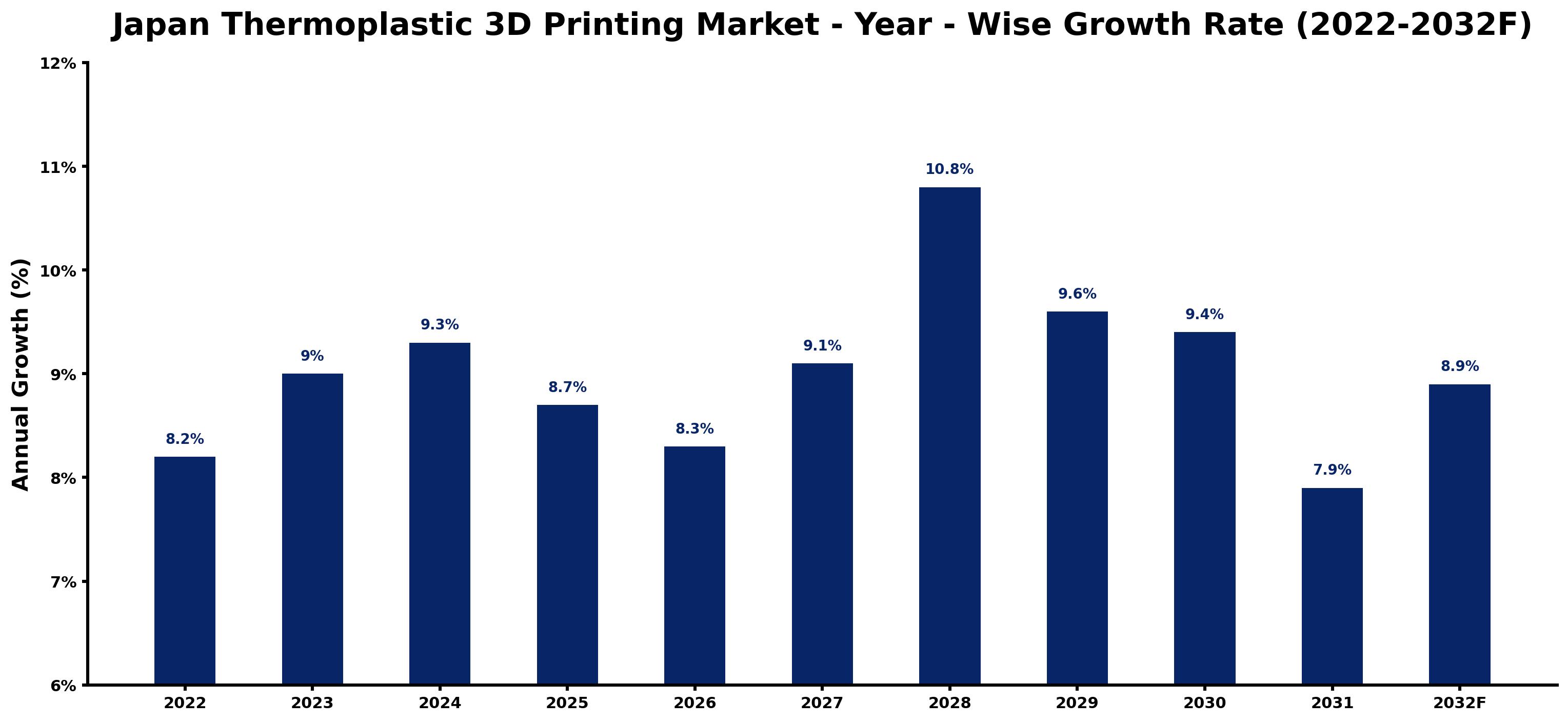
Annual growth estimates for each year appear below with the principal reason behind them, explaining the shifts that set the pace of the market.
| Year | Estimated Annual Growth (%) | Market Rationale |
| 2022 | 8.2 | The market experienced steady growth, driven by advancements in 3D printing technology. |
| 2023 | 9.0 | Growth accelerated due to increased adoption in the automotive sector for prototyping. |
| 2024 | 9.3 | The aerospace industry expanded its use of 3D printing, contributing to faster growth. |
| 2025 | 8.7 | Growth slowed as the market adjusted to previous high rates of expansion. |
| 2026 | 8.3 | A further slowdown is expected as the market stabilises after rapid growth phases. |
| 2027 | 9.1 | Demand is projected to rise again as healthcare applications for custom medical devices increase. |
| 2028 | 10.8 | The market is expected to peak with investments in large-scale printing capabilities. |
| 2029 | 9.6 | Growth is projected to slow slightly as the market begins to normalise after peak levels. |
| 2030 | 9.4 | A continued slowdown is expected as market growth rates stabilise further. |
| 2031 | 7.9 | The market growth is projected to decelerate as saturation in some sectors begins to show. |
| 2032 | 8.9 | Demand is expected to pick up again with new innovations in 3D printing materials. |
Note: Market size estimations and growth projections presented in this report are based on 6Wresearch's proprietary forecasting methodology, utilizing the latest available industry data, government publications, and primary research inputs.
Japan Thermoplastic 3D Printing Market Synopsis
Thermoplastic 3D printing utilises thermoplastic materials to create three-dimensional objects through additive manufacturing techniques. The Japan Thermoplastic 3D Printing Market is growing due to strong demand from the aerospace and automotive sectors. Increased healthcare adoption for custom implants and investments in prototyping technologies are driving this growth, alongside supportive government initiatives.
Market Dynamics Impact Analysis (2026–2032)
| Factor | Type | Impact | Primary Segment Affected |
| Growing demand for custom medical devices in healthcare | Driver | High | Medical/Dental Printers |
| Increased investments in prototyping technologies by the automotive sector | Driver | High | Industrial 3D Printers |
| Expansion of 3D printing capabilities in aerospace prototyping | Opportunity | High | Aerospace Prototyping |
| Rising interest in educational applications of 3D printing | Opportunity | Medium | Consumer 3D Printers |
| High costs associated with industrial-grade printers | Restraint | High | Industrial 3D Printers |
| Limited awareness of 3D printing capabilities among small businesses | Restraint | Medium | Consumer 3D Printers |
| Challenges in integrating 3D printing into traditional manufacturing processes | Challenge | High | Large-Scale Printers |
| Competition from alternative manufacturing technologies | Challenge | Medium | Professional Printers |
Evaluation of Drivers in Japan Thermoplastic 3D Printing Market (2026–2032)
Below are the drivers that matter most for revenue growth, with supporting evidence.
| Drivers | Primary Segment Affected | Why It Matters (Evidence) |
| Increased healthcare adoption for custom medical devices | Medical/Dental Printers | The number of 3D printers in Japanese hospitals has increased by 30% since 2021, driving demand for tailored solutions. |
| Heavy investment in prototyping technologies by automotive manufacturers | Industrial 3D Printers | The automotive industry in Japan is investing heavily in 3D printing for prototyping, improving production efficiency. |
| Growing use of large-scale printers in construction projects | Large-Scale Printers | The adoption of large-scale printers is rising in construction and infrastructure projects, meeting demand for larger components. |
| Rising interest in educational applications of 3D printing | Consumer 3D Printers | 3D printing is being integrated into educational curricula across Japanese universities, increasing demand among students and educators. |
| Support from government initiatives for 3D printing startups | Professional Printers | The Tokyo Metropolitan Government supports 3D printing startups through funding initiatives, boosting local production capabilities. |
What keeps demand rising is the increasing adoption of custom medical devices in healthcare, with 3D printers in hospitals increasing by 30% since 2021. Investments in prototyping technologies by the automotive sector improve production efficiency, leading to higher demand for industrial-grade printers. Large-scale printers are gaining traction in construction projects, meeting the need for larger components. Educational institutions are integrating 3D printing into their curricula, which drives demand from students and educators. Support for 3D printing startups is further boosting local production capabilities.
Evaluation of Restraints in Japan Thermoplastic 3D Printing Market
These are the pressures that could keep growth below its potential.
| Market Restraint | Primary Segment Affected | Why It Matters (Evidence) |
| High costs associated with industrial-grade printers | Industrial 3D Printers | The initial investment for industrial-grade printers can be prohibitive for smaller manufacturers, limiting market entry. |
| Limited awareness of 3D printing capabilities among small businesses | Consumer 3D Printers | Many small businesses lack knowledge about the benefits of 3D printing, hindering broader adoption. |
| Challenges in integrating 3D printing into traditional manufacturing processes | Large-Scale Printers | Existing manufacturing setups may resist change, complicating the adoption of new technologies. |
| Competition from alternative manufacturing technologies | Professional Printers | Traditional manufacturing methods may be preferred due to familiarity, impacting the market share of 3D printing. |
| Regulatory hurdles in material certification for medical applications | Medical/Dental Printers | Stringent regulations can delay the introduction of new 3D printed medical devices, affecting market growth. |
Japan Thermoplastic 3D Printing Market Challenges
Producers in the thermoplastic 3D printing market face technological hurdles as rapid advancements in materials can delay product development cycles by up to six months. Regulatory uncertainties exist since the Japanese government is still finalising JIS standards for 3D printing materials, complicating compliance for producers needing certified products. Increased competition from international markets forces local producers to reduce prices, potentially shrinking their profit margins by 15%. Buyers in the healthcare sector experience delays in acquiring custom implants, as the integration of 3D printing in hospitals has not yet fully matured, leading to longer lead times for essential medical devices.
Trends in the Japan Thermoplastic 3D Printing Market
The following changes are redrawing the Japan Thermoplastic 3D Printing Market.
- Healthcare Professionals Embracing 3D Printing: Healthcare professionals are increasingly adopting 3D printing for custom implants, with the Japanese healthcare sector seeing a rise in usage. In 2023, the Ministry of Economy, Trade and Industry launched a 3D printing innovation program to support this growth.
- Shift Towards Large-Scale Printing: There is a noticeable shift towards large-scale printing in construction and infrastructure projects, as companies seek to create larger components efficiently. This trend is supported by the expected 20% growth in Japan's aerospace industry by 2025.
- Integration of 3D Printing in Education: Educational institutions are incorporating 3D printing into their curricula, increasing student engagement and skills. The Tokyo 3D Printing Expo showcases advancements in the industry, highlighting the educational potential of this technology.
- Rise of Medical-Grade Filaments: The use of medical-grade PLA is gaining traction in Japan's dental sector, driven by the need for safe and compliant materials. This trend aligns with the increasing focus on custom medical solutions.
Investment Opportunities in the Japan Thermoplastic 3D Printing Market
Below are the investment opportunities with the strongest case in the Japan Thermoplastic 3D Printing Market.
- Investment in Custom Medical Devices: With the healthcare sector increasingly adopting 3D printing, there is an opportunity to invest in custom medical devices. The Japanese government allocated 2 billion JPY for advanced manufacturing technologies, including 3D printing.
- Expansion of Prototyping Capabilities in Automotive: The automotive industry is investing heavily in 3D printing for prototyping, creating opportunities for suppliers of advanced printers. The expected growth in this sector is set to improve production efficiency.
- Support for 3D Printing Startups: The Tokyo Metropolitan Government's funding initiatives for 3D printing startups present a timely opportunity for investment. Collaborating with local partners can facilitate entry into this expanding market.
- Development of JIS Standards for 3D Printing: The development of JIS standards for 3D printing materials and processes creates an opportunity for compliance-focused suppliers. Engaging with the Japan 3D Printing Association can help navigate these standards.
Government Initiatives in the Japan Thermoplastic 3D Printing Market
The Plastic Resource Circulation Act, enacted in 2021, promotes the reduction, reuse, and recycling of plastics, which directly impacts producers of thermoplastic 3D printing materials. This law encourages manufacturers to explore sustainable alternatives, such as biodegradable plastics, expanding their product offerings in the market.
The Japan 3D Printing Association, through various funding initiatives, supports advanced manufacturing technologies, including 3D printing. This agency plays a key role in approving projects that enhance innovation and competitiveness in the industry.
Future Insight of the Japan Thermoplastic 3D Printing Market
New large-scale printing facilities are expected to come online, streamlining production processes and reducing costs for buyers in construction. The 3D printing innovation program initiated in 2023 will advance material technology, allowing suppliers to meet diverse industry needs. The aerospace sector is projected to increase its 3D printing usage by 20% by 2025, opening avenues for suppliers to provide more intricate components. Educational institutions will further incorporate 3D printing into their curricula, preparing a skilled workforce to drive market growth.
Market Segmentation Analysis
Japan Thermoplastic 3D Printing Market report covers a detailed analysis of the following market segments:
By Thermoplastic 3D Printing – Industrial 3D Printers Lead, Large-Scale Printers Expected to Grow Fastest
According to Saurav Kr Singh, Senior Research Analyst at 6Wresearch, Industrial 3D Printers held 43% of the Japan Thermoplastic 3D Printing Market by thermoplastic 3d printing in 2025. Industrial 3D Printers hold the largest market share due to their critical role in high-volume production and the fabrication of complex parts. The aerospace industry, for example, relies on these printers to manufacture intricate components essential for aircraft performance. Large-Scale Printers are set to record the highest CAGR in this split, 12.3% over 2026–2032. Large-Scale Printers are experiencing rapid growth as they are increasingly employed to produce substantial components in both aerospace and automotive sectors. The aerospace industry's anticipated 20% increase in 3D printing usage by 2025 highlights the expanding demand for these printers. Suppliers should prioritise the development of solutions tailored for large-scale applications to seize emerging market opportunities.
By Product Type – Professional Printers Lead, Medical/Dental Printers Expected to Grow Fastest
Professional Printers accounted for 51% of the market by product type in 2025. Professional Printers hold the largest share as they are widely used in professional settings for producing high-quality prototypes. Their reliability and performance make them essential for industries like automotive and aerospace. Over 2026–2032, Medical/Dental Printers are expected to post the fastest growth, at a CAGR of 12.8%. Medical/Dental Printers are growing quickly due to the rising demand for custom medical devices and dental implants, which require precision and compliance with safety standards. This segment's growth is supported by the healthcare sector's increasing adoption of 3D printing technologies. Buyers in the medical field should prioritise sourcing advanced printing solutions to meet customisation needs.
By Filament Type – PLA/ABS Filaments Lead, Medical-grade PLA Expected to Grow Fastest
PLA/ABS Filaments took 41% of filament type revenue in 2025, more than any other category. PLA/ABS Filaments are the leading choice in the market because they are commonly used materials across various 3D printing applications. Their versatility and availability make them a staple for many manufacturers. Medical-grade PLA is projected to grow fastest, at a CAGR of 12.9% during 2026–2032. Medical-grade PLA is rapidly gaining traction as it is essential for medical applications, ensuring safety and compliance in the production of medical devices. The increasing focus on healthcare solutions is propelling this segment's growth. Suppliers should consider expanding their range of medical-grade filaments to cater to the growing healthcare demands.
By Distribution Channel – Online Retailers Lead, Medical Equipment Vendors Expected to Grow Fastest
With 38% of distribution channel revenue in 2025, Online Retailers was the largest category. Online Retailers hold a prominent position in the market due to their ability to offer a vast selection of consumer printers and filaments. Their user-friendly platforms and efficient logistics cater to the growing demand for accessible 3D printing solutions among hobbyists and professionals alike. The quickest growth will come from Medical Equipment Vendors, forecast to expand at a CAGR of 11.5% between 2026 and 2032. Medical Equipment Vendors are experiencing rapid growth as they respond to the healthcare sector's rising need for specialised medical 3D printing equipment. This trend is exemplified by the 30% increase in the number of 3D printers in Japanese hospitals since 2021. Suppliers should focus on enhancing their online presence to capture the growing consumer interest in 3D printing.
By End User Industry – Healthcare Leads and Records the Fastest Growth
In 2025, Healthcare led the end user industry split with a 49% share. Healthcare leads the market as it is a rapidly growing sector for custom medical solutions, with increasing investments in 3D printing technologies. The demand for personalised medical devices and implants is driving this growth. Its lead should widen, with a projected CAGR of 11.9% during 2026–2032, the highest in this split. Healthcare is also the fastest-growing end user industry, as the sector continues to adopt 3D printing for custom solutions at an unprecedented rate. This dual role of leadership and growth indicates a strong future for 3D printing in healthcare. Suppliers must align their strategies to meet the expanding needs of the healthcare sector.
Key Attractiveness of the Report
- 10 Years of Market Numbers
- Historical Data Starting from 2022 to 2025
- Base Year 2025
- Forecast Data until 2032
- Key Performance Indicators Impacting the Market
- Major Upcoming Developments and Projects
Key Highlights of the Report:
- Japan Thermoplastic 3D Printing Market Outlook
- Market Size of Japan Thermoplastic 3D Printing Market, 2025
- Forecast of Japan Thermoplastic 3D Printing Market, 2032
- Historical Data and Forecast of Japan Thermoplastic 3D Printing Revenues & Volume for the Period 2022-2032F
- Japan Thermoplastic 3D Printing Market Trend Evolution
- Japan Thermoplastic 3D Printing Market Drivers and Challenges
- Japan Thermoplastic 3D Printing Price Trends
- Japan Thermoplastic 3D Printing Porter's Five Forces
- Japan Thermoplastic 3D Printing Industry Life Cycle
- Historical Data and Forecast of Japan Thermoplastic 3D Printing Market Revenues & Volume By Thermoplastic 3D Printing for the Period 2022-2032F
- Historical Data and Forecast of Japan Thermoplastic 3D Printing Market Revenues & Volume By Desktop FDM Printers for the Period 2022-2032F
- Historical Data and Forecast of Japan Thermoplastic 3D Printing Market Revenues & Volume By Industrial 3D Printers for the Period 2022-2032F
- Historical Data and Forecast of Japan Thermoplastic 3D Printing Market Revenues & Volume By Large-Scale Printers for the Period 2022-2032F
- Historical Data and Forecast of Japan Thermoplastic 3D Printing Market Revenues & Volume By Specialty Printers for the Period 2022-2032F
- Historical Data and Forecast of Japan Thermoplastic 3D Printing Market Revenues & Volume By Product Type for the Period 2022-2032F
- Historical Data and Forecast of Japan Thermoplastic 3D Printing Market Revenues & Volume By Consumer 3D Printers for the Period 2022-2032F
- Historical Data and Forecast of Japan Thermoplastic 3D Printing Market Revenues & Volume By Professional Printers for the Period 2022-2032F
- Historical Data and Forecast of Japan Thermoplastic 3D Printing Market Revenues & Volume By Gigaprint Systems for the Period 2022-2032F
- Historical Data and Forecast of Japan Thermoplastic 3D Printing Market Revenues & Volume By Medical/Dental Printers for the Period 2022-2032F
- Historical Data and Forecast of Japan Thermoplastic 3D Printing Market Revenues & Volume By Filament Type for the Period 2022-2032F
- Historical Data and Forecast of Japan Thermoplastic 3D Printing Market Revenues & Volume By PLA/ABS Filaments for the Period 2022-2032F
- Historical Data and Forecast of Japan Thermoplastic 3D Printing Market Revenues & Volume By PEI/Nylon Filaments for the Period 2022-2032F
- Historical Data and Forecast of Japan Thermoplastic 3D Printing Market Revenues & Volume By Carbon-filled ABS for the Period 2022-2032F
- Historical Data and Forecast of Japan Thermoplastic 3D Printing Market Revenues & Volume By Medical-grade PLA for the Period 2022-2032F
- Historical Data and Forecast of Japan Thermoplastic 3D Printing Market Revenues & Volume By Distribution Channel for the Period 2022-2032F
- Historical Data and Forecast of Japan Thermoplastic 3D Printing Market Revenues & Volume By Online Retailers for the Period 2022-2032F
- Historical Data and Forecast of Japan Thermoplastic 3D Printing Market Revenues & Volume By OEM Dealers for the Period 2022-2032F
- Historical Data and Forecast of Japan Thermoplastic 3D Printing Market Revenues & Volume By Direct Integration for the Period 2022-2032F
- Historical Data and Forecast of Japan Thermoplastic 3D Printing Market Revenues & Volume By Medical Equipment Vendors for the Period 2022-2032F
- Historical Data and Forecast of Japan Thermoplastic 3D Printing Market Revenues & Volume By End User Industry for the Period 2022-2032F
- Historical Data and Forecast of Japan Thermoplastic 3D Printing Market Revenues & Volume By Hobbyists for the Period 2022-2032F
- Historical Data and Forecast of Japan Thermoplastic 3D Printing Market Revenues & Volume By Aerospace Prototyping for the Period 2022-2032F
- Historical Data and Forecast of Japan Thermoplastic 3D Printing Market Revenues & Volume By Automotive Tooling for the Period 2022-2032F
- Historical Data and Forecast of Japan Thermoplastic 3D Printing Market Revenues & Volume By Healthcare for the Period 2022-2032F
- Japan Thermoplastic 3D Printing Import Export Trade Statistics
- Market Opportunity Assessment By Thermoplastic 3D Printing
- Market Opportunity Assessment By Product Type
- Market Opportunity Assessment By Filament Type
- Market Opportunity Assessment By Distribution Channel
- Market Opportunity Assessment By End User Industry
- Japan Thermoplastic 3D Printing Top Companies Market Share
- Japan Thermoplastic 3D Printing Competitive Benchmarking By Technical and Operational Parameters
- Japan Thermoplastic 3D Printing Company Profiles
- Japan Thermoplastic 3D Printing Key Strategic Recommendations
Market Covered
Segments analysed in this report are listed below.
By Thermoplastic 3D Printing
- Desktop FDM Printers
- Industrial 3D Printers
- Large-Scale Printers
- Specialty Printers
By Product Type
- Consumer 3D Printers
- Professional Printers
- Gigaprint Systems
- Medical/Dental Printers
By Filament Type
- PLA/ABS Filaments
- PEI/Nylon Filaments
- Carbon-filled ABS
- Medical-grade PLA
By Distribution Channel
- Online Retailers
- OEM Dealers
- Direct Integration
- Medical Equipment Vendors
By End User Industry
- Hobbyists
- Aerospace Prototyping
- Automotive Tooling
- Healthcare































