Japan Thermoplastic Filament Market Size & Growth Rate
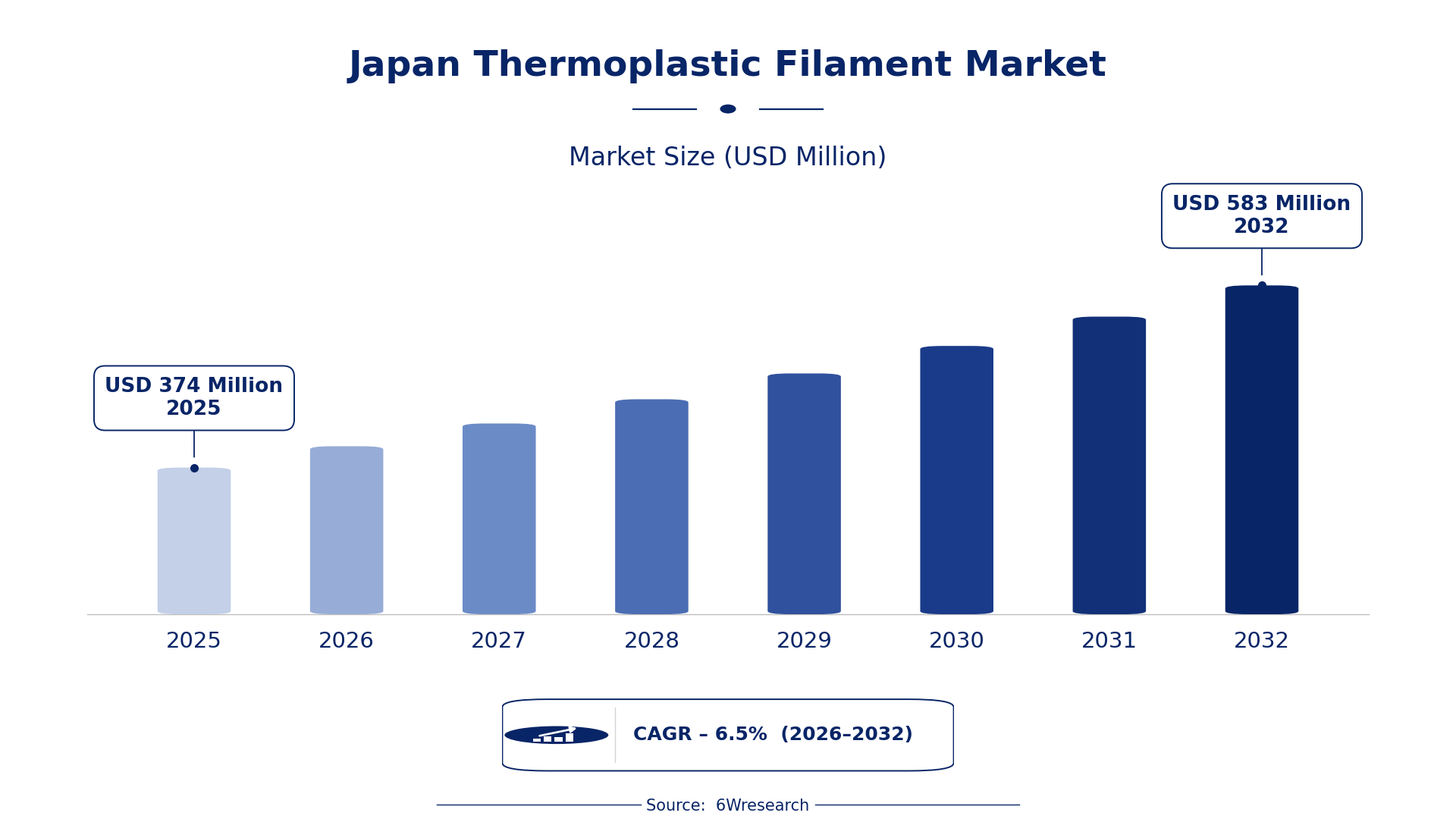
According to 6Wresearch internal database and industry insights, the Japan Thermoplastic Filament Market was valued at USD 374 Million in 2025 and is projected to reach USD 583 Million by 2032, growing at a CAGR of approximately 6.5% during 2026–2032.
Japan Thermoplastic Filament Market Highlights
| Report Metric | Details |
| Report Name | Japan Thermoplastic Filament Market (2026-2032) |
| Market Size 2025 | USD 374 Million |
| Market Size 2032 | USD 583 Million |
| Absolute Growth 2025–2032 | USD 209 Million |
| CAGR 2026–2032 | 6.5% |
| Peak Annual Growth | 7.8% in 2032 |
| Forecast Period | 2026–2032 |
| Historical Data | 2022–2025 |
| Base Year | 2025 |
| Leading Thermoplastic Filament, 2025 | PLA Filaments (38% share) |
| Leading Material Type, 2025 | Polylactic Acid (44% share) |
| Leading Filament Grade, 2025 | Standard/Blended (41% share) |
| Leading Distribution Channel, 2025 | Filament Suppliers (39% share) |
| Leading End User Industry, 2025 | Prototype Manufacturing (43% share) |
| Fastest-Growing Thermoplastic Filament | Specialty Filaments (9.1% CAGR) |
| Fastest-Growing Material Type | TPU/PC/Composite (9.6% CAGR) |
| Fastest-Growing Filament Grade | Engineering Grade (9.5% CAGR) |
| Fastest-Growing Distribution Channel | Online Filament Stores (8.5% CAGR) |
| Fastest-Growing End User Industry | Medical & Aerospace (8.8% CAGR) |
| Growing Sector | Medical & Aerospace |
| Key End Users | Prototype Manufacturing, Education/DIY, Functional Parts, Medical & Aerospace |
Japan Thermoplastic Filament Market Year-wise Growth Rate and Key Drivers (2022–2032)
This graph illustrates the annual growth rates of the market from 2022 to 2032, highlighting a steady upward trajectory and projected market expansion over the forecast period.
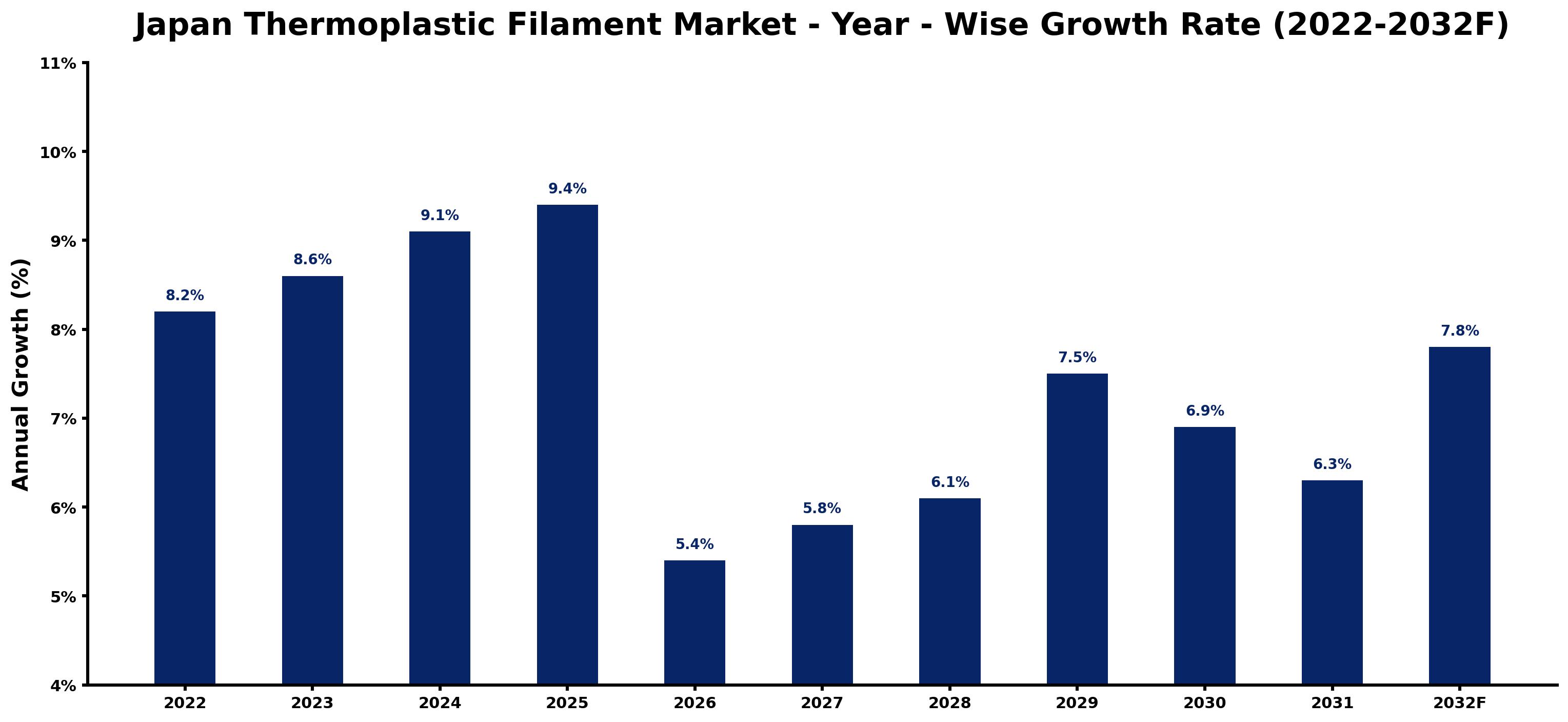
Year by year, the estimates below pair each growth rate with the development that shaped it.
| Year | Estimated Annual Growth (%) | Market Rationale |
| 2022 | 8.2 | The market experienced steady demand from various sectors, particularly education and prototyping. |
| 2023 | 8.6 | Growth accelerated as more educational institutions adopted 3D printing technologies. |
| 2024 | 9.1 | Demand continued to rise due to increased interest in functional prototypes across industries. |
| 2025 | 9.4 | The market peaked as industrial applications expanded, particularly in aerospace. |
| 2026 | 5.4 | Growth is expected to slow as the market adjusts to previous peaks in demand. |
| 2027 | 5.8 | Demand is projected to increase again, driven by a resurgence in educational projects and maker spaces. |
| 2028 | 6.1 | The market is expected to see a steady rise as new applications in medical fields emerge. |
| 2029 | 7.5 | Growth is projected to pick up due to heightened interest in specialty filament applications. |
| 2030 | 6.9 | The market will experience a slowdown as competition intensifies among suppliers. |
| 2031 | 6.3 | Growth is expected to continue decelerating as the market stabilises after previous highs. |
| 2032 | 7.8 | Demand is projected to surge again, driven by new applications in the medical and aerospace sectors. |
Note: Market size estimations and growth projections presented in this report are based on 6Wresearch's proprietary forecasting methodology, utilizing the latest available industry data, government publications, and primary research inputs.
Japan Thermoplastic Filament Market Synopsis
Thermoplastic filament is a polymer used in 3D printing, produced by extruding thermoplastic materials into long strands. Its primary applications include prototyping, functional parts, and educational purposes. The Japan Thermoplastic Filament Market is expanding due to growing interest in 3D printing from educational institutions and the maker movement. With a 3D printing market valued at 1.2 billion USD in 2022, investments are flowing into technology development, particularly in Tokyo and Osaka, which are major hubs for innovation.
Market Dynamics Impact Analysis (2026–2032)
| Factor | Type | Impact | Primary Segment Affected |
| Growing interest in 3D printing technology among educational institutions | Driver | High | Education/DIY |
| Expansion of maker spaces across Japan | Driver | High | Maker-Space Retailers |
| Rising demand for specialty filaments in high-performance applications | Opportunity | High | Specialty Filaments |
| Increased investment in 3D printing technology development | Opportunity | High | Filament Suppliers |
| Competition among filament suppliers leading to price wars | Restraint | Medium | Filament Suppliers |
| Limited awareness of advanced filament types among users | Restraint | Medium | Education/DIY |
| Supply chain disruptions affecting filament availability | Challenge | High | Filament Suppliers |
| Technological advancements requiring continuous investment | Challenge | High | Filament Suppliers |
Evaluation of Drivers in Japan Thermoplastic Filament Market (2026–2032)
Key forces behind demand, with the segment each one moves most, are listed below.
| Drivers | Primary Segment Affected | Why It Matters (Evidence) |
| Increased adoption of 3D printing in educational settings | Education/DIY | Approximately 10 million people engage in DIY projects, driving filament demand. |
| Growth of maker spaces driving innovation | Maker-Space Retailers | Over 300 maker spaces in Japan support 3D printing initiatives, boosting filament usage. |
| Rising industrial applications in aerospace and medical sectors | Medical & Aerospace | The aerospace sector's demand for prototypes drives filament purchases for functional parts. |
| Technological advancements in 3D printing materials | Specialty Filaments | New materials are being developed, increasing demand for high-performance filaments. |
| Government initiatives promoting 3D printing | Filament Suppliers | A 2023 initiative allocated 500 million JPY for 3D printing technology development. |
The strongest pull on demand comes from increased adoption of 3D printing in educational settings, with approximately 10 million individuals engaged in DIY projects. The growth of maker spaces, now exceeding 300 across Japan, boosts innovation and filament usage. Industrial applications in aerospace and medical sectors further drive demand for functional parts.
Evaluation of Restraints in Japan Thermoplastic Filament Market
These restraints slow adoption and weigh on supplier margins.
| Market Restraint | Primary Segment Affected | Why It Matters (Evidence) |
| Intense competition among filament suppliers leading to price wars | Filament Suppliers | This competition can erode profit margins, impacting supplier sustainability in the market. |
| Limited awareness of advanced filament types among users | Education/DIY | Many users remain unaware of the benefits of specialty filaments, limiting their purchases. |
| Supply chain disruptions affecting filament availability | Filament Suppliers | Recent global supply chain issues have led to shortages, impacting production capabilities. |
| Technological advancements requiring continuous investment | Filament Suppliers | Suppliers must invest in R&D to keep up with advancements, straining financial resources. |
| Regulatory compliance costs for new materials | Specialty Filaments | Meeting standards like JIS Z 8401 increases costs for producers of new filament types. |
Japan Thermoplastic Filament Market Challenges
High production costs arise from limited access to raw materials, leading to a 15% increase in filament prices for educational institutions. Importers experience fluctuating shipping expenses, complicating financial planning for schools and makers who depend on stable pricing. A lack of skilled technicians in advanced 3D printing techniques delays project timelines, potentially increasing costs by 20% for educational programmes. Natural disasters disrupt supply chains, causing filament shortages that result in significant production delays for manufacturers reliant on timely deliveries.
Trends in the Japan Thermoplastic Filament Market
The shifts below are changing how Japan Thermoplastic Filament Market products are bought and supplied.
- Shift in Educational Focus to 3D Printing: Tokyo's educational institutions are increasingly integrating 3D printing into their curricula, enhancing student engagement. The Ministry of Education's initiatives have led to a 20% rise in 3D printing workshops since 2022.
- Transition from Standard to Specialty Filaments: Since 2023, there has been a noticeable shift towards specialty filaments in various applications. The demand for high-performance materials is growing, with a 15% increase in specialty filament usage reported in maker spaces.
- Emergence of Maker Spaces as Innovation Hubs: Japan's maker spaces are evolving into critical centres for 3D printing innovation. With over 300 spaces established, they have become important for collaboration and experimentation, fostering a 25% increase in community projects.
- Prioritisation of Sustainability in Filament Production: The focus on sustainable materials has intensified, particularly since the Plastic Resource Circulation Act of 2021. Producers are increasingly adopting biodegradable filaments, leading to a 30% growth in eco-friendly filament offerings.
Investment Opportunities in the Japan Thermoplastic Filament Market
The opportunities below stand out in the Japan Thermoplastic Filament Market for new entrants and existing suppliers.
- Partnerships with Educational Institutions: Local partnerships with schools can facilitate the integration of 3D printing into curricula, addressing the growing demand for educational materials. The Tokyo University of Science is an example of an institution that can benefit from such collaborations.
- Investment in Specialty Filaments: With a 15% increase in specialty filament usage, investing in this segment presents a promising opportunity. Maker spaces across Japan are ideal for introducing innovative filament products.
- Expansion of Online Filament Stores: The rise of online shopping has created a gap in the market for filament suppliers. Establishing online stores can cater to the growing demand from DIY enthusiasts and educational users, particularly in urban areas.
- Development of Biodegradable Filaments: The focus on sustainability has led to a demand for biodegradable filaments. Suppliers can invest in developing these materials, aligning with the goals of the Plastic Resource Circulation Act.
Government Initiatives in the Japan Thermoplastic Filament Market
The Plastic Resource Circulation Act, enacted in 2021, promotes the reduction, reuse, and recycling of plastics, encouraging the use of biodegradable alternatives. This law impacts producers by requiring compliance with new standards, influencing the types of thermoplastic filaments available in the market. The GX Basic Policy, adopted in 2023, aims for about JPY 150 trillion in public-private decarbonisation investment over the next decade, which may support the development of sustainable filament technologies.
The Ministry of Education and the Ministry of Economy, Trade and Industry oversee the implementation of educational programs that promote 3D printing in schools. They have allocated funding for initiatives that enhance 3D printing technology development, including a recent allocation of 500 million JPY to support educational institutions in adopting advanced 3D printing technologies.
Future Insight of the Japan Thermoplastic Filament Market
The educational sector will transform with increased 3D printing adoption driven by government initiatives that support STEM education. By 2032, over 500 million JPY will be allocated for 3D printing technology development, fostering innovation. The Tokyo Maker Faire will continue to showcase numerous innovations, highlighting the growth of the maker movement. Standards like JIS Z 8401 will ensure consistent quality in filament production, benefiting both buyers and suppliers.
Market Segmentation Analysis
Japan Thermoplastic Filament Market report covers a detailed analysis of the following market segments:
By Thermoplastic Filament – PLA Filaments Lead, Specialty Filaments Expected to Grow Fastest
According to Saurav Kr Singh, Senior Research Analyst at 6Wresearch, PLA Filaments accounted for 38% of the market by thermoplastic filament in 2025. PLA filaments dominate the market due to their extensive use in educational settings and prototyping, supported by government initiatives that promote 3D printing in schools. The active engagement of around 10 million DIY enthusiasts further drives the demand for PLA filaments across Japan. The quickest growth will come from Specialty Filaments, forecast to expand at a CAGR of 9.1% between 2026 and 2032. Specialty filaments are rapidly gaining traction as industries demand materials with specific properties for unique applications, such as custom medical devices. The increasing focus on tailored solutions in sectors like aerospace ensures that this segment will continue to grow. Suppliers should focus on developing specialty filament options to meet the rising demand from various industries.
By Material Type – Polylactic Acid Leads, TPU/PC/Composite Expected to Grow Fastest
With 44% of material type revenue in 2025, Polylactic Acid was the largest category. Polylactic acid is the leading material due to its biodegradable properties, making it highly sought after for environmentally conscious 3D printing applications. Its widespread acceptance in educational programs further solidifies its market position. Over 2026–2032, TPU/PC/Composite is expected to post the fastest growth, at a CAGR of 9.6%. TPU/PC/composite materials are gaining traction as industries require flexible and composite parts for advanced applications, particularly in automotive and consumer products. The push for more adaptable materials is propelling this segment's growth. Buyers will benefit from a wider range of material options, particularly those focused on sustainability and flexibility.
By Filament Grade – Standard/Blended Leads, Engineering Grade Expected to Grow Fastest
Standard/Blended held 41% of the Japan Thermoplastic Filament Market by filament grade in 2025. Standard/blended filaments lead the market as they serve a broad spectrum of general 3D printing applications, making them accessible to a wide range of users. Their adaptability makes them the preferred choice for both hobbyists and professionals in Japan. Engineering Grade is projected to grow fastest, at a CAGR of 9.5% during 2026–2032. Engineering grade filaments are experiencing rapid growth as manufacturers increasingly require materials that provide higher performance for demanding applications, particularly in aerospace. This trend indicates a shift towards more specialised requirements within the industry. Suppliers need to expand their offerings of engineering grade filaments to capture the growing demand from high-performance sectors.
By Distribution Channel – Filament Suppliers Lead, Online Filament Stores Expected to Grow Fastest
In 2025, Filament Suppliers led the distribution channel split with a 39% share. Filament suppliers lead the distribution channel as they provide essential materials directly to users, ensuring a reliable supply for 3D printing needs. Their established networks and relationships with manufacturers facilitate consistent access to filament. Online Filament Stores are set to record the highest CAGR in this split, 8.5% over 2026–2032. Online filament stores are experiencing the fastest growth due to the convenience they offer for purchasing materials, particularly among DIY enthusiasts and small businesses. The shift towards e-commerce is transforming how users access 3D printing supplies. Suppliers should invest in online platforms to reach a broader audience and align with changing purchasing preferences.
By End User Industry – Prototype Manufacturing Leads, Medical & Aerospace Expected to Grow Fastest
The largest end user industry category in 2025 was Prototype Manufacturing, at 43% of revenue. Prototype manufacturing is the foremost end user industry, playing a crucial role in the development of new products across various sectors, including consumer goods and electronics. Continuous innovation in product design drives a steady demand for prototyping services in Japan. The quickest growth will come from Medical & Aerospace, forecast to expand at a CAGR of 8.8% between 2026 and 2032. The medical and aerospace industries are rapidly expanding, requiring advanced 3D printing solutions for specialised applications such as implants and lightweight components. This growth highlights the increasing integration of 3D printing technology in these critical sectors. Suppliers must adapt their offerings to meet the specific needs of the medical and aerospace industries to capitalise on this growth.
Key Attractiveness of the Report
- 10 Years of Market Numbers
- Historical Data Starting from 2022 to 2025
- Base Year 2025
- Forecast Data until 2032
- Key Performance Indicators Impacting the Market
- Major Upcoming Developments and Projects
Key Highlights of the Report:
- Japan Thermoplastic Filament Market Outlook
- Market Size of Japan Thermoplastic Filament Market, 2025
- Forecast of Japan Thermoplastic Filament Market, 2032
- Historical Data and Forecast of Japan Thermoplastic Filament Revenues & Volume for the Period 2022-2032F
- Japan Thermoplastic Filament Market Trend Evolution
- Japan Thermoplastic Filament Market Drivers and Challenges
- Japan Thermoplastic Filament Price Trends
- Japan Thermoplastic Filament Porter's Five Forces
- Japan Thermoplastic Filament Industry Life Cycle
- Historical Data and Forecast of Japan Thermoplastic Filament Market Revenues & Volume By Thermoplastic Filament for the Period 2022-2032F
- Historical Data and Forecast of Japan Thermoplastic Filament Market Revenues & Volume By PLA Filaments for the Period 2022-2032F
- Historical Data and Forecast of Japan Thermoplastic Filament Market Revenues & Volume By ABS Filaments for the Period 2022-2032F
- Historical Data and Forecast of Japan Thermoplastic Filament Market Revenues & Volume By Nylon/Polyamide Filaments for the Period 2022-2032F
- Historical Data and Forecast of Japan Thermoplastic Filament Market Revenues & Volume By Specialty Filaments for the Period 2022-2032F
- Historical Data and Forecast of Japan Thermoplastic Filament Market Revenues & Volume By Material Type for the Period 2022-2032F
- Historical Data and Forecast of Japan Thermoplastic Filament Market Revenues & Volume By Polylactic Acid for the Period 2022-2032F
- Historical Data and Forecast of Japan Thermoplastic Filament Market Revenues & Volume By Acrylonitrile-Butadiene-Styrene for the Period 2022-2032F
- Historical Data and Forecast of Japan Thermoplastic Filament Market Revenues & Volume By PA6/PA12 for the Period 2022-2032F
- Historical Data and Forecast of Japan Thermoplastic Filament Market Revenues & Volume By TPU/PC/Composite for the Period 2022-2032F
- Historical Data and Forecast of Japan Thermoplastic Filament Market Revenues & Volume By Filament Grade for the Period 2022-2032F
- Historical Data and Forecast of Japan Thermoplastic Filament Market Revenues & Volume By Standard/Blended for the Period 2022-2032F
- Historical Data and Forecast of Japan Thermoplastic Filament Market Revenues & Volume By Engineering Grade for the Period 2022-2032F
- Historical Data and Forecast of Japan Thermoplastic Filament Market Revenues & Volume By High-Durability for the Period 2022-2032F
- Historical Data and Forecast of Japan Thermoplastic Filament Market Revenues & Volume By Flexible/High-Strength for the Period 2022-2032F
- Historical Data and Forecast of Japan Thermoplastic Filament Market Revenues & Volume By Distribution Channel for the Period 2022-2032F
- Historical Data and Forecast of Japan Thermoplastic Filament Market Revenues & Volume By Filament Suppliers for the Period 2022-2032F
- Historical Data and Forecast of Japan Thermoplastic Filament Market Revenues & Volume By Online Filament Stores for the Period 2022-2032F
- Historical Data and Forecast of Japan Thermoplastic Filament Market Revenues & Volume By Industrial Distributors for the Period 2022-2032F
- Historical Data and Forecast of Japan Thermoplastic Filament Market Revenues & Volume By Maker-Space Retailers for the Period 2022-2032F
- Historical Data and Forecast of Japan Thermoplastic Filament Market Revenues & Volume By End User Industry for the Period 2022-2032F
- Historical Data and Forecast of Japan Thermoplastic Filament Market Revenues & Volume By Education/DIY for the Period 2022-2032F
- Historical Data and Forecast of Japan Thermoplastic Filament Market Revenues & Volume By Prototype Manufacturing for the Period 2022-2032F
- Historical Data and Forecast of Japan Thermoplastic Filament Market Revenues & Volume By Functional Parts for the Period 2022-2032F
- Historical Data and Forecast of Japan Thermoplastic Filament Market Revenues & Volume By Medical & Aerospace for the Period 2022-2032F
- Japan Thermoplastic Filament Import Export Trade Statistics
- Market Opportunity Assessment By Thermoplastic Filament
- Market Opportunity Assessment By Material Type
- Market Opportunity Assessment By Filament Grade
- Market Opportunity Assessment By Distribution Channel
- Market Opportunity Assessment By End User Industry
- Japan Thermoplastic Filament Top Companies Market Share
- Japan Thermoplastic Filament Competitive Benchmarking By Technical and Operational Parameters
- Japan Thermoplastic Filament Company Profiles
- Japan Thermoplastic Filament Key Strategic Recommendations
Market Covered
The study includes the following segmentation.
By Thermoplastic Filament
- PLA Filaments
- ABS Filaments
- Nylon/Polyamide Filaments
- Specialty Filaments
By Material Type
- Polylactic Acid
- Acrylonitrile-Butadiene-Styrene
- PA6/PA12
- TPU/PC/Composite
By Filament Grade
- Standard/Blended
- Engineering Grade
- High-Durability
- Flexible/High-Strength
By Distribution Channel
- Filament Suppliers
- Online Filament Stores
- Industrial Distributors
- Maker-Space Retailers
By End User Industry
- Education/DIY
- Prototype Manufacturing
- Functional Parts
- Medical & Aerospace































