Japan Thermosetting Resins Market Size & Growth Rate
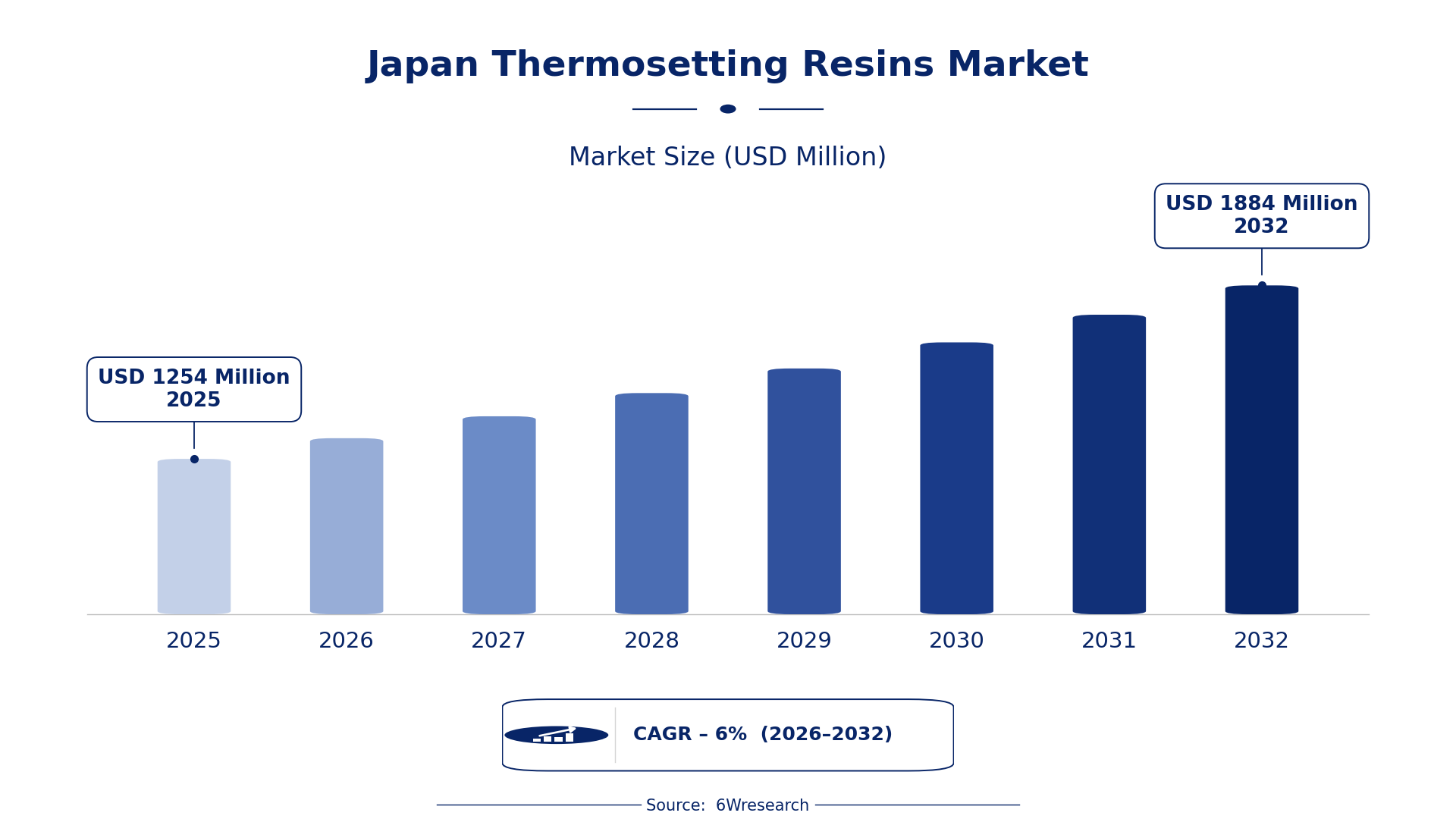
According to 6Wresearch internal database and industry insights, the Japan Thermosetting Resins Market was valued at USD 1,254 Million in 2025 and is projected to reach USD 1,884 Million by 2032, growing at a CAGR of approximately 6% during 2026–2032.
Japan Thermosetting Resins Market Highlights
| Report Metric | Details |
| Report Name | Japan Thermosetting Resins Market (2026-2032) |
| Market Size 2025 | USD 1,254 Million |
| Market Size 2032 | USD 1,884 Million |
| Absolute Growth 2025–2032 | USD 630 Million |
| CAGR 2026–2032 | 6% |
| Peak Annual Growth | 7.1% in 2028 |
| Forecast Period | 2026–2032 |
| Historical Data | 2022–2025 |
| Base Year | 2025 |
| Leading Resin Type, 2025 | Epoxy (53% share) |
| Leading Curing Method, 2025 | Heat-Cured (40% share) |
| Leading Application, 2025 | Laminates & Coatings (48% share) |
| Leading End User, 2025 | Furniture Manufacturers (43% share) |
| Fastest-Growing Curing Method | Catalyst-Based (8.4% CAGR) |
| Fastest-Growing Application | Structural Composites (8.2% CAGR) |
| Fastest-Growing End User | Aerospace OEMs (8.0% CAGR) |
| Growing Sector | Construction |
| Key End Users | Furniture Manufacturers, Aerospace OEMs, Semiconductor Firms, Wood Panel Producers |
Japan Thermosetting Resins Market Year-wise Growth Rate and Key Drivers (2022–2032)
This graph illustrates the annual growth rates of the market from 2022 to 2032, highlighting a steady upward trajectory and projected market expansion over the forecast period.
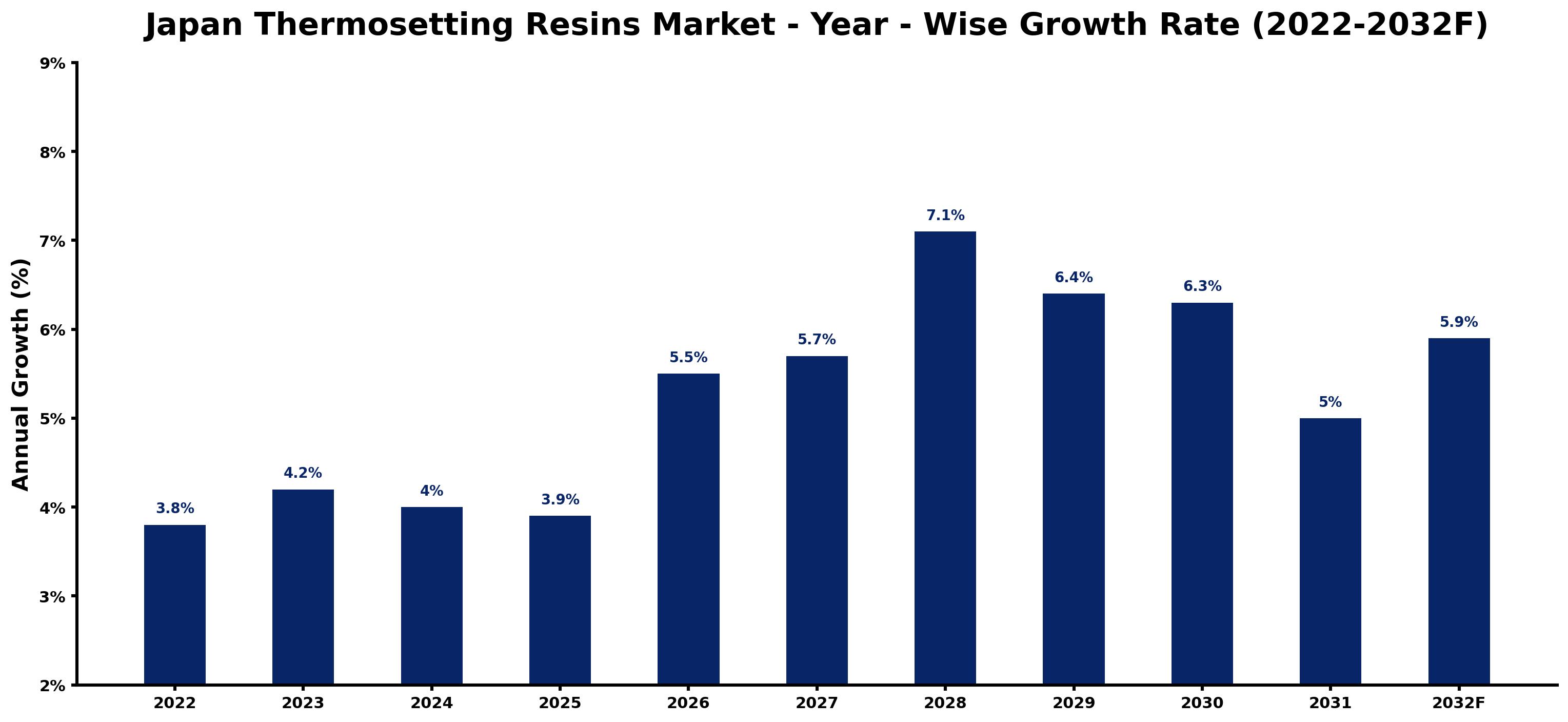
Year by year, the estimates below pair each growth rate with the development that shaped it.
| Year | Estimated Annual Growth (%) | Market Rationale |
| 2022 | 3.8 | The market exhibited steady demand from various sectors, particularly construction. |
| 2023 | 4.2 | Growth accelerated due to increased production and demand from furniture manufacturers. |
| 2024 | 4.0 | A slowdown occurred as the market adjusted to previous high growth rates. |
| 2025 | 3.9 | Market growth continued to slow as demand stabilised in key industries. |
| 2026 | 5.5 | Demand surged due to rising investments in aerospace and construction sectors. |
| 2027 | 5.7 | Growth increased as the electronics sector expanded its use of thermosetting resins. |
| 2028 | 7.1 | The market peaked with heightened demand from aerospace OEMs and construction. |
| 2029 | 6.4 | A slight slowdown followed as growth rates normalised after the peak. |
| 2030 | 6.3 | Demand remained strong, but growth rates continued to decelerate. |
| 2031 | 5.0 | The market stabilised as demand from furniture manufacturers levelled off. |
| 2032 | 5.9 | Growth is expected to rise again, driven by advancements in composite materials. |
Note: Market size estimations and growth projections presented in this report are based on 6Wresearch's proprietary forecasting methodology, utilizing the latest available industry data, government publications, and primary research inputs.
Japan Thermosetting Resins Market Synopsis
Thermosetting resins are polymers that cure to form infusible materials, primarily used in coatings, adhesives, and composites. In 2022, Japan produced approximately 150,000 tons of these resins, driven by strong demand from the construction and electronics sectors. Key factors include the growth of the furniture market, valued at over 1 trillion yen, and increasing aerospace applications projected to rise by 5% annually, indicating a robust future for thermosetting resins in Japan.
Market Dynamics Impact Analysis (2026–2032)
| Factor | Type | Impact | Primary Segment Affected |
| Growing demand from the construction industry | Driver | High | Laminates & Coatings |
| Increased aerospace applications | Driver | High | Structural Composites |
| Expansion in advanced composite materials | Opportunity | High | Structural Composites |
| Rising demand for eco-friendly resins | Opportunity | Medium | Melamine |
| Regulatory compliance costs | Restraint | High | Epoxy |
| Market saturation in furniture applications | Restraint | Medium | Laminates & Coatings |
| High competition among resin manufacturers | Challenge | High | Urea Formaldehyde |
| Fluctuating raw material prices | Challenge | Medium | Heat-Cured |
Evaluation of Drivers in Japan Thermosetting Resins Market (2026–2032)
These are the developments adding the most demand over the forecast period.
| Drivers | Primary Segment Affected | Why It Matters (Evidence) |
| Increased construction projects | Laminates & Coatings | The construction industry's value exceeding 1 trillion yen drives demand for thermosetting resins in coatings and adhesives. |
| Growth in aerospace applications | Structural Composites | The aerospace sector's projected 5% annual increase in resin use boosts demand for high-performance composites. |
| Expansion of the furniture market | Melamine | The furniture market's demand for laminates and coatings leads to higher consumption of melamine-based resins. |
| Technological advancements in resin production | Epoxy | Recent innovations improve epoxy formulations, increasing performance and attracting more buyers in various industries. |
| Rising semiconductor production | Electronics Encapsulation | The electronics sector's growth in semiconductor manufacturing increases the need for thermosetting resins for encapsulation. |
Several shifts outside the market lift sales. The construction industry's value, exceeding 1 trillion yen, drives demand for laminates and coatings, particularly in furniture production. The aerospace sector is projected to increase its use of thermosetting resins by 5% annually, further boosting demand. The growth of semiconductor production in Japan necessitates more thermosetting resins for encapsulating electronic devices, leading to increased purchases from electronics manufacturers. These factors create a strong demand for thermosetting resins across various industries.
Evaluation of Restraints in Japan Thermosetting Resins Market
Below are the constraints most often cited by buyers and suppliers, with the segment each affects.
| Market Restraint | Primary Segment Affected | Why It Matters (Evidence) |
| High compliance costs due to regulations | Epoxy | The Chemical Substances Control Law imposes strict evaluations, raising production costs for manufacturers by approximately 15%. |
| Market saturation in furniture applications | Laminates & Coatings | With over 60% of wood panel production using thermosetting resins, growth potential is limited. |
| Fluctuating raw material prices | Urea Formaldehyde | Volatility in raw material costs affects pricing strategies for resin producers, impacting margins by around 10%. |
| Intense competition among manufacturers | Melamine | Numerous players in the market lead to price wars, impacting profit margins by approximately 12%. |
| Limited awareness of eco-friendly alternatives | Heat-Cured | Buyers may hesitate to switch to more sustainable options, affecting market growth by limiting new product adoption. |
Japan Thermosetting Resins Market Challenges
Construction buyers in Japan face increased project costs due to supply chain disruptions, potentially inflating budgets by over 10%. Producers struggle to fulfil demand, leading to sourcing delays for thermosetting resins that can extend project timelines by several weeks. Limited skilled labour in resin production hampers output, resulting in a possible 20% decrease in production capacity for suppliers. Compliance with JIS K 6856 standards requires ongoing investments, costing producers up to 5 million yen annually, which restricts their ability to innovate and remain competitive.
Trends in the Japan Thermosetting Resins Market
The trends below show where the Japan Thermosetting Resins Market is heading.
- Shift from Traditional to Advanced Composite Materials: Since 2023, aerospace OEMs have increasingly adopted advanced composite materials, with a projected 5% annual increase in thermosetting resin use. This shift improves performance and reduces weight in aircraft, benefiting manufacturers.
- Transition from Conventional to Eco-Friendly Resins: Furniture manufacturers are prioritising eco-friendly resins, responding to consumer demand for sustainable products. In 2023, the market for eco-friendly laminates grew by 15%, indicating a shift.
- Emergence of Catalyst-Based Curing Methods: Starting in 2026, catalyst-based curing methods are gaining traction in industrial applications, with an expected CAGR of 8.4%. This trend allows for faster production cycles, appealing to manufacturers seeking efficiency.
- Growing Demand for Electronics Encapsulation: In 2022, the electronics sector significantly increased its use of thermosetting resins for encapsulation, with demand rising by 20%. This trend reflects the sector's expansion and the need for reliable protection.
Investment Opportunities in the Japan Thermosetting Resins Market
Investors looking at the Japan Thermosetting Resins Market should consider the following areas.
- Joint Ventures for Resin Production: Partnering with local manufacturers can strengthen resin production capabilities. The Tokyo region, a hub for thermosetting resin production, offers opportunities for collaboration to meet rising demand.
- Investment in Eco-Friendly Resin Development: With the market for eco-friendly laminates growing by 15%, supplying sustainable resins presents a promising opportunity. Engaging with furniture manufacturers can facilitate entry into this expanding segment.
- Expansion of Aerospace Applications: The aerospace sector's projected increase of 5% annually creates a gap for high-performance resins. Suppliers can enter through partnerships with aerospace OEMs to meet this demand.
- Development of Advanced Electronics Encapsulation Solutions: The electronics sector's increasing need for encapsulation presents an opportunity. Suppliers can explore certifications to provide tailored solutions for semiconductor firms.
Government Initiatives in the Japan Thermosetting Resins Market
The Chemical Substances Control Law, enacted in 1973, requires manufacturers to evaluate and control chemical substances used in thermosetting resins. This law ensures safety and compliance in production processes, impacting how producers operate. The Plastic Resource Circulation Act, introduced in 2021, promotes the reduction and recycling of plastics, encouraging the development of alternative materials, including eco-friendly thermosetting resins.
The Ministry of Economy, Trade and Industry supports initiatives to improve resin production capabilities, providing funding for projects aimed at increasing efficiency. The Japan Chemical Industry Association oversees the development of thermosetting resin technologies, facilitating research and innovation in this sector.
Future Insight of the Japan Thermosetting Resins Market
Advancements in composite material technology will transform demand for thermosetting resins by 2032, particularly within the aerospace sector, projected to increase usage by 5% annually. The government's new programme promoting advanced composites will drive innovation and efficiency in production processes. Enhanced production capabilities, supported by the Ministry of Economy, Trade and Industry, will allow suppliers to respond to growing market needs more effectively. As the furniture market expands, the demand for high-quality laminates and coatings will further increase opportunities for resin applications.
Market Segmentation Analysis
Japan Thermosetting Resins Market report covers a detailed analysis of the following market segments:
By Resin Type – Epoxy Leads and Records the Fastest Growth
According to Saurav Kr Singh, Senior Research Analyst at 6Wresearch, with 53% of resin type revenue in 2025, Epoxy was the largest category. Epoxy holds the largest market share due to its critical role in structural composites, particularly for aerospace applications. The extensive demand from manufacturers focused on high-performance materials reinforces its dominant position in Japan's thermosetting resin market. Epoxy is also forecast to expand faster than any other category, at a CAGR of 8.3% over 2026–2032. The epoxy segment also experiences the fastest growth, fuelled by increasing applications in aerospace as government initiatives promote advanced composite materials. This dual role will likely widen its market lead as demand continues to rise. Suppliers should prioritise enhancing epoxy production capabilities to effectively meet the growing demand.
By Curing Method – Heat-Cured Leads, Catalyst-Based Expected to Grow Fastest
Heat-Cured accounted for 40% of the market by curing method in 2025. Heat-Cured methods dominate the market as they are the standard for curing thermosetting resins across various applications. Their established presence in sectors like construction ensures continued reliance on this method for effective production. The quickest growth will come from Catalyst-Based, forecast to expand at a CAGR of 8.4% between 2026 and 2032. Catalyst-Based curing is rapidly gaining traction due to its efficiency in accelerating curing processes, especially in industrial applications. This growth indicates a shift towards more effective production techniques that can meet rising demands. Buyers should explore catalyst-based options to enhance their production efficiency and responsiveness.
By Application – Laminates & Coatings Lead, Structural Composites Expected to Grow Fastest
Laminates & Coatings held 48% of the Japan Thermosetting Resins Market by application in 2025. Laminates and Coatings represent the largest application area, particularly within the furniture sector, which generates substantial demand for thermosetting resins. The established use of these materials in furniture production ensures a stable market presence. Structural Composites are projected to grow fastest, at a CAGR of 8.2% during 2026–2032. Structural Composites are witnessing the fastest growth, driven by rising demands in aerospace and automotive industries for lightweight, durable materials. This trend underscores a shift towards more advanced applications in these critical sectors. Suppliers should consider expanding their product offerings in structural composites to capitalise on this growth opportunity.
By End User – Furniture Manufacturers Lead, Aerospace OEMs Expected to Grow Fastest
The largest end user category in 2025 was Furniture Manufacturers, at 43% of revenue. Furniture Manufacturers are the primary end users of thermosetting resins, utilising them extensively in their production processes. The scale and consistency of this sector guarantee ongoing demand for these materials, solidifying their market presence. Aerospace OEMs are set to record the highest CAGR in this split, 8.0% over 2026–2032. Aerospace OEMs represent the fastest-growing segment, propelled by increasing requirements for high-performance composites that meet stringent industry standards. This growth reflects a broader trend towards advanced materials in aerospace applications. Suppliers must adapt their strategies to meet the specific needs of aerospace OEMs to effectively capture this emerging market.
Key Attractiveness of the Report
- 10 Years of Market Numbers
- Historical Data Starting from 2022 to 2025
- Base Year 2025
- Forecast Data until 2032
- Key Performance Indicators Impacting the Market
- Major Upcoming Developments and Projects
Key Highlights of the Report:
- Japan Thermosetting Resins Market Outlook
- Market Size of Japan Thermosetting Resins Market, 2025
- Forecast of Japan Thermosetting Resins Market, 2032
- Historical Data and Forecast of Japan Thermosetting Resins Revenues & Volume for the Period 2022-2032F
- Japan Thermosetting Resins Market Trend Evolution
- Japan Thermosetting Resins Market Drivers and Challenges
- Japan Thermosetting Resins Price Trends
- Japan Thermosetting Resins Porter's Five Forces
- Japan Thermosetting Resins Industry Life Cycle
- Historical Data and Forecast of Japan Thermosetting Resins Market Revenues & Volume By Resin Type for the Period 2022-2032F
- Historical Data and Forecast of Japan Thermosetting Resins Market Revenues & Volume By Melamine for the Period 2022-2032F
- Historical Data and Forecast of Japan Thermosetting Resins Market Revenues & Volume By Urea Formaldehyde for the Period 2022-2032F
- Historical Data and Forecast of Japan Thermosetting Resins Market Revenues & Volume By Epoxy for the Period 2022-2032F
- Historical Data and Forecast of Japan Thermosetting Resins Market Revenues & Volume By Silicone Resin for the Period 2022-2032F
- Historical Data and Forecast of Japan Thermosetting Resins Market Revenues & Volume By Curing Method for the Period 2022-2032F
- Historical Data and Forecast of Japan Thermosetting Resins Market Revenues & Volume By Heat-Cured for the Period 2022-2032F
- Historical Data and Forecast of Japan Thermosetting Resins Market Revenues & Volume By Catalyst-Based for the Period 2022-2032F
- Historical Data and Forecast of Japan Thermosetting Resins Market Revenues & Volume By Thermal/UV Cure for the Period 2022-2032F
- Historical Data and Forecast of Japan Thermosetting Resins Market Revenues & Volume By Cold Cure for the Period 2022-2032F
- Historical Data and Forecast of Japan Thermosetting Resins Market Revenues & Volume By Application for the Period 2022-2032F
- Historical Data and Forecast of Japan Thermosetting Resins Market Revenues & Volume By Laminates & Coatings for the Period 2022-2032F
- Historical Data and Forecast of Japan Thermosetting Resins Market Revenues & Volume By Plywood & MDF for the Period 2022-2032F
- Historical Data and Forecast of Japan Thermosetting Resins Market Revenues & Volume By Structural Composites for the Period 2022-2032F
- Historical Data and Forecast of Japan Thermosetting Resins Market Revenues & Volume By Electronics Encapsulation for the Period 2022-2032F
- Historical Data and Forecast of Japan Thermosetting Resins Market Revenues & Volume By End User for the Period 2022-2032F
- Historical Data and Forecast of Japan Thermosetting Resins Market Revenues & Volume By Furniture Manufacturers for the Period 2022-2032F
- Historical Data and Forecast of Japan Thermosetting Resins Market Revenues & Volume By Wood Panel Producers for the Period 2022-2032F
- Historical Data and Forecast of Japan Thermosetting Resins Market Revenues & Volume By Aerospace OEMs for the Period 2022-2032F
- Historical Data and Forecast of Japan Thermosetting Resins Market Revenues & Volume By Semiconductor Firms for the Period 2022-2032F
- Japan Thermosetting Resins Import Export Trade Statistics
- Market Opportunity Assessment By Resin Type
- Market Opportunity Assessment By Curing Method
- Market Opportunity Assessment By Application
- Market Opportunity Assessment By End User
- Japan Thermosetting Resins Top Companies Market Share
- Japan Thermosetting Resins Competitive Benchmarking By Technical and Operational Parameters
- Japan Thermosetting Resins Company Profiles
- Japan Thermosetting Resins Key Strategic Recommendations
Market Covered
The following segment groups are covered in the report.
By Resin Type
- Melamine
- Urea Formaldehyde
- Epoxy
- Silicone Resin
By Curing Method
- Heat-Cured
- Catalyst-Based
- Thermal/UV Cure
- Cold Cure
By Application
- Laminates & Coatings
- Plywood & MDF
- Structural Composites
- Electronics Encapsulation
By End User
- Furniture Manufacturers
- Wood Panel Producers
- Aerospace OEMs
- Semiconductor Firms































