Japan third-party logistics for vehicles Market Size & Growth Rate
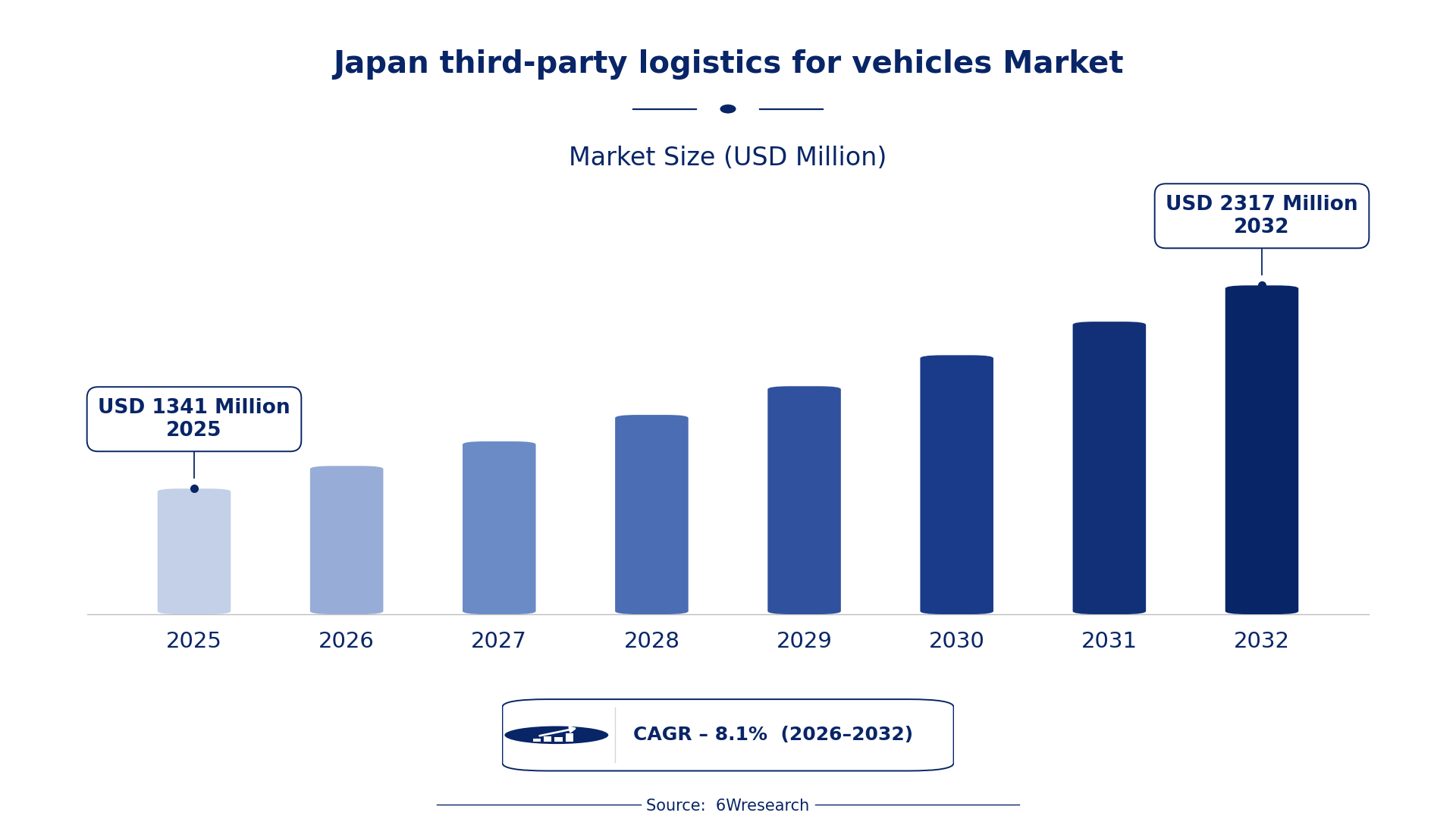
According to 6Wresearch internal database and industry insights, the Japan third-party logistics for vehicles Market was valued at USD 1,341 Million in 2025 and is projected to reach USD 2,317 Million by 2032, growing at a CAGR of approximately 8.1% during 2026–2032.
Japan third-party logistics for vehicles Market Highlights
| Report Metric | Details |
| Report Name | Japan third-party logistics for vehicles Market (2026-2032) |
| Market Size 2025 | USD 1,341 Million |
| Market Size 2032 | USD 2,317 Million |
| Absolute Growth 2025–2032 | USD 976 Million |
| CAGR 2026–2032 | 8.1% |
| Peak Annual Growth | 9.2% in 2028 |
| Forecast Period | 2026–2032 |
| Historical Data | 2022–2025 |
| Base Year | 2025 |
| Leading Service Type, 2025 | Inbound Logistics (48% share) |
| Leading Transport Mode, 2025 | Road/Rail (43% share) |
| Leading Client Type, 2025 | OEMs (49% share) |
| Leading End User, 2025 | Auto Manufacturers (43% share) |
| Fastest-Growing Service Type | Finished Vehicle Logistics (10.5% CAGR) |
| Fastest-Growing Transport Mode | Sea/Truck (10.9% CAGR) |
| Fastest-Growing Client Type | Dealerships (11.0% CAGR) |
| Fastest-Growing End User | Auto Distributors (10.1% CAGR) |
| Growing Sector | Auto Distributors |
| Key End Users | Auto Manufacturers, Auto Distributors, Parts Retailers, Vehicle Leasing Firms |
Japan third-party logistics for vehicles Market Year-wise Growth Rate and Key Drivers (2022–2032)
This graph illustrates the annual growth rates of the market from 2022 to 2032, highlighting a steady upward trajectory and projected market expansion over the forecast period.
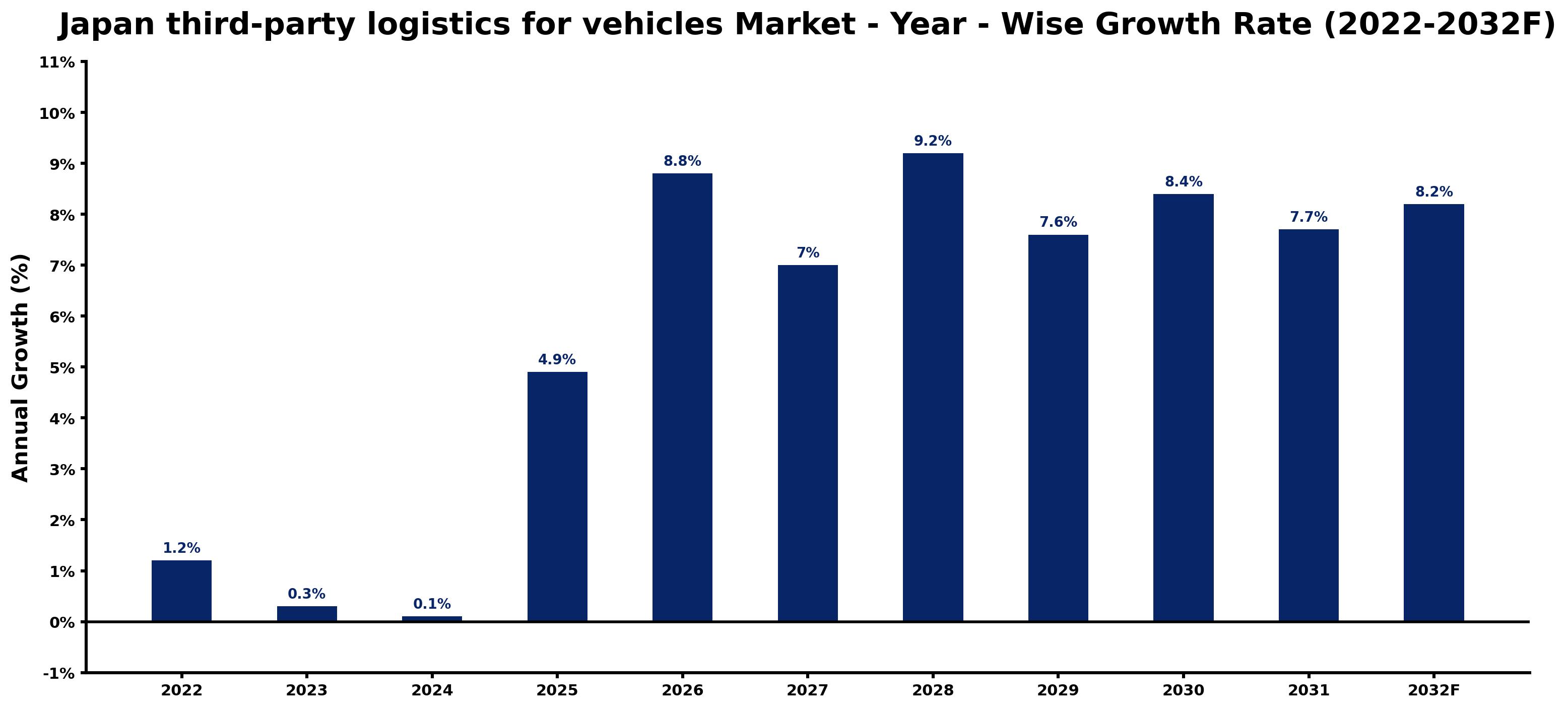
The yearly estimates that follow link every growth rate to its principal driver, so readers can see why the pace changed in each period.
| Year | Estimated Annual Growth (%) | Market Rationale |
| 2022 | 1.2 | The market experienced moderate growth due to steady automotive production levels. |
| 2023 | 0.3 | Growth slowed as manufacturers faced supply chain disruptions and labour shortages. |
| 2024 | 0.1 | Growth continued to slow as the logistics sector adjusted to changing demands. |
| 2025 | 4.9 | Demand surged as manufacturers ramped up production to meet domestic needs. |
| 2026 | 8.8 | Growth is expected to accelerate as investments in logistics infrastructure begin to take effect. |
| 2027 | 7.0 | Growth will slow as the market stabilises after a period of rapid expansion. |
| 2028 | 9.2 | The market is projected to peak as demand for finished vehicle logistics reaches new heights. |
| 2029 | 7.6 | Growth will slow as the market adjusts to peak demand levels. |
| 2030 | 8.4 | Demand is expected to increase again as new technologies improve logistics efficiency. |
| 2031 | 7.7 | Growth is projected to slow as the market begins to normalise after previous peaks. |
| 2032 | 8.2 | Demand will remain strong as the automotive sector continues to evolve. |
Note: Market size estimations and growth projections presented in this report are based on 6Wresearch's proprietary forecasting methodology, utilizing the latest available industry data, government publications, and primary research inputs.
Japan third-party logistics for vehicles Market Synopsis
Third-party logistics for vehicles in Japan involves managing and transporting automotive products, including finished vehicles and spare parts. The Japan third-party logistics for vehicles Market is projected to be worth over 1 trillion yen, driven by strong domestic demand from manufacturers and dealerships. The Kanto region serves as a major hub for logistics operations, while the government's green logistics initiative launched in 2023 aims to reduce carbon emissions, further stimulating investment in the sector.
Market Dynamics Impact Analysis (2026–2032)
| Factor | Type | Impact | Primary Segment Affected |
| Rising domestic vehicle production | Driver | High | Finished Vehicle Logistics |
| Increased demand for spare parts | Driver | High | Spare Parts Logistics |
| Growing investment in logistics infrastructure | Opportunity | High | Inbound Logistics |
| Expansion of electric vehicle logistics | Opportunity | Medium | Finished Vehicle Logistics |
| Labour shortages in the logistics sector | Restraint | High | Inbound Logistics |
| High logistics costs impacting profitability | Restraint | Medium | Spare Parts Logistics |
| Technological integration challenges | Challenge | High | Finished Vehicle Logistics |
| Regulatory compliance costs | Challenge | Medium | Inbound Logistics |
Evaluation of Drivers in Japan third-party logistics for vehicles Market (2026–2032)
The factors lifting demand, and the evidence behind each, are summarised below.
| Drivers | Primary Segment Affected | Why It Matters (Evidence) |
| Increased vehicle production levels | Finished Vehicle Logistics | Japan's automotive manufacturers produced over 5 million vehicles annually, driving demand for logistics services. |
| Growing aftermarket services | Spare Parts Logistics | With the average age of vehicles exceeding 10 years, demand for spare parts logistics is rising. |
| Investments in logistics technology | Inbound Logistics | The logistics sector is expected to see increased automation and technology adoption by 2025. |
| Expansion of electric vehicle market | Finished Vehicle Logistics | The logistics of electric vehicles is becoming increasingly important, reflecting changing consumer preferences. |
| Government initiatives promoting green logistics | Inbound Logistics | The green logistics initiative launched in 2023 aims to reduce carbon emissions, boosting logistics investments. |
Several shifts outside the market lift sales. In 2022, Japan produced over 5 million vehicles, which increased demand for finished vehicle logistics. The average age of vehicles exceeds 10 years, leading to a rise in spare parts logistics. By 2025, the logistics sector is expected to adopt increased automation, improving efficiency.
Evaluation of Restraints in Japan third-party logistics for vehicles Market
These restraints slow adoption and weigh on supplier margins.
| Market Restraint | Primary Segment Affected | Why It Matters (Evidence) |
| Labour shortages impacting logistics operations | Inbound Logistics | Japan's logistics sector employed approximately 1.5 million people in 2022, but shortages are limiting capacity. |
| High logistics costs affecting profitability | Spare Parts Logistics | The automotive sector accounts for about 20% of Japan's total logistics costs, straining margins. |
| Challenges in integrating new technologies | Finished Vehicle Logistics | Logistics providers face difficulties in adopting advanced technologies, impacting efficiency. |
| Increased operational costs from regulatory compliance | Inbound Logistics | Strict safety regulations increase operational costs for logistics providers. |
| Fluctuating fuel prices impacting logistics costs | Finished Vehicle Logistics | Rising fuel prices directly affect transportation costs, squeezing logistics margins. |
Japan third-party logistics for vehicles Market Challenges
Logistics providers in Japan face challenges due to outdated technology, complicating the management of over 5 million registered vehicles each year and leading to inefficiencies. Buyers experience delays, as these issues can extend delivery times beyond the standard 3-5 days, disrupting their supply chains. A shortage of skilled workers in the logistics sector forces suppliers to rely on overtime, significantly raising operational costs. Rising expenses from the national minimum wage increase to JPY 1,055 per hour further pressure profit margins, complicating pricing strategies for logistics providers.
Trends in the Japan third-party logistics for vehicles Market
The following changes are redrawing the Japan third-party logistics for vehicles Market.
- Shift towards Electric Vehicle Logistics: The logistics of electric vehicles is becoming increasingly important in Japan, with the government promoting green initiatives. In 2023, the green logistics initiative was launched to support this transition.
- Increased Automation in Logistics Operations: Logistics providers are adopting automation technologies to improve efficiency. By 2025, increased automation is expected to improve operational capabilities across the sector.
- Expansion of Green Logistics Practices: The government initiated a green logistics initiative in 2023, targeting reduced carbon emissions. This initiative aims to reshape logistics practices within the automotive sector.
- Growth in Spare Parts Logistics Demand: As the average age of vehicles in Japan exceeds 10 years, demand for spare parts logistics is rising. This trend reflects the need for efficient supply chains to support maintenance.
Investment Opportunities in the Japan third-party logistics for vehicles Market
The openings below show where demand in the Japan third-party logistics for vehicles Market is visible and how suppliers can enter.
- Timing for Infrastructure Investments: With the logistics market projected to be worth over 1 trillion yen, there is an opportunity for investment in infrastructure. The Kanto region is a key hub for logistics operations.
- Entry through Partnerships: Local partnerships can facilitate entry into the logistics market, especially for new technologies. Collaborating with regional logistics providers can improve service offerings.
- Supply Chain Optimization Services: The demand for optimizing supply chains is increasing, particularly among OEMs. Investing in logistics management solutions can meet this growing need.
- Gap in Electric Vehicle Logistics: With the rise of electric vehicles, there is a gap in logistics services tailored for this market. Focusing on electric vehicle logistics can provide growth opportunities.
Government Initiatives in the Japan third-party logistics for vehicles Market
The regulatory framework governing vehicle logistics in Japan is influenced by laws from the Ministry of Land, Infrastructure, Transport and Tourism, which ensure safety and efficiency in transportation. The Green Growth Strategy aims to support sustainable logistics practices, targeting a 46% reduction in greenhouse-gas emissions by 2030, which directly affects third-party logistics operations and their compliance requirements.
The Japan Automobile Manufacturers Association oversees vehicle logistics standards and promotes best practices in the sector. In 2023, the government allocated 5 billion yen for infrastructure improvements in logistics, aiding the development of efficient transportation networks.
Future Insight of the Japan third-party logistics for vehicles Market
The investment pipeline is projected to reach 5 billion yen, driving demand for advanced automation and technology in the logistics sector by 2032. This transformation will improve efficiency, enabling suppliers to meet the growing need for electric vehicle logistics. Stricter vehicle logistics standards will promote compliance and safety, benefiting both buyers and suppliers. The government's green logistics initiative will encourage sustainable practices, aligning with Japan's commitment to achieving net zero emissions by 2050.
Market Segmentation Analysis
Japan third-party logistics for vehicles Market report covers a detailed analysis of the following market segments:
By Service Type – Inbound Logistics Leads, Finished Vehicle Logistics Expected to Grow Fastest
According to Saurav Kr Singh, Senior Research Analyst at 6Wresearch, in 2025, Inbound Logistics led the service type split with a 48% share. Inbound logistics holds the largest share due to its essential function in receiving parts from suppliers to manufacturers, which is crucial for maintaining production schedules. This segment is particularly important in Japan's automotive industry, which requires logistics for over 5 million registered vehicles annually. Finished Vehicle Logistics is projected to grow fastest, at a CAGR of 10.5% during 2026–2032. Finished vehicle logistics is seeing rapid growth as dealerships demand quicker deliveries to meet customer expectations. The average delivery time of 3-5 days within Japan highlights the urgency for this segment, ensuring it remains a priority for logistics providers. Suppliers must optimise their inbound logistics processes to stay competitive in this growing market.
By Transport Mode – Road/Rail Leads, Sea/Truck Expected to Grow Fastest
The largest transport mode category in 2025 was Road/Rail, at 43% of revenue. Road and rail are the primary transport modes for vehicle logistics in Japan, effectively managing the majority of domestic transportation needs. This infrastructure supports the high volume of logistics activities necessary for the automotive sector. Sea/Truck is set to record the highest CAGR in this split, 10.9% over 2026–2032. Sea and truck transport is growing rapidly, fuelled by the increasing demand for international shipping of vehicles and parts. This trend is driven by Japan's expanding role in global automotive trade, necessitating efficient logistics solutions. Buyers should consider diversifying their transport methods to enhance logistics efficiency and reduce costs.
By Client Type – OEMs Lead, Dealerships Expected to Grow Fastest
OEMs accounted for 49% of the market by client type in 2025. OEMs represent the largest client type, as they require extensive logistics services to support their manufacturing processes, significantly influencing the logistics market. Their substantial production volumes create a strong demand for efficient supply chain management. The quickest growth will come from Dealerships, forecast to expand at a CAGR of 11.0% between 2026 and 2032. Dealerships are the fastest-growing client type, spurred by rising consumer demand for new vehicles and the need for efficient distribution networks. As dealerships expand their operations, their logistics needs will continue to increase, presenting opportunities for providers. Logistics providers should customise their services to align with the evolving needs of dealerships to capture this expanding market.
By End User – Auto Manufacturers Lead, Auto Distributors Expected to Grow Fastest
With 43% of end user revenue in 2025, Auto Manufacturers was the largest category. Auto manufacturers constitute the largest end user group, relying heavily on timely logistics for both parts and finished vehicles. Their critical role in the automotive supply chain underscores the need for effective logistics solutions to maintain operational efficiency. Over 2026–2032, Auto Distributors are expected to post the fastest growth, at a CAGR of 10.1%. Auto distributors are experiencing the fastest growth among end users, driven by the increasing demand for efficient distribution to dealerships. This trend indicates a rising necessity for robust logistics channels as the automotive market continues to expand. Logistics firms should enhance their service offerings to better support the distribution requirements of auto distributors.
Key Attractiveness of the Report
- 10 Years of Market Numbers
- Historical Data Starting from 2022 to 2025
- Base Year 2025
- Forecast Data until 2032
- Key Performance Indicators Impacting the Market
- Major Upcoming Developments and Projects
Key Highlights of the Report:
- Japan third-party logistics for vehicles Market Outlook
- Market Size of Japan third-party logistics for vehicles Market, 2025
- Forecast of Japan third-party logistics for vehicles Market, 2032
- Historical Data and Forecast of Japan third-party logistics for vehicles Revenues & Volume for the Period 2022-2032F
- Japan third-party logistics for vehicles Market Trend Evolution
- Japan third-party logistics for vehicles Market Drivers and Challenges
- Japan third-party logistics for vehicles Price Trends
- Japan third-party logistics for vehicles Porter's Five Forces
- Japan third-party logistics for vehicles Industry Life Cycle
- Historical Data and Forecast of Japan third-party logistics for vehicles Market Revenues & Volume By Service Type for the Period 2022-2032F
- Historical Data and Forecast of Japan third-party logistics for vehicles Market Revenues & Volume By Inbound Logistics for the Period 2022-2032F
- Historical Data and Forecast of Japan third-party logistics for vehicles Market Revenues & Volume By Finished Vehicle Logistics for the Period 2022-2032F
- Historical Data and Forecast of Japan third-party logistics for vehicles Market Revenues & Volume By Spare Parts Logistics for the Period 2022-2032F
- Historical Data and Forecast of Japan third-party logistics for vehicles Market Revenues & Volume By Reverse Logistics for the Period 2022-2032F
- Historical Data and Forecast of Japan third-party logistics for vehicles Market Revenues & Volume By Transport Mode for the Period 2022-2032F
- Historical Data and Forecast of Japan third-party logistics for vehicles Market Revenues & Volume By Road/Rail for the Period 2022-2032F
- Historical Data and Forecast of Japan third-party logistics for vehicles Market Revenues & Volume By Sea/Truck for the Period 2022-2032F
- Historical Data and Forecast of Japan third-party logistics for vehicles Market Revenues & Volume By Express Delivery for the Period 2022-2032F
- Historical Data and Forecast of Japan third-party logistics for vehicles Market Revenues & Volume By Pickup + Return for the Period 2022-2032F
- Historical Data and Forecast of Japan third-party logistics for vehicles Market Revenues & Volume By Client Type for the Period 2022-2032F
- Historical Data and Forecast of Japan third-party logistics for vehicles Market Revenues & Volume By OEMs for the Period 2022-2032F
- Historical Data and Forecast of Japan third-party logistics for vehicles Market Revenues & Volume By Dealerships for the Period 2022-2032F
- Historical Data and Forecast of Japan third-party logistics for vehicles Market Revenues & Volume By Aftermarket Suppliers for the Period 2022-2032F
- Historical Data and Forecast of Japan third-party logistics for vehicles Market Revenues & Volume By Used Vehicles for the Period 2022-2032F
- Historical Data and Forecast of Japan third-party logistics for vehicles Market Revenues & Volume By End User for the Period 2022-2032F
- Historical Data and Forecast of Japan third-party logistics for vehicles Market Revenues & Volume By Auto Manufacturers for the Period 2022-2032F
- Historical Data and Forecast of Japan third-party logistics for vehicles Market Revenues & Volume By Auto Distributors for the Period 2022-2032F
- Historical Data and Forecast of Japan third-party logistics for vehicles Market Revenues & Volume By Parts Retailers for the Period 2022-2032F
- Historical Data and Forecast of Japan third-party logistics for vehicles Market Revenues & Volume By Vehicle Leasing Firms for the Period 2022-2032F
- Japan third-party logistics for vehicles Import Export Trade Statistics
- Market Opportunity Assessment By Service Type
- Market Opportunity Assessment By Transport Mode
- Market Opportunity Assessment By Client Type
- Market Opportunity Assessment By End User
- Japan third-party logistics for vehicles Top Companies Market Share
- Japan third-party logistics for vehicles Competitive Benchmarking By Technical and Operational Parameters
- Japan third-party logistics for vehicles Company Profiles
- Japan third-party logistics for vehicles Key Strategic Recommendations
Market Covered
This report examines the market across the segments below.
By Service Type
- Inbound Logistics
- Finished Vehicle Logistics
- Spare Parts Logistics
- Reverse Logistics
By Transport Mode
- Road/Rail
- Sea/Truck
- Express Delivery
- Pickup + Return
By Client Type
- OEMs
- Dealerships
- Aftermarket Suppliers
- Used Vehicles
By End User
- Auto Manufacturers
- Auto Distributors
- Parts Retailers
- Vehicle Leasing Firms































