Japan Thixotropic Clay Market Size & Growth Rate
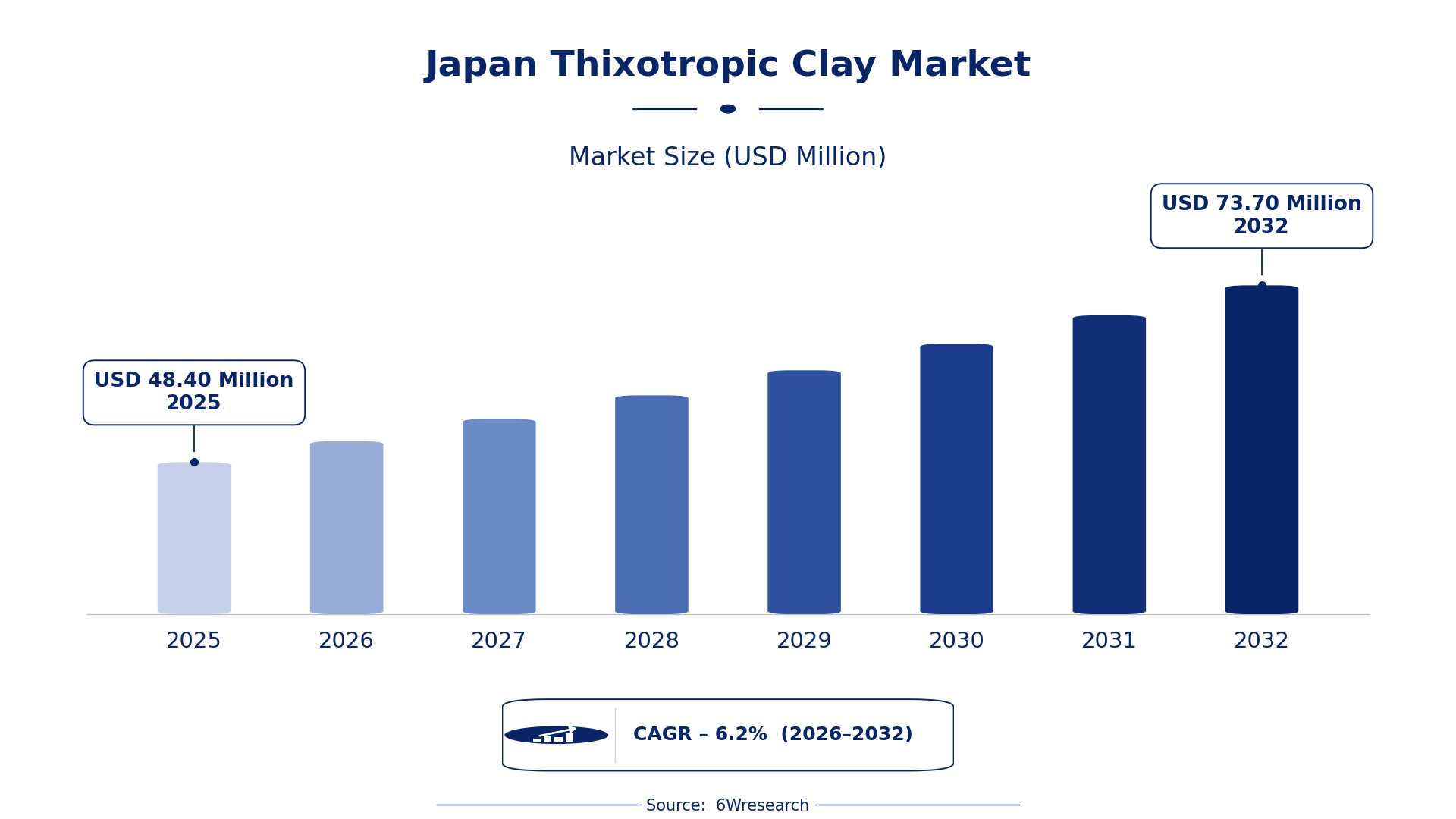
According to 6Wresearch internal database and industry insights, the Japan Thixotropic Clay Market was valued at USD 48.40 Million in 2025 and is projected to reach USD 73.70 Million by 2032, growing at a CAGR of approximately 6.2% during 2026–2032.
Japan Thixotropic Clay Market Highlights
| Report Metric | Details |
| Report Name | Japan Thixotropic Clay Market (2026-2032) |
| Market Size 2025 | USD 48.40 Million |
| Market Size 2032 | USD 73.70 Million |
| Absolute Growth 2025–2032 | USD 25.30 Million |
| CAGR 2026–2032 | 6.2% |
| Peak Annual Growth | 7.2% in 2032 |
| Forecast Period | 2026–2032 |
| Historical Data | 2022–2025 |
| Base Year | 2025 |
| Leading Clay Type, 2025 | Organoclay (43% share) |
| Leading Base Material, 2025 | Bentonite (36% share) |
| Leading Functionality, 2025 | Rheology Modifier (37% share) |
| Leading End User, 2025 | Paint Manufacturers (51% share) |
| Fastest-Growing Clay Type | Synthetic Clay (9.0% CAGR) |
| Fastest-Growing Base Material | Modified Silicates (8.6% CAGR) |
| Fastest-Growing Functionality | Suspension Stability (8.0% CAGR) |
| Fastest-Growing End User | Cosmetics Industry (8.1% CAGR) |
| Growing Sector | Cosmetics Industry |
| Key End Users | Paint Manufacturers, Cosmetics Industry, Oil & Gas Drillers, Polymer Manufacturers |
Japan Thixotropic Clay Market Year-wise Growth Rate and Key Drivers (2022–2032)
This graph illustrates the annual growth rates of the market from 2022 to 2032, highlighting a steady upward trajectory and projected market expansion over the forecast period.
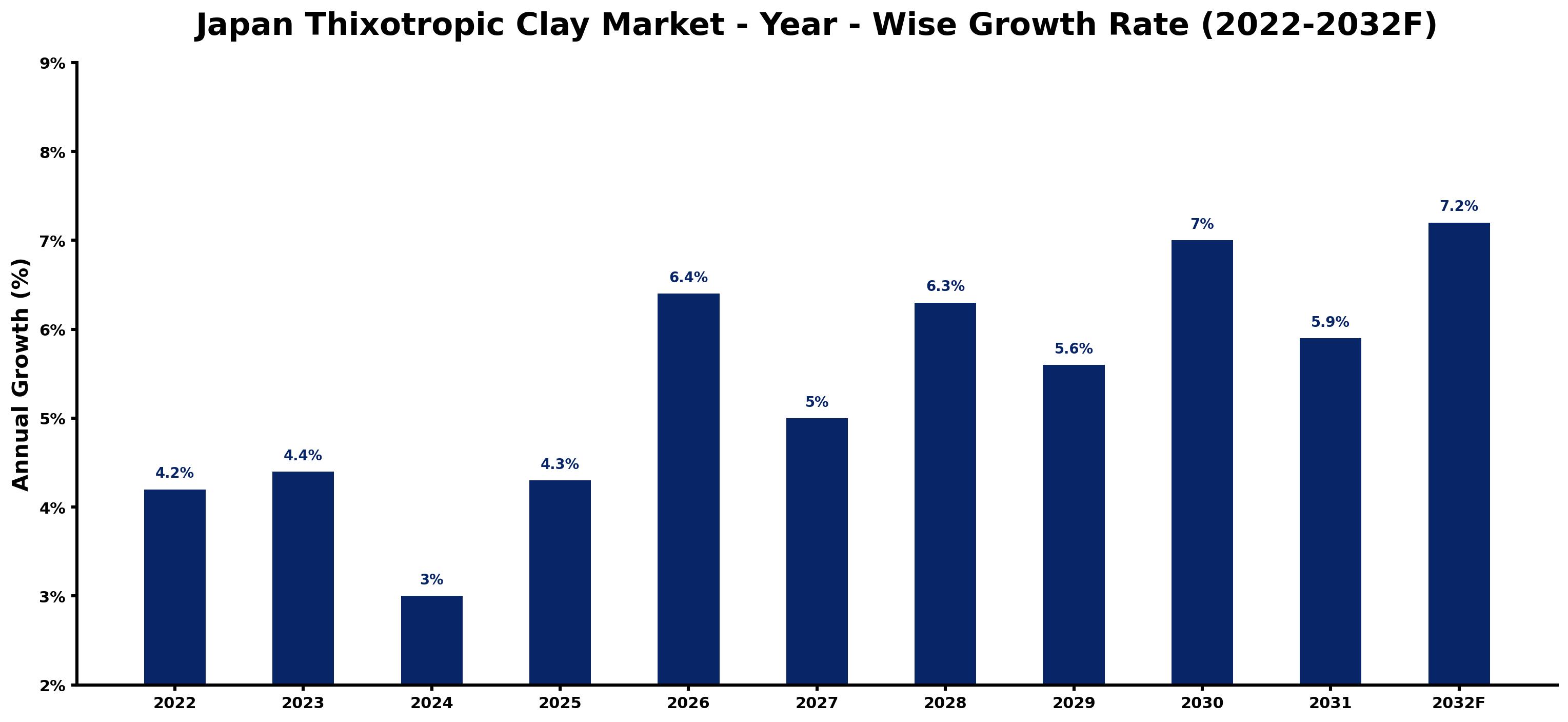
The following figures match every annual growth estimate with the main market development of that year, giving the reasoning behind each rise or slowdown.
| Year | Estimated Annual Growth (%) | Market Rationale |
| 2022 | 4.2 | Demand remained steady, driven by established industries utilizing thixotropic clay. |
| 2023 | 4.4 | Growth accelerated due to increased production in the cosmetics sector and paint formulations. |
| 2024 | 3.0 | Growth slowed as manufacturers adjusted to market conditions and demand patterns. |
| 2025 | 4.3 | Demand rose again, supported by new projects in the paint industry and construction. |
| 2026 | 6.4 | The market saw a surge as investments in innovative processing technologies increased. |
| 2027 | 5.0 | Growth slowed slightly as supply chain challenges affected production timelines. |
| 2028 | 6.3 | Demand picked up again, driven by rising cosmetics consumption and industrial applications. |
| 2029 | 5.6 | Growth decelerated as manufacturers faced competition from alternative materials. |
| 2030 | 7.0 | A resurgence in demand occurred, particularly in the oil and gas sector for drilling fluids. |
| 2031 | 5.9 | Growth moderated as market saturation in certain segments began to take effect. |
| 2032 | 7.2 | Demand peaked, driven by significant investments in sustainable mining practices. |
Note: Market size estimations and growth projections presented in this report are based on 6Wresearch's proprietary forecasting methodology, utilizing the latest available industry data, government publications, and primary research inputs.
Japan Thixotropic Clay Market Synopsis
Thixotropic clay is a unique material that alters its viscosity under shear stress, primarily sourced from natural clay minerals. Its applications span across paints, cosmetics, and drilling fluids, providing stability and flow characteristics. The Japan Thixotropic Clay Market is expanding, driven by the booming cosmetics industry, valued at over 3 trillion JPY, and the increasing demand from paint manufacturers in urban areas like Tokyo. Government initiatives to promote sustainable mining practices further support this growth, creating a favourable environment for producers and buyers alike.
Market Dynamics Impact Analysis (2026–2032)
| Factor | Type | Impact | Primary Segment Affected |
| Rising demand from the cosmetics industry for texture enhancement | Driver | High | Cosmetics Industry |
| Increased usage in industrial paints for viscosity control | Driver | High | Paint Manufacturers |
| Investment in innovative clay processing technologies | Opportunity | High | Natural Clay |
| Expansion of sustainable mining practices in clay extraction | Opportunity | Medium | Bentonite |
| Supply chain disruptions affecting raw material availability | Restraint | High | Organoclay |
| Competition from synthetic alternatives impacting market share | Restraint | Medium | Synthetic Clay |
| Rising costs of raw materials affecting production budgets | Challenge | High | Montmorillonite |
| Regulatory compliance requirements slowing down market entry | Challenge | Medium | Modified Silicates |
Evaluation of Drivers in Japan Thixotropic Clay Market (2026–2032)
Key forces behind demand, with the segment each one moves most, are listed below.
| Drivers | Primary Segment Affected | Why It Matters (Evidence) |
| Growing consumer preference for natural ingredients in cosmetics | Cosmetics Industry | This shift increases purchases of thixotropic clay as a key ingredient in formulations, with annual demand in cosmetics estimated at 50,000 tons. |
| Increased demand for high-performance paints in construction | Paint Manufacturers | The construction sector's expansion drives up the need for thixotropic clay in paint formulations, particularly in urban areas like Tokyo. |
| Rising oil and gas exploration activities requiring drilling fluids | Oil & Gas Drillers | The sector's growth boosts demand for thixotropic clay in drilling applications, with imports meeting a significant portion of this need. |
| Technological advancements in clay processing | Natural Clay | Improved processing attracts more buyers seeking high-quality thixotropic clay, enhancing product quality and consistency. |
| Urbanisation leading to higher construction and renovation projects | Bentonite | Increased construction activities in urban areas drive demand for thixotropic clay, particularly for use in paints. |
A wider customer base explains much of the growth, as the cosmetics industry increasingly favours natural ingredients, resulting in heightened demand for thixotropic clay in formulations. The construction sector's expansion, particularly in urban areas like Tokyo, has led to a surge in high-performance paint applications, further driving demand. In 2022, Japan produced approximately 1 million tons of bentonite clay, highlighting the industry's capacity to meet rising needs. The oil and gas sector relies heavily on imported thixotropic clay for drilling fluids, creating a consistent demand stream. Urbanisation is driving construction projects, leading to increased purchases of thixotropic clay for various applications.
Evaluation of Restraints in Japan Thixotropic Clay Market
Below are the constraints most often cited by buyers and suppliers, with the segment each affects.
| Market Restraint | Primary Segment Affected | Why It Matters (Evidence) |
| Price volatility of raw materials affects production costs, leading to unpredictable pricing for buyers. | Natural Clay | The reliance on natural resources makes pricing susceptible to market fluctuations, impacting buyer budgets. |
| Limited availability of high-quality thixotropic clay restricts production capacity and affects supply consistency. | Bentonite | Sourcing challenges from specific regions like Akita hinder the ability to meet growing demand. |
| Regulatory compliance costs increase operational expenses for producers, affecting pricing strategies. | Organoclay | Producers must invest in compliance with standards like JIS Z 8801, raising overall production costs. |
| Competition from synthetic alternatives poses a threat to market share for natural thixotropic clay. | Synthetic Clay | The rise of synthetic options offers lower-cost alternatives, impacting demand for natural products. |
| Environmental regulations impose restrictions on mining practices, complicating sourcing for producers. | Montmorillonite | Stricter regulations necessitate additional investments in sustainable practices, affecting supply chain efficiency. |
Japan Thixotropic Clay Market Challenges
Competition from lower-cost imports pressures local manufacturers to reduce prices, which can shrink profit margins for producers. Technology adoption is slow, as many local suppliers rely on outdated methods, delaying their ability to meet rising demand. New sustainable mining regulations increase operational costs, complicating pricing strategies for importers and distributors. A lack of skilled workers in advanced clay processing hampers innovation, resulting in potential contract losses for producers who cannot keep pace with market needs.
Trends in the Japan Thixotropic Clay Market
Several trends are reshaping the Japan Thixotropic Clay Market; the most important are set out below.
- Shift from Traditional to Sustainable Mining Practices: In 2023, the Japanese government launched a program to promote sustainable mining practices for clay, aiming to reduce environmental impact. This shift is expected to improve supplier compliance and attract environmentally conscious buyers.
- Transition from Natural to Modified Clays in Cosmetics: Since 2022, the cosmetics industry has increasingly adopted modified clays to meet evolving consumer preferences. This trend is reflected in the industry's valuation of over 3 trillion JPY, indicating a shift towards higher-quality formulations.
- Emergence of High-Performance Paints: The demand for high-performance paints has surged since 2022, particularly in urban construction projects. This trend is supported by the Japan Paint Manufacturers Association, which oversees standards for paint formulations.
- Growing Use of Thixotropic Clay in Drilling Fluids: In recent years, the oil and gas sector has expanded its use of thixotropic clay in drilling fluids, with imports playing a crucial role in meeting this demand.
Investment Opportunities in the Japan Thixotropic Clay Market
Below are the investment opportunities with the strongest case in the Japan Thixotropic Clay Market.
- Partnerships for Sustainable Mining: Local partnerships can facilitate compliance with sustainable mining practices, creating opportunities for investment in processing technologies. The government's 2023 subsidy program supports such initiatives, with a funding target of 1 billion JPY.
- Supply of High-Quality Thixotropic Clay: With annual demand in the cosmetics sector estimated at 50,000 tons, there is a significant gap for suppliers to fill. Collaborating with cosmetics manufacturers will enhance market entry.
- Investment in Advanced Processing Technologies: Investment in processing technologies is crucial, particularly as the government promotes these initiatives. Suppliers can leverage this support to improve product quality and market reach.
- Focus on Urban Construction Projects: As urbanisation drives construction, suppliers should target paint manufacturers in metropolitan areas. This strategy aligns with the projected growth in high-performance paint applications.
Government Initiatives in the Japan Thixotropic Clay Market
The Standards for Cosmetics, established in 2000 under the PMD Act, mandates that cosmetics sold in Japan adhere to specific ingredient regulations. This law ensures that thixotropic clay used in cosmetics meets safety and quality standards, benefiting both producers and consumers.
The Ministry of Economy, Trade and Industry (METI) oversees the implementation of the Hydrogen Society Promotion Act, which supports low-carbon hydrogen supply chains. This act encourages investment in sustainable practices, indirectly benefiting thixotropic clay producers by promoting environmentally friendly production methods.
Future Insight of the Japan Thixotropic Clay Market
By 2032, buyers in the cosmetics sector will benefit from improved processing technologies, driven by government subsidies for innovation. The JIS Z 8801 standard will elevate product quality and consistency, positively impacting both buyers and suppliers. Urban demand for thixotropic clay will rise, with consumption projected to reach 60,000 tons annually. Sustainable mining practices will become commonplace, ensuring a stable supply chain that aligns with environmental standards and buyer expectations.
Market Segmentation Analysis
Japan Thixotropic Clay Market report covers a detailed analysis of the following market segments:
By Clay Type – Organoclay Leads, Synthetic Clay Expected to Grow Fastest
According to Saurav Kr Singh, Senior Research Analyst at 6Wresearch, Organoclay took 43% of clay type revenue in 2025, more than any other category. Organoclay holds the largest share due to its widespread use as a rheology modifier in various applications, particularly in the paint and cosmetics industries. The strong demand from manufacturers in urban areas like Tokyo reinforces its dominant position in the market. Synthetic Clay is set to record the highest CAGR in this split, 9.0% over 2026–2032. The growth of Synthetic Clay is propelled by its increasing use in specialized formulations, particularly in high-performance applications. The rising need for tailored solutions in sectors such as cosmetics is expected to further boost its adoption. Suppliers should focus on developing tailored solutions to meet the rising demand for specialized formulations in the market.
By Base Material – Bentonite Leads, Modified Silicates Expected to Grow Fastest
Bentonite accounted for 36% of the market by base material in 2025. Bentonite holds the largest share as it is extensively utilised in drilling and construction, with Japan producing around 1 million tons annually. This widespread application across multiple sectors solidifies its position as the primary choice for thixotropic clay. Modified Silicates are projected to grow fastest, at a CAGR of 8.6% during 2026–2032. Modified Silicates are witnessing rapid growth due to their specific incorporation in formulations that require enhanced properties. The recent government initiatives promoting innovative processing technologies are expected to further boost their market presence. Suppliers should focus on enhancing the availability of Modified Silicates to meet the increasing demand in specialised applications.
By Functionality – Rheology Modifier Leads, Suspension Stability Expected to Grow Fastest
With 37% of functionality revenue in 2025, Rheology Modifier was the largest category. Rheology Modifier leads the market as it is crucial for controlling viscosity in formulations, which is vital for both paint and cosmetic products. Its essential role in ensuring optimal product performance reinforces its dominant market position. Over 2026–2032, Suspension Stability is expected to post the fastest growth, at a CAGR of 8.0%. Suspension Stability is experiencing the fastest growth because it is vital for maintaining product consistency in various applications. The rising consumer demand for high-quality formulations in cosmetics significantly contributes to this trend. Suppliers must concentrate on developing products that improve suspension stability to align with market expectations.
By End User – Paint Manufacturers Lead, Cosmetics Industry Expected to Grow Fastest
Paint Manufacturers held 51% of the Japan Thixotropic Clay Market by end user in 2025. Paint Manufacturers represent the largest user group as they are key consumers of thixotropic clay for paint formulations, incorporating it in over 60% of industrial paints produced in Japan. Their substantial demand establishes a robust foundation for this segment's market leadership. The quickest growth will come from Cosmetics Industry, forecast to expand at a CAGR of 8.1% between 2026 and 2032. The Cosmetics Industry is expanding rapidly, propelled by the significant incorporation of thixotropic clay in cosmetic products for texture and performance. The industry's valuation exceeding 3 trillion JPY highlights its potential for ongoing growth. Suppliers should seek collaborations with the cosmetics sector to take advantage of the increasing demand for thixotropic clay in cosmetic applications.
Key Attractiveness of the Report
- 10 Years of Market Numbers
- Historical Data Starting from 2022 to 2025
- Base Year 2025
- Forecast Data until 2032
- Key Performance Indicators Impacting the Market
- Major Upcoming Developments and Projects
Key Highlights of the Report:
- Japan Thixotropic Clay Market Outlook
- Market Size of Japan Thixotropic Clay Market, 2025
- Forecast of Japan Thixotropic Clay Market, 2032
- Historical Data and Forecast of Japan Thixotropic Clay Revenues & Volume for the Period 2022-2032F
- Japan Thixotropic Clay Market Trend Evolution
- Japan Thixotropic Clay Market Drivers and Challenges
- Japan Thixotropic Clay Price Trends
- Japan Thixotropic Clay Porter's Five Forces
- Japan Thixotropic Clay Industry Life Cycle
- Historical Data and Forecast of Japan Thixotropic Clay Market Revenues & Volume By Clay Type for the Period 2022-2032F
- Historical Data and Forecast of Japan Thixotropic Clay Market Revenues & Volume By Organoclay for the Period 2022-2032F
- Historical Data and Forecast of Japan Thixotropic Clay Market Revenues & Volume By Synthetic Clay for the Period 2022-2032F
- Historical Data and Forecast of Japan Thixotropic Clay Market Revenues & Volume By Natural Clay for the Period 2022-2032F
- Historical Data and Forecast of Japan Thixotropic Clay Market Revenues & Volume By Nanoclay for the Period 2022-2032F
- Historical Data and Forecast of Japan Thixotropic Clay Market Revenues & Volume By Base Material for the Period 2022-2032F
- Historical Data and Forecast of Japan Thixotropic Clay Market Revenues & Volume By Bentonite for the Period 2022-2032F
- Historical Data and Forecast of Japan Thixotropic Clay Market Revenues & Volume By Modified Silicates for the Period 2022-2032F
- Historical Data and Forecast of Japan Thixotropic Clay Market Revenues & Volume By Montmorillonite for the Period 2022-2032F
- Historical Data and Forecast of Japan Thixotropic Clay Market Revenues & Volume By Layered Silicates for the Period 2022-2032F
- Historical Data and Forecast of Japan Thixotropic Clay Market Revenues & Volume By Functionality for the Period 2022-2032F
- Historical Data and Forecast of Japan Thixotropic Clay Market Revenues & Volume By Rheology Modifier for the Period 2022-2032F
- Historical Data and Forecast of Japan Thixotropic Clay Market Revenues & Volume By Suspension Stability for the Period 2022-2032F
- Historical Data and Forecast of Japan Thixotropic Clay Market Revenues & Volume By Viscosity Control for the Period 2022-2032F
- Historical Data and Forecast of Japan Thixotropic Clay Market Revenues & Volume By Barrier Properties for the Period 2022-2032F
- Historical Data and Forecast of Japan Thixotropic Clay Market Revenues & Volume By End User for the Period 2022-2032F
- Historical Data and Forecast of Japan Thixotropic Clay Market Revenues & Volume By Paint Manufacturers for the Period 2022-2032F
- Historical Data and Forecast of Japan Thixotropic Clay Market Revenues & Volume By Cosmetics Industry for the Period 2022-2032F
- Historical Data and Forecast of Japan Thixotropic Clay Market Revenues & Volume By Oil & Gas Drillers for the Period 2022-2032F
- Historical Data and Forecast of Japan Thixotropic Clay Market Revenues & Volume By Polymer Manufacturers for the Period 2022-2032F
- Japan Thixotropic Clay Import Export Trade Statistics
- Market Opportunity Assessment By Clay Type
- Market Opportunity Assessment By Base Material
- Market Opportunity Assessment By Functionality
- Market Opportunity Assessment By End User
- Japan Thixotropic Clay Top Companies Market Share
- Japan Thixotropic Clay Competitive Benchmarking By Technical and Operational Parameters
- Japan Thixotropic Clay Company Profiles
- Japan Thixotropic Clay Key Strategic Recommendations
Market Covered
This report examines the market across the segments below.
By Clay Type
- Organoclay
- Synthetic Clay
- Natural Clay
- Nanoclay
By Base Material
- Bentonite
- Modified Silicates
- Montmorillonite
- Layered Silicates
By Functionality
- Rheology Modifier
- Suspension Stability
- Viscosity Control
- Barrier Properties
By End User
- Paint Manufacturers
- Cosmetics Industry
- Oil & Gas Drillers
- Polymer Manufacturers































