Japan Threadlocker Adhesives Market Size & Growth Rate
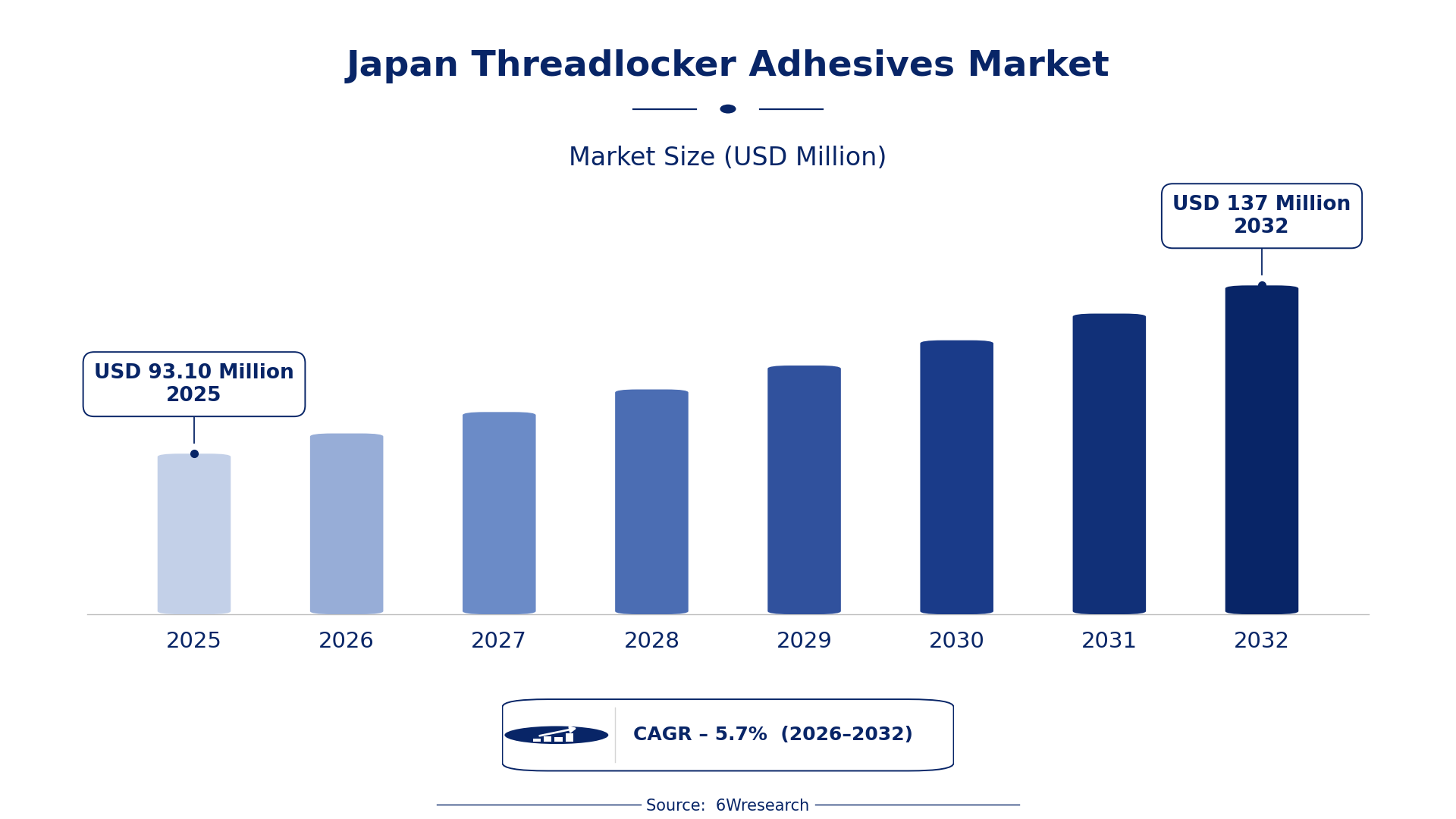
According to 6Wresearch internal database and industry insights, the Japan Threadlocker Adhesives Market was valued at USD 93.10 Million in 2025 and is projected to reach USD 137 Million by 2032, growing at a CAGR of approximately 5.7% during 2026–2032.
Japan Threadlocker Adhesives Market Highlights
| Report Metric | Details |
| Report Name | Japan Threadlocker Adhesives Market (2026-2032) |
| Market Size 2025 | USD 93.10 Million |
| Market Size 2032 | USD 137 Million |
| Absolute Growth 2025–2032 | USD 43.90 Million |
| CAGR 2026–2032 | 5.7% |
| Peak Annual Growth | 7.0% in 2032 |
| Forecast Period | 2026–2032 |
| Historical Data | 2022–2025 |
| Base Year | 2025 |
| Leading Adhesive Strength, 2025 | High Strength (34% share) |
| Leading Curing Method, 2025 | Anaerobic (47% share) |
| Leading Thread Size Suitability, 2025 | General Assembly (46% share) |
| Leading End User, 2025 | Automotive Assemblers (39% share) |
| Fastest-Growing Adhesive Strength | Low Strength (7.5% CAGR) |
| Fastest-Growing Curing Method | Surface-Insensitive (8.1% CAGR) |
| Fastest-Growing Thread Size Suitability | Greased Threads (7.6% CAGR) |
| Fastest-Growing End User | Maintenance Services (7.4% CAGR) |
| Growing Sector | Automotive |
| Key End Users | Automotive Assemblers, Electronics Industry, Maintenance Services |
Japan Threadlocker Adhesives Market Year-wise Growth Rate and Key Drivers (2022–2032)
This graph illustrates the annual growth rates of the market from 2022 to 2032, highlighting a steady upward trajectory and projected market expansion over the forecast period.
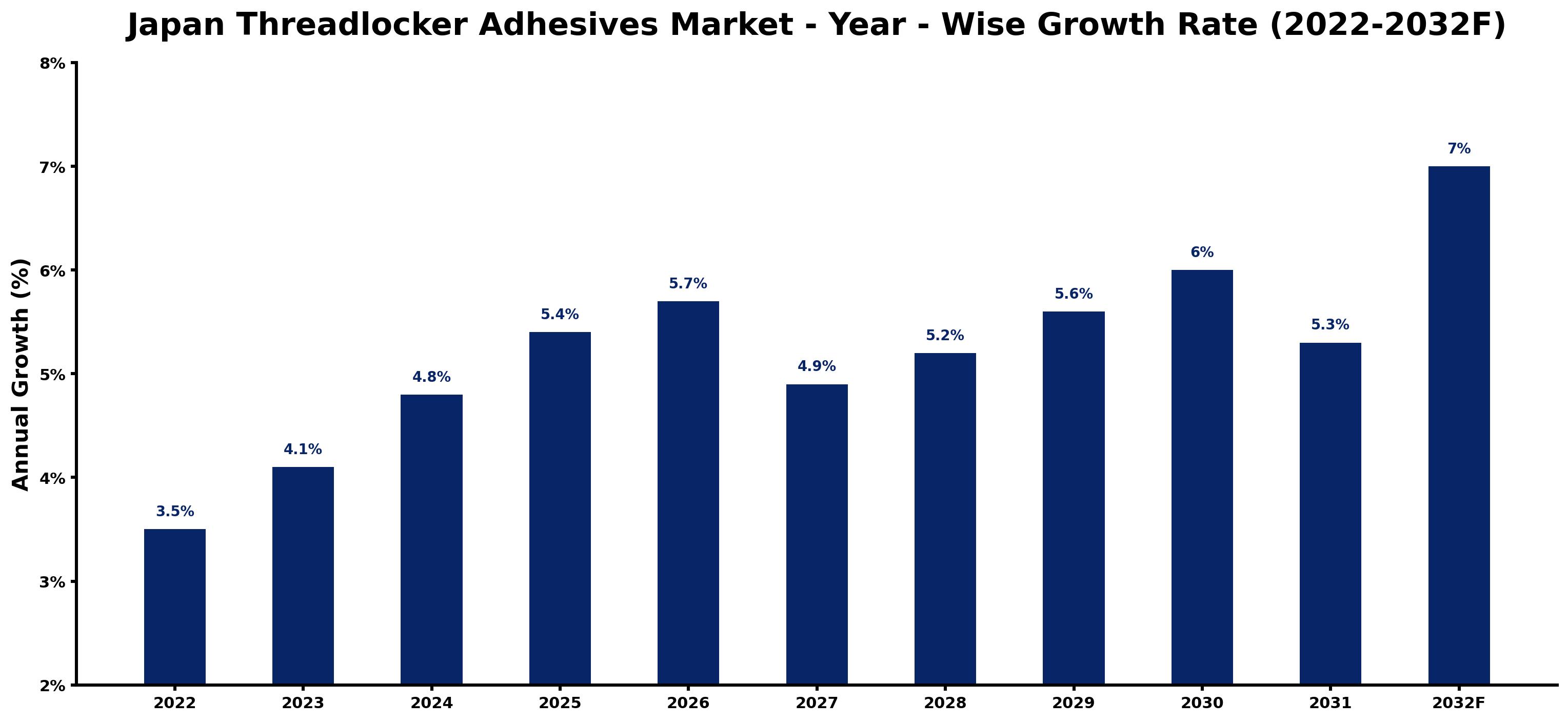
The table below sets out the estimated growth rate for each year and the main factor behind it.
| Year | Estimated Annual Growth (%) | Market Rationale |
| 2022 | 3.5 | Demand remained steady as the automotive sector continued to utilise threadlocker adhesives extensively. |
| 2023 | 4.1 | Growth accelerated due to increased production in the automotive industry and rising adhesive applications. |
| 2024 | 4.8 | The automotive sector's demand for high-strength adhesives drove further growth in this year. |
| 2025 | 5.4 | The automotive industry expanded, leading to a peak in adhesive consumption and production. |
| 2026 | 5.7 | The market is expected to see continued growth as automotive assemblers increase their use of high-strength adhesives. |
| 2027 | 4.9 | Growth is projected to slow slightly as the market adjusts to previous high levels of demand. |
| 2028 | 5.2 | Demand is expected to rebound as automotive production resumes its upward trend and maintenance services expand. |
| 2029 | 5.6 | The automotive sector's ongoing demand for reliable fastening solutions is projected to support market growth. |
| 2030 | 6.0 | Increased automotive production and maintenance needs will further boost adhesive consumption this year. |
| 2031 | 5.3 | Growth is expected to slow as the market stabilises after a period of rapid expansion in previous years. |
| 2032 | 7.0 | Demand is projected to surge as automotive assemblers increase their reliance on high-strength adhesives. |
Note: Market size estimations and growth projections presented in this report are based on 6Wresearch's proprietary forecasting methodology, utilizing the latest available industry data, government publications, and primary research inputs.
Japan Threadlocker Adhesives Market Synopsis
Threadlocker adhesives are anaerobic adhesives that secure threaded fasteners, made from methacrylate compounds that cure without air. Their primary applications include preventing loosening due to vibration and offering corrosion protection. The Japan Threadlocker Adhesives Market is growing due to demand from the automotive sector, which produces around 9 million vehicles annually. A government program launched in 2023 promotes advanced manufacturing technologies, further stimulating demand across various industries.
Market Dynamics Impact Analysis (2026–2032)
| Factor | Type | Impact | Primary Segment Affected |
| Rising automotive production | Driver | High | High Strength |
| Increased adoption of advanced manufacturing technologies | Driver | High | Anaerobic |
| Growing need for maintenance services | Opportunity | High | Maintenance Services |
| Expansion of the electronics industry | Opportunity | Medium | Electronics Industry |
| Compliance with JIS standards | Restraint | High | Anaerobic |
| Limited awareness of adhesive benefits | Restraint | Medium | General Assembly |
| Supply chain disruptions affecting production | Challenge | High | Automotive Assemblers |
| Competition from alternative fastening technologies | Challenge | Medium | Industrial Equipment Makers |
Evaluation of Drivers in Japan Threadlocker Adhesives Market (2026–2032)
The following drivers explain most of the expected growth.
| Drivers | Primary Segment Affected | Why It Matters (Evidence) |
| Increased automotive production | High Strength | The automotive sector's average production of 9 million vehicles annually drives demand for high-strength adhesives. |
| Adoption of advanced manufacturing technologies | Anaerobic | The 2023 government program to promote advanced manufacturing technologies boosts demand for anaerobic adhesives by improving production capabilities. |
| Growth in maintenance services | Maintenance Services | With over 1 million workers, maintenance services are expanding, increasing the need for threadlocker adhesives in repair applications. |
| Expansion of the electronics sector | Electronics Industry | The electronics industry, valued at over $100 billion, drives demand for reliable fastening solutions in device assembly. |
| Rising automotive assembly requirements | General Assembly | Automotive assemblers require adhesives to secure components, leading to increased purchases in the general assembly segment. |
A wider customer base explains much of the growth, as the automotive sector's average production of 9 million vehicles annually drives demand for high-strength adhesives. The electronics industry, valued at over $100 billion, drives demand for reliable fastening solutions, and automotive assemblers require adhesives to secure components, resulting in increased purchases in the general assembly segment.
Evaluation of Restraints in Japan Threadlocker Adhesives Market
These restraints slow adoption and weigh on supplier margins.
| Market Restraint | Primary Segment Affected | Why It Matters (Evidence) |
| Compliance with JIS standards | Anaerobic | Adhesives must meet JIS standards, requiring producers to invest in testing and certification processes to ensure quality. |
| Limited awareness of adhesive benefits | General Assembly | Many manufacturers lack knowledge about the advantages of using threadlocker adhesives, hindering market growth and adoption. |
| Supply chain disruptions affecting production | Automotive Assemblers | Supply chain issues can delay adhesive availability, impacting production schedules for automotive assemblers and their operations. |
| High competition from alternative fastening technologies | Industrial Equipment Makers | The presence of alternative fastening solutions can limit the market share of threadlocker adhesives, affecting sales. |
| Cost pressures from raw materials | Maintenance Services | Fluctuations in raw material prices can increase production costs, affecting pricing strategies for maintenance services and profitability. |
Japan Threadlocker Adhesives Market Challenges
Producers face skills shortages as the workforce ages, resulting in a lack of experienced technicians for adhesive application. This gap can delay production timelines, particularly impacting the automotive sector's capacity to meet demand. Rising raw material costs inflate production expenses by up to 20% for manufacturers, squeezing profit margins and affecting pricing strategies. Regulatory complexities surrounding JIS standards impose additional financial burdens on producers, who must invest in compliance testing, leading to increased operational costs that can reach several million yen annually.
Trends in the Japan Threadlocker Adhesives Market
The shifts below are changing how Japan Threadlocker Adhesives Market products are bought and supplied.
- Automotive Assemblers Increasing Adhesive Use: Automotive assemblers are adopting high-strength adhesives more frequently, with a projected 15% rise in usage by 2025, reflecting a shift towards more reliable fastening solutions in vehicle assembly.
- Tokyo Region Leading in Manufacturing Innovation: The Tokyo region is becoming a hub for advanced adhesive applications, supported by government initiatives that promote innovation in adhesive technologies, with annual investments exceeding $500 million in research.
- Surface-Insensitive Adhesives Gaining Popularity: Surface-insensitive adhesives are gaining traction in the electronics sector, with a growth rate of 8.1%, as manufacturers seek versatile solutions for various surfaces in device assembly.
- Greased Threads Segment Expanding: The greased threads segment is expanding due to increased lubrication in machinery, with a notable growth rate of 7.6%, reflecting changing industry practices and requirements.
Investment Opportunities in the Japan Threadlocker Adhesives Market
Investors looking at the Japan Threadlocker Adhesives Market should consider the following areas.
- Timing for Investment in High-Strength Adhesives: With the automotive sector projected to increase high-strength adhesive usage by 15% by 2025, suppliers should focus on this segment to meet rising demand for reliable fastening solutions.
- Supply of Surface-Insensitive Adhesives: The growing popularity of surface-insensitive adhesives, with an 8.1% growth rate, presents an opportunity for suppliers to cater to the electronics industry and its diverse needs.
- Expansion of Maintenance Services: As the maintenance services sector employs over 1 million workers, investing in threadlocker adhesives for repair applications can yield substantial returns for suppliers.
- Entry into the Greased Threads Market: The greased threads segment is growing rapidly, and suppliers can enter this market through partnerships with industrial equipment makers to provide tailored solutions.
Government Initiatives in the Japan Threadlocker Adhesives Market
The New Robot Strategy, launched in 2015, aims to expand the use of robots in manufacturing, services, agriculture, and care, positively impacting threadlocker adhesive producers by increasing automation in production processes. This strategy encourages investments in advanced adhesive technologies, ensuring compliance with industry standards and improving production efficiency.
The Ministry of Economy, Trade and Industry oversees regulations in the adhesive sector, approving funding for projects that support adhesive applications. This includes backing for initiatives that promote research and development, enabling producers to innovate and meet market demands effectively.
Future Insight of the Japan Threadlocker Adhesives Market
By 2032, buyers in the automotive sector will experience enhanced production processes due to advanced manufacturing technologies. The expected 15% increase in high-strength adhesive usage by 2025 will lead to the development of new adhesive formulations. Annual investments in research and development exceeding $500 million will drive improvements in adhesive performance, particularly for the electronics sector. The average vehicle age of over 13 years will create opportunities for suppliers to provide tailored solutions for maintenance applications.
Market Segmentation Analysis
Japan Threadlocker Adhesives Market report covers a detailed analysis of the following market segments:
By Adhesive Strength – High Strength Leads, Low Strength Expected to Grow Fastest
According to Saurav Kr Singh, Senior Research Analyst at 6Wresearch, with 34% of adhesive strength revenue in 2025, High Strength was the largest category. High strength threadlocker adhesives dominate the market due to their critical role in heavy machinery applications, where permanent bonding is essential. For instance, their use in automotive manufacturing ensures that components remain securely fastened under high-stress conditions. The quickest growth will come from Low Strength, forecast to expand at a CAGR of 7.5% between 2026 and 2032. Low strength threadlocker adhesives are experiencing rapid growth as they cater to non-critical applications that require disassembly, such as in maintenance tasks. This segment is gaining traction as more industries adopt flexible assembly processes. Suppliers should focus on developing products that cater to both high and low strength applications to meet diverse market needs.
By Curing Method – Anaerobic Leads, Surface-Insensitive Expected to Grow Fastest
Anaerobic took 47% of curing method revenue in 2025, more than any other category. Anaerobic adhesives lead the market as they are specifically designed for applications where air is absent during curing, making them ideal for various industrial uses. Their compliance with JIS standards further solidifies their position in the Japanese market. Surface-Insensitive is set to record the highest CAGR in this split, 8.1% over 2026–2032. Surface-insensitive adhesives are growing quickly due to their versatility, allowing application on various surfaces without special preparation. This adaptability is attracting more users in sectors that require quick and efficient bonding solutions. Buyers will benefit from a wider range of adhesive options that can simplify their application processes and reduce preparation time.
By Thread Size Suitability – General Assembly Leads, Greased Threads Expected to Grow Fastest
The largest thread size suitability category in 2025 was General Assembly, at 46% of revenue. General assembly threadlocker adhesives hold the largest share due to their widespread application in manufacturing processes across various industries, ensuring secure fastening in diverse uses. Their essential role in production lines, particularly within the automotive sector, reinforces their market dominance. Greased Threads are projected to grow fastest, at a CAGR of 7.6% during 2026–2032. The greased threads segment is experiencing rapid growth as these adhesives are specifically formulated for lubricated surfaces, which are increasingly prevalent in modern machinery. This trend reflects a shift towards enhanced lubrication practices in industrial applications, indicating strong future demand. Suppliers should focus on developing specialised adhesives for greased applications to capitalise on this expanding market.
By End User – Automotive Assemblers Lead, Maintenance Services Expected to Grow Fastest
Automotive Assemblers held 39% of the Japan Threadlocker Adhesives Market by end user in 2025. Automotive assemblers are the primary consumers of threadlocker adhesives, as these products are vital in assembly lines for securing components effectively. The robust automotive sector in Japan ensures a consistent demand for these reliable fastening solutions. Over 2026–2032, Maintenance Services are expected to post the fastest growth, at a CAGR of 7.4%. Maintenance services are growing swiftly as they increasingly utilise threadlocker adhesives for the repair and maintenance of machinery and equipment. The rising average age of vehicles in Japan drives up the need for maintenance, thereby boosting this segment's demand. Suppliers ought to target maintenance services with customised products to address the increasing need for effective repair solutions.
Key Attractiveness of the Report
- 10 Years of Market Numbers
- Historical Data Starting from 2022 to 2025
- Base Year 2025
- Forecast Data until 2032
- Key Performance Indicators Impacting the Market
- Major Upcoming Developments and Projects
Key Highlights of the Report:
- Japan Threadlocker Adhesives Market Outlook
- Market Size of Japan Threadlocker Adhesives Market, 2025
- Forecast of Japan Threadlocker Adhesives Market, 2032
- Historical Data and Forecast of Japan Threadlocker Adhesives Revenues & Volume for the Period 2022-2032F
- Japan Threadlocker Adhesives Market Trend Evolution
- Japan Threadlocker Adhesives Market Drivers and Challenges
- Japan Threadlocker Adhesives Price Trends
- Japan Threadlocker Adhesives Porter's Five Forces
- Japan Threadlocker Adhesives Industry Life Cycle
- Historical Data and Forecast of Japan Threadlocker Adhesives Market Revenues & Volume By Adhesive Strength for the Period 2022-2032F
- Historical Data and Forecast of Japan Threadlocker Adhesives Market Revenues & Volume By Low Strength for the Period 2022-2032F
- Historical Data and Forecast of Japan Threadlocker Adhesives Market Revenues & Volume By Medium Strength for the Period 2022-2032F
- Historical Data and Forecast of Japan Threadlocker Adhesives Market Revenues & Volume By High Strength for the Period 2022-2032F
- Historical Data and Forecast of Japan Threadlocker Adhesives Market Revenues & Volume By Oil Tolerant for the Period 2022-2032F
- Historical Data and Forecast of Japan Threadlocker Adhesives Market Revenues & Volume By Curing Method for the Period 2022-2032F
- Historical Data and Forecast of Japan Threadlocker Adhesives Market Revenues & Volume By Anaerobic for the Period 2022-2032F
- Historical Data and Forecast of Japan Threadlocker Adhesives Market Revenues & Volume By Heat-Resistant for the Period 2022-2032F
- Historical Data and Forecast of Japan Threadlocker Adhesives Market Revenues & Volume By Vibration-Resistant for the Period 2022-2032F
- Historical Data and Forecast of Japan Threadlocker Adhesives Market Revenues & Volume By Surface-Insensitive for the Period 2022-2032F
- Historical Data and Forecast of Japan Threadlocker Adhesives Market Revenues & Volume By Thread Size Suitability for the Period 2022-2032F
- Historical Data and Forecast of Japan Threadlocker Adhesives Market Revenues & Volume By Small Screws for the Period 2022-2032F
- Historical Data and Forecast of Japan Threadlocker Adhesives Market Revenues & Volume By General Assembly for the Period 2022-2032F
- Historical Data and Forecast of Japan Threadlocker Adhesives Market Revenues & Volume By Heavy Machinery Bolts for the Period 2022-2032F
- Historical Data and Forecast of Japan Threadlocker Adhesives Market Revenues & Volume By Greased Threads for the Period 2022-2032F
- Historical Data and Forecast of Japan Threadlocker Adhesives Market Revenues & Volume By End User for the Period 2022-2032F
- Historical Data and Forecast of Japan Threadlocker Adhesives Market Revenues & Volume By Electronics Industry for the Period 2022-2032F
- Historical Data and Forecast of Japan Threadlocker Adhesives Market Revenues & Volume By Automotive Assemblers for the Period 2022-2032F
- Historical Data and Forecast of Japan Threadlocker Adhesives Market Revenues & Volume By Industrial Equipment Makers for the Period 2022-2032F
- Historical Data and Forecast of Japan Threadlocker Adhesives Market Revenues & Volume By Maintenance Services for the Period 2022-2032F
- Japan Threadlocker Adhesives Import Export Trade Statistics
- Market Opportunity Assessment By Adhesive Strength
- Market Opportunity Assessment By Curing Method
- Market Opportunity Assessment By Thread Size Suitability
- Market Opportunity Assessment By End User
- Japan Threadlocker Adhesives Top Companies Market Share
- Japan Threadlocker Adhesives Competitive Benchmarking By Technical and Operational Parameters
- Japan Threadlocker Adhesives Company Profiles
- Japan Threadlocker Adhesives Key Strategic Recommendations
Market Covered
Segments analysed in this report are listed below.
By Adhesive Strength
- Low Strength
- Medium Strength
- High Strength
- Oil Tolerant
By Curing Method
- Anaerobic
- Heat-Resistant
- Vibration-Resistant
- Surface-Insensitive
By Thread Size Suitability
- Small Screws
- General Assembly
- Heavy Machinery Bolts
- Greased Threads
By End User
- Electronics Industry
- Automotive Assemblers
- Industrial Equipment Makers
- Maintenance Services































