Japan Threat Hunting Market Size & Growth Rate
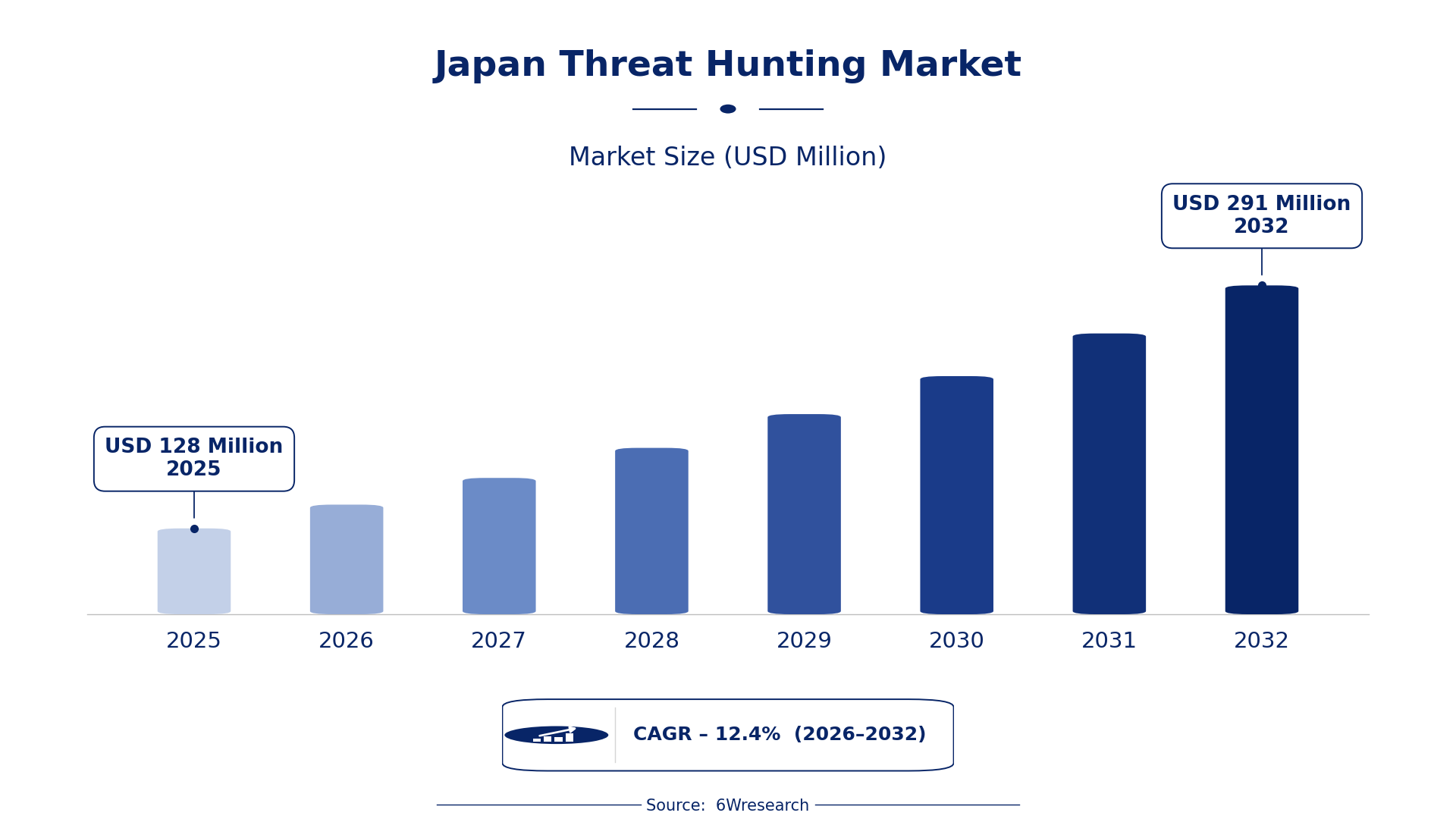
According to 6Wresearch internal database and industry insights, the Japan Threat Hunting Market was valued at USD 128 Million in 2025 and is projected to reach USD 291 Million by 2032, growing at a CAGR of approximately 12.4% during 2026–2032.
Japan Threat Hunting Market Highlights
| Report Metric | Details |
| Report Name | Japan Threat Hunting Market (2026-2032) |
| Market Size 2025 | USD 128 Million |
| Market Size 2032 | USD 291 Million |
| Absolute Growth 2025–2032 | USD 163 Million |
| CAGR 2026–2032 | 12.4% |
| Peak Annual Growth | 13.6% in 2027 |
| Forecast Period | 2026–2032 |
| Historical Data | 2022–2025 |
| Base Year | 2025 |
| Leading Hunting Type, 2025 | Proactive Hunting (37% share) |
| Leading Intelligence Source, 2025 | Internal Logs (35% share) |
| Leading Technique Used, 2025 | Indicator of Attack (IoA) (43% share) |
| Leading End User, 2025 | Security Operation Centers (46% share) |
| Fastest-Growing Hunting Type | Reactive Hunting (16.8% CAGR) |
| Fastest-Growing Intelligence Source | Threat Feeds (17.0% CAGR) |
| Fastest-Growing Technique Used | Behavior Analysis (15.9% CAGR) |
| Fastest-Growing End User | Enterprise IT (16.4% CAGR) |
| Growing Sector | Enterprise IT |
| Key End Users | Security Operation Centers, Enterprise IT, MSSPs, Cloud Service Providers |
Japan Threat Hunting Market Year-wise Growth Rate and Key Drivers (2022–2032)
This graph illustrates the annual growth rates of the market from 2022 to 2032, highlighting a steady upward trajectory and projected market expansion over the forecast period.
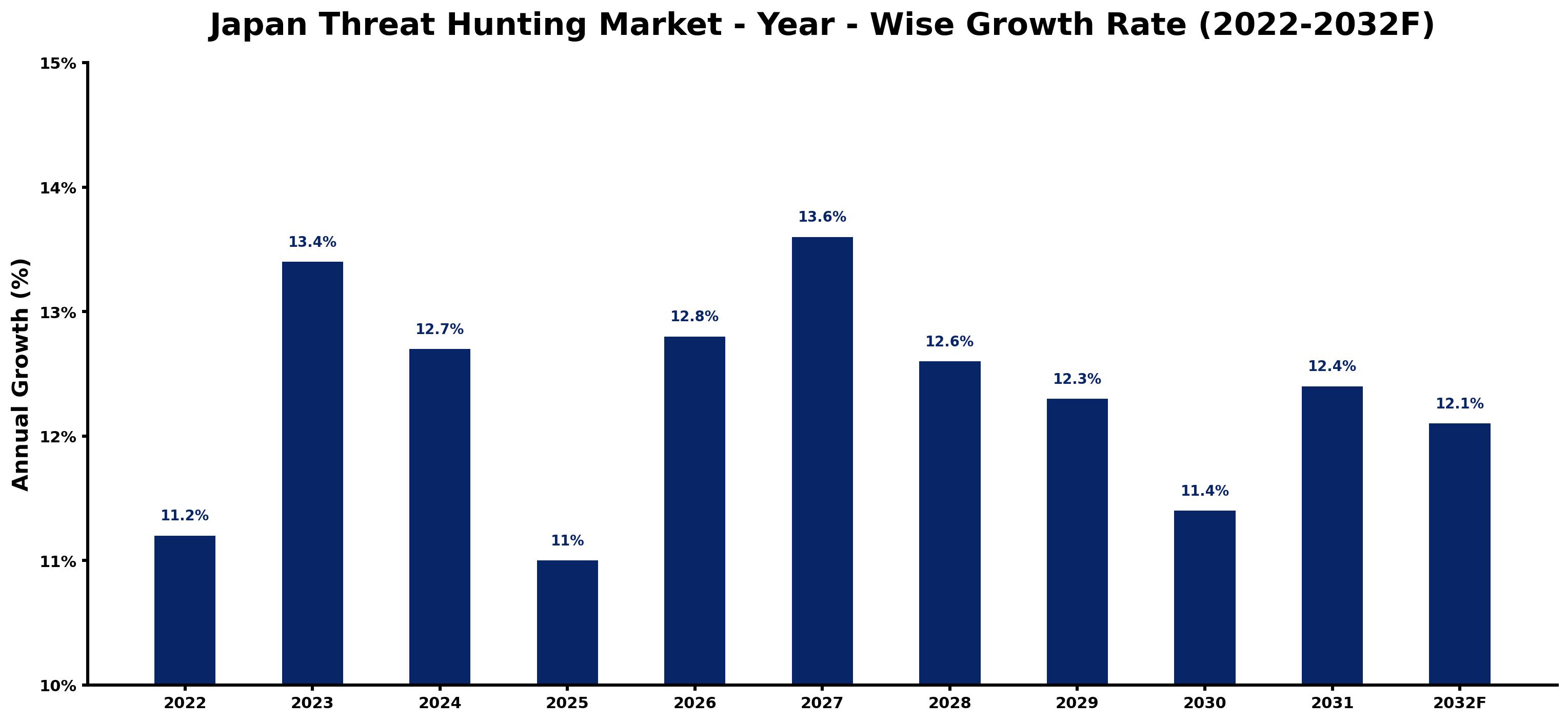
For each year, the table pairs the estimated growth rate with the leading influence on demand, showing how the drivers changed across the period.
| Year | Estimated Annual Growth (%) | Market Rationale |
| 2022 | 11.2 | The market experienced solid growth as businesses began prioritising cybersecurity measures. |
| 2023 | 13.4 | Demand surged due to increased cyber incidents, prompting greater investment in threat hunting. |
| 2024 | 12.7 | Growth slowed slightly as firms adjusted to new cybersecurity protocols and technologies. |
| 2025 | 11.0 | A continued focus on cybersecurity kept the market expanding, despite a further slowdown in growth. |
| 2026 | 12.8 | Investment in advanced threat detection technologies drove a resurgence in market growth. |
| 2027 | 13.6 | The market peaked as organisations ramped up their threat hunting capabilities significantly. |
| 2028 | 12.6 | Growth decelerated as the market began to stabilise after rapid expansions in previous years. |
| 2029 | 12.3 | A slight slowdown occurred as firms consolidated their cybersecurity strategies and investments. |
| 2030 | 11.4 | Continued focus on cybersecurity maintained growth, albeit at a reduced rate compared to previous years. |
| 2031 | 12.4 | Demand increased again as new threats emerged, prompting further investment in threat hunting. |
| 2032 | 12.1 | The market continued to grow steadily as businesses adapted to evolving cybersecurity challenges. |
Note: Market size estimations and growth projections presented in this report are based on 6Wresearch's proprietary forecasting methodology, utilizing the latest available industry data, government publications, and primary research inputs.
Japan Threat Hunting Market Synopsis
Threat hunting involves actively searching for cyber threats that may have bypassed existing security measures, primarily in sectors like finance and healthcare. The Japan Threat Hunting Market is expanding due to a sharp rise in reported cyber incidents, which increased by 30% in 2022. Over 70% of Japanese enterprises have adopted some form of threat hunting, driven by the need to strengthen their cybersecurity posture and incident response capabilities.
Market Dynamics Impact Analysis (2026–2032)
| Factor | Type | Impact | Primary Segment Affected |
| Increased cyber incidents drive demand for proactive measures. | Driver | High | Proactive Hunting |
| Growing awareness of cybersecurity threats creates opportunities for investment. | Driver | High | Reactive Hunting |
| Emerging technologies in threat detection present new avenues for growth. | Opportunity | High | Continuous Hunting |
| The rise in remote work increases the need for endpoint security solutions. | Opportunity | Medium | Endpoint Hunting |
| Limited skilled workforce hampers the growth of threat hunting initiatives. | Restraint | High | Proactive Hunting |
| High costs associated with advanced threat detection tools restrict market expansion. | Restraint | Medium | Reactive Hunting |
| Rapidly evolving cyber threats pose challenges for existing security frameworks. | Challenge | High | Continuous Hunting |
| Inadequate regulatory frameworks can delay the adoption of threat hunting practices. | Challenge | Medium | Endpoint Hunting |
Evaluation of Drivers in Japan Threat Hunting Market (2026–2032)
Below are the drivers that matter most for revenue growth, with supporting evidence.
| Drivers | Primary Segment Affected | Why It Matters (Evidence) |
| Increase in cyber incidents | Proactive Hunting | The number of reported cyber incidents in Japan rose by 30% in 2022, prompting organisations to invest in proactive threat hunting measures. |
| Growing cybersecurity budgets | Reactive Hunting | Cybersecurity investments are projected to grow by $100 million in 2023, leading businesses to prioritise reactive threat hunting capabilities. |
| Technological advancements in threat detection | Continuous Hunting | New tools improve detection capabilities, leading to increased demand for continuous threat hunting practices. |
| Rising awareness of cyber threats | Endpoint Hunting | As remote work increases, businesses are more aware of endpoint vulnerabilities, driving demand for enhanced endpoint threat hunting. |
| Support from government initiatives | Proactive Hunting | The Cybersecurity Strategy of Japan, updated in 2023, emphasises public-private partnerships for threat hunting, boosting market demand. |
Volumes grow on the back of the increasing number of reported cyber incidents, which rose by 30% in 2022, prompting businesses to improve their threat hunting capabilities. Investment in cybersecurity is projected to grow, with over 70% of Japanese enterprises implementing threat hunting measures. New tools are driving demand, as they improve detection capabilities. Public-private partnerships are expected to support market growth, while the rise in remote work has heightened awareness of endpoint vulnerabilities, resulting in greater investment in endpoint threat hunting solutions.
Evaluation of Restraints in Japan Threat Hunting Market
These are the pressures that could keep growth below its potential.
| Market Restraint | Primary Segment Affected | Why It Matters (Evidence) |
| Limited availability of skilled cybersecurity professionals | Proactive Hunting | The shortage of skilled professionals in Japan restricts the ability of organisations to implement effective threat hunting strategies. |
| High costs of advanced threat detection tools | Reactive Hunting | The financial burden associated with acquiring advanced tools can deter companies from investing in reactive threat hunting. |
| Complex regulatory environment | Continuous Hunting | Navigating the complex regulations can slow down the implementation of continuous threat hunting practices. |
| Resistance to change within organisations | Endpoint Hunting | Many organisations are hesitant to adopt new threat hunting practices, limiting their effectiveness in securing endpoints. |
| Inconsistent threat intelligence sources | Proactive Hunting | Reliance on inconsistent threat intelligence can undermine the effectiveness of proactive threat hunting efforts. |
Japan Threat Hunting Market Challenges
Japanese enterprises face high compliance costs from stringent regulations, such as JIS Q 27001, consuming up to 20% of their cybersecurity budgets. Many firms encounter supply chain disruptions for advanced threat detection tools, delaying essential measures for buyers in finance and healthcare. A 30% increase in reported cyber incidents in 2022 forces producers to reallocate resources, limiting their capacity for innovation. Intense competition among cybersecurity firms in Tokyo drives down pricing, which can compromise service quality for buyers seeking effective threat hunting solutions.
Trends in the Japan Threat Hunting Market
Four trends stand out in the Japan Threat Hunting Market.
- Shift from Reactive to Proactive Threat Hunting: Since 2022, organisations have increasingly adopted proactive threat hunting strategies to stay ahead of cyber threats. This shift is reflected in over 70% of enterprises implementing such measures, improving their cybersecurity posture.
- Emergence of Behaviour Analysis Techniques: In 2023, the adoption of behaviour analysis techniques gained traction in Japan, with a CAGR of 15.9%. This trend enables more effective detection of anomalies in user behaviour, improving overall security.
- Growth of Endpoint Security Solutions: The rise in remote work since 2020 has led to a notable increase in demand for endpoint security solutions, with many businesses focusing on securing their endpoints against potential threats.
- Expansion of Cybersecurity Awareness Programs: The Tokyo Metropolitan Government launched a cybersecurity awareness program in 2023, aiming to educate businesses about emerging threats and best practices, reflecting a growing commitment to cybersecurity.
Investment Opportunities in the Japan Threat Hunting Market
The following opportunities in the Japan Threat Hunting Market pair current demand with a clear way in.
- Investment in Advanced Threat Detection Tools: With cybersecurity investment projected to grow, there is a gap in advanced threat detection tools. Security Operation Centers in Tokyo are seeking innovative solutions to enhance their capabilities.
- Growing Demand for Endpoint Security Solutions: As remote work continues, enterprises are increasingly prioritising endpoint security. Cloud Service Providers are looking for partnerships to develop security solutions for their clients.
- Expansion of Cybersecurity Training Programs: With over 70% of enterprises implementing threat hunting, there is a need for training programs. Educational institutions in Japan can collaborate with industry leaders to develop specialised training.
- Development of Cybersecurity Standards: The need for standardised practices in threat hunting is clear. The Japan Information Technology Services Industry Association can play a key role in establishing these standards.
Government Initiatives in the Japan Threat Hunting Market
The Cybersecurity Basic Act, enacted in 2014, mandates cybersecurity measures for organisations, ensuring compliance with standards like JIS Q 27001. The updated Cybersecurity Strategy of Japan in 2023 focuses on strengthening national security through public-private partnerships and increased funding for cybersecurity initiatives.
The Digital Agency, established in September 2021, oversees government digital transformation and approves standards for cybersecurity measures. The agency is responsible for funding initiatives that improve cybersecurity infrastructure across various sectors.
Future Insight of the Japan Threat Hunting Market
The launch of public-private partnerships will enhance collaboration among stakeholders by 2032. The Tokyo Cybersecurity Conference will promote knowledge sharing, refining threat hunting techniques. Investment in cybersecurity is projected to rise, with the government allocating $100 million for initiatives in 2023, supporting critical sectors like finance and healthcare. Improved resource sharing will enable quicker response times, benefiting both buyers and suppliers.
Market Segmentation Analysis
Japan Threat Hunting Market report covers a detailed analysis of the following market segments:
By Hunting Type – Proactive Hunting Leads, Reactive Hunting Expected to Grow Fastest
According to Saurav Kr Singh, Senior Research Analyst at 6Wresearch, with 37% of hunting type revenue in 2025, Proactive Hunting was the largest category. Proactive Hunting commands the largest share as it actively seeks threats before they can inflict damage, particularly in critical sectors such as finance. With over 70% of Japanese enterprises adopting proactive strategies, its role in strengthening cybersecurity is evident. Over 2026–2032, Reactive Hunting is expected to post the fastest growth, at a CAGR of 16.8%. Reactive Hunting is experiencing rapid growth due to a 30% rise in reported cyber incidents in 2022, necessitating immediate responses to already detected threats. As Proactive Hunting remains dominant, its strong adoption will likely widen the gap over Reactive Hunting. This trend suggests that suppliers should focus on developing proactive solutions to meet the increasing security demands of enterprises.
By Intelligence Source – Internal Logs Lead, Threat Feeds Expected to Grow Fastest
Internal Logs accounted for 35% of the market by intelligence source in 2025. Internal Logs lead the market as they provide vital data for threat detection, allowing organisations to analyse past activities and spot anomalies effectively. Their critical role in many cybersecurity frameworks highlights their importance for effective threat hunting. Threat Feeds are projected to grow fastest, at a CAGR of 17.0% during 2026–2032. Threat Feeds are growing quickly as they deliver real-time threat intelligence, essential for organisations confronting evolving cyber threats. The increasing need for timely information to address new vulnerabilities is driving this segment's growth. Suppliers should enhance their threat feed capabilities to satisfy the rising demand for timely and actionable intelligence from enterprises.
By Technique Used – Indicator of Attack (IoA) Leads, Behavior Analysis Expected to Grow Fastest
The largest technique used category in 2025 was Indicator of Attack (IoA), at 43% of revenue. Indicator of Attack (IoA) is the leading technique as it effectively identifies specific attack patterns, allowing organisations to preemptively address potential threats. Its widespread application in threat detection strategies underscores its significance in maintaining cybersecurity. Behavior Analysis is set to record the highest CAGR in this split, 15.9% over 2026–2032. Behavior Analysis is growing quickly as it enables organisations to detect anomalies in user behaviour, which is essential in identifying sophisticated threats that traditional methods may miss. The increasing complexity of cyber threats is driving this technique's adoption. This growth suggests that suppliers should focus on developing advanced behaviour analysis tools to meet the evolving needs of cybersecurity.
By End User – Security Operation Centers Lead, Enterprise IT Expected to Grow Fastest
Security Operation Centers took 46% of end user revenue in 2025, more than any other category. Security Operation Centers hold the largest share due to their essential role in monitoring and responding to threats, creating a dedicated environment for cybersecurity operations. Their importance in managing security incidents makes them vital for organisations prioritising cybersecurity. The quickest growth will come from Enterprise IT, forecast to expand at a CAGR of 16.4% between 2026 and 2032. Enterprise IT is rapidly expanding as organisations increasingly recognise the necessity of implementing comprehensive security measures across their operations. The demand for integrated security solutions within enterprises is propelling this segment's growth. This trend indicates that suppliers should customise their offerings to address the specific needs of enterprise IT departments in strengthening their security frameworks.
Key Attractiveness of the Report
- 10 Years of Market Numbers
- Historical Data Starting from 2022 to 2025
- Base Year 2025
- Forecast Data until 2032
- Key Performance Indicators Impacting the Market
- Major Upcoming Developments and Projects
Key Highlights of the Report:
- Japan Threat Hunting Market Outlook
- Market Size of Japan Threat Hunting Market, 2025
- Forecast of Japan Threat Hunting Market, 2032
- Historical Data and Forecast of Japan Threat Hunting Revenues & Volume for the Period 2022-2032F
- Japan Threat Hunting Market Trend Evolution
- Japan Threat Hunting Market Drivers and Challenges
- Japan Threat Hunting Price Trends
- Japan Threat Hunting Porter's Five Forces
- Japan Threat Hunting Industry Life Cycle
- Historical Data and Forecast of Japan Threat Hunting Market Revenues & Volume By Hunting Type for the Period 2022-2032F
- Historical Data and Forecast of Japan Threat Hunting Market Revenues & Volume By Proactive Hunting for the Period 2022-2032F
- Historical Data and Forecast of Japan Threat Hunting Market Revenues & Volume By Reactive Hunting for the Period 2022-2032F
- Historical Data and Forecast of Japan Threat Hunting Market Revenues & Volume By Continuous Hunting for the Period 2022-2032F
- Historical Data and Forecast of Japan Threat Hunting Market Revenues & Volume By Endpoint Hunting for the Period 2022-2032F
- Historical Data and Forecast of Japan Threat Hunting Market Revenues & Volume By Intelligence Source for the Period 2022-2032F
- Historical Data and Forecast of Japan Threat Hunting Market Revenues & Volume By Internal Logs for the Period 2022-2032F
- Historical Data and Forecast of Japan Threat Hunting Market Revenues & Volume By Threat Feeds for the Period 2022-2032F
- Historical Data and Forecast of Japan Threat Hunting Market Revenues & Volume By SIEM Logs for the Period 2022-2032F
- Historical Data and Forecast of Japan Threat Hunting Market Revenues & Volume By EDR Integration for the Period 2022-2032F
- Historical Data and Forecast of Japan Threat Hunting Market Revenues & Volume By Technique Used for the Period 2022-2032F
- Historical Data and Forecast of Japan Threat Hunting Market Revenues & Volume By Indicator of Attack (IoA) for the Period 2022-2032F
- Historical Data and Forecast of Japan Threat Hunting Market Revenues & Volume By Behavior Analysis for the Period 2022-2032F
- Historical Data and Forecast of Japan Threat Hunting Market Revenues & Volume By Signature + Heuristic for the Period 2022-2032F
- Historical Data and Forecast of Japan Threat Hunting Market Revenues & Volume By File/Process Scanning for the Period 2022-2032F
- Historical Data and Forecast of Japan Threat Hunting Market Revenues & Volume By End User for the Period 2022-2032F
- Historical Data and Forecast of Japan Threat Hunting Market Revenues & Volume By Security Operation Centers for the Period 2022-2032F
- Historical Data and Forecast of Japan Threat Hunting Market Revenues & Volume By Enterprise IT for the Period 2022-2032F
- Historical Data and Forecast of Japan Threat Hunting Market Revenues & Volume By MSSPs for the Period 2022-2032F
- Historical Data and Forecast of Japan Threat Hunting Market Revenues & Volume By Cloud Service Providers for the Period 2022-2032F
- Japan Threat Hunting Import Export Trade Statistics
- Market Opportunity Assessment By Hunting Type
- Market Opportunity Assessment By Intelligence Source
- Market Opportunity Assessment By Technique Used
- Market Opportunity Assessment By End User
- Japan Threat Hunting Top Companies Market Share
- Japan Threat Hunting Competitive Benchmarking By Technical and Operational Parameters
- Japan Threat Hunting Company Profiles
- Japan Threat Hunting Key Strategic Recommendations
Market Covered
The report covers the following segments.
By Hunting Type
- Proactive Hunting
- Reactive Hunting
- Continuous Hunting
- Endpoint Hunting
By Intelligence Source
- Internal Logs
- Threat Feeds
- SIEM Logs
- EDR Integration
By Technique Used
- Indicator of Attack (IoA)
- Behavior Analysis
- Signature + Heuristic
- File/Process Scanning
By End User
- Security Operation Centers
- Enterprise IT
- MSSPs
- Cloud Service Providers































