Japan Threat Intelligence AI Market Size & Growth Rate
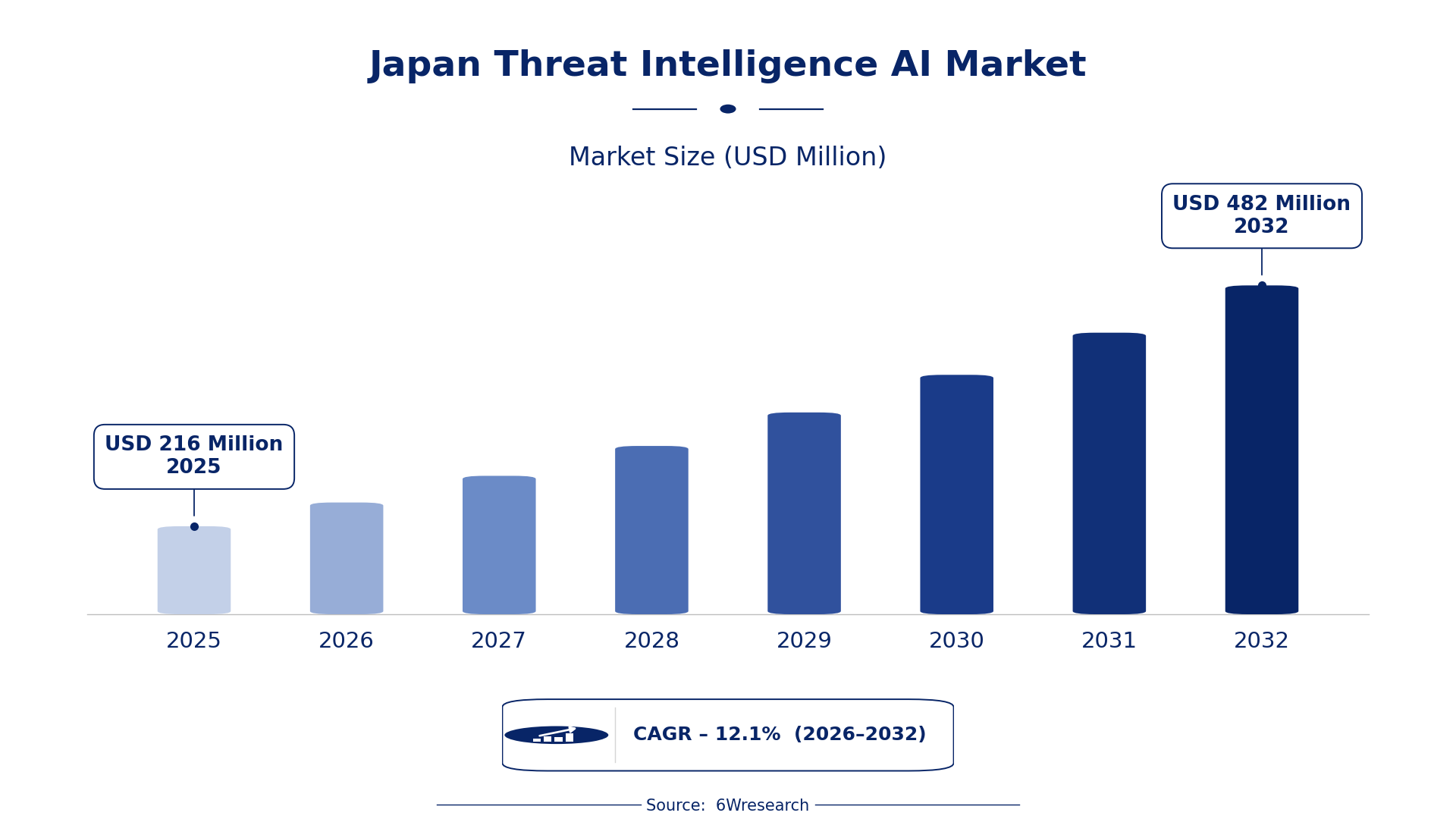
According to 6Wresearch internal database and industry insights, the Japan Threat Intelligence AI Market was valued at USD 216 Million in 2025 and is projected to reach USD 482 Million by 2032, growing at a CAGR of approximately 12.1% during 2026–2032.
Japan Threat Intelligence AI Market Highlights
| Report Metric | Details |
| Report Name | Japan Threat Intelligence AI Market (2026-2032) |
| Market Size 2025 | USD 216 Million |
| Market Size 2032 | USD 482 Million |
| Absolute Growth 2025–2032 | USD 266 Million |
| CAGR 2026–2032 | 12.1% |
| Peak Annual Growth | 13.7% in 2026 |
| Forecast Period | 2026–2032 |
| Historical Data | 2022–2025 |
| Base Year | 2025 |
| Leading Intelligence Type, 2025 | Tactical Intelligence (43% share) |
| Leading Data Source, 2025 | IPs (37% share) |
| Leading AI Methodology, 2025 | Machine Learning (44% share) |
| Leading End User, 2025 | SOC Teams (52% share) |
| Fastest-Growing Intelligence Type | Strategic Intelligence (16.2% CAGR) |
| Fastest-Growing Data Source | URLs (16.5% CAGR) |
| Fastest-Growing AI Methodology | Predictive Analytics (17.0% CAGR) |
| Fastest-Growing End User | CISOs (14.9% CAGR) |
| Growing Sector | cybersecurity |
| Key End Users | SOC Teams, CISOs, Security Vendors, Cybersecurity Researchers |
Japan Threat Intelligence AI Market Year-wise Growth Rate and Key Drivers (2022–2032)
This graph illustrates the annual growth rates of the market from 2022 to 2032, highlighting a steady upward trajectory and projected market expansion over the forecast period.
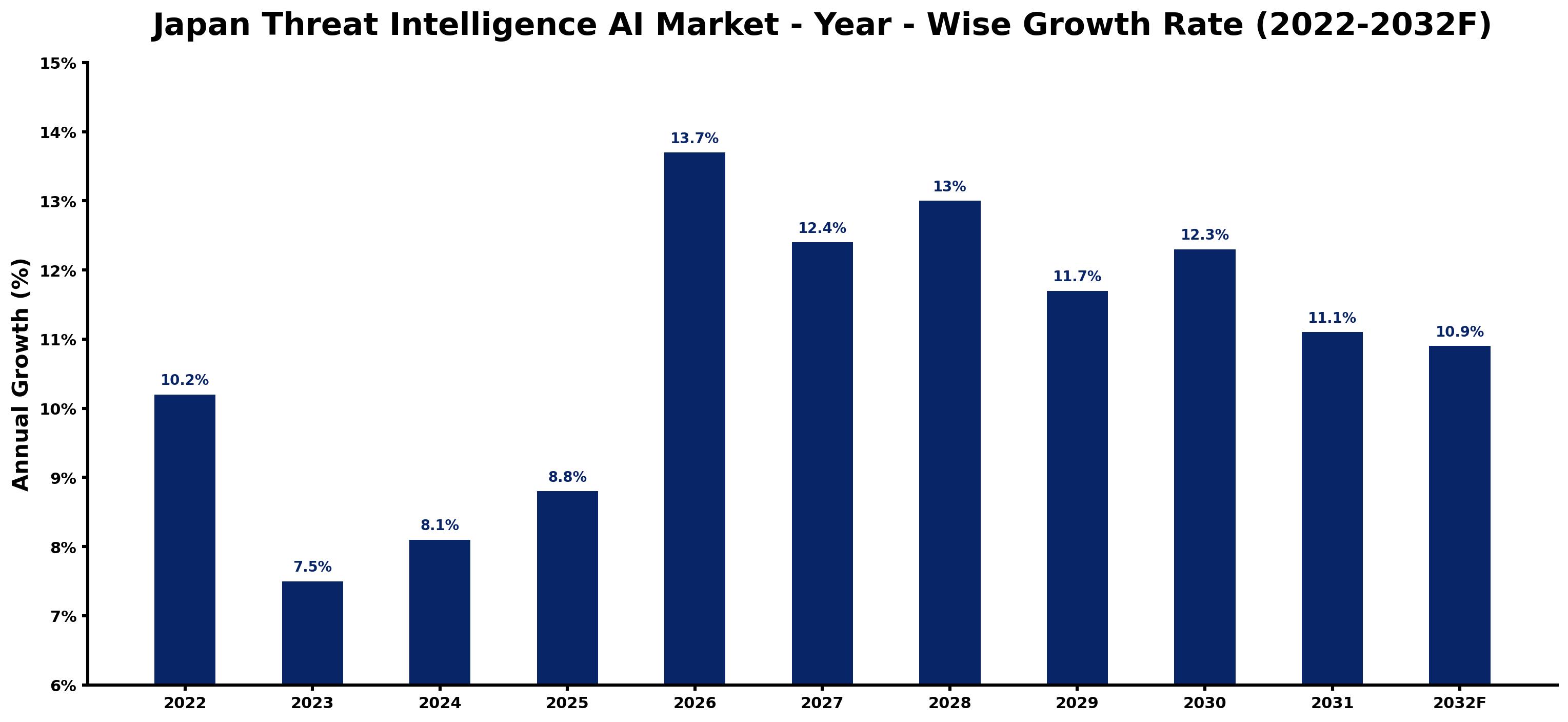
Below, each year's estimated growth is shown next to the factor that most influenced it.
| Year | Estimated Annual Growth (%) | Market Rationale |
| 2022 | 10.2 | The market experienced strong growth due to increased cybersecurity incidents and investments. |
| 2023 | 7.5 | Investment growth slowed as companies adjusted to new cybersecurity threats and strategies. |
| 2024 | 8.1 | Demand picked up as firms improved their cybersecurity measures in response to rising incidents. |
| 2025 | 8.8 | Increased awareness of cyber threats led to faster growth as companies invested more in AI solutions. |
| 2026 | 13.7 | The market is expected to surge as organisations adopt advanced AI technologies for threat detection. |
| 2027 | 12.4 | Growth is projected to slow as the market matures, with firms focusing on optimising existing solutions. |
| 2028 | 13.0 | Demand is expected to increase again as new threats emerge, prompting further investment in AI capabilities. |
| 2029 | 11.7 | Growth is anticipated to slow as companies consolidate their cybersecurity strategies and investments. |
| 2030 | 12.3 | Demand is projected to rise as firms expand their cybersecurity frameworks to include AI-driven solutions. |
| 2031 | 11.1 | Growth is expected to slow as the market stabilises with established players dominating the market. |
| 2032 | 10.9 | The market will continue to grow as companies increasingly rely on AI for security. |
Note: Market size estimations and growth projections presented in this report are based on 6Wresearch's proprietary forecasting methodology, utilizing the latest available industry data, government publications, and primary research inputs.
Japan Threat Intelligence AI Market Synopsis
Threat Intelligence AI utilises artificial intelligence to analyse data for cybersecurity threats, identifying potential attacks and improving security measures. The Japan Threat Intelligence AI Market is expanding rapidly, driven by over 70% of companies increasing their cybersecurity investments. The focus on advanced technology solutions and the national cybersecurity strategy launched in 2022, which emphasises AI and machine learning, further fuels this growth. As Tokyo emerges as a major hub for cybersecurity firms, demand for innovative threat intelligence solutions is projected to rise markedly.
Market Dynamics Impact Analysis (2026–2032)
| Factor | Type | Impact | Primary Segment Affected |
| Increased investment in cybersecurity measures | Driver | High | Tactical Intelligence |
| Emerging threats and cyber incidents | Driver | High | Strategic Intelligence |
| Growing need for real-time threat detection | Opportunity | High | Real-Time Alerts |
| Expansion of AI capabilities in cybersecurity | Opportunity | High | Machine Learning |
| Shortage of skilled cybersecurity professionals | Restraint | High | Technical Intelligence |
| High costs associated with advanced AI solutions | Restraint | Medium | Operational Intelligence |
| Rapid technological changes in cybersecurity | Challenge | High | Threat Modeling AI |
| Increasing regulatory requirements for data protection | Challenge | Medium | CISOs |
Evaluation of Drivers in Japan Threat Intelligence AI Market (2026–2032)
The main growth drivers and the segments they affect most are set out below.
| Drivers | Primary Segment Affected | Why It Matters (Evidence) |
| Rising cybersecurity incidents | Tactical Intelligence | Over 30% increase in reported incidents in 2022 drives demand for immediate threat response. |
| Investment in AI technologies | Strategic Intelligence | More than 70% of companies increased their cybersecurity budgets, improving long-term security planning. |
| Need for real-time monitoring | Real-Time Alerts | The demand for immediate threat detection solutions is rising as cyber threats become more sophisticated. |
| Adoption of machine learning algorithms | Machine Learning | The integration of AI technologies improves threat detection capabilities, leading to increased purchases. |
| Focus on predictive analytics | Predictive Analytics | Companies are investing in forecasting tools to anticipate potential cyber threats, driving demand. |
Spending rises because Tokyo is a major hub for cybersecurity firms, with over 70% of companies increasing their investments in cybersecurity measures last year. This trend reflects a growing need for advanced threat detection capabilities, as the number of reported cyber incidents rose by 30% in 2022. The focus on machine learning technologies improves the accuracy of threat detection algorithms, prompting organisations to invest in these solutions. The rising demand for real-time alerts supports the need for immediate response mechanisms, driving further purchases in the market.
Evaluation of Restraints in Japan Threat Intelligence AI Market
The main factors holding the market back are set out below.
| Market Restraint | Primary Segment Affected | Why It Matters (Evidence) |
| Limited availability of skilled professionals | Technical Intelligence | The cybersecurity sector faces a talent shortage, with over 50,000 unfilled positions impacting operational capabilities. |
| High costs of advanced AI solutions | Operational Intelligence | Investment in advanced technologies often exceeds budgets, limiting adoption among smaller firms. |
| Complexity of integrating AI solutions | Machine Learning | Many firms struggle with the technical challenges of implementing AI, hindering market growth. |
| Increasing regulatory compliance costs | CISOs | New data protection regulations impose additional financial burdens on organisations, impacting budgets. |
| Rapid technological changes | Threat Modeling AI | Keeping pace with evolving technologies requires constant investment, which can strain resources. |
Japan Threat Intelligence AI Market Challenges
High operational costs hinder the adoption of threat intelligence AI, with firms allocating over 20% of their IT budgets to cybersecurity solutions. Small and medium enterprises often lack the financial resources to invest adequately, leaving them vulnerable to cyber threats. A shortage of skilled professionals complicates technology implementation, as more than 50% of companies report difficulties in recruiting qualified talent, which delays the rollout of effective AI-driven systems. Outdated infrastructure leads to supply chain disruptions, causing a 30% increase in incident response times for affected organisations.
Trends in the Japan Threat Intelligence AI Market
The following changes are redrawing the Japan Threat Intelligence AI Market.
- Shift towards AI-driven Cybersecurity Solutions: In 2022, Japan launched a national cybersecurity strategy focusing on AI technologies, reflecting a 30% rise in reported incidents. This shift encourages firms to improve their security measures, resulting in increased demand for AI-driven solutions.
- Emergence of Real-Time Threat Detection: Tokyo is experiencing a surge in real-time threat detection solutions, with over 70% of firms investing in these technologies. This trend indicates a shift towards proactive cybersecurity measures, improving incident response times.
- Increased Focus on Predictive Analytics: Since 2023, organisations have prioritised predictive analytics to forecast potential cyber threats, with investments rising by 25%. This focus allows firms to anticipate and mitigate risks more effectively.
- Growth of Cybersecurity Research Initiatives: The National Institute of Information and Communications Technology has increased funding for cybersecurity research, with a 20% budget increase in 2023. This investment drives innovation and strengthens Japan's cybersecurity capabilities.
Investment Opportunities in the Japan Threat Intelligence AI Market
The openings below show where demand in the Japan Threat Intelligence AI Market is visible and how suppliers can enter.
- Gap in Skilled Cybersecurity Workforce: With over 50,000 unfilled cybersecurity positions, there is a pressing need for training programmes. Investing in educational initiatives can help meet this demand, particularly for SOC Teams in Tokyo.
- Demand for Advanced Threat Intelligence Solutions: As the number of cyber incidents rises, firms are seeking effective threat intelligence solutions. This presents an opportunity for suppliers to provide advanced technologies to security vendors in Japan.
- Expansion of AI Capabilities in Cybersecurity: With a projected 12.1% growth in the market, there is an opportunity to supply AI-driven solutions. Collaborating with cybersecurity researchers can enhance product offerings and market reach.
- Investment in Cybersecurity Innovation: Japan's Cybersecurity Innovation Forum in 2023 highlighted the need for new solutions, with funding increasing by 20%. This environment encourages investments in new technologies to meet emerging threats.
Government Initiatives in the Japan Threat Intelligence AI Market
The Cybersecurity Basic Act, enacted in 2014, established a framework for national cybersecurity efforts. This law mandates that organisations implement security measures and report incidents. In 2022, Japan launched a national cybersecurity strategy focusing on AI and machine learning technologies, further strengthening the legal framework for cybersecurity in the country.
The Japan Computer Security Incident Response Team Coordination Center provides resources for incident management, assisting SOC Teams in responding to threats. Additionally, the National Cyber Security Center coordinates among agencies, ensuring effective implementation of cybersecurity measures across the country.
Future Insight of the Japan Threat Intelligence AI Market
The establishment of the Cybersecurity Innovation Forum will promote collaboration among various stakeholders, paving the way for new strategies. By 2032, the integration of AI technologies will become commonplace, enhancing threat detection capabilities across the board. The National Institute of Information and Communications Technology will continue to support research initiatives, driving advancements in security practices. With 70% of firms expected to increase their cybersecurity investments, buyers will benefit from improved protection measures while suppliers will see a surge in demand for advanced solutions.
Market Segmentation Analysis
Japan Threat Intelligence AI Market report covers a detailed analysis of the following market segments:
By Intelligence Type – Tactical Intelligence Leads, Strategic Intelligence Expected to Grow Fastest
According to Saurav Kr Singh, Senior Research Analyst at 6Wresearch, with 43% of intelligence type revenue in 2025, Tactical Intelligence was the largest category. Tactical Intelligence holds the largest share as it is crucial for immediate threat response, particularly in sectors like finance where quick decision-making is essential. The rise in cyber incidents in Japan compels organisations to prioritise tactical intelligence for effective risk management. Strategic Intelligence is set to record the highest CAGR in this split, 16.2% over 2026–2032. Strategic Intelligence is experiencing rapid growth as organisations recognise the need for long-term security planning, especially following Japan's national cybersecurity strategy launched in 2022. This focus on strategic initiatives will likely expand its market presence. Suppliers should enhance their strategic intelligence offerings to align with the increasing demand for long-term security solutions.
By Data Source – IPs Lead, URLs Expected to Grow Fastest
IPs held 37% of the Japan Threat Intelligence AI Market by data source in 2025. IPs dominate the market because they are essential for identifying and tracking malicious activities, making them indispensable for cybersecurity operations across various sectors in Japan. Their widespread application among organisations highlights their critical role in threat intelligence efforts. URLs are projected to grow fastest, at a CAGR of 16.5% during 2026–2032. URLs are the fastest-growing data source as organisations focus more on monitoring web-based threats, particularly in response to the 30% increase in cyber incidents reported in 2022. This trend indicates a shift towards more comprehensive threat analysis. Buyers must enhance their URL monitoring capabilities to effectively counter emerging cyber threats.
By AI Methodology – Machine Learning Leads, Predictive Analytics Expected to Grow Fastest
The largest ai methodology category in 2025 was Machine Learning, at 44% of revenue. Machine Learning is the leading methodology, vital for improving threat detection algorithms used by cybersecurity teams throughout Japan. Its established presence in the market underscores its effectiveness in addressing immediate security challenges faced by organisations. The quickest growth will come from Predictive Analytics, forecast to expand at a CAGR of 17.0% between 2026 and 2032. Predictive Analytics is witnessing rapid growth as organisations aim to forecast potential cyber threats, aligning with the national emphasis on advanced technology solutions in cybersecurity. This methodology's ability to anticipate attacks will further drive its adoption. Suppliers should focus on developing predictive analytics tools to meet the rising demand for proactive threat management.
By End User – SOC Teams Lead, CISOs Expected to Grow Fastest
SOC Teams accounted for 52% of the market by end user in 2025. SOC Teams represent the largest user group, relying heavily on threat intelligence for effective incident response in organisations facing increasing cyber threats. Their critical role in security operations ensures a consistent demand for relevant solutions in the market. Over 2026–2032, CISOs are expected to post the fastest growth, at a CAGR of 14.9%. CISOs are the fastest-growing user segment as they increasingly leverage threat intelligence for strategic oversight, particularly in light of new cybersecurity regulations. Their focus on comprehensive security strategies will further elevate their significance in the market. Vendors should tailor their offerings to address the strategic needs of CISOs as they become increasingly central to cybersecurity initiatives.
Key Attractiveness of the Report
- 10 Years of Market Numbers
- Historical Data Starting from 2022 to 2025
- Base Year 2025
- Forecast Data until 2032
- Key Performance Indicators Impacting the Market
- Major Upcoming Developments and Projects
Key Highlights of the Report:
- Japan Threat Intelligence AI Market Outlook
- Market Size of Japan Threat Intelligence AI Market, 2025
- Forecast of Japan Threat Intelligence AI Market, 2032
- Historical Data and Forecast of Japan Threat Intelligence AI Revenues & Volume for the Period 2022-2032F
- Japan Threat Intelligence AI Market Trend Evolution
- Japan Threat Intelligence AI Market Drivers and Challenges
- Japan Threat Intelligence AI Price Trends
- Japan Threat Intelligence AI Porter's Five Forces
- Japan Threat Intelligence AI Industry Life Cycle
- Historical Data and Forecast of Japan Threat Intelligence AI Market Revenues & Volume By Intelligence Type for the Period 2022-2032F
- Historical Data and Forecast of Japan Threat Intelligence AI Market Revenues & Volume By Tactical Intelligence for the Period 2022-2032F
- Historical Data and Forecast of Japan Threat Intelligence AI Market Revenues & Volume By Strategic Intelligence for the Period 2022-2032F
- Historical Data and Forecast of Japan Threat Intelligence AI Market Revenues & Volume By Operational Intelligence for the Period 2022-2032F
- Historical Data and Forecast of Japan Threat Intelligence AI Market Revenues & Volume By Technical Intelligence for the Period 2022-2032F
- Historical Data and Forecast of Japan Threat Intelligence AI Market Revenues & Volume By Data Source for the Period 2022-2032F
- Historical Data and Forecast of Japan Threat Intelligence AI Market Revenues & Volume By IPs, URLs for the Period 2022-2032F
- Historical Data and Forecast of Japan Threat Intelligence AI Market Revenues & Volume By Dark Web Monitoring for the Period 2022-2032F
- Historical Data and Forecast of Japan Threat Intelligence AI Market Revenues & Volume By Real-Time Alerts for the Period 2022-2032F
- Historical Data and Forecast of Japan Threat Intelligence AI Market Revenues & Volume By Malware Code Analysis for the Period 2022-2032F
- Historical Data and Forecast of Japan Threat Intelligence AI Market Revenues & Volume By AI Methodology for the Period 2022-2032F
- Historical Data and Forecast of Japan Threat Intelligence AI Market Revenues & Volume By Machine Learning for the Period 2022-2032F
- Historical Data and Forecast of Japan Threat Intelligence AI Market Revenues & Volume By Predictive Analytics for the Period 2022-2032F
- Historical Data and Forecast of Japan Threat Intelligence AI Market Revenues & Volume By Deep Learning Classification for the Period 2022-2032F
- Historical Data and Forecast of Japan Threat Intelligence AI Market Revenues & Volume By Threat Modeling AI for the Period 2022-2032F
- Historical Data and Forecast of Japan Threat Intelligence AI Market Revenues & Volume By End User for the Period 2022-2032F
- Historical Data and Forecast of Japan Threat Intelligence AI Market Revenues & Volume By SOC Teams for the Period 2022-2032F
- Historical Data and Forecast of Japan Threat Intelligence AI Market Revenues & Volume By CISOs for the Period 2022-2032F
- Historical Data and Forecast of Japan Threat Intelligence AI Market Revenues & Volume By Security Vendors for the Period 2022-2032F
- Historical Data and Forecast of Japan Threat Intelligence AI Market Revenues & Volume By Cybersecurity Researchers for the Period 2022-2032F
- Japan Threat Intelligence AI Import Export Trade Statistics
- Market Opportunity Assessment By Intelligence Type
- Market Opportunity Assessment By Data Source
- Market Opportunity Assessment By AI Methodology
- Market Opportunity Assessment By End User
- Japan Threat Intelligence AI Top Companies Market Share
- Japan Threat Intelligence AI Competitive Benchmarking By Technical and Operational Parameters
- Japan Threat Intelligence AI Company Profiles
- Japan Threat Intelligence AI Key Strategic Recommendations
Market Covered
The study includes the following segmentation.
By Intelligence Type
- Tactical Intelligence
- Strategic Intelligence
- Operational Intelligence
- Technical Intelligence
By Data Source
- IPs
- URLs
- Dark Web Monitoring
- Real-Time Alerts
- Malware Code Analysis
By AI Methodology
- Machine Learning
- Predictive Analytics
- Deep Learning Classification
- Threat Modeling AI
By End User
- SOC Teams
- CISOs
- Security Vendors
- Cybersecurity Researchers































