Japan Thrombolytic Therapy Market Size & Growth Rate
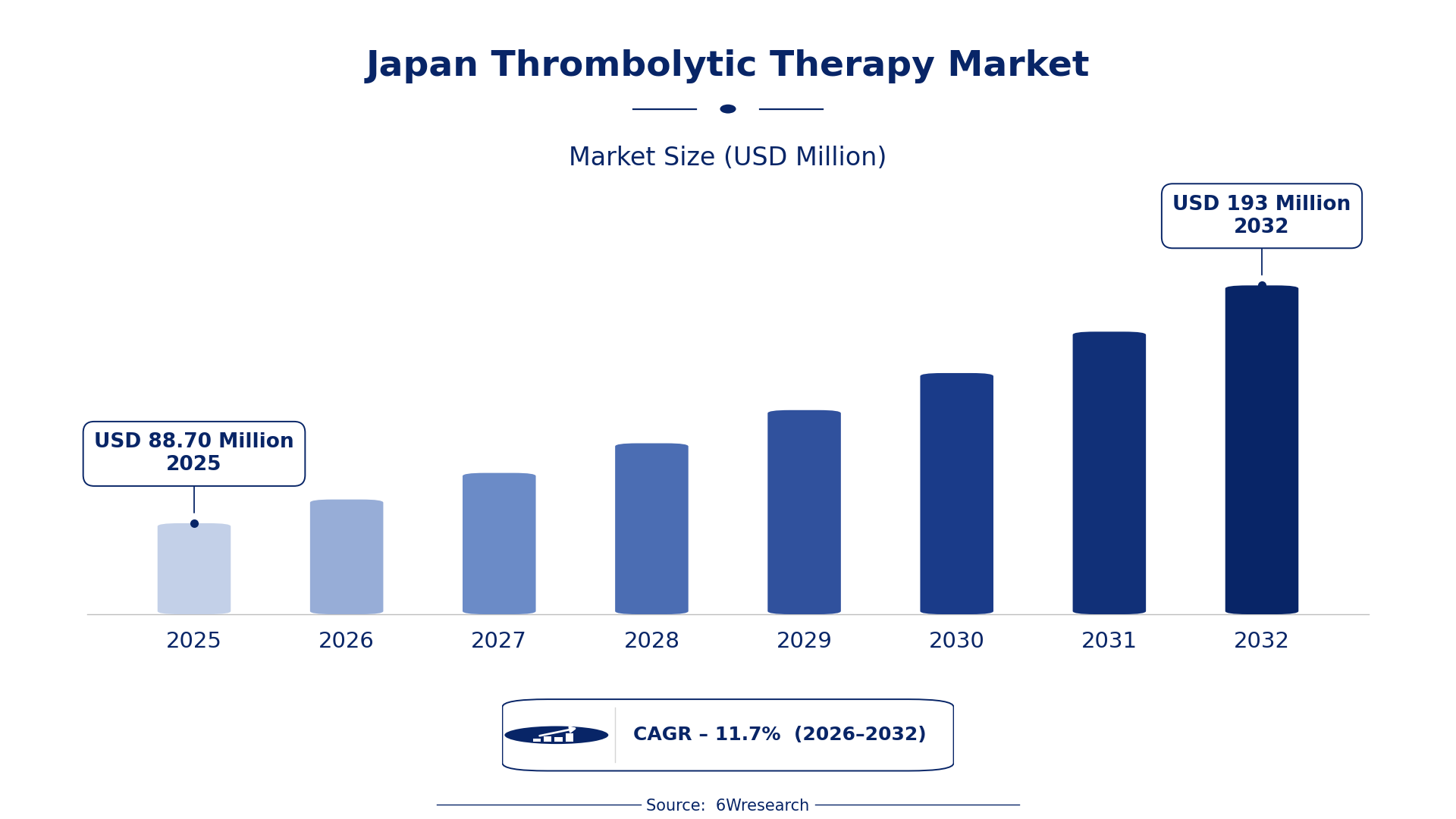
According to 6Wresearch internal database and industry insights, the Japan Thrombolytic Therapy Market was valued at USD 88.70 Million in 2025 and is projected to reach USD 193 Million by 2032, growing at a CAGR of approximately 11.7% during 2026–2032.
Japan Thrombolytic Therapy Market Highlights
| Report Metric | Details |
| Report Name | Japan Thrombolytic Therapy Market (2026-2032) |
| Market Size 2025 | USD 88.70 Million |
| Market Size 2032 | USD 193 Million |
| Absolute Growth 2025–2032 | USD 104.30 Million |
| CAGR 2026–2032 | 11.7% |
| Peak Annual Growth | 14.5% in 2032 |
| Forecast Period | 2026–2032 |
| Historical Data | 2022–2025 |
| Base Year | 2025 |
| Leading Drug Type, 2025 | tPA (Alteplase) (35% share) |
| Leading Delivery Method, 2025 | IV Infusion (40% share) |
| Leading Application Indication, 2025 | Acute Stroke (48% share) |
| Leading End User, 2025 | Hospitals (38% share) |
| Fastest-Growing Drug Type | Streptokinase (16.5% CAGR) |
| Fastest-Growing Delivery Method | Intravenous Injection (16.7% CAGR) |
| Fastest-Growing Application Indication | Myocardial Infarction (15.8% CAGR) |
| Fastest-Growing End User | Cardiac Centers (15.2% CAGR) |
| Growing Sector | Emergency Services |
| Key End Users | Hospitals, Cardiac Centers, Emergency Services |
Japan Thrombolytic Therapy Market Year-wise Growth Rate and Key Drivers (2022–2032)
This graph illustrates the annual growth rates of the market from 2022 to 2032, highlighting a steady upward trajectory and projected market expansion over the forecast period.
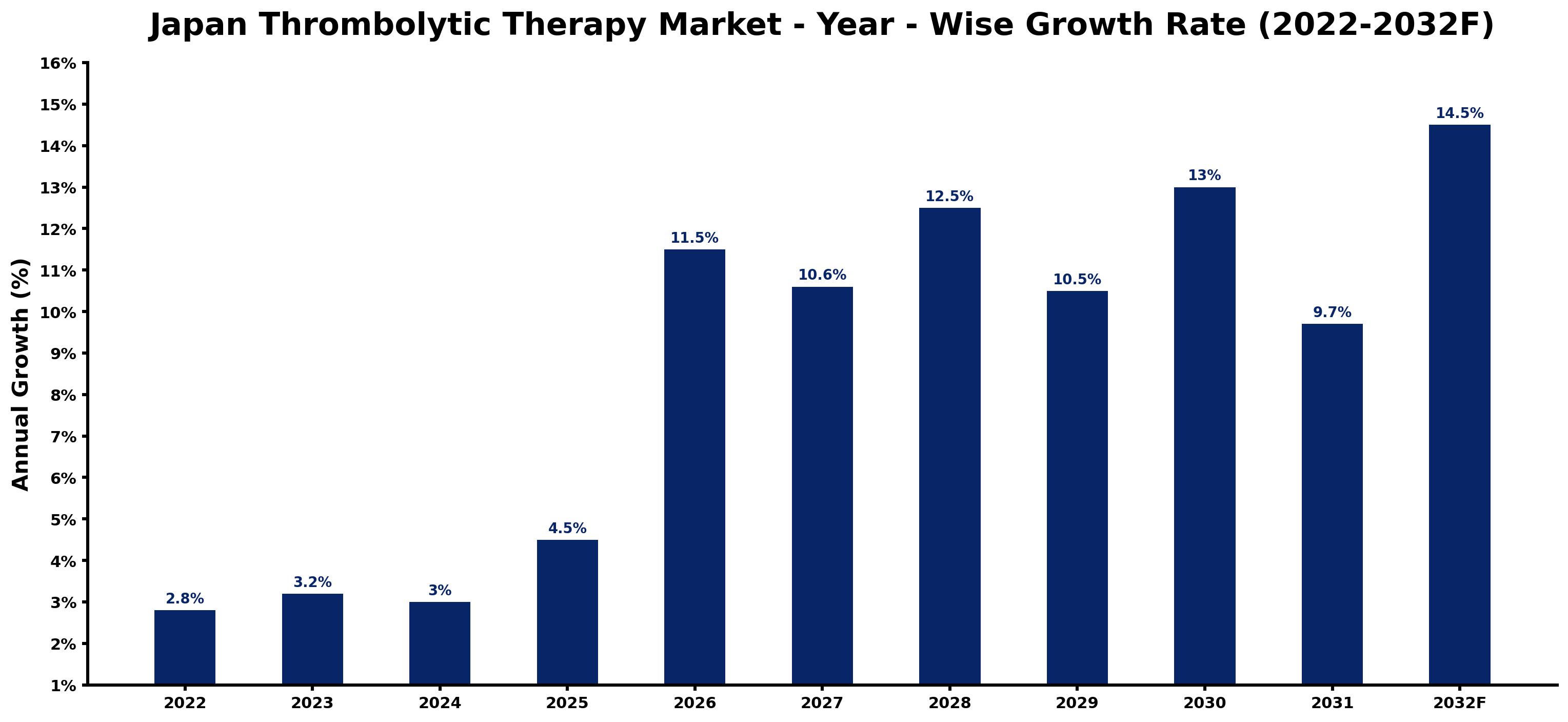
Annual growth estimates for each year appear below with the principal reason behind them, explaining the shifts that set the pace of the market.
| Year | Estimated Annual Growth (%) | Market Rationale |
| 2022 | 2.8 | The market experienced steady growth, reflecting ongoing demand for thrombolytic therapy. |
| 2023 | 3.2 | Growth accelerated as hospitals improved acute stroke treatment protocols and response times. |
| 2024 | 3.0 | The market saw a slight slowdown due to temporary resource constraints in healthcare facilities. |
| 2025 | 4.5 | Growth surged as hospitals expanded their emergency care units and treatment capabilities. |
| 2026 | 11.5 | Investment in training and technology is expected to drive demand for thrombolytics in acute care. |
| 2027 | 10.6 | The market is projected to experience a slowdown as hospitals adjust to new treatment guidelines. |
| 2028 | 12.5 | Demand is expected to rise sharply with advancements in thrombolytic drug administration techniques. |
| 2029 | 10.5 | Growth is projected to slow slightly as hospitals face staffing challenges amid increased patient loads. |
| 2030 | 13.0 | Investment in emergency medical services is expected to boost demand for thrombolytic therapies. |
| 2031 | 9.7 | Growth is projected to decelerate as hospitals focus on optimizing existing treatment protocols. |
| 2032 | 14.5 | Demand is expected to peak as new treatment standards and technologies are widely adopted. |
Note: Market size estimations and growth projections presented in this report are based on 6Wresearch's proprietary forecasting methodology, utilizing the latest available industry data, government publications, and primary research inputs.
Japan Thrombolytic Therapy Market Synopsis
Thrombolytic therapy utilises clot-dissolving medications to treat conditions such as myocardial infarction and acute stroke, primarily administered in hospitals. The Japan Thrombolytic Therapy Market is expanding due to increasing hospital admissions for acute stroke, with approximately 1.2 million cases in 2022. Ongoing advancements in treatment protocols and government initiatives, such as a programme launched in 2023 to improve acute stroke care, are driving further demand for these therapies.
Market Dynamics Impact Analysis (2026–2032)
| Factor | Type | Impact | Primary Segment Affected |
| Increasing hospital admissions for acute stroke drive demand for thrombolytic therapy. | Driver | High | Acute Stroke |
| Growing focus on emergency care units enhances treatment capabilities. | Driver | High | Hospitals |
| Rising number of trained emergency medical technicians creates a skilled workforce. | Opportunity | Medium | Emergency Services |
| Investment in advanced medical technologies opens new treatment avenues. | Opportunity | Medium | Cardiac Centers |
| Limited awareness among healthcare professionals may restrict therapy adoption. | Restraint | High | tPA (Alteplase) |
| Resource constraints in hospitals can hinder timely treatment delivery. | Restraint | Medium | Emergency Services |
| High costs of advanced thrombolytic agents can limit accessibility. | Challenge | High | tPA (Alteplase) |
| Inconsistent training for emergency medical technicians may delay treatment. | Challenge | Medium | Emergency Services |
Evaluation of Drivers in Japan Thrombolytic Therapy Market (2026–2032)
Demand rests on the following drivers, each shown with the segment it touches most.
| Drivers | Primary Segment Affected | Why It Matters (Evidence) |
| Increased hospital admissions for acute stroke drive demand for thrombolytics. | Acute Stroke | In 2022, Japan recorded approximately 1.2 million hospital admissions for acute stroke, prompting hospitals to enhance treatment protocols. |
| Investment in emergency care units enhances treatment capabilities. | Hospitals | With over 500 emergency care units installed, hospitals are better equipped to administer thrombolytic therapy. |
| Growing number of trained emergency medical technicians supports timely treatment. | Emergency Services | Japan has over 200,000 trained emergency medical technicians, improving response times for thrombolytic therapy administration. |
| Advancements in drug administration techniques increase therapy adoption. | Cardiac Centers | New initiatives in 2023 aim to enhance thrombolytic therapy training for healthcare professionals. |
| Government funding for emergency medical services boosts infrastructure. | Emergency Services | In 2023, the government allocated ¥2 billion to improve emergency medical services, enhancing thrombolytic therapy access. |
Several shifts outside the market lift sales. The number of hospital admissions for acute stroke reached approximately 1.2 million in 2022, prompting hospitals to improve their thrombolytic therapy protocols. Investment in emergency care units allows for better treatment capabilities, with hospitals actively seeking innovative solutions. The growing workforce of trained emergency medical technicians improves response times, ensuring timely administration of thrombolytics.
Evaluation of Restraints in Japan Thrombolytic Therapy Market
Below are the constraints most often cited by buyers and suppliers, with the segment each affects.
| Market Restraint | Primary Segment Affected | Why It Matters (Evidence) |
| Limited awareness among healthcare professionals restricts therapy adoption. | tPA (Alteplase) | Despite advancements, many healthcare professionals remain unaware of the latest thrombolytic protocols, affecting patient outcomes. |
| Resource constraints in hospitals hinder timely treatment delivery. | Emergency Services | Hospitals face resource limitations, which can delay the administration of thrombolytic therapy during emergencies. |
| High costs of advanced thrombolytic agents limit accessibility. | Hospitals | The high cost of some thrombolytic agents can restrict their use in less affluent hospitals. |
| Inconsistent training for emergency medical technicians delays treatment. | Emergency Services | Variability in training programs for emergency medical technicians can lead to delays in thrombolytic therapy administration. |
| Regulatory hurdles may slow the introduction of new therapies. | tPA (Alteplase) | New thrombolytic agents must navigate complex regulatory processes, delaying their availability in the market. |
Japan Thrombolytic Therapy Market Challenges
High costs of thrombolytic medications strain hospital budgets, limiting access for patients needing urgent treatment. Many hospitals in Japan face delays in administering thrombolytics due to an insufficient number of emergency care units, which can prolong recovery times for patients. Suppliers encounter challenges in meeting the stringent JIS Z 2801 standards for medical devices, resulting in increased compliance costs that restrict product availability. Rapid technological advancements require continuous training for healthcare professionals, diverting funds and delaying the implementation of improved treatment protocols in hospitals.
Trends in the Japan Thrombolytic Therapy Market
These developments are changing demand patterns in the Japan Thrombolytic Therapy Market.
- Shift from Traditional to Advanced Thrombolytic Agents: The trend towards advanced thrombolytic agents began in 2023, with increasing adoption of Tenecteplase due to its ease of administration. This change is evidenced by a growing preference among hospitals, improving treatment efficiency.
- Transition to Improved Emergency Medical Training: In 2023, a new initiative was launched to improve thrombolytic therapy training for healthcare professionals. This shift aims to ensure timely and effective treatment during emergencies, benefiting patient outcomes.
- Emergence of Telemedicine in Acute Care: Since 2023, telemedicine has gained traction in acute care settings, allowing remote consultations for thrombolytic therapy. This trend is particularly relevant in rural areas, improving access to specialists.
- Prioritisation of Patient-Centric Care Models: The focus on patient-centric care models has intensified since 2023, with hospitals adopting protocols that emphasise rapid thrombolytic therapy administration. This shift is driven by the need for improved patient outcomes.
Investment Opportunities in the Japan Thrombolytic Therapy Market
Below are the investment opportunities with the strongest case in the Japan Thrombolytic Therapy Market.
- Growing Demand for Training Programs: Now is an opportune time to invest in training programs for healthcare professionals, as the government allocated ¥2 billion in 2023 to improve emergency medical services. This investment will enhance the skills of emergency medical technicians.
- Expansion of Emergency Care Facilities: With over 500 emergency care units in Japan, there is an opportunity to supply advanced thrombolytic agents. Hospitals are actively seeking innovative solutions to improve treatment efficiency.
- Investment in Telemedicine Solutions: The increasing adoption of telemedicine in acute care presents an opportunity to develop remote consultation platforms. Hospitals, especially in rural areas, are looking for solutions to improve access to thrombolytic therapy.
- Enhancing Patient Education Initiatives: The focus on patient-centric care creates a need for educational materials about thrombolytic therapy. Hospitals are seeking resources to inform patients about treatment options and benefits.
Government Initiatives in the Japan Thrombolytic Therapy Market
The Medical Care Act of 1948 establishes standards for hospitals and clinics, ensuring that facilities are equipped to provide thrombolytic therapy. This law mandates specific staffing requirements and operational protocols to improve patient care. The Long-Term Care Insurance Act, in force since 2000, supports nursing care and services, indirectly benefiting thrombolytic therapy by ensuring that older patients have access to necessary treatments.
The Ministry of Health, Labour and Welfare oversees the approval of medical devices and therapies, including thrombolytics. In 2023, the ministry launched a program to improve acute stroke treatment protocols, allocating ¥2 billion to enhance emergency medical services and facilitate better access to thrombolytic therapies.
Future Insight of the Japan Thrombolytic Therapy Market
Investment in improving acute stroke treatment protocols will create demand for thrombolytic therapy services. By 2032, the average time from symptom onset to treatment in acute strokes is targeted to be under 3 hours, significantly benefiting patient outcomes. New training initiatives for healthcare professionals will promote adherence to updated guidelines, ensuring high-quality care. The establishment of more emergency care units will support quicker response times, ultimately elevating the effectiveness of thrombolytic therapy across Japan.
Market Segmentation Analysis
Japan Thrombolytic Therapy Market report covers a detailed analysis of the following market segments:
By Drug Type – tPA (Alteplase) Leads, Streptokinase Expected to Grow Fastest
According to Saurav Kr Singh, Senior Research Analyst at 6Wresearch, tPA (Alteplase) accounted for 35% of the market by drug type in 2025. tPA (Alteplase) holds the largest share in Japan as it is commonly used for acute ischemic stroke treatment, with over 1.2 million hospital admissions for this condition annually. The backing from medical guidelines and the high patient volume in urban hospitals solidify its leading status. Over 2026–2032, Streptokinase is expected to post the fastest growth, at a CAGR of 16.5%. Streptokinase is witnessing rapid growth, particularly for myocardial infarction cases, which are common within the healthcare system. The heightened focus on enhancing acute treatment protocols is likely to escalate the demand for this thrombolytic agent. This trend suggests that suppliers should strategically boost the distribution of Streptokinase to meet the rising treatment requirements.
By Delivery Method – IV Infusion Leads, Intravenous Injection Expected to Grow Fastest
IV Infusion took 40% of delivery method revenue in 2025, more than any other category. IV Infusion is the primary delivery method for thrombolytics in Japan, especially in hospitals where prompt administration is vital for patient outcomes. Its established role in emergency care settings highlights its significance in acute treatment scenarios. Intravenous Injection is set to record the highest CAGR in this split, 16.7% over 2026–2032. Intravenous Injection is rapidly gaining popularity as it becomes the preferred method in hospitals, allowing for quicker administration of thrombolytics. The emphasis on minimising response times in emergencies is a crucial factor behind this growth. Suppliers must prioritise the availability of intravenous delivery systems to cater to the increasing demand for swift thrombolytic therapy.
By Application Indication – Acute Stroke Leads, Myocardial Infarction Expected to Grow Fastest
With 48% of application indication revenue in 2025, Acute Stroke was the largest category. Acute Stroke remains the primary indication for thrombolytic therapy in Japan, with approximately 1.2 million hospital admissions annually for this condition. The focus on improving acute stroke treatment protocols further strengthens its leading position. Myocardial Infarction is projected to grow fastest, at a CAGR of 15.8% during 2026–2032. Myocardial Infarction is rapidly gaining traction as a key application for thrombolytics, driven by the high prevalence of heart conditions in the population. The emphasis on timely treatment for cardiac emergencies accelerates this segment's growth. Buyers should prioritise resources for myocardial infarction treatments to align with the growing focus on cardiac care.
By End User – Hospitals Lead, Cardiac Centers Expected to Grow Fastest
Hospitals held 38% of the Japan Thrombolytic Therapy Market by end user in 2025. Hospitals are the main setting for thrombolytic therapy in Japan, with over 8,000 facilities providing these treatments. The high volume of acute cases necessitates the availability of thrombolytic agents in these institutions. The quickest growth will come from Cardiac Centers, forecast to expand at a CAGR of 15.2% between 2026 and 2032. Cardiac Centers are experiencing rapid growth as specialised facilities for cardiac emergencies, reflecting the increasing need for focused care in this area. The rising number of trained emergency medical technicians supports this trend. Suppliers should target cardiac centers to meet the rising demand for specialised thrombolytic therapy.
Key Attractiveness of the Report
- 10 Years of Market Numbers
- Historical Data Starting from 2022 to 2025
- Base Year 2025
- Forecast Data until 2032
- Key Performance Indicators Impacting the Market
- Major Upcoming Developments and Projects
Key Highlights of the Report:
- Japan Thrombolytic Therapy Market Outlook
- Market Size of Japan Thrombolytic Therapy Market, 2025
- Forecast of Japan Thrombolytic Therapy Market, 2032
- Historical Data and Forecast of Japan Thrombolytic Therapy Revenues & Volume for the Period 2022-2032F
- Japan Thrombolytic Therapy Market Trend Evolution
- Japan Thrombolytic Therapy Market Drivers and Challenges
- Japan Thrombolytic Therapy Price Trends
- Japan Thrombolytic Therapy Porter's Five Forces
- Japan Thrombolytic Therapy Industry Life Cycle
- Historical Data and Forecast of Japan Thrombolytic Therapy Market Revenues & Volume By Drug Type for the Period 2022-2032F
- Historical Data and Forecast of Japan Thrombolytic Therapy Market Revenues & Volume By tPA (Alteplase) for the Period 2022-2032F
- Historical Data and Forecast of Japan Thrombolytic Therapy Market Revenues & Volume By Streptokinase for the Period 2022-2032F
- Historical Data and Forecast of Japan Thrombolytic Therapy Market Revenues & Volume By Tenecteplase for the Period 2022-2032F
- Historical Data and Forecast of Japan Thrombolytic Therapy Market Revenues & Volume By Reteplase for the Period 2022-2032F
- Historical Data and Forecast of Japan Thrombolytic Therapy Market Revenues & Volume By Delivery Method for the Period 2022-2032F
- Historical Data and Forecast of Japan Thrombolytic Therapy Market Revenues & Volume By IV Infusion for the Period 2022-2032F
- Historical Data and Forecast of Japan Thrombolytic Therapy Market Revenues & Volume By Intravenous Injection for the Period 2022-2032F
- Historical Data and Forecast of Japan Thrombolytic Therapy Market Revenues & Volume By Single Bolus for the Period 2022-2032F
- Historical Data and Forecast of Japan Thrombolytic Therapy Market Revenues & Volume By Multiple Bolus for the Period 2022-2032F
- Historical Data and Forecast of Japan Thrombolytic Therapy Market Revenues & Volume By Application Indication for the Period 2022-2032F
- Historical Data and Forecast of Japan Thrombolytic Therapy Market Revenues & Volume By Acute Stroke for the Period 2022-2032F
- Historical Data and Forecast of Japan Thrombolytic Therapy Market Revenues & Volume By Myocardial Infarction for the Period 2022-2032F
- Historical Data and Forecast of Japan Thrombolytic Therapy Market Revenues & Volume By Pulmonary Embolism for the Period 2022-2032F
- Historical Data and Forecast of Japan Thrombolytic Therapy Market Revenues & Volume By Arterial Blockage for the Period 2022-2032F
- Historical Data and Forecast of Japan Thrombolytic Therapy Market Revenues & Volume By End User for the Period 2022-2032F
- Historical Data and Forecast of Japan Thrombolytic Therapy Market Revenues & Volume By Hospitals for the Period 2022-2032F
- Historical Data and Forecast of Japan Thrombolytic Therapy Market Revenues & Volume By Cardiac Centers for the Period 2022-2032F
- Historical Data and Forecast of Japan Thrombolytic Therapy Market Revenues & Volume By Critical Care Units for the Period 2022-2032F
- Historical Data and Forecast of Japan Thrombolytic Therapy Market Revenues & Volume By Emergency Services for the Period 2022-2032F
- Japan Thrombolytic Therapy Import Export Trade Statistics
- Market Opportunity Assessment By Drug Type
- Market Opportunity Assessment By Delivery Method
- Market Opportunity Assessment By Application Indication
- Market Opportunity Assessment By End User
- Japan Thrombolytic Therapy Top Companies Market Share
- Japan Thrombolytic Therapy Competitive Benchmarking By Technical and Operational Parameters
- Japan Thrombolytic Therapy Company Profiles
- Japan Thrombolytic Therapy Key Strategic Recommendations
Market Covered
The study includes the following segmentation.
By Drug Type
- tPA (Alteplase)
- Streptokinase
- Tenecteplase
- Reteplase
By Delivery Method
- IV Infusion
- Intravenous Injection
- Single Bolus
- Multiple Bolus
By Application Indication
- Acute Stroke
- Myocardial Infarction
- Pulmonary Embolism
- Arterial Blockage
By End User
- Hospitals
- Cardiac Centers
- Critical Care Units
- Emergency Services































