Japan Thrombosis Therapeutics Market Size & Growth Rate
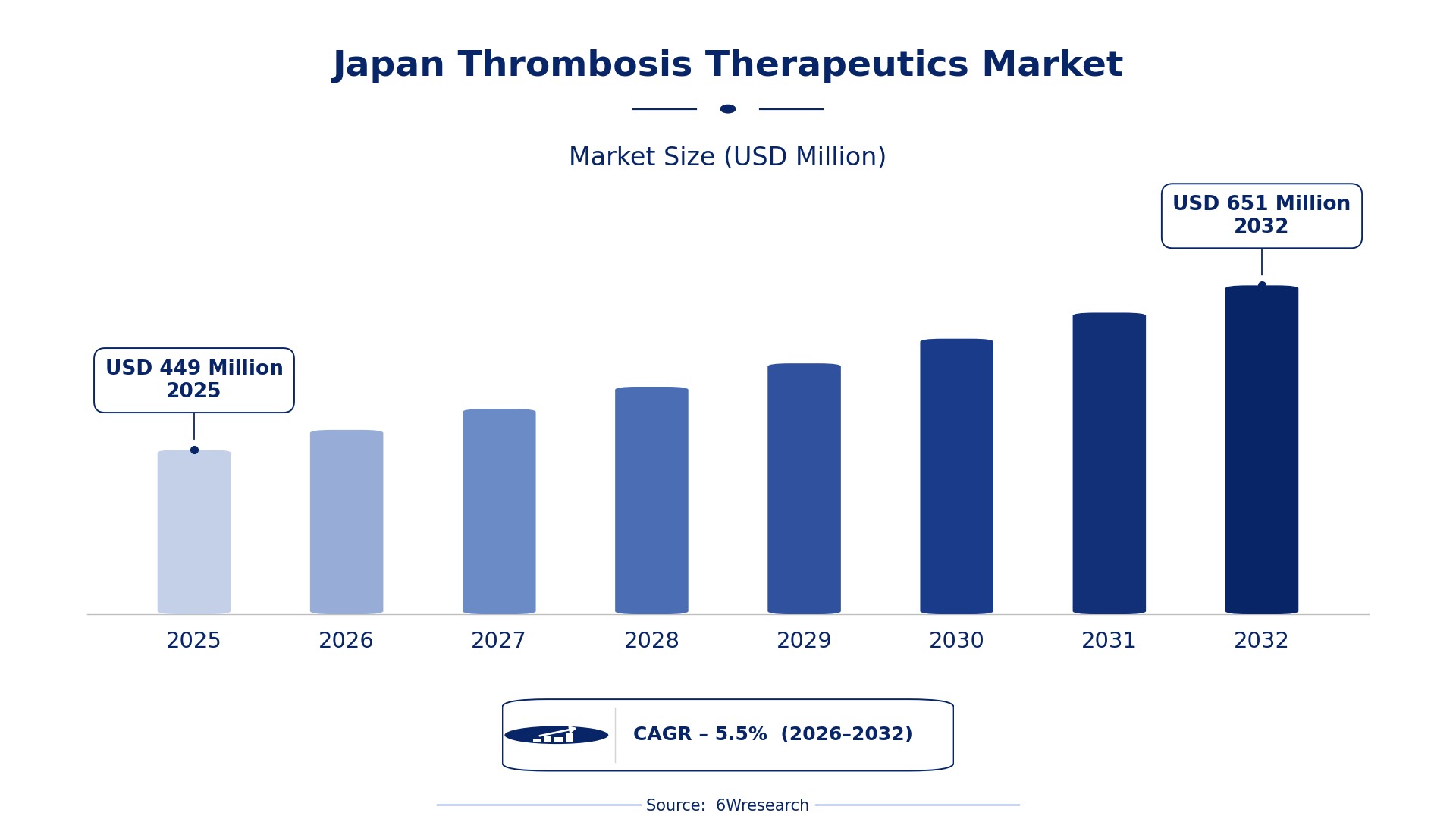
According to 6Wresearch internal database and industry insights, the Japan Thrombosis Therapeutics Market was valued at USD 449 Million in 2025 and is projected to reach USD 651 Million by 2032, growing at a CAGR of approximately 5.5% during 2026–2032.
Japan Thrombosis Therapeutics Market Highlights
| Report Metric | Details |
| Report Name | Japan Thrombosis Therapeutics Market (2026-2032) |
| Market Size 2025 | USD 449 Million |
| Market Size 2032 | USD 651 Million |
| Absolute Growth 2025–2032 | USD 202 Million |
| CAGR 2026–2032 | 5.5% |
| Peak Annual Growth | 6.8% in 2026 |
| Forecast Period | 2026–2032 |
| Historical Data | 2022–2025 |
| Base Year | 2025 |
| Leading Therapeutic Class, 2025 | Anticoagulants (35% share) |
| Leading Mechanism of Action, 2025 | Inhibit Clotting Factors (46% share) |
| Leading Administration Route, 2025 | Oral/Injectable (46% share) |
| Leading End User, 2025 | Cardiologists (43% share) |
| Fastest-Growing Therapeutic Class | Antiplatelet Drugs (7.2% CAGR) |
| Fastest-Growing Mechanism of Action | Block Platelet Aggregation (7.1% CAGR) |
| Fastest-Growing Administration Route | Oral (7.3% CAGR) |
| Fastest-Growing End User | Stroke Units (7.4% CAGR) |
| Growing Sector | cardiovascular care |
| Key End Users | hospitals, cardiologists, stroke units, general practitioners |
Japan Thrombosis Therapeutics Market Year-wise Growth Rate and Key Drivers (2022–2032)
This graph illustrates the annual growth rates of the market from 2022 to 2032, highlighting a steady upward trajectory and projected market expansion over the forecast period.
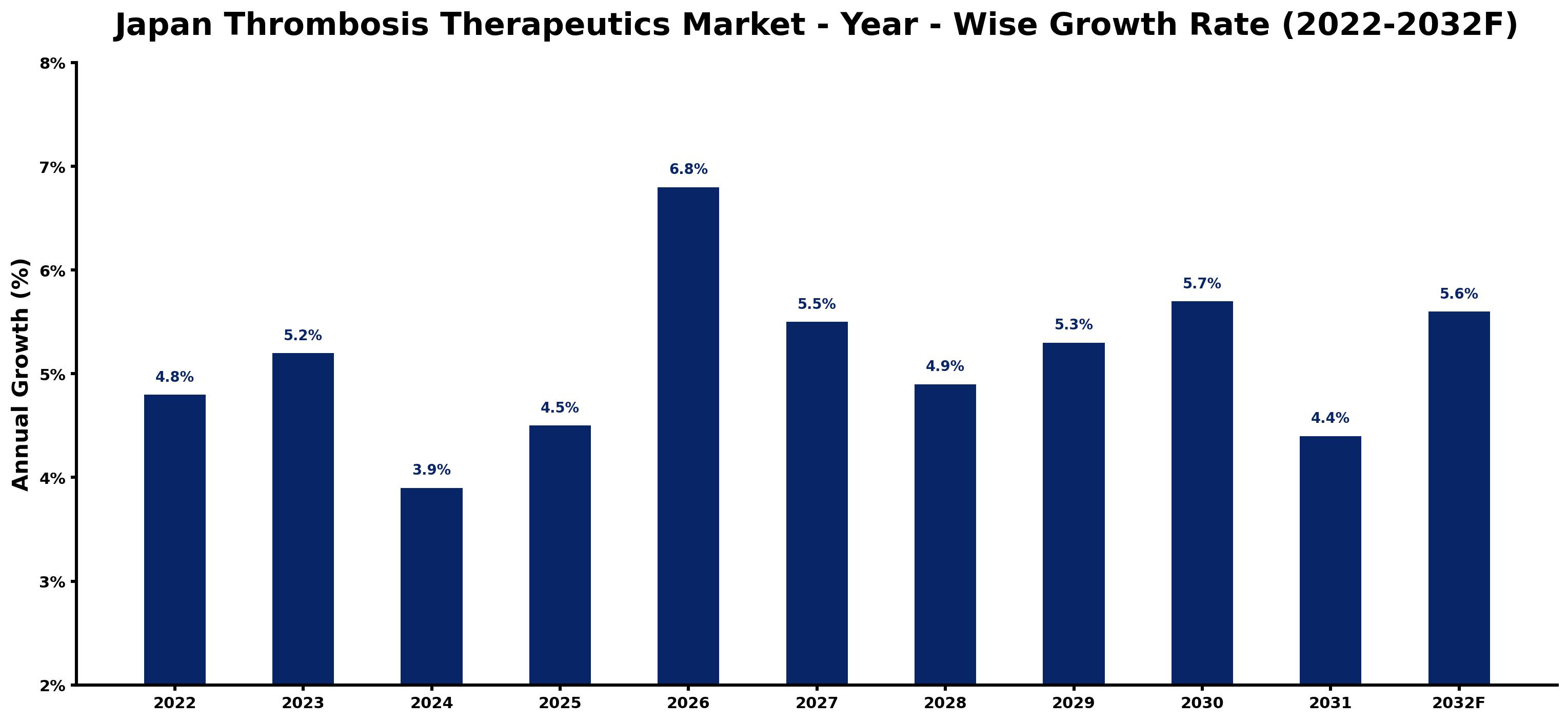
Year by year, the estimates below pair each growth rate with the development that shaped it.
| Year | Estimated Annual Growth (%) | Market Rationale |
| 2022 | 4.8 | The market experienced steady growth due to increased awareness of thrombosis conditions. |
| 2023 | 5.2 | Demand rose as healthcare providers adopted new treatment protocols for thrombosis management. |
| 2024 | 3.9 | Growth slowed as market saturation began to affect new product introductions. |
| 2025 | 4.5 | The introduction of new anticoagulants spurred renewed interest among prescribers. |
| 2026 | 6.8 | The market peaked as NOACs gained widespread acceptance among patients and providers. |
| 2027 | 5.5 | Growth is expected to slow as competition intensifies among existing therapeutic options. |
| 2028 | 4.9 | Market expansion is projected to continue, driven by the aging population requiring thrombosis care. |
| 2029 | 5.3 | Demand will increase as hospitals improve thrombosis treatment protocols and facilities. |
| 2030 | 5.7 | Growth is expected to continue as clinical pathways for stroke management become more established. |
| 2031 | 4.4 | The market will see a slowdown as regulatory changes begin to impact product approvals. |
| 2032 | 5.6 | Demand is expected to rise as investment in cardiovascular research continues to grow. |
Note: Market size estimations and growth projections presented in this report are based on 6Wresearch's proprietary forecasting methodology, utilizing the latest available industry data, government publications, and primary research inputs.
Japan Thrombosis Therapeutics Market Synopsis
Thrombosis therapeutics are vital medical products used to prevent and treat blood clots, primarily produced through chemical synthesis or biopharmaceutical processes. The Japan Thrombosis Therapeutics Market is propelled by healthcare providers, especially hospitals and cardiologists, who address conditions like deep vein thrombosis and pulmonary embolism. The rising prevalence of atrial fibrillation, with approximately 1.2 million patients diagnosed in 2023, and the adoption of NOACs, which reached over 40% of patients in 2022, are key drivers of market growth.
Market Dynamics Impact Analysis (2026–2032)
| Factor | Type | Impact | Primary Segment Affected |
| Rising prevalence of atrial fibrillation | Driver | High | Anticoagulants |
| Increased adoption of NOACs | Driver | High | NOACs |
| Expansion of stroke units | Opportunity | High | Stroke Units |
| Investment in cardiovascular research | Opportunity | Medium | General Hospitals |
| Regulatory hurdles for new product approvals | Restraint | High | Fibrinolytic Agents |
| Market saturation of existing products | Restraint | Medium | Antiplatelet Drugs |
| High costs of innovative treatments | Challenge | High | Anticoagulants |
| Competition from alternative therapies | Challenge | Medium | Block Platelet Aggregation |
Evaluation of Drivers in Japan Thrombosis Therapeutics Market (2026–2032)
Demand rests on the following drivers, each shown with the segment it touches most.
| Drivers | Primary Segment Affected | Why It Matters (Evidence) |
| Increasing patient population diagnosed with atrial fibrillation | Anticoagulants | In 2023, approximately 1.2 million patients in Japan were diagnosed, driving demand for anticoagulants. |
| Adoption of NOACs among patients | NOACs | Over 40% of patients received NOACs in 2022, leading to higher prescriptions. |
| Growth in the number of stroke units | Stroke Units | With over 1,500 stroke units operating in 2023, demand for thrombosis therapeutics rises. |
| Investment in cardiovascular research | General Hospitals | Investment reached 1 billion yen in 2023, supporting treatment options in hospitals. |
| Guidelines set by the Japanese Society of Thrombosis and Hemostasis | Fibrinolytic Agents | The society's guidelines promote the use of fibrinolytic agents in emergency departments. |
Volumes rise due to a substantial patient population diagnosed with atrial fibrillation, with around 1.2 million cases reported in 2023. This condition fuels demand for anticoagulants, which account for over 60% of the market. The establishment of more than 1,500 stroke units in Japan heightens the need for thrombosis therapeutics. Investment in cardiovascular research, totalling 1 billion yen in 2023, supports the expansion of treatment options available to healthcare providers. The increasing adoption of new treatments, such as NOACs, encourages healthcare providers to refine their prescribing practices.
Evaluation of Restraints in Japan Thrombosis Therapeutics Market
The following restraints limit how fast demand can grow.
| Market Restraint | Primary Segment Affected | Why It Matters (Evidence) |
| Outdated manufacturing technology leads to inefficiencies in producing thrombosis therapeutics, affecting supply. | Anticoagulants | This inefficiency results in delays that cost hospitals extra resources for patient management. |
| High costs due to stringent regulatory approvals for new anticoagulants delay market entry. | NOACs | Importers face delays of up to 12 months, impacting the availability of new treatment options. |
| Fierce competition for limited treatment options inflates healthcare costs. | Antiplatelet Drugs | This competition can inflate healthcare costs by 15% in some regions, affecting buyer decisions. |
| Reliance on specific suppliers for key raw materials disrupts supply chains. | Fibrinolytic Agents | Such disruptions risk treatment availability for over 1.2 million patients diagnosed with atrial fibrillation. |
| Limited awareness of thrombosis management guidelines among healthcare providers hampers effective treatment. | Inhibit Clotting Factors | This lack of awareness can lead to suboptimal prescribing practices and patient outcomes. |
Japan Thrombosis Therapeutics Market Challenges
In Japan, outdated manufacturing technology leads to inefficiencies in producing thrombosis therapeutics, causing delays that cost hospitals extra resources for patient management. Importers face high costs due to stringent regulatory approvals for new anticoagulants, delaying market entry by up to 12 months. Buyers contend with fierce competition for limited treatment options, inflating healthcare costs by 15% in some regions. Supply chain disruptions occur from reliance on specific suppliers for key raw materials, risking treatment availability for over 1.2 million patients diagnosed with atrial fibrillation.
Trends in the Japan Thrombosis Therapeutics Market
Buyers and suppliers in the Japan Thrombosis Therapeutics Market are adjusting to the following trends.
- Shift towards NOACs in Thrombosis Treatment: The adoption of NOACs has accelerated, with over 40% of patients receiving them in 2022. This trend indicates a preference for treatments that require less monitoring, influencing prescribing patterns among cardiologists.
- Growth of Stroke Units in Japan: The establishment of over 1,500 stroke units in 2023 has revolutionised acute care for stroke patients. This trend underscores the importance of specialised care in managing thrombotic events.
- Increased Investment in Cardiovascular Research: Investment in cardiovascular research reached 1 billion yen in 2023, reflecting a commitment to improving treatment options. This funding supports the development of new thrombosis therapeutics.
- Enhanced Clinical Pathways for Stroke Management: Clinical pathways for stroke management have been established nationwide, improving treatment consistency. This initiative aims to streamline care for patients experiencing thrombotic events.
Investment Opportunities in the Japan Thrombosis Therapeutics Market
The following opportunities in the Japan Thrombosis Therapeutics Market pair current demand with a clear way in.
- Expansion of Stroke Units in Urban Areas: With over 1,500 stroke units operating in Japan, there is a growing need for advanced thrombosis therapeutics. Suppliers can enter this market by partnering with hospitals to provide tailored solutions.
- Investment in New Anticoagulants: The market for new anticoagulants is expanding, with a projected growth of 5.5% by 2032. Hospitals are key buyers, and suppliers can engage through local partnerships.
- Development of Patient Education Programs: There is a need for improved patient education regarding thrombosis management, with potential for growth in educational resources. Healthcare providers are looking for materials to enhance patient understanding.
- Enhancement of Thrombosis Treatment Protocols: The average hospital stay for thrombosis patients is 7 days, indicating a need for efficient treatment protocols. Hospitals can benefit from adopting standardised care pathways.
Government Initiatives in the Japan Thrombosis Therapeutics Market
The NHI drug price standard, revised by the Ministry of Health, Labour and Welfare, sets reimbursement prices for thrombosis therapeutics, ensuring affordability for patients. The Medical Care Act of 1948 establishes standards for hospitals, promoting quality care in thrombosis management. In 2023, the average hospital stay for thrombosis patients was 7 days, highlighting the need for effective treatment protocols.
The Pharmaceuticals and Medical Devices Agency reviews pharmaceuticals and medical devices, ensuring safety and efficacy. The Japan Agency for Medical Research and Development funds medical research, supporting advancements in thrombosis therapeutics. In 2023, funding for cardiovascular research reached 1 billion yen, facilitating the development of new treatment options.
Future Insight of the Japan Thrombosis Therapeutics Market
Advancements in biopharmaceutical processes will reshape demand for thrombosis therapeutics by 2032, as new treatments emerge. The government's 2023 initiative to improve thromboembolism prevention strategies will promote the adoption of advanced therapies. Investment in cardiovascular research is expected to drive improvements in treatment efficacy. With over 2,000 hospitals implementing thrombosis treatment protocols, healthcare providers will be better positioned to adopt new standards and improve patient care.
Market Segmentation Analysis
Japan Thrombosis Therapeutics Market report covers a detailed analysis of the following market segments:
By Therapeutic Class – Anticoagulants Lead, Antiplatelet Drugs Expected to Grow Fastest
According to Saurav Kr Singh, Senior Research Analyst at 6Wresearch, the largest therapeutic class category in 2025 was Anticoagulants, at 35% of revenue. Anticoagulants dominate the market as they are essential for managing conditions like atrial fibrillation, impacting approximately 1.2 million patients in Japan. Their significance is heightened in areas such as Tokyo, where healthcare providers consistently rely on these therapeutics for effective treatment. Antiplatelet Drugs are set to record the highest CAGR in this split, 7.2% over 2026–2032. Antiplatelet drugs are experiencing rapid growth as they are increasingly prescribed for secondary prevention after strokes, indicating a shift in treatment strategies. The government's initiative in 2023 to enhance thromboembolism prevention is anticipated to further boost this segment's expansion. Suppliers should prioritise antiplatelet drugs to meet the increasing market demand.
By Mechanism of Action – Inhibit Clotting Factors Lead, Block Platelet Aggregation Expected to Grow Fastest
Inhibit Clotting Factors accounted for 46% of the market by mechanism of action in 2025. Inhibiting clotting factors is essential for the effectiveness of anticoagulants, making this mechanism critical for preventing blood clots. This approach is widely adopted in accordance with the guidelines from the Japanese Society of Thrombosis and Hemostasis. Over 2026–2032, Block Platelet Aggregation is expected to post the fastest growth, at a CAGR of 7.1%. Blocking platelet aggregation is becoming a key focus in managing thrombotic conditions, particularly for stroke patients. The establishment of clinical pathways for stroke management across Japan highlights the growing importance of this mechanism. Buyers should prioritise therapies that block platelet aggregation to stay aligned with current treatment strategies.
By Administration Route – Oral/Injectable Leads, Oral Expected to Grow Fastest
Oral/Injectable held 46% of the Japan Thrombosis Therapeutics Market by administration route in 2025. The oral and injectable routes are prevalent, providing flexibility in treatment, particularly for outpatient care. This is highlighted by the high usage of anticoagulants, which are commonly administered orally, reflecting patient preferences. The quickest growth will come from Oral, forecast to expand at a CAGR of 7.3% between 2026 and 2032. The oral administration route is gaining popularity due to its convenience for patients, especially those requiring long-term treatment. This trend is expected to continue as patient adherence becomes a key focus in therapeutic strategies. Suppliers should concentrate on developing oral formulations to align with the growing patient and provider preferences.
By End User – Cardiologists Lead, Stroke Units Expected to Grow Fastest
Cardiologists took 43% of end user revenue in 2025, more than any other category. Cardiologists are the primary prescribers of thrombosis therapeutics, with over 10,000 specialists concentrated in the Tokyo region. Their expertise is vital for managing complex cases, particularly in urban areas with high patient density. Stroke Units are projected to grow fastest, at a CAGR of 7.4% during 2026–2032. Stroke units are rapidly becoming the focal point for thrombosis management, as they play a critical role in treating patients with thrombotic issues. The establishment of over 1,500 stroke units in Japan highlights the increasing emphasis on specialised care. Suppliers should engage with stroke units to ensure their products are integrated into treatment protocols for optimal patient outcomes.
Key Attractiveness of the Report
- 10 Years of Market Numbers
- Historical Data Starting from 2022 to 2025
- Base Year 2025
- Forecast Data until 2032
- Key Performance Indicators Impacting the Market
- Major Upcoming Developments and Projects
Key Highlights of the Report:
- Japan Thrombosis Therapeutics Market Outlook
- Market Size of Japan Thrombosis Therapeutics Market, 2025
- Forecast of Japan Thrombosis Therapeutics Market, 2032
- Historical Data and Forecast of Japan Thrombosis Therapeutics Revenues & Volume for the Period 2022-2032F
- Japan Thrombosis Therapeutics Market Trend Evolution
- Japan Thrombosis Therapeutics Market Drivers and Challenges
- Japan Thrombosis Therapeutics Price Trends
- Japan Thrombosis Therapeutics Porter's Five Forces
- Japan Thrombosis Therapeutics Industry Life Cycle
- Historical Data and Forecast of Japan Thrombosis Therapeutics Market Revenues & Volume By Therapeutic Class for the Period 2022-2032F
- Historical Data and Forecast of Japan Thrombosis Therapeutics Market Revenues & Volume By Anticoagulants for the Period 2022-2032F
- Historical Data and Forecast of Japan Thrombosis Therapeutics Market Revenues & Volume By Antiplatelet Drugs for the Period 2022-2032F
- Historical Data and Forecast of Japan Thrombosis Therapeutics Market Revenues & Volume By Fibrinolytic Agents for the Period 2022-2032F
- Historical Data and Forecast of Japan Thrombosis Therapeutics Market Revenues & Volume By NOACs for the Period 2022-2032F
- Historical Data and Forecast of Japan Thrombosis Therapeutics Market Revenues & Volume By Mechanism of Action for the Period 2022-2032F
- Historical Data and Forecast of Japan Thrombosis Therapeutics Market Revenues & Volume By Inhibit Clotting Factors for the Period 2022-2032F
- Historical Data and Forecast of Japan Thrombosis Therapeutics Market Revenues & Volume By Block Platelet Aggregation for the Period 2022-2032F
- Historical Data and Forecast of Japan Thrombosis Therapeutics Market Revenues & Volume By Dissolve Clots for the Period 2022-2032F
- Historical Data and Forecast of Japan Thrombosis Therapeutics Market Revenues & Volume By Target Factor Xa/IIa for the Period 2022-2032F
- Historical Data and Forecast of Japan Thrombosis Therapeutics Market Revenues & Volume By Administration Route for the Period 2022-2032F
- Historical Data and Forecast of Japan Thrombosis Therapeutics Market Revenues & Volume By Oral/Injectable for the Period 2022-2032F
- Historical Data and Forecast of Japan Thrombosis Therapeutics Market Revenues & Volume By Oral for the Period 2022-2032F
- Historical Data and Forecast of Japan Thrombosis Therapeutics Market Revenues & Volume By IV for the Period 2022-2032F
- Historical Data and Forecast of Japan Thrombosis Therapeutics Market Revenues & Volume By Oral for the Period 2022-2032F
- Historical Data and Forecast of Japan Thrombosis Therapeutics Market Revenues & Volume By End User for the Period 2022-2032F
- Historical Data and Forecast of Japan Thrombosis Therapeutics Market Revenues & Volume By Cardiologists for the Period 2022-2032F
- Historical Data and Forecast of Japan Thrombosis Therapeutics Market Revenues & Volume By Stroke Units for the Period 2022-2032F
- Historical Data and Forecast of Japan Thrombosis Therapeutics Market Revenues & Volume By ICUs for the Period 2022-2032F
- Historical Data and Forecast of Japan Thrombosis Therapeutics Market Revenues & Volume By General Hospitals for the Period 2022-2032F
- Japan Thrombosis Therapeutics Import Export Trade Statistics
- Market Opportunity Assessment By Therapeutic Class
- Market Opportunity Assessment By Mechanism of Action
- Market Opportunity Assessment By Administration Route
- Market Opportunity Assessment By End User
- Japan Thrombosis Therapeutics Top Companies Market Share
- Japan Thrombosis Therapeutics Competitive Benchmarking By Technical and Operational Parameters
- Japan Thrombosis Therapeutics Company Profiles
- Japan Thrombosis Therapeutics Key Strategic Recommendations
Market Covered
Coverage by segment is as follows.
By Therapeutic Class
- Anticoagulants
- Antiplatelet Drugs
- Fibrinolytic Agents
- NOACs
By Mechanism of Action
- Inhibit Clotting Factors
- Block Platelet Aggregation
- Dissolve Clots
- Target Factor Xa/IIa
By Administration Route
- Oral/Injectable
- Oral
- IV
By End User
- Cardiologists
- Stroke Units
- ICUs
- General Hospitals































