Japan Throttle Control Valve Market Size & Growth Rate
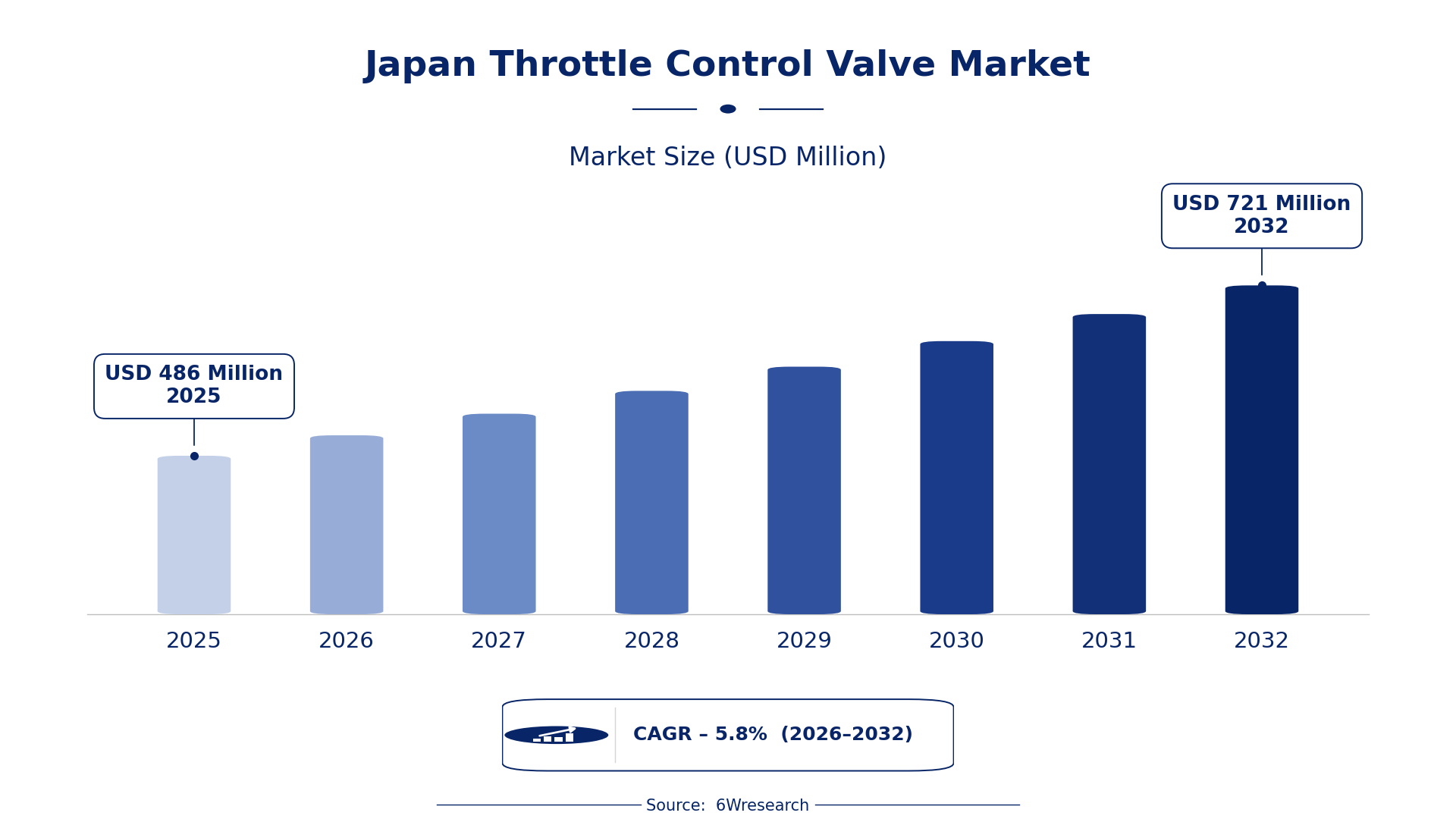
According to 6Wresearch internal database and industry insights, the Japan Throttle Control Valve Market was valued at USD 486 Million in 2025 and is projected to reach USD 721 Million by 2032, growing at a CAGR of approximately 5.8% during 2026–2032.
Japan Throttle Control Valve Market Highlights
| Report Metric | Details |
| Report Name | Japan Throttle Control Valve Market (2026-2032) |
| Market Size 2025 | USD 486 Million |
| Market Size 2032 | USD 721 Million |
| Absolute Growth 2025–2032 | USD 235 Million |
| CAGR 2026–2032 | 5.8% |
| Peak Annual Growth | 6.7% in 2028 |
| Forecast Period | 2026–2032 |
| Historical Data | 2022–2025 |
| Base Year | 2025 |
| Leading Throttle Control Valve, 2025 | Electronic Throttle Valves (41% share) |
| Leading Product Type, 2025 | Drive-by-Wire (44% share) |
| Leading Sensor Type, 2025 | Position Sensorified (41% share) |
| Leading Distribution Channel, 2025 | OEM Suppliers (41% share) |
| Leading End User Industry, 2025 | Passenger Vehicles (36% share) |
| Fastest-Growing Throttle Control Valve | Vacuum Throttle Valves (7.4% CAGR) |
| Fastest-Growing Product Type | Intake Control (8.0% CAGR) |
| Fastest-Growing Sensor Type | Mechanical Diaphragm (8.2% CAGR) |
| Fastest-Growing Distribution Channel | Aftermarket Dealers (7.6% CAGR) |
| Fastest-Growing End User Industry | Light Commercial Vehicles (7.8% CAGR) |
| Growing Sector | automotive industry |
| Key End Users | automotive manufacturers, aftermarket suppliers, vehicle owners, R&D facilities |
Japan Throttle Control Valve Market Year-wise Growth Rate and Key Drivers (2022–2032)
This graph illustrates the annual growth rates of the market from 2022 to 2032, highlighting a steady upward trajectory and projected market expansion over the forecast period.
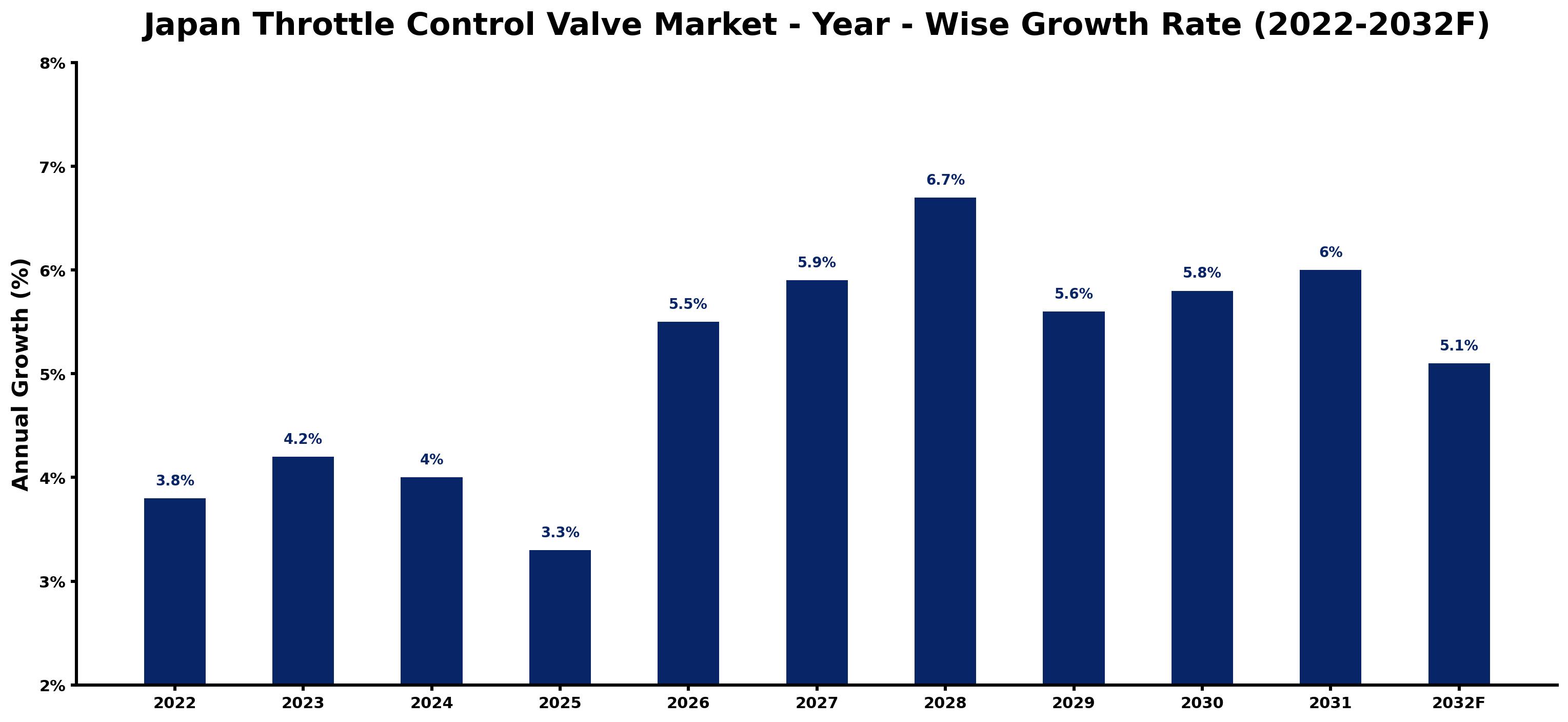
For each year, the table pairs the estimated growth rate with the leading influence on demand, showing how the drivers changed across the period.
| Year | Estimated Annual Growth (%) | Market Rationale |
| 2022 | 3.8 | The automotive sector maintained steady production levels, supporting demand for throttle control valves. |
| 2023 | 4.2 | Increased vehicle production and stricter emissions regulations spurred higher demand for advanced throttle systems. |
| 2024 | 4.0 | Growth moderated as manufacturers adjusted to supply chain challenges and fluctuating material costs. |
| 2025 | 3.3 | Demand continued to slow as market conditions stabilised, reflecting a cautious approach to investment. |
| 2026 | 5.5 | Investment in R&D is expected to surge, leading to a rebound in demand for advanced throttle control technologies. |
| 2027 | 5.9 | Growing consumer preference for fuel-efficient vehicles will drive further demand for advanced throttle solutions. |
| 2028 | 6.7 | The peak growth period will see rapid adoption of electronic throttle valves amid tightening emissions standards. |
| 2029 | 5.6 | Demand growth is projected to moderate as market saturation in certain segments begins to appear. |
| 2030 | 5.8 | The introduction of new automotive technologies is expected to increase demand for throttle control valves. |
| 2031 | 6.0 | Increased production of light commercial vehicles will further stimulate the throttle control valve market. |
| 2032 | 5.1 | Demand is projected to stabilise as manufacturers adapt to evolving regulatory requirements. |
Note: Market size estimations and growth projections presented in this report are based on 6Wresearch's proprietary forecasting methodology, utilizing the latest available industry data, government publications, and primary research inputs.
Japan Throttle Control Valve Market Synopsis
Throttle control valves regulate the flow of air or fuel in engines, primarily made from metal and plastic components. The Japan Throttle Control Valve Market is growing due to rising vehicle production, stricter emissions regulations, and investments in automotive R&D projected to reach ¥1 trillion by 2023. The Tokyo region serves as a key hub for automotive manufacturing, further supporting this expansion. As the industry evolves, the demand for advanced throttle control technologies continues to increase, driven by the need for improved fuel efficiency and compliance with environmental standards.
Market Dynamics Impact Analysis (2026–2032)
| Factor | Type | Impact | Primary Segment Affected |
| Increased vehicle production and emissions regulations drive demand for advanced throttle control valves. | Driver | High | Electronic Throttle Valves |
| Growing investments in automotive R&D unlock new technologies and innovations in throttle control systems. | Driver | High | Drive-by-Wire |
| The rising number of registered passenger vehicles creates a substantial demand for throttle control valves. | Opportunity | High | Passenger Vehicles |
| The shift towards electric vehicles presents opportunities for suppliers of advanced throttle control technologies. | Opportunity | Medium | Light Commercial Vehicles |
| Supply chain disruptions have affected the availability of key components for throttle control valves. | Restraint | High | Diesel Throttle Valves |
| Fluctuating material costs can impact production budgets and pricing strategies for manufacturers. | Restraint | Medium | Vacuum Throttle Valves |
| High costs associated with R&D and compliance can limit smaller manufacturers' market entry. | Challenge | High | E-Grip Throttle Valves |
| Intense competition among manufacturers can lead to price wars, affecting profitability. | Challenge | Medium | Motorcycles |
Evaluation of Drivers in Japan Throttle Control Valve Market (2026–2032)
The following drivers explain most of the expected growth.
| Drivers | Primary Segment Affected | Why It Matters (Evidence) |
| Increased vehicle production in Japan leads to higher demand for throttle control valves. | Passenger Vehicles | Japan's automotive industry produced 8.3 million vehicles in 2022, boosting valve requirements. |
| Stricter emissions regulations necessitate the adoption of electronic throttle valves in new vehicles. | Electronic Throttle Valves | The demand for electronic throttle valves is increasing due to stricter emissions regulations. |
| Investment in automotive R&D supports the development of advanced throttle control technologies. | Drive-by-Wire | In 2023, Japan's automotive sector invested ¥1 trillion in R&D, driving innovation. |
| The growing number of registered vehicles increases the need for replacement throttle control valves. | Aftermarket Dealers | As of 2023, there are over 5 million registered passenger vehicles in Japan. |
| The trend towards fuel efficiency drives demand for throttle control valves in various vehicle types. | Light Commercial Vehicles | The average age of vehicles on Japanese roads is 10.5 years, necessitating upgrades. |
Purchasing is picking up as Japan's automotive industry continues to expand, with 8.3 million vehicles produced in 2022. The increasing number of registered passenger vehicles, exceeding 5 million, creates a substantial aftermarket for throttle control valves. Investment in R&D reached ¥1 trillion in 2023, supporting the development of advanced technologies. The average age of vehicles on the road is 10.5 years, prompting upgrades for fuel efficiency. These factors drive the market for throttle control valves in Japan.
Evaluation of Restraints in Japan Throttle Control Valve Market
The following restraints limit how fast demand can grow.
| Market Restraint | Primary Segment Affected | Why It Matters (Evidence) |
| Supply chain disruptions have led to delays in the availability of throttle control valve components. | Diesel Throttle Valves | Manufacturers have faced challenges sourcing materials, impacting production timelines. |
| Fluctuating material costs can affect pricing strategies and profit margins for manufacturers. | Vacuum Throttle Valves | Rising costs of metals and plastics have pressured manufacturers to adjust pricing. |
| High R&D costs can limit smaller manufacturers' ability to compete in the market. | E-Grip Throttle Valves | Smaller firms may struggle to invest in necessary innovations due to budget constraints. |
| Regulatory compliance costs can burden manufacturers, affecting their operational efficiency. | Drive-by-Wire | Compliance with standards like JIS B 1001 requires substantial investment in testing. |
| Intense competition can lead to price wars, impacting profitability for valve manufacturers. | Motorcycles | As more players enter the market, pricing pressures increase, affecting margins. |
Japan Throttle Control Valve Market Challenges
Producers face challenges with outdated technology, as many manufacturing processes have not adapted to modern efficiency standards, leading to production delays that can extend timelines by 15%. Importers encounter supply chain disruptions, particularly from sourcing essential components, which can prolong lead times by 20%. Rising costs of raw materials, influenced by inflation, force buyers to pay up to 15% more for throttle control valves, squeezing their profit margins. Competition from emerging markets increases pressure on local manufacturers, resulting in potential market share losses for Japanese producers.
Trends in the Japan Throttle Control Valve Market
The following changes are redrawing the Japan Throttle Control Valve Market.
- Shift from Mechanical to Electronic Throttle Control: Since 2023, the automotive industry has increasingly adopted electronic throttle control systems. This transition reflects the need for improved fuel efficiency and compliance with emissions regulations, with electronic throttle valves projected to dominate the market by 2028.
- Growth in Aftermarket Demand for Throttle Control Valves: In 2023, the aftermarket for throttle control valves is expanding, driven by the increasing average age of vehicles on Japanese roads, which is 10.5 years. This trend highlights the need for replacement parts and upgrades to improve vehicle performance.
- Emergence of Advanced Throttle Control Technologies: The Tokyo Motor Show in 2023 showcased advancements in throttle control technology, reflecting the industry's focus on innovation. As manufacturers invest in R&D, new technologies are expected to reshape the throttle control valve market.
- Rising Demand for Fuel-Efficient Vehicles: The push for fuel efficiency has led to a surge in demand for throttle control valves, particularly in light commercial vehicles. In 2023, the automotive sector's investment in R&D reached ¥1 trillion, supporting this trend.
Investment Opportunities in the Japan Throttle Control Valve Market
Below are the investment opportunities with the strongest case in the Japan Throttle Control Valve Market.
- Tokyo as a Hub for Automotive Innovation: Tokyo is emerging as a key hub for automotive innovation, with investments exceeding ¥1 trillion in R&D. Suppliers can enter this market by partnering with local manufacturers to develop advanced throttle control technologies.
- Supply of Electronic Throttle Valves: The increasing demand for electronic throttle valves presents a notable opportunity, with a projected growth rate of 6.7% by 2028. Suppliers should focus on OEM partnerships to meet this growing demand.
- Gap in Aftermarket Supply for Throttle Control Valves: With over 5 million registered passenger vehicles, there is a notable gap in the aftermarket supply of throttle control valves. Companies can explore joint ventures with local distributors to capture this market.
- Investment in Fuel Efficiency Technologies: The automotive sector's ongoing investment in fuel efficiency technologies, projected to reach ¥1 trillion, creates opportunities for suppliers of throttle control valves. Collaborating with R&D facilities will facilitate market entry.
Government Initiatives in the Japan Throttle Control Valve Market
The Industrial Standardization Act (1949), amended in 2019, governs JIS standards, ensuring that throttle control valves meet quality requirements for automotive applications. The Electrical Appliance and Material Safety Act (1961) regulates the safety of electrical appliances, impacting the production of throttle control valves in Japan. These laws ensure that manufacturers adhere to safety standards, which is vital for maintaining product quality and consumer trust.
In 2023, the Ministry of Economy, Trade and Industry allocated ¥50 billion to support automotive innovation programs. The Japan Automobile Manufacturers Association oversees compliance with industry standards, ensuring that manufacturers meet regulatory requirements for throttle control valves.
Future Insight of the Japan Throttle Control Valve Market
Investment in automotive innovation will create substantial demand for throttle control valves, benefiting suppliers. By 2032, advancements in automation will enhance production efficiency, allowing suppliers to lower costs and improve delivery times. The Tokyo Motor Show will highlight new technologies, encouraging further investment in the industry. With the government aiming to reduce vehicle emissions by 2030, demand for advanced throttle control solutions will rise, shaping production strategies.
Market Segmentation Analysis
Japan Throttle Control Valve Market report covers a detailed analysis of the following market segments:
By Throttle Control Valve – Electronic Throttle Valves Lead, Vacuum Throttle Valves Expected to Grow Fastest
According to Saurav Kr Singh, Senior Research Analyst at 6Wresearch, with 41% of throttle control valve revenue in 2025, Electronic Throttle Valves was the largest category. Electronic throttle valves dominate the market as they are integral to modern vehicles, providing precise control for optimal engine performance. The Tokyo region, a major hub for automotive manufacturing, heavily utilises these valves to meet industry standards. Vacuum Throttle Valves are set to record the highest CAGR in this split, 7.4% over 2026–2032. Vacuum throttle valves are witnessing rapid growth due to their prevalence in older vehicle models, which still represent a substantial segment of the market. With over 5 million registered passenger vehicles in Japan, the demand for these components remains strong. Suppliers must focus on developing both electronic and vacuum throttle valves to address the varied requirements of the existing vehicle fleet.
By Product Type – Drive-by-Wire Leads, Intake Control Expected to Grow Fastest
Drive-by-Wire took 44% of product type revenue in 2025, more than any other category. Drive-by-wire technology leads the product type segment as it is essential for the control systems of contemporary vehicles, ensuring optimal performance and safety. The automotive sector's substantial investment of ¥1 trillion in R&D in 2023 highlights the importance of this technology. Over 2026–2032, Intake Control is expected to post the fastest growth, at a CAGR of 8.0%. Intake control systems are rapidly growing in demand as they play a critical role in improving engine efficiency, particularly with the push for compliance with stricter emissions regulations by 2030. This focus on efficiency will continue to drive the need for advanced intake control solutions. Buyers should prioritise investments in drive-by-wire and intake control technologies to enhance vehicle performance and adhere to forthcoming regulatory standards.
By Sensor Type – Position Sensorified Leads, Mechanical Diaphragm Expected to Grow Fastest
In 2025, Position Sensorified led the sensor type split with a 41% share. Position sensorified technology holds the largest share as it is critical for the accurate operation of throttle valves in modern vehicles. Its widespread application in conjunction with throttle systems highlights its importance in the automotive sector. The quickest growth will come from Mechanical Diaphragm, forecast to expand at a CAGR of 8.2% between 2026 and 2032. Mechanical diaphragm sensors are gaining traction as they find niche applications in specific vehicle models, despite being less common in mainstream use. Their unique functionality continues to attract interest from certain segments of the market. Suppliers should consider diversifying their sensor offerings to include both position sensorified and mechanical diaphragm options to meet varied market needs.
By Distribution Channel – OEM Suppliers Lead, Aftermarket Dealers Expected to Grow Fastest
OEM Suppliers accounted for 41% of the market by distribution channel in 2025. OEM suppliers are the primary source for vehicle manufacturers, ensuring that new vehicles are equipped with the latest throttle control technologies. This established relationship is vital in a market where quality and reliability are paramount for vehicle performance. Aftermarket Dealers are projected to grow fastest, at a CAGR of 7.6% during 2026–2032. Aftermarket dealers are experiencing rapid growth as vehicle owners increasingly seek replacement parts for older models, reflecting a trend towards maintaining and upgrading existing vehicles. This shift indicates a strong demand for aftermarket solutions in the throttle control valve market. Suppliers should refine their distribution strategies to effectively engage both OEM and aftermarket channels to maximise market reach.
By End User Industry – Passenger Vehicles Lead, Light Commercial Vehicles Expected to Grow Fastest
The largest end user industry category in 2025 was Passenger Vehicles, at 36% of revenue. Passenger vehicles represent the largest user segment for throttle control valves, driven by the high number of registered vehicles in Japan, exceeding 5 million as of 2023. This substantial installed base creates a consistent demand for these components. Light Commercial Vehicles are set to record the highest CAGR in this split, 7.8% over 2026–2032. Light commercial vehicles are experiencing the fastest growth due to increasing commercial activities and the need for efficient transport solutions. This trend indicates a rising demand for throttle control valves tailored to this sector. Suppliers must tailor their products to meet the specific requirements of both passenger and light commercial vehicle markets to capture growth opportunities.
Key Attractiveness of the Report
- 10 Years of Market Numbers
- Historical Data Starting from 2022 to 2025
- Base Year 2025
- Forecast Data until 2032
- Key Performance Indicators Impacting the Market
- Major Upcoming Developments and Projects
Key Highlights of the Report:
- Japan Throttle Control Valve Market Outlook
- Market Size of Japan Throttle Control Valve Market, 2025
- Forecast of Japan Throttle Control Valve Market, 2032
- Historical Data and Forecast of Japan Throttle Control Valve Revenues & Volume for the Period 2022-2032F
- Japan Throttle Control Valve Market Trend Evolution
- Japan Throttle Control Valve Market Drivers and Challenges
- Japan Throttle Control Valve Price Trends
- Japan Throttle Control Valve Porter's Five Forces
- Japan Throttle Control Valve Industry Life Cycle
- Historical Data and Forecast of Japan Throttle Control Valve Market Revenues & Volume By Throttle Control Valve for the Period 2022-2032F
- Historical Data and Forecast of Japan Throttle Control Valve Market Revenues & Volume By Electronic Throttle Valves for the Period 2022-2032F
- Historical Data and Forecast of Japan Throttle Control Valve Market Revenues & Volume By Vacuum Throttle Valves for the Period 2022-2032F
- Historical Data and Forecast of Japan Throttle Control Valve Market Revenues & Volume By Diesel Throttle Valves for the Period 2022-2032F
- Historical Data and Forecast of Japan Throttle Control Valve Market Revenues & Volume By E-Grip Throttle Valves for the Period 2022-2032F
- Historical Data and Forecast of Japan Throttle Control Valve Market Revenues & Volume By Product Type for the Period 2022-2032F
- Historical Data and Forecast of Japan Throttle Control Valve Market Revenues & Volume By Drive-by-Wire for the Period 2022-2032F
- Historical Data and Forecast of Japan Throttle Control Valve Market Revenues & Volume By Intake Control for the Period 2022-2032F
- Historical Data and Forecast of Japan Throttle Control Valve Market Revenues & Volume By Air Flow Regulation for the Period 2022-2032F
- Historical Data and Forecast of Japan Throttle Control Valve Market Revenues & Volume By Motorcycles for the Period 2022-2032F
- Historical Data and Forecast of Japan Throttle Control Valve Market Revenues & Volume By Sensor Type for the Period 2022-2032F
- Historical Data and Forecast of Japan Throttle Control Valve Market Revenues & Volume By Position Sensorified for the Period 2022-2032F
- Historical Data and Forecast of Japan Throttle Control Valve Market Revenues & Volume By Mechanical Diaphragm for the Period 2022-2032F
- Historical Data and Forecast of Japan Throttle Control Valve Market Revenues & Volume By Stepper Motor for the Period 2022-2032F
- Historical Data and Forecast of Japan Throttle Control Valve Market Revenues & Volume By Potentiometric for the Period 2022-2032F
- Historical Data and Forecast of Japan Throttle Control Valve Market Revenues & Volume By Distribution Channel for the Period 2022-2032F
- Historical Data and Forecast of Japan Throttle Control Valve Market Revenues & Volume By OEM Suppliers for the Period 2022-2032F
- Historical Data and Forecast of Japan Throttle Control Valve Market Revenues & Volume By Aftermarket Dealers for the Period 2022-2032F
- Historical Data and Forecast of Japan Throttle Control Valve Market Revenues & Volume By Automotive Distributors for the Period 2022-2032F
- Historical Data and Forecast of Japan Throttle Control Valve Market Revenues & Volume By Specialty Stores for the Period 2022-2032F
- Historical Data and Forecast of Japan Throttle Control Valve Market Revenues & Volume By End User Industry for the Period 2022-2032F
- Historical Data and Forecast of Japan Throttle Control Valve Market Revenues & Volume By Passenger Vehicles for the Period 2022-2032F
- Historical Data and Forecast of Japan Throttle Control Valve Market Revenues & Volume By Light Commercial Vehicles for the Period 2022-2032F
- Historical Data and Forecast of Japan Throttle Control Valve Market Revenues & Volume By Heavy-Duty Trucks for the Period 2022-2032F
- Historical Data and Forecast of Japan Throttle Control Valve Market Revenues & Volume By Powersports for the Period 2022-2032F
- Japan Throttle Control Valve Import Export Trade Statistics
- Market Opportunity Assessment By Throttle Control Valve
- Market Opportunity Assessment By Product Type
- Market Opportunity Assessment By Sensor Type
- Market Opportunity Assessment By Distribution Channel
- Market Opportunity Assessment By End User Industry
- Japan Throttle Control Valve Top Companies Market Share
- Japan Throttle Control Valve Competitive Benchmarking By Technical and Operational Parameters
- Japan Throttle Control Valve Company Profiles
- Japan Throttle Control Valve Key Strategic Recommendations
Market Covered
This report examines the market across the segments below.
By Throttle Control Valve
- Electronic Throttle Valves
- Vacuum Throttle Valves
- Diesel Throttle Valves
- E-Grip Throttle Valves
By Product Type
- Drive-by-Wire
- Intake Control
- Air Flow Regulation
- Motorcycles
By Sensor Type
- Position Sensorified
- Mechanical Diaphragm
- Stepper Motor
- Potentiometric
By Distribution Channel
- OEM Suppliers
- Aftermarket Dealers
- Automotive Distributors
- Specialty Stores
By End User Industry
- Passenger Vehicles
- Light Commercial Vehicles
- Heavy-Duty Trucks
- Powersports































