Japan Thrust Reverser Components / Cowl Market Size & Growth Rate
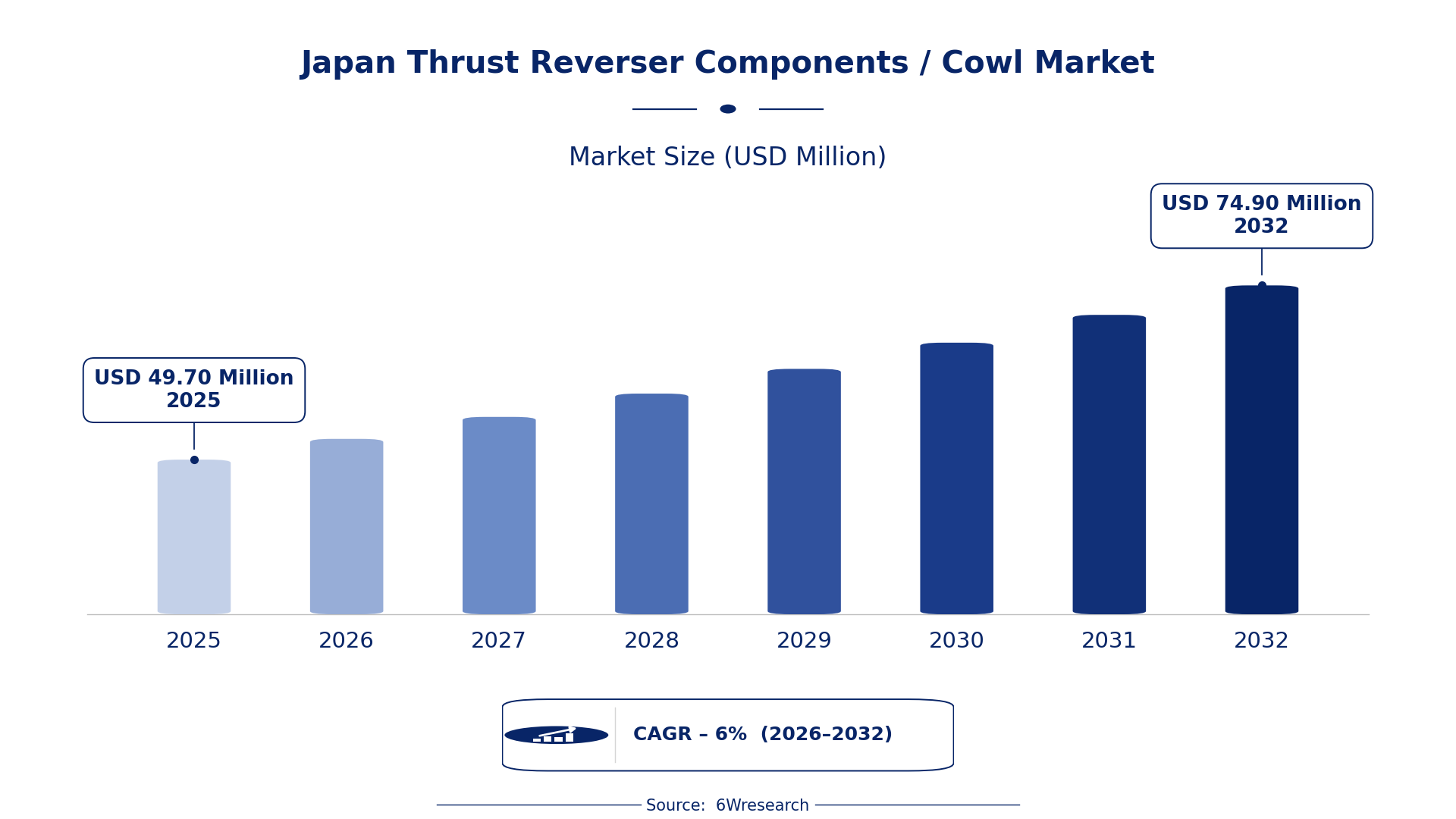
According to 6Wresearch internal database and industry insights, the Japan Thrust Reverser Components / Cowl Market was valued at USD 49.70 Million in 2025 and is projected to reach USD 74.90 Million by 2032, growing at a CAGR of approximately 6% during 2026–2032.
Japan Thrust Reverser Components / Cowl Market Highlights
| Report Metric | Details |
| Report Name | Japan Thrust Reverser Components / Cowl Market (2026-2032) |
| Market Size 2025 | USD 49.70 Million |
| Market Size 2032 | USD 74.90 Million |
| Absolute Growth 2025–2032 | USD 25.20 Million |
| CAGR 2026–2032 | 6% |
| Peak Annual Growth | 7.6% in 2032 |
| Forecast Period | 2026–2032 |
| Historical Data | 2022–2025 |
| Base Year | 2025 |
| Leading Thrust Reverser Components, 2025 | Cowl Inners/Outers (46% share) |
| Leading Component Type, 2025 | Composite Panels (33% share) |
| Leading Material, 2025 | CFRP/Aluminum (44% share) |
| Leading Distribution Channel, 2025 | OEM Manufacturers (40% share) |
| Leading End User Industry, 2025 | Commercial Airlines (37% share) |
| Fastest-Growing Thrust Reverser Components | Linkage Hinges (8.6% CAGR) |
| Fastest-Growing Component Type | Mechanical Linkages (8.5% CAGR) |
| Fastest-Growing Material | Steel / Titanium (8.7% CAGR) |
| Fastest-Growing Distribution Channel | Aerospace Vendors (7.6% CAGR) |
| Fastest-Growing End User Industry | MRO Providers (7.8% CAGR) |
| Growing Sector | MRO Providers |
| Key End Users | Commercial Airlines, MRO Providers, Engine Manufacturers, OEM Tier Components |
Japan Thrust Reverser Components / Cowl Market Year-wise Growth Rate and Key Drivers (2022–2032)
This graph illustrates the annual growth rates of the market from 2022 to 2032, highlighting a steady upward trajectory and projected market expansion over the forecast period.
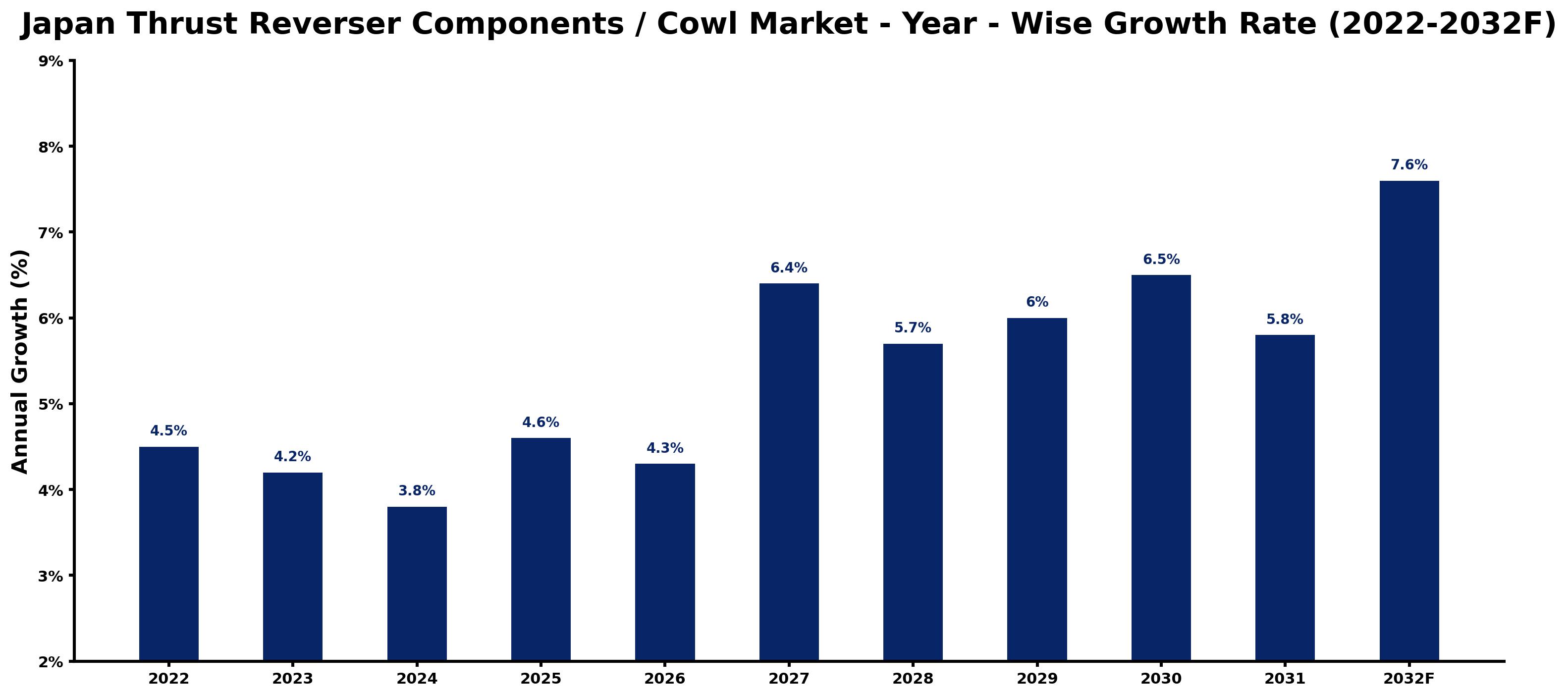
Each row of the following table gives one year's estimated growth and the event or demand shift that explains it.
| Year | Estimated Annual Growth (%) | Market Rationale |
| 2022 | 4.5 | The market experienced steady growth, driven by rising passenger traffic in commercial aviation. |
| 2023 | 4.2 | Growth slowed slightly as airlines adjusted operations to evolving market conditions. |
| 2024 | 3.8 | The market continued to grow as airlines focused on fleet upgrades and maintenance. |
| 2025 | 4.6 | Growth accelerated as airlines expanded their fleets and increased investments in MRO services. |
| 2026 | 4.3 | The market is expected to see a slowdown as airlines navigate economic fluctuations. |
| 2027 | 6.4 | Growth will rebound as the MRO sector expands, driven by increased aircraft utilization. |
| 2028 | 5.7 | The market's growth rate is projected to slow as airlines balance fleet management costs. |
| 2029 | 6.0 | Demand is expected to rise as airlines focus on operational efficiency and safety improvements. |
| 2030 | 6.5 | Growth will continue as investments in aerospace technology gain traction. |
| 2031 | 5.8 | The market is projected to experience a slowdown as airlines face operational challenges. |
| 2032 | 7.6 | Demand will surge due to substantial investments in aerospace technology and fleet modernization. |
Note: Market size estimations and growth projections presented in this report are based on 6Wresearch's proprietary forecasting methodology, utilizing the latest available industry data, government publications, and primary research inputs.
Japan Thrust Reverser Components / Cowl Market Synopsis
Thrust reverser components, including cowl assemblies, are critical for redirecting engine thrust during aircraft landings. These components are manufactured using advanced materials like composite panels and aluminum alloys, which improve aircraft safety and performance. The Japan Thrust Reverser Components / Cowl Market is expanding due to strong demand from domestic airlines and the growing maintenance, repair, and overhaul (MRO) sector. In 2022, Japan's commercial airline fleet included over 300 aircraft, highlighting the market's potential.
Market Dynamics Impact Analysis (2026–2032)
| Factor | Type | Impact | Primary Segment Affected |
| Rising demand for commercial aviation | Driver | High | Cowl Inners/Outers |
| Expansion of the MRO sector | Driver | High | Cowl Inners/Outers |
| Growing investments in aerospace technology | Opportunity | High | Cowl Inners/Outers |
| Increasing fleet modernization initiatives | Opportunity | High | Cowl Inners/Outers |
| Regulatory compliance costs | Restraint | Medium | Cowl Inners/Outers |
| Supply chain disruptions | Restraint | Medium | Cowl Inners/Outers |
| High competition among manufacturers | Challenge | High | Cowl Inners/Outers |
| Technological advancements requiring constant adaptation | Challenge | Medium | Cowl Inners/Outers |
Evaluation of Drivers in Japan Thrust Reverser Components / Cowl Market (2026–2032)
Key forces behind demand, with the segment each one moves most, are listed below.
| Drivers | Primary Segment Affected | Why It Matters (Evidence) |
| Increasing passenger traffic | Cowl Inners/Outers | In 2022, Japan's commercial airline fleet included over 300 aircraft, leading to heightened demand for thrust reverser components as airlines expand operations. |
| Investment in MRO services | Cowl Inners/Outers | The MRO sector in Japan is projected to grow, prompting airlines to allocate more resources for maintenance and parts procurement, driving component demand. |
| Technological advancements in aerospace | Cowl Inners/Outers | Japan's aerospace industry is supported by JAXA, driving innovation and increasing demand for advanced thrust reverser components and systems. |
| Growth of domestic airlines | Cowl Inners/Outers | With a population of approximately 126 million, Japan's airlines are expanding their fleets to meet rising travel demand, increasing component requirements. |
| Compliance with international standards | Cowl Inners/Outers | Japan adheres to ISO 9001 quality management standards, ensuring high-quality production and driving demand for certified thrust reverser components. |
Most of the extra volume stems from rising passenger traffic, with Japan's commercial airline fleet surpassing 300 aircraft in 2022. This growth fuels demand for thrust reverser components as airlines expand operations. Investment in the MRO sector is also considerable, prompting airlines to allocate more resources for maintenance and parts procurement. Domestic airlines are increasing their fleets to accommodate the growing population, further driving demand. Compliance with international quality standards ensures manufacturers produce certified thrust reverser components that satisfy market requirements.
Evaluation of Restraints in Japan Thrust Reverser Components / Cowl Market
The main factors holding the market back are set out below.
| Market Restraint | Primary Segment Affected | Why It Matters (Evidence) |
| High regulatory compliance costs | Cowl Inners/Outers | Compliance with various industry standards increases production costs, affecting manufacturers' pricing strategies and profitability. |
| Supply chain disruptions | Cowl Inners/Outers | Recent global supply chain issues have delayed the procurement of essential materials, impacting production timelines and delivery schedules. |
| Technological adaptation costs | Cowl Inners/Outers | Rapid technological advancements require continuous investment, straining budgets for manufacturers and limiting their ability to innovate. |
| Intense competition among manufacturers | Cowl Inners/Outers | High competition pressures pricing, making it challenging for smaller manufacturers to maintain market share and profitability. |
| Fluctuating demand from airlines | Cowl Inners/Outers | Economic uncertainties can lead to inconsistent demand for new aircraft, affecting sales of thrust reverser components. |
Japan Thrust Reverser Components / Cowl Market Challenges
Reliance on imported raw materials creates supply issues, leading to production delays of up to three months for producers. Increased competition from international firms pressures local manufacturers to lower prices, potentially shrinking profit margins by 15%. Rising costs of advanced materials, including composite panels, inflate production expenses by 10%, compelling producers to adjust pricing strategies. Buyers face longer lead times for thrust reverser components, which can delay aircraft maintenance and operational readiness, affecting flight schedules for airlines and resulting in potential revenue loss.
Trends in the Japan Thrust Reverser Components / Cowl Market
The trends below show where the Japan Thrust Reverser Components / Cowl Market is heading.
- Shift towards Advanced Composite Materials: The aerospace industry is increasingly adopting advanced materials like CFRP for thrust reverser components, improving performance and reducing weight. In 2022, Japan produced various grades of composite materials, reflecting this shift.
- Transition from In-House to Outsourced MRO Services: Since 2020, many airlines have shifted towards outsourcing MRO services to specialised providers, enhancing efficiency and reducing costs. This trend is clear as the MRO sector in Japan is projected to grow significantly.
- Emergence of Smart Thrust Reverser Systems: The integration of smart technologies in thrust reverser systems began in 2021, enhancing operational efficiency and safety. This shift is notable as the industry adapts to new technological standards.
- Focus on Sustainability in Aerospace Manufacturing: In recent years, the aerospace sector has prioritised sustainability, with initiatives to reduce waste and emissions. The Tokyo Metropolitan Government has launched initiatives to boost sustainability efforts in the aerospace sector.
Investment Opportunities in the Japan Thrust Reverser Components / Cowl Market
The following opportunities in the Japan Thrust Reverser Components / Cowl Market pair current demand with a clear way in.
- Supply of Advanced Composite Materials: Japan's aerospace industry produces various grades of composite materials, presenting an opportunity to supply these materials for thrust reverser components. The market gap is substantial as demand for lightweight structures increases, creating openings for suppliers.
- Investment in MRO Facilities: The MRO sector is experiencing growth, creating a need for investment in specialised facilities. Major airlines in Japan are seeking partnerships to enhance their maintenance capabilities and improve operational efficiency.
- Development of Smart Thrust Reverser Technologies: The shift towards smart technologies presents an opportunity to develop advanced thrust reverser systems. Collaborating with aerospace vendors can facilitate entry into this growing segment, meeting evolving market demands.
- Expansion of Aerospace Manufacturing Hubs: The Tokyo region is a key aerospace manufacturing hub, providing opportunities for investment in new facilities. Establishing local partnerships can enhance market entry and support growth in the sector.
Government Initiatives in the Japan Thrust Reverser Components / Cowl Market
The Economic Security Promotion Act of 2022 supports supply-chain resilience for critical aerospace products, ensuring that manufacturers can maintain production levels and meet quality standards. This law encourages investment in local production capabilities and aims to strengthen the overall competitiveness of the aerospace sector in Japan. Additionally, adherence to the PRTR Law and Chemical Substances Control Law ensures that manufacturers comply with environmental regulations, promoting sustainable practices in the industry.
The Japan Aerospace Industry Association (JAIA) plays an important role in implementing government initiatives, providing funding and support for research and development in aerospace technology. The Ministry of Economy, Trade and Industry (METI) oversees various funding programmes aimed at improving the capabilities of aerospace manufacturers. These initiatives help producers innovate and enhance their offerings, ensuring that they meet the evolving demands of the market.
Future Insight of the Japan Thrust Reverser Components / Cowl Market
Government funding programmes and initiatives will stimulate investment in aerospace technology, creating robust demand for thrust reverser components. Japan's commercial airline fleet is projected to exceed 350 aircraft by 2032, driving the need for advanced components. Enhanced engineering capabilities will enable the production of more efficient and reliable thrust reverser systems, benefiting both buyers and suppliers. The Ministry of Economy, Trade and Industry's commitment to technology development will strengthen Japan's competitive edge in the global aerospace market.
Market Segmentation Analysis
Japan Thrust Reverser Components / Cowl Market report covers a detailed analysis of the following market segments:
By Thrust Reverser Components – Cowl Inners/Outers Lead, Linkage Hinges Expected to Grow Fastest
According to Saurav Kr Singh, Senior Research Analyst at 6Wresearch, the largest thrust reverser components category in 2025 was Cowl Inners/Outers, at 46% of revenue. Cowl inners/outers hold the largest share as they are essential structural components of thrust reversers, ensuring effective thrust redirection during landings. The demand is driven by the over 300 aircraft in Japan's commercial airline fleet that require these components for optimal performance. Linkage Hinges are set to record the highest CAGR in this split, 8.6% over 2026–2032. Linkage hinges are experiencing rapid growth due to their critical role in the functionality of thrust reversers, with increasing investments in aircraft maintenance further boosting their demand. As the MRO sector expands, the need for these hinges will continue to rise, widening the lead of cowl inners/outers. Suppliers must enhance production capabilities of linkage hinges to meet the rising demand effectively.
By Component Type – Composite Panels Lead, Mechanical Linkages Expected to Grow Fastest
Composite Panels accounted for 33% of the market by component type in 2025. Composite panels hold the largest market share because of their lightweight and strong structural properties, making them ideal for aerospace applications. The focus on advanced materials within Japan's aerospace industry has solidified composite panels as the preferred choice for thrust reverser components. The quickest growth will come from Mechanical Linkages, forecast to expand at a CAGR of 8.5% between 2026 and 2032. Mechanical linkages are experiencing the fastest growth as they are vital for connecting various components, ensuring the functionality of thrust reversers. The increasing complexity of aircraft systems necessitates more sophisticated mechanical linkages, driving their demand. Buyers should ensure a reliable supply of mechanical linkages to maintain operational efficiency in aircraft systems.
By Material – CFRP/Aluminum Leads, Steel / Titanium Expected to Grow Fastest
In 2025, CFRP/Aluminum led the material split with a 44% share. CFRP/aluminum is the leading material for thrust reverser components due to its lightweight construction and strength, which are vital in aerospace applications. The focus on reducing aircraft weight for improved fuel efficiency has solidified the dominance of these materials in the market. Over 2026–2032, Steel / Titanium is expected to post the fastest growth, at a CAGR of 8.7%. Steel/titanium is witnessing rapid growth as these materials are crucial for high-stress components requiring durability and strength. The increasing demand for robust thrust reverser systems in commercial aviation is driving the adoption of steel and titanium. Suppliers should invest in sourcing high-quality steel and titanium to meet the increasing demands of the aerospace sector.
By Distribution Channel – OEM Manufacturers Lead, Aerospace Vendors Expected to Grow Fastest
With 40% of distribution channel revenue in 2025, OEM Manufacturers was the largest category. OEM manufacturers dominate the distribution channel as they are the primary producers of thrust reverser components, ensuring quality and compliance with industry standards. Their established relationships with commercial airlines create a consistent demand for these components. Aerospace Vendors are projected to grow fastest, at a CAGR of 7.6% during 2026–2032. Aerospace vendors are experiencing the fastest growth as they supply parts to both manufacturers and MROs, responding to the rising need for maintenance and repairs in the aviation sector. The growth of the MRO market is propelling demand for aerospace vendors' services. Suppliers should strengthen partnerships with aerospace vendors to enhance distribution efficiency and meet market needs.
By End User Industry – Commercial Airlines Lead, MRO Providers Expected to Grow Fastest
Commercial Airlines took 37% of end user industry revenue in 2025, more than any other category. Commercial airlines are the largest end users of thrust reverser systems, utilising them extensively for aircraft safety and operational efficiency during landings. The significant number of aircraft in Japan's commercial fleet necessitates a steady supply of thrust reverser components to support operations. MRO Providers are set to record the highest CAGR in this split, 7.8% over 2026–2032. MRO providers are growing rapidly as they play a crucial role in maintaining aircraft systems, ensuring the reliability of thrust reversers. The projected growth in the MRO sector indicates an increasing demand for maintenance services in aviation, further driving this segment. Buyers in the MRO sector should focus on securing reliable sources of thrust reverser components to effectively support their maintenance operations.
Key Attractiveness of the Report
- 10 Years of Market Numbers
- Historical Data Starting from 2022 to 2025
- Base Year 2025
- Forecast Data until 2032
- Key Performance Indicators Impacting the Market
- Major Upcoming Developments and Projects
Key Highlights of the Report:
- Japan Thrust Reverser Components / Cowl Market Outlook
- Market Size of Japan Thrust Reverser Components / Cowl Market, 2025
- Forecast of Japan Thrust Reverser Components / Cowl Market, 2032
- Historical Data and Forecast of Japan Thrust Reverser Components / Cowl Revenues & Volume for the Period 2022-2032F
- Japan Thrust Reverser Components / Cowl Market Trend Evolution
- Japan Thrust Reverser Components / Cowl Market Drivers and Challenges
- Japan Thrust Reverser Components / Cowl Price Trends
- Japan Thrust Reverser Components / Cowl Porter's Five Forces
- Japan Thrust Reverser Components / Cowl Industry Life Cycle
- Historical Data and Forecast of Japan Thrust Reverser Components / Cowl Market Revenues & Volume By Thrust Reverser Components for the Period 2022-2032F
- Historical Data and Forecast of Japan Thrust Reverser Components / Cowl Market Revenues & Volume By Cowl Inners/Outers for the Period 2022-2032F
- Historical Data and Forecast of Japan Thrust Reverser Components / Cowl Market Revenues & Volume By Linkage Hinges for the Period 2022-2032F
- Historical Data and Forecast of Japan Thrust Reverser Components / Cowl Market Revenues & Volume By Control Plows for the Period 2022-2032F
- Historical Data and Forecast of Japan Thrust Reverser Components / Cowl Market Revenues & Volume By Actuator Brackets for the Period 2022-2032F
- Historical Data and Forecast of Japan Thrust Reverser Components / Cowl Market Revenues & Volume By Component Type for the Period 2022-2032F
- Historical Data and Forecast of Japan Thrust Reverser Components / Cowl Market Revenues & Volume By Composite Panels for the Period 2022-2032F
- Historical Data and Forecast of Japan Thrust Reverser Components / Cowl Market Revenues & Volume By Mechanical Linkages for the Period 2022-2032F
- Historical Data and Forecast of Japan Thrust Reverser Components / Cowl Market Revenues & Volume By Deflector Devices for the Period 2022-2032F
- Historical Data and Forecast of Japan Thrust Reverser Components / Cowl Market Revenues & Volume By Mounting Structures for the Period 2022-2032F
- Historical Data and Forecast of Japan Thrust Reverser Components / Cowl Market Revenues & Volume By Material for the Period 2022-2032F
- Historical Data and Forecast of Japan Thrust Reverser Components / Cowl Market Revenues & Volume By CFRP/Aluminum for the Period 2022-2032F
- Historical Data and Forecast of Japan Thrust Reverser Components / Cowl Market Revenues & Volume By Steel / Titanium for the Period 2022-2032F
- Historical Data and Forecast of Japan Thrust Reverser Components / Cowl Market Revenues & Volume By High-Temp Alloy for the Period 2022-2032F
- Historical Data and Forecast of Japan Thrust Reverser Components / Cowl Market Revenues & Volume By Cast Aluminum for the Period 2022-2032F
- Historical Data and Forecast of Japan Thrust Reverser Components / Cowl Market Revenues & Volume By Distribution Channel for the Period 2022-2032F
- Historical Data and Forecast of Japan Thrust Reverser Components / Cowl Market Revenues & Volume By OEM Manufacturers for the Period 2022-2032F
- Historical Data and Forecast of Japan Thrust Reverser Components / Cowl Market Revenues & Volume By Aerospace Vendors for the Period 2022-2032F
- Historical Data and Forecast of Japan Thrust Reverser Components / Cowl Market Revenues & Volume By Aircraft OEMs for the Period 2022-2032F
- Historical Data and Forecast of Japan Thrust Reverser Components / Cowl Market Revenues & Volume By Direct Sales for the Period 2022-2032F
- Historical Data and Forecast of Japan Thrust Reverser Components / Cowl Market Revenues & Volume By End User Industry for the Period 2022-2032F
- Historical Data and Forecast of Japan Thrust Reverser Components / Cowl Market Revenues & Volume By Commercial Airlines for the Period 2022-2032F
- Historical Data and Forecast of Japan Thrust Reverser Components / Cowl Market Revenues & Volume By MRO Providers for the Period 2022-2032F
- Historical Data and Forecast of Japan Thrust Reverser Components / Cowl Market Revenues & Volume By Engine Manufacturers for the Period 2022-2032F
- Historical Data and Forecast of Japan Thrust Reverser Components / Cowl Market Revenues & Volume By OEM Tier Components for the Period 2022-2032F
- Japan Thrust Reverser Components / Cowl Import Export Trade Statistics
- Market Opportunity Assessment By Thrust Reverser Components
- Market Opportunity Assessment By Component Type
- Market Opportunity Assessment By Material
- Market Opportunity Assessment By Distribution Channel
- Market Opportunity Assessment By End User Industry
- Japan Thrust Reverser Components / Cowl Top Companies Market Share
- Japan Thrust Reverser Components / Cowl Competitive Benchmarking By Technical and Operational Parameters
- Japan Thrust Reverser Components / Cowl Company Profiles
- Japan Thrust Reverser Components / Cowl Key Strategic Recommendations
Market Covered
Segments analysed in this report are listed below.
By Thrust Reverser Components
- Cowl Inners/Outers
- Linkage Hinges
- Control Plows
- Actuator Brackets
By Component Type
- Composite Panels
- Mechanical Linkages
- Deflector Devices
- Mounting Structures
By Material
- CFRP/Aluminum
- Steel / Titanium
- High-Temp Alloy
- Cast Aluminum
By Distribution Channel
- OEM Manufacturers
- Aerospace Vendors
- Aircraft OEMs
- Direct Sales
By End User Industry
- Commercial Airlines
- MRO Providers
- Engine Manufacturers
- OEM Tier Components































