Japan Timing Chain Components Market Size & Growth Rate
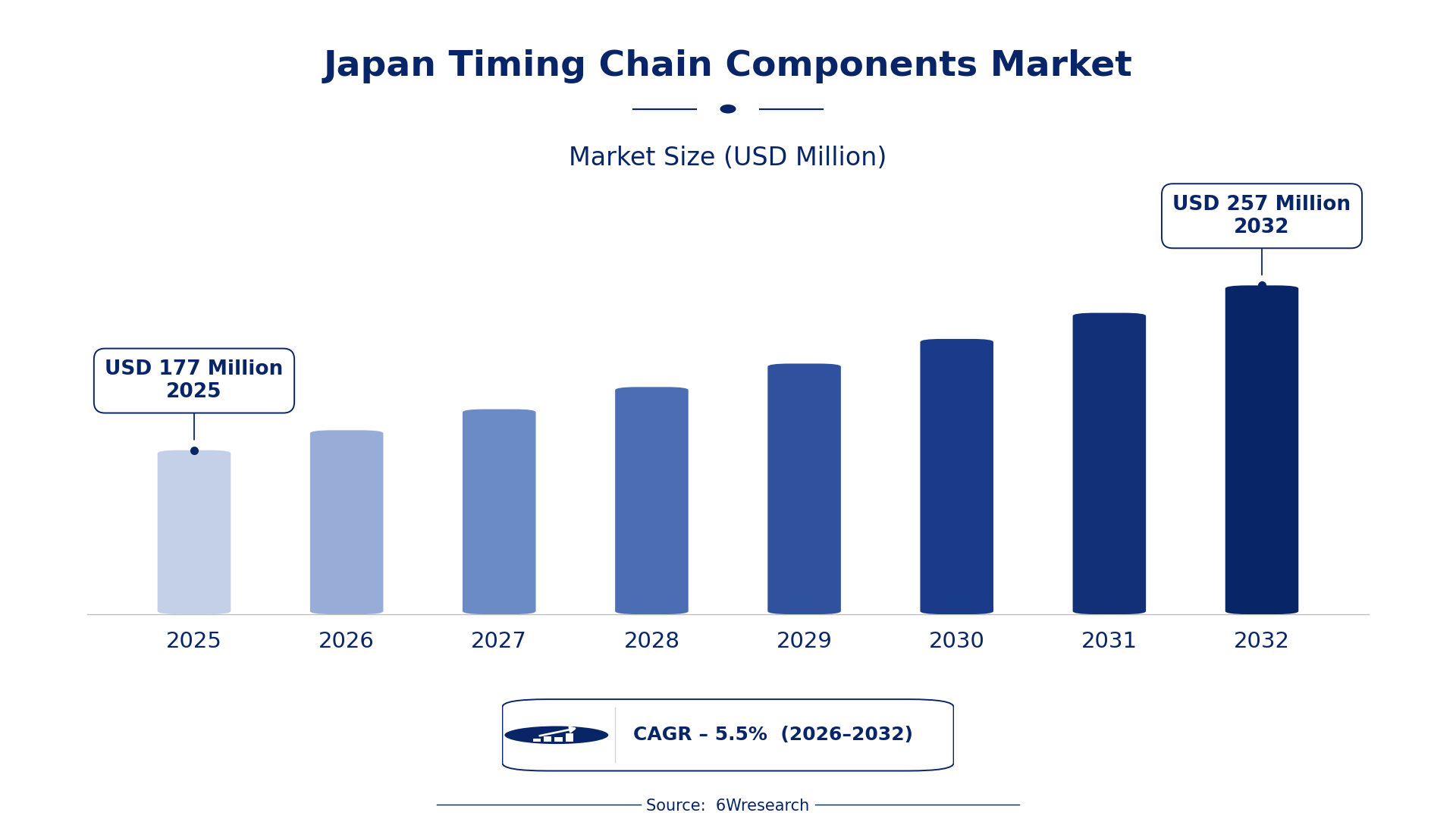
According to 6Wresearch internal database and industry insights, the Japan Timing Chain Components Market was valued at USD 177 Million in 2025 and is projected to reach USD 257 Million by 2032, growing at a CAGR of approximately 5.5% during 2026–2032.
Japan Timing Chain Components Market Highlights
| Report Metric | Details |
| Report Name | Japan Timing Chain Components Market (2026-2032) |
| Market Size 2025 | USD 177 Million |
| Market Size 2032 | USD 257 Million |
| Absolute Growth 2025–2032 | USD 80 Million |
| CAGR 2026–2032 | 5.5% |
| Peak Annual Growth | 6.6% in 2029 |
| Forecast Period | 2026–2032 |
| Historical Data | 2022–2025 |
| Base Year | 2025 |
| Leading Timing Chain Components, 2025 | Tensioners (43% share) |
| Leading Component Type, 2025 | Tensioner Assemblies (46% share) |
| Leading Material, 2025 | Heat-Treated Steel (44% share) |
| Leading Distribution Channel, 2025 | OEM Suppliers (41% share) |
| Leading End User Industry, 2025 | Automotive OEMs (36% share) |
| Fastest-Growing Component Type | Drive Gears (7.8% CAGR) |
| Fastest-Growing Material | Hardened Steel (7.9% CAGR) |
| Fastest-Growing Distribution Channel | Aftermarket Distributors (7.0% CAGR) |
| Fastest-Growing End User Industry | Repair Shops (7.2% CAGR) |
| Growing Sector | Repair Shops |
| Key End Users | Automotive OEMs, Repair Shops, Service Centers, Engine Manufacturers |
Japan Timing Chain Components Market Year-wise Growth Rate and Key Drivers (2022–2032)
This graph illustrates the annual growth rates of the market from 2022 to 2032, highlighting a steady upward trajectory and projected market expansion over the forecast period.
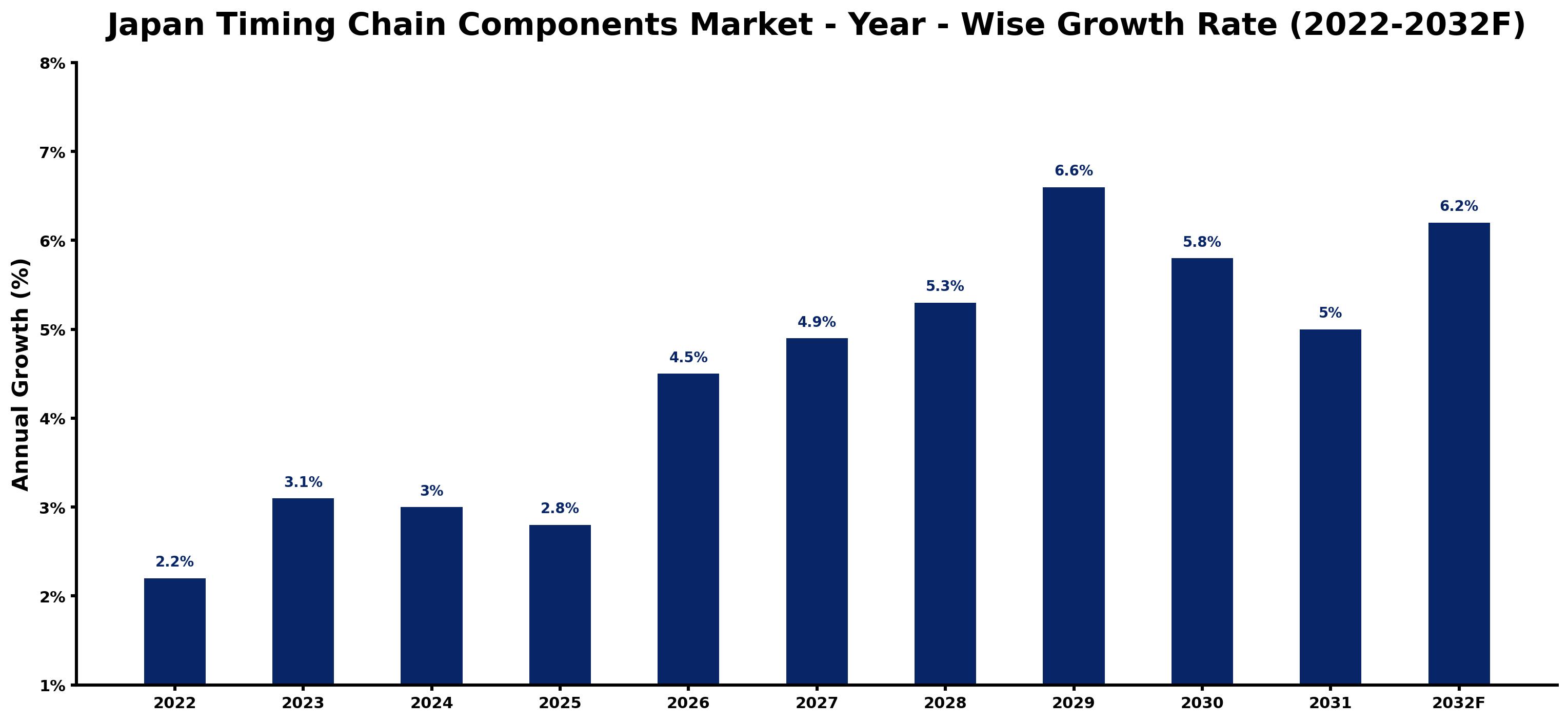
The table below sets out the estimated growth rate for each year and the main factor behind it.
| Year | Estimated Annual Growth (%) | Market Rationale |
| 2022 | 2.2 | The market experienced steady growth due to ongoing automotive production. |
| 2023 | 3.1 | Demand increased as automotive manufacturers ramped up vehicle output. |
| 2024 | 3.0 | Growth slowed as supply chain challenges began to impact production rates. |
| 2025 | 2.8 | The market continued to grow, albeit at a slower pace than before. |
| 2026 | 4.5 | Growth is expected to accelerate as investments in automotive innovation gain momentum. |
| 2027 | 4.9 | Demand is projected to rise further, driven by a recovering automotive sector. |
| 2028 | 5.3 | The market is expected to expand as new engine designs incorporate more timing chain components. |
| 2029 | 6.6 | Peak growth is anticipated as the automotive industry fully embraces technological advancements. |
| 2030 | 5.8 | Growth will slow slightly as the market begins to stabilise after peak demand. |
| 2031 | 5.0 | The market is expected to continue growing, supported by ongoing automotive production. |
| 2032 | 6.2 | Demand will increase again as the automotive sector focuses on sustainability. |
Note: Market size estimations and growth projections presented in this report are based on 6Wresearch's proprietary forecasting methodology, utilizing the latest available industry data, government publications, and primary research inputs.
Japan Timing Chain Components Market Synopsis
Timing chain components are mechanical parts essential for synchronising crankshaft and camshaft rotation in internal combustion engines. The Japan Timing Chain Components Market is expanding, driven by the production of 8.3 million vehicles in 2022 and a thriving aftermarket valued at approximately 2 trillion yen. Investment in automotive innovation and a focus on new engine designs are fuelling demand for these components, which improve engine performance and longevity.
Market Dynamics Impact Analysis (2026–2032)
| Factor | Type | Impact | Primary Segment Affected |
| Rising vehicle production in Japan | Driver | High | Timing Chains |
| Increasing demand for automotive repairs | Driver | High | Tensioners |
| Growing focus on automotive recycling | Opportunity | Medium | Sprockets & Gears |
| Expansion of aftermarket services | Opportunity | Medium | Tensioner Assemblies |
| Supply chain disruptions affecting production | Restraint | High | Timing Chains |
| High competition among suppliers | Restraint | Medium | Sprockets & Gears |
| Fluctuating raw material costs | Challenge | High | Tensioners |
| Regulatory compliance for new materials | Challenge | Medium | Timing Chains |
Evaluation of Drivers in Japan Timing Chain Components Market (2026–2032)
The factors lifting demand, and the evidence behind each, are summarised below.
| Drivers | Primary Segment Affected | Why It Matters (Evidence) |
| Increased vehicle production | Timing Chains | Japan's automotive industry produced 8.3 million vehicles in 2022, driving demand for timing chains. |
| Growth in the automotive aftermarket | Tensioners | The automotive aftermarket in Japan is valued at approximately 2 trillion yen, leading to higher demand for tensioners. |
| Technological advancements in engine design | Sprockets & Gears | Timing chains are used in over 70% of new engine designs in Japan, increasing demand for related components. |
| Rising average vehicle age | Tensioner Assemblies | The average age of vehicles on the road in Japan is 10.5 years, boosting demand for repair services. |
| Investment in automotive innovation | Timing Chains | The Ministry of Economy, Trade and Industry supports automotive innovation programs, driving demand for timing chain components. |
Spending rises because the automotive industry in Japan produced 8.3 million vehicles in 2022, increasing demand for timing chains. The automotive aftermarket, valued at approximately 2 trillion yen, also boosts the need for tensioners and other components. The average vehicle age of 10.5 years leads to higher repair service demand among repair shops. Investment in automotive innovation supports the development of new technologies, driving demand for high-quality timing chain components. New engine designs are expected to further increase the need for these products among manufacturers and repair facilities.
Evaluation of Restraints in Japan Timing Chain Components Market
The table below lists the restraints and the evidence behind each.
| Market Restraint | Primary Segment Affected | Why It Matters (Evidence) |
| Supply chain disruptions | Timing Chains | Ongoing supply chain issues have delayed production schedules, affecting component availability for manufacturers. |
| Intense competition among suppliers | Sprockets & Gears | High competition has led to pricing pressures, impacting profit margins for manufacturers in the sector. |
| Fluctuating raw material prices | Tensioners | Rising costs of heat-treated steel affect production expenses for tensioner manufacturers, squeezing margins. |
| Regulatory compliance challenges | Timing Chains | New regulations require additional testing and certification, increasing operational costs for producers. |
| Limited market diversification | Sprockets & Gears | Dependence on the automotive sector restricts growth opportunities in other industries, limiting expansion. |
Japan Timing Chain Components Market Challenges
Producers face intense competition from low-cost manufacturers in the region, which drives down prices and squeezes profit margins, ultimately reducing their ability to invest in quality improvements. Technicians experience skills shortages, leading to inefficiencies in production and potential delays, costing producers up to 20% in lost revenue. Technology gaps in automation result in higher defect rates, which can delay deliveries to buyers and increase operational costs by approximately 15%. Buyers struggle with an ageing vehicle fleet, averaging 10.5 years, causing a rise in demand for replacement components and escalating repair expenses.
Trends in the Japan Timing Chain Components Market
The shifts below are changing how Japan Timing Chain Components Market products are bought and supplied.
- Shift Towards Sustainable Practices: In 2023, Japan launched a new initiative for automotive component recycling, aiming to reduce waste in the industry. This initiative aligns with growing environmental awareness and is expected to increase demand for recyclable materials.
- Increase in Aftermarket Services: The number of registered automotive repair shops in Japan exceeds 4,000, reflecting a growing trend towards aftermarket services. This expansion supports increased demand for timing chain components and related parts.
- Adoption of Advanced Engine Technologies: The introduction of new engine designs in Japan has led to timing chains being used in over 70% of these engines. This trend indicates a strong demand for high-performance timing chain components.
- Focus on Vehicle Longevity: With the average age of vehicles on the road at 10.5 years, there is a growing emphasis on maintenance and repair services. This trend is driving demand for timing chain components among repair shops.
Investment Opportunities in the Japan Timing Chain Components Market
The following areas offer the clearest openings for investors and suppliers in the Japan Timing Chain Components Market.
- Partner with Local Suppliers: Now is an ideal time to invest in local partnerships to supply timing chain components, tapping into the automotive sector's growth. The Tokyo region, a major automotive hub, offers opportunities for collaboration.
- Expand into Aftermarket Services: With the automotive aftermarket valued at approximately 2 trillion yen, suppliers should focus on aftermarket services. Repair shops are increasingly seeking high-quality components to meet growing demand.
- Invest in Sustainable Materials: The recent push for recycling initiatives creates opportunities to supply eco-friendly materials for timing chain components. Engaging with automotive manufacturers focused on sustainability will be beneficial.
- Utilise Technological Advancements: Investing in advanced manufacturing technologies is crucial as the automotive industry evolves. Suppliers can benefit by aligning with new engine designs that require innovative timing chain solutions.
Government Initiatives in the Japan Timing Chain Components Market
The GX Promotion Act, introduced in 2023, establishes a legal framework for promoting sustainable practices in the automotive sector, building on previous regulations aimed at reducing environmental impact. This act encourages manufacturers to invest in eco-friendly technologies and materials, ensuring compliance with sustainability standards. The act is part of a broader effort to enhance the industry's environmental performance and reduce waste.
In 2022, the Ministry of Economy, Trade and Industry launched the Battery Industry Strategy, which aims to support the automotive industry's transition to electric vehicles. This initiative targets significant domestic battery manufacturing capacity by 2030, indirectly influencing demand for timing chain components as manufacturers adapt to new technologies.
Future Insight of the Japan Timing Chain Components Market
Investment in automotive innovation will drive advancements in timing chain components, creating demand for higher quality parts. By 2032, the adoption of JIS B 1801 standards will enhance product reliability, benefiting both buyers and suppliers. The 2023 recycling initiative will promote sustainable materials, aligning with environmental objectives. The Tokyo Motor Show will showcase new technologies, influencing future designs and increasing competition among suppliers, with the automotive aftermarket valued at approximately 2 trillion yen.
Market Segmentation Analysis
Japan Timing Chain Components Market report covers a detailed analysis of the following market segments:
By Timing Chain Components – Tensioners Lead and Record the Fastest Growth
According to Saurav Kr Singh, Senior Research Analyst at 6Wresearch, in 2025, Tensioners led the timing chain components split with a 43% share. Tensioners are essential for maintaining chain tension in engines, directly impacting performance and reliability. With Japan producing 8.3 million vehicles in 2022, the demand for reliable tensioners is substantial among both manufacturers and repair services. Tensioners are also forecast to expand faster than any other category, at a CAGR of 8.0% over 2026–2032. The growth of Tensioners will continue as they are integral to over 70% of new engine designs in Japan, ensuring their sustained market relevance. As automotive innovations progress, the need for advanced tensioning solutions will further solidify their market position. Suppliers should focus on enhancing the quality and availability of tensioners to meet the rising demand.
By Component Type – Tensioner Assemblies Lead, Drive Gears Expected to Grow Fastest
Tensioner Assemblies accounted for 46% of the market by component type in 2025. Tensioner Assemblies dominate the market as they are critical for effective chain tension management, which directly influences engine performance. The strong production rates in Japan's automotive sector underscore the reliance on these assemblies for optimal engine function. The quickest growth will come from Drive Gears, forecast to expand at a CAGR of 7.8% between 2026 and 2032. Drive Gears are witnessing growth due to their increasing application in various engine designs, despite being less common than tensioner assemblies. As manufacturers strive for improved efficiency, the demand for drive gears is projected to rise. Buyers need to adapt to the evolving requirements for both tensioner assemblies and drive gears to ensure optimal engine performance.
By Material – Heat-Treated Steel Leads, Hardened Steel Expected to Grow Fastest
Heat-Treated Steel held 44% of the Japan Timing Chain Components Market by material in 2025. Heat-Treated Steel is the predominant material used in timing chain components, offering durability and strength essential for engine operation. Its widespread application across the automotive industry underscores its importance in maintaining vehicle performance. Hardened Steel is projected to grow fastest, at a CAGR of 7.9% during 2026–2032. Hardened Steel is gaining traction as a preferred material due to its strength, making it suitable for high-performance applications. As manufacturers push for more resilient components, the demand for hardened steel will increase. Suppliers should invest in the development of both heat-treated and hardened steel products to cater to diverse market needs.
By Distribution Channel – OEM Suppliers Lead, Aftermarket Distributors Expected to Grow Fastest
With 41% of distribution channel revenue in 2025, OEM Suppliers was the largest category. OEM Suppliers lead the distribution channel as they are the primary source for manufacturers, ensuring the supply of high-quality components. Their established relationships with automotive OEMs facilitate consistent demand for timing chain components. Aftermarket Distributors are set to record the highest CAGR in this split, 7.0% over 2026–2032. Aftermarket Distributors are experiencing rapid growth as the automotive aftermarket in Japan is valued at approximately 2 trillion yen, highlighting the increasing reliance on repair services. This trend indicates a shift towards aftermarket solutions for vehicle maintenance. Suppliers must strengthen their distribution strategies to effectively reach both OEMs and aftermarket channels.
By End User Industry – Automotive OEMs Lead, Repair Shops Expected to Grow Fastest
Automotive OEMs took 36% of end user industry revenue in 2025, more than any other category. Automotive OEMs represent the largest end user group as they directly incorporate timing chain components in vehicle manufacturing. With approximately 5 million people employed in Japan's automotive industry, the demand from OEMs remains strong and consistent. Over 2026–2032, Repair Shops are expected to post the fastest growth, at a CAGR of 7.2%. Repair Shops are seeing rapid growth due to the average vehicle age of 10.5 years, which drives up maintenance and repair needs. As vehicles remain on the road longer, the importance of repair services will continue to rise. Suppliers should tailor their offerings to meet the distinct needs of both OEMs and repair shops.
Key Attractiveness of the Report
- 10 Years of Market Numbers
- Historical Data Starting from 2022 to 2025
- Base Year 2025
- Forecast Data until 2032
- Key Performance Indicators Impacting the Market
- Major Upcoming Developments and Projects
Key Highlights of the Report:
- Japan Timing Chain Components Market Outlook
- Market Size of Japan Timing Chain Components Market, 2025
- Forecast of Japan Timing Chain Components Market, 2032
- Historical Data and Forecast of Japan Timing Chain Components Revenues & Volume for the Period 2022-2032F
- Japan Timing Chain Components Market Trend Evolution
- Japan Timing Chain Components Market Drivers and Challenges
- Japan Timing Chain Components Price Trends
- Japan Timing Chain Components Porter's Five Forces
- Japan Timing Chain Components Industry Life Cycle
- Historical Data and Forecast of Japan Timing Chain Components Market Revenues & Volume By Timing Chain Components for the Period 2022-2032F
- Historical Data and Forecast of Japan Timing Chain Components Market Revenues & Volume By Timing Chains for the Period 2022-2032F
- Historical Data and Forecast of Japan Timing Chain Components Market Revenues & Volume By Sprockets & Gears for the Period 2022-2032F
- Historical Data and Forecast of Japan Timing Chain Components Market Revenues & Volume By Tensioners for the Period 2022-2032F
- Historical Data and Forecast of Japan Timing Chain Components Market Revenues & Volume By Guides & Rails for the Period 2022-2032F
- Historical Data and Forecast of Japan Timing Chain Components Market Revenues & Volume By Component Type for the Period 2022-2032F
- Historical Data and Forecast of Japan Timing Chain Components Market Revenues & Volume By Roller Chains for the Period 2022-2032F
- Historical Data and Forecast of Japan Timing Chain Components Market Revenues & Volume By Drive Gears for the Period 2022-2032F
- Historical Data and Forecast of Japan Timing Chain Components Market Revenues & Volume By Tensioner Assemblies for the Period 2022-2032F
- Historical Data and Forecast of Japan Timing Chain Components Market Revenues & Volume By Chain Guides for the Period 2022-2032F
- Historical Data and Forecast of Japan Timing Chain Components Market Revenues & Volume By Material for the Period 2022-2032F
- Historical Data and Forecast of Japan Timing Chain Components Market Revenues & Volume By Heat-Treated Steel for the Period 2022-2032F
- Historical Data and Forecast of Japan Timing Chain Components Market Revenues & Volume By Hardened Steel for the Period 2022-2032F
- Historical Data and Forecast of Japan Timing Chain Components Market Revenues & Volume By Hydraulic/Mechanical for the Period 2022-2032F
- Historical Data and Forecast of Japan Timing Chain Components Market Revenues & Volume By Polymer Inserts for the Period 2022-2032F
- Historical Data and Forecast of Japan Timing Chain Components Market Revenues & Volume By Distribution Channel for the Period 2022-2032F
- Historical Data and Forecast of Japan Timing Chain Components Market Revenues & Volume By OEM Suppliers for the Period 2022-2032F
- Historical Data and Forecast of Japan Timing Chain Components Market Revenues & Volume By Aftermarket Distributors for the Period 2022-2032F
- Historical Data and Forecast of Japan Timing Chain Components Market Revenues & Volume By Auto Parts Retailers for the Period 2022-2032F
- Historical Data and Forecast of Japan Timing Chain Components Market Revenues & Volume By Auto OE Channels for the Period 2022-2032F
- Historical Data and Forecast of Japan Timing Chain Components Market Revenues & Volume By End User Industry for the Period 2022-2032F
- Historical Data and Forecast of Japan Timing Chain Components Market Revenues & Volume By Automotive OEMs for the Period 2022-2032F
- Historical Data and Forecast of Japan Timing Chain Components Market Revenues & Volume By Repair Shops for the Period 2022-2032F
- Historical Data and Forecast of Japan Timing Chain Components Market Revenues & Volume By Service Centers for the Period 2022-2032F
- Historical Data and Forecast of Japan Timing Chain Components Market Revenues & Volume By Engine Manufacturers for the Period 2022-2032F
- Japan Timing Chain Components Import Export Trade Statistics
- Market Opportunity Assessment By Timing Chain Components
- Market Opportunity Assessment By Component Type
- Market Opportunity Assessment By Material
- Market Opportunity Assessment By Distribution Channel
- Market Opportunity Assessment By End User Industry
- Japan Timing Chain Components Top Companies Market Share
- Japan Timing Chain Components Competitive Benchmarking By Technical and Operational Parameters
- Japan Timing Chain Components Company Profiles
- Japan Timing Chain Components Key Strategic Recommendations
Market Covered
The report covers the following segments.
By Timing Chain Components
- Timing Chains
- Sprockets & Gears
- Tensioners
- Guides & Rails
By Component Type
- Roller Chains
- Drive Gears
- Tensioner Assemblies
- Chain Guides
By Material
- Heat-Treated Steel
- Hardened Steel
- Hydraulic/Mechanical
- Polymer Inserts
By Distribution Channel
- OEM Suppliers
- Aftermarket Distributors
- Auto Parts Retailers
- Auto OE Channels
By End User Industry
- Automotive OEMs
- Repair Shops
- Service Centers
- Engine Manufacturers































