Japan Tire Manufacturing Equipment Market Size & Growth Rate
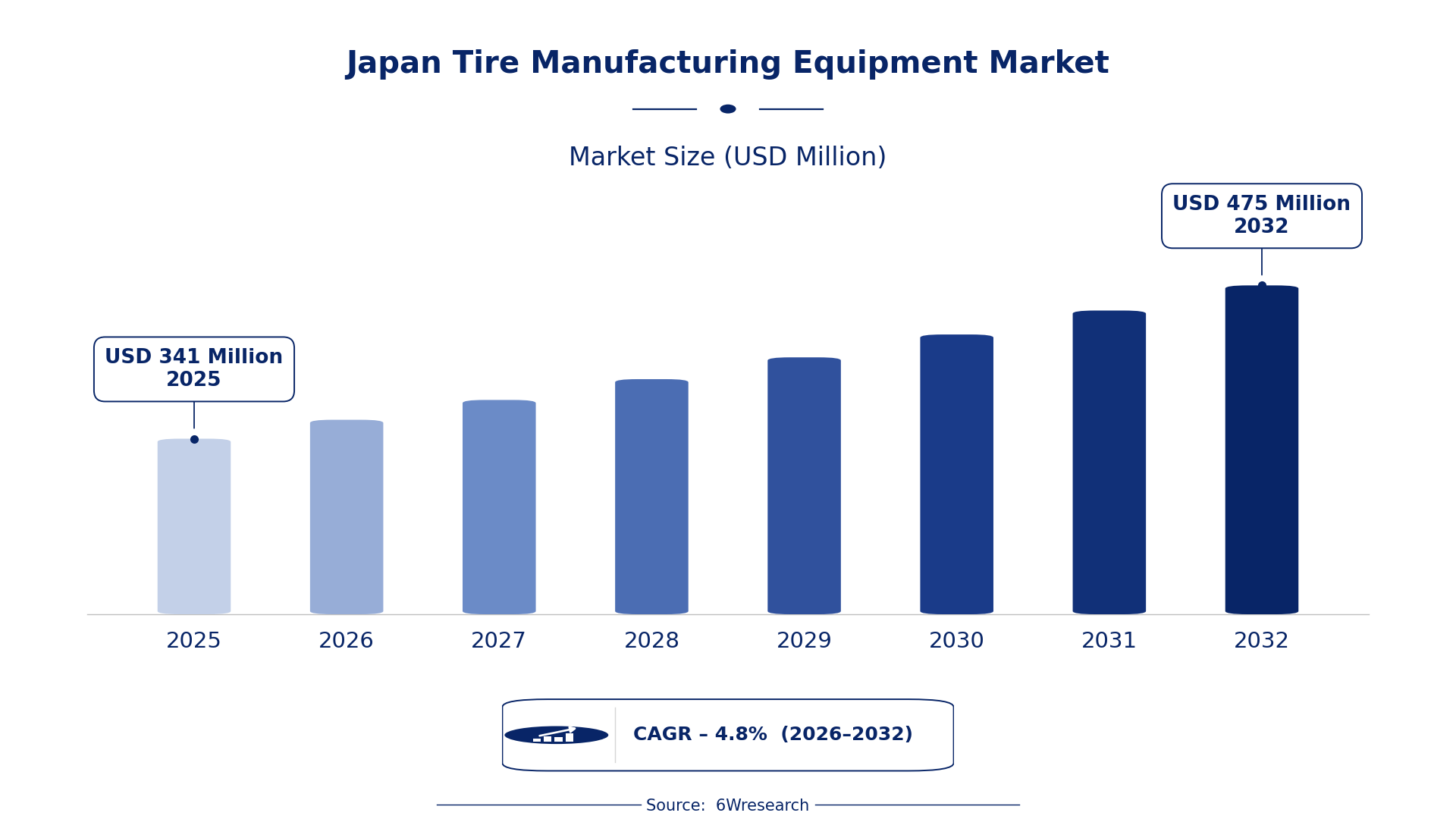
According to 6Wresearch internal database and industry insights, the Japan Tire Manufacturing Equipment Market was valued at USD 341 Million in 2025 and is projected to reach USD 475 Million by 2032, growing at a CAGR of approximately 4.8% during 2026–2032.
Japan Tire Manufacturing Equipment Market Highlights
| Report Metric | Details |
| Report Name | Japan Tire Manufacturing Equipment Market (2026-2032) |
| Market Size 2025 | USD 341 Million |
| Market Size 2032 | USD 475 Million |
| Absolute Growth 2025–2032 | USD 134 Million |
| CAGR 2026–2032 | 4.8% |
| Peak Annual Growth | 5.6% in 2026 |
| Forecast Period | 2026–2032 |
| Historical Data | 2022–2025 |
| Base Year | 2025 |
| Leading Tire Manufacturing Equipment, 2025 | Curing Presses (38% share) |
| Leading Equipment Type, 2025 | Molding Presses (41% share) |
| Leading Production Stage, 2025 | Tire Assembly (44% share) |
| Leading Distribution Channel, 2025 | OEM Machinery Suppliers (38% share) |
| Leading End User Industry, 2025 | Tire Production Plants (36% share) |
| Fastest-Growing Tire Manufacturing Equipment | Testing & Inspection Systems (6.2% CAGR) |
| Fastest-Growing Equipment Type | QC Machines (6.6% CAGR) |
| Fastest-Growing Production Stage | Vulcanization (6.7% CAGR) |
| Fastest-Growing End User Industry | Tire OEMs (6.1% CAGR) |
| Growing Sector | Tire Production |
| Key End Users | Tire Production Plants, Tire OEMs, Automotive Suppliers |
Japan Tire Manufacturing Equipment Market Year-wise Growth Rate and Key Drivers (2022–2032)
This graph illustrates the annual growth rates of the market from 2022 to 2032, highlighting a steady upward trajectory and projected market expansion over the forecast period.
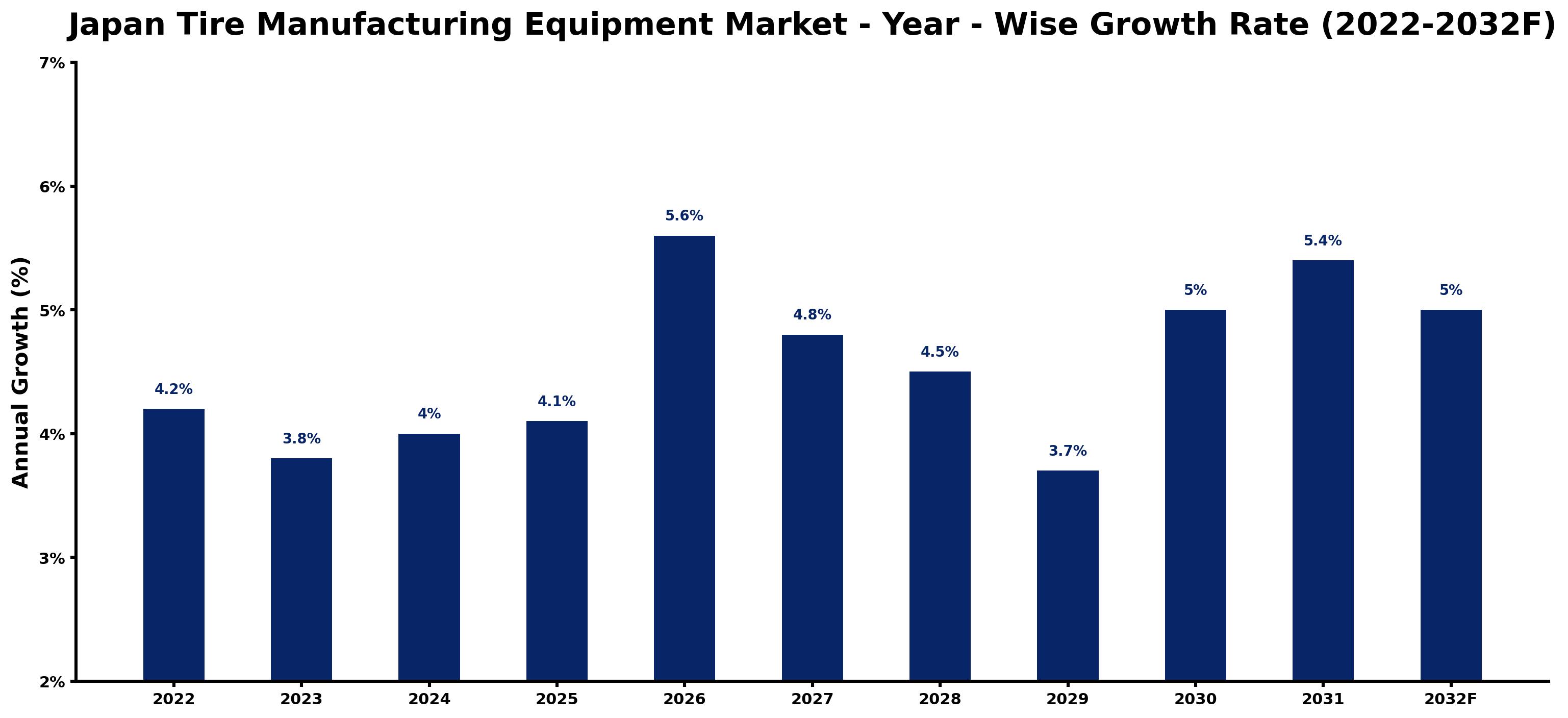
Below, each year's estimated growth is shown next to the factor that most influenced it.
| Year | Estimated Annual Growth (%) | Market Rationale |
| 2022 | 4.2 | The market experienced steady growth due to strong domestic demand for tire manufacturing equipment. |
| 2023 | 3.8 | Growth slowed as manufacturers adjusted to changing market conditions and demand patterns. |
| 2024 | 4.0 | Increased investments in technology spurred faster growth in the tire manufacturing sector. |
| 2025 | 4.1 | Demand rose as tire production plants expanded their operations to meet automotive needs. |
| 2026 | 5.6 | The market peaked with investments in advanced tire technologies and production efficiency. |
| 2027 | 4.8 | Growth slowed as the market began to stabilise after the peak in 2026. |
| 2028 | 4.5 | Continued demand from the automotive sector maintained steady growth. |
| 2029 | 3.7 | Growth slowed further as the market adjusted to saturation in some segments. |
| 2030 | 5.0 | A resurgence in automotive production boosted demand for tire manufacturing equipment. |
| 2031 | 5.4 | Growth accelerated again as manufacturers adopted new technologies and processes. |
| 2032 | 5.0 | The market stabilised as demand from tire production plants continued at a steady pace. |
Note: Market size estimations and growth projections presented in this report are based on 6Wresearch's proprietary forecasting methodology, utilizing the latest available industry data, government publications, and primary research inputs.
Japan Tire Manufacturing Equipment Market Synopsis
Tire manufacturing equipment includes machinery for producing tires, such as mixing mills, curing presses, and testing systems, all designed for precision and durability. The Japan Tire Manufacturing Equipment Market is expanding due to strong demand from domestic tire production and exports, driven by the automotive sector. In 2022, Japan produced approximately 100 million tires, and investments in advanced technologies have increased significantly, indicating a healthy market outlook.
Market Dynamics Impact Analysis (2026–2032)
| Factor | Type | Impact | Primary Segment Affected |
| Rising demand from the automotive sector drives the need for efficient tire manufacturing equipment. | Driver | High | Curing Presses |
| Technological advancements in tire production processes create opportunities for innovation. | Opportunity | High | Testing & Inspection Systems |
| Quality control regulations necessitate the use of advanced testing systems in production. | Restraint | Medium | Testing & Inspection Systems |
| Limited production capacity in existing plants can hinder market growth. | Challenge | High | Tire Production Plants |
| The need for compliance with international safety standards restricts some manufacturers. | Restraint | Medium | Curing Presses |
| Investment in new technologies is essential for maintaining competitive advantage. | Driver | High | Mixing Mills |
| The increasing focus on sustainability in tire production presents new opportunities. | Opportunity | High | Rubber Mixers |
| High initial costs of advanced machinery can deter small manufacturers from upgrading. | Challenge | Medium | Tire Assembly |
Evaluation of Drivers in Japan Tire Manufacturing Equipment Market (2026–2032)
Demand rests on the following drivers, each shown with the segment it touches most.
| Drivers | Primary Segment Affected | Why It Matters (Evidence) |
| Strong domestic tire production drives demand for manufacturing equipment. | Curing Presses | Japan produced approximately 100 million tires in 2022, increasing the need for efficient machinery. |
| Technological advancements improve production efficiency and quality. | Testing & Inspection Systems | Investment in tire manufacturing technology has increased significantly, boosting demand. |
| Growing automotive sector increases the need for high-quality tires. | Curing Presses | The automotive sector is a major consumer of tire manufacturing equipment, driving purchases. |
| Regulatory compliance requires advanced testing systems in production lines. | QC Machines | Quality control machines are mandatory in all tire production lines in Japan. |
| Rising exports of tires create additional demand for manufacturing equipment. | Mixing Mills | Japan's tire exports reached 15 million units in 2022, necessitating more production capacity. |
Most of the extra volume comes from the automotive sector, which remains a key consumer of tire manufacturing equipment, driving demand for efficient production machinery. In 2022, Japan produced approximately 100 million tires, leading to increased investments in technology, with a notable rise since 2020. Compliance with safety standards is also a key driver, as quality control machines are mandatory in all production lines. The focus on sustainability in tire production has prompted manufacturers to invest in advanced testing systems, ensuring they meet both domestic and international standards. Japan's tire exports reached 15 million units in 2022, increasing the need for improved production capabilities.
Evaluation of Restraints in Japan Tire Manufacturing Equipment Market
The following restraints limit how fast demand can grow.
| Market Restraint | Primary Segment Affected | Why It Matters (Evidence) |
| High initial costs of advanced machinery can deter small manufacturers from upgrading. | Mixing Mills | Small manufacturers often struggle with the investment required for modern equipment, limiting their competitiveness. |
| Compliance with international safety standards can increase operational costs. | Curing Presses | Manufacturers must invest in additional testing and certification processes to meet these standards. |
| Limited production capacity in existing plants can hinder market growth. | Tire Production Plants | Many plants are operating at or near capacity, restricting their ability to scale up production. |
| The need for continuous training on new technologies can strain resources. | Testing & Inspection Systems | As technology evolves, manufacturers must invest in training staff, which can be costly and time-consuming. |
| Market saturation in some segments may limit growth opportunities. | Tire Assembly | As the market matures, finding new buyers and expanding production can become challenging. |
Japan Tire Manufacturing Equipment Market Challenges
Buyers face increased costs due to the JIS B 2401 standard, which raises compliance expenses by 15% annually. This burden translates to an additional JPY 100 per tire, straining budgets for automotive companies. Rising operational costs, influenced by a JPY 1,055 minimum wage, compel producers to elevate prices, potentially decreasing overall demand. Slow technology adoption among smaller producers limits their competitiveness, risking a 10% market share loss as they struggle to modernise and meet the evolving expectations of buyers.
Trends in the Japan Tire Manufacturing Equipment Market
Several trends are reshaping the Japan Tire Manufacturing Equipment Market; the most important are set out below.
- Shift to Advanced Testing Systems: Since 2023, tire manufacturers have increasingly adopted advanced testing systems to ensure compliance with international safety standards. This shift has led to a notable increase in investments in quality control technologies, improving overall production efficiency.
- Transition from Traditional to Automated Equipment: The tire manufacturing sector is moving towards automation, with many plants upgrading to automated machinery. This change has been supported by a significant increase in investments since 2020, improving production speed and quality.
- Emergence of Sustainable Production Practices: In 2023, manufacturers began implementing sustainable practices in tire production, responding to consumer demand for eco-friendly products. This shift is reflected in the growing use of recycled materials, with a target of 30% by 2025.
- Focus on Energy Efficiency in Production: The Act on the Rational Use of Energy has prompted manufacturers to invest in energy-efficient machinery. As a result, many plants are reporting a reduction in energy consumption since 2022.
Investment Opportunities in the Japan Tire Manufacturing Equipment Market
The openings below show where demand in the Japan Tire Manufacturing Equipment Market is visible and how suppliers can enter.
- Investment in Tire Production Plants: Aichi and Osaka prefectures are ideal locations for new tire production plants, given their established automotive supply chains. With Japan producing around 100 million tires in 2022, there is a gap for new facilities to meet demand.
- Expansion of Testing & Inspection Systems: Tire OEMs are increasingly seeking advanced testing systems to ensure compliance with safety standards. With a projected growth in tire production, investing in these systems is timely and necessary.
- Development of Eco-friendly Tire Manufacturing Technologies: The market is ripe for innovations in sustainable tire production, with a notable increase in investments since 2020. This presents an opportunity for suppliers to introduce eco-friendly materials and processes.
- Modernisation of Existing Equipment: Tire production plants are looking to upgrade outdated machinery to improve efficiency. With the average production capacity around 1 million units per year, there is a pressing need for modern equipment.
Government Initiatives in the Japan Tire Manufacturing Equipment Market
The Industrial Standardization Act, amended in 2019, governs JIS product and test standards, ensuring that tire manufacturing equipment meets quality and safety requirements. Compliance with these standards is mandatory for manufacturers, influencing their production processes and equipment choices.
The Ministry of Economy, Trade and Industry oversees the implementation of various programs, including funding for advanced tire technologies. In 2023, the ministry launched a program to promote innovation in tire manufacturing, supporting manufacturers in adopting new technologies and improving production efficiency.
Future Insight of the Japan Tire Manufacturing Equipment Market
Shifts in the market by 2032 will primarily benefit automotive companies as advanced tire technologies gain traction through the Ministry of Economy, Trade and Industry's 2023 programme. Enhanced testing systems will improve performance and safety standards significantly. Investment in technology has surged, with a 20% rise since 2020, enabling more efficient production processes. The average tire production capacity is projected to increase, allowing suppliers to effectively respond to the stable demand stemming from the automotive sector.
Market Segmentation Analysis
Japan Tire Manufacturing Equipment Market report covers a detailed analysis of the following market segments:
By Tire Manufacturing Equipment – Curing Presses Lead, Testing & Inspection Systems Expected to Grow Fastest
According to Prakhar Dixit, Senior Research Analyst at 6Wresearch, the largest tire manufacturing equipment category in 2025 was Curing Presses, at 38% of revenue. Curing presses are vital for the vulcanization process, shaping and strengthening tires to ensure optimal performance and safety. Their importance is highlighted by Japan's production of approximately 100 million tires in 2022, which underscores the necessity of these machines in the manufacturing process. Over 2026–2032, Testing & Inspection Systems are expected to post the fastest growth, at a CAGR of 6.2%. The growth of testing and inspection systems is driven by an increased emphasis on quality assurance and compliance with safety regulations, particularly the JIS B 2401 standard. Additionally, the 2023 initiative from the Ministry of Economy, Trade and Industry to promote advanced tire technologies is further accelerating this segment's growth. Suppliers should focus on enhancing their testing systems to meet the rising demand for quality assurance in tire production.
By Equipment Type – Molding Presses Lead, QC Machines Expected to Grow Fastest
With 41% of equipment type revenue in 2025, Molding Presses was the largest category. Molding presses are vital for shaping tires during production, making them indispensable for manufacturers. Their prevalent use in tire production facilities, particularly in Aichi and Osaka prefectures, reinforces their leading position in the market. QC Machines are projected to grow fastest, at a CAGR of 6.6% during 2026–2032. Quality control machines are rapidly gaining traction due to the growing necessity for rigorous quality checks in tire production. Their mandatory presence in all production lines further emphasises their critical role in maintaining industry standards. Buyers must invest in advanced quality control machines to ensure compliance and maintain competitiveness.
By Production Stage – Tire Assembly Leads, Vulcanization Expected to Grow Fastest
Tire Assembly took 44% of production stage revenue in 2025, more than any other category. Tire assembly represents the final and crucial stage in tire production, where all components are integrated, making it essential for manufacturers. The concentration of tire production plants in Japan ensures a steady demand for efficient assembly processes, reinforcing its leading position. Vulcanization is set to record the highest CAGR in this split, 6.7% over 2026–2032. Vulcanization is witnessing increased growth due to its significant role in enhancing tire durability, which is a primary concern for manufacturers. The standardisation of vulcanization processes under ISO 9001 guarantees consistent quality, driving further investment in this critical area. Manufacturers should prioritise investments in vulcanization technologies to improve tire performance and longevity.
By Distribution Channel – OEM Machinery Suppliers Lead and Record the Fastest Growth
OEM Machinery Suppliers held 38% of the Japan Tire Manufacturing Equipment Market by distribution channel in 2025. OEM machinery suppliers are the primary source of essential equipment for tire manufacturing, establishing their dominance in the distribution channel. Their established relationships with tire production plants ensure a reliable supply of machinery to meet production requirements effectively. The same category are also set to grow fastest, at a CAGR of 5.9% during 2026–2032. The consistent growth of OEM machinery suppliers is reinforced by their capacity to provide comprehensive solutions tailored to the tire manufacturing process. As the market expands, their pivotal role in supporting production efficiency will continue to strengthen. Suppliers must strengthen partnerships with OEM machinery suppliers to enhance their market reach and service offerings.
By End User Industry – Tire Production Plants Lead, Tire OEMs Expected to Grow Fastest
In 2025, Tire Production Plants led the end user industry split with a 36% share. Tire production plants are the core facilities where tires are manufactured and assembled, making them the largest end user in the market. Their substantial output, with an average production capacity of around 1 million units per year, highlights their significance in the industry. Over 2026–2032, Tire OEMs are expected to post the fastest growth, at a CAGR of 6.1%. Tire OEMs are experiencing rapid growth as they adapt to the increasing demand for high-quality tires within the automotive sector. Their commitment to innovation and compliance with industry standards drives their expansion in the market. Suppliers should tailor their products to meet the specific needs of tire OEMs to capture a larger share of this growing segment.
Key Attractiveness of the Report
- 10 Years of Market Numbers
- Historical Data Starting from 2022 to 2025
- Base Year 2025
- Forecast Data until 2032
- Key Performance Indicators Impacting the Market
- Major Upcoming Developments and Projects
Key Highlights of the Report:
- Japan Tire Manufacturing Equipment Market Outlook
- Market Size of Japan Tire Manufacturing Equipment Market, 2025
- Forecast of Japan Tire Manufacturing Equipment Market, 2032
- Historical Data and Forecast of Japan Tire Manufacturing Equipment Revenues & Volume for the Period 2022-2032F
- Japan Tire Manufacturing Equipment Market Trend Evolution
- Japan Tire Manufacturing Equipment Market Drivers and Challenges
- Japan Tire Manufacturing Equipment Price Trends
- Japan Tire Manufacturing Equipment Porter's Five Forces
- Japan Tire Manufacturing Equipment Industry Life Cycle
- Historical Data and Forecast of Japan Tire Manufacturing Equipment Market Revenues & Volume By Tire Manufacturing Equipment for the Period 2022-2032F
- Historical Data and Forecast of Japan Tire Manufacturing Equipment Market Revenues & Volume By Mixing Mills for the Period 2022-2032F
- Historical Data and Forecast of Japan Tire Manufacturing Equipment Market Revenues & Volume By Tire Building Machines for the Period 2022-2032F
- Historical Data and Forecast of Japan Tire Manufacturing Equipment Market Revenues & Volume By Curing Presses for the Period 2022-2032F
- Historical Data and Forecast of Japan Tire Manufacturing Equipment Market Revenues & Volume By Testing & Inspection Systems for the Period 2022-2032F
- Historical Data and Forecast of Japan Tire Manufacturing Equipment Market Revenues & Volume By Equipment Type for the Period 2022-2032F
- Historical Data and Forecast of Japan Tire Manufacturing Equipment Market Revenues & Volume By Rubber Mixers for the Period 2022-2032F
- Historical Data and Forecast of Japan Tire Manufacturing Equipment Market Revenues & Volume By Construction Units for the Period 2022-2032F
- Historical Data and Forecast of Japan Tire Manufacturing Equipment Market Revenues & Volume By Molding Presses for the Period 2022-2032F
- Historical Data and Forecast of Japan Tire Manufacturing Equipment Market Revenues & Volume By QC Machines for the Period 2022-2032F
- Historical Data and Forecast of Japan Tire Manufacturing Equipment Market Revenues & Volume By Production Stage for the Period 2022-2032F
- Historical Data and Forecast of Japan Tire Manufacturing Equipment Market Revenues & Volume By Raw Compound Mixing for the Period 2022-2032F
- Historical Data and Forecast of Japan Tire Manufacturing Equipment Market Revenues & Volume By Tire Assembly for the Period 2022-2032F
- Historical Data and Forecast of Japan Tire Manufacturing Equipment Market Revenues & Volume By Vulcanization for the Period 2022-2032F
- Historical Data and Forecast of Japan Tire Manufacturing Equipment Market Revenues & Volume By Durability & Quality for the Period 2022-2032F
- Historical Data and Forecast of Japan Tire Manufacturing Equipment Market Revenues & Volume By Distribution Channel for the Period 2022-2032F
- Historical Data and Forecast of Japan Tire Manufacturing Equipment Market Revenues & Volume By OEM Machinery Suppliers for the Period 2022-2032F
- Historical Data and Forecast of Japan Tire Manufacturing Equipment Market Revenues & Volume By Industrial Integrators for the Period 2022-2032F
- Historical Data and Forecast of Japan Tire Manufacturing Equipment Market Revenues & Volume By Equipment Vendors for the Period 2022-2032F
- Historical Data and Forecast of Japan Tire Manufacturing Equipment Market Revenues & Volume By Lab Equipment Suppliers for the Period 2022-2032F
- Historical Data and Forecast of Japan Tire Manufacturing Equipment Market Revenues & Volume By End User Industry for the Period 2022-2032F
- Historical Data and Forecast of Japan Tire Manufacturing Equipment Market Revenues & Volume By Tire Production Plants for the Period 2022-2032F
- Historical Data and Forecast of Japan Tire Manufacturing Equipment Market Revenues & Volume By Automotive Suppliers for the Period 2022-2032F
- Historical Data and Forecast of Japan Tire Manufacturing Equipment Market Revenues & Volume By Tire OEMs for the Period 2022-2032F
- Historical Data and Forecast of Japan Tire Manufacturing Equipment Market Revenues & Volume By Certification Bodies for the Period 2022-2032F
- Japan Tire Manufacturing Equipment Import Export Trade Statistics
- Market Opportunity Assessment By Tire Manufacturing Equipment
- Market Opportunity Assessment By Equipment Type
- Market Opportunity Assessment By Production Stage
- Market Opportunity Assessment By Distribution Channel
- Market Opportunity Assessment By End User Industry
- Japan Tire Manufacturing Equipment Top Companies Market Share
- Japan Tire Manufacturing Equipment Competitive Benchmarking By Technical and Operational Parameters
- Japan Tire Manufacturing Equipment Company Profiles
- Japan Tire Manufacturing Equipment Key Strategic Recommendations
Market Covered
Segments analysed in this report are listed below.
By Tire Manufacturing Equipment
- Mixing Mills
- Tire Building Machines
- Curing Presses
- Testing & Inspection Systems
By Equipment Type
- Rubber Mixers
- Construction Units
- Molding Presses
- QC Machines
By Production Stage
- Raw Compound Mixing
- Tire Assembly
- Vulcanization
- Durability & Quality
By Distribution Channel
- OEM Machinery Suppliers
- Industrial Integrators
- Equipment Vendors
- Lab Equipment Suppliers
By End User Industry
- Tire Production Plants
- Automotive Suppliers
- Tire OEMs
- Certification Bodies































