Japan Tire Service Equipment Market Size & Growth Rate
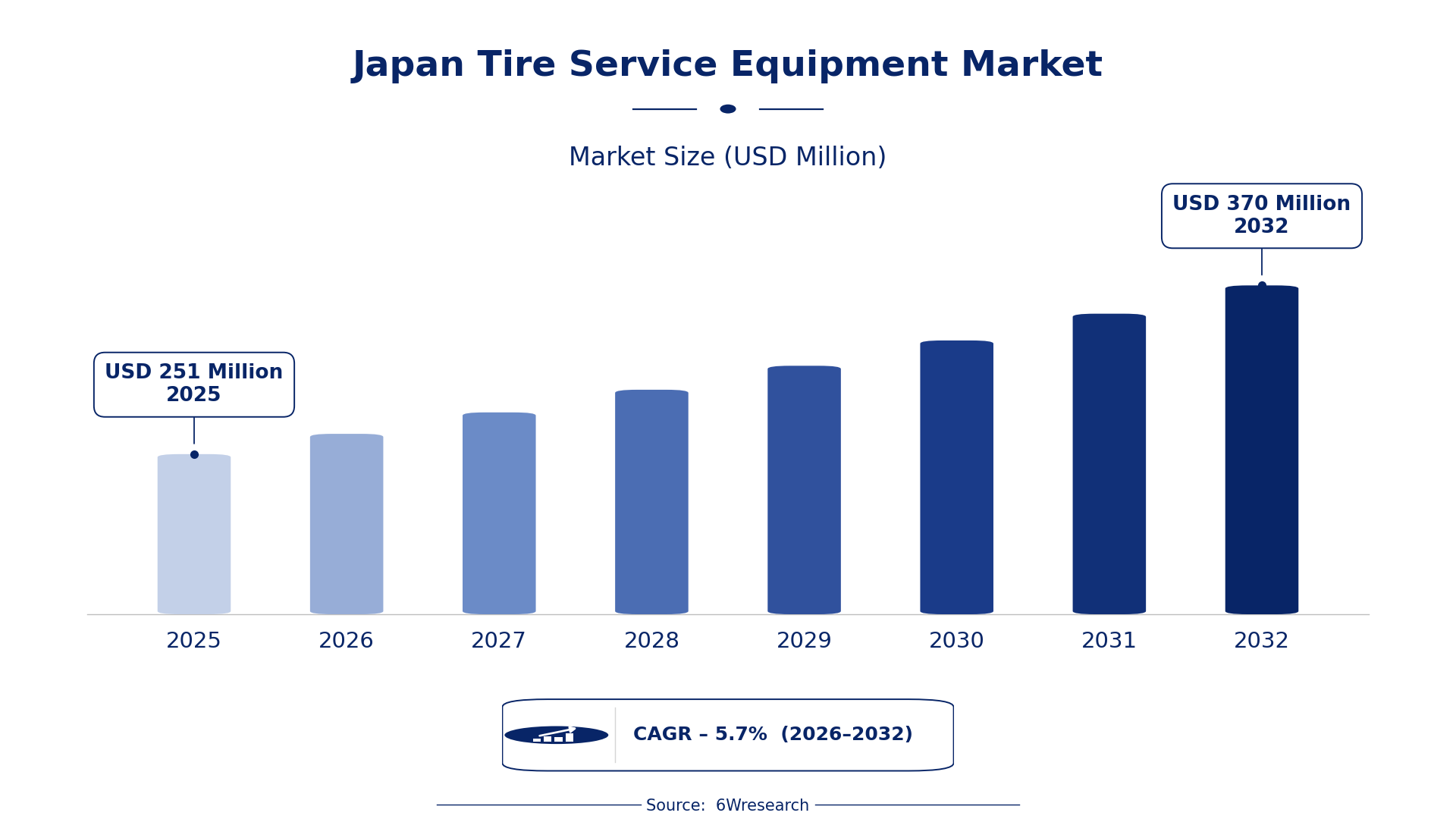
According to 6Wresearch internal database and industry insights, the Japan Tire Service Equipment Market was valued at USD 251 Million in 2025 and is projected to reach USD 370 Million by 2032, growing at a CAGR of approximately 5.7% during 2026–2032.
Japan Tire Service Equipment Market Highlights
| Report Metric | Details |
| Report Name | Japan Tire Service Equipment Market (2026-2032) |
| Market Size 2025 | USD 251 Million |
| Market Size 2032 | USD 370 Million |
| Absolute Growth 2025–2032 | USD 119 Million |
| CAGR 2026–2032 | 5.7% |
| Peak Annual Growth | 6.8% in 2028 |
| Forecast Period | 2026–2032 |
| Historical Data | 2022–2025 |
| Base Year | 2025 |
| Leading Equipment Type, 2025 | Tire Changers (47% share) |
| Leading Operation Mode, 2025 | Semi-Automatic (46% share) |
| Leading Workshop Type, 2025 | Car Garages (38% share) |
| Leading End User, 2025 | Service Centers (46% share) |
| Fastest-Growing Equipment Type | Wheel Balancers (8.0% CAGR) |
| Fastest-Growing Operation Mode | Manual/Electronic (8.1% CAGR) |
| Fastest-Growing Workshop Type | OEM Service Bays (8.2% CAGR) |
| Fastest-Growing End User | Automotive Dealers (7.4% CAGR) |
| Growing Sector | automotive service centers |
| Key End Users | service centers, car garages, automotive dealers, fleet workshops |
Japan Tire Service Equipment Market Year-wise Growth Rate and Key Drivers (2022–2032)
This graph illustrates the annual growth rates of the market from 2022 to 2032, highlighting a steady upward trajectory and projected market expansion over the forecast period.
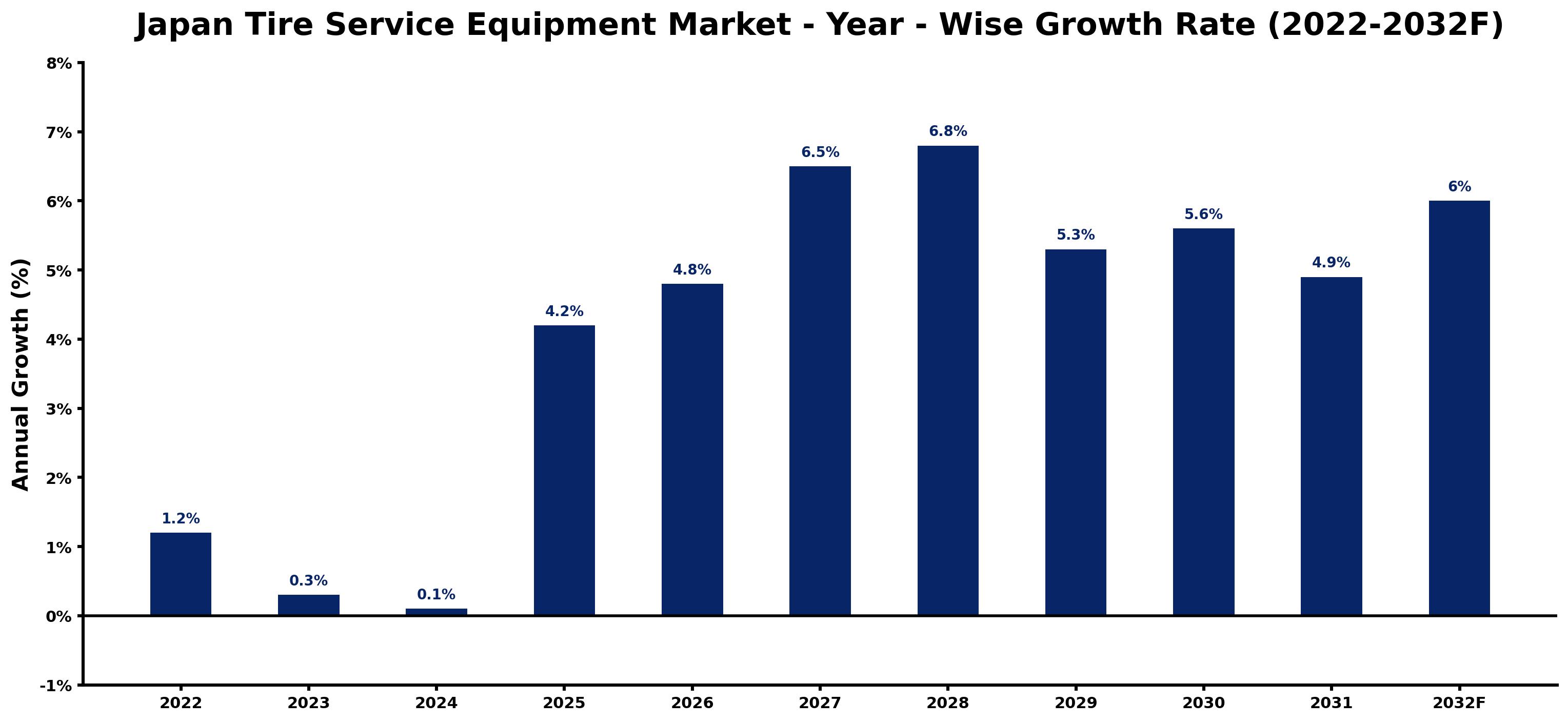
Each row of the following table gives one year's estimated growth and the event or demand shift that explains it.
| Year | Estimated Annual Growth (%) | Market Rationale |
| 2022 | 1.2 | The market experienced modest growth, reflecting steady demand for tire services. |
| 2023 | 0.3 | Growth slowed due to market saturation and fewer new vehicle registrations. |
| 2024 | 0.1 | Demand continued to slow as the market adjusted to previous years' growth rates. |
| 2025 | 4.2 | An increase in demand for tire services was noted as vehicle maintenance needs rose. |
| 2026 | 4.8 | Service centers are expected to expand their offerings to meet rising consumer expectations. |
| 2027 | 6.5 | Demand is projected to surge further due to increased vehicle usage and maintenance requirements. |
| 2028 | 6.8 | The market is expected to peak as service centers adopt advanced technologies for tire servicing. |
| 2029 | 5.3 | Growth will slow as the market begins to stabilise after the peak year. |
| 2030 | 5.6 | Demand is anticipated to increase again as vehicle maintenance becomes a priority for consumers. |
| 2031 | 4.9 | Growth will moderate as the market adjusts to higher service costs and competition. |
| 2032 | 6.0 | A renewed focus on vehicle safety and maintenance is expected to drive demand higher. |
Note: Market size estimations and growth projections presented in this report are based on 6Wresearch's proprietary forecasting methodology, utilizing the latest available industry data, government publications, and primary research inputs.
Japan Tire Service Equipment Market Synopsis
Tire service equipment includes essential tools for tire installation, maintenance, and repair, such as tire changers and wheel balancers. The Japan Tire Service Equipment Market is growing due to over 40 million registered vehicles and a 30% increase in tire service demand reported by service centers in 2023. The average age of vehicles in Japan is around 11 years, leading to a greater need for tire maintenance and repair services. This rising demand is further supported by the expansion of service centers and advancements in technology, which improve service quality and efficiency.
Market Dynamics Impact Analysis (2026–2032)
| Factor | Type | Impact | Primary Segment Affected |
| Rising vehicle maintenance needs drive demand for tire changers and wheel balancers. | Driver | High | Tire Changers |
| Technological advancements in tire service equipment enhance efficiency and service quality. | Driver | High | Wheel Balancers |
| The growth of service centers creates opportunities for advanced tire service equipment. | Opportunity | High | Service Centers |
| Increasing vehicle registrations provide a substantial market for tire service equipment. | Opportunity | High | Car Garages |
| Market saturation limits growth potential for new entrants in the tire service equipment sector. | Restraint | Medium | Tire Retailers |
| High operational costs can deter small workshops from upgrading their equipment. | Restraint | Medium | Quick Repair Shops |
| Competition from low-cost alternatives impacts pricing strategies for established suppliers. | Challenge | High | Fleet Workshops |
| Technological adoption requires significant investment, which can delay equipment upgrades. | Challenge | Medium | OEM Service Bays |
Evaluation of Drivers in Japan Tire Service Equipment Market (2026–2032)
Demand rests on the following drivers, each shown with the segment it touches most.
| Drivers | Primary Segment Affected | Why It Matters (Evidence) |
| Increasing vehicle maintenance frequency due to the average vehicle age of 11 years. | Tire Changers | This leads to higher demand for tire changers in service centers, essential for tire installation. |
| Technological advancements in wheel balancing equipment improve service efficiency. | Wheel Balancers | Service centers adopt these innovations to attract more customers and improve service quality. |
| The expansion of service centers boosts demand for tire service equipment. | Service Centers | As service centers grow, they require more equipment to handle increased tire service demand. |
| The rise in registered vehicles fuels the need for tire maintenance services. | Car Garages | With over 40 million vehicles in Japan, car garages are investing in tire service equipment. |
| Growing consumer awareness about vehicle safety increases demand for alignment machines. | Alignment Machines | Service centers are responding to consumer demands for better vehicle performance and safety. |
Volumes grow on the back of increasing vehicle maintenance needs, driven by the average vehicle age of 11 years, leading to more frequent tire services. Service centers report a 30% rise in tire service demand in 2023, prompting investments in tire changers and wheel balancers. The expansion of service centers boosts the need for alignment machines, as over 40 million registered vehicles require regular maintenance. Technological advancements in equipment improve efficiency, encouraging car garages to upgrade their tools. The growing focus on vehicle safety further drives demand for alignment services, ensuring vehicles meet performance standards.
Evaluation of Restraints in Japan Tire Service Equipment Market
These restraints slow adoption and weigh on supplier margins.
| Market Restraint | Primary Segment Affected | Why It Matters (Evidence) |
| High operational costs deter small workshops from upgrading equipment. | Quick Repair Shops | Many small workshops struggle to invest in new technologies, limiting their service capabilities. |
| Market saturation limits growth potential for new entrants. | Tire Retailers | With over 5,000 tire retailers, competition is fierce, making it hard for new businesses to thrive. |
| Competition from low-cost alternatives impacts pricing strategies. | Fleet Workshops | Fleet workshops may opt for cheaper equipment, affecting sales of higher-quality products. |
| Limited consumer awareness about advanced tire service technologies. | Service Centers | Some service centers may not invest in modern equipment due to a lack of understanding of its benefits. |
| Regulatory compliance costs can be burdensome for small operators. | Car Garages | Small car garages face challenges in meeting safety standards, which can increase operational expenses. |
Japan Tire Service Equipment Market Challenges
Service centers in Japan report a 30% increase in tire service demand in 2023, intensifying competition among producers. Many producers face difficulties complying with the JIS standard, leading to product approval delays of up to six months for distributors. Rising wages, with the national minimum wage at JPY 1,055 per hour, inflate operational costs for workshops, raising the average cost of tire service to approximately 5,000 JPY per vehicle. Buyers encounter challenges accessing advanced tire service equipment as government initiatives aimed at reducing vehicle emissions enforce stricter maintenance practices.
Trends in the Japan Tire Service Equipment Market
These developments are changing demand patterns in the Japan Tire Service Equipment Market.
- Shift towards Digital Laser-Based Alignment Machines: Digital laser-based alignment machines are gaining popularity in urban areas, with a notable increase in adoption among service centers. In 2023, around 20% of service centers in Tokyo reported using this technology, improving precision in vehicle alignment.
- Increase in Semi-Automatic Tire Changers: Quick repair shops are increasingly adopting semi-automatic tire changers, reflecting a shift towards efficiency. By 2025, around 60% of quick repair shops are expected to use semi-automatic systems, streamlining tire service processes.
- Expansion of Heavy Vehicle Bays: Heavy vehicle bays are expanding to accommodate larger trucks and buses, responding to the needs of the logistics sector. In 2023, the number of heavy vehicle bays increased by 15% across Japan, reflecting growing demand.
- Adoption of ISO 9001 in Service Centers: Service centers are adopting ISO 9001 for quality management, ensuring consistent service delivery. By 2026, over 40% of service centers are expected to achieve ISO 9001 certification, improving customer trust.
Investment Opportunities in the Japan Tire Service Equipment Market
Several openings in the Japan Tire Service Equipment Market merit attention from investors.
- Gap in Advanced Tire Service Equipment: With a projected market size of USD 370 million by 2032, there is a gap in advanced tire service equipment. Service centers are seeking partnerships to improve their offerings, particularly in urban areas like Tokyo.
- Investment in Eco-Friendly Tire Maintenance Solutions: The growing focus on sustainability presents an opportunity for eco-friendly tire maintenance solutions. Automotive dealers are looking for partners to supply environmentally friendly products, particularly in regions with strict emissions regulations.
- Expansion of Automotive Service Bays: As automotive dealers expand service bays to accommodate tire services, there is a demand for efficient tire service equipment. By collaborating with local manufacturers, suppliers can enter this growing market effectively.
- Emerging Demand for Nitrogen Inflation Systems: With inflation systems now standard in 70% of service centers, there is a growing market for nitrogen inflation systems. Quick repair shops are increasingly interested in these systems to improve tire longevity.
Government Initiatives in the Japan Tire Service Equipment Market
The Industrial Safety and Health Act (1972) sets clear regulations for tire service equipment safety, requiring producers to ensure that their machinery meets safety standards. Compliance with this act is essential for manufacturers and service providers, as it helps prevent accidents and ensures safe operations in workshops. Regular inspections and adherence to safety protocols are critical for maintaining operational integrity and consumer trust.
In 2023, the Ministry of Land, Infrastructure, Transport and Tourism approved over 1,000 new tire service facilities, impacting how service centers operate and maintain their equipment. The agency oversees vehicle maintenance regulations, ensuring that tire service equipment complies with national safety standards, which affects operational practices across the industry.
Future Insight of the Japan Tire Service Equipment Market
New tyre service facilities are expected to emerge by 2032, enhancing operational efficiency and service quality. The adoption of ISO 9001 for quality management will likely increase across automotive service centres, ensuring higher standards. With over 40 million registered vehicles in Japan, the demand for efficient tyre service solutions will grow, prompting suppliers to innovate. Expanding service bays will accommodate larger vehicles, diversifying offerings and attracting a broader customer base.
Market Segmentation Analysis
Japan Tire Service Equipment Market report covers a detailed analysis of the following market segments:
By Equipment Type – Tire Changers Lead, Wheel Balancers Expected to Grow Fastest
According to Saurav Kr Singh, Senior Research Analyst at 6Wresearch, the largest equipment type category in 2025 was Tire Changers, at 47% of revenue. Tire changers hold the largest share due to their essential role in over 80% of car garages, making them indispensable for tire installation and removal. Their widespread use across automotive service centres in Japan reinforces their strong market presence. Wheel Balancers are set to record the highest CAGR in this split, 8.0% over 2026–2032. Wheel balancers are experiencing rapid growth as their critical role in ensuring tire balance gains recognition, particularly with the increasing emphasis on vehicle performance. This demand is further fuelled by the rising interest in performance tuning among racing vehicles. Suppliers should prioritise the distribution of wheel balancers to meet the escalating market needs.
By Operation Mode – Semi-Automatic Leads, Manual/Electronic Expected to Grow Fastest
In 2025, Semi-Automatic led the operation mode split with a 46% share. Semi-automatic machines dominate the market as they are widely adopted in workshops for their efficiency in tire service operations. Their integration into many service centres reflects a shift towards more streamlined processes in vehicle maintenance. Over 2026–2032, Manual/Electronic is expected to post the fastest growth, at a CAGR of 8.1%. Manual/electronic operation modes are gaining traction as traditional setups continue to be preferred by certain workshops. This trend is likely to persist as these modes are familiar and reliable for many technicians. Buyers may benefit from considering a mix of operation modes to meet diverse workshop needs.
By Workshop Type – Car Garages Lead, OEM Service Bays Expected to Grow Fastest
Car Garages took 38% of workshop type revenue in 2025, more than any other category. Car garages dominate the market as they are the primary users of tire service equipment, servicing a substantial number of registered vehicles in Japan. Their established presence guarantees a continuous demand for essential tools like tire changers and wheel balancers. The quickest growth will come from OEM Service Bays, forecast to expand at a CAGR of 8.2% between 2026 and 2032. OEM service bays are witnessing the fastest growth as they are increasingly utilised for manufacturer services, reflecting a trend towards more specialised maintenance. This shift is influenced by the rising complexity of modern vehicles that require precise servicing. Suppliers should focus on OEM service bays to align with the growing demand for specialised tire services.
By End User – Service Centers Lead, Automotive Dealers Expected to Grow Fastest
With 46% of end user revenue in 2025, Service Centers was the largest category. Service centres command the largest share as they are the main users of tire service equipment, crucial for maintaining the high volume of vehicle maintenance in Japan. Their integral role in the automotive ecosystem ensures consistent demand for various tire service tools. Automotive Dealers are projected to grow fastest, at a CAGR of 7.4% during 2026–2032. Automotive dealers are rapidly expanding their service offerings, integrating tire services into their sales strategies. This shift is motivated by the need to provide comprehensive vehicle care to their customers. Suppliers should explore partnerships with automotive dealers to capitalise on this expanding service market.
Key Attractiveness of the Report
- 10 Years of Market Numbers
- Historical Data Starting from 2022 to 2025
- Base Year 2025
- Forecast Data until 2032
- Key Performance Indicators Impacting the Market
- Major Upcoming Developments and Projects
Key Highlights of the Report:
- Japan Tire Service Equipment Market Outlook
- Market Size of Japan Tire Service Equipment Market, 2025
- Forecast of Japan Tire Service Equipment Market, 2032
- Historical Data and Forecast of Japan Tire Service Equipment Revenues & Volume for the Period 2022-2032F
- Japan Tire Service Equipment Market Trend Evolution
- Japan Tire Service Equipment Market Drivers and Challenges
- Japan Tire Service Equipment Price Trends
- Japan Tire Service Equipment Porter's Five Forces
- Japan Tire Service Equipment Industry Life Cycle
- Historical Data and Forecast of Japan Tire Service Equipment Market Revenues & Volume By Equipment Type for the Period 2022-2032F
- Historical Data and Forecast of Japan Tire Service Equipment Market Revenues & Volume By Tire Changers for the Period 2022-2032F
- Historical Data and Forecast of Japan Tire Service Equipment Market Revenues & Volume By Wheel Balancers for the Period 2022-2032F
- Historical Data and Forecast of Japan Tire Service Equipment Market Revenues & Volume By Alignment Machines for the Period 2022-2032F
- Historical Data and Forecast of Japan Tire Service Equipment Market Revenues & Volume By Inflation Systems for the Period 2022-2032F
- Historical Data and Forecast of Japan Tire Service Equipment Market Revenues & Volume By Operation Mode for the Period 2022-2032F
- Historical Data and Forecast of Japan Tire Service Equipment Market Revenues & Volume By Semi-Automatic for the Period 2022-2032F
- Historical Data and Forecast of Japan Tire Service Equipment Market Revenues & Volume By Manual/Electronic for the Period 2022-2032F
- Historical Data and Forecast of Japan Tire Service Equipment Market Revenues & Volume By Digital Laser-Based for the Period 2022-2032F
- Historical Data and Forecast of Japan Tire Service Equipment Market Revenues & Volume By Nitrogen/Electric for the Period 2022-2032F
- Historical Data and Forecast of Japan Tire Service Equipment Market Revenues & Volume By Workshop Type for the Period 2022-2032F
- Historical Data and Forecast of Japan Tire Service Equipment Market Revenues & Volume By Car Garages for the Period 2022-2032F
- Historical Data and Forecast of Japan Tire Service Equipment Market Revenues & Volume By OEM Service Bays for the Period 2022-2032F
- Historical Data and Forecast of Japan Tire Service Equipment Market Revenues & Volume By Heavy Vehicle Bays for the Period 2022-2032F
- Historical Data and Forecast of Japan Tire Service Equipment Market Revenues & Volume By Quick Repair Shops for the Period 2022-2032F
- Historical Data and Forecast of Japan Tire Service Equipment Market Revenues & Volume By End User for the Period 2022-2032F
- Historical Data and Forecast of Japan Tire Service Equipment Market Revenues & Volume By Service Centers for the Period 2022-2032F
- Historical Data and Forecast of Japan Tire Service Equipment Market Revenues & Volume By Automotive Dealers for the Period 2022-2032F
- Historical Data and Forecast of Japan Tire Service Equipment Market Revenues & Volume By Fleet Workshops for the Period 2022-2032F
- Historical Data and Forecast of Japan Tire Service Equipment Market Revenues & Volume By Tire Retailers for the Period 2022-2032F
- Japan Tire Service Equipment Import Export Trade Statistics
- Market Opportunity Assessment By Equipment Type
- Market Opportunity Assessment By Operation Mode
- Market Opportunity Assessment By Workshop Type
- Market Opportunity Assessment By End User
- Japan Tire Service Equipment Top Companies Market Share
- Japan Tire Service Equipment Competitive Benchmarking By Technical and Operational Parameters
- Japan Tire Service Equipment Company Profiles
- Japan Tire Service Equipment Key Strategic Recommendations
Market Covered
The following segment groups are covered in the report.
By Equipment Type
- Tire Changers
- Wheel Balancers
- Alignment Machines
- Inflation Systems
By Operation Mode
- Semi-Automatic
- Manual/Electronic
- Digital Laser-Based
- Nitrogen/Electric
By Workshop Type
- Car Garages
- OEM Service Bays
- Heavy Vehicle Bays
- Quick Repair Shops
By End User
- Service Centers
- Automotive Dealers
- Fleet Workshops
- Tire Retailers































