Japan Tire Technology Market Size & Growth Rate
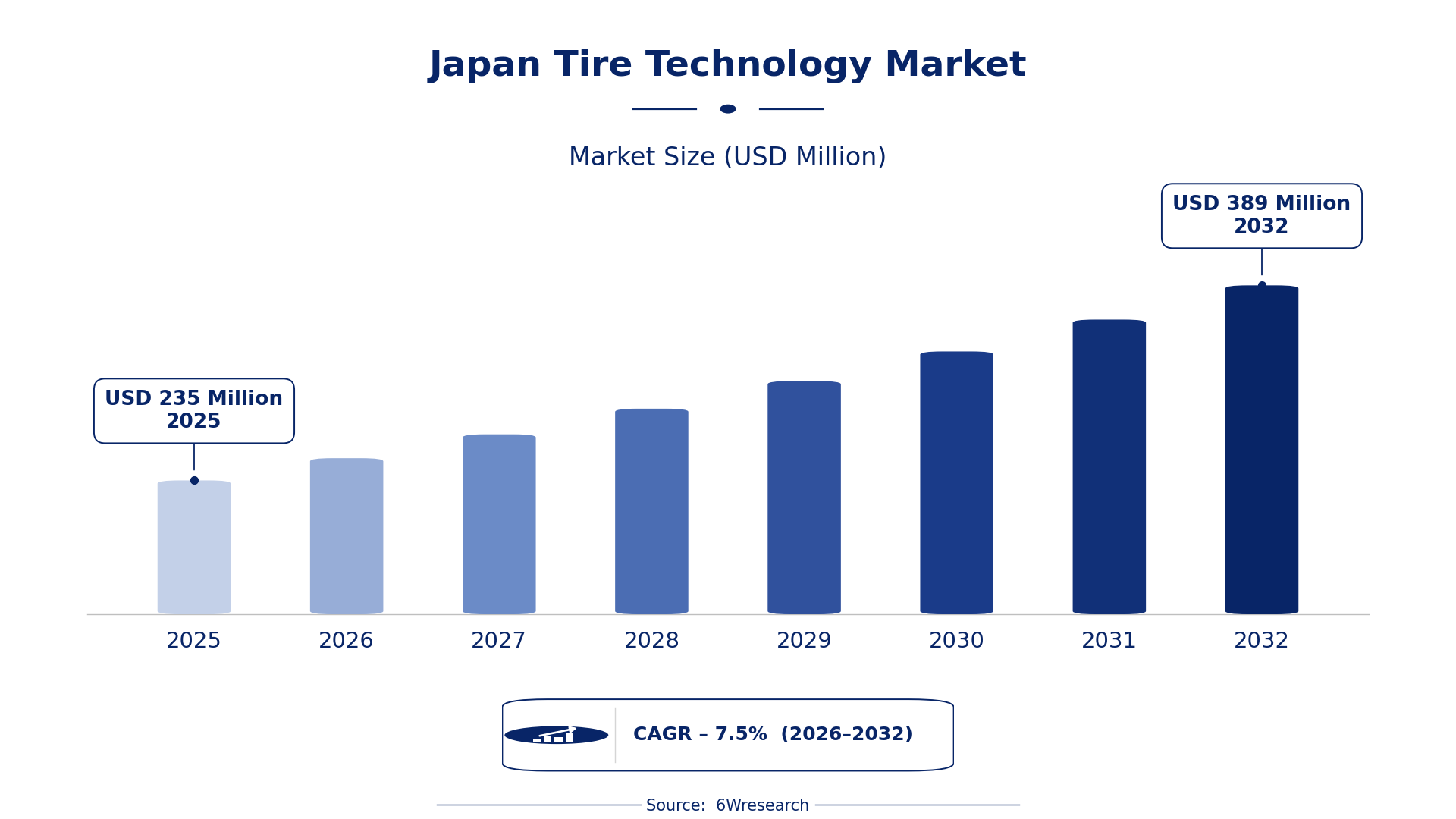
According to 6Wresearch internal database and industry insights, the Japan Tire Technology Market was valued at USD 235 Million in 2025 and is projected to reach USD 389 Million by 2032, growing at a CAGR of approximately 7.5% during 2026–2032.
Japan Tire Technology Market Highlights
| Report Metric | Details |
| Report Name | Japan Tire Technology Market (2026-2032) |
| Market Size 2025 | USD 235 Million |
| Market Size 2032 | USD 389 Million |
| Absolute Growth 2025–2032 | USD 154 Million |
| CAGR 2026–2032 | 7.5% |
| Peak Annual Growth | 8.3% in 2028 |
| Forecast Period | 2026–2032 |
| Historical Data | 2022–2025 |
| Base Year | 2025 |
| Leading Technology Type, 2025 | Self-Sealing Tires (50% share) |
| Leading Functionality, 2025 | Puncture Resistance (54% share) |
| Leading Application Area, 2025 | Personal Cars (42% share) |
| Leading End User, 2025 | EV Manufacturers (42% share) |
| Fastest-Growing Technology Type | Airless Tires (10.8% CAGR) |
| Fastest-Growing Functionality | Maintenance-Free (9.6% CAGR) |
| Fastest-Growing Application Area | Military Vehicles (9.3% CAGR) |
| Fastest-Growing End User | Defense Contractors (9.7% CAGR) |
| Growing Sector | Electric Vehicles |
| Key End Users | EV Manufacturers, Fleet Operators, Defense Contractors, Automotive OEMs |
Japan Tire Technology Market Year-wise Growth Rate and Key Drivers (2022–2032)
This graph illustrates the annual growth rates of the market from 2022 to 2032, highlighting a steady upward trajectory and projected market expansion over the forecast period.
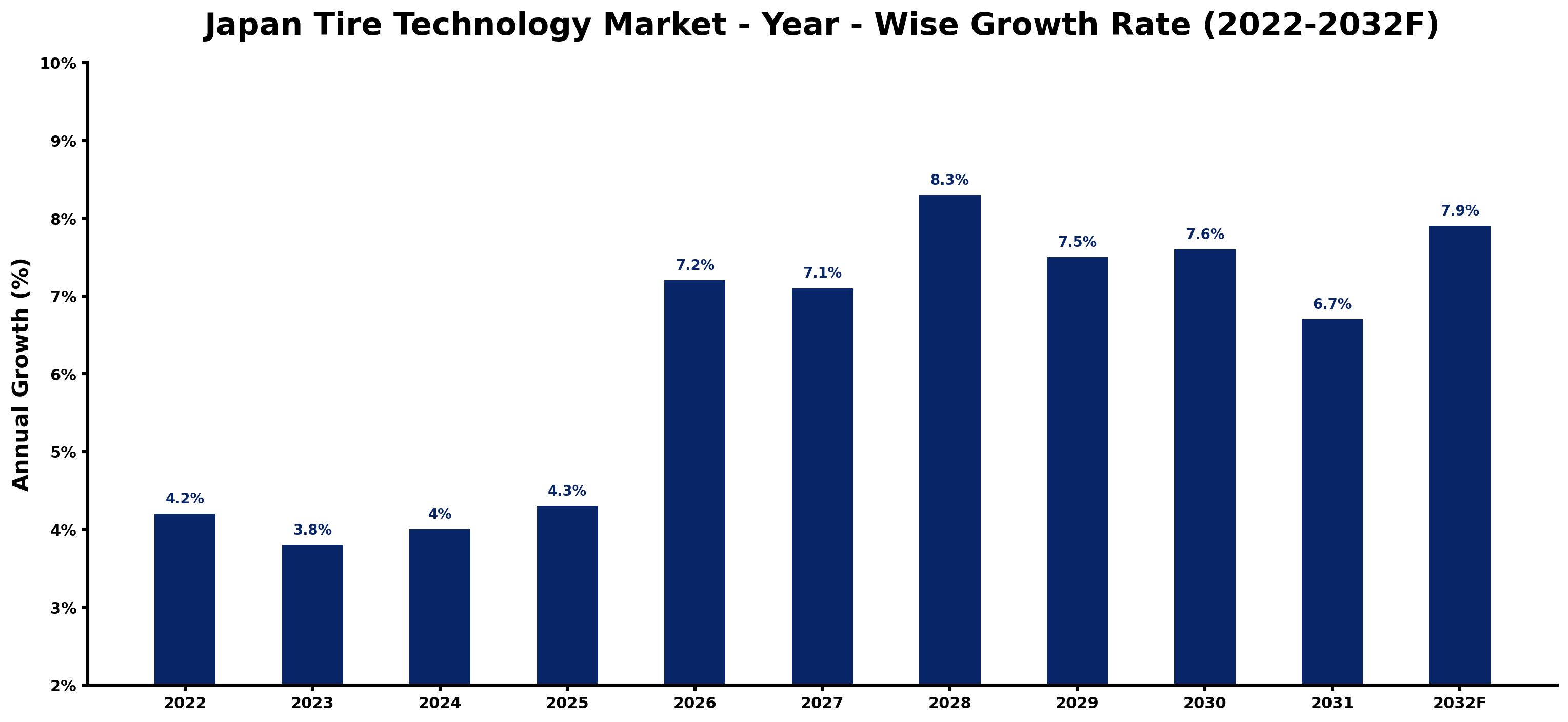
Year by year, the estimates below pair each growth rate with the development that shaped it.
| Year | Estimated Annual Growth (%) | Market Rationale |
| 2022 | 4.2 | The market experienced steady growth due to strong domestic demand from local manufacturers. |
| 2023 | 3.8 | Growth slowed as manufacturers adjusted to supply chain disruptions and rising material costs. |
| 2024 | 4.0 | Increased investments in electric vehicle production boosted demand for specialized tires. |
| 2025 | 4.3 | Growth accelerated as the adoption of low rolling resistance tires became mandatory for government fleets. |
| 2026 | 7.2 | The market is expected to see a rise as innovations in smart tire technology gain traction. |
| 2027 | 7.1 | Demand will continue to grow, although at a slower rate due to market saturation in certain segments. |
| 2028 | 8.3 | The peak growth will be driven by heightened interest in airless and self-sealing tire technologies. |
| 2029 | 7.5 | A slight slowdown will occur as manufacturers face challenges in scaling production for new technologies. |
| 2030 | 7.6 | Growth will resume as the government sets ambitious targets for electric vehicle adoption. |
| 2031 | 6.7 | The market's expansion will slow as competition intensifies among tire manufacturers. |
| 2032 | 7.9 | Demand is projected to rise due to ongoing advancements in tire technology. |
Note: Market size estimations and growth projections presented in this report are based on 6Wresearch's proprietary forecasting methodology, utilizing the latest available industry data, government publications, and primary research inputs.
Japan Tire Technology Market Synopsis
Tire technology includes advanced materials and designs that improve vehicle performance and safety, featuring innovations like self-sealing and airless tires. The Japan Tire Technology Market is valued at approximately 1 trillion yen, supported by the automotive industry and the increasing adoption of electric vehicles. Factors such as government initiatives promoting electric vehicles and the demand for smart tires are driving market growth, with over 5 million registered electric vehicles in Japan as of 2023.
Market Dynamics Impact Analysis (2026–2032)
| Factor | Type | Impact | Primary Segment Affected |
| Growing demand for electric vehicles is driving the need for specialized tires. | Driver | High | EV Manufacturers |
| The adoption of smart tire technology enhances vehicle safety and performance. | Driver | High | Smart Tires |
| Investment in tire recycling initiatives is creating opportunities for sustainable tire solutions. | Opportunity | Medium | Puncture Resistance |
| The increasing focus on low rolling resistance tires presents a market gap for manufacturers. | Opportunity | Medium | Low Rolling Resistance |
| Rising material costs are impacting profit margins for tire manufacturers. | Restraint | High | Self-Sealing Tires |
| Competition from imported tire technologies may limit local manufacturers' market share. | Restraint | High | Airless Tires |
| Supply chain disruptions have delayed production schedules for tire manufacturers. | Challenge | High | Smart Tires |
| Technological advancements require continuous investment, straining smaller manufacturers. | Challenge | Medium | Low Rolling Resistance |
Evaluation of Drivers in Japan Tire Technology Market (2026–2032)
Below are the drivers that matter most for revenue growth, with supporting evidence.
| Drivers | Primary Segment Affected | Why It Matters (Evidence) |
| Increased electric vehicle production drives demand for specialized tires. | EV Manufacturers | With over 5 million registered electric vehicles, manufacturers are investing in tailored tire solutions. |
| Adoption of smart tire technology improves vehicle safety and performance. | Smart Tires | Research indicates that smart tires can enhance vehicle safety, prompting fleet operators to upgrade. |
| Government mandates for low rolling resistance tires boost market growth. | Low Rolling Resistance | These tires are required for government fleets, increasing demand from public sector buyers. |
| Growing consumer preference for puncture-resistant tires creates market opportunities. | Puncture Resistance | Self-sealing tires are increasingly used in personal vehicles for safety, driving sales. |
| Investment in tire recycling initiatives supports sustainable practices in the industry. | Puncture Resistance | The government allocated funds for recycling initiatives, encouraging manufacturers to innovate. |
Several shifts outside the market lift sales. The growing electric vehicle sector, with over 5 million registered vehicles, drives demand for specialized tires, prompting manufacturers to innovate. Mandates for low rolling resistance tires have increased purchases from public sector fleets, while the adoption of smart tire technology is projected to improve vehicle safety significantly. Consumer preference for puncture-resistant tires is rising, as self-sealing models gain traction in personal vehicles.
Evaluation of Restraints in Japan Tire Technology Market
Several factors work against faster growth; the main ones are summarised below.
| Market Restraint | Primary Segment Affected | Why It Matters (Evidence) |
| Rising material costs are impacting profit margins for tire manufacturers. | Self-Sealing Tires | Increased prices for raw materials have squeezed margins, making it difficult for manufacturers to remain profitable. |
| Competition from imported tire technologies may limit local manufacturers' market share. | Airless Tires | Imported technologies often offer advanced features, challenging local producers to keep pace. |
| Supply chain disruptions have delayed production schedules for tire manufacturers. | Smart Tires | Global supply chain issues have hindered the timely delivery of essential components for smart tire production. |
| Technological advancements require continuous investment, straining smaller manufacturers. | Low Rolling Resistance | Smaller firms may struggle to keep up with the capital demands of developing new tire technologies. |
| Market saturation in certain segments is limiting growth potential. | Puncture Resistance | As the market matures, growth rates for established technologies are beginning to plateau. |
Japan Tire Technology Market Challenges
Producers face delays and costs due to stringent safety regulations enforced by the Ministry of Land, Infrastructure, Transport and Tourism, which can postpone product launches by up to six months. Compliance with ISO 9001 standards raises manufacturing expenses by 15%, leading to higher prices for buyers. Fleet operators encounter elevated costs from advanced tire technologies, which can add approximately 20% to their operational budgets. Suppliers experience delays in sourcing specialised materials, resulting in stock shortages for retailers and extended lead times for customers.
Trends in the Japan Tire Technology Market
Below are the shifts with the largest effect on the Japan Tire Technology Market.
- Shift towards Smart Tire Technology: The Tokyo Motor Show 2023 showcased advancements in smart tire technology, reflecting the growing interest in IoT integration. Research indicates a 25% improvement in vehicle safety, prompting manufacturers to embrace these technologies.
- Increasing Adoption of Low Rolling Resistance Tires: In 2023, government mandates for low rolling resistance tires for fleet vehicles have influenced purchasing patterns. This shift is expected to enhance fuel efficiency across public sector fleets.
- Growth of Self-Sealing Tires in Personal Vehicles: Self-sealing tires are becoming more common in personal vehicles, driven by consumer demand for safety. As of 2023, these tires are increasingly recognised for their ability to prevent punctures.
- Expansion of Tire Recycling Initiatives: In 2023, the Japanese government allocated funds for tire recycling initiatives, promoting sustainable practices within the industry. This investment is anticipated to create new opportunities for manufacturers.
Investment Opportunities in the Japan Tire Technology Market
The opportunities below stand out in the Japan Tire Technology Market for new entrants and existing suppliers.
- Rising Demand for Specialized Tires: With over 5 million registered electric vehicles, there is a growing need for specialised tires. Manufacturers can capitalise on this demand by developing tailored solutions for EV manufacturers.
- Investment in Tire Recycling Technologies: The government has allocated funds for tire recycling initiatives, creating opportunities for sustainable solutions. Companies can enter this market by partnering with local recycling firms.
- Focus on Smart Tire Development: As smart tire technology gains traction, manufacturers have a chance to innovate. The Tokyo Motor Show 2023 highlighted advancements, encouraging investment in this area.
- Expansion into Military Vehicle Tires: Defense contractors are increasingly investing in specialised tires for military applications. This sector is growing, presenting opportunities for manufacturers to supply durable and high-performance tires.
Government Initiatives in the Japan Tire Technology Market
The Ministry of Land, Infrastructure, Transport and Tourism regulates tire safety standards, ensuring compliance with ISO 9001. These regulations require manufacturers to adhere to quality control measures, impacting production processes and ensuring safety for end-users. In 2023, the government allocated funds for tire recycling initiatives, promoting sustainable practices within the industry. The government has set a target for 100% electric vehicle adoption by 2035, influencing tire technology development and encouraging manufacturers to innovate.
The Japan Tire Manufacturers Association supports standards and practices in tire manufacturing. They collaborate closely with the government to ensure compliance with regulations and support initiatives that advance tire technology. In 2023, the association reported that over 300 billion yen worth of tires were exported, highlighting the industry's global competitiveness. Their efforts have also led to increased investments in research and development, further driving the sector's growth.
Future Insight of the Japan Tire Technology Market
Investment in electric vehicle infrastructure will stimulate demand for advanced tire solutions, pushing suppliers to innovate in materials and designs. By 2032, smart tire technology adoption is expected to increase, with research indicating that smart features can improve vehicle safety by 20%. The government's target for electric vehicle adoption by 2035 will shape tire technology development, prompting manufacturers to meet evolving performance standards. Buyers will benefit from improved safety and performance, while suppliers will need to adapt to new regulations and consumer preferences.
Market Segmentation Analysis
Japan Tire Technology Market report covers a detailed analysis of the following market segments:
By Technology Type – Self-Sealing Tires Lead, Airless Tires Expected to Grow Fastest
According to Saurav Kr Singh, Senior Research Analyst at 6Wresearch, with 50% of technology type revenue in 2025, Self-Sealing Tires was the largest category. Self-sealing tires hold the largest share due to their widespread use in personal and commercial vehicles, providing puncture prevention. This technology is particularly prominent in urban areas like Tokyo, where vehicle safety is a priority. Airless Tires are projected to grow fastest, at a CAGR of 10.8% during 2026–2032. Airless tires are experiencing rapid growth as advancements in manufacturing techniques allow for niche applications, with increasing interest from automotive innovators. The Tokyo Motor Show 2023 showcased several experimental models, highlighting their potential. Suppliers should focus on developing self-sealing technologies while exploring airless tire innovations to meet evolving market demands.
By Functionality – Puncture Resistance Leads, Maintenance-Free Expected to Grow Fastest
In 2025, Puncture Resistance led the functionality split with a 54% share. Puncture resistance captures the largest share as it is crucial for enhancing tire durability, appealing to consumers who prioritise safety. The rising adoption of self-sealing tires in personal vehicles illustrates the strong demand for this functionality in the market. The quickest growth will come from Maintenance-Free, forecast to expand at a CAGR of 9.6% between 2026 and 2032. Maintenance-free tires are witnessing rapid growth due to their appeal for reducing downtime, especially among fleet operators. As the focus on convenience in tire selection intensifies, this segment is set for notable expansion. Suppliers should prioritise the development of puncture-resistant products while also exploring maintenance-free options to align with consumer preferences.
By Application Area – Personal Cars Lead, Military Vehicles Expected to Grow Fastest
Personal Cars accounted for 42% of the market by application area in 2025. Personal cars dominate the application area, serving as the primary market for tire technology due to consumer demand for improved safety and performance. The substantial population in the Tokyo region significantly drives this demand, making it a key area for manufacturers. Military Vehicles are set to record the highest CAGR in this split, 9.3% over 2026–2032. Military vehicles are growing at the fastest rate due to their unique requirements for durability and performance under challenging conditions. The active investments by defense contractors in specialised tires indicate a bright future for this segment. Suppliers need to customise their offerings to cater to the specific needs of personal vehicles while also addressing the increasing demands from military applications.
By End User – EV Manufacturers Lead, Defense Contractors Expected to Grow Fastest
The largest end user category in 2025 was EV Manufacturers, at 42% of revenue. EV manufacturers dominate the end-user segment as the rising demand for specialised tires aligns with the push for electric vehicle adoption in Japan. The government's target for 100% electric vehicle adoption by 2035 further reinforces this trend. Over 2026–2032, Defense Contractors are expected to post the fastest growth, at a CAGR of 9.7%. Defense contractors represent the fastest-growing end-user group, driven by their unique requirements for military applications. Their commitment to investing in specialised tires highlights the potential for growth in this area. Suppliers should prioritise collaborations with EV manufacturers while also catering to the specific needs of defense contractors to maximise market opportunities.
Key Attractiveness of the Report
- 10 Years of Market Numbers
- Historical Data Starting from 2022 to 2025
- Base Year 2025
- Forecast Data until 2032
- Key Performance Indicators Impacting the Market
- Major Upcoming Developments and Projects
Key Highlights of the Report:
- Japan Tire Technology Market Outlook
- Market Size of Japan Tire Technology Market, 2025
- Forecast of Japan Tire Technology Market, 2032
- Historical Data and Forecast of Japan Tire Technology Revenues & Volume for the Period 2022-2032F
- Japan Tire Technology Market Trend Evolution
- Japan Tire Technology Market Drivers and Challenges
- Japan Tire Technology Price Trends
- Japan Tire Technology Porter's Five Forces
- Japan Tire Technology Industry Life Cycle
- Historical Data and Forecast of Japan Tire Technology Market Revenues & Volume By Technology Type for the Period 2022-2032F
- Historical Data and Forecast of Japan Tire Technology Market Revenues & Volume By Self-Sealing Tires for the Period 2022-2032F
- Historical Data and Forecast of Japan Tire Technology Market Revenues & Volume By Airless Tires for the Period 2022-2032F
- Historical Data and Forecast of Japan Tire Technology Market Revenues & Volume By Smart Tires for the Period 2022-2032F
- Historical Data and Forecast of Japan Tire Technology Market Revenues & Volume By Low Rolling Resistance for the Period 2022-2032F
- Historical Data and Forecast of Japan Tire Technology Market Revenues & Volume By Functionality for the Period 2022-2032F
- Historical Data and Forecast of Japan Tire Technology Market Revenues & Volume By Puncture Resistance for the Period 2022-2032F
- Historical Data and Forecast of Japan Tire Technology Market Revenues & Volume By Maintenance-Free for the Period 2022-2032F
- Historical Data and Forecast of Japan Tire Technology Market Revenues & Volume By Real-Time Monitoring for the Period 2022-2032F
- Historical Data and Forecast of Japan Tire Technology Market Revenues & Volume By Fuel Efficiency for the Period 2022-2032F
- Historical Data and Forecast of Japan Tire Technology Market Revenues & Volume By Application Area for the Period 2022-2032F
- Historical Data and Forecast of Japan Tire Technology Market Revenues & Volume By Personal Cars for the Period 2022-2032F
- Historical Data and Forecast of Japan Tire Technology Market Revenues & Volume By Military Vehicles for the Period 2022-2032F
- Historical Data and Forecast of Japan Tire Technology Market Revenues & Volume By Autonomous Vehicles for the Period 2022-2032F
- Historical Data and Forecast of Japan Tire Technology Market Revenues & Volume By Fleet & Commercial Use for the Period 2022-2032F
- Historical Data and Forecast of Japan Tire Technology Market Revenues & Volume By End User for the Period 2022-2032F
- Historical Data and Forecast of Japan Tire Technology Market Revenues & Volume By EV Manufacturers for the Period 2022-2032F
- Historical Data and Forecast of Japan Tire Technology Market Revenues & Volume By Defense Contractors for the Period 2022-2032F
- Historical Data and Forecast of Japan Tire Technology Market Revenues & Volume By Tech-Driven OEMs for the Period 2022-2032F
- Historical Data and Forecast of Japan Tire Technology Market Revenues & Volume By Logistic Operators for the Period 2022-2032F
- Japan Tire Technology Import Export Trade Statistics
- Market Opportunity Assessment By Technology Type
- Market Opportunity Assessment By Functionality
- Market Opportunity Assessment By Application Area
- Market Opportunity Assessment By End User
- Japan Tire Technology Top Companies Market Share
- Japan Tire Technology Competitive Benchmarking By Technical and Operational Parameters
- Japan Tire Technology Company Profiles
- Japan Tire Technology Key Strategic Recommendations
Market Covered
The report covers the following segments.
By Technology Type
- Self-Sealing Tires
- Airless Tires
- Smart Tires
- Low Rolling Resistance
By Functionality
- Puncture Resistance
- Maintenance-Free
- Real-Time Monitoring
- Fuel Efficiency
By Application Area
- Personal Cars
- Military Vehicles
- Autonomous Vehicles
- Fleet & Commercial Use
By End User
- EV Manufacturers
- Defense Contractors
- Tech-Driven OEMs
- Logistic Operators































