Japan Tissue Graft Market Size & Growth Rate
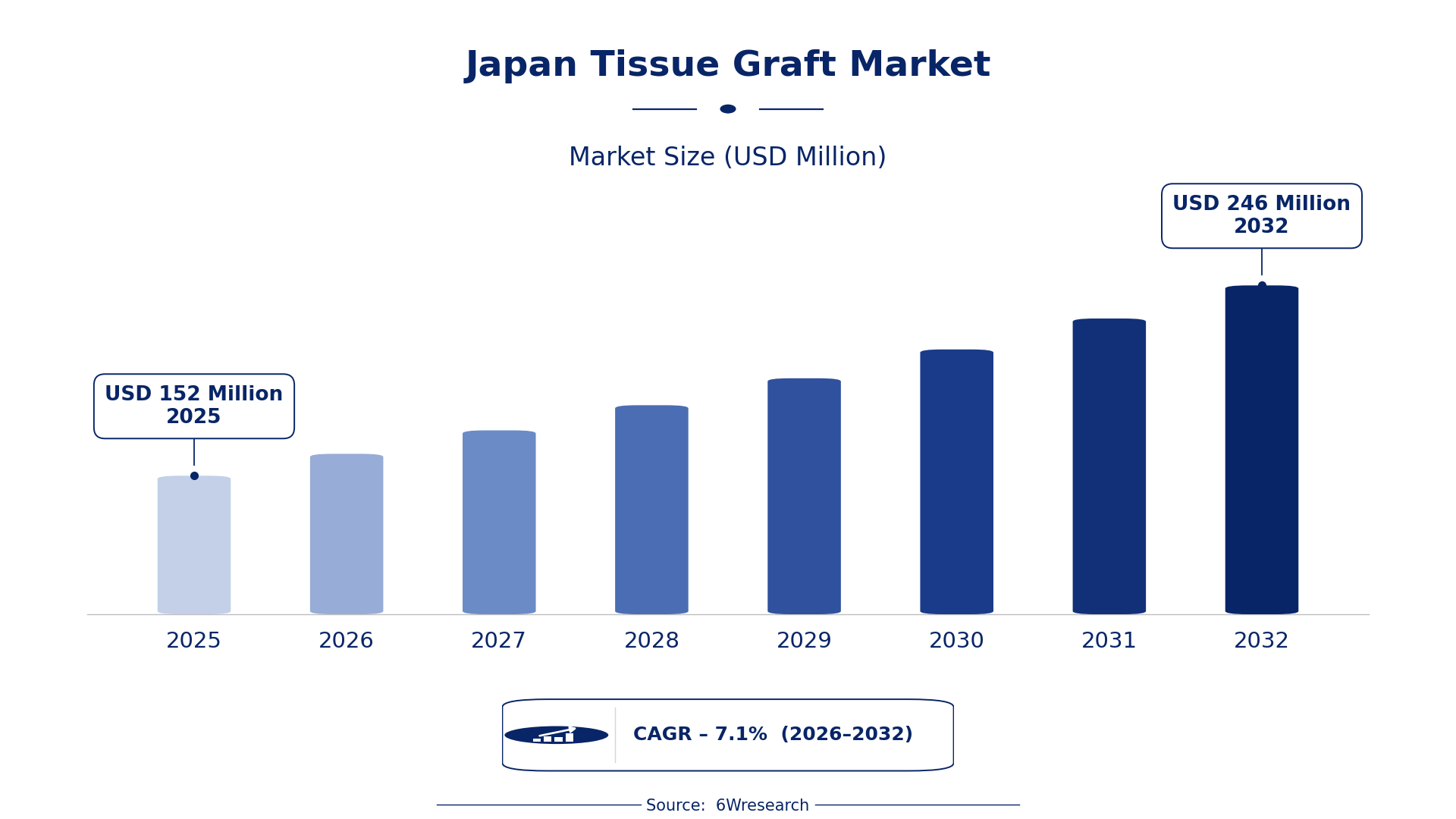
According to 6Wresearch internal database and industry insights, the Japan Tissue Graft Market was valued at USD 152 Million in 2025 and is projected to reach USD 246 Million by 2032, growing at a CAGR of approximately 7.1% during 2026–2032.
Japan Tissue Graft Market Highlights
| Report Metric | Details |
| Report Name | Japan Tissue Graft Market (2026-2032) |
| Market Size 2025 | USD 152 Million |
| Market Size 2032 | USD 246 Million |
| Absolute Growth 2025–2032 | USD 94 Million |
| CAGR 2026–2032 | 7.1% |
| Peak Annual Growth | 8.4% in 2026 |
| Forecast Period | 2026–2032 |
| Historical Data | 2022–2025 |
| Base Year | 2025 |
| Leading Graft Type, 2025 | Autografts (42% share) |
| Leading Source Material, 2025 | Patient's Own Tissue (49% share) |
| Leading Use Case, 2025 | Bone/Cartilage Repair (35% share) |
| Leading End User, 2025 | Orthopedic Clinics (53% share) |
| Fastest-Growing Graft Type | Synthetic Grafts (10.2% CAGR) |
| Fastest-Growing Source Material | Polymer Materials (9.7% CAGR) |
| Fastest-Growing Use Case | Dental/Spine Surgeries (9.6% CAGR) |
| Fastest-Growing End User | Specialty Hospitals (9.2% CAGR) |
| Growing Sector | Orthopedic surgeries |
| Key End Users | Orthopedic Clinics, Specialty Hospitals, Cardiovascular Units |
Japan Tissue Graft Market Year-wise Growth Rate and Key Drivers (2022–2032)
This graph illustrates the annual growth rates of the market from 2022 to 2032, highlighting a steady upward trajectory and projected market expansion over the forecast period.
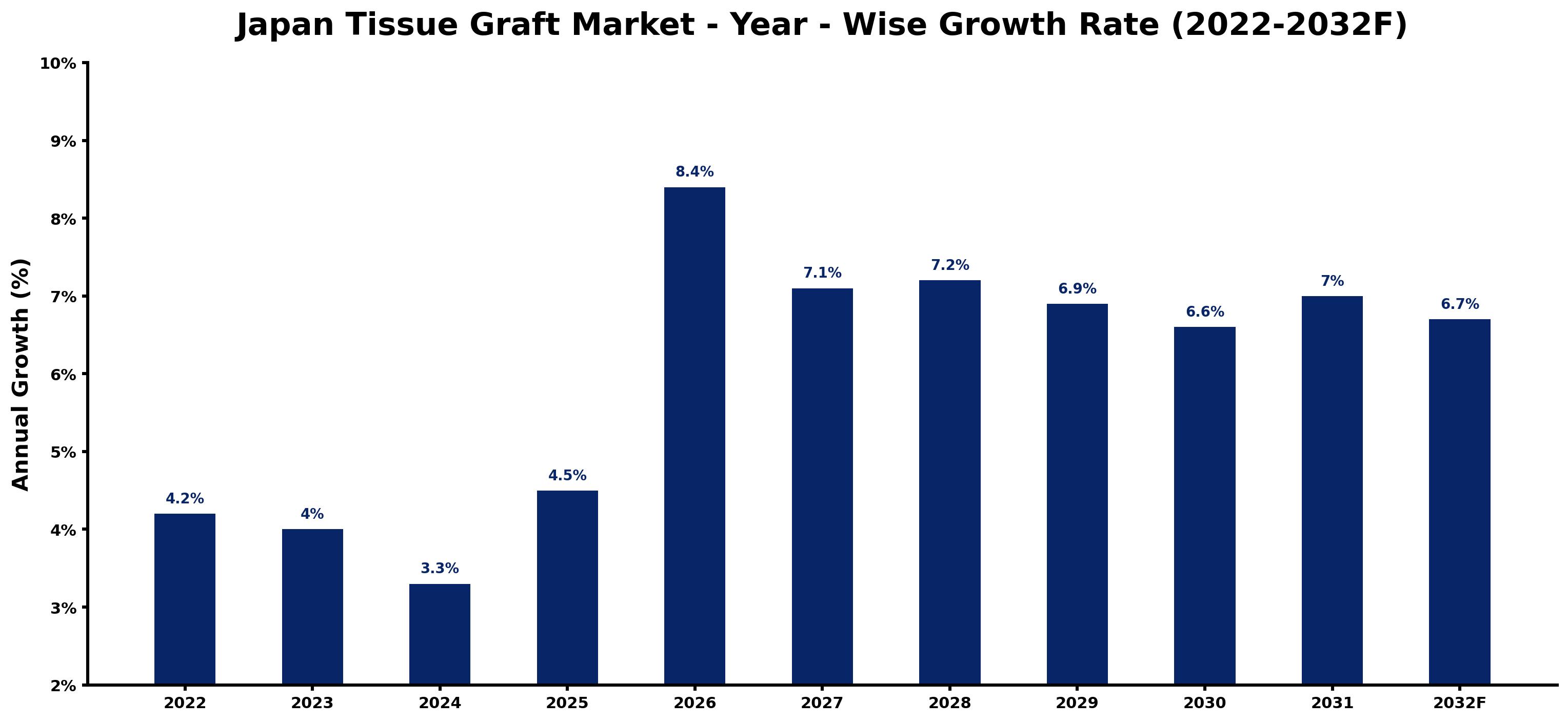
The following figures match every annual growth estimate with the main market development of that year, giving the reasoning behind each rise or slowdown.
| Year | Estimated Annual Growth (%) | Market Rationale |
| 2022 | 4.2 | Demand remained steady, reflecting ongoing surgical needs in the healthcare sector. |
| 2023 | 4.0 | Growth slowed slightly due to market saturation in certain surgical applications. |
| 2024 | 3.3 | A further slowdown occurred as competition intensified among graft suppliers. |
| 2025 | 4.5 | Demand increased as hospitals expanded their surgical capabilities and offerings. |
| 2026 | 8.4 | The market is expected to peak with heightened surgical procedures and innovations in graft technologies. |
| 2027 | 7.1 | Growth is projected to slow as supply chains face challenges in meeting rising demands. |
| 2028 | 7.2 | A slight recovery is expected as new applications for grafts gain traction. |
| 2029 | 6.9 | Growth is anticipated to slow again due to regulatory scrutiny affecting certain graft types. |
| 2030 | 6.6 | Demand is projected to stabilise as healthcare facilities adjust to market conditions. |
| 2031 | 7.0 | A resurgence in heart surgeries is expected to boost demand for tissue grafts. |
| 2032 | 6.7 | Growth is projected to slow slightly as market conditions begin to normalise. |
Note: Market size estimations and growth projections presented in this report are based on 6Wresearch's proprietary forecasting methodology, utilizing the latest available industry data, government publications, and primary research inputs.
Japan Tissue Graft Market Synopsis
Tissue grafts are biological materials used for repairing damaged tissues, including bone and cartilage. The Japan Tissue Graft Market is growing, supported by a population of approximately 125 million and an orthopedic market valued at around 1 trillion JPY. Government initiatives to improve graft availability and the rising popularity of synthetic grafts, which have seen a 20% increase in usage, are driving this trend.
Market Dynamics Impact Analysis (2026–2032)
| Factor | Type | Impact | Primary Segment Affected |
| Increasing demand from orthopedic clinics for surgical procedures | Driver | High | Orthopedic Clinics |
| Government funding for tissue graft research and development | Driver | High | Research Hospitals |
| Expansion of surgical capabilities in major regions like Tokyo and Osaka | Opportunity | High | Orthopedic Clinics |
| Growing interest in synthetic grafts for diverse surgical applications | Opportunity | High | Synthetic Grafts |
| Regulatory scrutiny limiting the adoption of xenografts | Restraint | Medium | Xenografts |
| Competition among graft suppliers leading to price pressures | Restraint | Medium | Allografts |
| High costs associated with advanced graft technologies | Challenge | High | Synthetic Grafts |
| Complex regulatory processes delaying product approvals | Challenge | Medium | Allografts |
Evaluation of Drivers in Japan Tissue Graft Market (2026–2032)
The following drivers explain most of the expected growth.
| Drivers | Primary Segment Affected | Why It Matters (Evidence) |
| Growing surgical procedures in orthopedic clinics | Orthopedic Clinics | This rise is reflected in the 1 trillion JPY orthopedic market, increasing demand for grafts. |
| Government funding for tissue graft research set at 5 billion JPY in 2023 | Research Hospitals | This funding encourages hospitals to adopt new graft technologies. |
| Increased heart valve replacement surgeries using tissue grafts | Cardiovascular Units | A rise in surgeries has led to a greater need for high-quality grafts. |
| Popularity of synthetic grafts, with a 20% increase in usage | Synthetic Grafts | This growth stems from their versatility in various surgical applications. |
| Expansion of donor human tissue networks regulated by the Japan Organ Transplant Network | Donor Human Tissue | This ensures a steady supply of grafts for surgical procedures across specialties. |
Several shifts outside the market lift sales. The orthopedic sector is expanding, with hospitals increasing graft purchases amid rising surgical procedures. Heart valve replacement surgeries have risen, leading to increased demand for grafts. The popularity of synthetic grafts has surged, prompting more hospitals to invest in these alternatives for diverse surgical applications.
Evaluation of Restraints in Japan Tissue Graft Market
The table below lists the restraints and the evidence behind each.
| Market Restraint | Primary Segment Affected | Why It Matters (Evidence) |
| Regulatory scrutiny affecting the adoption of xenografts | Xenografts | This scrutiny restricts their use in surgeries, impacting overall market growth. |
| Intense competition among graft suppliers leading to price pressures | Allografts | This competition reduces profit margins for suppliers, limiting their operational sustainability. |
| High costs associated with advanced synthetic graft technologies | Synthetic Grafts | These costs deter some healthcare facilities from adopting newer options. |
| Complex regulatory processes delaying product approvals | Allografts | These delays slow down the introduction of new graft types into the market. |
| Limited awareness of certain graft options among healthcare providers | Xenografts | This lack of knowledge hinders their adoption in surgical procedures. |
Japan Tissue Graft Market Challenges
Orthopedic clinics in Japan face a shortage of skilled professionals trained in graft techniques, leading to delays in surgeries and longer wait times for patients. High costs associated with advanced graft technologies limit access for smaller healthcare facilities, resulting in a referral rate of 30% to larger hospitals and postponing treatment. Regulatory scrutiny surrounding xenografts restricts their use, hindering broader adoption and innovation in the market. Supply chain disruptions arise from reliance on donor human tissue, causing inconsistent availability and delays in procedures for clinics across the country.
Trends in the Japan Tissue Graft Market
Below are the shifts with the largest effect on the Japan Tissue Graft Market.
- Shift towards Synthetic Grafts: The popularity of synthetic grafts has surged, with a 20% increase in usage over the last two years. This trend is apparent in various surgical applications, particularly in orthopedic clinics, where hospitals are increasingly opting for these alternatives.
- Expansion of Graft Research Initiatives: In 2023, the Ministry of Health, Labour and Welfare launched a program to improve tissue graft availability. This initiative aims to increase access to grafts in hospitals, directly impacting surgical outcomes and patient care.
- Growth in Heart Valve Replacement Surgeries: Heart valve replacement surgeries have seen a notable rise, with tissue grafts being preferred for these procedures. This trend reflects the increasing need for effective surgical solutions in cardiovascular care.
- Increased Focus on Quality Standards: The implementation of JIS T 0601 ensures quality and safety in tissue grafts. This standard is crucial for maintaining high standards in the production and application of grafts across healthcare facilities.
Investment Opportunities in the Japan Tissue Graft Market
Several openings in the Japan Tissue Graft Market merit attention from investors.
- Investment in Orthopedic Clinics: Tokyo and Osaka are major regions for orthopedic clinics, presenting an opportunity for suppliers. With a population of approximately 125 million, the demand for tissue grafts in these areas is substantial.
- Gap in Synthetic Graft Supply: The rising popularity of synthetic grafts, with a 20% increase in usage, highlights a supply gap. Suppliers can focus on enhancing production capabilities to meet this growing demand.
- Expansion of Research Hospitals: With government funding set at 5 billion JPY for 2023, there is a clear opportunity for investment in research hospitals. Collaborating with local institutions can facilitate innovation in graft technologies.
- Enhancing Graft Availability in Hospitals: The 2023 program launched by the Ministry of Health, Labour and Welfare aims to improve graft availability. Suppliers can engage with hospitals to ensure their products meet the new standards and requirements.
Government Initiatives in the Japan Tissue Graft Market
The Ministry of Health, Labour and Welfare's 2023 program improves tissue graft availability in hospitals. This initiative builds on existing laws like the PMD Act, which regulates the quality and approval of medical devices, ensuring that grafts meet safety standards for surgical use.
Orthopedic clinics benefit from the funding allocated for tissue graft research, allowing them to access advanced graft technologies. The Japan Organ Transplant Network plays an important role in regulating donor human tissue, ensuring a reliable supply for surgical procedures.
Future Insight of the Japan Tissue Graft Market
By 2032, buyers in healthcare facilities will see improved graft availability due to a new programme initiated by the Ministry of Health, Labour and Welfare. Synthetic graft usage will increase by 20%, reflecting a shift towards advanced materials. Government funding of 5 billion JPY for tissue graft research will drive innovation and introduce diverse graft options. As research progresses, suppliers will develop technologies that better align with the specific needs of healthcare providers, improving treatment outcomes.
Market Segmentation Analysis
Japan Tissue Graft Market report covers a detailed analysis of the following market segments:
By Graft Type – Autografts Lead, Synthetic Grafts Expected to Grow Fastest
According to Saurav Kr Singh, Senior Research Analyst at 6Wresearch, with 42% of graft type revenue in 2025, Autografts was the largest category. Autografts hold the largest share as they are essential in surgeries where the patient's own tissue is used for repair. Their importance is particularly evident in orthopedic procedures, which require high compatibility for successful surgical outcomes. Over 2026–2032, Synthetic Grafts are expected to post the fastest growth, at a CAGR of 10.2%. Synthetic grafts are experiencing rapid growth, highlighted by a 20% increase in usage over the last two years, as they serve as effective alternatives to biological grafts in various surgical applications. This trend is likely to continue as advancements in polymer materials enhance their performance. Suppliers should focus on expanding synthetic graft offerings to meet the rising market demand.
By Source Material – Patient's Own Tissue Leads, Polymer Materials Expected to Grow Fastest
In 2025, Patient's Own Tissue led the source material split with a 49% share. Patient's own tissue is the primary source for autografts, crucial for surgical repairs and minimising rejection rates. This method is widely adopted in orthopedic surgeries across Japan, reinforcing its dominant position in the market. The quickest growth will come from Polymer Materials, forecast to expand at a CAGR of 9.7% between 2026 and 2032. Polymer materials are increasingly utilised in synthetic graft applications, driving their rapid adoption. The shift towards these materials is supported by ongoing research and development in tissue graft technologies. Buyers may benefit from exploring options that incorporate polymer materials for improved surgical outcomes.
By Use Case – Bone/Cartilage Repair Leads, Dental/Spine Surgeries Expected to Grow Fastest
Bone/Cartilage Repair took 35% of use case revenue in 2025, more than any other category. Bone and cartilage repair is the leading application for various graft types in orthopedic surgeries, establishing it as the primary use case in the market. The high volume of orthopedic procedures performed in Japan significantly bolsters this segment's prominence. Dental/Spine Surgeries are set to record the highest CAGR in this split, 9.6% over 2026–2032. Dental and spine surgeries are emerging as the fastest-growing use cases for tissue grafts, reflecting an increase in specialised procedures that require grafting. This growth indicates a broader trend towards tailored surgical solutions in these areas. Suppliers should target their products towards the dental and spine surgery sectors to capitalise on this growth opportunity.
By End User – Orthopedic Clinics Lead, Specialty Hospitals Expected to Grow Fastest
The largest end user category in 2025 was Orthopedic Clinics, at 53% of revenue. Orthopedic clinics are the primary end users for tissue grafts, as they conduct a high volume of surgeries requiring these materials. The concentration of such clinics in major urban areas like Tokyo and Osaka further solidifies their leading position. Specialty Hospitals are projected to grow fastest, at a CAGR of 9.2% during 2026–2032. Specialty hospitals are becoming the fastest-growing end users of various graft types, driven by their focus on specialized surgeries that require advanced graft solutions. This trend indicates an increasing reliance on tissue grafts in complex medical procedures. Suppliers should strengthen partnerships with specialty hospitals to align with their growing needs for diverse graft options.
Key Attractiveness of the Report
- 10 Years of Market Numbers
- Historical Data Starting from 2022 to 2025
- Base Year 2025
- Forecast Data until 2032
- Key Performance Indicators Impacting the Market
- Major Upcoming Developments and Projects
Key Highlights of the Report:
- Japan Tissue Graft Market Outlook
- Market Size of Japan Tissue Graft Market, 2025
- Forecast of Japan Tissue Graft Market, 2032
- Historical Data and Forecast of Japan Tissue Graft Revenues & Volume for the Period 2022-2032F
- Japan Tissue Graft Market Trend Evolution
- Japan Tissue Graft Market Drivers and Challenges
- Japan Tissue Graft Price Trends
- Japan Tissue Graft Porter's Five Forces
- Japan Tissue Graft Industry Life Cycle
- Historical Data and Forecast of Japan Tissue Graft Market Revenues & Volume By Graft Type for the Period 2022-2032F
- Historical Data and Forecast of Japan Tissue Graft Market Revenues & Volume By Autografts for the Period 2022-2032F
- Historical Data and Forecast of Japan Tissue Graft Market Revenues & Volume By Allografts for the Period 2022-2032F
- Historical Data and Forecast of Japan Tissue Graft Market Revenues & Volume By Xenografts for the Period 2022-2032F
- Historical Data and Forecast of Japan Tissue Graft Market Revenues & Volume By Synthetic Grafts for the Period 2022-2032F
- Historical Data and Forecast of Japan Tissue Graft Market Revenues & Volume By Source Material for the Period 2022-2032F
- Historical Data and Forecast of Japan Tissue Graft Market Revenues & Volume By Patient's Own Tissue for the Period 2022-2032F
- Historical Data and Forecast of Japan Tissue Graft Market Revenues & Volume By Donor Human Tissue for the Period 2022-2032F
- Historical Data and Forecast of Japan Tissue Graft Market Revenues & Volume By Animal-Derived for the Period 2022-2032F
- Historical Data and Forecast of Japan Tissue Graft Market Revenues & Volume By Polymer Materials for the Period 2022-2032F
- Historical Data and Forecast of Japan Tissue Graft Market Revenues & Volume By Use Case for the Period 2022-2032F
- Historical Data and Forecast of Japan Tissue Graft Market Revenues & Volume By Bone/Cartilage Repair for the Period 2022-2032F
- Historical Data and Forecast of Japan Tissue Graft Market Revenues & Volume By Dental/Spine Surgeries for the Period 2022-2032F
- Historical Data and Forecast of Japan Tissue Graft Market Revenues & Volume By Heart Valve Replacement for the Period 2022-2032F
- Historical Data and Forecast of Japan Tissue Graft Market Revenues & Volume By Soft Tissue Repair for the Period 2022-2032F
- Historical Data and Forecast of Japan Tissue Graft Market Revenues & Volume By End User for the Period 2022-2032F
- Historical Data and Forecast of Japan Tissue Graft Market Revenues & Volume By Orthopedic Clinics for the Period 2022-2032F
- Historical Data and Forecast of Japan Tissue Graft Market Revenues & Volume By Specialty Hospitals for the Period 2022-2032F
- Historical Data and Forecast of Japan Tissue Graft Market Revenues & Volume By Cardiovascular Units for the Period 2022-2032F
- Historical Data and Forecast of Japan Tissue Graft Market Revenues & Volume By Research Hospitals for the Period 2022-2032F
- Japan Tissue Graft Import Export Trade Statistics
- Market Opportunity Assessment By Graft Type
- Market Opportunity Assessment By Source Material
- Market Opportunity Assessment By Use Case
- Market Opportunity Assessment By End User
- Japan Tissue Graft Top Companies Market Share
- Japan Tissue Graft Competitive Benchmarking By Technical and Operational Parameters
- Japan Tissue Graft Company Profiles
- Japan Tissue Graft Key Strategic Recommendations
Market Covered
The study includes the following segmentation.
By Graft Type
- Autografts
- Allografts
- Xenografts
- Synthetic Grafts
By Source Material
- Patient's Own Tissue
- Donor Human Tissue
- Animal-Derived
- Polymer Materials
By Use Case
- Bone/Cartilage Repair
- Dental/Spine Surgeries
- Heart Valve Replacement
- Soft Tissue Repair
By End User
- Orthopedic Clinics
- Specialty Hospitals
- Cardiovascular Units
- Research Hospitals































