Japan Tissue Regeneration Market Size & Growth Rate
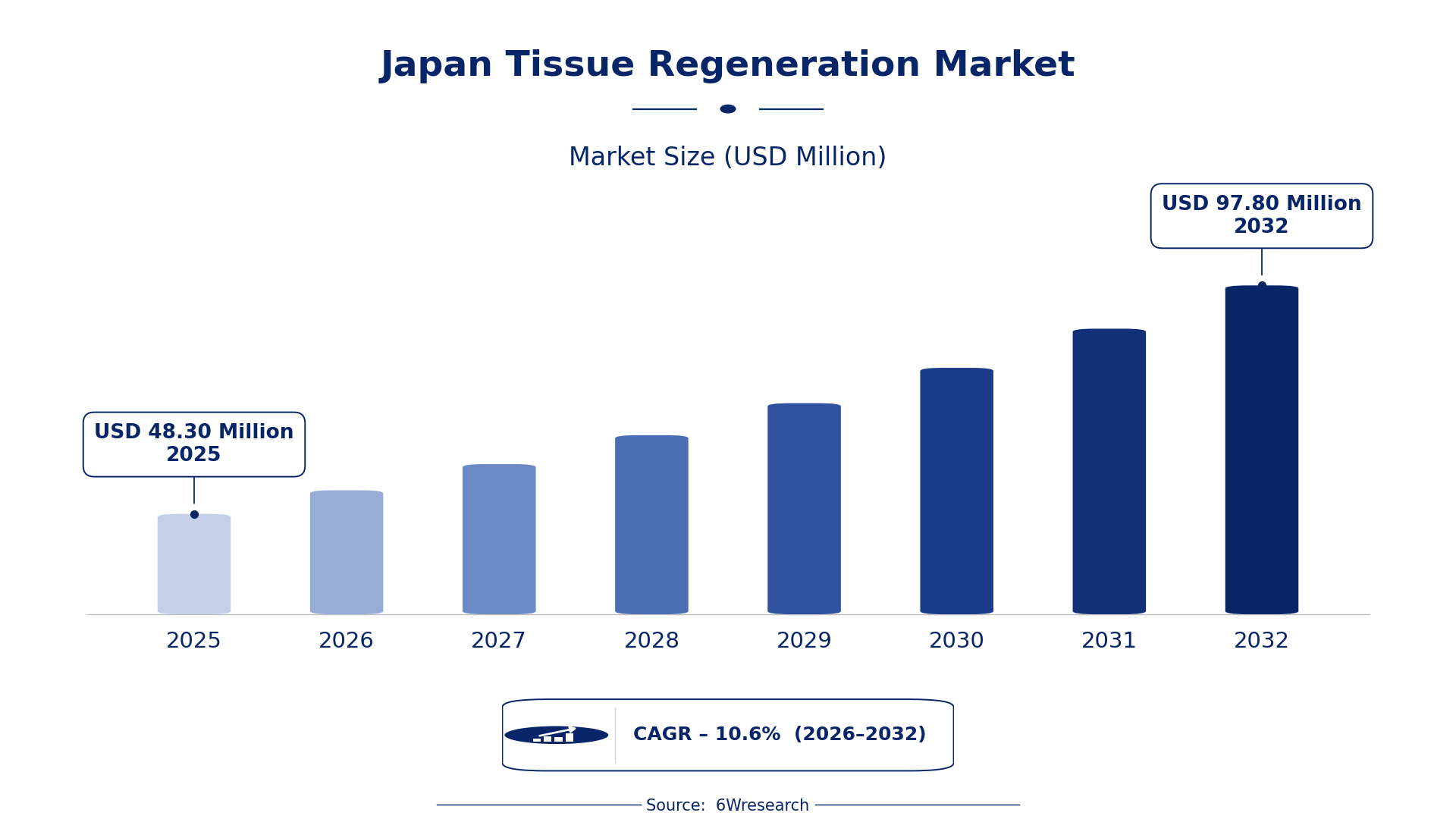
According to 6Wresearch internal database and industry insights, the Japan Tissue Regeneration Market was valued at USD 48.30 Million in 2025 and is projected to reach USD 97.80 Million by 2032, growing at a CAGR of approximately 10.6% during 2026–2032.
Japan Tissue Regeneration Market Highlights
| Report Metric | Details |
| Report Name | Japan Tissue Regeneration Market (2026-2032) |
| Market Size 2025 | USD 48.30 Million |
| Market Size 2032 | USD 97.80 Million |
| Absolute Growth 2025–2032 | USD 49.50 Million |
| CAGR 2026–2032 | 10.6% |
| Peak Annual Growth | 11.3% in 2028 |
| Forecast Period | 2026–2032 |
| Historical Data | 2022–2025 |
| Base Year | 2025 |
| Leading Regeneration Type, 2025 | Stem Cell Therapy (39% share) |
| Leading Technique Used, 2025 | Autologous Transplant (54% share) |
| Leading Target Tissue, 2025 | Muscle/Bone (42% share) |
| Leading End User, 2025 | Advanced Hospitals (40% share) |
| Fastest-Growing Regeneration Type | Growth Factor Therapy (14.6% CAGR) |
| Fastest-Growing Technique Used | Biomolecule Delivery (14.1% CAGR) |
| Fastest-Growing Target Tissue | Internal Organs (14.0% CAGR) |
| Fastest-Growing End User | Biotech Startups (14.2% CAGR) |
| Growing Sector | Regenerative medicine |
| Key End Users | Hospitals, research institutions, clinics |
Japan Tissue Regeneration Market Year-wise Growth Rate and Key Drivers (2022–2032)
This graph illustrates the annual growth rates of the market from 2022 to 2032, highlighting a steady upward trajectory and projected market expansion over the forecast period.
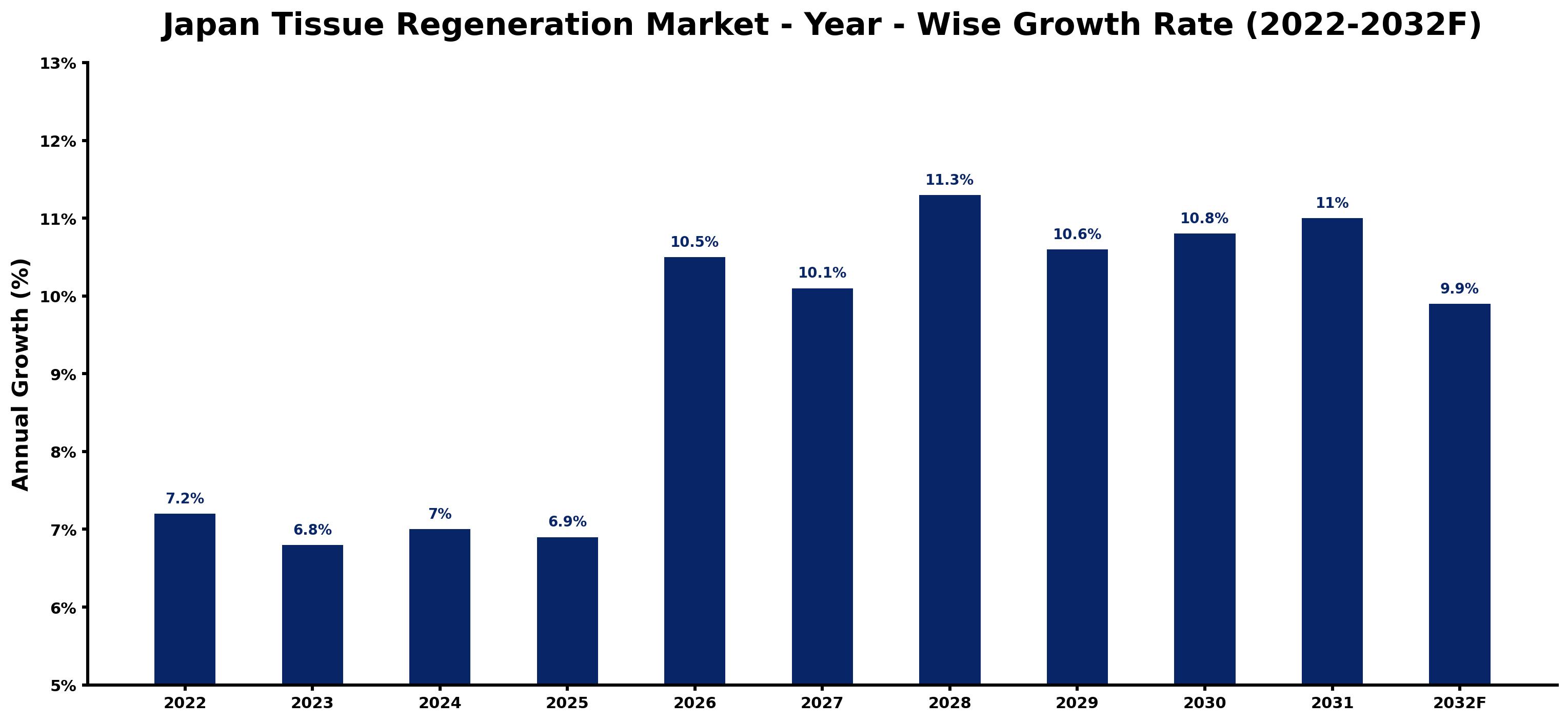
The following figures match every annual growth estimate with the main market development of that year, giving the reasoning behind each rise or slowdown.
| Year | Estimated Annual Growth (%) | Market Rationale |
| 2022 | 7.2 | The market showed strong demand with a notable patient population requiring regenerative therapies. |
| 2023 | 6.8 | Growth slowed slightly as healthcare providers adjusted to new treatment protocols. |
| 2024 | 7.0 | Demand increased as more stem cell therapies gained approval, expanding treatment options. |
| 2025 | 6.9 | Market growth decelerated as advanced hospitals faced resource allocation challenges. |
| 2026 | 10.5 | Growth accelerated due to increased investments in regenerative medicine infrastructure. |
| 2027 | 10.1 | Demand moderated as the market began to stabilise after rapid expansions. |
| 2028 | 11.3 | The peak growth year saw heightened interest in new therapies and technologies. |
| 2029 | 10.6 | Growth slowed slightly as market saturation began to influence new approvals. |
| 2030 | 10.8 | Demand rose again as advanced hospitals expanded their regenerative service offerings. |
| 2031 | 11.0 | Growth continued as research institutions pushed for more clinical trials. |
| 2032 | 9.9 | The market is expected to stabilise with ongoing advancements in treatment methodologies. |
Note: Market size estimations and growth projections presented in this report are based on 6Wresearch's proprietary forecasting methodology, utilizing the latest available industry data, government publications, and primary research inputs.
Japan Tissue Regeneration Market Synopsis
Tissue regeneration employs advanced techniques like stem cell therapy and scaffold-based approaches to restore damaged tissues. The Japan Tissue Regeneration Market is supported by a patient population of 2 million requiring regenerative therapies, alongside government funding of ¥10 billion for 2023. An increasing number of approved stem cell therapies and the active involvement of regenerative clinics and research institutions are driving market growth in Japan.
Market Dynamics Impact Analysis (2026–2032)
| Factor | Type | Impact | Primary Segment Affected |
| Increasing number of approved stem cell therapies driving demand for innovative treatments. | Driver | High | Stem Cell Therapy |
| Growing patient population requiring tissue regeneration therapies enhances market potential. | Driver | High | Advanced Hospitals |
| Emerging demand for innovative regenerative therapies creates investment opportunities. | Opportunity | High | Biotech Startups |
| Government funding for regenerative medicine research opens new avenues for development. | Opportunity | High | R&D Labs |
| Regulatory challenges in obtaining approvals for new therapies may limit market expansion. | Restraint | Medium | Scaffold-Based |
| High costs associated with advanced regenerative treatments could restrict patient access. | Restraint | High | Autologous Transplant |
| Limited awareness of regenerative therapies among healthcare providers affects adoption. | Challenge | Medium | Growth Factor Therapy |
| Competition among regenerative clinics may lead to pricing pressures in the market. | Challenge | High | Regenerative Clinics |
Evaluation of Drivers in Japan Tissue Regeneration Market (2026–2032)
The following drivers explain most of the expected growth.
| Drivers | Primary Segment Affected | Why It Matters (Evidence) |
| Growing patient population requiring regenerative therapies. | Stem Cell Therapy | With 2 million patients needing treatment, healthcare providers are increasingly adopting stem cell therapies. |
| Increased government funding for regenerative medicine research. | Advanced Hospitals | The ¥10 billion budget for 2023 supports advanced hospitals in expanding their regenerative treatment offerings. |
| Rising number of approved stem cell therapies increases treatment options. | Scaffold-Based | As of 2023, there are 50 approved therapies, encouraging more healthcare providers to adopt these solutions. |
| Advancements in tissue engineering techniques boost market potential. | Growth Factor Therapy | Research institutions are focusing on new therapies, leading to higher demand for growth factor applications. |
| Expansion of regenerative clinics across Japan increases service availability. | Regenerative Clinics | Over 300 clinics are now specialising in tissue regeneration, improving access for patients. |
Orders keep climbing as the patient population requiring regenerative therapies reaches 2 million, prompting healthcare providers to expand their offerings. The approval of 50 stem cell therapies as of 2023 has encouraged more clinics to adopt these treatments. Institutions are driving advancements in tissue engineering, leading to increased demand for growth factor therapies. With over 300 regenerative clinics in Japan, patient access to these treatments is improving significantly.
Evaluation of Restraints in Japan Tissue Regeneration Market
Below are the constraints most often cited by buyers and suppliers, with the segment each affects.
| Market Restraint | Primary Segment Affected | Why It Matters (Evidence) |
| Regulatory hurdles in obtaining approvals for new therapies limit market growth. | Scaffold-Based | The lengthy approval process can delay the introduction of new scaffold technologies, impacting market entry. |
| High costs associated with advanced regenerative treatments restrict patient access. | Autologous Transplant | Many patients cannot afford the expensive procedures, limiting market expansion. |
| Limited awareness of regenerative therapies among healthcare providers affects adoption. | Growth Factor Therapy | Healthcare providers may hesitate to recommend therapies they are unfamiliar with, reducing patient access. |
| Competition among regenerative clinics may lead to pricing pressures. | Regenerative Clinics | Price wars could reduce profitability and affect service quality, impacting clinic sustainability. |
| Insufficient training for medical professionals in regenerative techniques hampers growth. | Biomolecule Delivery | A lack of trained personnel can slow the adoption of advanced therapies, delaying patient treatment. |
Japan Tissue Regeneration Market Challenges
Regenerative clinics face a skills shortage, as limited training programmes in tissue regeneration constrain the workforce in Japan. This challenge stems from a lack of specialised educational institutions, resulting in hiring delays that can extend patient wait times by up to six months. Technology adoption remains slow, with only 50 approved stem cell therapies available, largely due to stringent regulations from the Ministry of Health, Labour and Welfare. This situation limits treatment options for clinics, affecting access to necessary therapies for patients. High costs of advanced treatments often compel buyers to postpone essential care, impacting recovery for approximately 2 million patients.
Trends in the Japan Tissue Regeneration Market
Buyers and suppliers in the Japan Tissue Regeneration Market are adjusting to the following trends.
- Increase in Approved Stem Cell Therapies: The number of approved stem cell therapies in Japan reached 50 as of 2023, reflecting a shift towards this treatment option. This trend indicates a growing acceptance and integration of stem cell applications in clinical settings, improving patient access.
- Growth of Advanced Hospitals: Advanced Hospitals are increasingly adopting new regenerative treatments, holding a market share of 40% in 2025. This shift is driven by the rising patient population and the need for specialised care in regenerative medicine.
- Expansion of Regenerative Clinics: The proliferation of over 300 regenerative clinics in Japan highlights the increasing demand for tissue regeneration services. This trend is reshaping healthcare, making advanced treatments more accessible to patients.
- Focus on Research and Development Labs: With 20 active research institutions dedicated to tissue engineering, Japan is prioritising innovation in regenerative medicine. This focus is expected to lead to new therapies and improved patient outcomes.
Investment Opportunities in the Japan Tissue Regeneration Market
Where to invest in the Japan Tissue Regeneration Market: the main openings are set out below.
- Government Funding for Regenerative Medicine: The government has allocated ¥10 billion for regenerative medicine research in 2023, creating opportunities for R&D Labs to develop new therapies. This funding can be pursued through partnerships with academic institutions.
- Growing Demand for Biotech Startups: With a patient population of 2 million requiring regenerative therapies, Biotech Startups have a significant opportunity to innovate. Collaborating with research institutions can enhance their product offerings.
- Emerging Market for Internal Organs: The Internal Organs segment is projected to grow at 14.0%, driven by advancements in research. Investment in this area can be pursued through joint ventures with leading research institutions.
- Increasing Focus on Biomolecule Delivery: The Biomolecule Delivery segment is gaining traction, projected to grow at 14.1%. This presents opportunities for companies to invest in new delivery systems that improve treatment efficacy.
Government Initiatives in the Japan Tissue Regeneration Market
The Clinical Trials Act, established in 2017, sets rules for conducting clinical research, ensuring that new therapies are rigorously tested and validated before reaching the market. This law improves the safety and efficacy of treatments available to patients, fostering trust in regenerative therapies. The Next-Generation Medical Infrastructure Act, enacted in 2017, allows certified bodies to anonymise medical data for research and product development, promoting advancement in regenerative medicine.
The Pharmaceuticals and Medical Devices Agency (PMDA) oversees the approval of regenerative therapies, ensuring safety and efficacy. The Agency for Medical Research and Development (AMED) funds medical research and development projects, including those focused on tissue regeneration, supporting innovation and improving treatment options. AMED's budget for 2023 is ¥10 billion, facilitating advancements in regenerative medicine.
Future Insight of the Japan Tissue Regeneration Market
By 2032, a shift in policy will drive advancements in regenerative medicine, prompting increased government funding to support new treatments. Clinics will adopt advanced technologies and expand their service offerings in response to these changes. Collaborations between research institutions and clinics will enhance the development of novel therapies. As standards like JIS T 14971 become more widely implemented, buyers will benefit from improved safety and efficacy in treatments, which will ultimately lead to better patient outcomes.
Market Segmentation Analysis
Japan Tissue Regeneration Market report covers a detailed analysis of the following market segments:
By Regeneration Type – Stem Cell Therapy Leads, Growth Factor Therapy Expected to Grow Fastest
According to Saurav Kr Singh, Senior Research Analyst at 6Wresearch, Stem Cell Therapy took 39% of regeneration type revenue in 2025, more than any other category. Stem Cell Therapy holds the largest share due to its extensive application in regenerative treatments, with over 50 approved therapies in Japan. This method is widely adopted by healthcare providers in major hubs like Tokyo and Osaka, ensuring a robust installed base. The quickest growth will come from Growth Factor Therapy, forecast to expand at a CAGR of 14.6% between 2026 and 2032. Growth Factor Therapy is experiencing rapid growth as it becomes increasingly recognised for its role in enhancing healing processes, particularly in post-surgical recovery. The rising patient population of 2 million needing regenerative therapies further fuels this segment's expansion. Suppliers should focus on developing products that cater to the growing demand for Growth Factor Therapy.
By Technique Used – Autologous Transplant Leads, Biomolecule Delivery Expected to Grow Fastest
The largest technique used category in 2025 was Autologous Transplant, at 54% of revenue. Autologous Transplant dominates the market as it is commonly used for personal tissue regeneration, ensuring compatibility and reducing rejection rates. This technique is particularly favoured in advanced hospitals that provide specialised treatments. Over 2026–2032, Biomolecule Delivery is expected to post the fastest growth, at a CAGR of 14.1%. Biomolecule Delivery is witnessing the fastest growth due to its critical role in targeted treatment applications, aligning with the increasing focus on personalised medicine. The demand for effective delivery mechanisms is rising as more therapies are developed. Buyers will benefit from advancements in Biomolecule Delivery techniques as they seek more effective treatment options.
By Target Tissue – Muscle/Bone Leads, Internal Organs Expected to Grow Fastest
In 2025, Muscle/Bone led the target tissue split with a 42% share. Muscle/Bone is the leading segment as it is critical for orthopedic and muscular repairs, addressing a significant portion of the patient population. The focus on these tissues aligns with the capabilities of advanced hospitals to provide specialised care. Internal Organs are set to record the highest CAGR in this split, 14.0% over 2026–2032. Internal Organs are emerging as the fastest-growing area of research, driven by the need for innovative treatments for complex conditions. As research institutions increase their focus on these tissues, the market potential expands. Suppliers should consider investing in research for Internal Organs to capitalise on this emerging opportunity.
By End User – Advanced Hospitals Lead, Biotech Startups Expected to Grow Fastest
Advanced Hospitals accounted for 40% of the market by end user in 2025. Advanced Hospitals lead the market by offering specialised regenerative treatments that cater to a wide range of patient needs. Their established infrastructure and expertise in regenerative medicine make them the preferred choice for patients seeking advanced therapies. Biotech Startups are projected to grow fastest, at a CAGR of 14.2% during 2026–2032. Biotech Startups are the fastest-growing segment as they bring fresh ideas and innovative solutions to the market, responding to the increasing demand for regenerative therapies. Their agility allows them to adapt quickly to emerging trends and technologies. Suppliers may find opportunities for collaboration with Biotech Startups to leverage their innovative approaches.
Key Attractiveness of the Report
- 10 Years of Market Numbers
- Historical Data Starting from 2022 to 2025
- Base Year 2025
- Forecast Data until 2032
- Key Performance Indicators Impacting the Market
- Major Upcoming Developments and Projects
Key Highlights of the Report:
- Japan Tissue Regeneration Market Outlook
- Market Size of Japan Tissue Regeneration Market, 2025
- Forecast of Japan Tissue Regeneration Market, 2032
- Historical Data and Forecast of Japan Tissue Regeneration Revenues & Volume for the Period 2022-2032F
- Japan Tissue Regeneration Market Trend Evolution
- Japan Tissue Regeneration Market Drivers and Challenges
- Japan Tissue Regeneration Price Trends
- Japan Tissue Regeneration Porter's Five Forces
- Japan Tissue Regeneration Industry Life Cycle
- Historical Data and Forecast of Japan Tissue Regeneration Market Revenues & Volume By Regeneration Type for the Period 2022-2032F
- Historical Data and Forecast of Japan Tissue Regeneration Market Revenues & Volume By Stem Cell Therapy for the Period 2022-2032F
- Historical Data and Forecast of Japan Tissue Regeneration Market Revenues & Volume By Scaffold-Based for the Period 2022-2032F
- Historical Data and Forecast of Japan Tissue Regeneration Market Revenues & Volume By Growth Factor Therapy for the Period 2022-2032F
- Historical Data and Forecast of Japan Tissue Regeneration Market Revenues & Volume By Cell-Based Grafts for the Period 2022-2032F
- Historical Data and Forecast of Japan Tissue Regeneration Market Revenues & Volume By Technique Used for the Period 2022-2032F
- Historical Data and Forecast of Japan Tissue Regeneration Market Revenues & Volume By Autologous Transplant for the Period 2022-2032F
- Historical Data and Forecast of Japan Tissue Regeneration Market Revenues & Volume By Biodegradable Support for the Period 2022-2032F
- Historical Data and Forecast of Japan Tissue Regeneration Market Revenues & Volume By Biomolecule Delivery for the Period 2022-2032F
- Historical Data and Forecast of Japan Tissue Regeneration Market Revenues & Volume By Cultured Cells for the Period 2022-2032F
- Historical Data and Forecast of Japan Tissue Regeneration Market Revenues & Volume By Target Tissue for the Period 2022-2032F
- Historical Data and Forecast of Japan Tissue Regeneration Market Revenues & Volume By Muscle/Bone for the Period 2022-2032F
- Historical Data and Forecast of Japan Tissue Regeneration Market Revenues & Volume By Skin/Nerve for the Period 2022-2032F
- Historical Data and Forecast of Japan Tissue Regeneration Market Revenues & Volume By Internal Organs for the Period 2022-2032F
- Historical Data and Forecast of Japan Tissue Regeneration Market Revenues & Volume By Connective Tissue for the Period 2022-2032F
- Historical Data and Forecast of Japan Tissue Regeneration Market Revenues & Volume By End User for the Period 2022-2032F
- Historical Data and Forecast of Japan Tissue Regeneration Market Revenues & Volume By Regenerative Clinics for the Period 2022-2032F
- Historical Data and Forecast of Japan Tissue Regeneration Market Revenues & Volume By R&D Labs for the Period 2022-2032F
- Historical Data and Forecast of Japan Tissue Regeneration Market Revenues & Volume By Advanced Hospitals for the Period 2022-2032F
- Historical Data and Forecast of Japan Tissue Regeneration Market Revenues & Volume By Biotech Startups for the Period 2022-2032F
- Japan Tissue Regeneration Import Export Trade Statistics
- Market Opportunity Assessment By Regeneration Type
- Market Opportunity Assessment By Technique Used
- Market Opportunity Assessment By Target Tissue
- Market Opportunity Assessment By End User
- Japan Tissue Regeneration Top Companies Market Share
- Japan Tissue Regeneration Competitive Benchmarking By Technical and Operational Parameters
- Japan Tissue Regeneration Company Profiles
- Japan Tissue Regeneration Key Strategic Recommendations
Market Covered
Segments analysed in this report are listed below.
By Regeneration Type
- Stem Cell Therapy
- Scaffold-Based
- Growth Factor Therapy
- Cell-Based Grafts
By Technique Used
- Autologous Transplant
- Biodegradable Support
- Biomolecule Delivery
- Cultured Cells
By Target Tissue
- Muscle/Bone
- Skin/Nerve
- Internal Organs
- Connective Tissue
By End User
- Regenerative Clinics
- R&D Labs
- Advanced Hospitals
- Biotech Startups































