Japan Titanium Forged Engine Parts Market Size & Growth Rate
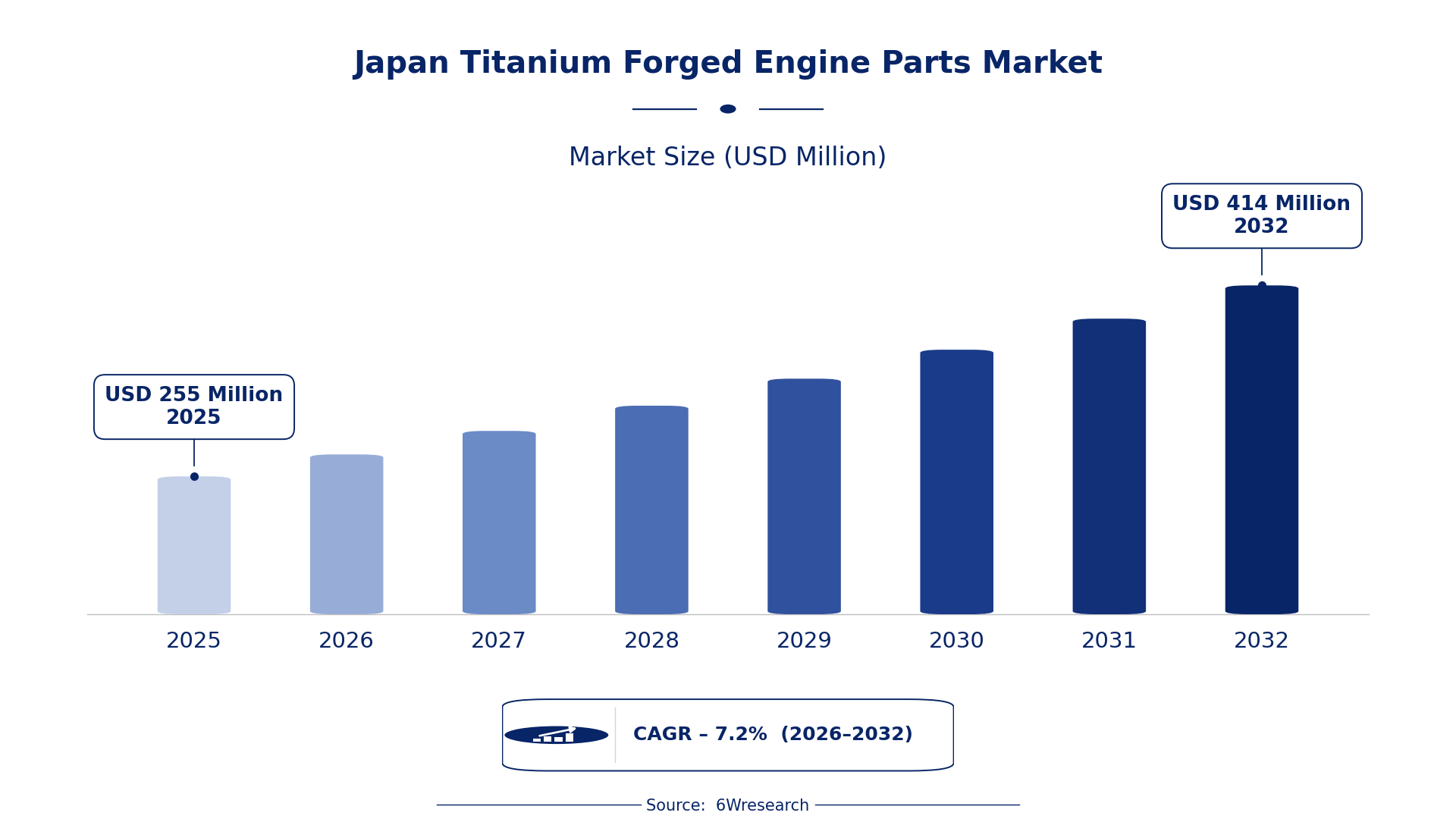
According to 6Wresearch internal database and industry insights, the Japan Titanium Forged Engine Parts Market was valued at USD 255 Million in 2025 and is projected to reach USD 414 Million by 2032, growing at a CAGR of approximately 7.2% during 2026–2032.
Japan Titanium Forged Engine Parts Market Highlights
| Report Metric | Details |
| Report Name | Japan Titanium Forged Engine Parts Market (2026-2032) |
| Market Size 2025 | USD 255 Million |
| Market Size 2032 | USD 414 Million |
| Absolute Growth 2025–2032 | USD 159 Million |
| CAGR 2026–2032 | 7.2% |
| Peak Annual Growth | 8.0% in 2028 |
| Forecast Period | 2026–2032 |
| Historical Data | 2022–2025 |
| Base Year | 2025 |
| Leading Part Type, 2025 | Turbine Disks (46% share) |
| Leading Forging Method, 2025 | Open Die Forging (44% share) |
| Leading Application Vehicle, 2025 | Fighter Aircraft (40% share) |
| Leading End User, 2025 | Aerospace OEMs (39% share) |
| Fastest-Growing Part Type | Engine Blades (10.1% CAGR) |
| Fastest-Growing Forging Method | Precision Forging (10.4% CAGR) |
| Fastest-Growing Application Vehicle | Jet Engines (9.7% CAGR) |
| Fastest-Growing End User | Defense Contractors (9.3% CAGR) |
| Growing Sector | Aerospace |
| Key End Users | Aerospace OEMs, Defense Contractors, Engine Manufacturers, MRO Facilities |
Japan Titanium Forged Engine Parts Market Year-wise Growth Rate and Key Drivers (2022–2032)
This graph illustrates the annual growth rates of the market from 2022 to 2032, highlighting a steady upward trajectory and projected market expansion over the forecast period.
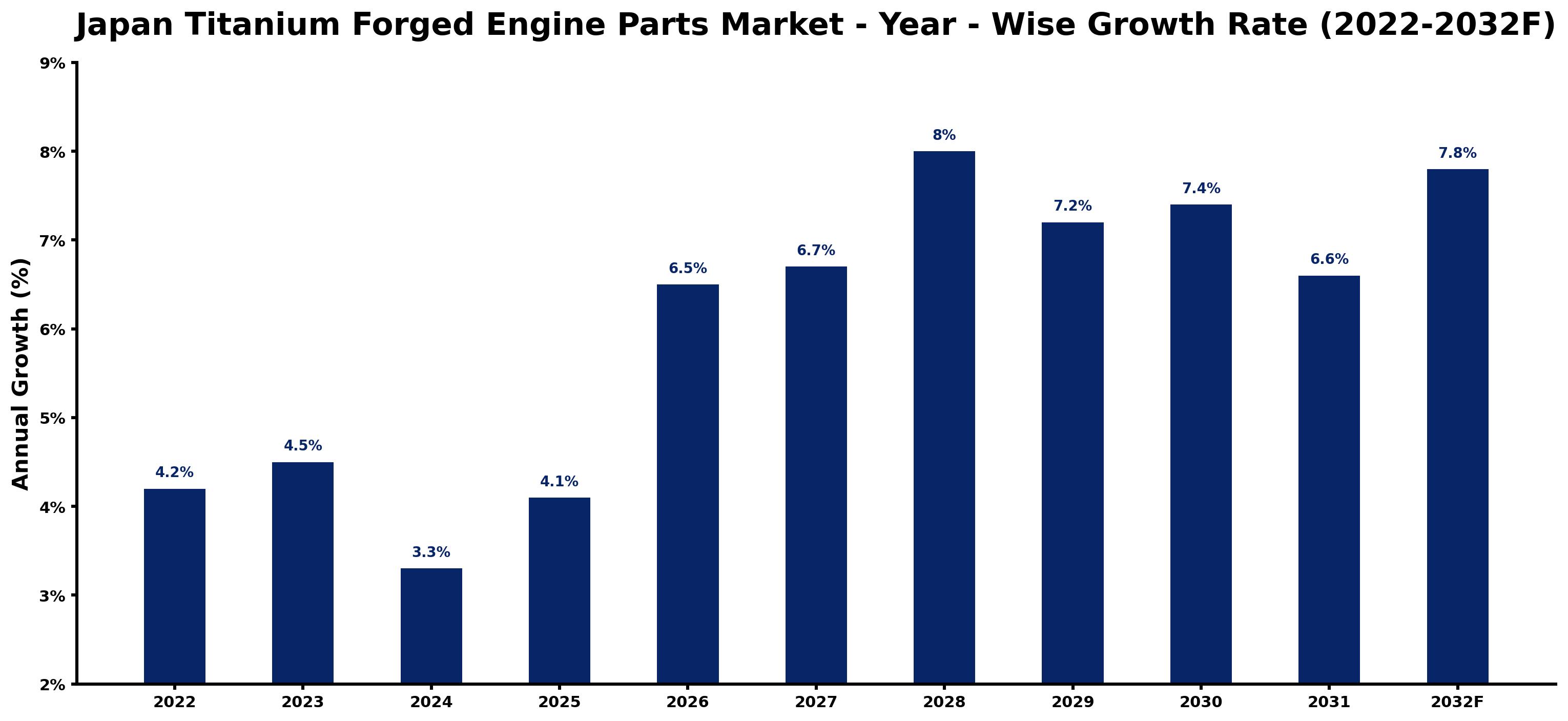
The table below sets out the estimated growth rate for each year and the main factor behind it.
| Year | Estimated Annual Growth (%) | Market Rationale |
| 2022 | 4.2 | The market experienced steady growth due to strong aerospace demand. |
| 2023 | 4.5 | Growth accelerated as domestic manufacturers increased production capacity. |
| 2024 | 3.3 | A slowdown occurred as supply chain challenges impacted output. |
| 2025 | 4.1 | Demand rose again as defense contractors expanded their projects. |
| 2026 | 6.5 | Growth accelerated with increased investments in aerospace innovation. |
| 2027 | 6.7 | Demand continued to rise as new aerospace projects were initiated. |
| 2028 | 8.0 | The market peaked with significant defense budget allocations. |
| 2029 | 7.2 | A slowdown was noted as growth rates normalised after the peak. |
| 2030 | 7.4 | Demand increased again due to new technology adoption. |
| 2031 | 6.6 | Growth slowed as market conditions stabilised post-peak. |
| 2032 | 7.8 | Demand is expected to rise with ongoing technological advancements. |
Note: Market size estimations and growth projections presented in this report are based on 6Wresearch's proprietary forecasting methodology, utilizing the latest available industry data, government publications, and primary research inputs.
Japan Titanium Forged Engine Parts Market Synopsis
Titanium forged engine parts are high-performance components made from titanium alloys, primarily used in aerospace applications like jet engines and fighter aircraft. The Japan Titanium Forged Engine Parts Market is expanding due to increased domestic production, driven by defense contractors and aerospace manufacturers. With over 200 certified aerospace manufacturers and a defense budget of $50 billion allocated for aerospace projects in 2023, the market is positioned for growth as innovation continues to thrive.
Market Dynamics Impact Analysis (2026–2032)
| Factor | Type | Impact | Primary Segment Affected |
| Increased defense spending in Japan | Driver | High | Fighter Aircraft |
| Growing demand for lightweight materials in aerospace | Driver | High | Jet Engines |
| Emerging demand for advanced aerospace components | Opportunity | High | Engine Blades |
| Investment in aerospace innovation and startups | Opportunity | Medium | Aerospace OEMs |
| Supply chain disruptions affecting production | Restraint | High | Compressor Rings |
| High production costs for titanium materials | Restraint | Medium | Shafts |
| Limited skilled workforce in advanced manufacturing | Challenge | High | Turbine Disks |
| Regulatory compliance costs for aerospace standards | Challenge | Medium | Engine Blades |
Evaluation of Drivers in Japan Titanium Forged Engine Parts Market (2026–2032)
The table below links each growth driver to the segment it affects and the evidence for it.
| Drivers | Primary Segment Affected | Why It Matters (Evidence) |
| Increased defense budget allocations | Fighter Aircraft | Japan's defense budget allocated $50 billion for aerospace projects, driving demand for titanium parts. |
| Rising aerospace manufacturing capacity | Jet Engines | Japan produced 1,200 tons of titanium forged parts in 2022, increasing supply for manufacturers. |
| Growing aerospace workforce | Engine Blades | The aerospace sector employs over 80,000 people, boosting production capabilities. |
| Demand for corrosion-resistant materials | Compressor Rings | The need for durable components in aerospace applications boosts demand for titanium parts. |
| Adoption of JIS Q 9100 standards | Shafts | Widespread adoption of these standards ensures high-quality production, driving purchases. |
Much of the new demand stems from Japan's defense budget, which allocated $50 billion for aerospace projects in 2023, boosting purchases of titanium parts. The aerospace sector employs over 80,000 people, improving production capabilities and leading to increased output of titanium forged engine parts. The adoption of JIS Q 9100 standards ensures high-quality production, further stimulating purchases. The emphasis on corrosion-resistant materials in aerospace applications drives demand for titanium components, particularly in jet engines and fighter aircraft.
Evaluation of Restraints in Japan Titanium Forged Engine Parts Market
The table below lists the restraints and the evidence behind each.
| Market Restraint | Primary Segment Affected | Why It Matters (Evidence) |
| Supply chain disruptions impacting production timelines | Compressor Rings | Supply chain challenges have delayed the delivery of critical materials, affecting production schedules. |
| High production costs for titanium materials | Shafts | The rising costs of titanium alloys increase overall production expenses for manufacturers. |
| Limited availability of skilled workforce | Turbine Disks | The aerospace sector faces a shortage of skilled workers, hindering production efficiency. |
| Regulatory compliance costs for aerospace standards | Engine Blades | Compliance with stringent aerospace standards increases operational costs for manufacturers. |
| Market competition from alternative materials | Fighter Aircraft | Competition from composite materials may limit the growth of titanium part usage. |
Japan Titanium Forged Engine Parts Market Challenges
Japan's aerospace sector faces stringent regulations that complicate production for manufacturers. Compliance with various standards can consume up to 15% of producers' operational budgets, reducing their financial flexibility. Intense competition among over 200 certified aerospace manufacturers drives down profit margins, limiting suppliers' ability to invest in advanced technologies. Rapid advancements in material science raise expectations for buyers, yet producers often struggle to keep pace, causing delays that can extend lead times by 20%, disrupting project timelines for buyers.
Trends in the Japan Titanium Forged Engine Parts Market
Several trends are reshaping the Japan Titanium Forged Engine Parts Market; the most important are set out below.
- Shift from Traditional Materials to Titanium Alloys: In Japan, the aerospace industry is increasingly adopting titanium alloys over traditional materials for engine components, driven by their lightweight and corrosion-resistant properties. In 2023, over 200 certified aerospace manufacturers are utilising these materials.
- Transition to Advanced Manufacturing Techniques: Tokyo is experiencing a shift towards advanced manufacturing techniques, with a focus on precision forging for producing high-performance parts. This change is evident as precision forging is expected to grow at a CAGR of 10.4% through 2032.
- Emerging Focus on Sustainability: The aerospace sector is prioritising sustainability, with the GX Basic Policy aiming for JPY 150 trillion in decarbonisation investments over the next decade. This shift began in 2023, influencing material choices and production methods.
- Increased Investment in Aerospace Startups: The Tokyo Metropolitan Government is supporting aerospace startups with funding, encouraging innovation in titanium forged parts. In 2023, this initiative aims to enhance the local supply chain and promote new technologies.
Investment Opportunities in the Japan Titanium Forged Engine Parts Market
The opportunities below stand out in the Japan Titanium Forged Engine Parts Market for new entrants and existing suppliers.
- Timing for Investment in Advanced Materials: With Japan's defense budget reaching $50 billion in 2023, the opportunity exists for suppliers to invest in advanced titanium materials for aerospace applications, particularly for defense contractors.
- Supply of Precision Forging Services: The growing demand for precision forging, projected to grow at 10.4% CAGR, presents an opportunity for service providers to offer specialised forging techniques to aerospace OEMs.
- Expansion in Aerospace Manufacturing Facilities: The key industrial regions of Tokyo and Nagoya are ideal for establishing new aerospace manufacturing facilities, leveraging the existing workforce and infrastructure.
- Support for Aerospace Innovation: The Japan Aerospace Exploration Agency (JAXA) is actively promoting aerospace innovation, creating opportunities for partnerships and investments in advanced titanium forged parts.
Government Initiatives in the Japan Titanium Forged Engine Parts Market
The GX Basic Policy, adopted in 2023, aims for JPY 150 trillion in public-private decarbonisation investment over the next decade, enhancing support for aerospace manufacturers. This policy builds on the Industrial Standardization Act, which governs product and test standards, ensuring compliance and quality in production.
Aerospace OEMs leverage the funding from the Tokyo Metropolitan Government to support startups focused on aerospace innovation. This scheme facilitates the development of new technologies and materials, boosting the competitiveness of local manufacturers.
Future Insight of the Japan Titanium Forged Engine Parts Market
Advancements in precision forging techniques will transform the demand for titanium forged engine parts by 2032, driven by initiatives from the Japan Aerospace Exploration Agency. New materials will improve the performance of components, meeting the aerospace industry's increasing standards. A projected increase in the defense budget will create opportunities for suppliers in military aerospace projects. Collaborations between startups and established manufacturers will facilitate faster product development, ensuring buyers receive innovative solutions more efficiently.
Market Segmentation Analysis
Japan Titanium Forged Engine Parts Market report covers a detailed analysis of the following market segments:
By Part Type – Turbine Disks Lead, Engine Blades Expected to Grow Fastest
According to Saurav Kr Singh, Senior Research Analyst at 6Wresearch, the largest part type category in 2025 was Turbine Disks, at 46% of revenue. Turbine disks hold the largest share as they are critical components in jet engines, essential for performance and safety. Their production volume in Japan reflects strong demand from aerospace manufacturers, particularly in the fighter aircraft sector. Over 2026–2032, Engine Blades are expected to post the fastest growth, at a CAGR of 10.1%. Engine blades are experiencing rapid growth due to their essential role in optimising engine performance, with increased investments in aerospace projects driving this demand. The focus on high-performance engines in the defence sector will likely widen the lead of turbine disks. Suppliers should enhance production capabilities for engine blades to meet the rising demand from aerospace manufacturers.
By Forging Method – Open Die Forging Leads, Precision Forging Expected to Grow Fastest
Open Die Forging took 44% of forging method revenue in 2025, more than any other category. Open die forging leads the market, primarily used for less common aerospace applications, which still accounts for a notable share of production. Its versatility allows for the creation of larger components, appealing to various manufacturers in the aerospace sector. Precision Forging is set to record the highest CAGR in this split, 10.4% over 2026–2032. Precision forging is growing swiftly as it is preferred for high precision parts, crucial for meeting stringent aerospace standards. The increasing complexity of engine designs necessitates this method for optimal performance and reliability, ensuring that open die forging maintains its lead. Buyers should prioritise suppliers with advanced precision forging capabilities to ensure the quality of components.
By Application Vehicle – Fighter Aircraft Leads, Jet Engines Expected to Grow Fastest
Fighter Aircraft held 40% of the Japan Titanium Forged Engine Parts Market by application vehicle in 2025. Fighter aircraft represent the largest application area for titanium forged parts, driven by the need for high-performance materials in military aviation. Japan's substantial defence budget significantly supports this segment, ensuring continued demand. Jet Engines are projected to grow fastest, at a CAGR of 9.7% during 2026–2032. Jet engines are the fastest-growing application due to their primary use in both commercial and military sectors, with rising demand for advanced propulsion systems. The emphasis on innovation in aerospace technology will further solidify the position of fighter aircraft. Suppliers must align their offerings with the increasing needs of jet engine applications to capture emerging market opportunities.
By End User – Aerospace OEMs Lead, Defense Contractors Expected to Grow Fastest
In 2025, Aerospace OEMs led the end user split with a 39% share. Aerospace OEMs are the primary customers for titanium forged parts, driving demand through extensive production needs for aircraft components. Their established relationships with manufacturers ensure a consistent market for these high-performance parts. The quickest growth will come from Defense Contractors, forecast to expand at a CAGR of 9.3% between 2026 and 2032. Defense contractors are rapidly increasing their usage of titanium forged parts, propelled by heightened defence budgets and ongoing projects. This sector's focus on advanced materials for military applications will continue to drive growth, reinforcing the position of aerospace OEMs. Suppliers should strengthen partnerships with defense contractors to capitalise on the growing demand in this segment.
Key Attractiveness of the Report
- 10 Years of Market Numbers
- Historical Data Starting from 2022 to 2025
- Base Year 2025
- Forecast Data until 2032
- Key Performance Indicators Impacting the Market
- Major Upcoming Developments and Projects
Key Highlights of the Report:
- Japan Titanium Forged Engine Parts Market Outlook
- Market Size of Japan Titanium Forged Engine Parts Market, 2025
- Forecast of Japan Titanium Forged Engine Parts Market, 2032
- Historical Data and Forecast of Japan Titanium Forged Engine Parts Revenues & Volume for the Period 2022-2032F
- Japan Titanium Forged Engine Parts Market Trend Evolution
- Japan Titanium Forged Engine Parts Market Drivers and Challenges
- Japan Titanium Forged Engine Parts Price Trends
- Japan Titanium Forged Engine Parts Porter's Five Forces
- Japan Titanium Forged Engine Parts Industry Life Cycle
- Historical Data and Forecast of Japan Titanium Forged Engine Parts Market Revenues & Volume By Part Type for the Period 2022-2032F
- Historical Data and Forecast of Japan Titanium Forged Engine Parts Market Revenues & Volume By Turbine Disks for the Period 2022-2032F
- Historical Data and Forecast of Japan Titanium Forged Engine Parts Market Revenues & Volume By Engine Blades for the Period 2022-2032F
- Historical Data and Forecast of Japan Titanium Forged Engine Parts Market Revenues & Volume By Compressor Rings for the Period 2022-2032F
- Historical Data and Forecast of Japan Titanium Forged Engine Parts Market Revenues & Volume By Shafts for the Period 2022-2032F
- Historical Data and Forecast of Japan Titanium Forged Engine Parts Market Revenues & Volume By Forging Method for the Period 2022-2032F
- Historical Data and Forecast of Japan Titanium Forged Engine Parts Market Revenues & Volume By Open Die Forging for the Period 2022-2032F
- Historical Data and Forecast of Japan Titanium Forged Engine Parts Market Revenues & Volume By Precision Forging for the Period 2022-2032F
- Historical Data and Forecast of Japan Titanium Forged Engine Parts Market Revenues & Volume By Closed Die Forging for the Period 2022-2032F
- Historical Data and Forecast of Japan Titanium Forged Engine Parts Market Revenues & Volume By Rotary Forging for the Period 2022-2032F
- Historical Data and Forecast of Japan Titanium Forged Engine Parts Market Revenues & Volume By Application Vehicle for the Period 2022-2032F
- Historical Data and Forecast of Japan Titanium Forged Engine Parts Market Revenues & Volume By Fighter Aircraft for the Period 2022-2032F
- Historical Data and Forecast of Japan Titanium Forged Engine Parts Market Revenues & Volume By Jet Engines for the Period 2022-2032F
- Historical Data and Forecast of Japan Titanium Forged Engine Parts Market Revenues & Volume By Commercial Airliners for the Period 2022-2032F
- Historical Data and Forecast of Japan Titanium Forged Engine Parts Market Revenues & Volume By Helicopters for the Period 2022-2032F
- Historical Data and Forecast of Japan Titanium Forged Engine Parts Market Revenues & Volume By End User for the Period 2022-2032F
- Historical Data and Forecast of Japan Titanium Forged Engine Parts Market Revenues & Volume By Aerospace OEMs for the Period 2022-2032F
- Historical Data and Forecast of Japan Titanium Forged Engine Parts Market Revenues & Volume By Defense Contractors for the Period 2022-2032F
- Historical Data and Forecast of Japan Titanium Forged Engine Parts Market Revenues & Volume By Engine Manufacturers for the Period 2022-2032F
- Historical Data and Forecast of Japan Titanium Forged Engine Parts Market Revenues & Volume By MRO Facilities for the Period 2022-2032F
- Japan Titanium Forged Engine Parts Import Export Trade Statistics
- Market Opportunity Assessment By Part Type
- Market Opportunity Assessment By Forging Method
- Market Opportunity Assessment By Application Vehicle
- Market Opportunity Assessment By End User
- Japan Titanium Forged Engine Parts Top Companies Market Share
- Japan Titanium Forged Engine Parts Competitive Benchmarking By Technical and Operational Parameters
- Japan Titanium Forged Engine Parts Company Profiles
- Japan Titanium Forged Engine Parts Key Strategic Recommendations
Market Covered
Segments analysed in this report are listed below.
By Part Type
- Turbine Disks
- Engine Blades
- Compressor Rings
- Shafts
By Forging Method
- Open Die Forging
- Precision Forging
- Closed Die Forging
- Rotary Forging
By Application Vehicle
- Fighter Aircraft
- Jet Engines
- Commercial Airliners
- Helicopters
By End User
- Aerospace OEMs
- Defense Contractors
- Engine Manufacturers
- MRO Facilities































