Japan Titanium Printing Market Size & Growth Rate
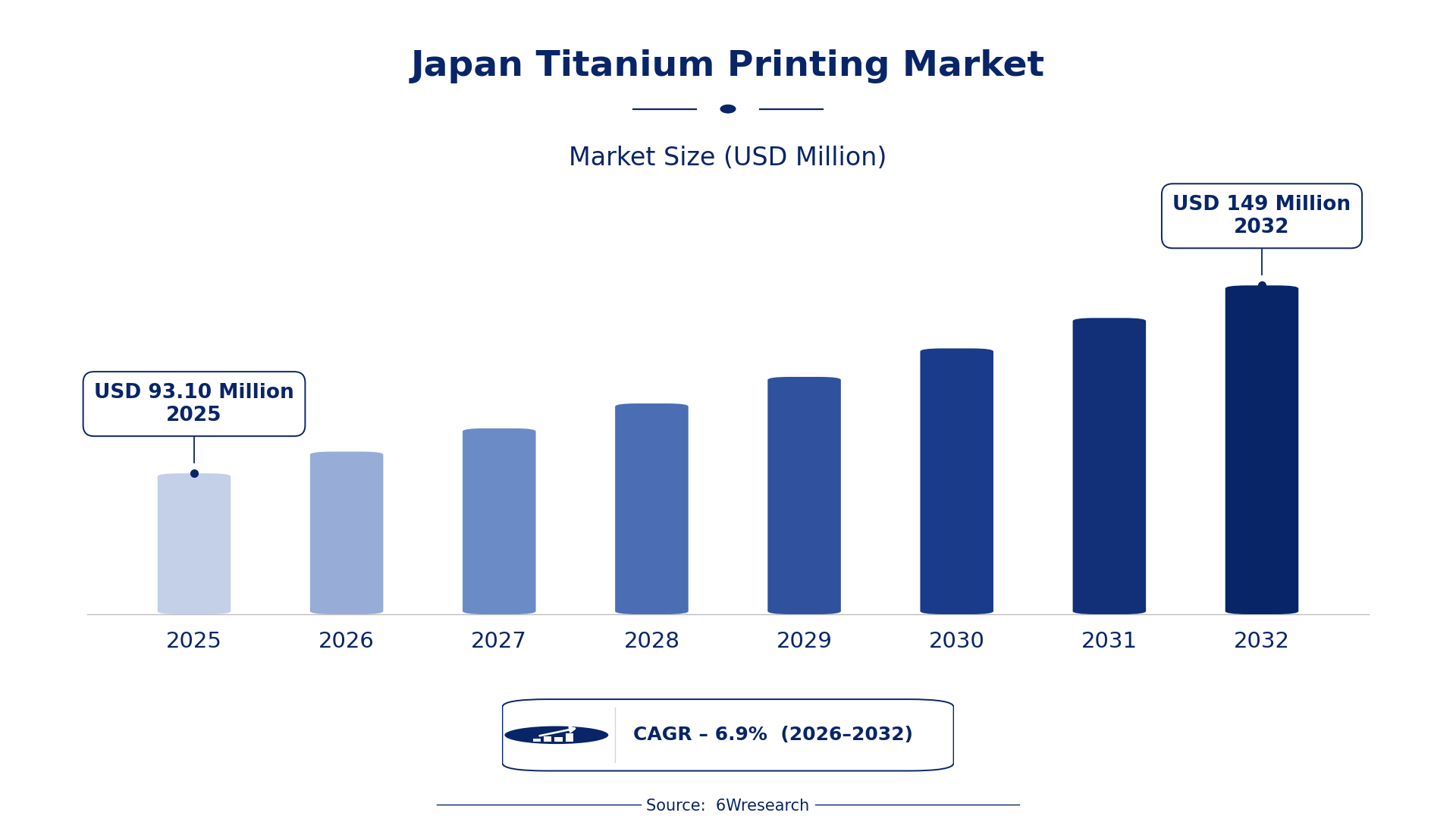
According to 6Wresearch internal database and industry insights, the Japan Titanium Printing Market was valued at USD 93.10 Million in 2025 and is projected to reach USD 149 Million by 2032, growing at a CAGR of approximately 6.9% during 2026–2032.
Japan Titanium Printing Market Highlights
| Report Metric | Details |
| Report Name | Japan Titanium Printing Market (2026-2032) |
| Market Size 2025 | USD 93.10 Million |
| Market Size 2032 | USD 149 Million |
| Absolute Growth 2025–2032 | USD 55.90 Million |
| CAGR 2026–2032 | 6.9% |
| Peak Annual Growth | 8.2% in 2032 |
| Forecast Period | 2026–2032 |
| Historical Data | 2022–2025 |
| Base Year | 2025 |
| Leading Printing Type, 2025 | 3D Printing (49% share) |
| Leading Technique Used, 2025 | Laser Powder Bed Fusion (39% share) |
| Leading Application Sector, 2025 | Aerospace Components (46% share) |
| Leading End User, 2025 | Custom Prosthetics Labs (51% share) |
| Fastest-Growing Printing Type | Additive Manufacturing (9.9% CAGR) |
| Fastest-Growing Technique Used | DMLS/EBM (9.2% CAGR) |
| Fastest-Growing Application Sector | Dental/Medical Devices (9.1% CAGR) |
| Growing Sector | Aerospace Components |
| Key End Users | Aerospace manufacturers, healthcare providers, custom prosthetics labs, research institutions |
Japan Titanium Printing Market Year-wise Growth Rate and Key Drivers (2022–2032)
This graph illustrates the annual growth rates of the market from 2022 to 2032, highlighting a steady upward trajectory and projected market expansion over the forecast period.
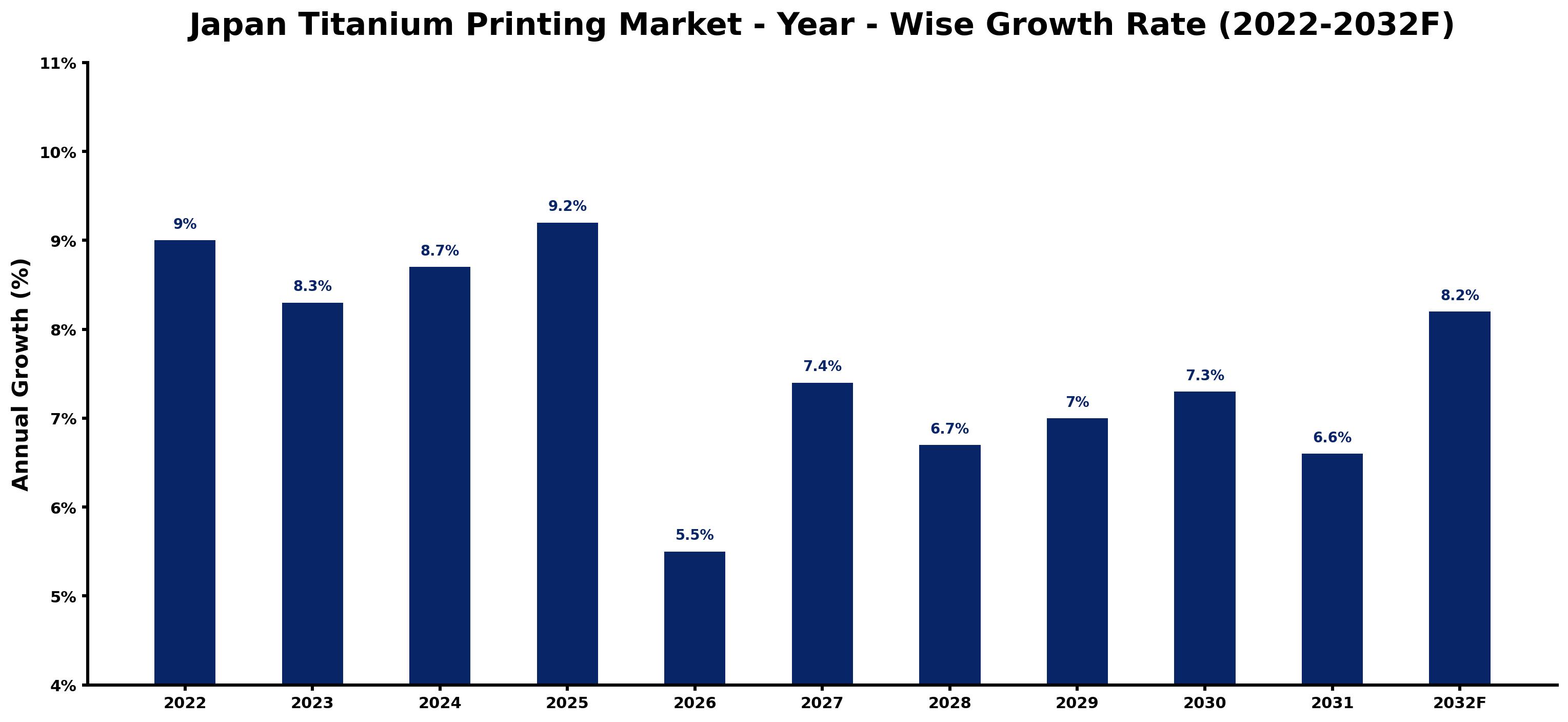
The yearly estimates that follow link every growth rate to its principal driver, so readers can see why the pace changed in each period.
| Year | Estimated Annual Growth (%) | Market Rationale |
| 2022 | 9.0 | The market showed strong demand from various sectors, particularly aerospace and healthcare. |
| 2023 | 8.3 | Growth slowed slightly due to supply chain adjustments affecting production timelines. |
| 2024 | 8.7 | Increased investments in aerospace components drove a faster growth rate this year. |
| 2025 | 9.2 | The aerospace sector's expansion led to peak growth, with high orders for titanium parts. |
| 2026 | 5.5 | Growth is expected to slow as the market adjusts to previous high demand levels and production capacity. |
| 2027 | 7.4 | A recovery in demand from the healthcare sector will boost growth rates once more. |
| 2028 | 6.7 | Growth is projected to moderate as the market stabilises after earlier fluctuations in demand. |
| 2029 | 7.0 | A resurgence in aerospace projects will contribute to a renewed increase in demand. |
| 2030 | 7.3 | Continued investments in medical devices will support further growth in the titanium printing market. |
| 2031 | 6.6 | Growth is expected to slow due to market saturation in certain sectors, particularly aerospace. |
| 2032 | 8.2 | A surge in new aerospace projects is anticipated to drive growth to its peak. |
Note: Market size estimations and growth projections presented in this report are based on 6Wresearch's proprietary forecasting methodology, utilizing the latest available industry data, government publications, and primary research inputs.
Japan Titanium Printing Market Synopsis
Titanium printing utilises titanium powder to manufacture parts through various techniques, primarily melting titanium powder with lasers or electron beams. This technology is essential for producing aerospace components, medical devices, and custom prosthetics. The Japan Titanium Printing Market is expanding, driven by increasing healthcare demands and investments in aerospace components.
Market Dynamics Impact Analysis (2026–2032)
| Factor | Type | Impact | Primary Segment Affected |
| Increasing healthcare demands drive custom prosthetics production. | Driver | High | Custom Prosthetics Labs |
| Growing aerospace investments lead to higher demand for titanium components. | Driver | High | Aerospace Components |
| The rising number of custom prosthetics labs creates a need for titanium printing services. | Opportunity | High | Custom Prosthetics Labs |
| The aerospace sector's expansion presents opportunities for new entrants in titanium printing. | Opportunity | High | Aerospace Components |
| Supply chain disruptions can limit production capabilities for titanium printing. | Restraint | Medium | Additive Manufacturing |
| High-quality standards and regulations increase operational costs for producers. | Restraint | Medium | 3D Printing |
| Limited availability of skilled technicians affects production efficiency. | Challenge | High | Laser Powder Bed Fusion |
| Competition from alternative materials may hinder market growth. | Challenge | Medium | Aerospace Components |
Evaluation of Drivers in Japan Titanium Printing Market (2026–2032)
Below are the drivers that matter most for revenue growth, with supporting evidence.
| Drivers | Primary Segment Affected | Why It Matters (Evidence) |
| Rising healthcare demands for custom prosthetics. | Custom Prosthetics Labs | With over 300 labs in Japan, the need for titanium parts is increasing due to the demand for tailored solutions. |
| Investments in the aerospace sector. | Aerospace Components | Projected growth in the aerospace sector is driving demand for lightweight and durable titanium components, expected to increase by 20% by 2025. |
| Government initiatives promoting advanced manufacturing. | Aerospace Components | The Semiconductor and Digital Industry Strategy aims to boost technological capabilities, increasing titanium printing adoption by 30% by 2025. |
| Research advancements in titanium printing techniques. | Laser Powder Bed Fusion | Institutions are innovating processes that improve production efficiency by 25%, enhancing output for manufacturers. |
| Increased titanium powder production under JIS standards. | 3D Printing | Quality assurance measures boost buyer confidence, encouraging more purchases from manufacturers, with production expected to rise by 15%. |
Behind the steady rise in orders sits the increasing healthcare demand for custom prosthetics, with over 300 labs across Japan requiring titanium parts. The aerospace sector is projected to grow, with investments in titanium components expected to increase by 20% by 2025. Compliance with JIS standards in titanium powder production increases buyer confidence, driving more purchases from manufacturers. This combination of healthcare and aerospace demands is creating a vibrant market for titanium printing.
Evaluation of Restraints in Japan Titanium Printing Market
The main factors holding the market back are set out below.
| Market Restraint | Primary Segment Affected | Why It Matters (Evidence) |
| Supply chain disruptions affecting production timelines. | 3D Printing | Recent global supply chain issues have led to delays in the availability of raw materials for titanium printing. |
| High operational costs due to stringent quality standards. | Laser Powder Bed Fusion | Compliance with JIS standards increases production costs by approximately 15%, impacting profit margins for manufacturers. |
| Limited skilled workforce in titanium printing techniques. | Custom Prosthetics Labs | The shortage of trained technicians hampers production efficiency and limits market growth, affecting over 300 labs. |
| Competition from alternative materials in aerospace applications. | Aerospace Components | The rise of composite materials poses a challenge to the adoption of titanium in aerospace manufacturing, limiting market share. |
| Market saturation in certain sectors, particularly aerospace. | Aerospace Components | As the market matures, growth opportunities may become limited, affecting long-term demand for titanium components. |
Japan Titanium Printing Market Challenges
In 2023, Japan's titanium powder production faced delays due to stringent JIS standards, causing supply shortages that hindered production timelines for manufacturers. Local producers encounter pressure from cheaper imported materials, forcing them to lower prices and reducing profit margins for suppliers. Rising costs of raw materials, influenced by global market fluctuations, increase expenses for end users like hospitals and aerospace firms, resulting in potential project delays. Some facilities struggle with outdated technology, limiting efficiency and extending lead times for buyers seeking advanced titanium printing solutions.
Trends in the Japan Titanium Printing Market
Buyers and suppliers in the Japan Titanium Printing Market are adjusting to the following trends.
- Shift in Aerospace Component Production: Tokyo is experiencing a shift towards titanium components in aerospace manufacturing, due to their lightweight properties. In 2023, new projects announced by the Japan Aerospace Exploration Agency are expected to require substantial amounts of titanium.
- Custom Prosthetics Labs Expanding: Custom Prosthetics Labs are increasingly adopting titanium for tailored solutions, with over 1 million procedures annually in Japan. This trend highlights the growing demand for durable and biocompatible materials in healthcare.
- Rising Interest in Advanced Techniques: Research institutions are focusing on new titanium ink formulations for printing, with the Tokyo Institute of Technology leading the way. This development is expected to improve the capabilities of titanium printing in various sectors.
- Emerging Applications in Aerospace: The aerospace sector is exploring titanium for new applications in lightweight components. This trend reflects the material's versatility, with potential applications in advanced aerospace technologies.
Investment Opportunities in the Japan Titanium Printing Market
The opportunities below stand out in the Japan Titanium Printing Market for new entrants and existing suppliers.
- Gap in Custom Prosthetics Production: With over 300 labs requiring titanium parts, there is a gap in supply. Investing in titanium printing technology can meet this demand, particularly in regions like Tokyo.
- Aerospace Sector Growth Timing: The aerospace sector's projected growth creates a timely opportunity for investment in titanium printing. Collaborating with aerospace manufacturers can improve market entry and expand production capabilities.
- Entry through Joint Ventures: Forming joint ventures with local manufacturers can facilitate entry into the titanium printing market. This approach can utilise existing networks and expertise, particularly in key regions like Aichi.
- Support for Startups in Aerospace: The Tokyo Metropolitan Government supports startups in aerospace, including those using titanium printing. This initiative presents an opportunity for investors to tap into innovative projects and technologies.
Government Initiatives in the Japan Titanium Printing Market
The Advanced Manufacturing Strategy initiated by the Japanese government aims to boost additive manufacturing capabilities, including titanium printing. This strategy encourages investments in technology and infrastructure, targeting a 20% increase in production efficiency by 2025. Additionally, the Ministry of Economy, Trade and Industry promotes the adoption of advanced manufacturing techniques across various sectors, improving competitiveness.
The Clinical Trials Act ensures that medical devices, including those made from titanium, undergo rigorous testing and approval processes. This law guarantees that these products meet safety and efficacy standards. The Pharmaceuticals and Medical Devices Agency (PMDA) oversees these regulations, providing a framework that supports innovation while safeguarding public health.
Future Insight of the Japan Titanium Printing Market
Investment in titanium printing technology will surpass 50 billion yen by 2032, creating substantial demand for high-quality components. This influx will enable suppliers to improve their production capabilities and meet the growing needs of sectors like aerospace and healthcare. Innovations in titanium implant technologies will support over 1 million dental procedures annually. Research at institutions like the Tokyo Institute of Technology will drive advancements in printing techniques, solidifying Japan's position in the global market.
Market Segmentation Analysis
Japan Titanium Printing Market report covers a detailed analysis of the following market segments:
By Printing Type – 3D Printing Leads, Additive Manufacturing Expected to Grow Fastest
According to Saurav Kr Singh, Senior Research Analyst at 6Wresearch, with 49% of printing type revenue in 2025, 3D Printing was the largest category. 3D printing holds the largest share as it is essential for creating complex geometries needed in medical and aerospace applications. Facilities across Japan that adhere to ISO 9001 standards predominantly use this method, ensuring compliance with high-quality requirements. Additive Manufacturing is set to record the highest CAGR in this split, 9.9% over 2026–2032. Additive manufacturing is witnessing rapid growth as it encompasses various techniques, including 3D printing, that are increasingly adopted for producing titanium parts. The government's 'Advanced Manufacturing Strategy' significantly promotes these technologies, leading to wider adoption and market expansion. Suppliers must enhance their additive manufacturing capabilities to meet the increasing market demand.
By Technique Used – Laser Powder Bed Fusion Leads, DMLS/EBM Expected to Grow Fastest
Laser Powder Bed Fusion held 39% of the Japan Titanium Printing Market by technique used in 2025. Laser powder bed fusion dominates the market as it is extensively used for producing high-precision titanium parts, especially in the aerospace sector. This technique is favoured for its ability to create lightweight components that meet stringent industry standards. DMLS/EBM is projected to grow fastest, at a CAGR of 9.2% during 2026–2032. DMLS/EBM is growing quickly due to its specific advantages in melting titanium, making it ideal for applications requiring high-quality parts. The increasing number of aerospace projects announced in 2023 further fuels this growth. Buyers should consider investing in DMLS/EBM technologies to stay competitive in producing high-quality titanium components.
By Application Sector – Aerospace Components Lead, Dental/Medical Devices Expected to Grow Fastest
Aerospace Components took 46% of application sector revenue in 2025, more than any other category. Aerospace components lead the market due to their critical role in producing lightweight and durable parts essential for aviation. The substantial investments in titanium components for aerospace applications indicate a robust and ongoing demand in this sector. The quickest growth will come from Dental/Medical Devices, forecast to expand at a CAGR of 9.1% between 2026 and 2032. The dental and medical device sector is experiencing the fastest growth, driven by the rising number of titanium implant procedures, which exceed 1 million annually in Japan. This surge in demand for implants necessitates advancements in production techniques and innovation within the medical field. Suppliers should target the dental and medical device sectors to capitalise on the growing demand for titanium applications.
By End User – Custom Prosthetics Labs Lead and Record the Fastest Growth
The largest end user category in 2025 was Custom Prosthetics Labs, at 51% of revenue. Custom prosthetics labs lead the market as they increasingly utilise titanium for tailored solutions, reflecting a growing trend towards personalised medical applications. This sector's expansion is supported by over 300 labs across Japan focusing on custom prosthetics. Custom Prosthetics Labs are also forecast to expand faster than any other category, at a CAGR of 9.0% over 2026–2032. Custom prosthetics labs are also the fastest-growing end user due to the rising demand for personalised solutions in healthcare. The convergence of advanced printing techniques and increasing healthcare needs will likely widen this lead. Suppliers must align their offerings with the needs of custom prosthetics labs to capture this expanding market.
Key Attractiveness of the Report
- 10 Years of Market Numbers
- Historical Data Starting from 2022 to 2025
- Base Year 2025
- Forecast Data until 2032
- Key Performance Indicators Impacting the Market
- Major Upcoming Developments and Projects
Key Highlights of the Report:
- Japan Titanium Printing Market Outlook
- Market Size of Japan Titanium Printing Market, 2025
- Forecast of Japan Titanium Printing Market, 2032
- Historical Data and Forecast of Japan Titanium Printing Revenues & Volume for the Period 2022-2032F
- Japan Titanium Printing Market Trend Evolution
- Japan Titanium Printing Market Drivers and Challenges
- Japan Titanium Printing Price Trends
- Japan Titanium Printing Porter's Five Forces
- Japan Titanium Printing Industry Life Cycle
- Historical Data and Forecast of Japan Titanium Printing Market Revenues & Volume By Printing Type for the Period 2022-2032F
- Historical Data and Forecast of Japan Titanium Printing Market Revenues & Volume By 3D Printing for the Period 2022-2032F
- Historical Data and Forecast of Japan Titanium Printing Market Revenues & Volume By Additive Manufacturing for the Period 2022-2032F
- Historical Data and Forecast of Japan Titanium Printing Market Revenues & Volume By Inkjet Printing for the Period 2022-2032F
- Historical Data and Forecast of Japan Titanium Printing Market Revenues & Volume By Binder Jetting for the Period 2022-2032F
- Historical Data and Forecast of Japan Titanium Printing Market Revenues & Volume By Technique Used for the Period 2022-2032F
- Historical Data and Forecast of Japan Titanium Printing Market Revenues & Volume By Laser Powder Bed Fusion for the Period 2022-2032F
- Historical Data and Forecast of Japan Titanium Printing Market Revenues & Volume By DMLS/EBM for the Period 2022-2032F
- Historical Data and Forecast of Japan Titanium Printing Market Revenues & Volume By Titanium Ink Formulation for the Period 2022-2032F
- Historical Data and Forecast of Japan Titanium Printing Market Revenues & Volume By Powder-Based for the Period 2022-2032F
- Historical Data and Forecast of Japan Titanium Printing Market Revenues & Volume By Application Sector for the Period 2022-2032F
- Historical Data and Forecast of Japan Titanium Printing Market Revenues & Volume By Dental/Medical Devices for the Period 2022-2032F
- Historical Data and Forecast of Japan Titanium Printing Market Revenues & Volume By Aerospace Components for the Period 2022-2032F
- Historical Data and Forecast of Japan Titanium Printing Market Revenues & Volume By Flexible Electronics for the Period 2022-2032F
- Historical Data and Forecast of Japan Titanium Printing Market Revenues & Volume By Industrial Tools for the Period 2022-2032F
- Historical Data and Forecast of Japan Titanium Printing Market Revenues & Volume By End User for the Period 2022-2032F
- Historical Data and Forecast of Japan Titanium Printing Market Revenues & Volume By Custom Prosthetics Labs for the Period 2022-2032F
- Historical Data and Forecast of Japan Titanium Printing Market Revenues & Volume By Space Startups for the Period 2022-2032F
- Historical Data and Forecast of Japan Titanium Printing Market Revenues & Volume By Printed Circuit Firms for the Period 2022-2032F
- Historical Data and Forecast of Japan Titanium Printing Market Revenues & Volume By Prototyping Units for the Period 2022-2032F
- Japan Titanium Printing Import Export Trade Statistics
- Market Opportunity Assessment By Printing Type
- Market Opportunity Assessment By Technique Used
- Market Opportunity Assessment By Application Sector
- Market Opportunity Assessment By End User
- Japan Titanium Printing Top Companies Market Share
- Japan Titanium Printing Competitive Benchmarking By Technical and Operational Parameters
- Japan Titanium Printing Company Profiles
- Japan Titanium Printing Key Strategic Recommendations
Market Covered
Segments analysed in this report are listed below.
By Printing Type
- 3D Printing
- Additive Manufacturing
- Inkjet Printing
- Binder Jetting
By Technique Used
- Laser Powder Bed Fusion
- DMLS/EBM
- Titanium Ink Formulation
- Powder-Based
By Application Sector
- Dental/Medical Devices
- Aerospace Components
- Flexible Electronics
- Industrial Tools
By End User
- Custom Prosthetics Labs
- Space Startups
- Printed Circuit Firms
- Prototyping Units































