Japan Titanium Raw Materials Market Size & Growth Rate
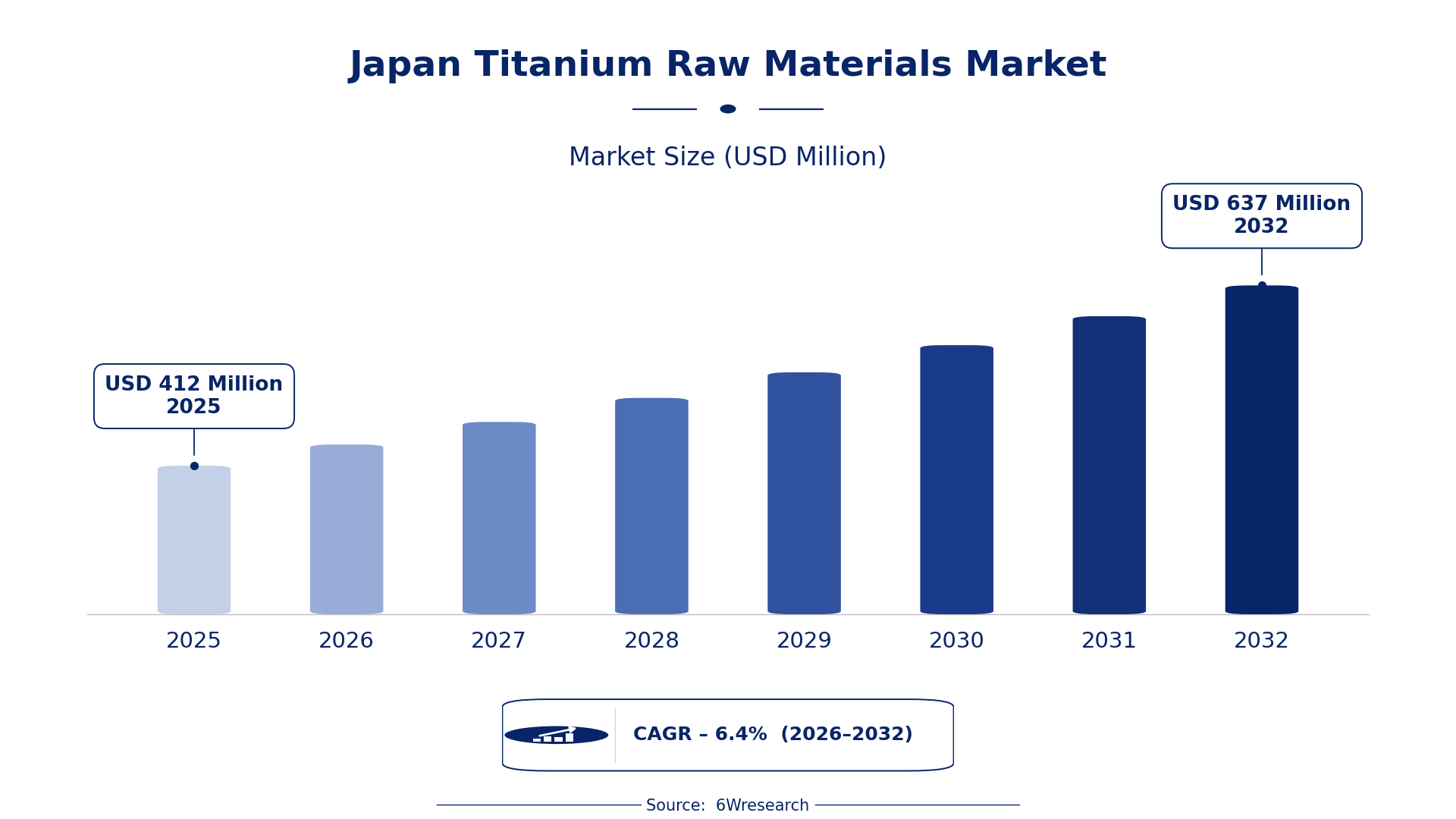
According to 6Wresearch internal database and industry insights, the Japan Titanium Raw Materials Market was valued at USD 412 Million in 2025 and is projected to reach USD 637 Million by 2032, growing at a CAGR of approximately 6.4% during 2026–2032.
Japan Titanium Raw Materials Market Highlights
| Report Metric | Details |
| Report Name | Japan Titanium Raw Materials Market (2026-2032) |
| Market Size 2025 | USD 412 Million |
| Market Size 2032 | USD 637 Million |
| Absolute Growth 2025–2032 | USD 225 Million |
| CAGR 2026–2032 | 6.4% |
| Peak Annual Growth | 7.3% in 2028 |
| Forecast Period | 2026–2032 |
| Historical Data | 2022–2025 |
| Base Year | 2025 |
| Leading Raw Material Type, 2025 | Titanium Sponge (45% share) |
| Leading Processing Stage, 2025 | Primary Metal (40% share) |
| Leading End Application Sector, 2025 | Aerospace (36% share) |
| Leading End User, 2025 | Metal Refineries (45% share) |
| Fastest-Growing Raw Material Type | Rutile (9.4% CAGR) |
| Fastest-Growing Processing Stage | Ore Concentrate (8.9% CAGR) |
| Fastest-Growing End Application Sector | Pigment & Paint (8.4% CAGR) |
| Fastest-Growing End User | Chemical Companies (8.2% CAGR) |
| Growing Sector | Aerospace |
| Key End Users | Aerospace manufacturers, Metal refineries, Alloy producers, Chemical companies |
Japan Titanium Raw Materials Market Year-wise Growth Rate and Key Drivers (2022–2032)
This graph illustrates the annual growth rates of the market from 2022 to 2032, highlighting a steady upward trajectory and projected market expansion over the forecast period.
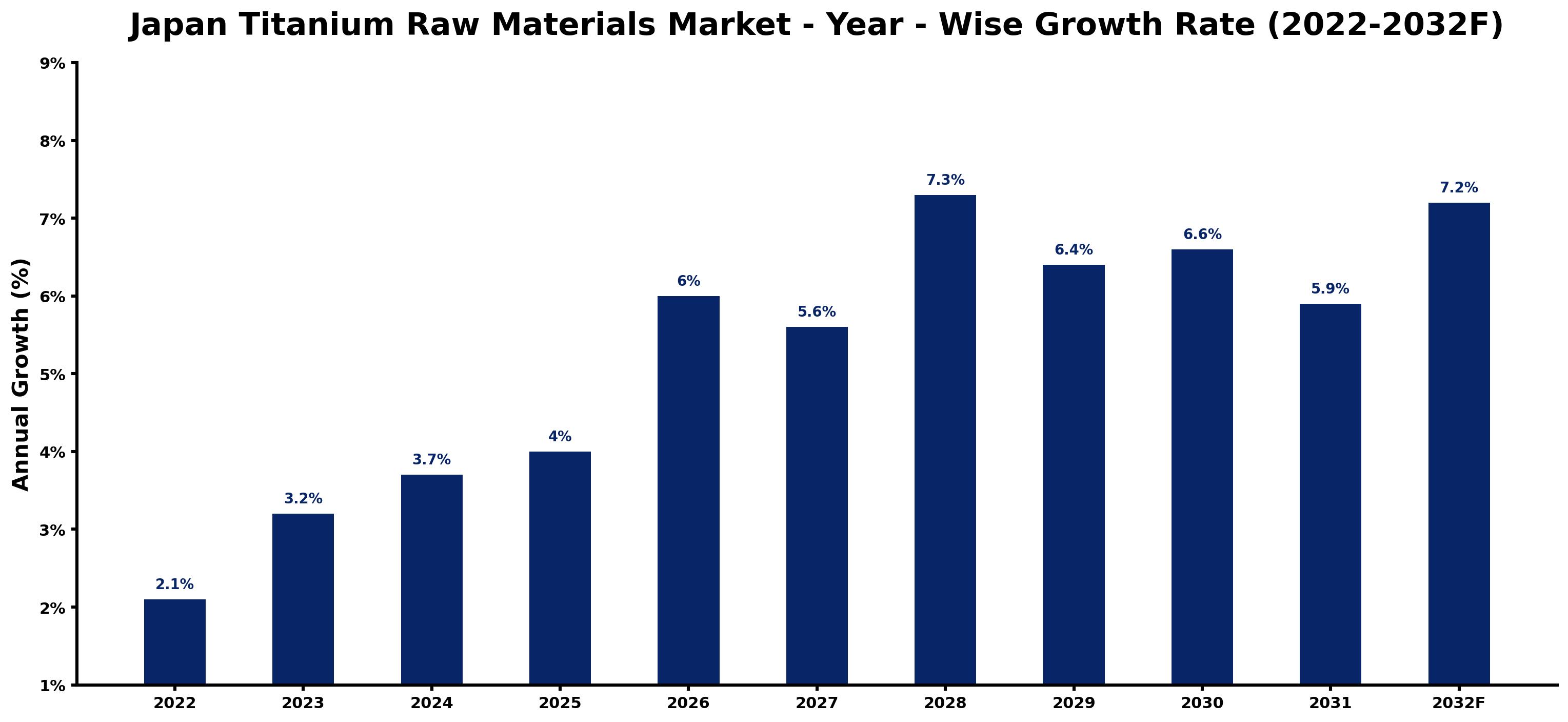
The table below sets out the estimated growth rate for each year and the main factor behind it.
| Year | Estimated Annual Growth (%) | Market Rationale |
| 2022 | 2.1 | The market experienced steady growth due to existing demand from various sectors. |
| 2023 | 3.2 | Growth accelerated as the aerospace sector increased its titanium purchases. |
| 2024 | 3.7 | Continued expansion in aerospace and industrial applications drove higher demand. |
| 2025 | 4.0 | Demand peaked as production capabilities expanded to meet rising needs. |
| 2026 | 6.0 | The market is projected to grow as investments in titanium processing technologies increase. |
| 2027 | 5.6 | Growth is expected to slow slightly as supply chain adjustments take place. |
| 2028 | 7.3 | A surge in aerospace production will lead to the highest growth rate recorded. |
| 2029 | 6.4 | Growth is anticipated to decelerate as market conditions stabilise after rapid expansion. |
| 2030 | 6.6 | Demand will rise again as new aerospace projects are initiated. |
| 2031 | 5.9 | The market is expected to see a slight slowdown due to saturation in some sectors. |
| 2032 | 7.2 | A resurgence in aerospace and industrial demand will drive growth higher. |
Note: Market size estimations and growth projections presented in this report are based on 6Wresearch's proprietary forecasting methodology, utilizing the latest available industry data, government publications, and primary research inputs.
Japan Titanium Raw Materials Market Synopsis
Titanium raw materials are derived from ores containing titanium dioxide, processed through methods like the Kroll process to produce titanium sponge. The Japan Titanium Raw Materials Market is growing, driven by the aerospace sector, which accounts for approximately 30% of total titanium consumption. Increased investments in processing technologies and Japan's ambitious decarbonisation targets aim for a 46% reduction in greenhouse gas emissions by 2030, further boosting demand for these materials.
Market Dynamics Impact Analysis (2026–2032)
| Factor | Type | Impact | Primary Segment Affected |
| Increased demand from the aerospace sector drives titanium purchases. | Driver | High | Titanium Sponge |
| Technological advancements in titanium processing enhance production efficiency. | Driver | High | Primary Metal |
| Growing interest in sustainable practices creates opportunities for titanium recycling. | Opportunity | High | Titanium Slag |
| The aerospace industry's expansion necessitates more titanium supply. | Opportunity | High | Aerospace |
| High production costs limit the competitiveness of domestic titanium products. | Restraint | Medium | Titanium Sponge |
| Supply chain disruptions can impact timely deliveries of titanium materials. | Restraint | Medium | Primary Metal |
| Competition from lower-cost titanium producers affects market pricing. | Challenge | High | Titanium Sponge |
| Technological barriers in recycling processes hinder market growth. | Challenge | Medium | Titanium Slag |
Evaluation of Drivers in Japan Titanium Raw Materials Market (2026–2032)
The table below links each growth driver to the segment it affects and the evidence for it.
| Drivers | Primary Segment Affected | Why It Matters (Evidence) |
| Rising aerospace production increases titanium demand. | Titanium Sponge | The aerospace sector in Japan accounts for approximately 30% of titanium demand, prompting higher purchases. |
| Investments in processing technologies boost production capacity. | Primary Metal | Over 1 billion yen has been invested in titanium research and development since 2020, increasing output. |
| Sustainability initiatives drive interest in titanium recycling. | Titanium Slag | The government has initiated programs to improve titanium recycling technologies, creating new market opportunities. |
| Expansion of industrial applications for titanium materials. | Alloys | The growth of various industries increases the need for titanium alloys, driving demand. |
| Increased construction activities raise demand for welding electrodes. | Welding Electrodes | The rising construction sector boosts the need for titanium in welding applications. |
Buyers are adding capacity as the aerospace sector increases its titanium purchases, accounting for about 30% of total demand. Investments exceeding 1 billion yen in titanium research and development since 2020 have improved production capabilities, allowing for greater output. The expansion of industrial applications for titanium materials fuels demand, while increased construction activities raise the need for titanium in welding electrodes, contributing to overall market growth.
Evaluation of Restraints in Japan Titanium Raw Materials Market
Several factors work against faster growth; the main ones are summarised below.
| Market Restraint | Primary Segment Affected | Why It Matters (Evidence) |
| High production costs limit competitiveness. | Titanium Sponge | Producers face challenges with high operational costs, impacting pricing strategies and market positioning. |
| Supply chain disruptions affect delivery timelines. | Primary Metal | Recent global supply chain issues have delayed shipments, affecting manufacturers' ability to meet demand. |
| Limited recycling capabilities hinder market expansion. | Titanium Slag | Technological barriers in recycling processes restrict the availability of recycled titanium materials. |
| Dependence on imports for certain titanium grades. | Purified Ore | Some high-purity titanium grades are sourced internationally, exposing buyers to supply risks. |
| Market saturation in certain sectors slows growth. | Alloys | As the market matures, growth rates in established sectors begin to stabilise. |
Japan Titanium Raw Materials Market Challenges
Producers face rising operational costs due to stringent emissions regulations, as Japan targets a 46% reduction by 2030, potentially increasing expenses by 15% for titanium manufacturers. Slow technology adoption results in outdated processing methods, causing production delays of up to six months for suppliers. Increased competition from lower-cost imports pressures domestic producers to lower prices by 10%, impacting their profitability. Skills shortages in advanced processing techniques restrict plants' capacity to meet demand, potentially delaying project timelines by two years for buyers.
Trends in the Japan Titanium Raw Materials Market
Four trends stand out in the Japan Titanium Raw Materials Market.
- Shift towards Sustainable Titanium Recycling: Japan's government has initiated programs to improve titanium recycling technologies, aiming for a more circular economy. This shift is projected to increase recycled titanium supply, addressing sustainability concerns and reducing reliance on virgin materials.
- Increase in Aerospace Production: The aerospace sector is expanding rapidly, with significant investments in new aircraft manufacturing. This growth is anticipated to increase titanium demand, with the sector accounting for approximately 30% of total consumption in Japan.
- Growing Demand for Titanium Alloys: Alloy producers are experiencing increased demand as industries seek lightweight, high-strength materials. The titanium alloy market is expected to grow, driven by various applications in aerospace and automotive sectors.
- Expansion of Industrial Applications: The use of titanium in various industrial applications is rising, particularly in construction and manufacturing. This trend is supported by increasing construction activities, which are boosting the demand for titanium materials.
Investment Opportunities in the Japan Titanium Raw Materials Market
Where to invest in the Japan Titanium Raw Materials Market: the main openings are set out below.
- Aerospace Sector Expansion: Aerospace manufacturers are ramping up production, creating a growing demand for titanium. With a projected increase in aircraft manufacturing, suppliers should focus on meeting this rising need.
- Sustainability Initiatives: Japan's commitment to reducing greenhouse gas emissions creates opportunities for titanium recycling. Suppliers can invest in recycling technologies to meet the increasing demand for sustainable materials.
- Technological Advancements in Processing: Investments in advanced titanium processing technologies present opportunities for suppliers. The focus on efficiency and innovation can lead to increased market share in the aerospace sector.
- Growing Construction Sector: The construction industry's expansion is driving demand for titanium in welding applications. Suppliers should consider partnerships with construction firms to tap into this growing market.
Government Initiatives in the Japan Titanium Raw Materials Market
The GX Promotion Act (2023) establishes a framework for Japan's decarbonisation strategy, building on previous laws like the PRTR Law. This act encourages investments in sustainable practices, impacting titanium producers by promoting recycling and reducing emissions.
Over JPY 150 trillion is targeted for public and private decarbonisation investment over the next decade, overseen by the Ministry of Economy, Trade and Industry. This funding supports initiatives that improve titanium processing and recycling capabilities, benefiting both producers and buyers.
Future Insight of the Japan Titanium Raw Materials Market
Japan's policy-driven shift towards decarbonisation will catalyse advancements in titanium recycling technologies by 2032, improving sustainability in the supply chain. Approximately JPY 150 trillion in public and private investment will enhance research and development, driving production efficiencies. Growth in the titanium alloy market will compel producers to innovate and adapt to evolving industry needs. New standards like JIS H 4600 will establish quality benchmarks in titanium applications, ensuring safety and reliability for buyers while strengthening market competitiveness.
Market Segmentation Analysis
Japan Titanium Raw Materials Market report covers a detailed analysis of the following market segments:
By Raw Material Type – Titanium Sponge Leads, Rutile Expected to Grow Fastest
According to Saurav Kr Singh, Senior Research Analyst at 6Wresearch, Titanium Sponge held 45% of the Japan Titanium Raw Materials Market by raw material type in 2025. Titanium Sponge commands the largest share owing to its essential role in aerospace and high-performance applications, particularly prevalent in the Kansai region known for high-grade production. The installed base of around 50 titanium production facilities supports its widespread use across various industries. The quickest growth will come from Rutile, forecast to expand at a CAGR of 9.4% between 2026 and 2032. Rutile is experiencing the fastest growth as it serves as the primary source for titanium dioxide production, which reached 150,000 tons in 2022. The increasing demand for titanium dioxide in numerous applications is driving this segment's rapid expansion. This trend indicates that suppliers must enhance their focus on rutile to meet the rising market demand.
By Processing Stage – Primary Metal Leads, Ore Concentrate Expected to Grow Fastest
Primary Metal accounted for 40% of the market by processing stage in 2025. Primary Metal leads this segment as it is extensively utilised in various industrial applications, ensuring consistent demand from diverse sectors. The well-established production processes and facilities for primary metal in Japan solidify its dominant position. Ore Concentrate is projected to grow fastest, at a CAGR of 8.9% during 2026–2032. Ore Concentrate is the fastest-growing segment as it is a vital raw material for titanium production, coinciding with the rising output in the titanium industry. The emphasis on refining ore concentrate is projected to increase alongside the growth of titanium applications. Buyers may find value in securing long-term contracts for ore concentrate to reduce supply risks.
By End Application Sector – Aerospace Leads, Pigment & Paint Expected to Grow Fastest
Aerospace took 36% of end application sector revenue in 2025, more than any other category. Aerospace is the leading sector for titanium demand, accounting for approximately 30% of the total consumption in Japan. The critical need for titanium in aircraft manufacturing solidifies its position as the largest application area. Over 2026–2032, Pigment & Paint is expected to post the fastest growth, at a CAGR of 8.4%. Pigment & Paint is the fastest-growing application due to the rising use of titanium in coatings and pigments, driven by the overall growth in the construction and chemical industries. This sector's expansion is expected to continue as demand for high-quality pigments increases. Suppliers should invest in marketing strategies targeting the pigment and paint sector to capitalise on this growth.
By End User – Metal Refineries Lead, Chemical Companies Expected to Grow Fastest
With 45% of end user revenue in 2025, Metal Refineries was the largest category. Metal Refineries represent the largest user group as they process titanium for various applications, ensuring a consistent demand for raw materials. Their established infrastructure and expertise in refining titanium contribute to their leading position. Chemical Companies are set to record the highest CAGR in this split, 8.2% over 2026–2032. Chemical Companies are growing rapidly as they increasingly incorporate titanium into their chemical processes, reflecting the broader trend of utilising advanced materials in manufacturing. This trend is likely to accelerate as industries seek to improve efficiency. Suppliers should consider tailored solutions for chemical companies to meet their specific titanium needs.
Key Attractiveness of the Report
- 10 Years of Market Numbers
- Historical Data Starting from 2022 to 2025
- Base Year 2025
- Forecast Data until 2032
- Key Performance Indicators Impacting the Market
- Major Upcoming Developments and Projects
Key Highlights of the Report:
- Japan Titanium Raw Materials Market Outlook
- Market Size of Japan Titanium Raw Materials Market, 2025
- Forecast of Japan Titanium Raw Materials Market, 2032
- Historical Data and Forecast of Japan Titanium Raw Materials Revenues & Volume for the Period 2022-2032F
- Japan Titanium Raw Materials Market Trend Evolution
- Japan Titanium Raw Materials Market Drivers and Challenges
- Japan Titanium Raw Materials Price Trends
- Japan Titanium Raw Materials Porter's Five Forces
- Japan Titanium Raw Materials Industry Life Cycle
- Historical Data and Forecast of Japan Titanium Raw Materials Market Revenues & Volume By Raw Material Type for the Period 2022-2032F
- Historical Data and Forecast of Japan Titanium Raw Materials Market Revenues & Volume By Titanium Sponge for the Period 2022-2032F
- Historical Data and Forecast of Japan Titanium Raw Materials Market Revenues & Volume By Rutile for the Period 2022-2032F
- Historical Data and Forecast of Japan Titanium Raw Materials Market Revenues & Volume By Titanium Slag for the Period 2022-2032F
- Historical Data and Forecast of Japan Titanium Raw Materials Market Revenues & Volume By Synthetic Ilmenite for the Period 2022-2032F
- Historical Data and Forecast of Japan Titanium Raw Materials Market Revenues & Volume By Processing Stage for the Period 2022-2032F
- Historical Data and Forecast of Japan Titanium Raw Materials Market Revenues & Volume By Primary Metal for the Period 2022-2032F
- Historical Data and Forecast of Japan Titanium Raw Materials Market Revenues & Volume By Ore Concentrate for the Period 2022-2032F
- Historical Data and Forecast of Japan Titanium Raw Materials Market Revenues & Volume By Byproduct Feedstock for the Period 2022-2032F
- Historical Data and Forecast of Japan Titanium Raw Materials Market Revenues & Volume By Purified Ore for the Period 2022-2032F
- Historical Data and Forecast of Japan Titanium Raw Materials Market Revenues & Volume By End Application Sector for the Period 2022-2032F
- Historical Data and Forecast of Japan Titanium Raw Materials Market Revenues & Volume By Aerospace for the Period 2022-2032F
- Historical Data and Forecast of Japan Titanium Raw Materials Market Revenues & Volume By Pigment & Paint for the Period 2022-2032F
- Historical Data and Forecast of Japan Titanium Raw Materials Market Revenues & Volume By Welding Electrodes for the Period 2022-2032F
- Historical Data and Forecast of Japan Titanium Raw Materials Market Revenues & Volume By Alloys for the Period 2022-2032F
- Historical Data and Forecast of Japan Titanium Raw Materials Market Revenues & Volume By End User for the Period 2022-2032F
- Historical Data and Forecast of Japan Titanium Raw Materials Market Revenues & Volume By Metal Refineries for the Period 2022-2032F
- Historical Data and Forecast of Japan Titanium Raw Materials Market Revenues & Volume By Chemical Companies for the Period 2022-2032F
- Historical Data and Forecast of Japan Titanium Raw Materials Market Revenues & Volume By Industrial Suppliers for the Period 2022-2032F
- Historical Data and Forecast of Japan Titanium Raw Materials Market Revenues & Volume By Alloy Producers for the Period 2022-2032F
- Japan Titanium Raw Materials Import Export Trade Statistics
- Market Opportunity Assessment By Raw Material Type
- Market Opportunity Assessment By Processing Stage
- Market Opportunity Assessment By End Application Sector
- Market Opportunity Assessment By End User
- Japan Titanium Raw Materials Top Companies Market Share
- Japan Titanium Raw Materials Competitive Benchmarking By Technical and Operational Parameters
- Japan Titanium Raw Materials Company Profiles
- Japan Titanium Raw Materials Key Strategic Recommendations
Market Covered
Coverage by segment is as follows.
By Raw Material Type
- Titanium Sponge
- Rutile
- Titanium Slag
- Synthetic Ilmenite
By Processing Stage
- Primary Metal
- Ore Concentrate
- Byproduct Feedstock
- Purified Ore
By End Application Sector
- Aerospace
- Pigment & Paint
- Welding Electrodes
- Alloys
By End User
- Metal Refineries
- Chemical Companies
- Industrial Suppliers
- Alloy Producers































