Japan Topical Cosmetic Creams & Dermatology Market Size & Growth Rate
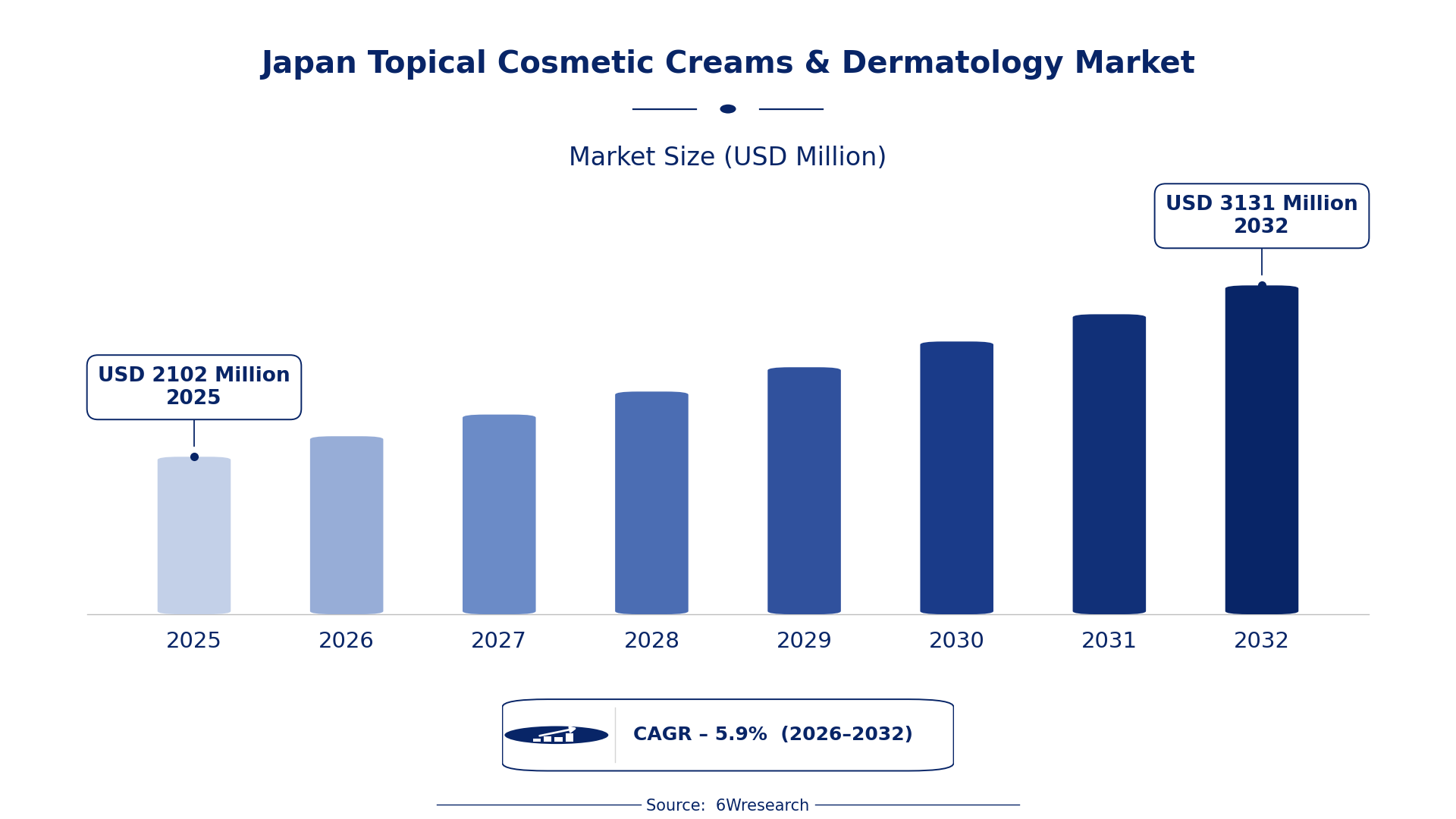
According to 6Wresearch internal database and industry insights, the Japan Topical Cosmetic Creams & Dermatology Market was valued at USD 2,102 Million in 2025 and is projected to reach USD 3,131 Million by 2032, growing at a CAGR of approximately 5.9% during 2026–2032.
Japan Topical Cosmetic Creams & Dermatology Market Highlights
| Report Metric | Details |
| Report Name | Japan Topical Cosmetic Creams & Dermatology Market (2026-2032) |
| Market Size 2025 | USD 2,102 Million |
| Market Size 2032 | USD 3,131 Million |
| Absolute Growth 2025–2032 | USD 1,029 Million |
| CAGR 2026–2032 | 5.9% |
| Peak Annual Growth | 6.2% in 2030 |
| Forecast Period | 2026–2032 |
| Historical Data | 2022–2025 |
| Base Year | 2025 |
| Leading Topical Dermatology/Cosmetic, 2025 | Anti-Aging Creams (40% share) |
| Leading Product Type, 2025 | Retinoids (47% share) |
| Leading Active Ingredient, 2025 | Retinol (45% share) |
| Leading Distribution Channel, 2025 | Beauty Stores (41% share) |
| Leading End User Industry, 2025 | Women 25+ (39% share) |
| Fastest-Growing Topical Dermatology/Cosmetic | Sunscreens (7.9% CAGR) |
| Fastest-Growing Product Type | SPF Lotions (8.3% CAGR) |
| Fastest-Growing Active Ingredient | Peptides (8.0% CAGR) |
| Fastest-Growing Distribution Channel | Supermarkets (7.5% CAGR) |
| Fastest-Growing End User Industry | All Skin Types (8.7% CAGR) |
| Growing Sector | All Skin Types |
| Key End Users | Women 25+, All Skin Types, Postpartum/Scar Care, Eczema |
Japan Topical Cosmetic Creams & Dermatology Market Year-wise Growth Rate and Key Drivers (2022–2032)
This graph illustrates the annual growth rates of the market from 2022 to 2032, highlighting a steady upward trajectory and projected market expansion over the forecast period.
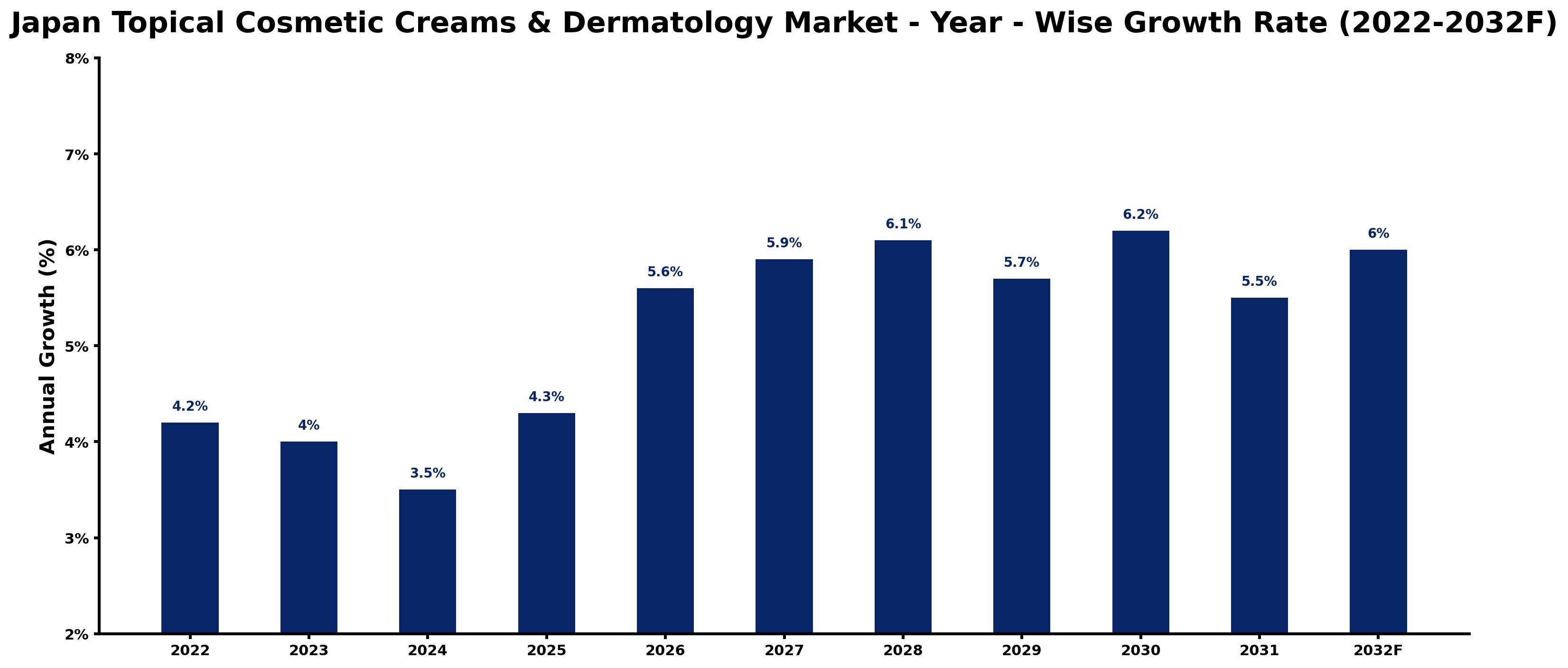
The yearly estimates that follow link every growth rate to its principal driver, so readers can see why the pace changed in each period.
| Year | Estimated Annual Growth (%) | Market Rationale |
| 2022 | 4.2 | The market showed steady growth due to persistent demand for skincare products. |
| 2023 | 4.0 | Growth slowed as consumers became more selective in their skincare purchases. |
| 2024 | 3.5 | The market experienced further slowdown amid increasing competition and market saturation. |
| 2025 | 4.3 | Growth accelerated as anti-aging products gained popularity among consumers. |
| 2026 | 5.6 | The introduction of new sunscreen formulations is expected to boost market performance. |
| 2027 | 5.9 | Increased awareness of skin health will drive higher demand for dermatological products. |
| 2028 | 6.1 | Consumer interest in new skincare solutions is projected to rise, supporting growth. |
| 2029 | 5.7 | Growth will slow as economic factors lead to more cautious consumer spending. |
| 2030 | 6.2 | The market will peak as demand for high-SPF products surges during summer months. |
| 2031 | 5.5 | Growth will moderate as the market begins to stabilise after rapid expansion. |
| 2032 | 6.0 | Demand is projected to rise again as new product lines are introduced. |
Note: Market size estimations and growth projections presented in this report are based on 6Wresearch's proprietary forecasting methodology, utilizing the latest available industry data, government publications, and primary research inputs.
Japan Topical Cosmetic Creams & Dermatology Market Synopsis
Topical cosmetic creams and dermatology products are designed to treat skin conditions and improve appearance. The Japan Topical Cosmetic Creams & Dermatology Market is expanding, driven by a growing population seeking effective skincare solutions. In 2023, over 70% of women aged 25 and older regularly used anti-aging creams, while the Tokyo metropolitan area accounts for over 30% of cosmetic retail sales, highlighting urban demand for these products.
Market Dynamics Impact Analysis (2026–2032)
| Factor | Type | Impact | Primary Segment Affected |
| Growing awareness of skin health among consumers | Driver | High | Anti-Aging Creams |
| Rising demand for specialized treatments like sunscreens | Driver | High | Sunscreens |
| Increased investment in dermatological care facilities | Opportunity | Medium | Prescription Dermatology |
| Expansion of beauty retail channels in urban areas | Opportunity | Medium | Beauty Stores |
| Strict regulations under the PMDA affecting product formulations | Restraint | High | Anti-Aging Creams |
| Market saturation leading to intense competition among brands | Restraint | Medium | Anti-Aging Creams |
| High costs of compliance with safety standards | Challenge | High | Anti-Aging Creams |
| Limited access to dermatological care in rural areas | Challenge | Medium | Anti-Aging Creams |
Evaluation of Drivers in Japan Topical Cosmetic Creams & Dermatology Market (2026–2032)
Below are the drivers that matter most for revenue growth, with supporting evidence.
| Drivers | Primary Segment Affected | Why It Matters (Evidence) |
| Increased consumer spending on skincare products | Anti-Aging Creams | The average annual spending on skincare products in Japan is around 20,000 JPY, encouraging purchases of anti-aging solutions. |
| Growing popularity of high-SPF sunscreens | Sunscreens | Sales of SPF 50 products have seen a steady increase, reflecting consumer prioritisation of UV protection. |
| Rising awareness of skin conditions like eczema | Prescription Dermatology | In 2023, a campaign by the Japan Dermatological Association promoted eczema awareness, driving demand for treatments. |
| Urbanisation leading to more beauty retail outlets | Beauty Stores | The Tokyo metropolitan area accounts for over 30% of Japan's cosmetic retail sales, boosting accessibility. |
| Increased focus on anti-aging solutions among older demographics | Retinoids | Over 70% of women aged 25 and older regularly use anti-aging creams, driving demand for retinoid products. |
Much of the new demand traces back to increased consumer spending on skincare, with annual expenditure reaching around 20,000 JPY. The growing popularity of high-SPF sunscreens has led to a steady rise in sales, particularly for SPF 50 products. Awareness campaigns have heightened interest in treatments for skin conditions like eczema. Urbanisation is also a factor, as the Tokyo metropolitan area accounts for over 30% of cosmetic retail sales, improving product accessibility. The focus on anti-aging solutions among women aged 25 and older has driven demand for retinoids, with a large percentage of this demographic regularly using such products.
Evaluation of Restraints in Japan Topical Cosmetic Creams & Dermatology Market
Below are the constraints most often cited by buyers and suppliers, with the segment each affects.
| Market Restraint | Primary Segment Affected | Why It Matters (Evidence) |
| Sourcing delays due to stringent regulations | Prescription Dermatology | Compliance with the Pharmaceutical and Medical Device Act causes a 15% increase in lead times for clinics needing timely treatments. |
| High production costs from compliance requirements | Anti-Aging Creams | Adhering to JIS quality benchmarks can increase production expenses by 10%. |
| Skills shortages in dermatological expertise | Prescription Dermatology | Hinders hospitals' ability to meet rising patient demands, delaying treatment for conditions like eczema. |
| Intense competition in urban areas | Anti-Aging Creams | Over 30% of cosmetic retail sales occur in the Tokyo metropolitan area, driving down profit margins. |
| Market saturation affecting growth | Anti-Aging Creams | Increasing competition leads to more selective consumer spending. |
Japan Topical Cosmetic Creams & Dermatology Market Challenges
Over 30% of cosmetic retail sales occur in the Tokyo metropolitan area, creating intense competition among suppliers that reduces profit margins for producers. Sourcing delays for dermatology products arise from strict regulations, causing a 15% increase in lead times for clinics needing timely treatments. Compliance with the JIS quality benchmarks complicates production processes, resulting in additional costs that can reach 10% of expenses for manufacturers. A shortage of dermatological expertise limits hospitals' capacity to meet rising patient demands, resulting in longer wait times for conditions like eczema.
Trends in the Japan Topical Cosmetic Creams & Dermatology Market
Buyers and suppliers in the Japan Topical Cosmetic Creams & Dermatology Market are adjusting to the following trends.
- Urbanisation Driving Cosmetic Sales: Urbanisation has impacted cosmetic sales, particularly in the Tokyo metropolitan area, which accounts for over 30% of the market. This trend indicates a shift in consumer behaviour towards premium products.
- Rise of Eczema Awareness Campaigns: In 2023, the Japan Dermatological Association launched campaigns to promote eczema awareness, leading to a 20% increase in related product sales. This initiative highlights the growing focus on skin health.
- Growing Interest in Anti-Aging Solutions: The demand for anti-aging solutions surged in 2023, particularly among women aged 25 and older. This demographic's focus on skincare has driven sales of retinoids and similar products.
- Shift Towards High-SPF Products: The trend towards high-SPF products began in 2023, with SPF 50 products seeing a notable increase in sales. This shift reflects growing consumer awareness of UV protection, particularly in urban areas like Tokyo.
Investment Opportunities in the Japan Topical Cosmetic Creams & Dermatology Market
Several openings in the Japan Topical Cosmetic Creams & Dermatology Market merit attention from investors.
- Expansion of Dermatological Services: The demand for dermatological services is increasing, particularly in rural areas. Investing in mobile clinics can improve access to skincare treatments for underserved populations.
- Development of Natural Ingredient Products: With rising consumer preference for natural ingredients, the market for organic skincare products is expected to grow. Suppliers should focus on developing products that meet this demand, particularly among health-conscious consumers.
- Investment in E-commerce Platforms: The e-commerce sector in Japan is growing rapidly, with online sales projected to rise by 15% annually. Investing in e-commerce platforms can help suppliers reach a wider audience, particularly younger consumers.
- Launch of Innovative Anti-Aging Products: The anti-aging segment is projected to grow as consumers seek effective solutions. Investing in research and development for new formulations can capture this expanding market.
Government Initiatives in the Japan Topical Cosmetic Creams & Dermatology Market
The Standards for Cosmetics established under the Pharmaceutical and Medical Device Act (PMDA) set strict regulations for cosmetic products in Japan. These regulations require producers to adhere to specific ingredient lists, ensuring safety and quality. Compliance with these standards is essential for manufacturers to market their products effectively, as they must conduct thorough testing and certification processes to meet consumer expectations and regulatory requirements. This framework helps maintain high safety standards for topical cosmetic creams and dermatology products.
In 2023, a government initiative aimed at improving access to dermatological care in rural areas was launched, backed by the Ministry of Health, Labour and Welfare. This initiative focuses on funding projects that enhance service delivery and patient education. The government allocated approximately 500 million JPY for this programme, which aims to increase the availability of dermatological services and improve health outcomes for underserved populations, ultimately benefiting both producers and consumers in the market.
Future Insight of the Japan Topical Cosmetic Creams & Dermatology Market
A new initiative aimed at enhancing dermatological care access in rural areas will improve service delivery by 2032. Increased skin health awareness will drive demand for dermatology products, particularly among older adults. The rise of telemedicine platforms will facilitate consultations, allowing suppliers to reach a broader audience. By 2032, the average annual spending on skincare products per person will rise to approximately 25,000 JPY, reflecting a growing consumer commitment to skin health.
Market Segmentation Analysis
Japan Topical Cosmetic Creams & Dermatology Market report covers a detailed analysis of the following market segments:
By Topical Dermatology/Cosmetic – Anti-Aging Creams Lead, Sunscreens Expected to Grow Fastest
According to Saurav Kr Singh, Senior Research Analyst at 6Wresearch, the largest topical dermatology/cosmetic category in 2025 was Anti-Aging Creams, at 40% of revenue. Anti-aging creams dominate the market as they are extensively used by over 70% of women aged 25 and older, who actively seek effective solutions for skin rejuvenation. This high usage rate in urban areas like Tokyo significantly contributes to their leading position in sales. Over 2026–2032, Sunscreens are expected to post the fastest growth, at a CAGR of 7.9%. Sunscreens are rapidly gaining traction due to heightened public awareness of skin health, particularly with the increasing sales of SPF 50 products. Campaigns promoting skin care awareness, such as those from dermatological associations, are further driving this growth. Suppliers should focus on expanding their sunscreen product lines to meet the rising consumer demand.
By Product Type – Retinoids Lead, SPF Lotions Expected to Grow Fastest
Retinoids took 47% of product type revenue in 2025, more than any other category. Retinoids hold the largest market share as they are widely acknowledged for their effectiveness in treating acne and promoting skin renewal, appealing to a broad demographic. Their strong endorsement by dermatologists reinforces their established presence in the skincare market. The quickest growth will come from SPF Lotions, forecast to expand at a CAGR of 8.3% between 2026 and 2032. SPF lotions are experiencing the fastest growth attributed to the rising consumer focus on daily sun protection, with many prioritising products that offer UV defence. This trend is further supported by health campaigns highlighting the importance of sun safety. Buyers are likely to demand a wider variety of SPF options, prompting suppliers to diversify their product offerings.
By Active Ingredient – Retinol Leads, Peptides Expected to Grow Fastest
Retinol held 45% of the Japan Topical Cosmetic Creams & Dermatology Market by active ingredient in 2025. Retinol is the leading active ingredient, valued for its anti-aging properties and effectiveness in improving skin texture, making it a staple in many skincare routines. Its popularity is reinforced by endorsements from skincare professionals. Peptides are projected to grow fastest, at a CAGR of 8.0% during 2026–2032. Peptides are rapidly gaining traction as they are recognised for their skin repair and anti-aging effects, appealing to consumers looking for advanced skincare solutions. Increased marketing efforts around peptide formulations contribute to their growth. Suppliers should invest in research and development of peptide-based products to capitalise on this emerging trend.
By Distribution Channel – Beauty Stores Lead, Supermarkets Expected to Grow Fastest
With 41% of distribution channel revenue in 2025, Beauty Stores was the largest category. Beauty stores are the leading retail channel for cosmetic products, providing a curated selection that attracts dedicated skincare consumers. Their focus on specialised products enhances the shopping experience and builds customer loyalty. Supermarkets are set to record the highest CAGR in this split, 7.5% over 2026–2032. Supermarkets are witnessing the fastest growth as they offer convenient access to a wide array of cosmetic products, catering to consumers who prefer one-stop shopping solutions. This shift towards convenience is a significant factor in the channel's expansion. Suppliers may need to strengthen their distribution strategies to include supermarkets for broader market reach.
By End User Industry – Women 25+ Leads, All Skin Types Expected to Grow Fastest
In 2025, Women 25+ led the end user industry split with a 39% share. Women aged 25 and older represent the largest segment, primarily seeking anti-aging and skincare products that cater to their specific needs. This demographic's consistent purchasing behaviour underpins market stability and growth. Over 2026–2032, All Skin Types are expected to post the fastest growth, at a CAGR of 8.7%. All skin types are becoming the fastest-growing segment as products increasingly cater to diverse skin needs, reflecting a broader awareness of skincare inclusivity. This trend is likely to continue as consumers seek tailored solutions. Suppliers should consider developing products that address the needs of all skin types to capture this expanding market.
Key Attractiveness of the Report
- 10 Years of Market Numbers
- Historical Data Starting from 2022 to 2025
- Base Year 2025
- Forecast Data until 2032
- Key Performance Indicators Impacting the Market
- Major Upcoming Developments and Projects
Key Highlights of the Report:
- Japan Topical Cosmetic Creams & Dermatology Market Outlook
- Market Size of Japan Topical Cosmetic Creams & Dermatology Market, 2025
- Forecast of Japan Topical Cosmetic Creams & Dermatology Market, 2032
- Historical Data and Forecast of Japan Topical Cosmetic Creams & Dermatology Revenues & Volume for the Period 2022-2032F
- Japan Topical Cosmetic Creams & Dermatology Market Trend Evolution
- Japan Topical Cosmetic Creams & Dermatology Market Drivers and Challenges
- Japan Topical Cosmetic Creams & Dermatology Price Trends
- Japan Topical Cosmetic Creams & Dermatology Porter's Five Forces
- Japan Topical Cosmetic Creams & Dermatology Industry Life Cycle
- Historical Data and Forecast of Japan Topical Cosmetic Creams & Dermatology Market Revenues & Volume By Topical Dermatology/Cosmetic for the Period 2022-2032F
- Historical Data and Forecast of Japan Topical Cosmetic Creams & Dermatology Market Revenues & Volume By Anti-Aging Creams for the Period 2022-2032F
- Historical Data and Forecast of Japan Topical Cosmetic Creams & Dermatology Market Revenues & Volume By Sunscreens for the Period 2022-2032F
- Historical Data and Forecast of Japan Topical Cosmetic Creams & Dermatology Market Revenues & Volume By Scar/Stretch Mark Creams for the Period 2022-2032F
- Historical Data and Forecast of Japan Topical Cosmetic Creams & Dermatology Market Revenues & Volume By Prescription Dermatology for the Period 2022-2032F
- Historical Data and Forecast of Japan Topical Cosmetic Creams & Dermatology Market Revenues & Volume By Product Type for the Period 2022-2032F
- Historical Data and Forecast of Japan Topical Cosmetic Creams & Dermatology Market Revenues & Volume By Retinoids for the Period 2022-2032F
- Historical Data and Forecast of Japan Topical Cosmetic Creams & Dermatology Market Revenues & Volume By SPF Lotions for the Period 2022-2032F
- Historical Data and Forecast of Japan Topical Cosmetic Creams & Dermatology Market Revenues & Volume By Silicone Gels for the Period 2022-2032F
- Historical Data and Forecast of Japan Topical Cosmetic Creams & Dermatology Market Revenues & Volume By Corticosteroid Creams for the Period 2022-2032F
- Historical Data and Forecast of Japan Topical Cosmetic Creams & Dermatology Market Revenues & Volume By Active Ingredient for the Period 2022-2032F
- Historical Data and Forecast of Japan Topical Cosmetic Creams & Dermatology Market Revenues & Volume By Retinol, Peptides for the Period 2022-2032F
- Historical Data and Forecast of Japan Topical Cosmetic Creams & Dermatology Market Revenues & Volume By Titanium/Zinc Oxide for the Period 2022-2032F
- Historical Data and Forecast of Japan Topical Cosmetic Creams & Dermatology Market Revenues & Volume By Silicone Gel for the Period 2022-2032F
- Historical Data and Forecast of Japan Topical Cosmetic Creams & Dermatology Market Revenues & Volume By Hydrocortisone for the Period 2022-2032F
- Historical Data and Forecast of Japan Topical Cosmetic Creams & Dermatology Market Revenues & Volume By Distribution Channel for the Period 2022-2032F
- Historical Data and Forecast of Japan Topical Cosmetic Creams & Dermatology Market Revenues & Volume By Beauty Stores for the Period 2022-2032F
- Historical Data and Forecast of Japan Topical Cosmetic Creams & Dermatology Market Revenues & Volume By Supermarkets for the Period 2022-2032F
- Historical Data and Forecast of Japan Topical Cosmetic Creams & Dermatology Market Revenues & Volume By Pharmacies for the Period 2022-2032F
- Historical Data and Forecast of Japan Topical Cosmetic Creams & Dermatology Market Revenues & Volume By Medical Clinics for the Period 2022-2032F
- Historical Data and Forecast of Japan Topical Cosmetic Creams & Dermatology Market Revenues & Volume By End User Industry for the Period 2022-2032F
- Historical Data and Forecast of Japan Topical Cosmetic Creams & Dermatology Market Revenues & Volume By Women 25+ for the Period 2022-2032F
- Historical Data and Forecast of Japan Topical Cosmetic Creams & Dermatology Market Revenues & Volume By All Skin Types for the Period 2022-2032F
- Historical Data and Forecast of Japan Topical Cosmetic Creams & Dermatology Market Revenues & Volume By Postpartum/Scar Care for the Period 2022-2032F
- Historical Data and Forecast of Japan Topical Cosmetic Creams & Dermatology Market Revenues & Volume By Eczema, Psoriasis for the Period 2022-2032F
- Japan Topical Cosmetic Creams & Dermatology Import Export Trade Statistics
- Market Opportunity Assessment By Topical Dermatology/Cosmetic
- Market Opportunity Assessment By Product Type
- Market Opportunity Assessment By Active Ingredient
- Market Opportunity Assessment By Distribution Channel
- Market Opportunity Assessment By End User Industry
- Japan Topical Cosmetic Creams & Dermatology Top Companies Market Share
- Japan Topical Cosmetic Creams & Dermatology Competitive Benchmarking By Technical and Operational Parameters
- Japan Topical Cosmetic Creams & Dermatology Company Profiles
- Japan Topical Cosmetic Creams & Dermatology Key Strategic Recommendations
Market Covered
This report examines the market across the segments below.
By Topical Dermatology/Cosmetic
- Anti-Aging Creams
- Sunscreens
- Scar/Stretch Mark Creams
- Prescription Dermatology
By Product Type
- Retinoids
- SPF Lotions
- Silicone Gels
- Corticosteroid Creams
By Active Ingredient
- Retinol
- Peptides
- Titanium/Zinc Oxide
- Silicone Gel
- Hydrocortisone
By Distribution Channel
- Beauty Stores
- Supermarkets
- Pharmacies
- Medical Clinics
By End User Industry
- Women 25+
- All Skin Types
- Postpartum/Scar Care
- Eczema
- Psoriasis































