Japan Topical Eye Medications Market Size & Growth Rate
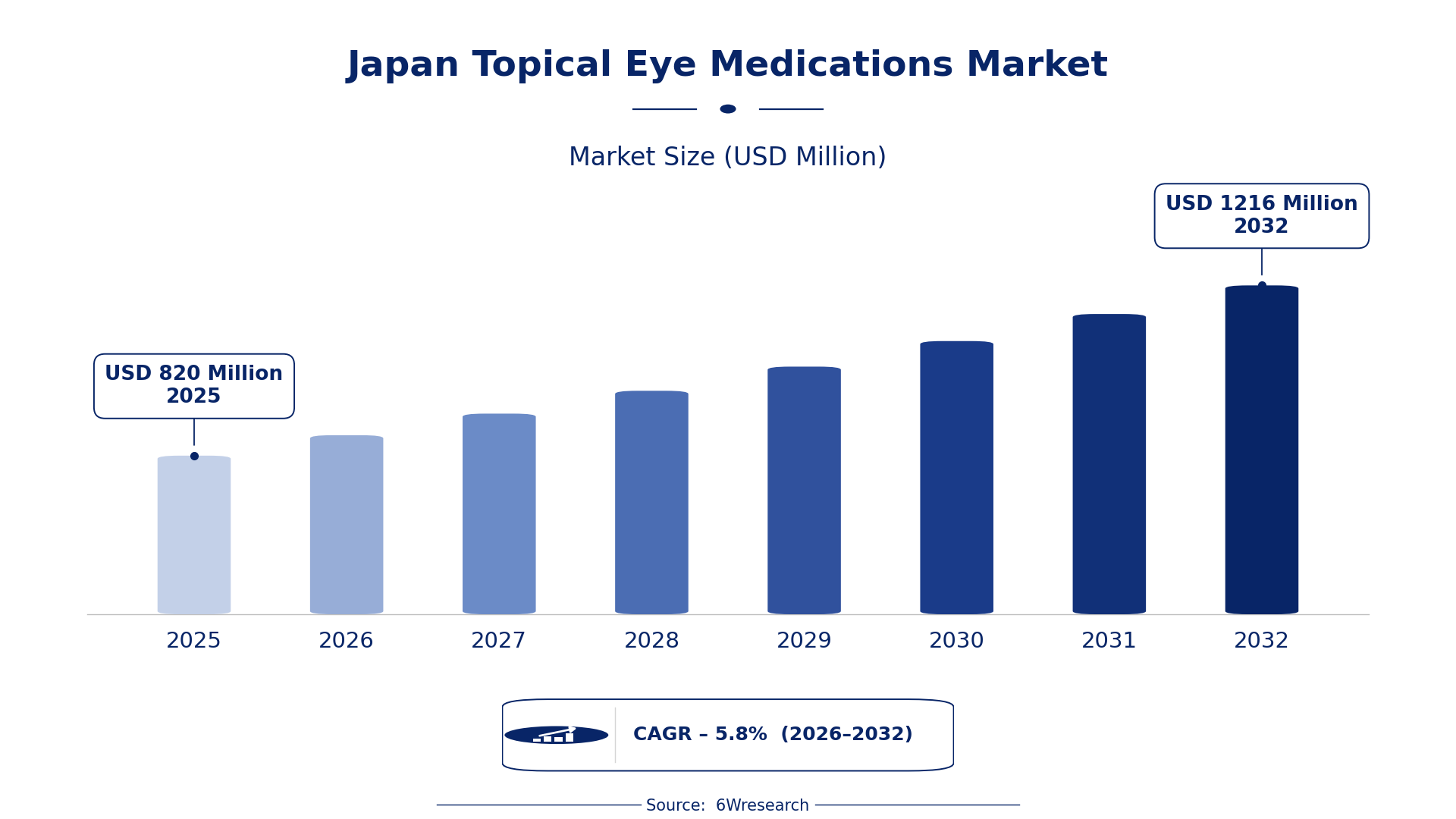
According to 6Wresearch internal database and industry insights, the Japan Topical Eye Medications Market was valued at USD 820 Million in 2025 and is projected to reach USD 1,216 Million by 2032, growing at a CAGR of approximately 5.8% during 2026–2032.
Japan Topical Eye Medications Market Highlights
| Report Metric | Details |
| Report Name | Japan Topical Eye Medications Market (2026-2032) |
| Market Size 2025 | USD 820 Million |
| Market Size 2032 | USD 1,216 Million |
| Absolute Growth 2025–2032 | USD 396 Million |
| CAGR 2026–2032 | 5.8% |
| Peak Annual Growth | 6.8% in 2029 |
| Forecast Period | 2026–2032 |
| Historical Data | 2022–2025 |
| Base Year | 2025 |
| Leading Topical Eye Medications, 2025 | Ophthalmic Antibiotics (48% share) |
| Leading Product Type, 2025 | Eye Drops (43% share) |
| Leading Active Ingredient, 2025 | Ciprofloxacin (45% share) |
| Leading Distribution Channel, 2025 | Pharmacies (41% share) |
| Leading End User Industry, 2025 | Eye Infections (45% share) |
| Fastest-Growing Topical Eye Medications | Anti-Glaucoma Drops (7.7% CAGR) |
| Fastest-Growing Product Type | Timolol (8.7% CAGR) |
| Fastest-Growing Active Ingredient | Tobramycin (7.8% CAGR) |
| Fastest-Growing Distribution Channel | Optometry Clinics (7.3% CAGR) |
| Fastest-Growing End User Industry | Glaucoma Patients (7.6% CAGR) |
| Growing Sector | ophthalmic healthcare |
| Key End Users | hospitals, clinics, pharmacies |
Japan Topical Eye Medications Market Year-wise Growth Rate and Key Drivers (2022–2032)
This graph illustrates the annual growth rates of the market from 2022 to 2032, highlighting a steady upward trajectory and projected market expansion over the forecast period.
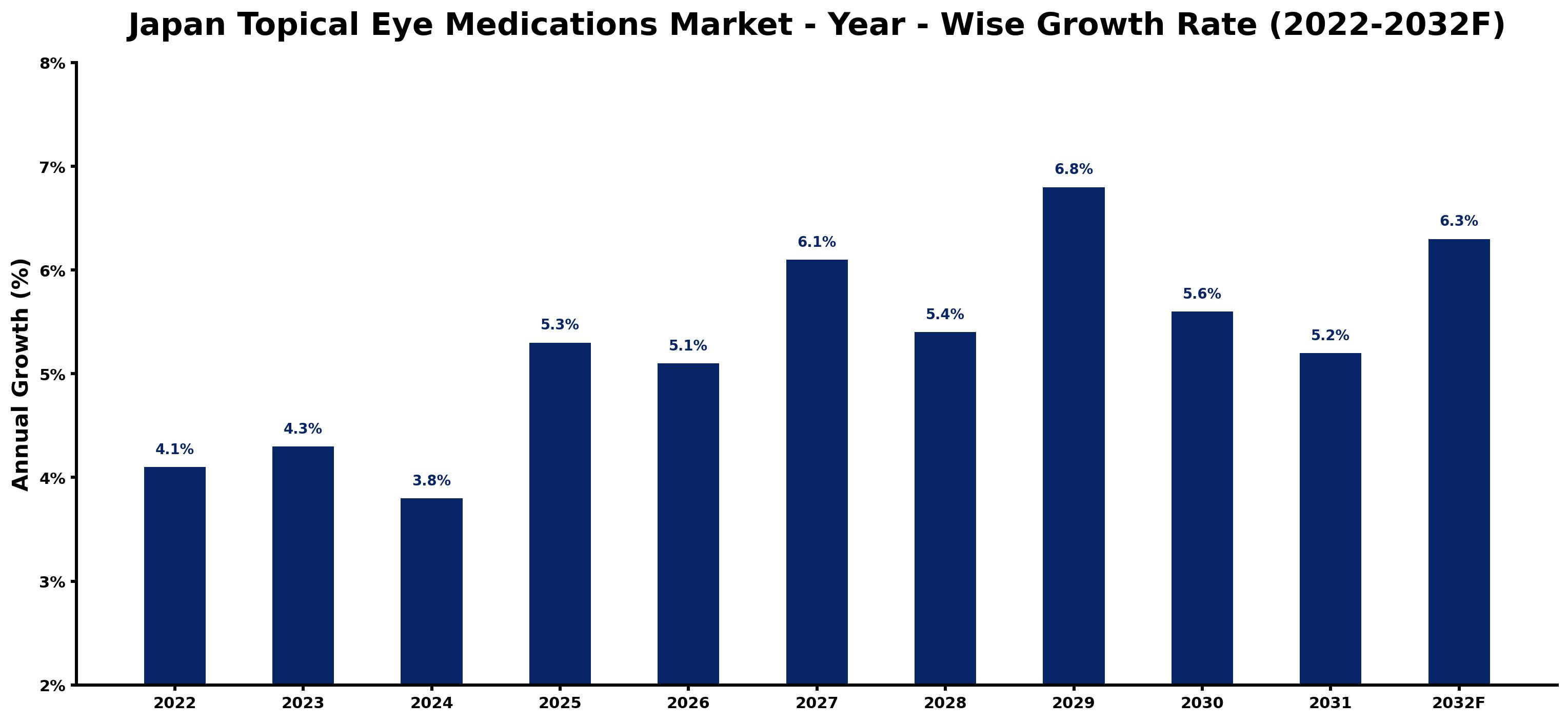
The following figures match every annual growth estimate with the main market development of that year, giving the reasoning behind each rise or slowdown.
| Year | Estimated Annual Growth (%) | Market Rationale |
| 2022 | 4.1 | The market experienced steady growth due to a significant portion of the population suffering from eye-related conditions. |
| 2023 | 4.3 | Demand increased as healthcare providers prioritised enhancing eye care services and patient outcomes. |
| 2024 | 3.8 | Growth slowed as the market adjusted to previous high demand levels and faced increased competition. |
| 2025 | 5.3 | The market surged with heightened awareness of eye health and a rise in prescriptions for topical medications. |
| 2026 | 5.1 | Growth is expected to slow as the market stabilises following the peak in demand for eye medications last year. |
| 2027 | 6.1 | Demand will rise as new treatment options become available, particularly for managing glaucoma. |
| 2028 | 5.4 | The market is projected to experience a slowdown as competition intensifies among various topical eye medication providers. |
| 2029 | 6.8 | Growth is expected to accelerate due to rising awareness and the introduction of new products in the ophthalmic sector. |
| 2030 | 5.6 | Demand will slow as market saturation begins to affect growth rates in established segments. |
| 2031 | 5.2 | Growth is projected to moderate as competitive pressures and market dynamics stabilise. |
| 2032 | 6.3 | Demand is expected to rise due to ongoing healthcare initiatives and an ageing population requiring eye care. |
Note: Market size estimations and growth projections presented in this report are based on 6Wresearch's proprietary forecasting methodology, utilizing the latest available industry data, government publications, and primary research inputs.
Japan Topical Eye Medications Market Synopsis
Topical eye medications are pharmaceutical formulations intended for ocular application, primarily designed to treat conditions such as eye infections, glaucoma, and dry eyes. The Japan Topical Eye Medications Market is expanding due to an ageing population, with 29.3% of citizens aged 65 or older, alongside a growing focus on eye health. The annual expenditure on eye care exceeds 500 billion yen, driven by healthcare providers and hospitals that are improving their ophthalmic services. This growth is supported by a robust domestic pharmaceutical industry and ongoing health initiatives aimed at improving access to eye care, particularly in urban areas.
Market Dynamics Impact Analysis (2026–2032)
| Factor | Type | Impact | Primary Segment Affected |
| An ageing population drives demand for eye care solutions, particularly for glaucoma and dry eye treatments. | Driver | High | Anti-Glaucoma Drops |
| The rise in eye-related conditions creates opportunities for innovative product development and market entry. | Opportunity | High | Ophthalmic Antibiotics |
| Regulatory hurdles can slow down the approval process for new ophthalmic products, affecting market entry. | Restraint | Medium | Ophthalmic Antibiotics |
| Increased competition among manufacturers may lead to price wars, impacting profit margins. | Challenge | High | Anti-Redness Solutions |
| Growing awareness of eye health leads to increased prescriptions for topical medications. | Driver | High | Eye Drops |
| The expansion of optometry clinics enhances access to eye care, driving demand for topical medications. | Opportunity | Medium | Lubricating Eye Drops |
| Stringent regulations for product safety and efficacy can delay market entry for new treatments. | Restraint | High | Anti-Glaucoma Drops |
| Market saturation in established segments may hinder growth potential for new entrants. | Challenge | Medium | Eye Infections |
Evaluation of Drivers in Japan Topical Eye Medications Market (2026–2032)
Key forces behind demand, with the segment each one moves most, are listed below.
| Drivers | Primary Segment Affected | Why It Matters (Evidence) |
| The increasing prevalence of glaucoma among the elderly population drives demand for anti-glaucoma drops. | Anti-Glaucoma Drops | Over 2 million people in Japan are diagnosed with glaucoma annually, leading to higher prescriptions. |
| The rise in dry eye syndrome cases boosts the demand for lubricating eye drops. | Lubricating Eye Drops | Around 20% of adults in Japan report experiencing dry eye symptoms, prompting more purchases. |
| Healthcare providers are expanding their ophthalmic services, increasing the need for topical eye medications. | Eye Drops | With approximately 8,100 hospitals in Japan, the demand for effective treatments is growing. |
| The focus on eye health awareness campaigns encourages more consumers to seek treatment for eye conditions. | Ophthalmic Antibiotics | Health initiatives launched in 2023 aim to improve public awareness of eye care. |
| The introduction of new formulations in topical eye medications stimulates market growth. | Anti-Redness Solutions | Products using hyaluronic acid are gaining traction in pharmacies, providing more options. |
Volumes grow on the back of an ageing population, with 29.3% of citizens aged 65 or older in September 2024. The prevalence of glaucoma is high, with over 2 million diagnoses annually, prompting increased prescriptions for anti-glaucoma drops. The rise in dry eye syndrome, affecting around 20% of adults, fuels demand for lubricating eye drops. New formulations, such as those containing hyaluronic acid, are also gaining popularity, providing more options in pharmacies. The expansion of healthcare services is evident as hospitals and clinics improve their ophthalmic offerings, leading to greater demand for effective treatments.
Evaluation of Restraints in Japan Topical Eye Medications Market
Several factors work against faster growth; the main ones are summarised below.
| Market Restraint | Primary Segment Affected | Why It Matters (Evidence) |
| Regulatory compliance for new ophthalmic products can delay market entry, affecting availability. | Ophthalmic Antibiotics | Stringent regulations from the Ministry of Health, Labour and Welfare can extend approval timelines. |
| Market saturation in established segments can limit growth opportunities for new entrants. | Anti-Glaucoma Drops | With many established products, new entrants face challenges in gaining market share. |
| High competition among manufacturers may lead to price wars, affecting profitability. | Anti-Redness Solutions | As more players enter the market, pricing pressures can impact margins. |
| Limited awareness among consumers about available treatments can hinder market growth. | Lubricating Eye Drops | Despite the high prevalence of dry eye, not all consumers seek treatment options. |
| Complex supply chains can lead to distribution challenges for topical eye medications. | Eye Drops | Pharmacies account for over 60% of distribution, making logistics critical. |
Japan Topical Eye Medications Market Challenges
Buyers face escalating costs due to the rising prevalence of eye conditions, with over 2 million new glaucoma diagnoses each year straining healthcare budgets. Regulatory hurdles slow the approval process for new medications, delaying access for hospitals and increasing treatment expenses. Many clinics rely on outdated diagnostic equipment, which can lead to misdiagnosis and ineffective treatments, inflating costs for patients. The significant portion of the population aged 65 and older intensifies the demand for effective eye care, resulting in longer wait times for treatments and increased pressure on healthcare resources.
Trends in the Japan Topical Eye Medications Market
These developments are changing demand patterns in the Japan Topical Eye Medications Market.
- Launch of Health Initiatives: In 2023, Japan initiated a health programme aimed at improving eye health awareness, particularly in rural areas. This initiative is expected to increase access to eye care services, driving demand for topical eye medications.
- Shift Towards New Formulations: The introduction of products featuring hyaluronic acid began in 2022, providing better hydration for dry eyes. This trend is evident in pharmacies, where these eye drops are becoming increasingly popular.
- Increased Focus on Glaucoma Management: Since 2022, there has been a growing emphasis on glaucoma management due to the high prevalence of the condition. This focus has led to a rise in prescriptions for anti-glaucoma drops, particularly Timolol.
- Expansion of Optometry Clinics: The growth of optometry clinics in urban areas is changing the distribution for topical eye medications. With a projected CAGR of 7.3%, these clinics are becoming key players in the eye care market.
Investment Opportunities in the Japan Topical Eye Medications Market
The opportunities below stand out in the Japan Topical Eye Medications Market for new entrants and existing suppliers.
- Glaucoma Patients Seeking Treatment: With over 2 million diagnosed annually, there is a pressing need for effective anti-glaucoma drops. Investing in targeted marketing strategies in urban areas can help capture this demand.
- Rising Demand for Dry Eye Relief: The prevalence of dry eye syndrome, affecting around 20% of adults, presents an opportunity for new lubricating eye drop products. Focusing on pharmacies in metropolitan regions can support market entry.
- Healthcare Providers Expanding Services: As hospitals and clinics expand their ophthalmic services, there is a growing need for topical eye medications. Collaborating with healthcare providers can facilitate product distribution and increase sales.
- Development of Advanced Formulations: The market gap for advanced formulations, such as those using hyaluronic acid, offers investment opportunities. Engaging with research institutions can speed up development and approval processes.
Government Initiatives in the Japan Topical Eye Medications Market
The Medical Care Act of 1948 sets essential standards for hospitals and clinics, ensuring quality care in ophthalmic treatments. This law mandates that facilities meet specific staffing and operational criteria, which directly impacts the availability of topical eye medications in Japan. Additionally, Japan's national medical care expenditure was about JPY 46.7 trillion in fiscal 2022, highlighting the importance of healthcare funding in this sector.
The Pharmaceuticals and Medical Devices Agency (PMDA) reviews and approves ophthalmic products, ensuring they meet safety and efficacy standards. Established in 2004, the PMDA monitors post-market safety, which is crucial for maintaining consumer trust in topical eye medications. The Japan Agency for Medical Research and Development (AMED), established in April 2015, funds medical research and development, supporting advancements in ophthalmic treatments.
Future Insight of the Japan Topical Eye Medications Market
Government initiatives will improve access to eye care, particularly in rural regions, as new programs are rolled out. Emerging diagnostic technologies will refine patient evaluations, which will improve treatment effectiveness and reduce expenses for clinics. Updated guidelines from the Japanese Ophthalmological Society will raise quality standards in eye care practices, benefiting both buyers and suppliers. As annual eye care spending exceeds 500 billion yen, investment in new ophthalmic medications will grow, creating a more competitive market.
Market Segmentation Analysis
Japan Topical Eye Medications Market report covers a detailed analysis of the following market segments:
By Topical Eye Medications – Ophthalmic Antibiotics Lead, Anti-Glaucoma Drops Expected to Grow Fastest
According to Saurav Kr Singh, Senior Research Analyst at 6Wresearch, in 2025, Ophthalmic Antibiotics led the topical eye medications split with a 48% share. Ophthalmic antibiotics are crucial for treating bacterial eye infections, with over 2 million cases diagnosed annually in Japan. Their widespread use in hospitals and clinics, particularly in metropolitan areas, underscores their importance in the healthcare system. Anti-Glaucoma Drops are projected to grow fastest, at a CAGR of 7.7% during 2026–2032. The increasing prevalence of glaucoma, especially among the ageing population averaging around 70 years, is driving demand for anti-glaucoma drops. This trend is likely to continue as healthcare providers prioritise effective management of intraocular pressure. Suppliers should focus on expanding their offerings in ophthalmic antibiotics to meet the growing healthcare needs in Japan.
By Product Type – Eye Drops Lead, Timolol Expected to Grow Fastest
Eye Drops took 43% of product type revenue in 2025, more than any other category. Eye drops represent the most common form of topical eye medications, widely used for various ocular conditions. Their versatility and ease of application make them the preferred choice among healthcare providers and patients alike. The quickest growth will come from Timolol, forecast to expand at a CAGR of 8.7% between 2026 and 2032. Timolol, a widely prescribed eye drop for glaucoma, is gaining traction as awareness of glaucoma management increases. Its effectiveness in controlling intraocular pressure ensures its rapid adoption in treatment protocols. Buyers will benefit from a broader range of effective eye drop formulations as competition increases in the market.
By Active Ingredient – Ciprofloxacin Leads, Tobramycin Expected to Grow Fastest
The largest active ingredient category in 2025 was Ciprofloxacin, at 45% of revenue. Ciprofloxacin stands out as a leading antibiotic for eye infections, known for its proven effectiveness and widespread prescription. Its established market presence ensures consistent demand from healthcare practitioners addressing ocular health. Over 2026–2032, Tobramycin is expected to post the fastest growth, at a CAGR of 7.8%. Tobramycin is gaining traction due to its efficacy against bacterial infections, which is particularly important in the context of rising antibiotic resistance. Its growing endorsement by ophthalmologists is a key factor in its rapid market ascent. Suppliers should focus on developing effective formulations with active ingredients like tobramycin to align with increasing market needs.
By Distribution Channel – Pharmacies Lead, Optometry Clinics Expected to Grow Fastest
With 41% of distribution channel revenue in 2025, Pharmacies was the largest category. Pharmacies serve as the primary distribution channel for topical eye medications, accounting for over 60% of sales. Their convenience and established trust among consumers make them the preferred choice for purchasing eye care products. Optometry Clinics are set to record the highest CAGR in this split, 7.3% over 2026–2032. Optometry clinics are rapidly emerging as key distributors of eye medications, particularly as they enhance their focus on comprehensive eye care. This trend is expected to gain momentum as patients increasingly seek specialised treatment options. Suppliers should consider forming partnerships with optometry clinics to tap into this growing distribution channel.
By End User Industry – Eye Infections Lead, Glaucoma Patients Expected to Grow Fastest
Eye Infections accounted for 45% of the market by end user industry in 2025. Eye infections are the primary condition treated with topical eye medications, representing a substantial portion of the market. The high prevalence of these infections among the elderly population ensures consistent demand. Glaucoma Patients are projected to grow fastest, at a CAGR of 7.6% during 2026–2032. Glaucoma patients represent a specific user group requiring long-term management, driving the growth of medications tailored to their needs. As awareness and diagnosis of glaucoma improve, this segment will continue to expand. Suppliers must adapt their strategies to cater to the unique needs of glaucoma patients to capture this growing market.
Key Attractiveness of the Report
- 10 Years of Market Numbers
- Historical Data Starting from 2022 to 2025
- Base Year 2025
- Forecast Data until 2032
- Key Performance Indicators Impacting the Market
- Major Upcoming Developments and Projects
Key Highlights of the Report:
- Japan Topical Eye Medications Market Outlook
- Market Size of Japan Topical Eye Medications Market, 2025
- Forecast of Japan Topical Eye Medications Market, 2032
- Historical Data and Forecast of Japan Topical Eye Medications Revenues & Volume for the Period 2022-2032F
- Japan Topical Eye Medications Market Trend Evolution
- Japan Topical Eye Medications Market Drivers and Challenges
- Japan Topical Eye Medications Price Trends
- Japan Topical Eye Medications Porter's Five Forces
- Japan Topical Eye Medications Industry Life Cycle
- Historical Data and Forecast of Japan Topical Eye Medications Market Revenues & Volume By Topical Eye Medications for the Period 2022-2032F
- Historical Data and Forecast of Japan Topical Eye Medications Market Revenues & Volume By Ophthalmic Antibiotics for the Period 2022-2032F
- Historical Data and Forecast of Japan Topical Eye Medications Market Revenues & Volume By Anti-Glaucoma Drops for the Period 2022-2032F
- Historical Data and Forecast of Japan Topical Eye Medications Market Revenues & Volume By Anti-Redness Solutions for the Period 2022-2032F
- Historical Data and Forecast of Japan Topical Eye Medications Market Revenues & Volume By Lubricating Eye Drops for the Period 2022-2032F
- Historical Data and Forecast of Japan Topical Eye Medications Market Revenues & Volume By Product Type for the Period 2022-2032F
- Historical Data and Forecast of Japan Topical Eye Medications Market Revenues & Volume By Eye Drops for the Period 2022-2032F
- Historical Data and Forecast of Japan Topical Eye Medications Market Revenues & Volume By Timolol, Latanoprost for the Period 2022-2032F
- Historical Data and Forecast of Japan Topical Eye Medications Market Revenues & Volume By Tetrahydrozoline for the Period 2022-2032F
- Historical Data and Forecast of Japan Topical Eye Medications Market Revenues & Volume By Artificial Tears for the Period 2022-2032F
- Historical Data and Forecast of Japan Topical Eye Medications Market Revenues & Volume By Active Ingredient for the Period 2022-2032F
- Historical Data and Forecast of Japan Topical Eye Medications Market Revenues & Volume By Ciprofloxacin, Tobramycin for the Period 2022-2032F
- Historical Data and Forecast of Japan Topical Eye Medications Market Revenues & Volume By Beta-blocker, PG Analog for the Period 2022-2032F
- Historical Data and Forecast of Japan Topical Eye Medications Market Revenues & Volume By Vasoconstrictor for the Period 2022-2032F
- Historical Data and Forecast of Japan Topical Eye Medications Market Revenues & Volume By Hyaluronic Acid for the Period 2022-2032F
- Historical Data and Forecast of Japan Topical Eye Medications Market Revenues & Volume By Distribution Channel for the Period 2022-2032F
- Historical Data and Forecast of Japan Topical Eye Medications Market Revenues & Volume By Pharmacies for the Period 2022-2032F
- Historical Data and Forecast of Japan Topical Eye Medications Market Revenues & Volume By Optometry Clinics for the Period 2022-2032F
- Historical Data and Forecast of Japan Topical Eye Medications Market Revenues & Volume By Supermarkets for the Period 2022-2032F
- Historical Data and Forecast of Japan Topical Eye Medications Market Revenues & Volume By Pharmacies for the Period 2022-2032F
- Historical Data and Forecast of Japan Topical Eye Medications Market Revenues & Volume By End User Industry for the Period 2022-2032F
- Historical Data and Forecast of Japan Topical Eye Medications Market Revenues & Volume By Eye Infections for the Period 2022-2032F
- Historical Data and Forecast of Japan Topical Eye Medications Market Revenues & Volume By Glaucoma Patients for the Period 2022-2032F
- Historical Data and Forecast of Japan Topical Eye Medications Market Revenues & Volume By General Consumers for the Period 2022-2032F
- Historical Data and Forecast of Japan Topical Eye Medications Market Revenues & Volume By Dry Eye Relief for the Period 2022-2032F
- Japan Topical Eye Medications Import Export Trade Statistics
- Market Opportunity Assessment By Topical Eye Medications
- Market Opportunity Assessment By Product Type
- Market Opportunity Assessment By Active Ingredient
- Market Opportunity Assessment By Distribution Channel
- Market Opportunity Assessment By End User Industry
- Japan Topical Eye Medications Top Companies Market Share
- Japan Topical Eye Medications Competitive Benchmarking By Technical and Operational Parameters
- Japan Topical Eye Medications Company Profiles
- Japan Topical Eye Medications Key Strategic Recommendations
Market Covered
The report covers the following segments.
By Topical Eye Medications
- Ophthalmic Antibiotics
- Anti-Glaucoma Drops
- Anti-Redness Solutions
- Lubricating Eye Drops
By Product Type
- Eye Drops
- Timolol
- Latanoprost
- Tetrahydrozoline
- Artificial Tears
By Active Ingredient
- Ciprofloxacin
- Tobramycin
- Beta-blocker
- PG Analog
- Vasoconstrictor
- Hyaluronic Acid
By Distribution Channel
- Pharmacies
- Optometry Clinics
- Supermarkets
By End User Industry
- Eye Infections
- Glaucoma Patients
- General Consumers
- Dry Eye Relief































