Japan Total Artificial Organs Market Size & Growth Rate
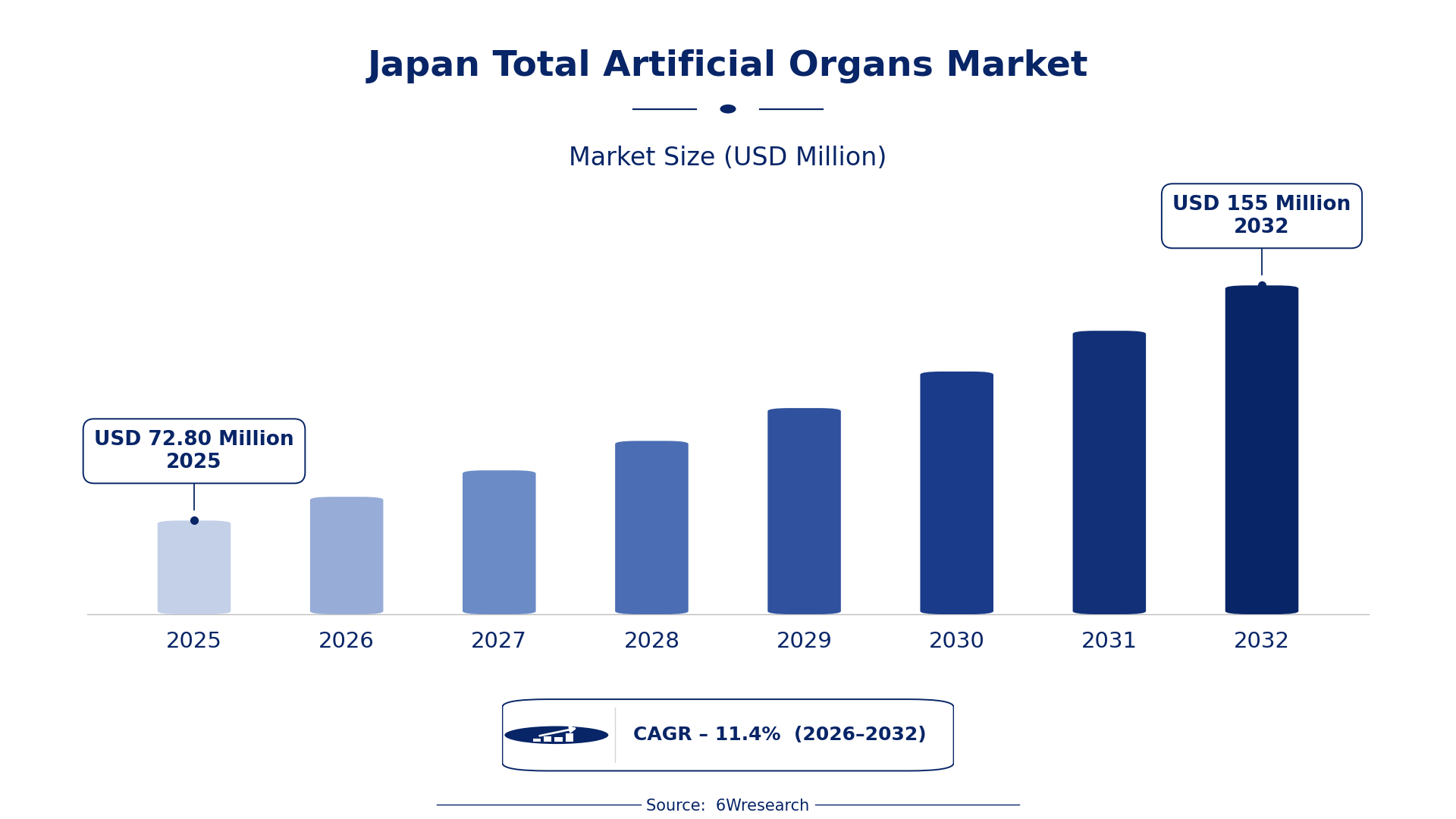
According to 6Wresearch internal database and industry insights, the Japan Total Artificial Organs Market was valued at USD 72.80 Million in 2025 and is projected to reach USD 155 Million by 2032, growing at a CAGR of approximately 11.4% during 2026–2032.
Japan Total Artificial Organs Market Highlights
| Report Metric | Details |
| Report Name | Japan Total Artificial Organs Market (2026-2032) |
| Market Size 2025 | USD 72.80 Million |
| Market Size 2032 | USD 155 Million |
| Absolute Growth 2025–2032 | USD 82.20 Million |
| CAGR 2026–2032 | 11.4% |
| Peak Annual Growth | 15.1% in 2032 |
| Forecast Period | 2026–2032 |
| Historical Data | 2022–2025 |
| Base Year | 2025 |
| Leading Artificial Organs, 2025 | Artificial Hearts (38% share) |
| Leading Product Type, 2025 | PITM Systems (44% share) |
| Leading Organ Replacement Type, 2025 | Ventricular Assist (45% share) |
| Leading Distribution Channel, 2025 | Medical Device Manufacturers (40% share) |
| Leading End User Industry, 2025 | Cardiac Surgery Centers (40% share) |
| Fastest-Growing Artificial Organs | Artificial Lungs (15.6% CAGR) |
| Fastest-Growing Product Type | Bio-Artificial Kidneys (17.7% CAGR) |
| Fastest-Growing Organ Replacement Type | Oxygenation Support (16.5% CAGR) |
| Fastest-Growing Distribution Channel | Critical Care Distributors (16.1% CAGR) |
| Fastest-Growing End User Industry | Nephrology Clinics (15.1% CAGR) |
| Growing Sector | Nephrology Clinics |
| Key End Users | Cardiac Surgery Centers, Nephrology Clinics, ICUs & Emergency Care, Transplant Centers |
Japan Total Artificial Organs Market Year-wise Growth Rate and Key Drivers (2022–2032)
This graph illustrates the annual growth rates of the market from 2022 to 2032, highlighting a steady upward trajectory and projected market expansion over the forecast period.
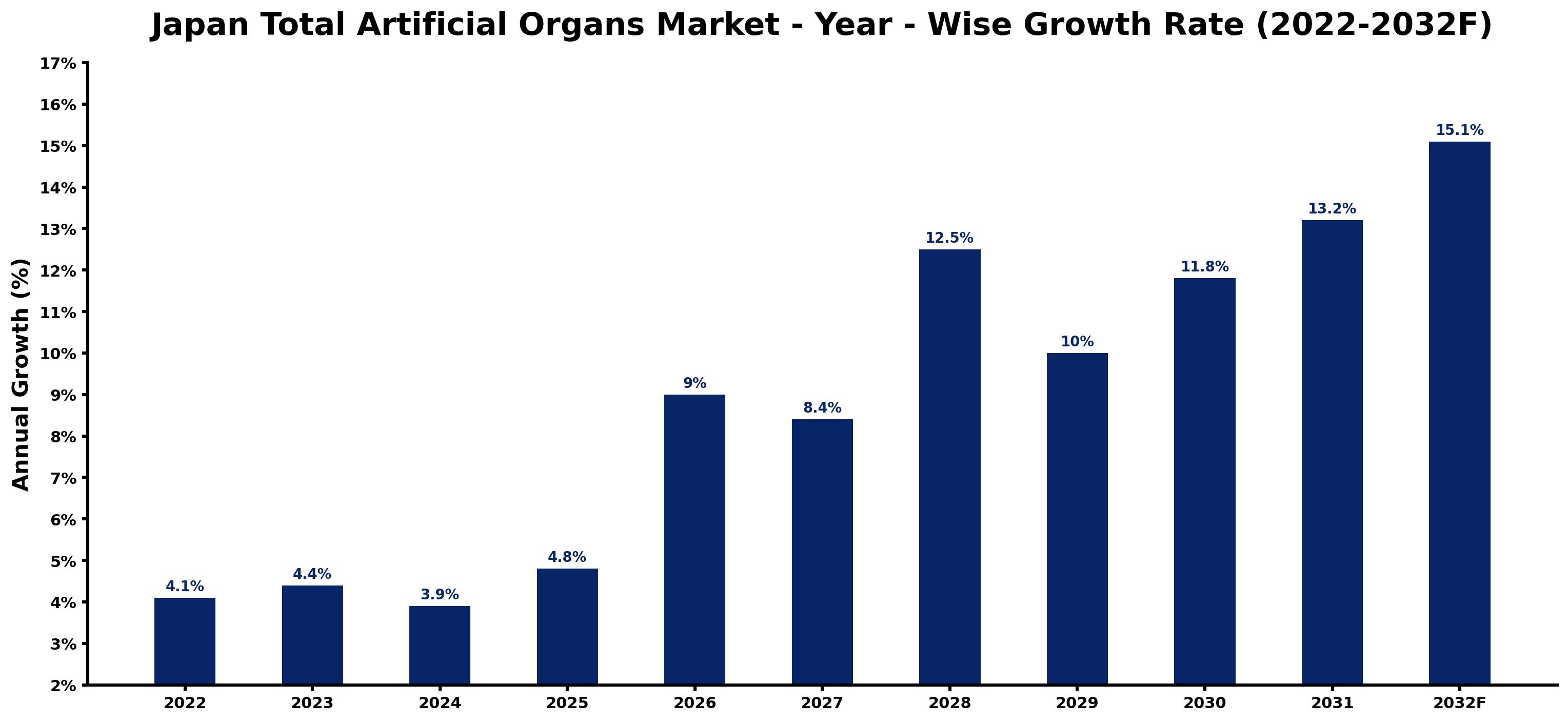
For each year, the table pairs the estimated growth rate with the leading influence on demand, showing how the drivers changed across the period.
| Year | Estimated Annual Growth (%) | Market Rationale |
| 2022 | 4.1 | The market experienced steady growth, reflecting ongoing advancements in medical technology. |
| 2023 | 4.4 | Growth accelerated due to increased investments in healthcare infrastructure and organ transplant technologies. |
| 2024 | 3.9 | A slight slowdown occurred as the market adjusted to new regulatory frameworks and standards. |
| 2025 | 4.8 | Growth rebounded with heightened demand for artificial organs amid rising chronic disease cases. |
| 2026 | 9.0 | The market is expected to expand as hospitals adopt advanced organ support systems. |
| 2027 | 8.4 | A slowdown in growth is projected as market saturation begins to affect new purchases. |
| 2028 | 12.5 | Demand is expected to surge again with innovations in artificial organ technology and increased public awareness. |
| 2029 | 10.0 | Growth is projected to moderate as competition intensifies among manufacturers and suppliers. |
| 2030 | 11.8 | The market will see renewed interest driven by government initiatives to increase organ donation rates. |
| 2031 | 13.2 | Growth will continue to rise due to the increasing elderly population requiring advanced medical care. |
| 2032 | 15.1 | A peak in growth is expected as breakthrough technologies transform organ replacement solutions. |
Note: Market size estimations and growth projections presented in this report are based on 6Wresearch's proprietary forecasting methodology, utilizing the latest available industry data, government publications, and primary research inputs.
Japan Total Artificial Organs Market Synopsis
Total artificial organs are advanced medical devices designed to replicate human organ functions, utilising biocompatible materials and engineering techniques. Their primary applications include life support for organ failure patients and improving quality of life for transplant candidates. The Japan Total Artificial Organs Market is expanding, driven by a population of approximately 125 million suffering from chronic diseases, around 300 cardiac surgery centers, and government initiatives aimed at improving organ transplant technologies, with a budget of ¥5 billion in 2023.
Market Dynamics Impact Analysis (2026–2032)
| Factor | Type | Impact | Primary Segment Affected |
| Increasing prevalence of chronic diseases drives demand for artificial organs. | Driver | High | Artificial Hearts |
| Technological advancements in organ replacement systems create new market opportunities. | Driver | High | Bio-Artificial Kidneys |
| Growing patient population on dialysis highlights the need for kidney replacement technologies. | Opportunity | High | Total Kidney Replacement |
| Emerging research on artificial organ technologies opens avenues for innovation. | Opportunity | Medium | Artificial Lungs |
| Regulatory challenges may delay the approval of new artificial organ technologies. | Restraint | High | PITM Systems |
| High costs associated with advanced medical devices limit access for some healthcare facilities. | Restraint | Medium | ECMO Systems |
| Limited reimbursement policies may restrict market growth for certain artificial organs. | Challenge | High | Artificial Hearts |
| Capacity constraints in production facilities can hinder supply chain efficiency. | Challenge | Medium | Total Kidney Replacement |
Evaluation of Drivers in Japan Total Artificial Organs Market (2026–2032)
Key forces behind demand, with the segment each one moves most, are listed below.
| Drivers | Primary Segment Affected | Why It Matters (Evidence) |
| Rising cases of heart disease increase demand for artificial hearts. | Artificial Hearts | Approximately 340,000 patients in Japan require advanced heart support, driving purchases. |
| Technological advancements in kidney replacement technologies improve treatment options. | Total Kidney Replacement | With around 340,000 dialysis patients, demand for new solutions is growing. |
| Government funding for organ transplant technologies boosts market growth. | Bio-Artificial Kidneys | The ¥5 billion budget in 2023 supports research and development in artificial organs. |
| Increased awareness around organ donation encourages more patients to seek artificial organs. | Artificial Lungs | Public campaigns aim to improve organ donation rates, positively impacting demand. |
| Expansion of cardiac surgery centers enhances access to artificial heart technologies. | Ventricular Assist | With around 300 cardiac surgery centers, more patients can receive advanced treatments. |
Several shifts outside the market lift sales. The increasing prevalence of chronic diseases, with approximately 340,000 patients on dialysis, drives demand for kidney replacement technologies. A budget of ¥5 billion in 2023 for organ transplant technologies supports research and development, boosting the market. Awareness campaigns are increasing organ donation rates, further encouraging patients to seek artificial organs. The growth of cardiac surgery centers, numbering around 300, increases access to advanced heart support technologies, leading to higher purchases across the sector.
Evaluation of Restraints in Japan Total Artificial Organs Market
Below are the constraints most often cited by buyers and suppliers, with the segment each affects.
| Market Restraint | Primary Segment Affected | Why It Matters (Evidence) |
| Regulatory hurdles delay the approval of new artificial organ technologies. | PITM Systems | The lengthy approval process can postpone market entry for new devices, affecting supply. |
| High production costs limit the availability of advanced artificial organs. | ECMO Systems | Manufacturers face challenges in scaling production while maintaining quality standards. |
| Limited reimbursement options restrict patient access to certain artificial organs. | Artificial Hearts | Patients may struggle to afford advanced treatments without adequate insurance coverage. |
| Competition among manufacturers may lead to price wars, impacting profitability. | Total Kidney Replacement | As more players enter the market, pricing pressures can affect revenue for producers. |
| Supply chain disruptions can hinder the timely delivery of critical medical devices. | Bio-Artificial Kidneys | Global supply chain issues may delay essential components needed for production. |
Japan Total Artificial Organs Market Challenges
Dependence on specific biocompatible materials creates supply issues, leading to production delays of up to six months for producers, which hampers hospitals' ability to deliver timely patient care. Stringent compliance with ISO 13485 certification results in regulatory hurdles, causing approval delays that can extend to two years for importers, limiting the availability of new technologies for clinics. Buyers face high costs for artificial organs, with average prices exceeding ¥10 million, restricting access for patients requiring urgent treatment. Lengthy clinical trials, often taking over five years, slow technology development, delaying new treatment options for patients awaiting transplants.
Trends in the Japan Total Artificial Organs Market
These developments are changing demand patterns in the Japan Total Artificial Organs Market.
- Shift Towards Biocompatible Materials: Japan is adopting biocompatible materials in artificial organ production, improving patient safety and device longevity. The Japan Agency for Medical Research and Development is leading initiatives to develop these materials, focusing on biocompatibility standards.
- Growing Use of ECMO Systems in Critical Care: The adoption of ECMO systems in ICUs is rising, with approximately 15,000 units installed nationwide. This trend reflects the increasing need for advanced life support in critical care settings, driven by the aging population.
- Expansion of Cardiac Surgery Centers: The number of cardiac surgery centers across Japan has reached around 300, facilitating greater access to advanced heart treatments. This expansion supports the rising demand for artificial hearts and related technologies.
- Increased Research on Artificial Organ Technologies: Clinical trials for new artificial organ technologies are being conducted at major universities, promoting innovation. This research is crucial for developing next-generation devices that meet evolving patient needs.
Investment Opportunities in the Japan Total Artificial Organs Market
The opportunities below stand out in the Japan Total Artificial Organs Market for new entrants and existing suppliers.
- Investment in Kidney Replacement Technologies: The total number of dialysis patients in Japan is approximately 340,000, indicating a market gap. Investing in kidney replacement technologies can address this demand, particularly in Nephrology Clinics.
- Development of Advanced Artificial Heart Solutions: With the average age of artificial heart recipients around 55 years, there is a growing need for new solutions. Collaborating with cardiac surgery centers can facilitate entry into this expanding market.
- Supply of Biocompatible Materials for Artificial Organs: The shift towards biocompatible materials presents an opportunity for suppliers. Focusing on partnerships with medical device manufacturers can strengthen market presence in this sector.
- Expansion of Critical Care Distribution Channels: The growing demand for ECMO systems highlights the need for efficient distribution channels. Establishing joint ventures with critical care distributors can streamline access to essential medical devices.
Government Initiatives in the Japan Total Artificial Organs Market
The Economic Security Promotion Act, enacted in 2022, supports supply-chain resilience for critical products, including artificial organs. This law complements the Long-Term Care Insurance Act, which has been in force since 2000, providing funding for nursing care and support services, thus improving the overall healthcare framework for artificial organ producers and users.
The Ministry of Health, Labour and Welfare oversees the approval of medical devices, including artificial organs. The agency funds initiatives to improve healthcare infrastructure, ensuring that new technologies meet safety and quality standards, which directly benefits both producers and patients.
Future Insight of the Japan Total Artificial Organs Market
By 2032, the investment pipeline for organ transplant technologies will expand, driven by a government budget of ¥5 billion aimed at improving these systems. This funding will stimulate demand for advanced artificial organs, benefiting both buyers and suppliers. Streamlined approval processes for medical devices will enable faster market entry for new technologies. Increased public awareness campaigns will likely improve organ donation rates, further supporting the need for advanced medical solutions.
Market Segmentation Analysis
Japan Total Artificial Organs Market report covers a detailed analysis of the following market segments:
By Artificial Organs – Artificial Hearts Lead, Artificial Lungs Expected to Grow Fastest
According to Saurav Kr Singh, Senior Research Analyst at 6Wresearch, Artificial Hearts accounted for 38% of the market by artificial organs in 2025. Artificial Hearts command the largest share because they are vital for patients with severe heart failure, addressing a critical healthcare need. The established network of cardiac surgery centres across Japan ensures a steady demand for these essential devices. The quickest growth will come from Artificial Lungs, forecast to expand at a CAGR of 15.6% between 2026 and 2032. The growth of Artificial Lungs is propelled by the increasing incidence of severe respiratory failure among patients, creating urgent demand. With the average wait time for organ transplants exceeding 5 years, the necessity for these devices is intensifying. Suppliers should focus on scaling production to meet the rising demand for artificial organs.
By Product Type – PITM Systems Lead, Bio-Artificial Kidneys Expected to Grow Fastest
PITM Systems took 44% of product type revenue in 2025, more than any other category. PITM Systems are at the forefront as they play a crucial role in supporting organ function for patients requiring assistance. Their integration into various healthcare settings underscores their importance as a key solution for medical professionals. Bio-Artificial Kidneys are set to record the highest CAGR in this split, 17.7% over 2026–2032. Bio-Artificial Kidneys are witnessing rapid growth, primarily due to the approximately 340,000 patients on dialysis in Japan. This significant patient population highlights the pressing need for advancements in kidney replacement technologies. Buyers can anticipate greater availability and advancements in kidney replacement solutions.
By Organ Replacement Type – Ventricular Assist Leads, Oxygenation Support Expected to Grow Fastest
In 2025, Ventricular Assist led the organ replacement type split with a 45% share. Ventricular Assist devices dominate the market as they are essential for heart transplant candidates, providing necessary support for circulation. Their established use in cardiac surgery centres reinforces their strong market position. Oxygenation Support is projected to grow fastest, at a CAGR of 16.5% during 2026–2032. Oxygenation Support systems are gaining momentum as they are critical for treating patients in respiratory distress. The ongoing clinical trials for new technologies suggest a promising future for this segment. Suppliers should prioritise research and development to enhance oxygenation support technologies.
By Distribution Channel – Medical Device Manufacturers Lead, Critical Care Distributors Expected to Grow Fastest
Medical Device Manufacturers held 40% of the Japan Total Artificial Organs Market by distribution channel in 2025. Medical Device Manufacturers are the primary producers of artificial organs, ensuring a consistent supply to healthcare facilities. Their established relationships with hospitals and clinics facilitate effective distribution and market access. Over 2026–2032, Critical Care Distributors are expected to post the fastest growth, at a CAGR of 16.1%. Critical Care Distributors are expanding rapidly, as they play a crucial role in the distribution of essential medical devices. Their direct connections with healthcare providers position them well for continued growth in this sector. Suppliers must strengthen collaborations with distributors to improve market penetration and service delivery.
By End User Industry – Cardiac Surgery Centers Lead, Nephrology Clinics Expected to Grow Fastest
With 40% of end user industry revenue in 2025, Cardiac Surgery Centers was the largest category. Cardiac Surgery Centers lead the market as specialised facilities conducting heart-related surgeries that require advanced artificial organs. Their focus on enhancing patient outcomes drives the demand for these technologies. The quickest growth will come from Nephrology Clinics, forecast to expand at a CAGR of 15.1% between 2026 and 2032. Nephrology Clinics are experiencing swift growth due to the increasing focus on kidney-related treatments, particularly for dialysis patients. This trend reflects a broader shift towards specialised care within the healthcare landscape. Buyers in nephrology should brace for an influx of new technologies and treatment options.
Key Attractiveness of the Report
- 10 Years of Market Numbers
- Historical Data Starting from 2022 to 2025
- Base Year 2025
- Forecast Data until 2032
- Key Performance Indicators Impacting the Market
- Major Upcoming Developments and Projects
Key Highlights of the Report:
- Japan Total Artificial Organs Market Outlook
- Market Size of Japan Total Artificial Organs Market, 2025
- Forecast of Japan Total Artificial Organs Market, 2032
- Historical Data and Forecast of Japan Total Artificial Organs Revenues & Volume for the Period 2022-2032F
- Japan Total Artificial Organs Market Trend Evolution
- Japan Total Artificial Organs Market Drivers and Challenges
- Japan Total Artificial Organs Price Trends
- Japan Total Artificial Organs Porter's Five Forces
- Japan Total Artificial Organs Industry Life Cycle
- Historical Data and Forecast of Japan Total Artificial Organs Market Revenues & Volume By Artificial Organs for the Period 2022-2032F
- Historical Data and Forecast of Japan Total Artificial Organs Market Revenues & Volume By Artificial Hearts for the Period 2022-2032F
- Historical Data and Forecast of Japan Total Artificial Organs Market Revenues & Volume By Total Kidney Replacement for the Period 2022-2032F
- Historical Data and Forecast of Japan Total Artificial Organs Market Revenues & Volume By Artificial Lungs for the Period 2022-2032F
- Historical Data and Forecast of Japan Total Artificial Organs Market Revenues & Volume By Liver Support Devices for the Period 2022-2032F
- Historical Data and Forecast of Japan Total Artificial Organs Market Revenues & Volume By Product Type for the Period 2022-2032F
- Historical Data and Forecast of Japan Total Artificial Organs Market Revenues & Volume By PITM Systems for the Period 2022-2032F
- Historical Data and Forecast of Japan Total Artificial Organs Market Revenues & Volume By Bio-Artificial Kidneys for the Period 2022-2032F
- Historical Data and Forecast of Japan Total Artificial Organs Market Revenues & Volume By ECMO Systems for the Period 2022-2032F
- Historical Data and Forecast of Japan Total Artificial Organs Market Revenues & Volume By Bioartificial Liver for the Period 2022-2032F
- Historical Data and Forecast of Japan Total Artificial Organs Market Revenues & Volume By Organ Replacement Type for the Period 2022-2032F
- Historical Data and Forecast of Japan Total Artificial Organs Market Revenues & Volume By Ventricular Assist for the Period 2022-2032F
- Historical Data and Forecast of Japan Total Artificial Organs Market Revenues & Volume By Hemodialysis + Biofilter for the Period 2022-2032F
- Historical Data and Forecast of Japan Total Artificial Organs Market Revenues & Volume By Oxygenation Support for the Period 2022-2032F
- Historical Data and Forecast of Japan Total Artificial Organs Market Revenues & Volume By Enzyme+Apheresis for the Period 2022-2032F
- Historical Data and Forecast of Japan Total Artificial Organs Market Revenues & Volume By Distribution Channel for the Period 2022-2032F
- Historical Data and Forecast of Japan Total Artificial Organs Market Revenues & Volume By Medical Device Manufacturers for the Period 2022-2032F
- Historical Data and Forecast of Japan Total Artificial Organs Market Revenues & Volume By Hospital Vendors for the Period 2022-2032F
- Historical Data and Forecast of Japan Total Artificial Organs Market Revenues & Volume By Critical Care Distributors for the Period 2022-2032F
- Historical Data and Forecast of Japan Total Artificial Organs Market Revenues & Volume By Specialty Biomedical Sellers for the Period 2022-2032F
- Historical Data and Forecast of Japan Total Artificial Organs Market Revenues & Volume By End User Industry for the Period 2022-2032F
- Historical Data and Forecast of Japan Total Artificial Organs Market Revenues & Volume By Cardiac Surgery Centers for the Period 2022-2032F
- Historical Data and Forecast of Japan Total Artificial Organs Market Revenues & Volume By Nephrology Clinics for the Period 2022-2032F
- Historical Data and Forecast of Japan Total Artificial Organs Market Revenues & Volume By ICUs & Emergency Care for the Period 2022-2032F
- Historical Data and Forecast of Japan Total Artificial Organs Market Revenues & Volume By Transplant Centers for the Period 2022-2032F
- Japan Total Artificial Organs Import Export Trade Statistics
- Market Opportunity Assessment By Artificial Organs
- Market Opportunity Assessment By Product Type
- Market Opportunity Assessment By Organ Replacement Type
- Market Opportunity Assessment By Distribution Channel
- Market Opportunity Assessment By End User Industry
- Japan Total Artificial Organs Top Companies Market Share
- Japan Total Artificial Organs Competitive Benchmarking By Technical and Operational Parameters
- Japan Total Artificial Organs Company Profiles
- Japan Total Artificial Organs Key Strategic Recommendations
Market Covered
The following segment groups are covered in the report.
By Artificial Organs
- Artificial Hearts
- Total Kidney Replacement
- Artificial Lungs
- Liver Support Devices
By Product Type
- PITM Systems
- Bio-Artificial Kidneys
- ECMO Systems
- Bioartificial Liver
By Organ Replacement Type
- Ventricular Assist
- Hemodialysis + Biofilter
- Oxygenation Support
- Enzyme+Apheresis
By Distribution Channel
- Medical Device Manufacturers
- Hospital Vendors
- Critical Care Distributors
- Specialty Biomedical Sellers
By End User Industry
- Cardiac Surgery Centers
- Nephrology Clinics
- ICUs & Emergency Care
- Transplant Centers































