Japan Touchless Entry Solutions Market Size & Growth Rate
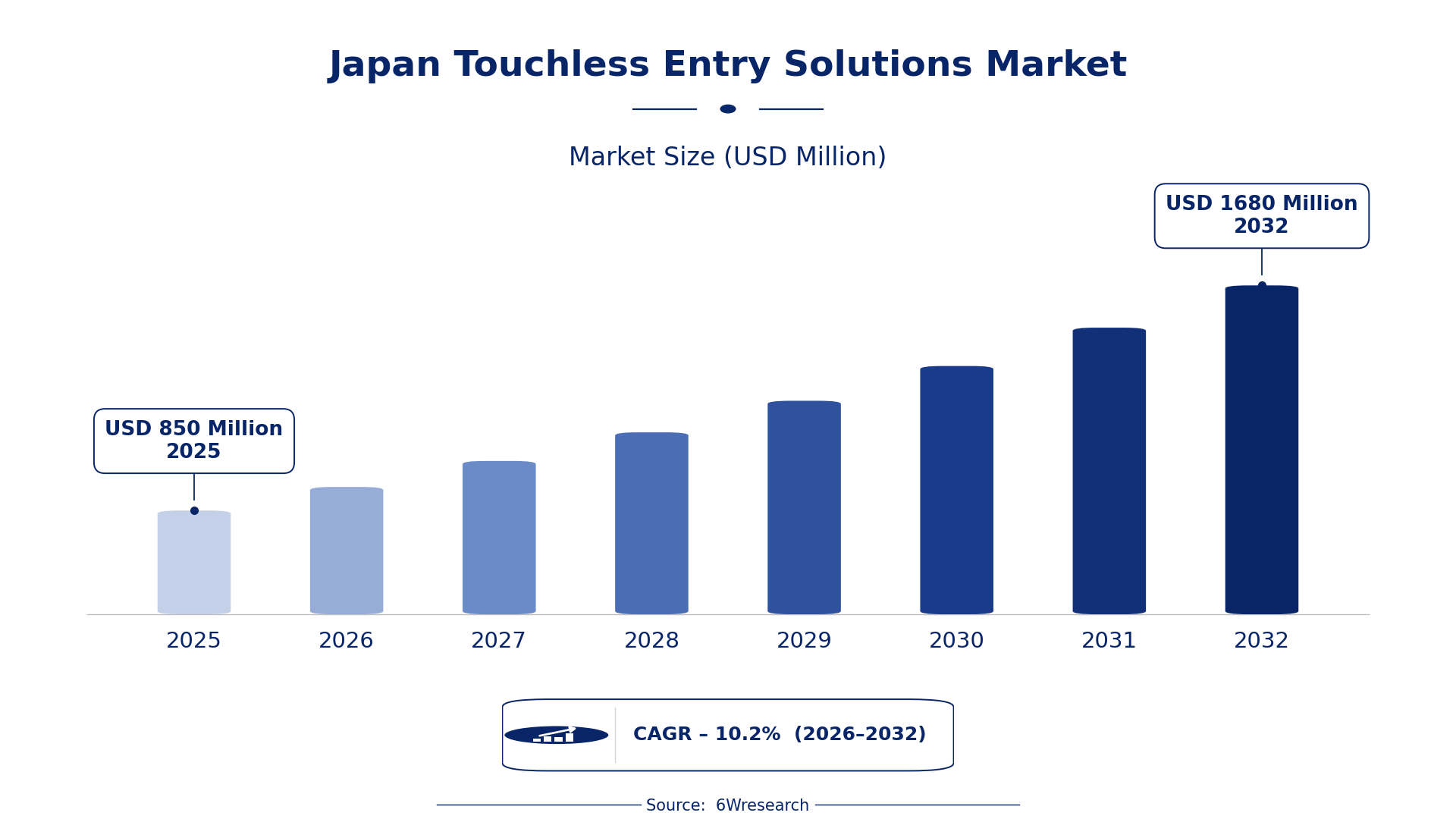
According to 6Wresearch internal database and industry insights, the Japan Touchless Entry Solutions Market was valued at USD 850 Million in 2025 and is projected to reach USD 1,680 Million by 2032, growing at a CAGR of approximately 10.2% during 2026–2032.
Japan Touchless Entry Solutions Market Highlights
| Report Metric | Details |
| Report Name | Japan Touchless Entry Solutions Market (2026-2032) |
| Market Size 2025 | USD 850 Million |
| Market Size 2032 | USD 1,680 Million |
| Absolute Growth 2025–2032 | USD 830 Million |
| CAGR 2026–2032 | 10.2% |
| Peak Annual Growth | 11.7% in 2032 |
| Forecast Period | 2026–2032 |
| Historical Data | 2022–2025 |
| Base Year | 2025 |
| Leading Technology Type, 2025 | Biometric-Based (38% share) |
| Leading Access Method, 2025 | Face Recognition (42% share) |
| Leading Application Area, 2025 | Commercial Buildings (45% share) |
| Leading End User, 2025 | Enterprises (50% share) |
| Fastest-Growing Technology Type | Mobile App-Based (14.9% CAGR) |
| Fastest-Growing Access Method | Bluetooth/NFC (14.6% CAGR) |
| Fastest-Growing Application Area | Residential Complexes (12.4% CAGR) |
| Fastest-Growing End User | Smart Home Users (13.7% CAGR) |
| Growing Sector | Residential Complexes |
| Key End Users | Commercial Buildings, Hospitality, Residential Complexes, Automotive |
Japan Touchless Entry Solutions Market Year-wise Growth Rate and Key Drivers (2022–2032)
This graph illustrates the annual growth rates of the market from 2022 to 2032, highlighting a steady upward trajectory and projected market expansion over the forecast period.
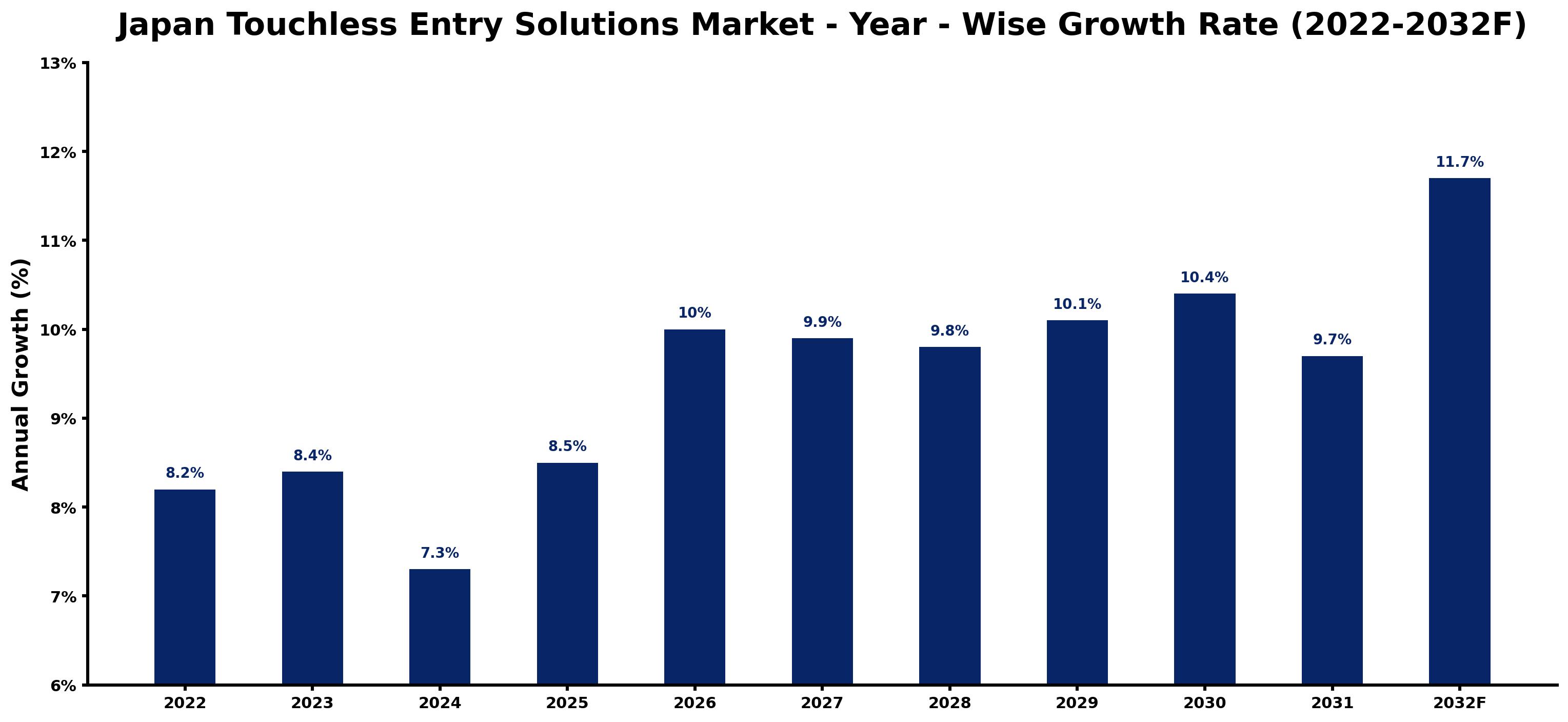
Annual growth estimates for each year appear below with the principal reason behind them, explaining the shifts that set the pace of the market.
| Year | Estimated Annual Growth (%) | Market Rationale |
| 2022 | 8.2 | The market experienced steady growth, driven by increased adoption in commercial buildings. |
| 2023 | 8.4 | Demand accelerated as more enterprises implemented touchless solutions for improved security. |
| 2024 | 7.3 | Growth slowed slightly due to market saturation in some commercial sectors. |
| 2025 | 8.5 | Demand surged again as new hotel constructions integrated touchless entry systems. |
| 2026 | 10.0 | Growth is expected to accelerate with rising smart home adoption among residential users. |
| 2027 | 9.9 | A slight slowdown is projected as the market matures and competition intensifies. |
| 2028 | 9.8 | Demand will continue to grow but at a slower rate as market conditions stabilise. |
| 2029 | 10.1 | Growth is expected to pick up again as urban areas expand their touchless infrastructure. |
| 2030 | 10.4 | Increased investments in smart city projects will further boost demand for touchless solutions. |
| 2031 | 9.7 | The market will experience a slowdown as growth begins to normalise after rapid expansion. |
| 2032 | 11.7 | Demand is projected to peak with significant investments in touchless technologies across sectors. |
Note: Market size estimations and growth projections presented in this report are based on 6Wresearch's proprietary forecasting methodology, utilizing the latest available industry data, government publications, and primary research inputs.
Japan Touchless Entry Solutions Market Synopsis
Touchless Entry Solutions utilise technologies such as RFID, biometrics, and mobile applications to facilitate contactless access, improving security and convenience in various settings. The Japan Touchless Entry Solutions Market is expanding due to strong demand from commercial buildings, residential complexes, and the hospitality sector. The smart home market, valued at approximately 1.5 trillion JPY in 2023, along with government initiatives promoting smart city projects, is driving further adoption of these technologies.
Market Dynamics Impact Analysis (2026–2032)
| Factor | Type | Impact | Primary Segment Affected |
| Increased adoption of touchless solutions in commercial buildings improves security and convenience. | Driver | High | Commercial Buildings |
| Growing residential smart home market drives demand for touchless entry solutions. | Driver | High | Residential Complexes |
| Expansion of smart city initiatives creates opportunities for touchless technology integration. | Opportunity | High | Commercial Buildings |
| Rising demand for improved guest experiences in hospitality opens new markets for touchless systems. | Opportunity | High | Hospitality |
| Market saturation in some sectors may limit growth potential for new entrants. | Restraint | Medium | Commercial Buildings |
| High initial investment costs can deter adoption among smaller enterprises. | Restraint | Medium | Enterprises |
| Intense competition among suppliers may lead to price wars, affecting profitability. | Challenge | High | Biometric-Based |
| Rapid technological advancements require constant innovation from suppliers to stay relevant. | Challenge | High | Biometric-Based |
Evaluation of Drivers in Japan Touchless Entry Solutions Market (2026–2032)
Key forces behind demand, with the segment each one moves most, are listed below.
| Drivers | Primary Segment Affected | Why It Matters (Evidence) |
| Increased security concerns drive demand for touchless entry solutions in commercial buildings. | Commercial Buildings | Tokyo has over 1,000 commercial buildings using touchless systems, improving security and convenience. |
| Growing smart home adoption boosts the demand for mobile app-based entry solutions. | Mobile App-Based | In 2023, Japan reached 7 million smart homes, increasing the need for touchless access. |
| The hospitality sector's focus on improved guest experiences promotes the use of biometric systems. | Biometric-Based | Biometric access control is used in over 30% of new commercial buildings, reflecting industry trends. |
| Urban population density drives the need for efficient access solutions in residential areas. | Residential Complexes | Tokyo's population density exceeds 6,000 people per square kilometer, necessitating touchless solutions. |
| Government initiatives supporting smart city projects enhance the market for touchless technologies. | Commercial Buildings | The Japanese government allocated 500 million JPY for smart city projects, including touchless systems. |
The strongest pull on demand comes from commercial buildings, where security concerns are rising. The smart home market, valued at approximately 1.5 trillion JPY in 2023, drives demand for mobile app-based solutions. With 7 million smart homes in Japan, residential users increasingly seek touchless entry options. The hospitality sector is integrating biometric access control systems in over 30% of new constructions, reflecting a shift towards improved guest experiences. Urban population density drives the need for efficient access solutions in residential areas, particularly in cities where the population density is high.
Evaluation of Restraints in Japan Touchless Entry Solutions Market
Several factors work against faster growth; the main ones are summarised below.
| Market Restraint | Primary Segment Affected | Why It Matters (Evidence) |
| Market saturation in commercial buildings limits new growth opportunities. | Commercial Buildings | As many commercial buildings have already adopted touchless systems, new installations are declining. |
| High initial costs deter smaller enterprises from investing in touchless solutions. | Enterprises | Smaller businesses often struggle to justify the investment in advanced access technologies. |
| Limited awareness of touchless technologies hinders adoption in residential areas. | Residential Complexes | Many homeowners remain unaware of the benefits of touchless entry solutions. |
| Regulatory compliance can complicate the implementation of new technologies. | Hospitality | Hotels must navigate complex regulations when integrating touchless systems. |
| Intense competition among suppliers may lead to price wars, affecting profitability. | Biometric-Based | Competition can drive down prices, making it difficult for suppliers to maintain margins. |
Japan Touchless Entry Solutions Market Challenges
Producers of touchless entry solutions face intense competition, which drives down prices and reduces profit margins. This competition stems from Japan's advanced technology sector, leading to a 15% revenue decline for smaller producers in 2023. Skills shortages in technical areas hinder the development of these systems, causing longer product launch timelines for producers. Buyers experience installation delays, with some projects postponed by up to three months. Supply chain disruptions raise costs for producers, forcing buyers to pay up to 20% more for installations.
Trends in the Japan Touchless Entry Solutions Market
These developments are changing demand patterns in the Japan Touchless Entry Solutions Market.
- Shift from Traditional to Touchless Entry Systems: Since 2022, many commercial buildings in Tokyo have transitioned to touchless entry systems, improving security and convenience. Over 1,000 buildings have adopted these technologies, reflecting a growing trend in urban areas.
- Rise of Mobile App-Based Solutions: In 2023, mobile app-based touchless entry solutions gained traction, particularly in residential complexes. With 7 million smart homes in Japan, the demand for convenient access methods continues to grow.
- Increased Integration in Hospitality: Since 2023, hotels in Osaka and Kyoto have increasingly integrated touchless entry systems into their guest management processes. This shift improves guest experiences and security, with a notable rise in installations.
- Focus on Biometric Technologies: In 2023, biometric access control systems became prevalent in over 30% of new commercial buildings. This trend reflects the industry's emphasis on security and efficient access for users.
Investment Opportunities in the Japan Touchless Entry Solutions Market
The following opportunities in the Japan Touchless Entry Solutions Market pair current demand with a clear way in.
- Focus on Urban Areas: Urban centres like Tokyo are prioritising touchless technologies in public buildings. Suppliers can enter this market by collaborating with local authorities and supporting smart city initiatives.
- Invest in Smart Home Solutions: With 7 million smart homes in Japan, there is a growing demand for touchless entry solutions. Suppliers should target residential complexes to meet this rising need.
- Capitalize on Hospitality Sector Growth: The hospitality industry is rapidly adopting touchless systems for guest management. Suppliers can benefit by providing tailored solutions to hotels and resorts.
- Collaborate with Government Initiatives: The Japanese government allocated 500 million JPY for smart city projects, including touchless entry systems. Suppliers should engage with government agencies to secure contracts.
Government Initiatives in the Japan Touchless Entry Solutions Market
The Ministry of Internal Affairs and Communications is enhancing urban infrastructure through smart city initiatives that include touchless technologies. This complements existing laws like the ISO/IEC 30136:2020 standard, which establishes guidelines for touchless entry systems, ensuring compliance and safety in installations.
In 2023, the Japanese government allocated 500 million JPY for smart city projects that include touchless entry systems. The Ministry of Internal Affairs and Communications oversees these initiatives, funding the integration of modern access solutions in urban environments.
Future Insight of the Japan Touchless Entry Solutions Market
A policy-driven shift towards smart city initiatives will prioritise touchless entry solutions, reshaping urban access by 2032. New standards will emerge, particularly in biometric systems, improving security in public buildings. With 500 million JPY allocated for smart city projects, suppliers will see rising demand for these technologies. The Japan Access Control Association will promote best practices, encouraging broader adoption among buyers and creating new opportunities for suppliers.
Market Segmentation Analysis
Japan Touchless Entry Solutions Market report covers a detailed analysis of the following market segments:
By Technology Type – Biometric-Based Leads, Mobile App-Based Expected to Grow Fastest
According to Saurav Kr Singh, Senior Research Analyst at 6Wresearch, with 38% of technology type revenue in 2025, Biometric-Based was the largest category. Biometric-based systems are predominant in Japan due to their essential role in high-security settings, such as corporate offices requiring strict identity verification. This technology's reliability makes it a preferred choice for organisations prioritising security. Over 2026–2032, Mobile App-Based is expected to post the fastest growth, at a CAGR of 14.9%. Mobile app-based solutions are rapidly gaining traction, particularly as the number of smart homes in Japan reaches 7 million, driving the demand for convenient access methods. This trend indicates that mobile technology will continue to play a crucial role in everyday access solutions. Suppliers must enhance mobile app functionalities to cater to the increasing consumer demand for convenience.
By Access Method – Face Recognition Leads, Bluetooth/NFC Expected to Grow Fastest
Face Recognition held 42% of the Japan Touchless Entry Solutions Market by access method in 2025. Face recognition technology leads the market, particularly in hospitality settings where it facilitates seamless guest experiences during check-in. Its widespread implementation in hotels demonstrates its effectiveness and growing popularity. The quickest growth will come from Bluetooth/NFC, forecast to expand at a CAGR of 14.6% between 2026 and 2032. Bluetooth/NFC access methods are on the rise, especially within smart homes where mobile access is increasingly desired. The integration of these technologies into daily life is a key factor propelling their growth. Suppliers should focus on developing Bluetooth/NFC capabilities to align with the expanding smart home trend.
By Application Area – Commercial Buildings Lead, Residential Complexes Expected to Grow Fastest
Commercial Buildings accounted for 45% of the market by application area in 2025. Commercial buildings represent the largest application area, with significant implementations in office and retail environments across Japan. The presence of over 1,000 commercial buildings in Tokyo using touchless systems underscores their importance in this sector. Residential Complexes are set to record the highest CAGR in this split, 12.4% over 2026–2032. Residential complexes are witnessing the fastest growth, driven by advancements in smart home technology that boost demand for touchless solutions. This trend is closely linked to the increasing number of smart homes. This shift suggests that suppliers should enhance their offerings for residential applications to capitalise on emerging market opportunities.
By End User – Enterprises Lead, Smart Home Users Expected to Grow Fastest
Enterprises took 50% of end user revenue in 2025, more than any other category. Enterprises are the leading end users of touchless entry solutions, driven by their substantial need for secure access in corporate environments. The demand for robust security measures within businesses fuels the adoption of these technologies. Smart Home Users are projected to grow fastest, at a CAGR of 13.7% during 2026–2032. Smart home users are the fastest-growing segment, as more individuals seek the convenience of touchless solutions in their daily routines. The rising number of smart homes significantly contributes to this trend. This indicates that suppliers should tailor their products to meet the specific needs of smart home users for improved market penetration.
Key Attractiveness of the Report
- 10 Years of Market Numbers
- Historical Data Starting from 2022 to 2025
- Base Year 2025
- Forecast Data until 2032
- Key Performance Indicators Impacting the Market
- Major Upcoming Developments and Projects
Key Highlights of the Report:
- Japan Touchless Entry Solutions Market Outlook
- Market Size of Japan Touchless Entry Solutions Market, 2025
- Forecast of Japan Touchless Entry Solutions Market, 2032
- Historical Data and Forecast of Japan Touchless Entry Solutions Revenues & Volume for the Period 2022-2032F
- Japan Touchless Entry Solutions Market Trend Evolution
- Japan Touchless Entry Solutions Market Drivers and Challenges
- Japan Touchless Entry Solutions Price Trends
- Japan Touchless Entry Solutions Porter's Five Forces
- Japan Touchless Entry Solutions Industry Life Cycle
- Historical Data and Forecast of Japan Touchless Entry Solutions Market Revenues & Volume By Technology Type for the Period 2022-2032F
- Historical Data and Forecast of Japan Touchless Entry Solutions Market Revenues & Volume By RFID-Based for the Period 2022-2032F
- Historical Data and Forecast of Japan Touchless Entry Solutions Market Revenues & Volume By Biometric-Based for the Period 2022-2032F
- Historical Data and Forecast of Japan Touchless Entry Solutions Market Revenues & Volume By Mobile App-Based for the Period 2022-2032F
- Historical Data and Forecast of Japan Touchless Entry Solutions Market Revenues & Volume By Keypadless Systems for the Period 2022-2032F
- Historical Data and Forecast of Japan Touchless Entry Solutions Market Revenues & Volume By Access Method for the Period 2022-2032F
- Historical Data and Forecast of Japan Touchless Entry Solutions Market Revenues & Volume By Card Swipe for the Period 2022-2032F
- Historical Data and Forecast of Japan Touchless Entry Solutions Market Revenues & Volume By Face Recognition for the Period 2022-2032F
- Historical Data and Forecast of Japan Touchless Entry Solutions Market Revenues & Volume By Bluetooth/NFC for the Period 2022-2032F
- Historical Data and Forecast of Japan Touchless Entry Solutions Market Revenues & Volume By PIN-Free Access for the Period 2022-2032F
- Historical Data and Forecast of Japan Touchless Entry Solutions Market Revenues & Volume By Application Area for the Period 2022-2032F
- Historical Data and Forecast of Japan Touchless Entry Solutions Market Revenues & Volume By Commercial Buildings for the Period 2022-2032F
- Historical Data and Forecast of Japan Touchless Entry Solutions Market Revenues & Volume By Residential Complexes for the Period 2022-2032F
- Historical Data and Forecast of Japan Touchless Entry Solutions Market Revenues & Volume By Hospitality for the Period 2022-2032F
- Historical Data and Forecast of Japan Touchless Entry Solutions Market Revenues & Volume By Automotive for the Period 2022-2032F
- Historical Data and Forecast of Japan Touchless Entry Solutions Market Revenues & Volume By End User for the Period 2022-2032F
- Historical Data and Forecast of Japan Touchless Entry Solutions Market Revenues & Volume By Enterprises for the Period 2022-2032F
- Historical Data and Forecast of Japan Touchless Entry Solutions Market Revenues & Volume By Smart Home Users for the Period 2022-2032F
- Historical Data and Forecast of Japan Touchless Entry Solutions Market Revenues & Volume By Hotels & Resorts for the Period 2022-2032F
- Historical Data and Forecast of Japan Touchless Entry Solutions Market Revenues & Volume By Vehicle OEMs for the Period 2022-2032F
- Japan Touchless Entry Solutions Import Export Trade Statistics
- Market Opportunity Assessment By Technology Type
- Market Opportunity Assessment By Access Method
- Market Opportunity Assessment By Application Area
- Market Opportunity Assessment By End User
- Japan Touchless Entry Solutions Top Companies Market Share
- Japan Touchless Entry Solutions Competitive Benchmarking By Technical and Operational Parameters
- Japan Touchless Entry Solutions Company Profiles
- Japan Touchless Entry Solutions Key Strategic Recommendations
Market Covered
The following segment groups are covered in the report.
By Technology Type
- RFID-Based
- Biometric-Based
- Mobile App-Based
- Keypadless Systems
By Access Method
- Card Swipe
- Face Recognition
- Bluetooth/NFC
- PIN-Free Access
By Application Area
- Commercial Buildings
- Residential Complexes
- Hospitality
- Automotive
By End User
- Enterprises
- Smart Home Users
- Hotels & Resorts
- Vehicle OEMs































