Japan Touchless Hygiene Market Size & Growth Rate
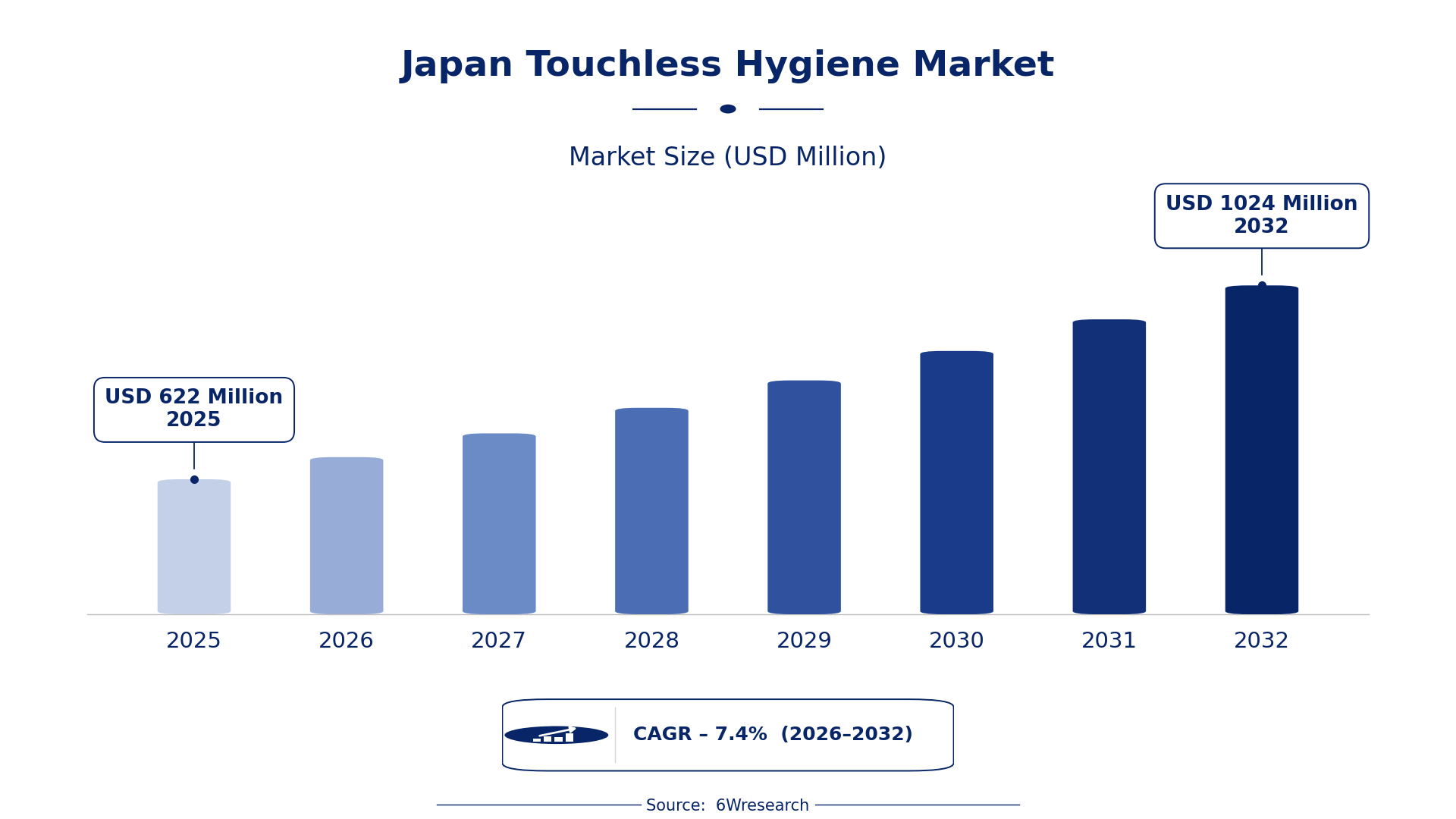
According to 6Wresearch internal database and industry insights, the Japan Touchless Hygiene Market was valued at USD 622 Million in 2025 and is projected to reach USD 1,024 Million by 2032, growing at a CAGR of approximately 7.4% during 2026–2032.
Japan Touchless Hygiene Market Highlights
| Report Metric | Details |
| Report Name | Japan Touchless Hygiene Market (2026-2032) |
| Market Size 2025 | USD 622 Million |
| Market Size 2032 | USD 1,024 Million |
| Absolute Growth 2025–2032 | USD 402 Million |
| CAGR 2026–2032 | 7.4% |
| Peak Annual Growth | 8.1% in 2028 |
| Forecast Period | 2026–2032 |
| Historical Data | 2022–2025 |
| Base Year | 2025 |
| Leading Product Type, 2025 | Sanitizer Dispensers (45% share) |
| Leading Technology Used, 2025 | Motion Sensors (52% share) |
| Leading Use Case, 2025 | Infection Control (37% share) |
| Leading End User, 2025 | Hospitals (41% share) |
| Fastest-Growing Product Type | Touchless Trash Bins (10.8% CAGR) |
| Fastest-Growing Technology Used | Proximity Detection (10.4% CAGR) |
| Fastest-Growing Use Case | Waste Management (9.8% CAGR) |
| Fastest-Growing End User | Clinics (9.5% CAGR) |
| Growing Sector | Healthcare Facilities |
| Key End Users | Hospitals, Clinics, Food Service Areas, Healthcare Facilities |
Japan Touchless Hygiene Market Year-wise Growth Rate and Key Drivers (2022–2032)
This graph illustrates the annual growth rates of the market from 2022 to 2032, highlighting a steady upward trajectory and projected market expansion over the forecast period.
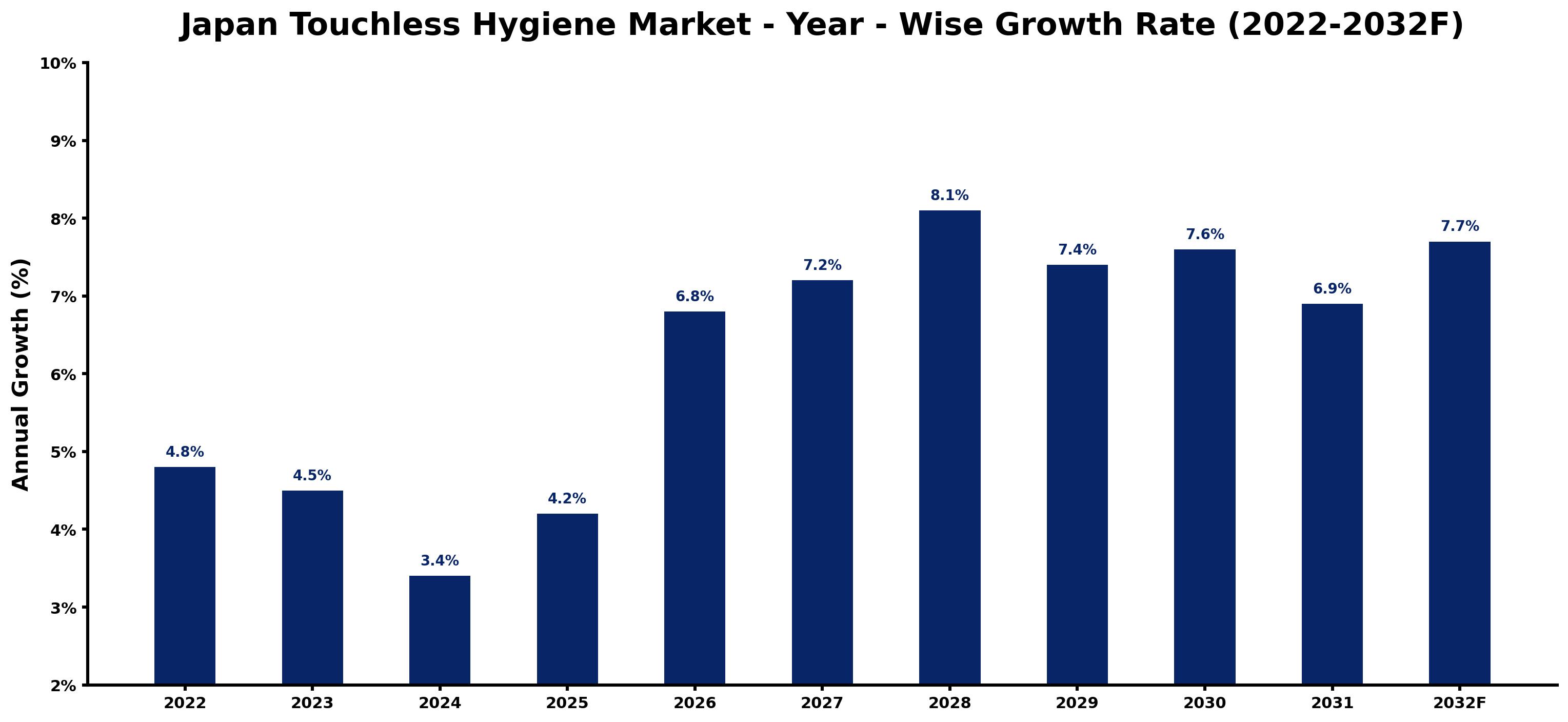
Each row of the following table gives one year's estimated growth and the event or demand shift that explains it.
| Year | Estimated Annual Growth (%) | Market Rationale |
| 2022 | 4.8 | The market experienced steady growth due to heightened hygiene awareness following health crises. |
| 2023 | 4.5 | Growth slowed as market saturation began to impact new installations and upgrades. |
| 2024 | 3.4 | Further slowdown occurred as consumer spending stabilised in the post-health crisis environment. |
| 2025 | 4.2 | Growth accelerated again as hospitals upgraded their hygiene facilities to meet new standards. |
| 2026 | 6.8 | Investment in touchless technology is expected to surge, driven by rising demand for infection control measures. |
| 2027 | 7.2 | Demand will continue to rise as healthcare facilities expand their touchless hygiene systems. |
| 2028 | 8.1 | The market is projected to peak due to substantial investments in advanced touchless solutions across various sectors. |
| 2029 | 7.4 | Growth will moderate slightly as the market begins to stabilise after reaching peak levels. |
| 2030 | 7.6 | Increased focus on sustainability in hygiene solutions will spur further investments. |
| 2031 | 6.9 | Growth will slow as the market matures, with fewer new entrants in the sector. |
| 2032 | 7.7 | Demand is expected to rise again as technological advancements create new opportunities. |
Note: Market size estimations and growth projections presented in this report are based on 6Wresearch's proprietary forecasting methodology, utilizing the latest available industry data, government publications, and primary research inputs.
Japan Touchless Hygiene Market Synopsis
Touchless hygiene solutions, including sanitizer dispensers and automatic soap units, are designed to promote cleanliness and reduce the spread of germs. Hospitals and clinics lead the demand for these products, supported by government measures aimed at improving public health standards and promoting hygiene practices.
Market Dynamics Impact Analysis (2026–2032)
| Factor | Type | Impact | Primary Segment Affected |
| Increased health awareness post-pandemic | Driver | High | Infection Control |
| Rising investments in healthcare infrastructure | Driver | High | Hospitals |
| Growing demand for touchless solutions in public spaces | Opportunity | High | Touchless Trash Bins |
| Expansion of touchless technology in food service areas | Opportunity | Medium | Automatic Soap Units |
| High initial costs of installation | Restraint | Medium | Sanitizer Dispensers |
| Limited consumer knowledge about touchless hygiene benefits | Restraint | High | UV Sterilizers |
| Competition from traditional hygiene solutions | Challenge | Medium | Touchless Trash Bins |
| Technological challenges in system integration | Challenge | High | Automatic Soap Units |
Evaluation of Drivers in Japan Touchless Hygiene Market (2026–2032)
Key forces behind demand, with the segment each one moves most, are listed below.
| Drivers | Primary Segment Affected | Why It Matters (Evidence) |
| Increased health awareness | Infection Control | This has led to a 37% share in the market as hospitals upgrade their hygiene systems. |
| Investment in healthcare infrastructure | Hospitals | Hospitals are investing heavily in touchless solutions, contributing to overall market growth. |
| Rising demand for touchless solutions | Touchless Trash Bins | Public spaces are increasingly adopting these solutions, contributing to a growth rate of 10.8%. |
| Technological advancements in touchless systems | Automatic Soap Units | These advancements are driving demand as facilities seek modern solutions for hygiene. |
| Government initiatives promoting hygiene standards | UV Sterilizers | Such initiatives are increasing awareness and adoption of advanced hygiene technologies. |
Orders continue to rise as health awareness increases, resulting in a growing market share for infection control solutions in hospitals. Investment in healthcare infrastructure fuels demand, with hospitals upgrading their hygiene systems to meet evolving standards. The adoption of touchless trash bins is on the rise in public spaces, contributing to a notable growth rate. Technological advancements in automatic soap units are further stimulating demand as facilities seek modern solutions.
Evaluation of Restraints in Japan Touchless Hygiene Market
The following restraints limit how fast demand can grow.
| Market Restraint | Primary Segment Affected | Why It Matters (Evidence) |
| High initial costs of touchless systems | Sanitizer Dispensers | These systems can deter smaller facilities from investing, impacting overall market penetration. |
| Limited consumer knowledge about touchless hygiene | UV Sterilizers | This lack of awareness can slow adoption rates, affecting market growth. |
| Regulatory hurdles for new technology approvals | Infection Control | Such hurdles can slow the introduction of new products into the market. |
| Competition from traditional hygiene solutions | Touchless Trash Bins | These alternatives often have lower upfront costs, making them more attractive to budget-conscious buyers. |
| Technological challenges in system integration | Automatic Soap Units | These challenges can delay installations, impacting timely market growth. |
Japan Touchless Hygiene Market Challenges
Producers face elevated production costs due to limited local sourcing options, inflating expenses by up to 20% and squeezing profit margins. A shortage of skilled workers in advanced technology hampers suppliers' ability to improve operational efficiency, resulting in delays that can extend lead times by three weeks for buyers. Local manufacturers confront fierce competition from imported alternatives, forcing them to reduce prices and risking a 15% revenue decline for those unable to adapt. Slow technology adoption hinders buyers from accessing new innovations, causing delays in product launches and weakening market competitiveness.
Trends in the Japan Touchless Hygiene Market
The shifts below are changing how Japan Touchless Hygiene Market products are bought and supplied.
- Shift from Manual to Touchless Hygiene Solutions: Hospitals are increasingly adopting touchless hygiene solutions, with automatic systems holding a 41% market share, reflecting a growing preference for these technologies.
- Increased Adoption of UV Sterilizers in Healthcare: Healthcare facilities are increasingly adopting UV sterilizers, with a notable 15% rise in installations in 2023, demonstrating a shift towards advanced disinfection methods.
- Expansion of Touchless Solutions in Food Service Areas: Food service areas are rapidly integrating touchless hygiene solutions, with a 20% increase in installations reported in 2023, highlighting the demand for enhanced cleanliness.
- Growing Interest in Proximity Detection Technologies: Proximity detection technologies are gaining traction, particularly in public restrooms, with a 10% increase in installations in 2023, reflecting a shift towards more hygienic solutions.
Investment Opportunities in the Japan Touchless Hygiene Market
Investors looking at the Japan Touchless Hygiene Market should consider the following areas.
- Expansion of Touchless Hygiene in Hospitals: With hospitals accounting for 41% of the market, there is an opportunity to supply advanced touchless systems, particularly in urban areas seeing increased patient volumes.
- Partnerships for Proximity Detection Solutions: Now is the time to invest in proximity detection technologies, especially in healthcare facilities, as demand is expected to rise in the coming years.
- Investment in Touchless Trash Bins for Public Spaces: Public spaces are increasingly adopting touchless trash bins, creating opportunities for suppliers to enter this growing market segment.
- Focus on Automatic Soap Units in Food Service Areas: The food service sector is expanding its use of automatic soap units, presenting opportunities for suppliers to partner with local facilities to meet this demand.
Government Initiatives in the Japan Touchless Hygiene Market
Producers and buyers of touchless hygiene solutions are influenced by various policy measures. The Semiconductor and Digital Industry Strategy (METI, June 2021) aims to secure domestic semiconductor manufacturing, which is essential for the production of advanced touchless devices. The Economic Security Promotion Act (2022) supports supply-chain resilience for critical products, ensuring that manufacturers can access necessary materials for production and facilitating the development of new technologies in the sector.
The PMDA oversees the approval of medical devices, including touchless hygiene solutions, ensuring they meet safety standards. AMED, established in April 2015, funds medical research and development, supporting innovations in hygiene technology. These agencies facilitate the introduction of new products into the market, ensuring compliance with safety and efficacy standards, with AMED funding numerous projects aimed at enhancing hygiene practices.
Future Insight of the Japan Touchless Hygiene Market
Investment in automated hygiene solutions will surge, generating substantial demand for touchless systems. By 2032, the integration of smart technology in hygiene products will elevate efficiency by 30%, benefiting both buyers and suppliers. Training programmes will address skills gaps, creating a more proficient workforce. New industry standards will streamline product development, allowing suppliers to introduce innovations more rapidly and meet evolving consumer expectations.
Market Segmentation Analysis
Japan Touchless Hygiene Market report covers a detailed analysis of the following market segments:
By Product Type – Sanitizer Dispensers Lead, Touchless Trash Bins Expected to Grow Fastest
According to Saurav Kr Singh, Senior Research Analyst at 6Wresearch, in 2025, Sanitizer Dispensers led the product type split with a 45% share. Sanitizer dispensers dominate the market because they are crucial for hygiene in high-traffic areas, particularly in facilities such as hospitals and shopping centres. Their widespread installation in these environments ensures a steady demand from both public and private sectors. Over 2026–2032, Touchless Trash Bins are expected to post the fastest growth, at a CAGR of 10.8%. Touchless trash bins are experiencing rapid growth as urban municipalities and commercial establishments aim to reduce contact during waste disposal. The increasing emphasis on cleanliness in public spaces propels this segment's expansion. This trend indicates that suppliers must focus on enhancing their offerings of touchless trash bins to meet the rising hygiene expectations of consumers.
By Technology Used – Motion Sensors Lead, Proximity Detection Expected to Grow Fastest
Motion Sensors accounted for 52% of the market by technology used in 2025. Motion sensors hold the largest share as they are integral to many touchless hygiene products, providing convenience and efficiency. Their extensive application in high-traffic areas, such as airports, reinforces their market presence. The quickest growth will come from Proximity Detection, forecast to expand at a CAGR of 10.4% between 2026 and 2032. Proximity detection technology is growing swiftly due to its effectiveness in reducing the spread of germs in public settings. The ongoing push for contactless solutions in commercial spaces fuels this trend. Buyers are likely to seek products featuring proximity detection to align with hygiene standards.
By Use Case – Infection Control Leads, Waste Management Expected to Grow Fastest
Infection Control took 37% of use case revenue in 2025, more than any other category. Infection control leads the market as it is vital for preventing disease transmission, particularly in medical environments. The urgent need for effective hygiene practices in hospitals and clinics has solidified this use case's dominance. Waste Management is set to record the highest CAGR in this split, 9.8% over 2026–2032. Waste management is emerging as the fastest-growing use case as organisations adopt touchless solutions to improve cleanliness and operational efficiency. The rising focus on hygienic waste disposal in urban settings drives this trend. Suppliers should adapt their strategies to address the growing emphasis on waste management solutions in various sectors.
By End User – Hospitals Lead, Clinics Expected to Grow Fastest
The largest end user category in 2025 was Hospitals, at 41% of revenue. Hospitals are the primary end user segment due to their rigorous hygiene standards and the high volume of patients requiring care. This consistent demand for advanced hygiene solutions is critical for maintaining patient safety. Clinics are projected to grow fastest, at a CAGR of 9.5% during 2026–2032. Clinics are experiencing the most rapid growth as they implement new hygiene protocols to meet the expectations of patients. The increasing number of outpatient services further accelerates the need for touchless hygiene products in these settings. Suppliers need to customise their offerings to effectively meet the evolving hygiene requirements of clinics.
Key Attractiveness of the Report
- 10 Years of Market Numbers
- Historical Data Starting from 2022 to 2025
- Base Year 2025
- Forecast Data until 2032
- Key Performance Indicators Impacting the Market
- Major Upcoming Developments and Projects
Key Highlights of the Report:
- Japan Touchless Hygiene Market Outlook
- Market Size of Japan Touchless Hygiene Market, 2025
- Forecast of Japan Touchless Hygiene Market, 2032
- Historical Data and Forecast of Japan Touchless Hygiene Revenues & Volume for the Period 2022-2032F
- Japan Touchless Hygiene Market Trend Evolution
- Japan Touchless Hygiene Market Drivers and Challenges
- Japan Touchless Hygiene Price Trends
- Japan Touchless Hygiene Porter's Five Forces
- Japan Touchless Hygiene Industry Life Cycle
- Historical Data and Forecast of Japan Touchless Hygiene Market Revenues & Volume By Product Type for the Period 2022-2032F
- Historical Data and Forecast of Japan Touchless Hygiene Market Revenues & Volume By Sanitizer Dispensers for the Period 2022-2032F
- Historical Data and Forecast of Japan Touchless Hygiene Market Revenues & Volume By Touchless Trash Bins for the Period 2022-2032F
- Historical Data and Forecast of Japan Touchless Hygiene Market Revenues & Volume By UV Sterilizers for the Period 2022-2032F
- Historical Data and Forecast of Japan Touchless Hygiene Market Revenues & Volume By Automatic Soap Units for the Period 2022-2032F
- Historical Data and Forecast of Japan Touchless Hygiene Market Revenues & Volume By Technology Used for the Period 2022-2032F
- Historical Data and Forecast of Japan Touchless Hygiene Market Revenues & Volume By Motion Sensors for the Period 2022-2032F
- Historical Data and Forecast of Japan Touchless Hygiene Market Revenues & Volume By Proximity Detection for the Period 2022-2032F
- Historical Data and Forecast of Japan Touchless Hygiene Market Revenues & Volume By Light-Based for the Period 2022-2032F
- Historical Data and Forecast of Japan Touchless Hygiene Market Revenues & Volume By Infrared Activation for the Period 2022-2032F
- Historical Data and Forecast of Japan Touchless Hygiene Market Revenues & Volume By Use Case for the Period 2022-2032F
- Historical Data and Forecast of Japan Touchless Hygiene Market Revenues & Volume By Infection Control for the Period 2022-2032F
- Historical Data and Forecast of Japan Touchless Hygiene Market Revenues & Volume By Waste Management for the Period 2022-2032F
- Historical Data and Forecast of Japan Touchless Hygiene Market Revenues & Volume By Surface Disinfection for the Period 2022-2032F
- Historical Data and Forecast of Japan Touchless Hygiene Market Revenues & Volume By Handwashing Stations for the Period 2022-2032F
- Historical Data and Forecast of Japan Touchless Hygiene Market Revenues & Volume By End User for the Period 2022-2032F
- Historical Data and Forecast of Japan Touchless Hygiene Market Revenues & Volume By Hospitals for the Period 2022-2032F
- Historical Data and Forecast of Japan Touchless Hygiene Market Revenues & Volume By Clinics for the Period 2022-2032F
- Historical Data and Forecast of Japan Touchless Hygiene Market Revenues & Volume By Healthcare Facilities for the Period 2022-2032F
- Historical Data and Forecast of Japan Touchless Hygiene Market Revenues & Volume By Food Service Areas for the Period 2022-2032F
- Japan Touchless Hygiene Import Export Trade Statistics
- Market Opportunity Assessment By Product Type
- Market Opportunity Assessment By Technology Used
- Market Opportunity Assessment By Use Case
- Market Opportunity Assessment By End User
- Japan Touchless Hygiene Top Companies Market Share
- Japan Touchless Hygiene Competitive Benchmarking By Technical and Operational Parameters
- Japan Touchless Hygiene Company Profiles
- Japan Touchless Hygiene Key Strategic Recommendations
Market Covered
This report examines the market across the segments below.
By Product Type
- Sanitizer Dispensers
- Touchless Trash Bins
- UV Sterilizers
- Automatic Soap Units
By Technology Used
- Motion Sensors
- Proximity Detection
- Light-Based
- Infrared Activation
By Use Case
- Infection Control
- Waste Management
- Surface Disinfection
- Handwashing Stations
By End User
- Hospitals
- Clinics
- Healthcare Facilities
- Food Service Areas































