Japan Tower HMI Display Market Size & Growth Rate
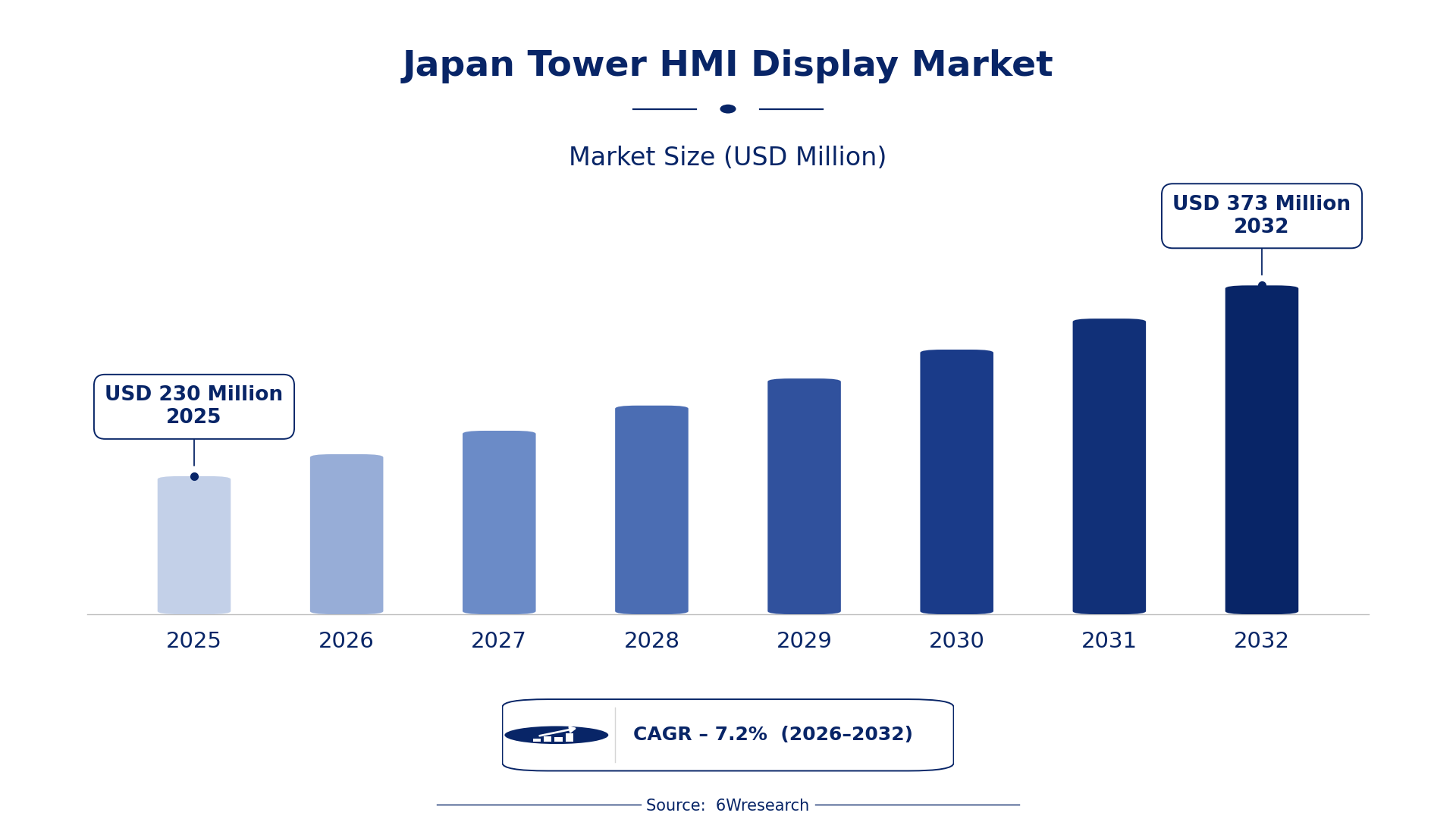
According to 6Wresearch internal database and industry insights, the Japan Tower HMI Display Market was valued at USD 230 Million in 2025 and is projected to reach USD 373 Million by 2032, growing at a CAGR of approximately 7.2% during 2026–2032.
Japan Tower HMI Display Market Highlights
| Report Metric | Details |
| Report Name | Japan Tower HMI Display Market (2026-2032) |
| Market Size 2025 | USD 230 Million |
| Market Size 2032 | USD 373 Million |
| Absolute Growth 2025–2032 | USD 143 Million |
| CAGR 2026–2032 | 7.2% |
| Peak Annual Growth | 8.6% in 2027 |
| Forecast Period | 2026–2032 |
| Historical Data | 2022–2025 |
| Base Year | 2025 |
| Leading Display Type, 2025 | LCD Tower HMI (42% share) |
| Leading Interface Capability, 2025 | Touch-Based UI (40% share) |
| Leading Application Area, 2025 | Machine Control Panels (34% share) |
| Leading End User, 2025 | Manufacturing Plants (52% share) |
| Fastest-Growing Display Type | LED Tower HMI (9.7% CAGR) |
| Fastest-Growing Interface Capability | Visual Alerts + Status (9.0% CAGR) |
| Fastest-Growing Application Area | Automated Systems (8.8% CAGR) |
| Fastest-Growing End User | Industrial Automation (9.4% CAGR) |
| Growing Sector | Industrial Automation |
| Key End Users | Manufacturing Plants, Industrial Automation, OEM Facilities |
Japan Tower HMI Display Market Year-wise Growth Rate and Key Drivers (2022–2032)
This graph illustrates the annual growth rates of the market from 2022 to 2032, highlighting a steady upward trajectory and projected market expansion over the forecast period.
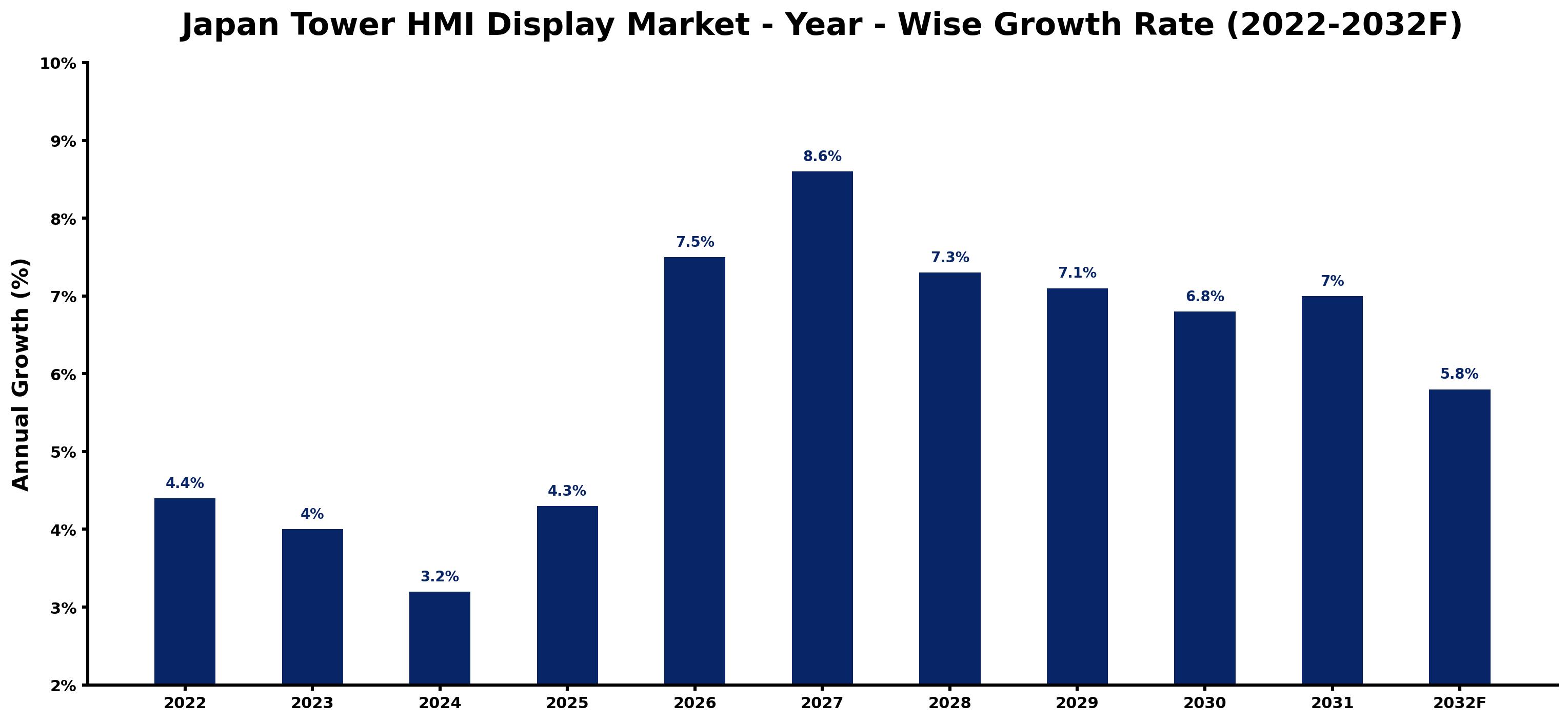
The table below sets out the estimated growth rate for each year and the main factor behind it.
| Year | Estimated Annual Growth (%) | Market Rationale |
| 2022 | 4.4 | The market experienced stable growth due to ongoing investments in automation. |
| 2023 | 4.0 | Growth slowed as manufacturers adjusted to supply chain challenges and inflation. |
| 2024 | 3.2 | The market continued to slow as firms focused on efficiency improvements. |
| 2025 | 4.3 | Growth accelerated as smart factory initiatives gained traction in the sector. |
| 2026 | 7.5 | Demand is expected to rise as technological advancements in automation are adopted widely. |
| 2027 | 8.6 | The market is projected to peak as manufacturers invest heavily in modernising equipment. |
| 2028 | 7.3 | Growth is anticipated to decelerate as market saturation begins to impact new purchases. |
| 2029 | 7.1 | A further slowdown is expected as firms consolidate their automation investments. |
| 2030 | 6.8 | The market will continue to decelerate as the focus shifts to operational efficiency. |
| 2031 | 7.0 | Growth is projected to increase as new technologies begin to drive fresh demand. |
| 2032 | 5.8 | The market is expected to experience a slowdown as competition intensifies and prices stabilise. |
Note: Market size estimations and growth projections presented in this report are based on 6Wresearch's proprietary forecasting methodology, utilizing the latest available industry data, government publications, and primary research inputs.
Japan Tower HMI Display Market Synopsis
Tower HMI Displays serve as advanced interfaces that utilise LCD or LED technology for communication between operators and machinery. These displays are essential for monitoring and controlling industrial processes in Japan's manufacturing sector. The Japan Tower HMI Display Market is expanding due to ongoing investments in industrial automation, with over 60% of manufacturing plants employing HMI technology. Initiatives like the Smart Factory programme aim to improve efficiency by 30% by 2030, further driving demand for these displays.
Market Dynamics Impact Analysis (2026–2032)
| Factor | Type | Impact | Primary Segment Affected |
| Increased investment in automation technologies | Driver | High | Industrial Automation |
| Growing adoption of touch-based interfaces | Driver | High | LCD Tower HMI |
| Rising demand for smart factory upgrades | Opportunity | High | LCD Tower HMI |
| Expansion of manufacturing facilities in Tokyo and Osaka | Opportunity | Medium | LCD Tower HMI |
| High costs associated with advanced display technologies | Restraint | High | LCD Tower HMI |
| Limited awareness of HMI benefits among small manufacturers | Restraint | Medium | LCD Tower HMI |
| High initial investment costs for automation systems | Challenge | High | Industrial Automation |
| Shortage of skilled workforce in automation sectors | Challenge | Medium | LCD Tower HMI |
Evaluation of Drivers in Japan Tower HMI Display Market (2026–2032)
The main growth drivers and the segments they affect most are set out below.
| Drivers | Primary Segment Affected | Why It Matters (Evidence) |
| Investment in industrial automation systems | Industrial Automation | Japan's installed base of industrial automation systems exceeds 1 million units, driving demand for Tower HMI Displays. |
| Adoption of touch-based interfaces | Manufacturing Plants | Over 50% of manufacturing plants in Japan now utilise touch-based interfaces, increasing demand for user-friendly displays. |
| Smart factory initiatives | LCD Tower HMI | The Smart Factory initiative aims to enhance efficiency by 30% by 2030, boosting demand for advanced display technologies. |
| Growth in robotics applications | LCD Tower HMI | The robotics market in Japan is valued at over $10 billion, contributing to the need for sophisticated HMI displays. |
| Focus on operational efficiency | LCD Tower HMI | Japan's manufacturing sector contributes 20% to GDP, necessitating efficient monitoring solutions like Tower HMI Displays. |
What keeps demand rising is the investment in industrial automation systems, with over 1 million units installed across Japan. As more than 60% of manufacturing plants adopt touch-based interfaces, the need for user-friendly HMI solutions increases. The robotics market, valued at over $10 billion, drives the requirement for advanced interfaces. Manufacturers are increasingly focused on operational efficiency, making HMI solutions critical for monitoring and control in production environments. The ongoing trend towards automation supports the demand for sophisticated displays in various applications.
Evaluation of Restraints in Japan Tower HMI Display Market
The main factors holding the market back are set out below.
| Market Restraint | Primary Segment Affected | Why It Matters (Evidence) |
| High costs of advanced display technologies | LCD Tower HMI | The average cost of implementing advanced HMI systems can exceed ¥10 million, limiting adoption among smaller firms. |
| Limited awareness of HMI benefits | LCD Tower HMI | Approximately 30% of small manufacturers remain unaware of the efficiency gains from HMI technology, hindering market growth. |
| Complex integration with existing systems | LCD Tower HMI | Integrating new HMI displays with legacy systems often incurs additional costs, averaging ¥5 million, slowing down upgrades. |
| Regulatory compliance costs | LCD Tower HMI | Compliance with JIS standards can require investment of up to ¥3 million in testing and certification for new products. |
| Market saturation in major regions | Industrial Automation | As major industrial regions become saturated, growth opportunities diminish for new entrants, with only 5% growth expected. |
Japan Tower HMI Display Market Challenges
Producers encounter a skills shortage, as the average age of manufacturing equipment exceeds 10 years, delaying necessary upgrades for over 60% of plants. Regulatory compliance with JIS standards raises operational costs, forcing producers to allocate up to 15% of their budgets to meet these requirements. Technology adoption lags, which can reduce productivity by 30% for facilities relying on outdated systems. Supply chain disruptions occur due to dependence on obsolete components, extending lead times by several weeks for producers needing timely replacements.
Trends in the Japan Tower HMI Display Market
Several trends are reshaping the Japan Tower HMI Display Market; the most important are set out below.
- Shift in Manufacturing Focus to Smart Factories: Tokyo is experiencing a shift towards smart factories, with investments aimed at improving automation. In 2023, Japan launched a programme for smart factory upgrades, targeting a 30% efficiency increase by 2030.
- Increase in Touch-Based Interface Adoption: In recent years, the adoption of touch-based interfaces has surged, with over 50% of manufacturing plants now using them. This trend reflects a growing preference for user-friendly operations in industrial settings.
- Expansion of Robotics Integration in Manufacturing: The integration of robotics in manufacturing is increasing, with the robotics market valued at over $10 billion. This trend drives demand for advanced HMI displays to facilitate operator-machine communication.
- Growth of Multi-Color HMI Displays: There is a rising preference for Multi-Color HMI Displays in manufacturing, improving user interaction through colour-coded alerts. This shift is clear as manufacturers seek to enhance visual feedback in operations.
Investment Opportunities in the Japan Tower HMI Display Market
Several openings in the Japan Tower HMI Display Market merit attention from investors.
- Investment in Smart Factory Technologies: Tokyo is currently investing heavily in smart factory technologies, aiming for a 30% efficiency increase by 2030. This presents a valuable opportunity for suppliers of HMI solutions.
- Expansion of Manufacturing Facilities in Osaka: With major investments in manufacturing facilities in Osaka, there is a growing demand for advanced HMI solutions. Suppliers can enter this market through partnerships with local manufacturers.
- Focus on Automation in Manufacturing Plants: The ongoing trend towards automation in manufacturing plants, which account for over 52% of the market, creates a demand for sophisticated HMI displays. Local partnerships can facilitate market entry.
- Rising Demand for User-Friendly Interfaces: The adoption rate of touch-based interfaces exceeds 50%, indicating a strong market for user-friendly HMI solutions. Suppliers should consider certification to meet local standards.
Government Initiatives in the Japan Tower HMI Display Market
The Industrial Safety and Health Act, enacted in 1972, mandates employer responsibilities for workplace safety, including the safe use of machinery and hazardous substances. This law ensures that manufacturers must adhere to strict safety standards, influencing the design and implementation of Tower HMI Displays in factories. The New Robot Strategy launched in 2015 aims to expand the use of robotics in various sectors, further promoting automation and the integration of advanced HMI technologies in manufacturing.
In 2023, the Japanese government initiated a programme to support smart factory upgrades, with funding exceeding ¥100 billion allocated for the development of automation technologies. The Ministry of Economy, Trade and Industry oversees this initiative, encouraging manufacturers to adopt advanced HMI displays to improve operational efficiency and safety.
Future Insight of the Japan Tower HMI Display Market
By 2032, a significant shift towards smart factory upgrades will reshape manufacturing practices, driven by government initiatives and industry standards. Automation investments are expected to exceed ¥1 trillion annually, allowing suppliers to enhance their product offerings. The installed base of industrial automation systems will likely surpass 1 million units, improving operational efficiency. As the adoption of touch-based interfaces increases beyond 50%, buyers will benefit from more user-friendly HMI displays, optimising their workflows.
Market Segmentation Analysis
Japan Tower HMI Display Market report covers a detailed analysis of the following market segments:
By Display Type – LCD Tower HMI Leads, LED Tower HMI Expected to Grow Fastest
According to Saurav Kr Singh, Senior Research Analyst at 6Wresearch, LCD Tower HMI accounted for 42% of the market by display type in 2025. LCD Tower HMI Displays dominate the market due to their extensive application in real-time data display across various machines, particularly in major industrial hubs like Tokyo and Osaka. Their established reliability ensures they remain integral to existing manufacturing processes, solidifying their leading position. Over 2026–2032, LED Tower HMI is expected to post the fastest growth, at a CAGR of 9.7%. LED Tower HMI Displays are witnessing rapid growth because they provide enhanced visibility in diverse lighting conditions, making them ideal for contemporary manufacturing environments. The recent launch of smart factory upgrades in 2023 is propelling this shift towards advanced display technologies. Suppliers must focus on developing LED products to cater to the rising demand for improved visibility in industrial applications.
By Interface Capability – Touch-Based UI Leads, Visual Alerts + Status Expected to Grow Fastest
Touch-Based UI held 40% of the Japan Tower HMI Display Market by interface capability in 2025. Touch-Based User Interfaces are preferred for their user-friendly operation, which is vital in fast-paced manufacturing settings where quick interactions are necessary. The adoption rate exceeding 50% illustrates their widespread acceptance among operators. The quickest growth will come from Visual Alerts + Status, forecast to expand at a CAGR of 9.0% between 2026 and 2032. Visual Alerts and Status interfaces are gaining traction as they provide critical information for immediate operator awareness, essential for maintaining safety and efficiency in operations. This trend is likely to accelerate as more facilities implement automation technologies. Buyers should prioritise systems that integrate visual alerts to improve operational responsiveness and safety.
By Application Area – Machine Control Panels Lead, Automated Systems Expected to Grow Fastest
Machine Control Panels took 34% of application area revenue in 2025, more than any other category. Machine Control Panels are essential for operational control in factories, serving as the primary interface for monitoring and managing machinery. Their critical role in ensuring smooth operations solidifies their leading market share. Automated Systems are projected to grow fastest, at a CAGR of 8.8% during 2026–2032. Automated Systems are rapidly becoming the fastest-growing area as they are integral to the functioning of automated processes, reflecting the industry's shift towards increased automation. This growth is supported by substantial investments in industrial automation exceeding ¥1 trillion annually. Suppliers must adapt their offerings to cater to the increasing integration of automated systems in manufacturing.
By End User – Manufacturing Plants Lead, Industrial Automation Expected to Grow Fastest
In 2025, Manufacturing Plants led the end user split with a 52% share. Manufacturing Plants represent the largest segment of Tower HMI Displays users, employing these systems extensively for monitoring and controlling machinery across various production lines. Their crucial contribution to Japan's GDP underscores the importance of this segment within the market. Industrial Automation is set to record the highest CAGR in this split, 9.4% over 2026–2032. Industrial Automation is experiencing the fastest growth as it plays a vital role in enhancing efficiency and safety in manufacturing, especially with the emphasis on smart factory initiatives. This trend is expected to continue as more facilities aim to modernise their operations. Suppliers should prioritise solutions that support industrial automation to meet the increasing demand for operational efficiency and safety.
Key Attractiveness of the Report
- 10 Years of Market Numbers
- Historical Data Starting from 2022 to 2025
- Base Year 2025
- Forecast Data until 2032
- Key Performance Indicators Impacting the Market
- Major Upcoming Developments and Projects
Key Highlights of the Report:
- Japan Tower HMI Display Market Outlook
- Market Size of Japan Tower HMI Display Market, 2025
- Forecast of Japan Tower HMI Display Market, 2032
- Historical Data and Forecast of Japan Tower HMI Display Revenues & Volume for the Period 2022-2032F
- Japan Tower HMI Display Market Trend Evolution
- Japan Tower HMI Display Market Drivers and Challenges
- Japan Tower HMI Display Price Trends
- Japan Tower HMI Display Porter's Five Forces
- Japan Tower HMI Display Industry Life Cycle
- Historical Data and Forecast of Japan Tower HMI Display Market Revenues & Volume By Display Type for the Period 2022-2032F
- Historical Data and Forecast of Japan Tower HMI Display Market Revenues & Volume By LCD Tower HMI for the Period 2022-2032F
- Historical Data and Forecast of Japan Tower HMI Display Market Revenues & Volume By LED Tower HMI for the Period 2022-2032F
- Historical Data and Forecast of Japan Tower HMI Display Market Revenues & Volume By Multi-Color HMI for the Period 2022-2032F
- Historical Data and Forecast of Japan Tower HMI Display Market Revenues & Volume By Modular HMI for the Period 2022-2032F
- Historical Data and Forecast of Japan Tower HMI Display Market Revenues & Volume By Interface Capability for the Period 2022-2032F
- Historical Data and Forecast of Japan Tower HMI Display Market Revenues & Volume By Touch-Based UI for the Period 2022-2032F
- Historical Data and Forecast of Japan Tower HMI Display Market Revenues & Volume By Visual Alerts + Status for the Period 2022-2032F
- Historical Data and Forecast of Japan Tower HMI Display Market Revenues & Volume By RGB Light Indicators for the Period 2022-2032F
- Historical Data and Forecast of Japan Tower HMI Display Market Revenues & Volume By Stackable Units for the Period 2022-2032F
- Historical Data and Forecast of Japan Tower HMI Display Market Revenues & Volume By Application Area for the Period 2022-2032F
- Historical Data and Forecast of Japan Tower HMI Display Market Revenues & Volume By Machine Control Panels for the Period 2022-2032F
- Historical Data and Forecast of Japan Tower HMI Display Market Revenues & Volume By Automated Systems for the Period 2022-2032F
- Historical Data and Forecast of Japan Tower HMI Display Market Revenues & Volume By Assembly Lines for the Period 2022-2032F
- Historical Data and Forecast of Japan Tower HMI Display Market Revenues & Volume By Smart Factories for the Period 2022-2032F
- Historical Data and Forecast of Japan Tower HMI Display Market Revenues & Volume By End User for the Period 2022-2032F
- Historical Data and Forecast of Japan Tower HMI Display Market Revenues & Volume By Manufacturing Plants for the Period 2022-2032F
- Historical Data and Forecast of Japan Tower HMI Display Market Revenues & Volume By Industrial Automation for the Period 2022-2032F
- Historical Data and Forecast of Japan Tower HMI Display Market Revenues & Volume By OEM Facilities for the Period 2022-2032F
- Historical Data and Forecast of Japan Tower HMI Display Market Revenues & Volume By Robotics Integrators for the Period 2022-2032F
- Japan Tower HMI Display Import Export Trade Statistics
- Market Opportunity Assessment By Display Type
- Market Opportunity Assessment By Interface Capability
- Market Opportunity Assessment By Application Area
- Market Opportunity Assessment By End User
- Japan Tower HMI Display Top Companies Market Share
- Japan Tower HMI Display Competitive Benchmarking By Technical and Operational Parameters
- Japan Tower HMI Display Company Profiles
- Japan Tower HMI Display Key Strategic Recommendations
Market Covered
The report covers the following segments.
By Display Type
- LCD Tower HMI
- LED Tower HMI
- Multi-Color HMI
- Modular HMI
By Interface Capability
- Touch-Based UI
- Visual Alerts + Status
- RGB Light Indicators
- Stackable Units
By Application Area
- Machine Control Panels
- Automated Systems
- Assembly Lines
- Smart Factories
By End User
- Manufacturing Plants
- Industrial Automation
- OEM Facilities
- Robotics Integrators































